Archive for Featured

The Written History of the Unwritten Rules, Part 1: “Instruments of the Devil”

It seems like every year there’s another incident in major league baseball that spurs renewed media and public interest in the game’s unwritten rules. In 2018, there was Ronald Acuña Jr. being injured by a José Ureña beanball; in 2019, there was Brad Keller throwing at Tim Anderson after a bat flip (and Anderson’s ensuing suspension). As the 2020 season began, I wondered whether a strange, truncated year under the shadow of a pandemic would allow for the annual unwritten rules controversy to arise. Two weeks ago, I got my answer in the dustup around Fernando Tatis Jr.’s 3-0 grand slam.

The Tatis incident seemed to draw more online attention than past unwritten rules controversies — a glance at Google Trends would appear to confirm that feeling. It also seemed to draw essentially universal disdain. Usually, there will be at least a few public holdouts against unwritten rules violations like bat flips, often citing “respect” — for “the game,” or for the pitcher victimized by the home run — as a reason why baseball should continue to hold onto its unspoken traditions. But in the case of Tatis, the violation perceived by Chris Woodward and Ian Gibaut was so patently ridiculous that almost no one joined them in saying it was wrong. Former and current players, media commentators — all were pretty much united in support for Tatis and scorn for the people trying to make him apologize. MLB itself handed down suspensions to Woodward and Gibaut for Gibaut throwing behind Manny Machado in response, making this particular unwritten rules scandal feel like it could be a turning point in the yearly discourse merry-go-round.

Watching everything unfold, though, I found myself wondering about the history of these incidents — not the unwritten rules themselves, but the public fascination with them. When did baseball writers start trying to document the unwritten rules, to name them as such? What kinds of violations of these rules have historically sparked interest, and how can the controversies of the past illuminate our present discussions?

As I dug into the newspaper archives, I found that the ways in which the unwritten rules of baseball were discussed shifted in interesting ways over time. So this history will be divided into three parts. What follows is a survey of the earliest days of baseball’s unwritten rules — from the late 19th century into the first decade of the 20th.

***
Read the rest of this entry »


The 2020 Replacement-Level Killers: Second Basemen and Shortstops

For the full introduction to the Replacement-Level Killers series, follow the link above, but to give you the CliffsNotes version: yes, things are different this year, and not just because the lone trade deadline falls on August 31. We’ve got just a month’s worth of performances to analyze (sometimes less, due to COVID-19 outbreaks), about a month still to play, and thanks to the expanded playoff field, all but six teams — the Pirates, Angels, Red Sox, Mariners, Royals, and Rangers — are within two games of a playoff spot.

While still focusing upon teams that meet the loose definition of contenders (a .500 record or Playoff Odds of at least 10%), I’ll incorporate our Depth Charts’ rest-of-season WAR projections into the equation, considering any team with a total of 0.4 WAR or less to be in the replacement-level realm (that’s 1.1 WAR over the course of 162 games, decidedly subpar). I don’t expect every team I identify to upgrade before the August 31 trade deadline, I’m not concerned with the particulars of which players they might pursue or trade away, and I may give a few teams in each batch a lightning round-type treatment, as I see their problems as less pressing given other context, such as returns from injury, contradictory defensive metrics, and bigger holes elsewhere on the roster.

Note that all individual stats in this article are through August 25, but the won-loss records and Playoff Odds include games of August 26.

Today, I’ll address second basemen and shortstops. Read the rest of this entry »


The Three Batter Minimum’s Effect on Late-Game Strategy

As part of Major League Baseball’s ongoing efforts to improve the pace of game play, this year the league introduced the three-batter minimum rule, which requires that barring injury, any reliever coming into the game either needs to pitch to three batters or finish an inning. The rule was designed to prevent late-game pitching changes and the break in the action those changes entail. Whether the rule was likely to have any great impact was debatable given the lack of changes to begin with. The unusual season might not provide us with too much information with which to evaluate how the rule is impacting pace of play, but reliever appearances per team per game are up from 3.4 a year ago to 3.6, and the length of relief appearances is virtually unchanged at a little over an inning per appearance. While we might not be able to judge pace of play this season, we can see the impact of the rule on late-game strategy.

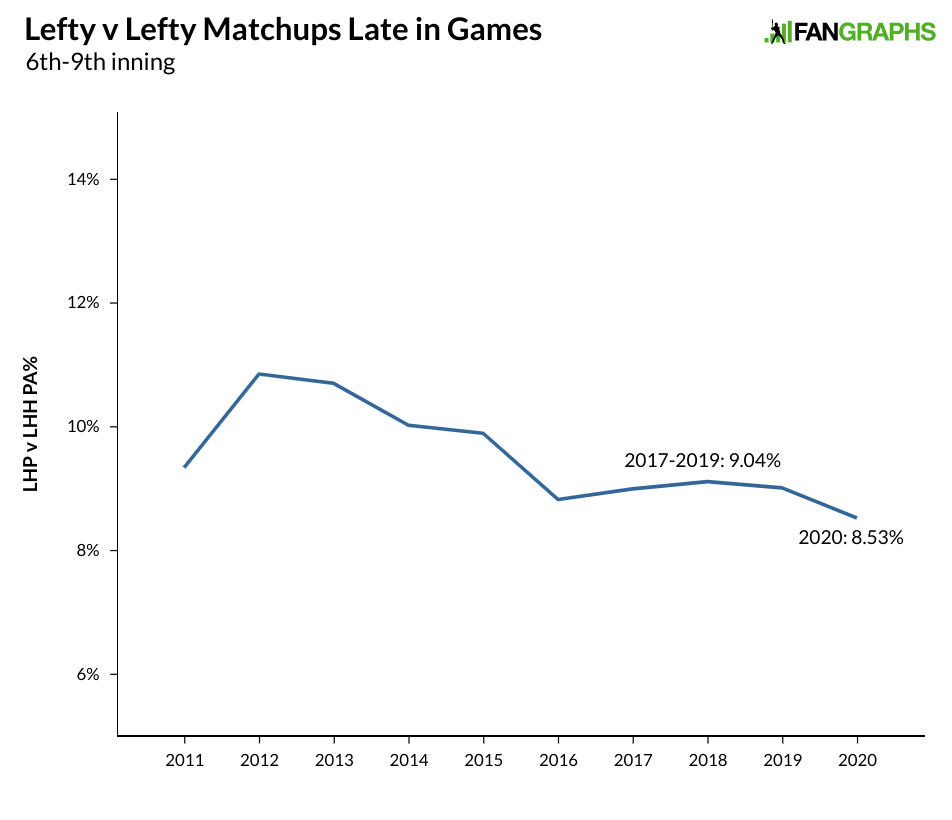
The rule was seen as the death-knell of the LOOGY, preventing specialists from coming in to face just a single batter. One-batter appearances are occurring about half as often, so there’s certainly an impact there, but how that has changed the platoon advantage is a different matter. To start, let’s just look at the sixth through the ninth innings and how often we are seeing that lefty vs. lefty matchup. The graph below shows the percentage of lefty on lefty matchups late in games compared to total plate appearances:

Read the rest of this entry »


The 2020 Replacement-Level Killers: Catcher

For the full introduction to the Replacement-Level Killers series, follow the link above, but to give you the CliffsNotes version: yes, things are different this year, and not just because the lone trade deadline falls on August 31. We’ve got just a month’s worth of performances to analyze (sometimes less, due to COVID-19 outbreaks), about a month still to play, and thanks to the expanded playoff field, all but six teams — the Pirates, Angels, Red Sox, Mariners, Royals, and Rangers — are within two and a half games of a playoff spot.

While still focusing upon teams that meet the loose definition of contenders (a .500 record or Playoff Odds of at least 10%), I’ll incorporate our Depth Charts’ rest-of-season WAR projections into the equation, considering any team with a total of 0.4 WAR or less to be in the replacement-level realm (that’s 1.1 WAR over the course of 162 games, decidedly subpar). I don’t expect every team to go out and track down an upgrade before the August 31 trade deadline, I’m not concerned with the particulars of which players they might pursue or trade away, and I may give a few teams in each batch a lightning round-type treatment, as I see their problems as less pressing given other context, such as returns from injury, contradictory defensive metrics, and bigger holes elsewhere on the roster. Got it? Good.

Note that all individual stats in this article are through August 24, but the won-loss records and Playoff Odds include games of August 25.

2020 Replacement Level Killers: Catchers
Team AVG OBP SLG wRC+ Bat BsR Fld WAR ROS WAR Tot WAR
Rockies .223 .253 .287 29 -9.2 -1.6 -1.2 -0.6 0.0 -0.6
Diamondbacks .190 .248 .310 49 -7.1 -0.5 -2.0 -0.3 0.3 0.0
Blue Jays .131 .253 .250 43 -7.3 -0.8 -0.6 -0.4 0.5 0.1
Rays .156 .240 .322 57 -5.3 -0.9 -0.8 -0.2 0.3 0.1
Indians .101 .245 .146 16 -11.1 -0.5 1.4 -0.3 0.4 0.1
Padres .114 .188 .273 27 -9.5 0.1 0.8 -0.3 0.4 0.1
Giants .198 .259 .297 55 -6.5 -0.7 0.2 -0.1 0.3 0.2
Cardinals .210 .231 .226 26 -6.2 -0.4 0.9 -0.2 0.5 0.3
Statistics through August 24. ROS = Rest-of-season WAR, via our Depth Charts.

Have we discussed the possibility of adding a second designated hitter to the lineup? Some of these offensive performances truly offend the sensibilities, just as particularly inept pitchers hitting may do. By Nichols’ Law of Catcher Defense, these guys should be the second coming of Johnny Bench or at least Ivan Rodriguez behind the plate, and yet many of them are in the red defensively — even the team with the catcher who himself is widely acknowledged as Pudge’s successor when it comes to being the game’s best defender. Also, what the hell happened to the catchers in the NL West? Somebody should be dialing Russell Martin’s number. Read the rest of this entry »


Fred Lynn on His Time as a Tiger, Part Two

This is Part Two of an interview — the primary focus being his year-plus with the Detroit Tigers— with former All-Star outfielder Fred Lynn. Part One can be found here.

———

David Laurila: In 1989 — your one full season in Detroit — the team lost over 100 games. What happened?

Fred Lynn: “It was an older team. They’d also traded Luis Salazar and Tommy Brookens, our two third basemen, and got Chris Brown from the Giants. That didn’t work out so well. Chris got hurt, plus Brookie and Luis had been really popular in the clubhouse. Sometimes you lose something in the clubhouse more than you lose on the field, and I think that was the case with those guys. As professionals you have to move on, but sometimes there’s a hole.

“Tram got hurt that year, too. He had a banged up knee and was kind of hobbling around. That hurt us a lot. Darrell [Evans] was gone, too. So there was a little bit of a changing of the guard, and with a pitch here and a pitch there… a lot of little things can happen that will turn around a season.

“And we didn’t play as well as we should have, to be honest. The pitching was… they had a tough year, and when that happens the offense feels like it has to score more runs. That puts a lot of pressure on the position players. The same thing is happening with the Red Sox right now. The offense feels like they have to score a million, and you can’t do that day in and day out. When the load is like that, it’s a tough one to bear.”

Laurila: Earlier we touched on how underrated Evans was. Chet Lemon is another guy who was better than a lot of people probably realize. Read the rest of this entry »


The 2020 Replacement-Level Killers: First Base

In a race for a playoff spot, every edge matters. And yet all too often, for reasons that extend beyond a player’s statistics, managers and general managers fail to make the moves that could improve their teams, allowing subpar production to fester at the risk of smothering a club’s postseason hopes. In Baseball Prospectus’ 2007 book It Ain’t Over ‘Til It’s Over, I compiled a historical All-Star squad of ignominy, identifying players at each position whose performances had dragged their teams down in tight races: the Replacement-Level Killers. I’ve revisited the concept numerous times at multiple outlets, and have presented it at FanGraphs in an expanded format since 2018.

Things are different this year, as you may have noticed. With six days to go before the August 31 deadline, just a month’s worth of performance to analyze — if, that is, a team has avoided a COVID-19 outbreak that has blown a hole in its schedule — and 23 teams within two games of spot in the expanded playoff field through Monday, putting together this year’s set of Replacement-Level Killers is a challenge like no other. The sample sizes are tiny, especially when players are sharing a position; month-long slumps are hardly unique. Even without being a complete devotee to exactitude, normally I’m able to curate a tidy list at each position by focusing on the subset of contenders (teams with .500 records or at least a 10% chance of reaching the playoffs) who have gotten less than 1.0 WAR at that spot through roughly two-thirds of the season. Scale that down to 30 games, and the threshold becomes 0.3 WAR or less, in which case a single good day by a player at the position in question might boost him from Killer to mid-pack producer.

Thus, I’m doing things a bit differently this time around. While still focusing upon teams that meet the loose definition of contenders (apologies in advance to fans of the Royals, Angels, Tigers, Red Sox, Rangers, Mariners, and Pirates), I’ll incorporate our Depth Charts rest-of-season WARs into the equation, considering any team that comes out with a total of 0.4 WAR or less to be in the replacement-level realm (that’s 1.1 WAR over the course of 162 games, decidedly subpar), though I may give a few teams in each batch a lightning round-type treatment, as I see their problems as less pressing given other contexts (returns from injury, contradictory defensive metrics, bigger holes elsewhere on the roster etc.) and I’ve pledged to keep these from becoming 3,000-word tomes. Read the rest of this entry »


Yu Darvish Has Whirled His Way Back To the Top

Back before the Chicago Cubs decided to go full-on Ebenezer Scrooge, they aggressively pursued top players in free agency to improve their roster. One of those players was Yu Darvish, an ace for the Rangers and Dodgers after seven years of dominating the Japan Pacific League, a feat he accomplished while still a teenager. Darvish was the best pitcher available after the 2017 season and the Cubs signed him to a six-year, $126 million contract, a sum commensurate with his abilities. And unlike his first deal in the majors, Darvish didn’t have to contend with a posting fee; when the right-hander came to the States, the Nippon Ham Fighters got nearly as much ($51.7 million) as he did ($56 million).

The initial returns were not promising. The Cubs won 95 games in 2018 before being bounced in the Wild Card game by the Colorado Rockies, while triceps and elbow issues limited Darvish to just eight games. Those were mostly ineffective games to boot, as his walk rate jumped to career highs, his ERA and FIP ballooned to near five, and he failed to complete the fifth inning in five of his starts. MRIs revealed no structural damage to his arm, but the team was careful; the triceps is important in the arm deceleration phase of a pitcher’s delivery:

Activity of the triceps muscles, as well as activity of the anconeus and wrist flexor muscles, helped the joint’s ligaments apply a compression force during this phase in order to stabilize the elbow and prevent elbow distraction.

Darvish was already a veteran of one Tommy John surgery and the Cubs were rightly conservative about rushing their ace to full-time duty. The first victory of 2019 was just staying healthy, which he achieved; Darvish only missed a single start down the stretch due to forearm pain. But the control wasn’t there in the early-going and a third of the way through the season, his ERA was at 5.40 with an extremely worrying 38 walks in 11 starts. Indeed, even late as Independence Day, Darvish’s ERA was north of five. Read the rest of this entry »


Prospect Roundup: Cronenworth, McKenzie, Skubal, and More

We’re a week from the Trade Deadline and still, almost all of the available information on pro prospects is limited to the big league level. That’s where I’ve been focusing my attention, with new player opinions then reflected on The Board, to which I made the following updates over the weekend.

Entering the 100

Padres infielder Jake Cronenworth becomes the first 2020 Pick to Click to, well, click. He moves into the top 100, ranked 93rd. At 26.6 years old, he becomes the oldest player on the hundred, pacing A’s catcher Sean Murphy by about seven months. Most of his pre-season scouting report holds water except that Cronenworth suddenly has relevant pop. He hit a ball 110 mph this year, up from a max of 106 mph last season in the minors. He now looks like an everyday player at a premium position rather than a super utility type, so he slots into the top 100 ahead of similar players who are a couple years away (like Brayan Rocchio) but behind players who are either there or who are close but much younger (like Washington infielder Luis García).

Cleveland righty Triston McKenzie made his big league debut in what was his first competitive game since 2018 due to multiple injuries and the global pandemic. Not only is he healthy, but McKenzie is throwing harder. His fastball lived in the 90-93 range in 2018 and was 90-94 this spring as he prepared for the season. He’s now living in the 93-96 range and leaned on the heater in big spots during his debut, shaking off Roberto Pérez to get to it. Hopes that McKenzie would eventually develop a third pitch have more than come to fruition, as both his slider and changeup have evolved to complement the fastball/curveball combo that headlines his arsenal.

So how about Dane Dunning? The 25-year-old, who debuted last week, also had not pitched since 2018, with his layoff due to Tommy John surgery. His stuff looked as it did pre-surgery, with the fastball in the 91-94 range, and both breaking balls effective. Read the rest of this entry »


Sunday Notes: Chris Mears Liked Matt Manning in the 2016 Draft

Five of the first 12 picks in the 2016 draft were high school pitchers. In order, those selections were: Ian Anderson to the Braves (third overall), Riley Pint to the Rockies (fourth), Braxton Garrett to the Marlins (seventh), Matt Manning to the Tigers (ninth), and Jay Groome to the Red Sox (12th). Not surprisingly, their respective development paths have varied, injuries hindering the progress of fully half.

Chris Mears — at the time a pitching crosschecker for the Red Sox — was especially enamored with Manning.

“I liked his athleticism, his looseness, his fastball quality,” said Mears, who is now one of Boston’s two pitching coordinators, along with Shawn Haviland. “I thought he would be a longer-term development type guy — the Tigers have done a really good job; he’s made adjustments faster than I would have anticipated — but I remember him being a guy I really wanted.”

Asked why he’d viewed him as a longer-term project, Mears cited Manning’s basketball background, and “less pitching experience than many high-school draftees have at that point in their careers.” Moreover, Manning is 6’ 6” and “usually those long-lever guys take a little bit longer to get the feel of repeating their delivery.” Mears also saw a breaking ball that while having good shape and spin, wasn’t always consistent.

Which doesn’t mean he wasn’t enthralled with his potential. Mears first saw Manning at the Arizona Fall Classic, and based on that look he and Josh Labandeira, Boston’s Northern California area scout, went to see him early the following spring. Read the rest of this entry »


2020 Trade Value: #1 to #10

While a shortened season might make this year’s version of our Trade Value Series an unusual one, with the deadline looming, we are not about to break with tradition. For a more detailed introduction to this year’s exercise, as well as a look at those players who fell just short of the top 50, be sure to read the Introduction and Honorable Mentions piece, which can be found in the widget above along with the other installments in the Series.

For those who have been reading the Trade Value Series the last few seasons, the format should look familiar. For every player, you’ll see a table with the player’s projected five-year WAR from 2021-2025, courtesy of Dan Szymborski’s ZiPS projections. The table will also include the player’s guaranteed money, if any, the year through which the team has contractual control of the player, last year’s rank, and then projections, contract status, and age for each individual season through 2025, if the player is under contract or team control for those seasons. Last year’s rank includes a link to the relevant 2019 post. Thanks are due to Sean Dolinar for creating the tables in these posts. At the bottom of the page, there will be an updated grid showing all the players who have been ranked up to this point.

With that out of the way, let’s finish the rankings.

Five-Year WAR +20.0
Guaranteed Dollars –
Team Control Through 2024
Previous Rank #21
Year Age Projected WAR Contract Status
2021 26 +4.3 Pre-Arb
2022 27 +4.4 Arb1
2023 28 +3.9 Arb2
2024 29 +3.8 Arb3
Pre-Arb
Arb

Since the beginning of last season, no pitcher has thrown more innings than Shane Bieber’s 249. Only four pitchers have a higher WAR than his 7.0 over than span: Gerrit Cole, Lance Lynn, Max Scherzer, and Jacob deGrom. Cole just landed a monster contract. Lynn and Scherzer are in their 30s and will be free agents at the end of next season; deGrom is also in his 30s and makes more than $30 million a year. Bieber is 25 years old, will make the league minimum next season, and won’t be a free agent until after 2024.

Bieber’s performance and projections put him in a higher tier than Walker Buehler (18th in these rankings), who has a similar number of years of control remaining, but at a higher cost due to Buehler’s status as a Super Two. Bieber’s projections are just a bit lower than Jack Flaherty’s (19th), with the Cleveland right-hander boasting slightly better performance since the start of last year; he separates himself from Flaherty with an extra year of team control at virtually no cost. Unless Bieber wins a Cy Young award, he seems likely to make between $15 million to $20 million total over the next three seasons, and only $30 million to $40 million through the end of the 2024 season, or roughly the yearly salaries of Cole, deGrom, and Scherzer. Pitchers are inherently risky and the threat of Tommy John surgery always looms, which is really all that pushed Bieber to the back of the top 10 instead of being closer to the middle. When you factor in his contract status, Bieber is the most valuable pitcher in baseball. Read the rest of this entry »

