Archive for Featured

The 2019 FanGraphs Franchise Player Draft: Picks 1-15

Yesterday, we released the results of the back half of the 2019 FanGraphs Franchise Player Draft. As a reminder, the idea behind the exercise is simple: throwing out existing contracts, teams, and other real life sundry, which player would you most want to build a baseball franchise around if you were starting from scratch? Today, we offer picks 1-15 for your amusement and derision. Enjoy!

…

Devan Fink, Pick 1: Mike Trout, Los Angeles Angels
There’s no easier pick than Mike Trout at No. 1. He’s the only player in the league who guarantees elite production every year. Every time we think we’ve found someone better — whether it be Bryce Harper, Mookie Betts, Christian Yelich, or Cody Bellinger — Trout comes back to remind us why he reigns supreme.

Since 2005, no player has produced more WAR than Trout’s 71.0. He didn’t even debut until 2011. He has posted eight straight seasons with a wRC+ of 167 or better. He’s rated out as a positive defender in all but two seasons. Heck, even his baserunning has been worth 4.5 runs this year, eighth-best in the majors.

Perhaps the only downside, if you want to call it that, is Trout’s age. Position players tend to peak around 28, and Trout is 27. We don’t know how gracefully he will decline, but even at 70 or 80 percent of his current talent level, Trout would be one of the best. Age should not deter me.

Mike Trout is the best player of this generation. He could go down as the best player in baseball history. Wanting to start my team with anyone else would be foolish.

Eric Longenhagen, Pick 2: Francisco Lindor, Cleveland Indians
I assumed Trout would be off the board at No. 1, so my mix for this selection was Lindor, Mookie Betts (who I’d have announced as a second baseman), and Alex Bregman. Frankie is fourth among hitters in WAR since 2016 and would probably be third, ahead of Christian Yelich, had he not missed a few weeks this year with a calf and then ankle injury. He’s an elite athlete and defender at a premium position, and a dynamic offensive player who has grown into more power than even those who were most enthused about his future anticipated he would while he was a prospect. A switch-hitter with a 116 wRC+ from the left side and a 128 wRC+ from the right side, Lindor is also matchup-proof in an age when teams are more intelligently and proactively attacking hitters with relievers.

He also has the emotional maturity and easy-going affability suited to being a franchise’s cultural cornerstone, both in the clubhouse and off the field. His well-known, infectious smile and effervescence are great to be around, but he’s also an intense, vocal leader when he needs to be and has been willing to confront veterans about their play. Is that as important as his talent? No, but when everyone at the top of this draft is an elite talent, it’s a separator.

Rian Watt, Pick 3: Alex Bregman, Houston Astros
If Trout had been on the board at three, I’d have taken Trout. But Bregman would have been my choice even if I’d had Eric’s slot at two, as much as I love Lindor and Cody Bellinger (the other two players I considered here). That’s because Alex Bregman is 25 years old, already does just about everything right on the baseball field, and is still getting better. After hitting 31 homers across 700 or so plate appearances last year, he already has 23 in half that many trips to the plate so far this season. Last year, he was already one of the few players in baseball to walk more than he struck out (just four qualified players met that standard last year) and this year he’s bumped his walk rate more than three points while holding his strikeout rate basically steady. He’s good on the bases, and he’s terrific with the glove at third. He’s bilingual, a rock in the clubhouse, and already a world champion. Besides Trout, who is the best baseball player most of us will ever see, there’s nobody I’d want more to start a franchise with than Bregman.

Brendan Gawlowski, Pick 4: Cody Bellinger, Los Angeles Dodgers
This was not an easy decision. To the consternation of my friends, I interrupted a good half hour of our trip pinging back and forth between FanGraphs and Baseball Savant, making sure I took the right guy here. Would I be overreacting to select Cody Bellinger after a hot three months? To pass over Mookie Betts after his (relatively) slow start? Isn’t Christian Yelich the safe option? Would this blurb be more interesting if I picked Ohtani?

Ultimately, it came down to the swing. In an era characterized by uppercut hacks, Bellinger’s steep and swift cut still stands out for its unapologetic force. It’s easy to imagine how, in trusted hands, that swing could produce a 40-homer season or three. It is not, however, the measured and efficient stroke we associate with the game’s most judicious hitters. And yet Bellinger has walked more than he’s struck out this season. Anyone who can do this kind of damage, with that kind of discipline, must be pretty special. To top it all off, he’s also just 23 and he plays a capable center field. He is a remarkable talent, and a guy I feel comfortable drafting No. 4 overall.

Audrey Stark, Pick 5: Anthony Rendon, Washington Nationals
When selecting a franchise player, I wanted a “veteran” with consistently above-average play in the field and at the plate. It is important for this player to have experience so they can take on a leadership role in the clubhouse, but also have enough playing years left to be a cornerstone for this new ballclub over the next several seasons. At the end of the day, I felt like Anthony Rendon exemplifies all of those things.

Since the beginning of the 2017 season, his WAR is fourth in all of baseball. He has 144 wRC+ over that period and a 23.6 defensive rating. Rendon is a consistent hitter and an above-average third baseman. He is also a low-key, unproblematic person. Rendon seems like a genuinely good human, in addition to being a great baseball player. He is involved in the Nationals’ charity organization and his biggest scandal was cutting off his hair. I like watching him play; that’s the sort of person I’d like to build a team around.

Jason Martinez, Pick 6: Fernando Tatis Jr., San Diego Padres
Through his first 55 games as a big leaguer, Tatis has been a human highlight-reel with a collection of amazing baserunning and defensive feats. Even as he skyrocketed up the prospect rankings in recent years, there were some concerns that he wouldn’t be able to stick at shortstop long-term. Now, it would be difficult to tell which defender on the left side of the Padres’ infield is nicknamed “El Ministro de Defensa” and which one was in Double-A this time last season. While Manny Machado has been as good as advertised at the hot corner, it’s Tatis who seems to steal the show on a regular basis.

And the kid can hit, too. At his current pace, the 20-year-old would have 135 runs, 27 doubles, 15 triples, 41 home runs, 97 RBI, and 38 stolen bases over his first 162 games. Which shortstops have put up numbers that even remotely resemble those? A few players come to mind, all amongst the greatest to ever step foot on a baseball diamond.

There’s no question that we’re witnessing a rare five-tool shortstop in action. What makes Tatis stand out even more, however, are the incredible baseball instincts that enhance each one of those tools. It’s a big part of why he can be so good at such a young age, and why he’s the kind of player who you would build your franchise around.

Sung Min Kim, Pick 7: Christian Yelich, Milwaukee Brewers
If I were start a new franchise, there aren’t a lot of players I’d want more than the 27-year-old Christian Yelich. Sometimes, you don’t have to overthink it. Hitting for a 180 wRC+ and slashing .329/.433/.707 with 31 home runs through 82 games, Yelich is one of the bona-fide superstars of major league baseball. While his defense is not all that elite, his bat has amassed enough value to boast a 5.1 WAR, third-best among all positional players. The ridiculous thing about Yelich is that he’s taken steps to be a more dangerous hitter after his 2018 MVP campaign. He’s hitting fewer grounders (2.20 GB/FB compared to 1.11) while lifting the ball more (23.5 FB% to 38.7%), which has resulted in a higher home run rate despite a lower HR/FB rate (35.0% vs. 34.1%). What he’s doing right now is so ridiculous that you couldn’t possibly expect him to keep up this pace for the rest of the season or the next few years … unless he does. Even if things normalize a bit, he’d still be a 5-WAR player who has a lot of good years left in the tank.

Eli Ben-Porat, Pick 8: Wander Franco, Tampa Bay Rays
Baseball’s current economic environment necessitates accumulating surplus value by leveraging cost controlled years. Given the recent trend of team-friendly deals, especially those that included free-agent years, it seemed imperative to build a franchise around one of these players. Players who fit that mold (and were available at No. 8) were Wander Franco, Ronald Acuna, Gleyber Torres, Juan Soto, and Vlad Jr.

No prospect is a sure thing, but prospects who hit for power and don’t strike out are a very rare breed. Wander Franco, despite being extremely young for his level, has walked 50% more than he’s struck out, all while hitting for power and getting on base at a high clip. To top off his flawless profile, he also looks likely to stick at shortstop. Vlad Jr. shares a lot of the same traits as Franco, but he’s likely to be a liability on defense, much like Juan Soto.

The decision came down to Franco, Torres, and Acuna, all players who have shown they can play up the middle. They’re all young, but at 18, Franco is the youngest, a cornerstone I can build around for years to come.

Nick Pollack, Pick 9: Mookie Betts, Boston Red Sox
Mookie Betts was an easy choice and doesn’t require much defending. He’s a blend of offensive and defensive excellence, putting up 33.6 WAR in four-and-a-half seasons worth of games. Even in 2019’s “down” first half, Betts has still posted a 124 wRC+ as he holds a -2% strikeout-to-walk ratio, seemingly on the precipice of a return to the elites in the second half. Oh, and his glove is still ridiculously good in the outfield.

And on top of all his on-the-field talents, a franchise player needs to be a leader. A player who builds a clubhouse, displays maturity to steer new members in the right direction, a face of an organization who forces outsiders to flock to what you’re selling. Betts carries this without question, providing a steady rock to set the proper tone to lead a team.

At a young age of 26-years-old, Betts is an excellent combination of veteran leadership and elite performance while being highly capable of handling himself as the leader of a team. Honestly, who wouldn’t want Mookie Betts?

Tony Wolfe, Pick 10: Ronald Acuna Jr., Atlanta Braves
I strongly considered Vladimir Guerrero Jr. here because of the enormous upside that comes with his bat and his incredibly young age. Then I remembered Ronald Acuna Jr. is just one year older than Vlad, has almost as much upside offensively, and has already amassed nearly 7.0 WAR in 201 big league games. Acuna, 21, currently sits in the 95th percentile in both sprint speed and xwOBA, and has made some strides as a defender in center field. If we factored in team control, salaries, and all of that into this draft, Acuna’s legitimately gross contract might make him the No. 1 overall pick. But even after that’s set aside, it’s difficult for me to imagine a better player to build around than the center fielder, barely of legal drinking age, who already hits the ball harder than almost anyone else, runs faster than almost anyone else, and walks 10 percent of the time.

Mike Podhorzer, Pick 11: Manny Machado, San Diego Padres
I immediately eliminated pitchers from consideration, as their skills change more rapidly and injuries seemingly derail their performances more frequently than hitters. I wanted a hitter who could add defensive value, in addition to being highly productive at the plate, and of course, is young enough to still be in his prime. It’s easy to forget that Manny Machado just turned 27, as it feels like he has been around forever. It’s true that he hasn’t been absolutely elite offensively during his career, but he has still been pretty darn good (.349 wOBA and 120 wRC+). While he hasn’t performed nearly as well with the glove at shortstop as at third base, his ability to play two premium positions competently (and he has been a fantastic third baseman throughout his career) provides valuable roster flexibility. With strong contributions from both sides of the field, he’s clearly a guy to build a club around.

Dylan Higgins, Pick 12: Shohei Ohtani, Los Angeles Angels
I won’t insist that Shohei Ohtani is the most talented baseball player on the planet, but I’m willing to suggest it. Do you want someone that hits the ball very hard? What about someone who runs very fast? An ace pitcher should certainly be near the top of your list. Ohtani checks every box, having already proven to be outstanding at the plate and on the mound, and he hasn’t even had the opportunity to show what he could do in the field.

Baseball has had several multi-sport stars in the century since it last saw a legitimate two-way legend. Bo Jackson was absolutely incredible, but he wasn’t especially productive (7.7 WAR in 694 games across seven seasons). Ohtani is already over halfway there (4.1 WAR) after 1 1/2 years, and that’s including a Tommy John surgery and no defense. I will sell so many Sho Knows t-shirts.

Ohtani is a superstar on both sides of the ball and both sides of the globe, and he hasn’t come close to reaching his potential. He’s just 25, he can already do everything, and he isn’t even healthy. I am in love with the face of my new franchise at pick No. 12.

David Laurila, Pick 13: Matt Chapman, Oakland Athletics
When I learned we would be doing this draft, one of my first thoughts was “If he’s available, I’m taking Fernando Tatis Jr.” The opportunity never presented itself — he was long gone by the time my pick rolled around — so I defaulted to Rafael Devers, who I liken to a young David Ortiz. Then I changed my mind. Is there a more-under-appreciated superstar in the game of baseball than Matt Chapman? Superstar? Yes, it is reasonable to place that tag on the 26-year-old Oakland Athletics third baseman.

Brooks Robinson is in the Hall of Fame because he was an all-time great defender at the hot corner, as well as a steady, productive hitter. Chapman is on track to be just that. His glove is as good as it gets, while his offensive numbers — don’t forget that he plays his home games in Oakland — are quietly superb. He’s on pace to hit 40 home runs this year, and his wOBA and wRC+ since the start of last season are .369 and 136 respectively. He’s been worth 10 WAR over that same period. Matt Chapman is the type of player you can build a team around.

Paul Sporer, Pick 14: Gleyber Torres, New York Yankees
Torres is a 22-year old, up the middle infielder who showed that his debut effort (120 wRC+) was not only legit but may have undersold his premium bat. He takes a 130 mark into the second half and was rightfully named to his first All-Star game. Torres doesn’t have any 70s on his scouting report but rather a collection of 50-60 grade tools that add up to elite upside. Small plate skill improvements this year have him closer to his minor league rates (20% K, 10% BB) and if he continues to produce at this clip, he will have a double digit walk rate annually. His defense at shortstop isn’t top of the scale but it’s good enough to hold the position for the foreseeable future, with second base remaining a perfectly reasonable fallback. One of the game’s brightest stars, Torres could soon be hitting 30+ home runs while landing in the 4-5 WAR range every year.

Jake Mailhot, Pick 15: Joey Gallo, Texas Rangers
No one in baseball hits the ball harder than Joey Gallo. There are few who walk more than Joey Gallo. There are even fewer still who strikeout more than Joey Gallo. Therein lies the risk in picking him to headline this hypothetical baseball franchise. But the power is just so tantalizing. And to his credit, he’s made some real changes to his approach at the plate this year. He’s chasing pitches out of the zone far less often while managing to hit the ball harder than ever. When he does make contact—even if it isn’t all that often—he’s running an expected wOBA of .686! He’s also no slouch in the field either. He’s put up positive defensive marks at all three outfield positions and can play either infield corner in a pinch. That defensive value and flexibility elevates him above some of the other bat-first options on the board. His relative youth—he’ll turn 26 this November—gives him the perfect mix of short term and long term value. Picking Gallo feels like an endorsement of a particular baseball aesthetic, one centered around the three true outcomes, but his strong skills beyond his extreme power makes him a franchise cornerstone.


The 2019 FanGraphs Franchise Player Draft: Picks 16-30

In 2011 and 2012, FanGraphs, borrowing from ESPN, held a Franchise Player Draft. The Hardball Times revived the draft in 2017, and we thought we’d take a crack at it again now. The idea is a simple one: throwing out existing contracts, teams, and other real life sundry, which player would you most want to build a baseball franchise around if you were starting from scratch? These picks were based solely on the players’ abilities as they stand now; those participating got to decide on their own how to value wins now versus wins in the long-term. To maintain a bit of mystery for the No. 1 pick, today we’ll present picks 16-30. Tomorrow, the top half of the draft will be revealed. We hope you enjoy. — Meg Rowley

…

Ben Clemens, Pick 16: Juan Soto, Washington Nationals
I was overjoyed to see Soto still available at 16. He was in my personal top 10 — I thought there was no chance he’d fall this far. He’s still only 20, and at this point has two years worth of strong performance in the majors. He might never be a great defender, but he does so much at the plate that I don’t care. Hit for power? He has 34 extra-base hits already this year and a sterling .237 ISO. Control the plate? He walks 15.6% of the time for his career, nearly as often as he strikes out. Hit for average? He has a career .344 BABIP, and projection systems think he’ll stick around .330 for the rest of the year. It’s hard to imagine a more complete offensive player as a 20-year-old, short of Trout’s age-20 season. Maybe he won’t realize ZiPS’ lofty three-year projections, but almost no one is a better bet to be a great hitter five years from now than Soto. I considered Vlad in this spot as well, but they’re almost the same age and Soto has been excellent in the majors for longer, which I value more than Vlad’s prospect pedigree. Read the rest of this entry »


Finding a New Baseball Home in the KBO, Part 1

RHP Tyler Wilson of the LG Twins (Sung Min Kim/FanGraphs)

Last week, I sat down with four of the foreign-born players in the Korea Baseball Organization (KBO) to discuss their experiences playing in Korea.

Right-handed pitcher Josh Lindblom of the Doosan Bears is the true veteran among all the foreign-born players in the KBO. He started his KBO career with the Lotte Giants in 2015, where he played until 2016, before taking a detour to the States to play for the Pirates in 2017; he returned to Lotte in the second half of that year. In 2018, he signed with the Bears and has been the ace of their staff. This season, Lindblom is the league’s top pitcher: he’s 13-1 with a 1.89 ERA and a 3.09 FIP in 119.0 IP with 112 strikeouts and 18 walks. His 5.38 WAR leads the KBO.

Infielder and designated hitter Jamie Romak of the SK Wyverns was acquired during the 2017 season as a replacement for Danny Worth. Since coming over to Korea, Romak has been one of the most prolific home run hitters in the league, belting 94 out of the park while boasting a career .562 slugging percentage. He’s currently tied for first in home runs (20) while hitting a healthy .276/.366/.517, good for a 136.6 wRC+ on the season.

Right-handed pitcher Tyler Wilson is a former Baltimore Oriole who signed with the LG Twins for the 2018 season and settled in nicely as their staff ace. His strong campaign that year (9-4, 3.07 ERA in 170.0 IP with a 6.33 WAR) earned him another contract with the Twins. This season, Wilson is currently fourth in ERA (2.62) and seventh in WAR (2.85) among all pitchers while headlining the LG Twins rotation that has led the team to fourth place in the 10-team league.

Left-handed pitcher Chad Bell of the Hanwha Eagles is new to the KBO this season. Bell was signed along with fellow former Detroit Tiger Warwick Saupold to be the Eagles’ new rotation arms. Through 18 starts in the KBO, Bell is 5-9 with a 4.00 ERA and 78 strikeouts to 43 walks in 108.0 IP.

What were your first impressions after arriving in Korea?

Lindblom: When I first signed here, I didn’t know what to expect. I never had any reason to come to Asia at all. My expectation, to be honest, was kind of low. Just having a western mindset, you think that America is the best and when you get here, you realize that things that are different can be good too. It was good, but in a different way. You can’t really compare Asia to America. It’s like comparing an apple to an airplane.

Romak: My exact first impression was coming across the bridge from the Incheon International Airport into the Songdo area, which is where we live. It was nighttime, all the big buildings were lit up and it was very exciting. It was very cool. And of course, I was looking forward to the opportunity.

Wilson: We play in Seoul so it’s a huge city. I grew up in a small town in Virginia. I’ve lived in Virginia my whole life, so to see a big city like Seoul and get used to living here was an adjustment. There’s a lot of people, obviously. Different language. So just getting used to things I hadn’t seen before and routines I hadn’t partaken in before, like taking the subway every day to work, there were just a lot of different adjustments to the lifestyle.

Bell: The first thing that took over for me, on the baseball side of things, was the fans’ passion for the game. You just don’t see that everywhere. In this season’s first series – versus the Doosan Bears – when you look at Jamsil Stadium, and the place is split right down the middle between Doosan and Hanwha fans, and everybody’s going insane for nine innings. It was unreal. Off the field, the main differences were cultural ones. Food, communication, etc., stuff like that. Some places it’s easier and some places it’s harder. You just have to get used to it. On the baseball field, you’re playing baseball. I have to use a translator to communicate with people, but in the end, it’s the same game but the atmosphere is electric. Read the rest of this entry »


Fernando Tatis Jr. Talks Hitting

Fernando Tatís Jr is arguably the most-exciting young player in the game. He’s certainly gotten off to a rousing start. Through his first 55 games with the San Diego Padres, the 20-year-old shortstop is slashing .327/.393/.620, with 14 home runs, a 162 wRC+, and 13 stolen bases. Twice he’s scored on a sacrifice fly that was caught by the second baseman. Defensively, his range and his arm have both elicited oohs and aahs from what is becoming an increasingly-invigorated Padres fanbase.

The conversation that follows is focused entirely on the young man’s approach to hitting. He’s learned his lessons well — primarily from his father, former big-league infielder Fernando Tatis — but at the same time, his M.O. at the plate is straightforward. Tatis likes to keep things simple, and that’s unlikely to change anytime soon. Given the numbers he’s been putting up, why should it?

———

David Laurila: Is hitting simple, or is it complicated?

Fernando Tatis: “It’s complicated if you want it to be. I think if you take it as simple as possible, you can be more consistent every day. People make it complicated when they start doing a lot of stuff — when you start doing a lot of stuff to your mind; when you think you’re doing this, you’re doing that. For me, a big thing is to remember that I’m playing baseball. I’m just a kid playing in a park. Yes, I have to make adjustments sometimes, but as simple as I can be at the plate is way better.”

Laurila: Are you basically hunting fastballs?

Tatis: “I’m always looking fastballs. I don’t want it to sound like hitting is that easy. Don’t get me wrong. Hitting is not easy. But again, as simple as I can make it is way better.”

Laurila: How do you go about recognizing breaking pitches? Is it mostly a matter of reps?

Tatis: “More reps will be better for you, but for me, recognizing breaking balls is … a big part is when you’re looking for his fastball, you forget about everything down. If you see spin up, those are the good ones to hit. The ones down are going to be hard.” Read the rest of this entry »


It Was a Home Run Derby for the Ages (Especially for Those Under 30)

The pairing was worth the wait: two rookies, both denied well-earned call-ups last year due to service-time shenanigans, not only clubbed their way into the 2019 Home Run Derby at Cleveland’s Progressive Field, but all the way to the finals. In the end, the Mets’ Peter Alonso bested the Blue Jays’ Vladimir Guerrero Jr., who had done nothing less than steal the show by setting Derby records in every round. Alonso’s 23rd home run of the final round, which landed with around 18 seconds left in regulation time, beat Guerrero’s freshly-set record without his even needing to tap into his bonus time.

Between a more aerodynamic ball that is being launched with record frequency, and a decision on the part of officials not to enforce the rule requiring the pitcher to wait until the previous ball had landed (a source of controversy amid Bryce Harper’s 2018 win), Derby records were demolished left and right. And while it lacked the likes of Harper, Mike Trout, Manny Machado, Aaron Judge, and so on, youngest Derby field ever (average age 25.26 years) threw the spotlight on some of the sport’s brightest young talents. Every contestant except one (Carlos Santana) was 27 or younger. Even with a decided lack of star power — just five of the top 20 players in total home runs participated, none of them previous winners — the head-to-head, single-elimination bracket format, with timed four-minute rounds and 30 seconds of bonus time added for hitting two 440-foot homers (as measured by Statcast), kept things entertaining, though the event did wind up running long.

While the 24-year-old Alonso, who has already homered 30 times for the Mets this year, emerged victorious thanks to a trio of walk-off wins, the 20-year-old Guerrero, the youngest participant in Derby history, and the first offspring of a previous winner to participate (dad Vlad won in 2007) was the star of the night. Due in part to his delayed call-up and some early difficulty adjusting to the majors, the game’s consensus top prospect has hit just eight regular season homers (which might be the fewest of a Derby participant — I’m not sure), but on Monday night he showed poise well beyond his years, particularly during the extended exposure he received in an epic semifinal battle with Joc Pederson. The pair not only finished regulation time tied at 29, which matched the single-round record that Guerrero had just set in the quarterfinals, but they remained tied through a one-minute tiebreaker round and the first three-swing “Swing-Off” in Derby history. More on that momentarily.

Read the rest of this entry »


Liam Hendriks, AL All-Star

The past year has been a whirlwind for Liam Hendriks. A little over a year ago, he was designated for assignment by the Oakland Athletics. At that point in the 2018 season, he was sporting a 7.36 ERA with an ugly 6.43 FIP while also missing more than a month with a groin strain. No one claimed him on waivers and he was sent outright to Triple-A. He worked hard to regain his confidence while also honing his repertoire. He was recalled in September and pitched well enough as an opener to get the start in the Wild Card game against the Yankees. However, that game didn’t go to plan after an Aaron Judge two-run homer got the home team on the board early.

Even after all those setbacks, Hendriks has flourished as a critical piece in the A’s bullpen this year. He started the year in a familiar role, making a couple of opener starts and coming out of the pen as a middle reliever. But as the back-end of the Oakland bullpen began to struggle, Hendriks found his way into higher leverage situations. The climax of his year-long turnaround came when he was named to the American League All-Star team as a replacement for Charlie Morton.

Here’s how Hendriks stacks up against his fellow All-Star relievers and a few other top candidates.

American League All-Star Relievers + Others
Player IP SV K/BB WPA ERA- FIP- WAR
Liam Hendriks 48.2 5 4.07 1.85 21 45 1.8
Brad Hand 37.1 23 5.50 1.49 46 41 1.5
Aroldis Chapman 34.2 24 4.17 0.62 39 38 1.4
Ryan Pressly 39.2 3 7.83 1.61 31 57 1.2
Shane Greene 33 22 3.40 1.27 24 80 0.7
Ken Giles 31 13 5.89 1.19 32 32 1.4
Roberto Osuna 37 19 6.50 1.73 44 60 1.2
Ty Buttrey 42 2 4.17 0.39 58 62 1.2
Taylor Rogers 39.2 12 7.29 2.56 39 59 1.2
Ian Kennedy 35 11 5.25 -0.19 78 51 1.1
Highlighted relievers selected to All-Star roster.

Any of the other candidates listed above could have been chosen and no one would have batted an eye (ok, maybe not Ian Kennedy). But Hendriks leads the AL in WAR as well as park- and league-adjusted ERA. He’s been terrific, and the adjustments he’s made since last September are driving his newfound success. Read the rest of this entry »


Previewing the 2019 Home Run Derby

This year’s Home Run Derby arrives at a time of unprecedented long ball saturation, no matter how one chooses to measure its dimensions. Teams are hitting 1.37 home runs per game, a 9.2% increase over 2017, the year of MLB’s previous high rate. Homers make up 3.6% of all plate appearances and 5.3% of all batted ball events, gains of 8.7% and 10.5% relative to 2017. You can more or less double those increases when comparing this year to last year, during which the frequency (1.15 per game) was merely the fifth-highest of all time, a hair behind 2016 (1.16). It’s getting kind of ridiculous, particularly now that we understand that recent changes to the ball’s materials and manufacturing process have resulted in a more aerodynamic ball that carries further.

Given that I’m the old crankypants who last week declared that we’ve reached the point of too many homers, you might find it odd that I’m the one touting the Derby, but I see no contradiction. I’m firm in my belief that we can indulge in a bake-off without mandating that everybody eat a whole pie — rather, 1.37 whole pies — per day.

Besides, while it took MLB more than 30 years — there was a derby television show in 1960, and the event has been part of the All-Star festivities since 1985 — to find a Derby format that works, the head-to-head single-elimination bracket setup with timed, four-minute rounds and 30 seconds of bonus time added for hitting two 440-foot homers, as measured by Statcast, really does make for an entertaining event. The fireworks produced by the likes of Giancarlo Stanton at Petco Park in 2016, or Aaron Judge at Marlins Park in 2017, or Bryce Harper at Nationals Park last year were a gas to watch, creating the kind of whizz-bang spectacle that raises the profile of recognizable stars and helps to grow the game. That said, the television ratings for last year’s event set a 20-year-low, so what do I know?

Read the rest of this entry »


MLB All-Star Game Rosters by the Numbers

One of the effects of the top-heavy American League and the middle-heavy National League was the NL posting a 158-142 record in interleague play last season. While the AL took the All-Star Game in extra innings and the Boston Red Sox won the World Series, the NL won more regular season games. We don’t yet know how this year’s All-Star Game or World Series will play out, but the NL has again taken a healthy lead when it comes to interleague play with an 83-65 record through games on July 1. Last year, the AL appeared to have the edge on paper when it came to the All-Star Game rosters, but the teams seem evenly matched this season.

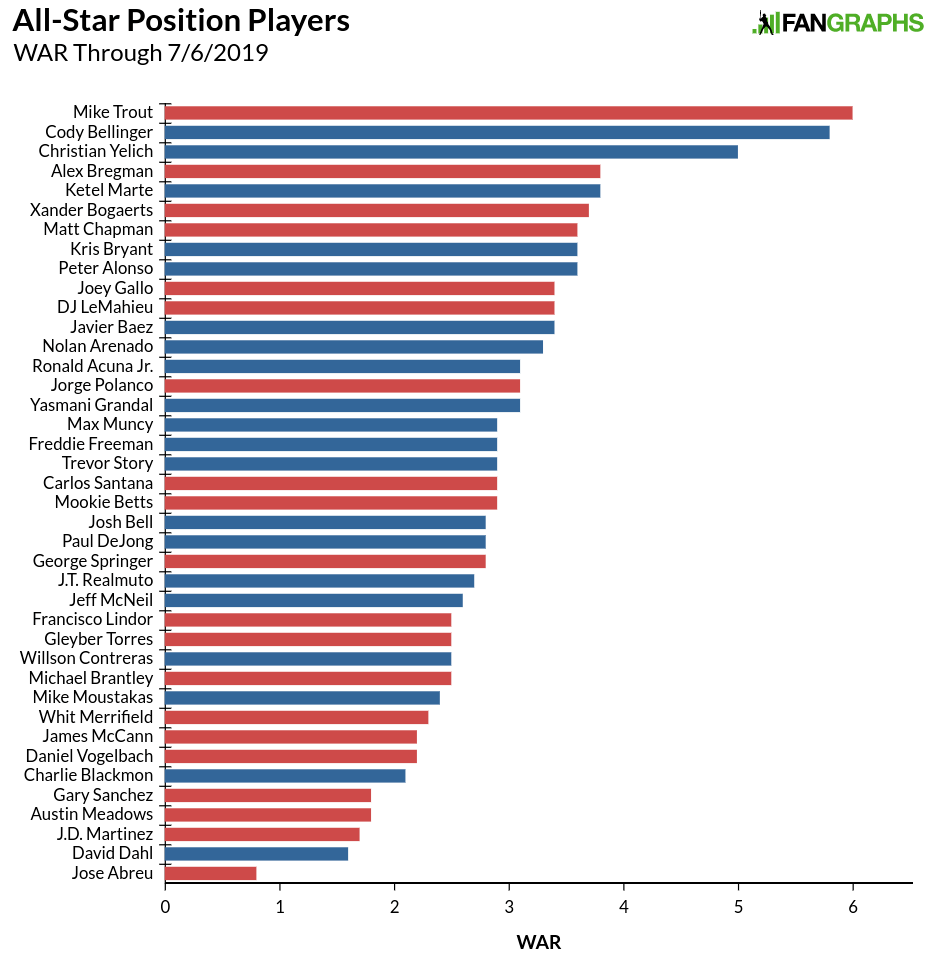
The graph below shows all position players named to the initial All-Star Game rosters through play on July 6.

The National League has three of the top five spots with Mike Trout and Alex Bregman representing the AL. After Trout, the NL is represented by 12 of the next 17 players. The American League does have some pretty big names with better track records near the bottom of the graph like Mookie Betts, Whit Merrifield, Francisco Lindor, and J.D. Martinez, those players have yet to put everything together this season. The NL has a roughly seven-win advantage at 62.9 to 55.9, which amounts to roughly a third of a win per player. As Devan Fink noted last week, the All-Star starters by WAR weren’t too far off from the actual results, and Xander Bogaerts‘ late inclusion means the top nine players by first-half WAR made the team. Of the top-30 position players by WAR, only Marcus Semien, Max Kepler, Rafael Devers, Yoan Moncada, and Eduardo Escobar failed to make the rosters.

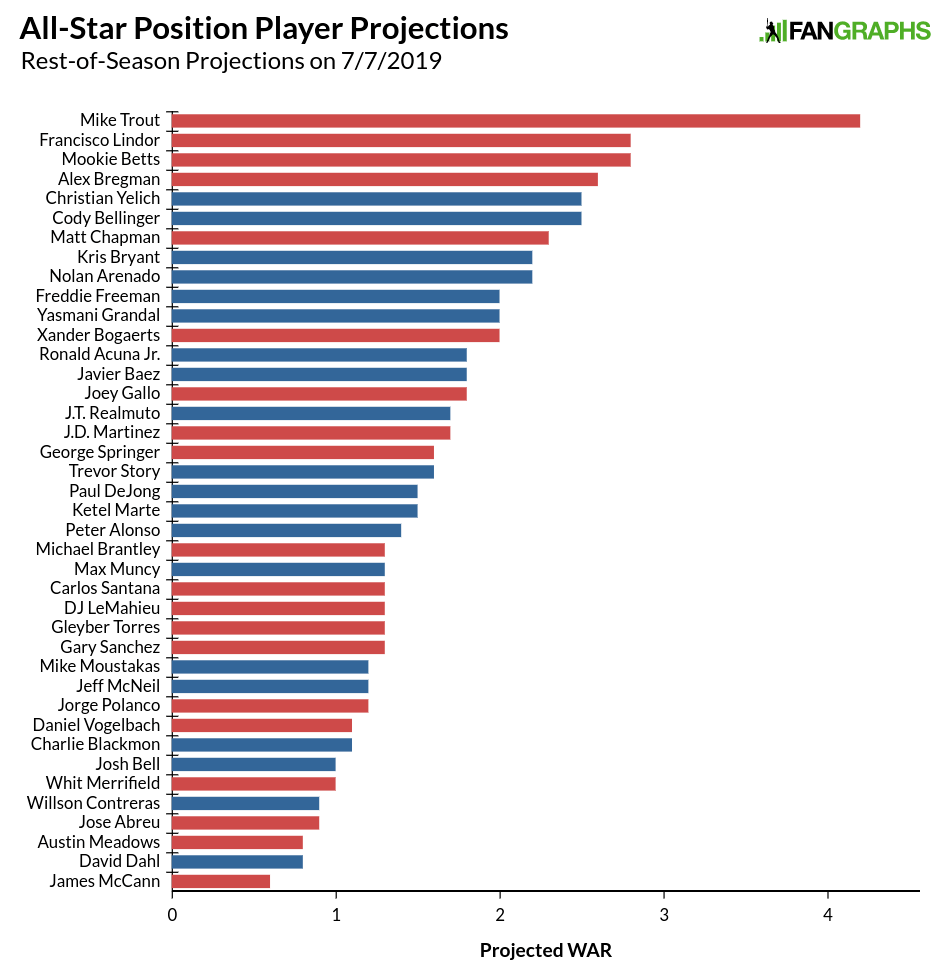
Looking solely at half a season’s worth of games isn’t necessarily the best indicator of talent. One could argue that the best measure of how good a player is right now might be that player’s projections over the course of the rest of the season. Here are those projections in graph form.

That Mike Trout is something else. His 4.2 projection for the second half of the season is far and away ahead of everyone else. His half-season projection would have placed him among the top 30 preseason projections. Put another way, if Mike Trout only played in every other game, he would still be All-Star worthy. We see Betts and Lindor’s talent level rise near the top of the graph above, and the NL can’t quite recover. Before roster changes, the NL had the advantage, but taking away Anthony Rendon from the NL and replacing Hunter Pence in the AL shifted the projections toward the AL with a 33.9 to 32.2 WAR advantage. Even with Trout, the AL still trails the NL in projected WAR, 34.9 to 33.7.

This how the position player side of the rosters break down.

2019 All-Star Position Players
WAR ROS Projections Total
NL 62.9 32.2 95.1
AL 55.9 33.9 89.8
Difference 7.0 -1.7 5.3

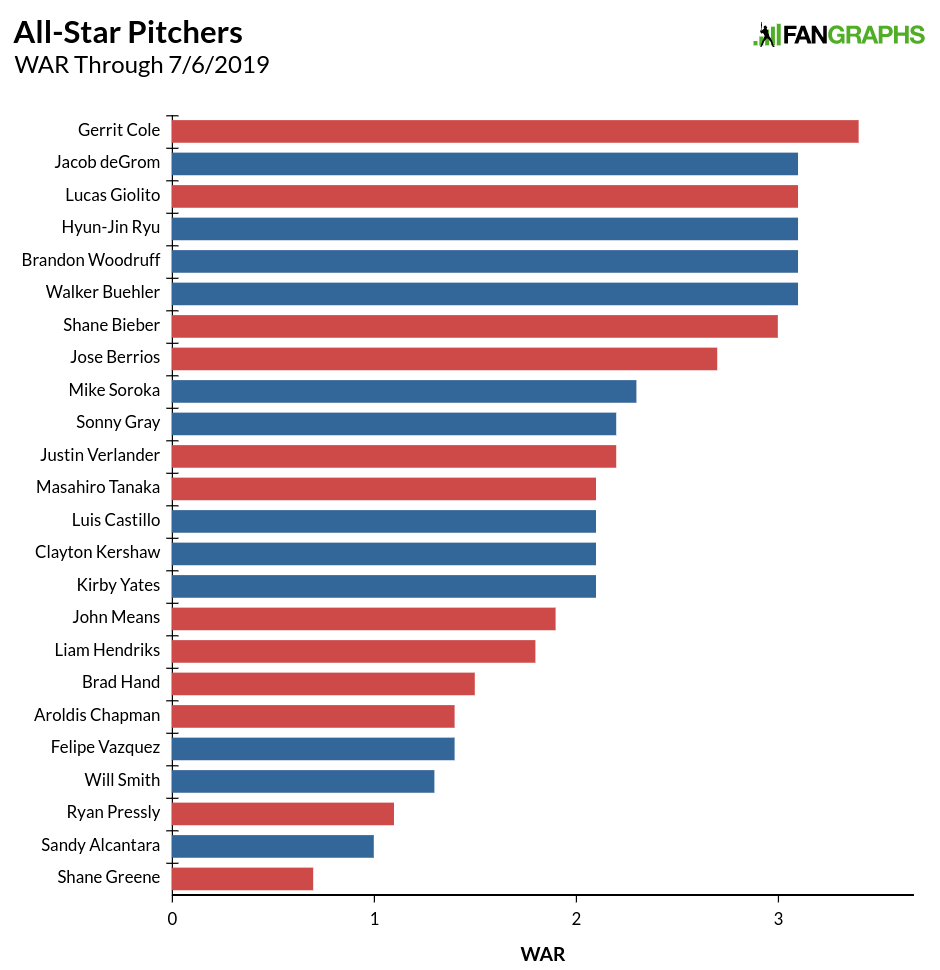
On the pitching side, the AL is bringing two more relievers than the NL, so in total WAR, the NL has a built-in advantage given the innings starters can pile up, though removing Max Scherzer leaves a pretty big dent in the NL squad’s top of the rotation.

The NL tops the AL 26.9 to 24.9, with the additional starters tipping things to the senior circuit. Given ERA’s relative prominence, we might expect a few more missing players from our WAR leaderboards in the midsummer classic, though we still have a pretty good representation based on WAR. Lance Lynn, the AL’s WAR leader, did not make the squad. The only other pitcher in the top 12 not to make the roster at some point in this process was Stephen Strasburg. In the top 20, Frankie Montas, who is suspended, didn’t make the team for obvious reasons, while Matthew Boyd, Chris Sale, Zack Wheeler, and German Marquez also failed to make the team. Several players in the bottom half of the graph above were their respective team’s lone representative, indicating that some of the choices are more roster filler than picking the most deserving players.

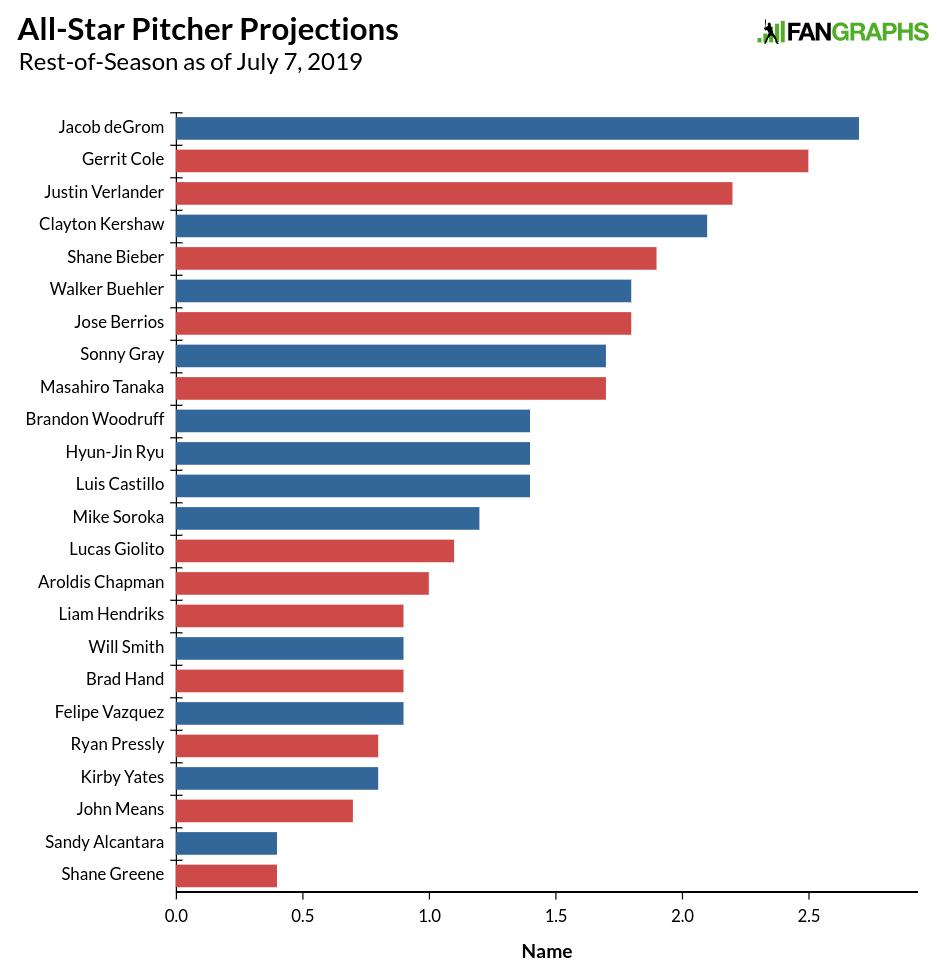
As for the projections, even without Scherzer, the NL still has the top projected pitcher in Jacob deGrom.

Without Scherzer, a sizable NL advantage shrinks down to less than a win. All of the relievers near the bottom along with Baltimore’s John Means and Miami’s Sandy Alcantara help create the NL’s small advantage due to fewer relievers. In terms of projections, Chris Sale is the big name missing. In comparing the pitching staffs, the leagues look like this:

2019 All-Star Roster Pitchers
WAR ROS Projections Total
NL 26.9 16.7 43.6
AL 24.9 15.9 40.8
Difference 2.0 0.8 2.8

When we put it all together, the NL has the advantage in performance so far this season, but the projections are nearly identical.

2019 All-Star Rosters
AL NL Difference
Position Player WAR 55.9 62.9 7.0
Pitching WAR 24.9 26.9 2.0
TOTAL 80.8 89.8 9.0
Position Player Proj. WAR 33.9 32.2 -1.7
Pitching Proj. WAR 15.9 16.7 0.8
TOTAL 49.8 48.9 -0.9

Before the injury replacements, the NL’s advantage was sizable. Losing the two Nationals’ stars in Rendon and Scherzer was a pretty big blow and essentially leveled the playing field in terms of talent. At the end of the year, the NL squad is likely to outproduce their AL foes. As for how much this advantage will actually matter in the All-Star Game, it probably won’t. It is a one-game exhibition and the game isn’t played repeatedly over the course of a season. With similar projections, the leagues looked pretty balanced. The American League has won the last six All-Star Games, but that history isn’t likely to matter for this year’s contest.


Sunday Notes: Dakota Hudson Metamorphosed Into a Throwback

Dakota Hudson is somewhat of a square peg in a round hole. At a time where four-seamers at the belt are de rigueur, the 24-year-old St. Louis Cardinals right-hander likes to live near the knees. Since debuting last season, Hudson has thrown his signature sinker a full 50% of the time. And he’s done so successfully. Hudson has a 3.31 ERA over 119-and-two-thirds career innings.

He hasn’t always relied on the worm-killer responsible for his MLB-best (among qualified pitchers) 60.3% ground-ball rate. As a young pitcher at Mississippi State University, Hudson was primarily four-seamers from straight over the top, and a breaking ball he couldn’t consistently command. Then came his metamorphosis.

“Butch Thompson was my pitching coach at the time,” explained Hudson. “I was 10 or 11 appearances into my sophomore year, and had just gotten through maybe two innings. He came up to me and said, ‘Hey, are you willing to make a change?’Of course I was. So I dropped down.”

The original plan was to drop all the way down to sidearm, but Hudson couldn’t comfortably get that low. He ultimately ended up closer to three-quarters, with a sinker and a cutter/slider becoming his weapons of choice.

The process of finding the most-optimal arm slot was achieved sans a catcher. Read the rest of this entry »


Called Up: Dylan Cease

How would you adjust your pre-draft evaluation of a high school pitcher if you knew he couldn’t pass a physical? That is what teams needed to decide about White Sox righty Dylan Cease, who after a surgery, a year of rehab, and four years of development, will make his first big league start today.

Some version of this scenario occurs almost annually: High school pitcher throws hard during his showcase summer, becomes very famous, comes out the following spring throwing even harder, then breaks. In Cease’s case, he was 93-96 and touching 98 during showcases, then touching 100 early the following spring before he was shut down with an elbow injury that would, as teams knew ahead of the draft, eventually require surgery.

For some teams, the injury shut the door on Cease as an option entirely. He was a Vanderbilt commit whose long arm action some teams had already feared increased his risk of injury, or at least might impede his ability to develop command and a changeup, and funnel him toward a bullpen role.

But Cease also had among the 2014 draft’s best velocity and breaking ball combination. The Cubs properly assessed his signability, and after cutting an underslot deal with Kyle Schwarber for $1.5 million at pick No. 4, they suddenly had a bunch of extra bonus pool money to play with. They ended up signing three high school pitchers to overslot bonuses — Cease, Justin Steele and Carson Sands — and cutting underslot deals of varying amounts at every other pick in the first 10 rounds.

Cease signed for $1.5 million, which was the slot value of that draft’s 38th pick and is around where high school pitchers with this kind of stuff, albeit healthy ones, typically come off the board these days. It took a fortuitous intersection of several variables: Cease’s talent, the Cubs optimistic evaluation of it and his signability, the opportunity created by the underslot deal with Schwarber, and a level of comfort in taking an injured player aided by risk diversification in the other overslot high schoolers. The high school pitching crop in 2014 was wild, and a few of those players probably contributed to the current reticence to pick a similar guy very early. Read the rest of this entry »