Archive for Featured

Sunday Notes: Tyler Clippard’s New Pitch Came Out of His Back Pocket

Tyler Clippard got top billing in this column nine months ago. A Toronto Blue Jay at the time, he boasted a 3.17 ERA, and had allowed just 6.5 hits per nine innings over 696 career appearances. Thanks in part to a lack of save opportunities, he was one of the most-underrated relievers in the game.

Twisting a familiar phrase, the more things remain the same, the more they change. Clippard is now a Cleveland Indian, and while he’s still gobbling up outs — his 3.05 ERA and 5.2 H/9 are proof in the pudding — he’s getting them in a new way. At age 34, having lost an inch or two off his fastball, the under-the-radar righty has pulled an old pitch out of his back pocket.

“Toward the end of last season, I started to incorporate a two-seamer,” said Clippard, who’d scrapped the pitch after transitioning to the bullpen in 2009. The new role wasn’t the primary driver, though. As he explained, “I mostly got rid of it because it wasn’t necessarily sinking. I thought, ‘If it’s not sinking, why should I throw it?’”

A decade later, a reason for throwing it emerged.

“Traditionally, I’ve been a fly-ball pitcher and have given up home runs,” said Clippard, who has surrendered 99 of them at baseball’s highest level. “In the overall scheme of things, I have’t been too concerned about that. There was a year, 2011, when I gave up 11 home runs — which is a lot for a reliever — but I had a 1.83 [ERA]. I can give up home runs and still be fine. At the same time, if I can keep the ball in the ballpark a little bit more, that’s obviously going to benefit me.”

Hence the reintroduction of a two-seamer… this despite the fact that it isn’t diving any more now than it did a decade ago. Read the rest of this entry »

A Conversation with Phil “The Vulture” Regan

The New York Mets made an out-of-the-box move yesterday, hiring 82-year-old Phil Regan as their interim pitching coach. The former big-league hurler, and longtime coach, takes over for Dave Eiland, who along with understudy Chuck Hernandez, was relieved of his duties in the throes of what has been an underachieving season.

As you should be aware, Regan’s nickname is “The Vulture.” It was given to him by Sandy Koufax, in a year that Regan went 14-1 out of the Dodgers bullpen with 21 saves and a 1.62 ERA. Prior to that 1966 season, he’d pitched primarily as a starter for the Detroit Tigers, the team he grew up rooting for in rural Michigan. Overall, Regan appeared in 551 games, for four teams, from 1960-1972.

The excerpted interview that follows was conducted approximately five or six years ago and was intended for inclusion in a book project — conversations with Detroit Tigers players of yesteryear — that has remained on the back burner. Given the timeliness of Regan’s hiring, I am choosing to share highlights from the interview here.

———

David Laurila: You were born in 1937, and grew up in southwest Michigan rooting for the Tigers.

Phil Regan: “Yes, I grew up in a town called Wayland. My earliest recollection of the Tigers was listening to Harry Heilmann call games on the radio. I recall players like George Kell, Johnny Lipon, Hoot Evers, Johnny Groth, and Vic Wertz. But my favorite of all was Hal Newhouser. He always seemed to be the one who pitched on Sundays, often against Bob Feller. He was my hero.

“During the week, I’d rush home from school, turn on the radio, and listen to Harry Heilmann and then, later on, Van Patrick. In those days we didn’t have a lot of television, but we always had the games on the radio. Of course, being from Michigan, I grew up wanting to play for the Tigers.”

Laurila: You ended up signing with them after graduating from high school.

Regan: “I did. As a kid, I never really got to play many games of baseball, because I lived out on a little farm, near a little town. Mostly I threw against a barn, with my brother, and stuff like that. But I had a good arm, and after graduating I was invited to Tiger Stadium to work out. They offered me a contract, but I decided that I wanted to go to Western Michigan [University]. After a year at Western, I decided to sign with the Tigers. From there I went into their minor league system.”

Laurila: How much did you sign for? Read the rest of this entry »


Lance Lynn, AL Pitcher WAR Leader

In the winter of 2017, Lance Lynn was coming off a season with a solid 3.43 ERA but poor peripheral numbers and couldn’t get the multi-year deal he desired, eventually settling with the Minnesota Twins. Lynn got off to a rough start, but from May on he put up a 3.34 FIP and a 4.13 ERA with the Twins and Yankees (following a trade), with the former number making Lynn one of the top-15 pitchers in the game and the latter number befitting an average-to-slightly above-average innings-eater. Heading into 2018, Lynn was paid based on his poor FIP and not his solid ERA, but heading into 2019, Lynn received a contract based on his average ERA and not on his very good FIP. Lynn agreed to a three-year deal worth $30 million to pitch for Texas, and 15 starts into in his Rangers career, the MLB pitching WAR leaderboard looks like this:

MLB Pitching WAR Leaders
Name IP K/9 BB/9 ERA FIP WAR
Max Scherzer 106.1 12.4 1.9 2.62 2.19 4.2
Lance Lynn 93 9.9 2.3 4.16 3.00 3.2
Hyun-Jin Ryu 93 8.2 0.5 1.26 2.51 3.1
Matthew Boyd 88.2 11.4 1.7 3.35 3.00 2.8
Chris Sale 90.1 13.0 2.1 3.49 2.80 2.8
Lucas Giolito 85.1 11.0 3.1 2.74 3.08 2.8
Gerrit Cole 96.2 13.8 2.3 3.54 3.10 2.7
Jose Berrios 97.2 8.7 1.6 2.86 3.52 2.6
Frankie Montas 82 9.7 2.3 2.85 2.89 2.6
Charlie Morton 87.1 11.0 3.2 2.37 2.88 2.5
Jacob deGrom 91 11.1 2.0 3.26 3.21 2.5
Jake Odorizzi 76.1 10.0 2.8 2.24 2.99 2.4
Stephen Strasburg 96 10.8 2.3 3.75 3.27 2.4

There’s Max Scherzer at the top, and right behind him is Lynn with 3.2 wins above replacement on the season. While some might have the urge to point to Lynn’s 4.16 ERA and insist there is something wrong with WAR, particularly at FanGraphs, I would request fighting against any such urges. First, I’d like to note that over at Baseball-Reference, Lynn’s 2.7 WAR ranks 12th in all of baseball and isn’t too far off from the one above. As for that ERA, Lynn has put together an unusual season with respect to runs allowed. First, Lynn has no unearned runs on the year. While most pitchers’ earned run totals are around 90%-95% of their runs allowed, Lynn’s runs have all been earned. Indeed, Rangers pitchers outside of Lynn have earned run totals that are 93% of their total runs allowed. While it is possible that Lynn has benefited from great defense, that’s unlikely as we’ll get to below. In any event, that explains roughly 0.3 of Lynn’s higher ERA. Read the rest of this entry »


Anthony Rendon Keeps Getting Better

The first round of All-Star voting comes to a close on June 26th, which means we’re just over a week away from an annual tradition unlike any other: Anthony Rendon not getting the respect he deserves. He’s sitting fifth among NL third basemen in the vote, below the top-3 cutoff for this year’s final-day runoff. He’s also sixth in the majors among all batters in fWAR, which likely means he’ll make his All-Star debut this year. Yes, you read that right — Anthony Rendon has never been an All-Star.

All-Star results aren’t everything, of course. They matter for arbitration payouts, as Tommy Pham will tell you, but they’re not always (or even often) accurate reflections of who has provided the most value on the field. Still, it’s remarkable that Rendon has never been an All-Star. Since he debuted in 2013, he’s been the 12th-most valuable hitter in baseball, second only to Josh Donaldson among third basemen. If Rendon makes the team this year as a reserve, it will be fitting, because he’s never been more deserving than he is right now; he’s taken his offensive game to new heights from an already impressive baseline. He’s been outright Trout-ian at the plate this year, fixing weaknesses while sticking with strengths.

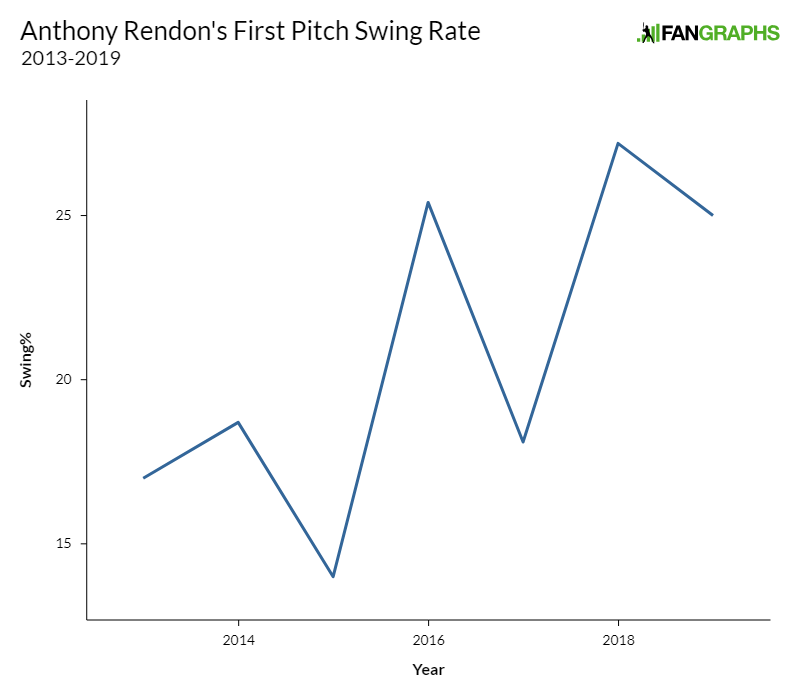
When I looked into Rendon’s 2018 this offseason, I focused on his newfound aggression. He increased his swing rate more than almost every other player in baseball last year, particularly on the first pitch of a plate appearance. Looking back a few more years, this seems like a change Rendon has been leaning into over time. He was passive to start at-bats at the start of his career, and he has been ramping it up over time, though he’s dialed it back marginally this year:

First-pitch swing rate is a blunt tool. Imagine a batter who is universally feared. Pitchers rarely attempt to challenge him. They throw him strikes on only 10% of first pitches. He’s wildly aggressive, swinging at 80% of strikes and 10% of balls. Still, that’s only an 17% swing rate, which sounds quite passive. Imagine another hitter, this one a patient sort with no pop whatsoever. Pitchers absolutely pound the zone against him — we’re talking a 90% zone rate, completely unheard of. He’s one of the most patient hitters in baseball, only swinging at 20% of strikes, and no balls whatsoever. This gets him to an 18% first-pitch swing rate. Clearly, we need to consider how pitchers attack Rendon to say anything definitive about his swing rates. Read the rest of this entry »


The Sinker Paradox

Two things are very much true in modern baseball, and they’re in seemingly direct contradiction with one another. The first hardly requires any introduction: fly balls are leaving parks like never before. There’s almost no point in linking to a story about it, because there’s no way you haven’t heard if you are reading this website, but what the heck, here’s Ken Rosenthal talking about it. Baseball in 2019 is a game of home runs — allow fly balls at your own risk.

At the same time, the two-seam, sinking fastball is going extinct. The trend started a while ago, and it doesn’t look like it’s stopping anytime soon. Cutting sinkers has worked, kind of, and progressive teams like the Astros and Rays are leaning into it. Heck, overhand arm slots and high-spin four-seam fastballs are the hallmarks of modern pitching. Teams are looking for them in draft picks and getting young pitchers to throw more of them.

Think about those two things for a second. Fly balls are more dangerous than ever, but the pitch that is best at avoiding fly balls is on the decline. It’s a mystery worthy of Sherlock Holmes, and today I’m throwing on my deerstalker hat. The first thing we need to do is confirm that fly balls really are worth more than ever. This might seem trivial, but it’s worth doing, if only to figure out just how much more fly balls are worth these days. Read the rest of this entry »


Yankees Acquire Edwin, Continue to Stockpile Power

Edwin Encarnacion is 36 years old now, but age hasn’t stopped him from mashing baseballs. Among qualified American League hitters, he ranks 12th in wRC+ (139), leads the league in home runs (21), and is fourth in isolated power (.290). He’s accrued 1.7 WAR, which is pretty good at this point of the season, especially given his subpar defense. Of course, nobody is employing Encarnacion for his glove.

When Seattle acquired Encarnacion this past offseason, everybody knew he’d be traded sooner rather than later. The Mariners are in the midst of a rebuild and are reportedly “trying to trade everyone” before the July 31 deadline. Encarnacion, with his age and contract, was an obvious candidate to be moved.

It only took until the middle of June for the Mariners to find a suitor. The Yankees now employ Edwin Encarnacion.

Yankees Get:

  • 1B/3B/DH Edwin Encarnacion (though it’s likely he’ll primarily be a DH)

Mariners Get:

Let’s touch on the Mariners’ return first before talking about the big parrot in the room. Juan Then was actually a Mariners farmhand two years ago. The Yankees acquired Then (and minor league hurler JP Sears) during the 2017-18 offseason in exchange for Nick Rumbelow.

Then is only 19 years old and he’s still in rookie ball. Prior to this season, Eric Longenhagen and Kiley McDaniel ranked Then as the No. 31 prospect in New York’s system, noting that he is “advanced for his age” but has “middling stuff and physical projection.” It’s worth noting that Then seems to have developed a better fastball in the Yankees system. But again, it’s awfully hard to project a 19-year-old who hasn’t reached full-season ball. We know he’s a young arm of some promise, but the delta in his potential outcomes is very wide.

As an interesting side note, reports suggest that the Mariners chose to deal Encarnacion to the Yankees because New York was willing to absorb more money than other interested clubs. By prioritizing salary flexibility, Seattle’s move is somewhat reminiscent of how the Marlins handled the Giancarlo Stanton trade, in which the Yankees gave up significantly less player value to bring in another slugger because they were able to take on big money. It’s not ideal for rebuilding teams to prioritize monetary value over player return on transactions, but it is what it is. Money is a big part of how organizations operate, and sometimes you’re going to see deals like that. Read the rest of this entry »


Sunday Notes: Rangers Broadcaster Matt Hicks Learned a Lesson From Fat Jack

Matt Hicks has been Eric Nadel’s partner in the Texas Rangers radio booth since 2012. Prior to that, the Maryland native called games for the Frederick Keys (1989-1994), the El Paso Diablos (1995-2004), and the Corpus Christi Hooks (2005-2011). One month into his professional baseball broadcasting career, he learned an important lesson, courtesy of an incredulous Fat Jack.

“That first year in Frederick, we played in a Babe Ruth League park because the stadium was still being built,” Hicks told me recently. “Center field was 355 feet from home plate. As you can imagine, the stands were rudimentary; we had metal bleachers, we had a small roof. Anyway, it was April, freezing cold, and we were playing a doubleheader. There was hardly anybody there for the night portion — 100 people, if that.”

In the aftermath of a clumsy call of a boneheaded play, a voice punctured the chilly, nighttime air. Clear as a bell, it was directed at the rookie broadcaster.

“We had a runner on second base, and one of our guys laid down a bunt,” explained Hicks. “The play was made — the batter was thrown out — and when I looked up, I was expecting to see a runner at third base. He was still at second. I didn’t know what to say. When I got to that part of calling the play — the guy’s name was Scott Meadows — I said, ‘Meadows is still at second base; he didn’t go to third because…’ Then I paused and said something lame. I said, ’He didn’t have any choice.’

Cue up the choice words. Read the rest of this entry »


The Phillies Have Their Ace Back

A year ago, Aaron Nola was one of the best pitchers in baseball. His 3.01 FIP was very good, his 2.37 ERA was even better, and his 5.4 WAR was fourth in the National League and helped him to a third-place finish in the Cy Young voting. After four starts this season, Nola pitched like one of the worst pitchers in baseball with a 6.25 FIP, a 7.45 ERA, an ugly 13% walk rate, and a -0.2 WAR that ranked 74th out of 77 qualified pitchers. At that time, Dan Szymborksi diagnosed Nola’s issue with walks and homers and noted the following:

At least in the early going, batters seem to simply be taking a more passive approach to Nola after his breakout 2018 season, and he hasn’t adjusted. And he’s getting away from some of the things that he did successfully in 2018, such as daring to throw curves to lefties when behind in the count (he’s dropped from 39% to 20%). Batters are more patient and Nola’s been more predictable.

Since that time, Nola has essentially returned to form. He had one more bad start where he gave up two homers but encouragingly struck out nine batters against one walk. Since that start, Nola has taken the mound nine times and his FIP has been 3.30, a 76 FIP- in this run-scoring environment and very close to the 73 he’s put up over the last three years. His ERA is a very good 3.48, and though his walk rate is slightly elevated at 10%, his 26% strikeout rate is right in line with last season. In his piece, Szymborski produced a table showing the cause of Nola’s high walk rates. Batters weren’t chasing pitches they used to and they were making contact when they did. Here’s the bulk of that table, with Nola’s work through the time of Dan’s piece on April 18 and since then.

Aaron Nola Plate Discipline
Year K% BB% O-Swing% Z-Swing% Swing% O-Contact% Zone% F-Strike% SwStr%
2016 25.1% 6.0% 29.5% 55.7% 42.2% 61.5% 48.3% 60.7% 9.6%
2017 26.6% 7.1% 29.4% 60.8% 44.5% 59.3% 48.2% 64.4% 10.8%
2018 27.0% 7.0% 33.2% 64.2% 47.0% 60.9% 44.7% 69.4% 12.4%
Thru 4/15/19 21.8% 12.6% 25.5% 55.4% 38.4% 70.0% 43.0% 48.3% 8.4%
Since 4/15/19 26.8% 9.2% 30.3% 57.0% 41.1% 61.8% 40.4% 62.4% 9.2%

Nola isn’t quite repeating what he did a year ago, but he’s not too far off either. He’s throwing fewer pitches in the strike zone and he’s not getting as many swinging strikes, which is something of an issue, but when hitters swing at pitches outside the zone, they are whiffing like they used to. Getting a lot more first strikes is a good thing for Nola, but even better, he’s actually finishing off batters once he gets that first strike. Read the rest of this entry »


Joey Gallo Talks Hitting

Joey Gallo is a unique hitter having an outstanding season. Though temporarily sidelined with an oblique injury, he’s slashing .276/.421/.653, with 17 home runs in 214 plate appearances and a 170 wRC+. And when he’s not bopping, he’s usually fanning or walking. The 25-year-old Texas Rangers slugger has the second-highest walk rate, and the second-highest strikeout rate, among qualified major league batters. The antithesis of a singles hitter, Gallo is all about Three True Outcomes.

Gallo sat down for an in-depth discussion of the art and science of hitting earlier this week.

———

David Laurila: Straightforward question to start: What is your hitting approach?

Joey Gallo: “I feel that I have a pretty in-depth thought process at the plate. I always have an approach. I think a lot of people assume I just go up there kind of ‘beer-league-softball,’ and try to crush everything I see. But I have a plan of what I want to do against a certain guy; the pitches I want to look for; who is behind the plate, umpire-wise; who is calling the pitches, catcher-wise; what the environment is; what the situation is. There’s a lot that goes into hitting. It’s not just me trying to put the ball into the seats.”

Laurila: Nuance aside, are you generally hunting fastballs middle, and adjusting from there?

Gallo: “I don’t want to give away exactly what I’m thinking at the plate. Obviously, you’re taught to look fastball and adjust to off-speed, but there are situations where you change that approach and look for different stuff. It changes at-bat to at-bat. Sometimes you’re looking off-speed. Sometimes you’re looking for a certain location. You’re not always just looking fastball, because the guys are so good in this league that you can’t always have exactly the same approach.”

Laurila: Have you made changes this year with either your approach or your mechanics?

Gallo: “I’m trying to stay through the ball a lot more now. That’s something we’ve worked on: I try to stay as short and compact as I can. One thing we talked about when Luis Ortiz was hired [as hitting coach] was that I don’t need to generate any more power. All I have to do is touch the ball; all I have to do is put the barrel to the ball. So we worked on simplifying my swing, throughout the offseason and in spring training. I had too much movement for a big guy. Now I’m just thinking about getting my foot down and putting the barrel to the ball.”

Laurila: Is there any compromise with the shortening up? All hitters have their timing mechanisms. Read the rest of this entry »


Everyone Should Want Marcus Stroman

We are still about seven weeks shy of the trade deadline, but the list of teams trying to add to their rosters (and their counterparts willing to move quality players) is beginning to show its form. And as they are very July, teams are on the lookout for starting pitching, with the list of pitchers who might be available also beginning to take shape: Madison Bumgarner of the Giants, Marcus Stroman and Aaron Sanchez of the Blue Jays, the Rangers’ Mike Minor, the Tigers’ Matthew Boyd, and perhaps Mike Leake and Marco Gonzalez of the Mariners are all potential targets. Inevitably, some of these players will be traded and make a difference for teams down the stretch, but beyond simple availability, it is probably useful to know why a pitcher is desirable in the first place. Marcus Stroman is a good pitcher having a good year, and with another season of team control after this one, he might be the best starting pitcher traded this season.

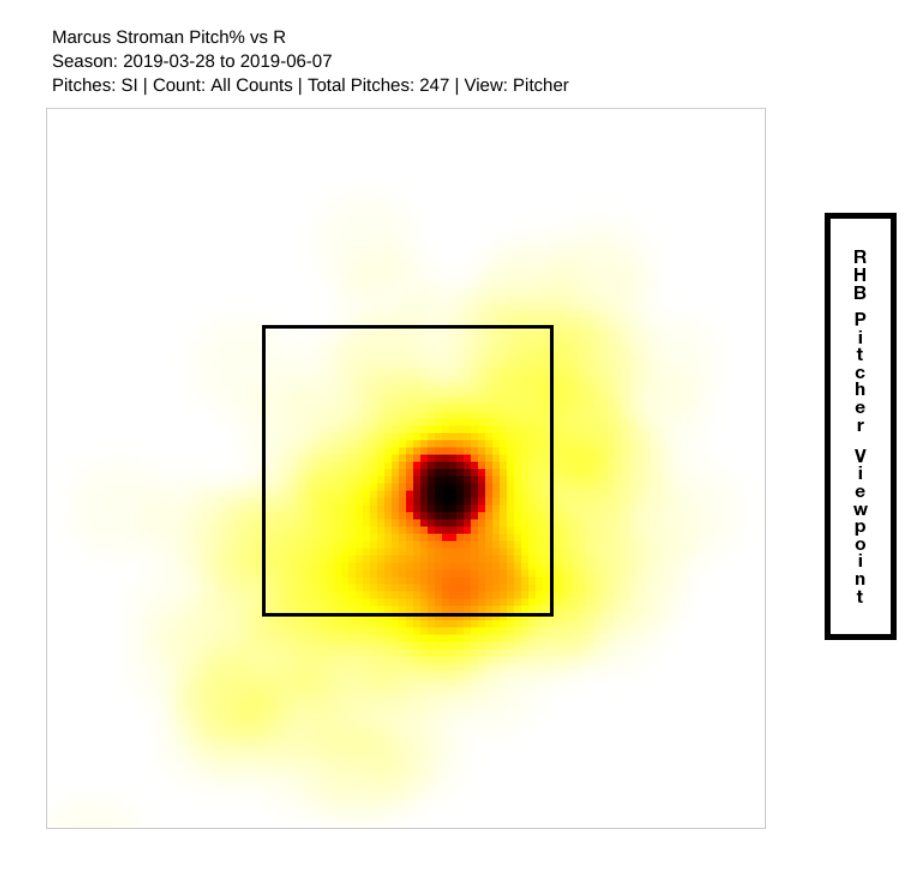
Stroman is a bit of a throwback in today’s game, relying on a sinker and posting pedestrian strikeout totals. He challenges hitters with the sinker, as evidenced by his heatmap against right-handers using the pitch this season:

Read the rest of this entry »

