I want to stress how outrageous it is that Michael Lorenzen was not the first former Cal State Fullerton two-way player to sign a free agent contract this winter. The guy who beat him to the punch, J.D. Davis, played 144 games for the Giants last year, starting 116 of them at third base. He’d gone through arbitration. More to the point, on March 1 he was the presumptive starter for a team with playoff aspirations, and he was under contract on March 10.
Then Davis got cut in order to save a few bucks in the wake of the Matt Chapmansigning, and he ended up signing for less than half of his original salary with the Oakland A’s. There, he’ll be managed by Mark Kotsay, a former Cal State Fullerton two-way player.
While all of that was happening, Lorenzen was sitting by the phone. Or more likely, given his physique, he was lifting the phone just to get a good pump in, even though the only sound on the other end was a dial tone. Finally, overnight just six days before his team’s first regular season game, Lorenzen has a deal with the Texas Rangers: One year, $4.5 million, with an additional $2.5 million possible in incentives. Read the rest of this entry »
Earlier today we published the positional power rankings for center field. For the first time since 2013, and for just the third time in the history of the positional power rankings, the Angels are not in the top spot. To put this changing of the guard in perspective, I went back and read all of the entries about Mike Trout and the Angels. This article is not a eulogy. Instead, we are here today to commemorate his greatness. It’s a retrospective of sorts, both of Trout’s peak and our coverage of it, but I would remind you that he’s not yet reached the compiling phase of his Hall of Fame career. In fact, among center fielders, only Aaron Judge is projected for a higher wRC+ than Trout this season. The Angels still rank fourth, despite the fact that Trout is projected to play less center field and more DH this season because Shohei Ohtani is no longer on the team. Trout is only 32, and it would hardly be surprising if he returns to the 160ish wRC+ that both we and the projections have come to expect.
Besides, praising Trout is one of main the reasons I’m writing here at all. I started reading FanGraphs religiously sometime between 2014 and 2016. I had a lot of free time at work, and I spent pretty much all of it doing what you’re doing right now. At some point, we switched from a cubicle farm to an open office. Concerned that everyone would be able to see my computer screen, I remember wondering whether I’d have to quit, or whether I’d be able to devise some way to hide the fact that, rather than working, I was just reading the same green website all day. I never did figure out how to hide it, but it turned out that nobody seemed to mind much. What I loved most of all, what turned me into a moderately knowledgeable baseball person, was reading about Mike Trout.
I know that many people, the sainted Sam Miller chief among them, have done incredible writing about Trout elsewhere. But to me personally, Trout is the player whose career is most tightly intertwined with the story of this site. His ascent as an all-around superstar, along with the agita surrounding the race for the 2013 AL MVP, made him the poster boy for advanced metrics in general and WAR in particular. Here was a player whose greatness was visible, but whose contributions in every facet of the game added up to more than the eye could see and way more than the Triple Crown stats could tell you. And here was a website full of great writers who couldn’t wait to show you — with graphs and GIFs and gags — how to appreciate that greatness and recognize it for yourself. Could Trout end up with the most WAR ever? Could he be as valuable to the Angels as LeBron James was to his team? How much was his production actually worth? How the hell did he hit a home run on this pitch? Or this pitch? Where would he rank according to a brand new stat?
Sometimes my wife does this thing that I love: We’ll just be sitting on the couch making each other laugh, and she’ll stop and say, “We’re so happy.” It’s true. We are so happy. But it’s also obvious enough that you might think there’s no reason to say it. You’d be wrong. We’re not going to be newlyweds forever, and it really is important to appreciate just how good we have it. In 2014, August Fagerstrom expressed that sentiment in the first of what turned into a series of check-ins about Trout’s place in history: “You might be tired of hearing or reading about Mike Trout, but you really shouldn’t be. Don’t take this one for granted… enough can’t be said about him.” A writer’s job is to ask interesting questions. Trout’s greatness has been such that for 12 years now, those questions have often been about the exact same topic. Somehow, the writers here have done an incrediblejob of finding creative ways to make sure we appreciate it, of fighting what Justin Klugh called “the normalization of Mike Trout’s massive talent.” If David Appelman were to collect the best articles about Trout from the past 10 years and publish them in a book, I’d buy the hell out of it. They changed my life. In fact, here’s one of the very first things I ever wrote for FanGraphs, just a few months before I’d get my first chance at actual baseball writing. Please ignore the superfluous comma.
All of this writing was and still is necessary because Trout has been so good for so long that it can be hard to wrap your arms around his greatness. Julio Rodríguez is a megastar with a mega-contract who finally displaced Trout by starting his career with back-to-back seasons worth 5-plus WAR at ages 21 and 22. But Trout, a year younger than Rodríguez in his rookie season, started out with back-to-back 10-win campaigns, excluding his 40-game cup of coffee as in 2011, his age-19 season. Over each of their first two full seasons, Trout was worth nine more WAR than Rodríguez! He averaged 8.9 WAR during his first eight seasons, then he put up 2.5 WAR in 2020, the equivalent of 6.8 WAR in a full season. In 2019, Angels center fielders were projected 9.2 WAR, more than double our projection for the Brewers, the no. 2 team at the position. That was the median projection, and the Halos fell short only because Trout missed nearly 30 games. It’s bonkers, and again, that’s just the peak. As recently as 2022, he put up 6.0 WAR in 119 games. Last season, the miserable slog that got him dethroned, he still put up the 11th-most WAR among all center fielders despite playing just 82 games, and if you look only at value accrued while playing center, he moves up to seventh, with 3.1 WAR in 79 games. From the very beginning, putting Trout’s career into a comprehensible context has required a healthy dose of ingenuity from our writers. It’s like a diagram of a skyscraper; you need that tiny picture of a human at the bottom just to remind you of what normal human scale looks like.
Speaking of scale, Trout has consistently destroyed the graphs that started appearing with the positional power rankings in 2014. He was blowing the curve not for a high school math class, but for the very best baseball players in the world. Year after year, his bar on the far the left dwarfed every other center fielder in baseball until, gradually, it didn’t.
The positional power rankings started in 2012, just in time for a certain toolsy center fielder to be name-checked as “the uber-prospect Mike Trout.” He was also projected for 100 PAs in left field. The ZiPS projections for Peter Bourjos and Vernon Wells were a little too rosy, but uber-prospect or not, no one could have been prepared for the .326/.399/.564 slash line that Trout put up in his rookie season. As you can tell from the tables, things were a little rough and ready back then. Fun fact: This table also represents the lowest ranking the Angels have ever had in center field.
By 2013, both the projections and the authors of the rankings were ready to crown Trout. On his own, he was projected for 6.8 WAR, nearly a full win above Andrew McCutchen’s Pirates in first place. However, Trout was still projected to spend most of his time in left in order to make room for Bourjos in center. “He’s a star even if his performance figures to take a slight step back following one of the best rookie seasons we’ll ever see,” wrote Mike Axisa. Over in left field, where a partial season from Trout was enough to lift the Angels into second place, Michael Barr called Trout, “The statistical community consensus AL MVP and real-world runner up,” but cautioned that, “it would probably be foolish to project a repeat of one of the greatest offensive performances in recent history.” He was right: Trout wouldn’t repeat his performance; he’d be even better.
In 2014, Jason Collette started his introduction by explaining why the graph looked so weird: “If you’ve been looking at the scale of these charts and wondering why we set the top end of the range to +9 when the best team is usually closer to +6, here’s your answer. Stupid Mike Trout.” He then called Trout, “the best player at his position, nee [sic], the game,” which will never not make me laugh. In 2015, Craig Edwards repeated what by that point had become a refrain: “Mike Trout is the best player in baseball, and it is not particularly close.” In 2016, Trout was simply “the best in the world.” (Also, let’s briefly remember Trout’s projected backups in those seasons: JB Shuck, Collin Cowgill, Craig Gentry, and Rafael Ortega!)
That’s when the player capsules about Trout started changing a bit. By 2017, it wasn’t enough just to acknowledge Trout’s greatness. Some poetry was necessary. “There is no one at his level,” wrote Dave Cameron. “There is no one near his level. There is no one on a level that can see Trout’s level from their level.” Just a year later, Trout had been so good for so long that it was assumed. His dominance had reached its hipster phase, and it was time for some snark. “Just in case you hadn’t thought about it enough recently,” wrote Jeff Sullivan, “Mike Trout is good.” In 2019, Dan Szymborski saved his snark for the question of whether the Angels would ever actually put a winning team around Trout: “It’s not the steak’s fault if someone puts ketchup on it.” Craig Edwards got topical in 2020: “He also wears a mask around others because it is known to prevent the spread of the coronavirus. He truly is an MVP.”
The big shift came in 2021. That was the first time an author considered the possibility that some young star might actually overtake Trout on the rankings. Brendan Gawlowski named five candidates: Luis Robert Jr., Ramón Laureano, Trent Grisham, Kyle Lewis, and Cristian Pache. None of them has topped Trout yet, and when push came to shove, Gawlowski wrote, “One of these years, he’ll slow down but if 2021 is the season, the projections will be as surprised and disappointed as anyone.” By 2022, Ben Clemens gave voice to the reality depicted in the bar graph: “He’s still the king… But after a decade on top, Trout’s hold on the No. 1 spot has loosened.” Ben noted that although the bat was still there, Trout’s issues were durability and defense.
That brings us to 2023, when Michael Baumann went so far as to invite another center fielder into the top tier, calling Trout and Rodríguez “the two clear best center fielders in baseball, and writing, “If anyone were to displace Trout as the premier center fielder in the game, Rodríguez is the most likely candidate.” That day, so long in coming, is finally here.
I can’t tell you how much fun it was to write this article. It was also difficult, because the authors here — one of whom works in the front office of the team that finally wrested the top spot from the Angels — have written so, so many fun things about Mike Trout. I spent hours getting lost in them when I should have been writing. Below are links to every year of the center field positional power rankings, as well as the left field entries from 2012 and 2013. I’d also encourage you to simply explore the blog roll of articles about Trout. Scroll around and click on anything with a title that sounds fun. I’m sure you’ll enjoy it, and I’m sure we’ll keep writing fun things about Trout for a long time to come.
I went to high school in a state with an extremely late calendar, and I took a lot of AP classes. Which meant that from about the second week of May until the end of the school year in late June, most of my class schedule was pretty pointless. It’s hard to get a bunch of overworked, checked-out teens to focus in class with nothing on the line, especially when said teens have just seen the sun for the first time in six months. Full credit to the teachers who were able to thread that needle, but in general we watched a lot of movies and played a lot of rummy while the clock ran out.
And that’s sort of where we are in spring training. With most rosters all but set and the Dodgers and Padres already playing meaningful games in Korea, the only thing left to do is find a live rooster — was it a live rooster? — to take the curse off Jake Cronenworth’s glove. And that’s not gonna take all week.
Ben Lindbergh and Meg Rowley banter about the Giants signing Blake Snell, whether Snell is now underrated, San Francisco’s offseason, Scott Boras’s offseason, leaguewide spending, an MLBPA power struggle, and (39:03) a 150-year-old message about baseball players in spring, then preview the 2024 Atlanta Braves (45:42) with 92.9 The Game’s Grant McAuley, and the 2024 Chicago White Sox (1:24:54) with Sox Machine’s James Fegan.
Two weeks ago, I wrote about Marlins righthander Max Meyer, an electrifying arm whose debut campaign two years ago was cut short by Tommy John surgery. I had been a big fan of Meyer’s game dating back to his days at the University of Minnesota, but in the pros he’d stumbled into a situation that’s fascinated me for years: the Marlins’ starting rotation.
The Marlins are a weird organization, battling from the bottom up against a tightfisted owner. They’ve seen off numerous well-regarded figures in both front office and field management — Michael Hill, Don Mattingly, and most recently Kim Ng — and from a cultural perspective they’ve vacillated between Florida’s two great cultural signifiers: the blue blazer and the pink flamingo.
But by God, they’ve tried stuff. And sometimes, they’ve been successful. Over the past five seasons, they have more playoff appearances and more postseason series wins than the Mets, Giants, Cubs, or Mariners. Most of all, they’ve been good at developing pitching. Read the rest of this entry »
It was closer than a lot of us thought it’d be, but Blake Snell has found a job before the Second Coming. The reigning Cy Young winner, left unemployed past St. Patrick’s Day by the merciless vicissitudes of the market, has come to terms with the San Francisco Giants on a two-year, $62 million contract with an opt-out after the 2024 season. Snell’s compensation includes a $17 million signing bonus, payable in January 2026, and a $15 million base salary in 2024.
Snell’s agent, Scott Boras, ran out the usual playbook — leave it late, hold the line, appeal directly to ownership. Boras has gotten more players nine-figure contracts than most agents have in their email contacts, and this is how he does it. And at the risk of being a huge bummer about Snell getting a top-10 AAV ever for a pitcher, the plan seems to have backfired. Read the rest of this entry »
Two of the outfielders I would have been most interested in signing this winter (as high-quality backups) both agreed to deals last week. Normally, that wouldn’t be a big deal; that’s what offseasons are for, after all. But both of them signed roughly two weeks away from Opening Day, and for meaningfully less than I would have predicted. That means that you can’t disconnect their deals from the context in which they were signed. That also means they get wrapped up into one article, so here we go. This will be a three-parter: Michael A. Taylor’s signing with the Pirates, Adam Duvall’s signing with the Braves, and the market forces behind both moves.
Taylor to the Pirates
This one was so obvious in retrospect. The Pirates have a lot of interesting young players, but one thing they didn’t have was a complete outfield. They have Bryan Reynolds and Jack Suwinski, both potential pieces of the future and interesting players right now in their own right. But that’s only two outfielders, and Suwinski is more of an emergency center fielder than an everyday one. The options after that – Edward Olivares, Connor Joe – felt more like platoon pieces than everyday starters.
Taylor, who signed a one-year deal worth $4 million, makes the whole picture look a lot better. He’s an elite center field defender, regardless of which system you’re grading him on. That lets Suwinski and Reynolds handle the corners, more natural positions for both. It also means the Pirates won’t have to make a tough decision against lefty pitching: either to play the lefty-hitting Suwinski — who before the Taylor deal was their best defensive center field, even though isn’t really suited to play that position full time — despite the platoon disadvantage, or sacrifice defense. Now they can mix and match far more easily.
Taylor’s offensive game has always been his weak link, and that absolutely limited his market. He’s a career .239/.294/.389 hitter, good for an 82 wRC+, which spells out his upside pretty clearly. He’s an average overall player, give or take a rounding error, so long as he’s an elite defender. In each of the last three years, that’s been almost exactly what happened; his defense has carried him even when his offense hasn’t. When he smacked a career-high 21 homers last year, his production boomed, and he racked up 1.7 WAR in only 388 plate appearances.
We’re projecting a return to career norms for Taylor’s offense, and it’s not hard to see why. He posted easily the best power production of his career, and in a way that doesn’t feel sticky. Before last year, he’d hit 113 doubles and 74 home runs over his first nine seasons. He had 14 doubles and 21 homers in 2023, a meaningful deviation from his normal output. That all comes down to an impressive barrel rate and more aerial contact than ever, but I think it’s reasonable to project a return to career norms there, and Pittsburgh is a terrible park for righty power, which should push that even a bit lower.
If the Pirates are looking for a repeat of last year’s offense in a full-time role, they’ll likely be disappointed. But they absolutely don’t need that. He brings the floor of their outfield up significantly, to a roughly average unit. We think the Pirates will get nearly as many WAR from their outfielders (6.6) as the Mike Trout-led Angels (7.0) — partly because Angels right fielders are projected for 0.4 WAR, the worst total in the majors — with less injury risk. And all of that for $4 million! I love this signing for a team on the fringes of the playoff race thanks to the paper-soft NL Central.
Duvall to the Braves
Now for a signing that will matter far less in the regular season. The Braves signed Adam Duvall, who last year with the Red Sox put together his best season on a rate basis but dealt with plenty of injuries. He’s making $3 million on a one-year deal.
Duvall is the archetypical boom/bust hitter. He strikes out roughly 30% of the time, even in good years. He doesn’t walk a lot. What he does do is put the ball in the air at an absurd rate, and with authority. His career barrel rate, 11.8%, is in the top 10% of all hitters in the Statcast era. If pitchers hang ’em, he can definitely bang ’em.
I’d say that Duvall’s .284 ISO in 2023 was an unsustainable caricature of his offensive game, but his career mark is an also-outrageous .240. He’s never going to get on base much, but his power is as real as it gets, even as he enters his age-35 season. He truly doesn’t do anything else – his career OBP is below .300, a woeful number for a theoretically offense-first outfielder – but I can’t emphasize enough how real his power is.
The Red Sox put Duvall in center field in 2023, which caused some excitement about his ability to move up the defensive spectrum. I didn’t completely buy it, though, and it seems like teams didn’t either. At best, he’s a backup to the durable Michael Harris II. The real reason Duvall is headed to the Braves is insurance for their high-risk plan in left field. Atlanta moved a lot of pieces around to bring in Jarred Kelenic over the winter. The ceiling is high for the former top prospect, but let’s be realistic: the floor is unfathomably low.
Kelenic has a lot of prospect shine, but he’s a career 85 wRC+ hitter in 1,000 plate appearances of big league playing time. He’s been one of the worst hitters in baseball this spring, for whatever that’s worth. He has huge platoon splits; he’s been unplayably bad against lefties in a limited sample. I think that the Braves will give him a chance to hit against everyone and establish himself as an everyday player, but there’s no guarantee that he will.
Signing Duvall means that there’s an off ramp if things don’t work out with Kelenic. Until they added him, the alternatives were so bad that Kelenic might have retained his job even if he were to play quite poorly. Now, there’s a limit to how bad that position can get, because Duvall feels like a bankable option. He doesn’t have huge platoon splits, though he’ll surely be taking some of Kelenic’s playing time against tough lefties. But he can also just take playing time, period, if Atlanta decides its gamble isn’t paying off.
That’s really smart team-building, as far as I’m concerned. The Kelenic experiment isn’t a high-leverage one for the Braves, who figure to run roughshod over the NL East regardless of what their left fielders do. But when it comes to building a World Series winner, patching potential holes for cheap in March is a lot better than doing so for a premium at the trade deadline.
Why So Little Money?
Both Taylor and Duvall landed in my top 50 free agents list this offseason. The crowd and I both missed pretty badly on our estimates for both. I had Taylor down for one year and $9 million; the crowd called for two years at $7 million per. I did worse with Duvall; I had him pegged at one year and $10 million, while the crowd went for one year and $8 million. Neither player even got half the guarantees we estimated for them.
It’s all part of the same story that’s been going on in free agency for years. The middle class is getting squeezed. Teams prefer to look internally for roughly average options, confident in their ability to develop cheap alternatives who aren’t much worse than those available in free agency. That doesn’t work for stars – it’s a lot easier to find a minor leaguer who’s 90% of Taylor than one who’s 90% of Mookie Betts, obviously – so great players still sign big deals, but solid regulars feel the pinch.
I’ve tried to account for that in my contract projections by changing the scale that I use to convert WAR into salary. I’ve made the first 1.5 wins progressively less valuable over time to reflect the way teams are behaving. For what it’s worth, I think that behavior is completely logical; in a game of limited resources (an assumption completely worth challenging, but outside the scope of this article), pouring your money into chasing stars and then trying to replicate role players is a good strategy.
These two deals squeeze that distribution down even further. It’s hard to imagine Taylor or Duvall finishing less than a win above replacement, even in a part-time role. Fitting a curve to account for these salaries as well as some of the bigger deals signed in free agency would require making the first win almost completely worthless, even lower than I’ve forced it in recent years.
I’m going to handle these contracts in my future free agency prediction endeavors by hedging. I’ll use the data points, of course, but I think it’s reasonable to look at both of these as casualties of circumstances rather than perfect harbingers of the new normal. It’s hard to predict which free agents will get squeezed ex ante; every year, someone ends up sitting on the vine longer than expected because there aren’t quite enough teams looking for veterans.
I’m going to resist taking too broad of a lesson here, though. Taylor and Duvall are both outfielders with only one carrying tool, but players like that signed earlier this winter on more reasonable deals. The middle class is still getting squeezed, without a doubt. I just wouldn’t take these two deals as evidence of an acceleration of the trend. More likely, they’re victims of timing who will be huge bargains for the clubs that signed them.
With the start of the season just two weeks away, it’s time for one of my most beloved/hated/dreaded annual traditions: making my picks for breakouts and busts. For those of you who haven’t read one of these pieces in the past, these are my picks for the players who are the most likely to change the general consensus about them over the course of the 2024 season. And since we’re talking about generally low-probability outcomes — this isn’t a list of players with better or worse projections than last year — there’s no exercise with more potential to make me look super smart… or dumb. For every J.P. Crawford or Steven Kwan triumph, there’s an instance of Andrew Vaughn-induced shame.
As usual, let’s start with a quick table of the triumphs and humiliations of last year’s picks:
It was about an average year. Vaughn and Christian Walker were the biggest misses, and Jordan Walker’s lousy defense kept him from being a win. Now on to this year’s picks.
The Breakouts
Spencer Torkelson, Detroit Tigers Spencer Torkelson’s .233/.313/.446 line certainly didn’t knock any socks off, but he was a (relative) beast over the last two months of the season, hitting .244/.329/.526 with 16 homers. Now, I always warn folks to not read too much into monthly splits because there’s a tendency to think that splits coinciding with a good explanation are enough to overcome the small sample size issues, and because the endpoints are selective. The two-month split, however, isn’t why Torkelson’s here. Rather, there was a lot of evidence to suggest that he was underperforming his peripherals for most of the season up until that point. From the beginning of the season through August 8, Torkelson was the biggest zStats underachiever with significant playing time. Using only Statcast data with no information as to actual results, ZiPS thought that in that span Tork should have been an .868 OPS hitter; his actual OPS was .688. His OPS after that day? .921! Remember, Torkelson was a top-five prospect in baseball entering his rookie season in 2022, so even though his first year was a disaster, he’s not some 31-year-old beer leaguer coming out of nowhere.
Patrick Bailey’s Bat, San Francisco Giants
I can’t really call it a full breakout since Patrick Bailey already had an overall breakout season, thanks to defense that crushed even the loftiest of expectations. What puts him here is that people may be sleeping on his bat. No, I don’t think there’s any chance he starts hitting like Buster Posey, but Bailey’s otherworldly defense and lackluster bat (wRC+ of 78) appears to have pigeonholed him as a typical no-hit, all-glove backstop. I think that would be a mistake. Catchers have really weird developmental curves and I can’t stress enough how difficult it is for a catcher to nearly skip the high minors; he only played 28 games above A-ball before debuting in San Francisco. He hit .251/.351/.424 in the minors – again, not star quality but far from a total zero – and even without full developmental time offensively, he wasn’t completely destroyed by MLB pitching. In fact, he showed surprisingly solid plate discipline and power for a prospect with so little experience with the bat. Both ZiPS and our Depth Charts project Bailey to have an 82 wRC+, but I would not be shocked if he finished the season with a mark between 95 and 100, which, if his defense holds up, would make him an elite catcher overall.
Wyatt Langford, Texas Rangers
I don’t have a formal rule about it, but when ZiPS projects a player with little or no MLB experience to lead in a significant stat, I should take it very seriously since ZiPS doesn’t often go nuts about minor leaguers. The last player I can think of is Luis Arraez, who had a 21% chance of hitting .300 for his rookie season, according to ZiPS, which also projected him to have the highest batting average in baseball by 2020. ZiPS thinks Wyatt Langford is going to lead the majors in doubles and be one of the best offensive rookies in recent years. He was one of the few college hitters that ZiPS saw as nearly ready for the majors in 2023, and it liked him more than similarly advanced hitters Nolan Schanuel and Dylan Crews. Since ZiPS is my sidekick – or maybe it’s the other way around – I gotta have its back!
Anthony Volpe, New York Yankees Anthony Volpe had a solid rookie season, but given his elite prospect status, it was a mild disappointment that he was only league average. Because of this, I think people are now underselling his offensive upside. He hit for a lot of power for a 22-year-old shortstop (21 home runs, .174 ISO). He also stole 24 bases on 29 tries, including successfully swiping each of his first 15 attempts, and was worth 3.5 base running runs. Two of his biggest problems were that he didn’t get on base enough (.283 OBP, 8.7 BB%) and struck out too much (27.8 K%), but these weren’t issues for him in the minors, and some of his fundamentals here are promising — he actually gets off to fewer 0-1 counts than most players with his strikeout rate. All of this suggests that he should figure things out with more major league experience. ZiPS also thinks he should have had a .312 BABIP given his Statcast data, instead of his actual mark of .259, which indicates that some of his woes were likely do to bad luck.
Keibert Ruiz, Washington Nationals
As with Volpe, I think Keibert Ruiz’s low BABIP, especially his .223 BABIP in the first half, made his season look a lot weaker than it was. ZiPS saw a .270 BABIP as a more reasonable number for him as a hitter in the first half, and that number continued to rise in the second half; he had a .285 zBABIP by the end of the season. Giving Ruiz back some of the batting average makes his actual .226/.279/.360 first-half line look a lot less abysmal and his .300/.342/.467 one in the second half look less like a fluke. In fact, except for a bit more power, most of the difference between his first half and second half was BABIP, so the halves weren’t quite as different as they appeared. Overall, his zStats line of .274/.330/.445 reflects a much more advanced hitter than we saw overall in 2023.
As I reminded people with Bailey, catchers tend to have a weird developmental pattern, and Ruiz has been no exception. Ruiz was a top prospect for a long time before hitting the Double-A wall, and his standing fell quite a bit in the eyes of prospect watchers. But he re-established himself as a top prospect to a degree that he was a huge part of Washington’s return when it traded Max Scherzer and Trea Turner to the Dodgers in 2021. I think people forget how young he still is at 25, and being older is not as big of a deal for a catching prospect than for someone at any other position.
Elly De La Cruz, Cincinnati Reds Elly De La Cruz is a common breakout pick for obvious reasons, but I’m including him here specifically because his plate discipline wasn’t as bad as it looks from the raw stats. ZiPS actually thought, from his plate discipline data, that his strikeout rate should have been more like 27% instead of nearly 34%, enough to knock off 27 strikeouts. And given that he should be a high BABIP player, because he was the fastest man in baseball last year, putting more balls in play would benefit him more than it would most players. Overall, his zStats line last year was .273/.323/.449, compared to his actual line of .235/.300/.410, meaning the holes in his game aren’t quite as deep as his reputation would suggest.
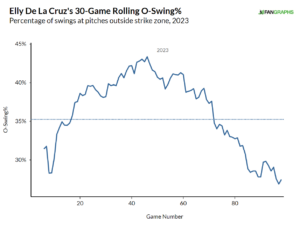
And if you don’t buy that, he did show better plate discipline as the season progressed. I’ll again warn of the dangers of storylines that coincide with splits, but things like offensive swing percentage stabilize very quickly, mitigating some of the sample size issues. I don’t think it’s a stretch to look at the graph below and conclude that De La Cruz got caught up in the hype of his initial success and became too aggressive. As a result, he started struggling before coming to realize that he had gotten away from the approach that made him such a dynamic player in the first place.
Dominic Canzone, Seattle Mariners
One should be suspicious of Pacific Coast League stats, but Dominic Canzone’s .354/.431/.634 line last year was good even by PCL standards, enough for a 151 wRC+ in the league. However, that success didn’t follow him to the majors. He probably doesn’t have a lot of upside, but the rate of his improvement over the last couple of years suggests that there’s a chance he could have a nice little Geronimo Berroa-esque run.
Tucupita Marcano, San Diego Padres
This one is kind of a stretch because I don’t see an obvious path for Tucupita Marcano to get much playing time. He hasn’t hit at all in the majors yet, but he’s also had a weird minor league career; he’s still just coming off his age-23 season and has made some progress at translating his minor league plate discipline to the majors. ZiPS isn’t in on him, but Steamer is, and if he can managed his 94 wRC+ Steamer projection, along with a decent glove (though more at second base than short) and his speed, he’ll at least be interesting. Gotta have one out there pick, no?
The Busts
Cody Bellinger, Chicago Cubs
I don’t think Cody Bellinger will fall anywhere near the depths of his brutal 2021 season, but there are reasons to be suspicious of last year’s resurgence. He changed some of his mechanics and altered his approach, especially in two-strike counts, to make more contact, and those adjustments should be sustainable. It’s the power numbers that are a bit preposterous, to the degree I can’t think of any comparable player who managed to maintain this amount of power with mediocre-at-best exit velocity numbers. Statcast’s expected slugging percentage knocks 88 points off his actual one, and the ZiPS version (zSLG) is 20 points meaner than that.
J.T. Realmuto, Philadelphia Phillies
This one hurts, especially for a player ZiPS was so excited about in 2015-2016 before his breakout. But the decline in J.T. Realmuto’s offensive numbers in 2023 is supported by the drop in his peripheral numbers; he was just a bit worse at everything last year. He’s also a catcher entering his mid 30s. This is a gut thing more than a projection thing, but I suspect any kind of a leg injury would be a bigger deal for a surprisingly quick player like Realmuto, whose offensive stats already reflect his speed, than for your typical catcher.
Isaac Paredes, Tampa Bay Rays Isaac Paredes is a good hitter, but is he really a 140 wRC+ guy? In both Statcast and ZiPS, Paredes had an even larger disparity between his actual power numbers and his peripherals than Bellinger. That said, there’s some good news, because unlike Bellinger, Paredes has done this before. There were 20 hitters in 2022 that hit at least five more homers than zHR expected, and 18 of them went on to hit fewer home runs in 2023. Paredes was one of the two who hit more (the other was Pete Alonso). Because Paredes has such a low hard-hit percentage, I’m not completely on board yet.
Lane Thomas, Washington Nationals
One thing about Cinderella stories is that people tend to overrate them after the ball. Most of these stories don’t involve permanent stardom; Joey Meneses and Frank Schwindel are two example of people getting too excited about an older breakout guy. Unlike Schwindel, Lane Thomas is probably still a league-average player, on the level of his 2021 and 2022 seasons, but I’d be shocked to see him hit 30 homers again. He’s probably a stopgap center fielder/fourth outfielder type, and I’m seeing him surprisingly high in some fantasy rankings.
Dominic Fletcher, Chicago White Sox
I was pretty shocked to see the White Sox trade Cristian Mena for Dominic Fletcher, even with the assumption that ZiPS is being too exuberant about Mena in ranking him at the back of the top 50 prospects. If you evaluate him the way our prospect team does, a fourth outfielder for a 45 FV prospect is quite a rich gain. And it’s looking like the Sox will give Fletcher a pretty good chance at getting the majority of the playing time in right field. It’s not as bad as the team’s irrational excitement about Oscar Colás last year, but there’s just not a lot of support for Fletcher’s maintaining his .301/.350/.441 line from his brief stint in the majors. That’s ridiculously higher than his zStats slash line of .249/.290/.376, which works out to a difference of 125 OPS points.
Orion Kerkering enjoyed a meteoric rise to the big leagues last year. The 2022 fifth-round draft pick began the campaign in Low-A Clearwater, and when
October rolled around he was taking the mound for the Philadelphia Phillies in the postseason. His numbers along the way were eye-catching. Pitching out of the bullpen at four minor-league levels, the University of South Florida product logged a 1.51 ERA and a 38.9% strikeout rate over 53-and-two-thirds innings. Called up in late September, he proceeded to fan six batters and allow one run in three appearances comprising the same number of innings.
That Kerkering was then entrusted to take the ball in the playoffs was a testament to his talent — a big part of which is a bat-missing offering even more impressive than his 98.6-mph fastball.
“That’s hard for me to do,” Kerkering replied when asked to describe his signature pitch. “I call it a slider and everyone says it’s one of the best ones out there. To that, I’m kind of, ‘OK, whatever. That’s fine.’ I just trust it as much as I can.”
The 22-year-old right-hander started throwing a slider as a Venice, Florida prep. Velocity-wise, it was 78-81 mph early on, and from there it got “faster and faster” to where it is now a crisp 86-87. The shape is basically the same — “with maybe a little more movement” — as is the grip.
“It’s kind of like how you teach a 12-year-old a curveball,” he said of the grip. “But instead of spinning on top of it, I spin on the 1:20-2:00 o’clock axis. If you think of [Clayton] Kershaw’s curveball, it will spin and then drop. Mine is the same way. It has the gyro spin, then it takes off.” Read the rest of this entry »
How about this: How about you and I forget for a couple minutes that we’re at FanGraphs, deep in the stat-swamped soul of the sabermetrics community? Let’s just pretend you’re reading an article on a website with a name like SuperCoolBaseballStuff.com. This is not the time to get lost in the weeds. Spring is in the air, and we’re rhapsodizing about the smell of the freshly cut grass. The birds have returned, and they’re waking us up at dawn with their incessant noises. Now is the time to be excited about baseball (and annoyed about the birds), and quite simply, nobody does more exciting stuff on a baseball field than Oneil Cruz and Elly De La Cruz. So let’s keep it simple. Let’s talk about all the superlatives that make the pair so exciting as we race toward the 2024 season.
For the first time, both Cruz and De La Cruz will be in the show at the same time. Cruz was called up for good in June 2022, and he finished the season on a high note, running a 133 wRC+ over the final month. He came into 2023 with the stated goal of a 30-30 season, but in just his ninth game, he fractured his left fibula during a collision at the plate. De La Cruz was called up in June 2023 and promptly went supernova. He ran a 179 wRC+ with eight stolen bases and 10 extra-base hits over his first 16 games, but struggled over the last few months. This year, they’ll be the Opening Day shortstops for their respective teams, and Cruz is on record saying that his ankle feels not just 100%, but 200%, which may very well be a record.
Somehow, the two players are extremely similar while also being completely unprecedented. The similarities start with their surnames, and then there’s the fact that they’re both young, ridiculously tall shortstops who hail from the Dominican Republic and play in the NL Central. The height thing is likely a bigger deal than you realize. Cruz is 6’7” and De La Cruz is 6’5”. According to Stathead, that makes them just the seventh and eighth players ever to be 6’5” or taller and play a single inning of shortstop in, ahem, the bigs. They’re the only ones ever to be regular starters at the position; those other six combined for a total of 113 games at short. You’re not going to believe this, but until Cruz dethroned him, the leader was Michael Morse, with 57 games. The 6’5” Morse, who finished his career with -73.2 total defensive runs, totaled 450 innings at short for the Mariners in 2005, racking up -13 DRS and a UZR/150 of -20.9.
Cruz and De La Cruz have both played in exactly 98 big league games, and their skillsets are nearly identical, as well. They’ve both walked 35 times, struck out 33.7% of the time, and posted batting averages and on-base percentages within two points of one another. Here’s what that similarity looks like courtesy of some cherry-picked Baseball Savant sliders:
Not that it matters much, but 2022 Cruz is on the left and 2023 De La Cruz is on the right. There’s so much red and so much blue. These are insanely fun profiles. Cruz and De La Cruz do everything at 100 miles per hour, except for hitting the baseball, which they do at 120. They run like cheetahs who were genetically modified for maximum speed and then shot out of a cannon. They crush baseballs like PETA-members who just found out that the baseballs were responsible for performing the illegal experiments on those cheetahs. They throw the ball over to first as if they heard you get an extra out if you manage to blast it right through the first baseman’s solar plexus. They whiff like they think they can generate enough wind power to solve the climate crisis all by themselves. They’re boom and bust personified. They’re the middle schoolers who figured out that you could game the typing test by absolutely going for broke, because 150 words per minute minus a 50% error rate still leaves you at 75 words per minute. They’re like basketball played on roller skates. It’s poetry when it works, carnage when it doesn’t, and impossible to turn away from.
As for whether the whole package will work, well that’s trickier. Here are the final grades the two players received from our prospect team upon graduation:
Prospect Grades
Tool
Oneil Cruz
Elly De La Cruz
Hit
30 / 40
30 / 40
Game Power
40 / 70
45 / 70
Raw Power
80 / 80
60 / 70
Speed
60 / 45
80 / 70
Field
40 / 45
45 / 55
FV
60
60
Again, the numbers are very similar, but Cruz, all of two inches taller, has a tougher path defensively. He’s always been capable of making a great play, but he’s never looked like a sure thing at short, in terms of either range or hands, and he didn’t look at home in left field when the Pirates tried him out there in the minors. In 2022, he graded out as a hair above average according to DRS, but the other defensive metrics didn’t love him. As he continues to fill out, he’s less likely to maintain his speed and range. On the other hand, he owns a career 106 wRC+. He managed to cut his chase and whiff rates toward the end of 2022. In the short samples of 12 LiDOM games and nine MLB games, he boasted vastly improved walk and strikeout rates in 2023. Those trends have now held through nine spring training games as well, long enough for Cruz to tie for the MLB lead with five homers.
As Robert Orr demonstrated over at Baseball Prospectus, the switch-hitting De La Cruz made his own plate discipline gains during the 2023 season, going from a 38.8% chase rate in July to 25.7% in September and October. In fact, according to Pitcher List, by the end of the season, his swing decisions were well above average.
Although he ended the season on a low note in terms of performance, De La Cruz actually posted a .334 xwOBA in September and October, his best figure of the season by a wide margin. De La Cruz put up a 24.5% HR/FB in 2023, 10th-highest among qualified players, but that masked the fact that his 53.9% groundball rate was the 11th-highest. It’s possible that chasing less soft stuff below the zone will help him to put more balls in the air going forward. Even if that doesn’t happen, it’s possible that he’ll just keep hitting the ball hard enough that he doesn’t need to lift it very often to do damage. Moreover, De La Cruz is better positioned to stick at shortstop. He graded out well according to OAA and UZR, though DRS and DRP were less impressed. Importantly, he’s also just 22, and he has time to improve. Although he put up just an 84 wRC+ last year, his defense and his propensity to take any and every base helped him put up 1.7 WAR in his 98 games.
For both players, the future has some truly massive error bars. They’re just 22 and 25 years old, and they’ve yet to play a full season’s worth of games. With apologies to Michael Morse, there just aren’t many comparable players we can look to for insights on their development. Their tools are so preposterous that their ceiling is somewhere out by the asteroid belt. But their long levers and their unproven eyes could keep them from ever making enough contact to take advantage of all that power. All the same, even if they just manage to stick it out as league-average shortstops, they’ll achieve it by way of some of the most electric, entertaining baseball the world has ever seen. They’ll also be doing it in an era where each 100 mph throw from deep in the hole and each 122 mph rocket off the bat can be tracked and marveled at in all its gaudy splendor. It’s time to get excited.




 Sponsor Us on Patreon
 Facebook Group
 Twitter Account
 EW Subreddit
 Effectively Wild Wiki
 iTunes Feed
 Get Our Merch!