Archive for Teams

David Fletcher, Anachronism

The list of batters who go down in the count 0-1 least often mostly makes sense. Mike Trout and Cody Bellinger are in the top five, due to a combination of their sterling batting eyes and pitchers staying away from them. Justin Smoak, Mike Moustakas, and Anthony Rizzo comprise the rest of the top five, and even if they don’t quite have the fearsome power of Bellinger and Trout, they have enough power that pitchers often pitch them carefully. Smoak has the lowest ISO of the five at .205. Pitchers are being rationally cautious.

Number six on the list will make you question what you think you know about first strike rate. David Fletcher, the Angels infielder, is number six, and he couldn’t look any more different than the guys ahead of him. I don’t mean physically, though that’s true as well — at 5-foot-10 and 175 pounds, Fletcher isn’t an imposing power presence. No, what I mean is that Fletcher plays baseball in a style that can best be described as a throwback. Not only that, he’s succeeding, putting together a second consecutive solid major league season despite a game that would look more at home in the 1980s than in 2019.

If Tyler O’Neill is one extreme of the game, David Fletcher is the other. Think of a stereotype about baseball in 2019, and Fletcher probably defies it. Strikeout rates inexorably on the rise? Fletcher is striking out 8.3% of the time this year, the lowest rate among qualified hitters. Big swings and big whiffs? Fletcher makes contact on a dizzying 92.1% of his swings. The world gone mad for home runs and power? Fletcher’s .126 ISO is 12th-lowest in baseball this year, and that comes largely from his 20 doubles; he hits home runs on 5.6% of his fly balls, the sixth-lowest rate in the majors.

It’s easy to read the headlines in 2019, to see Pete Alonso hitting balls to Andromeda and Christian Yelich crushing home runs on nearly a third of his fly balls, and think that the only way to succeed in baseball is via home runs. There’s some truth to that, honestly — as pitchers throw harder and harder, stringing together a series of hits gets increasingly challenging, and a home run lets the offense skip all of that. That’s not a rule, though — it’s merely the path of least resistance. Read the rest of this entry »


This Week’s Prospect Movers

Below are some changes we made to The BOARD in the past week, with our reasons for doing so. All hail the BOARD.

Moved Up

Ronny Mauricio, SS, New York Mets:
We got some immediate feedback on Monday’s sweeping update, which included more industry interest in Mauricio. The average major league swinging strike rate is 11%. Mauricio has a 12% swinging strike rate, and is a switch-hitting, 6-foot-4 teenager facing full-season pitching. It’s common for lanky teenagers to struggle with contact as they grow into their frames, but Mauricio hasn’t had that issue so far.

Oneil Cruz, SS, Pittsburgh Pirates:
One of us was sent Cruz’s minor league exit velocities and they’re shockingly close to what Yordan Alvarez’s have been in the big leagues. Of course, there remains great uncertainty about where Cruz will end up on defense, and hitters this size (Cruz is listed at 6-foot-7) are swing and miss risks, but this is a freakish, elite power-hitting talent.

Marco Luciano, SS, San Francisco Giants:
This guy has No. 1 overall prospect potential as a shortstop with 70 or better raw power. He belongs up near Bobby Witt, who is older but might also be a plus shortstop while we’re still not sure if Luciano will stay there.

George Valera, OF, Cleveland Indians:
Valera is torching the Penn League at 18 and a half years old, and we’re not sure any high school hitter in this year’s draft class would be able to do it. His defensive instincts give him a shot to stay in center field despite middling raw speed, and his swing should allow him to get to all of his raw power, so it becomes less important that his body is projectable. He would have been fifth on our 2019 draft board were he playing at a high school somewhere in the U.S., so he’s now slotted in the between JJ Bleday and C.J. Abrams on our overall list. Read the rest of this entry »


The A’s Deserve Your Attention, Again

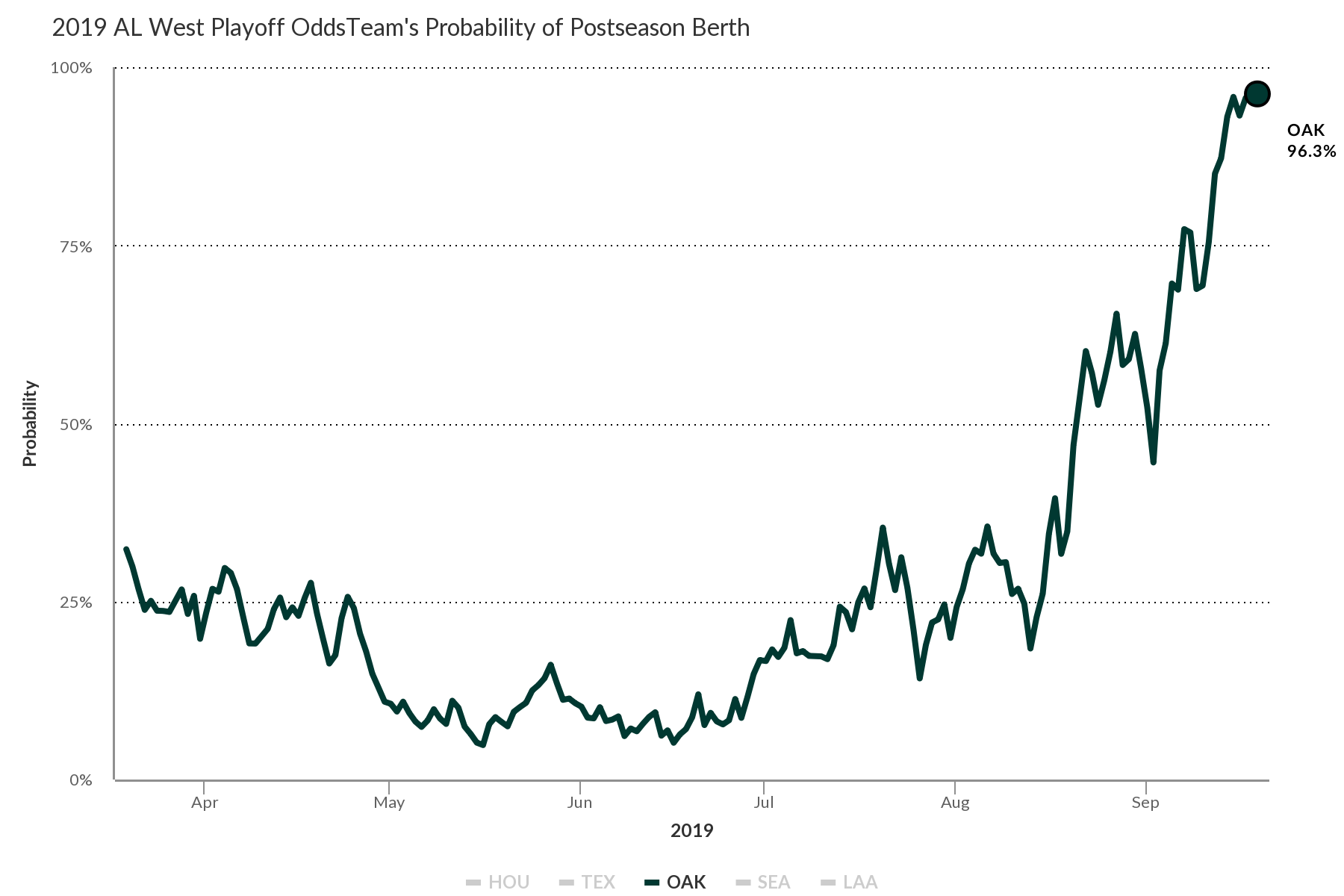
On this date one year ago, the baseball season was in the midst of its brief halt for the All-Star Game in Washington, D.C. For the Oakland Athletics, it felt as if the season was just getting started. Through the end of May, the team had merely been average, at least by the most traditional statistic: win-loss record. On May 31, the A’s were 29-28. But a 68-37 record (a 105-win pace) over their final 105 games turned a decent season into an excellent one. The A’s finished 97-65, the franchise’s best record since 2002, en route to capturing the second AL Wild Card spot.

In 2019, the Athletics are writing the script to a sequel. On May 31, the team was again 29-28, but since that time, their 26-13 record is the second-best in the American League and the fourth-best in baseball overall. During this stretch, their pitching has been remarkable:

Best Pitching Staffs Since June 1
Team Innings ERA FIP xFIP K% BB% WAR
Nationals 331.0 3.43 3.67 4.07 24.9% 7.0% 6.8
Athletics 351.2 3.63 3.93 4.58 19.9% 6.5% 6.5
Dodgers 358.1 3.09 3.67 3.68 26.2% 6.2% 5.9
Rays 379.2 4.08 3.85 3.82 25.8% 7.2% 5.6
Indians 331.0 3.70 4.10 4.09 26.6% 7.6% 5.2

Read the rest of this entry »


Yankees Trade for Terrance Gore and His Unusually Poor Stolen Base Numbers

Terrance Gore’s job is to come into games as a pinch-runner and steal bases. He might want to do more, but at the major league level, baserunning is his calling. Entering this season, Gore had totaled one hit, one walk, and one HBP in his career, including the postseason. Despite almost never reaching base, Gore has 32 career steals and had been caught just five teams before this year. Of his 61 appearances before 2019, 55 have come in September, when rosters are larger, or in the playoffs, when fewer pitchers are required. The Royals gave Gore a shot at slightly more playing time this year, but ultimately designated him for assignment. After he cleared waivers, he was traded to the New York Yankees for cash considerations, so Gore might once again loom large in September and the postseason.

What’s weird about Gore this season is that his stolen base numbers aren’t very good. He’s 13-of-18 on steals, and while that might be just fine for most players, when stealing bases is a huge part of your job, it’s really not that great. His sprint speed is one of the best in the game, so it’s pretty curious that he’s been caught stealing five times. Maybe teams are onto him, though that never stopped him before. Let’s take a closer look.

Gore’s first caught stealing happened on April 17 in the eighth inning. He didn’t get caught stealing so much as he got caught leaning as the photo shows below.

Gore’s next misadventure on the basepaths happened against the Yankees on April 21. Second one same as the first. Read the rest of this entry »


The Rangers Should Make a Major Minor Move

In a year not otherwise flowing with surprises on the team level, the Texas Rangers have been a big one. A 50-46 record isn’t one that’s dominating the American League or the AL West but it’s good enough that if the season ended today, the Rangers would finish 16 games ahead of their preseason ZiPS projections on a seasonal basis. One of the players most responsible for Texas’s surprise prediction-rebellion is Mike Minor. At 8-4 with a 2.73 ERA — even his 3.82 FIP is just fine in 2019’s Sillyball environment — Minor made his first All-Star Game. From missing two seasons with shoulder problems to becoming a successful Royals reclamation projection to growing into a solid No. 2 starter to being named an All-Star, Minor’s emergence has been one of the best stories in baseball in 2019. And sports being cruel sometimes, the Rangers may very well be best-served by allowing Minor to wear another uniform in the denouement.

Coming into 2019, the computer’s reasons for Rangers skepticism were straightforward: Texas had some interesting, top-tier talent but also a stunning lack of depth around the diamond. Not a single Ranger had a three-WAR season in 2018 and the team’s WAR leader, Jurickson Profar, was an Oakland Athletic. Even the team’s most interesting talent had questions, whether it was Joey Gallo‘s batting average, Jose Leclerc‘s sustainability, Rougned Odor alternating between being Jeff Kent and Clark Kent, or Nomar Mazara’s puzzling lack of development. On some level, ZiPS wasn’t wrong, as the Rangers still lack depth, but it missed out on the magnitude of their good performances. Mike Minor and Lance Lynn look like pitchers you’d actually like pitching in a playoff game, Joey Gallo has spent much of the season challenging the Alomar Line instead of the Mendoza, and Hunter Pence is having one of the wildest, out-of-nowhere offensive comebacks that I can remember.

So, given all these happy surprises, which have led to real playoff contention, why should they explore a Minor trade? Read the rest of this entry »


Tyler O’Neill is Everything All at Once

On an extremely superficial level, Tyler O’Neill looks like any other high-level prospect bouncing between the minors and the majors. After posting a 107 wRC+ in his first shot at Triple-A in 2017, he’s been excellent there over the past two years, putting up a combined 143 wRC+ in 427 PA. He’s been above-average in parts of two seasons in the majors — a 121 wRC+ over 232 PA. If the Cardinals didn’t have such an outfield logjam, he might have earned more major league playing time; indeed, the team traded Tommy Pham last summer in an attempt to find more plate appearances for O’Neill and Harrison Bader.

Look even slightly closer, though, and the narrative of O’Neill as average baseball player falls apart. Here is O’Neill, after his teammates tore off his jersey and undershirt following a walk-off home run. Even through the water droplets on the camera lens, his bulk is obvious:

How average can someone with biceps the size of most human beings’ legs be? Read the rest of this entry »


Justin Turner Talks Hitting

Justin Turner jumpstarted his career following a swing change prior to the 2014 season. The Los Angeles Dodgers third baseman has spoken on the subject several times, with no shortage of stories chronicling his journeyman-to-slugger evolution.

That doesn’t mean that Turner doesn’t have more to say about hitting. He still has plenty to share on the intricacies of his craft, both philosophically and as they pertain to his own experience. When it comes to a good thing, there’s always room for more.

The conversation that follows took place this past Sunday.

———

David Laurila: Do you see hitting as more or an art, or more of a science?

Justin Turner: “Honestly, I think it’s both. When you’re talking about the mechanics of the swing, and the position you’re trying to get in, there is definitely science involved. You need to understand how your body works — or, if you’re working with someone else, understanding how their body works — in order to get into the best position to have consistent success.

“Then, when you’re in the box, you have that cat-and-mouse game with the pitcher you’re going to face three or four times. How is he going to attack you? How is he going to approach you? That’s more of the art of hitting.”

Laurila: Doing what feels natural isn’t always going to be optimal. Is that accurate?

Turner: “Usually, what’s natural is what’s comfortable. You definitely want to feel comfortable in the box, but sometimes when you get into bad habits, comfortable isn’t always the right answer. I think there’s a time for feeling uncomfortable, to get yourself out of some unwanted habits you have. If that makes sense.”

Laurila: Can you elaborate? Read the rest of this entry »


Adam Wainwright’s Recent Resurgence

Adam Wainwright wasn’t supposed to be pitching this season. After a 13-year run that had become increasingly injury-plagued since 2015, he was contemplating retiring at the end of 2018. His five-year contract extension, which had been paying him almost $20 million annually, was expiring at the end of the year and he had spent the majority of the season on the injured list with elbow inflammation. At 37 years old with a very successful and storied career under his belt, no one would have questioned him if he had hung up his spikes.

Wainwright returned to the mound for four starts in September and rediscovered his feel for pitching, even if his results didn’t exactly match. He allowed 12 runs in just over 22 innings in the final month of the season despite posting a 3.21 FIP during that stretch. Instead of a last-minute retirement tour, those four games became the building blocks for his resurgence this year.

It turns out the Cardinals weren’t ready to part with Wainwright either. They re-signed him to a one-year, incentive-laden contract with a $2 million base salary. With Carlos Martinez injured and then sent to the bullpen, Michael Wacha ineffective and also relegated to relief, and Alex Reyes not yet ready for prime time, the Cardinals have had to rely on Wainwright a little more than they were supposed to. Read the rest of this entry »


Concussions Have Pushed Francisco Cervelli’s Career to a Crossroads

It’s been a strange couple of weeks for Francisco Cervelli. The 33-year-old Pirates catcher, who hasn’t played since May 25 due to a concussion, was quoted as saying earlier this month that he was giving up catching due to the toll of multiple concussions, but on Saturday, he refuted that report. Either way, his career appears to be at a crossroads, and his situation serves to remind us just how vulnerable catchers are to such injuries.

Cervelli — whose surname means “brains” in Italian, hence the nickname “Frankie Brains” — began the season in a slump and was hitting just .193/.279/.248 when, in a game against the Dodgers, Joc Pederson’s broken bat struck him in the mask:

He was placed on the seven-day injured list, and after undergoing several rounds of tests, wasn’t cleared to resume baseball activities until late June. It was the sixth documented concussion of the catcher’s 11-year major league career; he suffered one with the Yankees in 2011, two with the Pirates in 2017, and two last year. While he served primarily as a backup during parts of seven seasons (2008-14) with New York — a period that included a near-full season exile to Triple-A and a 50-game Biogenesis-related PED suspension — he’s been the Pirates’ primary backstop since arriving in a November 2014 trade for reliever Justin Wilson, one that rates as quite the heist given that Wilson’s 1.5 WAR in his lone season in the Bronx (though Yankees general manager Brian Cashman did flip him to the Tigers for Chad Green and Luis Cessa, a move that’s still paying dividends). Read the rest of this entry »


Ronald Acuña, Free Swinger

Ronald Acuña had Steve Cishek right where he wanted him. He had worked the count to 3-0, and with a man on first base, Cishek was in a tough situation. The Cubs led by only two, and that put Cishek in quite the bind. Walk Acuña, and the tying run would be aboard with no one out. Give him a pitch to hit, and the game could be tied in a single swing. Acuña waited, Cishek dealt, and the result:

Cishek, no doubt, made the exact pitch he was hoping for. Still, it was a tremendously aggressive swing from Acuña, at a pitch that he couldn’t do much with. No real harm done — Acuña walked on the very next pitch. Cishek, as it turns out, was wild that day — he’d walked Freddie Freeman before Acuña, and he walked Nick Markakis after him to load the bases. All three scored, and the Braves won. Still, what was Acuña doing swinging there? Cishek had thrown seven straight balls to start the inning. The Braves weren’t punished for Acuña’s aggression, but the swing seemed a bit out of place. Read the rest of this entry »