Archive for Teams

Picks to Click: Who We Expect to Make the 2020 Top 100

When publishing our lists — in particular, the top 100 — we’re frequently asked who, among the players excluded from this year’s version, might have the best chance of appearing on next year’s version. Whose stock are we buying? This post represents our best attempt to answer all of those questions at once.

This is the second year that we’re doing this, and we have some new rules. First, none of the players you see below will have ever been a 50 FV or better in any of our write-ups or rankings. So while we think Austin Hays might have a bounce back year and be a 50 FV again, we’re not allowed to include him here; you already know about him. We also forbid ourselves from using players who were on last year’s inaugural list. (We were right about 18 of the 63 players last year, a 29% hit rate, though we have no idea if that’s good or not, as it was our first time engaging in the exercise.) At the end of the piece, we have a list of potential high-leverage relievers who might debut this year. They’re unlikely to ever be a 50 FV or better because of their role, but they often have a sizable impact on competitive clubs, and readers seemed to like that we had that category last year.

We’ve separated this year’s players into groups or “types” to make it a little more digestible, and to give you some idea of the demographics we think pop-up guys come from, which could help you identify some of your own with THE BOARD. For players who we’ve already covered this offseason, we included a link to the team lists, where you can find a full scouting report. We touch briefly on the rest of the names in this post. Here are our picks to click:

Teenage Pitchers
Torres was young for his draft class, is a plus athlete, throws really hard, and had surprisingly sharp slider command all last summer. White looked excellent in the fall when the Rangers finally allowed their high school draftees to throw. He sat 92-94, and his changeup and breaking ball were both above-average. Pardinho and Woods Richardson are the two advanced guys in this group. Thomas is the most raw but, for a someone who hasn’t been pitching for very long, he’s already come a long way very quickly.

Eric Pardinho, RHP, Toronto Blue Jays (full report)
Lenny Torres, Jr., RHP, Cleveland Indians
Simeon Woods Richardson, RHP, New York Mets (full report)
Adam Kloffenstein, RHP, Toronto Blue Jays (full report)
Grayson Rodriguez, RHP, Baltimore Orioles (full report)
Owen White, RHP, Texas Rangers
Mason Denaburg, RHP, Washington Nationals (full report)
Tahnaj Thomas, RHP, Pittsburgh Pirates (full report)

The “This is What They Look Like” Group
If you like big, well-made athletes, this list is for you. Rodriguez was physically mature compared to his DSL peers and also seems like a mature person. The Mariners have indicated they’re going to send him right to Low-A this year. He could be a middle-of-the-order, corner outfield power bat. Luciano was the Giants’ big 2018 July 2 signee. He already has huge raw power and looks better at short than he did as an amateur. Canario has elite bat speed. Adams was signed away from college football but is more instinctive than most two-sport athletes. Most of the stuff he needs to work on is related to getting to his power.

Julio Rodriguez, RF, Seattle Mariners
Marco Luciano, SS, San Francisco Giants
Alexander Canario, RF, San Francisco Giants
Jordyn Adams, CF, Los Angeles Angels
Jordan Groshans, 3B, Toronto Blue Jays (full report)
Jhon Torres, OF, St. Louis Cardinals (full report)
Shervyen Newton, SS, New York Mets (full report)
Kevin Alcantara, CF, New York Yankees (full report)
Freudis Nova, SS, Houston Astros
Brice Turang, SS, Milwaukee Brewers (full report)
Connor Scott, CF, Miami Marlins (full report)

Advanced Young Bats with Defensive Value
This is the group that produces the likes of Vidal Brujan and Luis Urias. Edwards is a high-effort gamer with 70 speed and feel for line drive contact. Marcano isn’t as stocky and strong as X, but he too has innate feel for contact, and could be a plus middle infield defender. Perez has great all-fields contact ability and might be on an Andres Gimenez-style fast track, where he reaches Double-A at age 19 or 20. Ruiz is the worst defender on this list, but he has all-fields raw power and feel for contact. He draws Alfonso Soriano comps. Palacios is the only college prospect listed here. He had three times as many walks as strikeouts at Towson last year. Rosario controls the zone well, is fast, and is a plus defender in center field.

Xavier Edwards, SS, San Diego Padres
Antoni Flores, SS, Boston Red Sox (full report)
Jose Devers, SS, Miami Marlins (full report)
Tucupita Marcano, SS, San Diego Padres
Wenceel Perez, SS, Detroit Tigers
Esteury Ruiz, 2B, San Diego Padres
Richard Palacios, SS, Cleveland Indians
Antonio Cabello, CF, New York Yankees (full report)
Cole Roederer, LF, Chicago Cubs (full report)
Jeisson Rosario, CF, San Diego Padres
Luis Garcia, SS, Philadelphia Phillies (full report)
Simon Muzziotti, CF, Philadelphia Phillies (full report)

Corner Power Bats
Nevin will probably end up as a contact-over-power first baseman, but he might also end up with a 70 bat. He looked great against Fall League pitching despite having played very little as a pro due to injury. Lavigne had a lot of pre-draft helium and kept hitting after he signed. He has all-fields power. Apostel saw reps at first during instructs but has a good shot to stay at third. He has excellent timing and explosive hands.

Grant Lavigne, 1B, Colorado Rockies
Sherten Apostel, 3B, Texas Rangers
Triston Casas, 1B, Boston Red Sox (full report)
Dylan Carlson, RF, St. Louis Cardinals (full report)
Moises Gomez, RF, Tampa Bay Rays (full report)
Elehuris Montero, 3B, St. Louis Cardinals (full report)
Nathaniel Lowe, 1B, Tampa Bay Rays (full report)
Tyler Nevin, 1B, Colorado Rockies

College-aged Pitchers
It’s hard to imagine any of these guys rocketing into the top 50 overall. Rather, we would anticipate that they end up in the 60-100 range on next year’s list. Gilbert was a workhorse at Stetson and his velo may spike with reshaped usage. Singer should move quickly because of how advanced his command is. Lynch’s pre-draft velocity bump held throughout the summer, and he has command of several solid secondaries. Abreu spent several years in rookie ball and then had a breakout 2018, forcing Houston to 40-man him to protect him from the Rule 5. He’ll tie Dustin May for the second-highest breaking ball spin rate on THE BOARD when the Houston list goes up. We’re intrigued by what Dodgers player dev will do with an athlete like Gray. Phillips throws a ton of strikes and has a good four-pitch mix.

Logan Gilbert, RHP, Seattle Mariners
Zac Lowther, LHP, Baltimore Orioles (full report)
Brady Singer, RHP, Kansas City Royals
Bryan Abreu, RHP, Houston Astros
Daniel Lynch, LHP, Kansas City Royals
Wil Crowe, RHP, Washington Nationals (full report)
Josiah Gray, RHP, Los Angeles Dodgers
Jordan Holloway, RHP, Miami Marlins (full report)
Tyler Phillips, RHP, Texas Rangers

Bounce Back Candidates
The Dodgers have a strong track record of taking severely injured college arms who return with better stuff after a long period of inactivity. That could be Grove, their 2018 second rounder, who missed most of his sophomore and junior seasons at West Virginia. McCarthy was also hurt during his junior season and it may have obscured his true abilities. Burger is coming back from multiple Achilles ruptures, but was a strong college performer with power before his tire blew.

Michael Grove, RHP, Los Angeles Dodgers
Jake McCarthy, CF, Arizona Diamondbacks
Jake Burger, 3B, Chicago White Sox
Thomas Szapucki, LHP, New York Mets (full report)

Catchers
We’re very excited about the current crop of minor league catchers. Naylor is athletic enough that he’s likely to improve as a defender and he has rare power for the position.

Ivan Herrera, C, St. Louis Cardinals (full report)
Bo Naylor, C, Cleveland Indians
Payton Henry, C, Milwaukee Brewers (full report)

Potentially Dominant Relievers
These names lean “multi-inning” rather than “closer.” Gonsolin was a two-way player in college who has been the beneficiary of sound pitch design. He started last year but was up to 100 mph out of the bullpen the year before. He now throws a four seamer rather than a sinker and he developed a nasty splitter in 2017. He also has two good breaking balls. He has starter stuff but may break in as a reliever this year.

Trent Thornton, RHP, Toronto Blue Jays (full report)
Darwinzon Hernandez, LHP, Boston Red Sox (full report)
Dakota Hudson, RHP, St. Louis Cardinals (full report)
Sean Reid-Foley, RHP, Toronto Blue Jays (full report)
Colin Poche, LHP, Tampa Bay Rays (full report)
Trevor Stephan, RHP, New York Yankees (full report)
Vladimir Gutierrez, RHP, Cincinnati Reds (full report)
Dakota Mekkes, RHP, Chicago Cubs (full report)
Tony Gonsolin, RHP, Los Angeles Dodgers
Mauricio Llovera, RHP, Philadelphia Phillies (full report)

Aaron Nola Took the Guaranteed Money

No matter what you think about the current market dynamics, one thing is becoming increasingly clear: Free agency is leaving more and more players at best annoyed, and at worst pissed off. Many free agents are signed, of course, and some of them are signed to big, healthy contracts, but other premium players are still without employers, and the messaging has hardly been subtle. Players and the union aren’t pleased. Even if the team side of the equation isn’t doing anything wrong, the state of things is far from harmonious. A greater number of players are talking about what they see as a problem.

Imagine yourself, then, as a player who’s not yet a free agent. You might be inclined to believe you’re exceptional. Maybe you figure things’ll be worked out by the time it’s your turn. But you keep hearing about how free agency isn’t what it used to be. Even if most of the money is still there, nothing happens fast. There’s a lot of uncertainty. The idea of reaching free agency has been somewhat devalued. At least in theory, you’d figure this could lead to an increase in the number of long-term contract extensions.

It’s too early to know if there’s a trend. And no player is going to come out and say “I signed this extension because free agency is bad now.” But Aaron Nola has become the latest player to give up a free-agent year or two. Not for free, obviously. He’s going to get paid. It’s a question of whether he’ll get paid enough. It’s getting harder to calculate what “enough” even is.

Read the rest of this entry »


Brett Anderson is Back in Green and Gold (Again)

Just under two weeks ago, when I was writing a piece connecting the unsigned players from among our Top 50 Free Agents list to teams that appeared to have needs, Wade Miley came off the board by signing a one-year deal with the Astros. A similar thing happened in writing that piece’s sequel, covering a handful of the best of the unranked and unsigned free agents, as Brett Anderson pre-empted the publication by re-signing with the A’s on a one-year deal. He’ll cost a pittance, as he’s guaranteed a modest $1.5 million, with another $1 million possible in undisclosed incentives.

Though it feels like he’s been around forever, Anderson just turned 31 on February 1. That said, the 2006 second-round pick by the Diamondbacks (out of high school in Stillwater, Oklahoma) has already spent parts of 10 seasons in the majors. I should emphasize the word parts there because, well, we’ve rarely seen a whole season from him. As a rookie with the A’s in 2009 — a season in which he entered ranked seventh on Baseball America’s Top 100 Prospects list — he made 30 starts and threw 175.1 innings en route to 3.5 WAR. But only once since then has he started 30 times in a major league season. Hell, only once since then has he even reached 20 starts in the bigs: in 2015, he completed a solid 31-start, 180.1-inning campaign for the Dodgers (3.69 ERA, 3.94 FIP, 1.6 WAR). Read the rest of this entry »


Rocco Baldelli Extols Charlie Montoyo’s Leadership Skills (And Nelson Cruz’s, Too)

Rocco Baldelli knows Charlie Montoyo well. Not only did they spend the last four seasons together on Tampa Bay’s coaching staff, but Baldelli once played for the 53-year-old Montoyo in the minors. Minnesota’s new manager counts Toronto’s new manager as both a mentor and a friend.

Not surprisingly, Baldelli was effusive in his praise when I asked him about Montoyo. Citing his experience and leadership skills, he opined that the Blue Jays are getting “a tremendous manager and a great person.” Fittingly, Montoyo was hired on October 25, the same day his 37-year-old protege was tabbed by the Twins.

Baldelli wasn’t caught by surprise when he heard the news from north of the border. He knew that Montoyo had interviewed with the Cincinnati Reds, and that he would soon be doing the same with Toronto. The second of those sit-downs obviously went well. Mere days after meeting with him, the Blue Jays announced Montoyo’s hiring.

All told, five candidates went through the interview process in Toronto. Baldelli didn’t want to go on the record as to whether he was one of them, but he did allow that his post-season vacation plans were put on hold for a period of weeks. Multiple teams met with him about their openings. That was to be expected. The “future-manager” tag was assigned to him by myriad members of the media over the course of the 2018 season. Read the rest of this entry »


2019 ZiPS Projections – Tampa Bay Rays

After having typically appeared in the hallowed pages of Baseball Think Factory, Dan Szymborski’s ZiPS projections have now been released at FanGraphs for more than half a decade. The exercise continues this offseason. Below are the projections for the Tampa Bay Rays.

Batters

The Rays are similar to the St. Louis Cardinals in that they’re almost always one of the highest-floor teams in baseball. Since the team’s breakout season in 2008, which saw them reach the World Series, they’ve only really had one season that you could reasonably call lousy, the 68-94 campaign in 2016. Otherwise, Tampa’s been middling at worst, with a stretch of high-70s/low-80s wins that in large part reflects some draft struggles.

Since 2009, the Rays have only really hit on two players in the draft: Kevin Kiermaier and Blake Snell. Now, the jury is still out on some of these drafts, especially the more recent ones, but it’s hard for a team with Tampa Bay’s revenue model — and given some of the surrounding issues, they’re one of the few teams that really does seem to struggle financially — to compete consistently without drafts paying off. Read the rest of this entry »


Dustin Fowler on His Biggest Adjustment

Dustin Fowler may need to make an adjustment. The 24-year-old outfielder is coming off a rookie campaign that saw him slash an anemic .224/.256/.354, with six home runs, in 203 plate appearances. The Triple-A portion of his season was encouraging — a .310 BA and an .817 OPS — but his performance against big league pitching fell short of expectations. He went into the year ranked as Oakland’s No. 4 prospect.

He’d already made a notable adjustment. Prior to being acquired by the A’s in the 2017 trade deadline deal that sent Sonny Gray to the Yankees, Fowler had lowered his hands at the urging of then hitting coach, P.J. Pilittere. The reason was twofold: the team that drafted Fowler out of a Dexter, Georgia high school felt it would help him tap into his power. Every bit as importantly, his left-handed stroke wasn’t consistently catching up to high-octane heat.

Fowler talked about the 2016 adjustment midway through last season.

———

Dustin Fowler: “I hadn’t had much coaching growing up, so I was very raw. I’d just had small-town coaching — not the big coaching I needed — so going into pro ball was the first time I got some real one-on-ones on how to hit.

“I was very tall in my stance. I was upright, and my hands were over my head. Ever since grabbing a bat, I’d put them up there. My hand-eye coordination was good enough to make it work against pitching that wasn’t as good — slower pitching — but it worked less and less here. There’s a big difference from high school to pro ball. The pitches here harder, and I wasn’t catching up to balls. I was just fouling them off, or making fly-ball outs. Read the rest of this entry »


2019 ZiPS Projections – San Francisco Giants

After having typically appeared in the hallowed pages of Baseball Think Factory, Dan Szymborski’s ZiPS projections have now been released at FanGraphs for more than half a decade. The exercise continues this offseason. Below are the projections for the San Francisco Giants.

Batters

Be very careful when scrolling down to look at the depth chart. The way these things work, the first thing you’ll see is the outfield, which is likely to remain an absolutely brutal mess, one that couldn’t even be half-solved by a Ronald Acuña/Juan Soto-esque rise to power by Heliot Ramos, one of San Francisco’s few top prospects. Let’s put it this way: ZiPS projects Rule 5 draftee Drew Ferguson to be arguably the best outfielder on the team, with two of the other top outfielders being a minor-league signing and a waiver claim from the Rangers. The good news is that most of the group actually projects above replacement-level, so there’s a weird amount of adequacy in terms of the depth, but the projections give absolutely none of the team’s current group a chance to have much of an upside.

Things get sunnier when you look at the infield, which is the primary reason the Giants are likely to still be projected above the Padres for one last run (though probably just for one, unless the Padres are notably unlucky or incompetent). ZiPS essentially projects improvement for all of the team’s infield starters, kind of a rarity given the generally justifiable grumpy conservativeness to which projections systems are prone. The quality of the infield lends itself well to the argument that the Giants probably ought to have won more games last year. Not enough to be a playoff team, mind you, but at least enough to tone down the bleakness.

The worrisome thing about the offense is that most of the highlight players are at ages where their downsides can still hit like a ton of bricks and fast, and there’s no counterbalancing breakout potential. To the team’s credit, they’ve given every indication they realize that the outfield is bit of a tire fire. The Giants were in on all of the Marlins outfielders last winter, brought in Andrew McCutchen for 2018 (before trading him to the Yankees), and are now courting Bryce Harper. If any team is able to convince Harper to sign a shorter-term contract, San Francisco seems like a possibility; a superstar season from Harper could get the team into plausible contention, given their outfield weakness. And time is of the essence — if the infield starters don’t bounce back, this team is absolute toast.

I am still confused as to the baseball purpose of Pablo Sandoval remaining on the roster. Did someone in the organization finish last in their fantasy baseball league, and this is their punishment?

Pitchers

Johnny Cueto could theoretically return in September, but I think the smart money is still on him not making an appearance until 2020. Which, in addition to being unfortunate for Cueto, is rather bad timing for the Giants, who are less likely to be playing meaningful games in 2020 than this year.

Madison Bumgarner only gets a two-WAR projection, but that’s over just 147 innings, due largely to his attendance over the last two seasons, when he’s missed time due to freak injuries, one caused by something somewhat unusual (a dirt bike), the other by something somewhat mundane (a line drive). Since no elbow or shoulders were involved, I’m more optimistic about Bumgarner getting back to the 200 inning range than the projections are, which would boost his WAR to around three. ZiPS projects Dereck Rodriguez to be roughly league-average, which will be disappointing to Giants fans after a season in which Rodriguez was one of the team’s few highlights, but he has a very short record track record and a low K rate, so ZiPS isn’t putting him on the Kyle Hendricks pile yet. He’s certainly unlikely to repeat the 0.68 HR/9, even playing in Oracle Park.

The bullpen isn’t flashy, but the front-end is solidly above-average, and the team’s depth projects as more than adequate for its needs. San Francisco has shown an ability to turn random pieces into good relievers, and has a solid record with reclamation projects, such as Sam Dyson.

Bench and Prospects

After Joey Bart and Heliot Ramos, both likely to get official projections next year, the cupboard gets bare quickly. ZiPS does project Shaun Anderson to be a decent No. 3 starter for a time in his prime, and it has a long-term fascination with Conner Menez, but there’s just not much there there. Honestly, if the Giants had better prospects after their top two guys, I’d expect them to already have been traded for a starting pitcher. Most teams have a position player or two who ZiPS thinks projects better than the scouting reports indicate, but I’m just not seeing anybody here. Despite playing in the Pacific Coast League, Triple-A Sacramento only had one player who hit 15 homers (Chris Shaw).

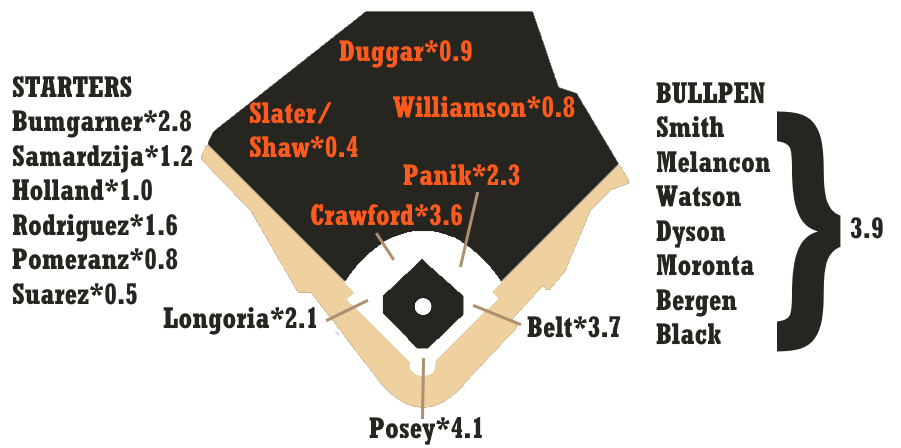
One pedantic note for 2019: for the WAR graphic, I’m using FanGraphs’ depth chart playing time, not the playing time ZiPS spits out, so there will be occasional differences in WAR totals.

Ballpark graphic courtesy Eephus League. Depth charts constructed by way of those listed here at site.

Batters – Counting Stats
Player B Age PO G AB R H 2B 3B HR RBI BB SO SB CS
Buster Posey R 32 C 115 423 53 122 24 1 8 53 48 56 4 1
Brandon Crawford L 32 SS 143 507 59 129 29 4 14 67 46 115 4 4
Brandon Belt L 31 1B 117 416 57 104 25 3 15 53 62 122 4 1
Joe Panik L 28 2B 122 444 57 122 24 4 7 44 40 47 4 1
Evan Longoria R 33 3B 136 528 58 136 31 3 16 65 34 105 3 1
Alen Hanson B 26 2B 132 398 51 99 18 8 9 42 21 88 17 7
Breyvic Valera B 27 2B 126 424 50 113 16 4 5 38 37 48 7 7
Anthony Garcia R 27 LF 126 449 60 111 25 1 16 56 43 108 3 2
Drew Ferguson R 26 CF 92 348 45 85 18 2 6 31 39 101 9 6
Austin Slater R 26 RF 118 411 48 105 22 2 8 48 34 113 9 4
Stephen Vogt L 34 C 116 373 40 92 20 2 12 47 34 75 0 1
John Andreoli R 29 LF 115 420 52 94 19 4 6 35 51 130 20 7
Steven Duggar L 25 CF 117 467 55 116 26 4 6 42 46 139 13 6
Brock Stassi L 29 1B 89 286 35 68 16 1 6 30 37 67 0 1
Mac Williamson R 28 LF 101 348 46 81 17 1 14 43 30 103 3 2
Abiatal Avelino R 24 SS 132 489 53 119 20 6 9 43 26 108 16 6
Henry Ramos B 27 CF 99 347 39 91 17 3 7 35 24 75 6 4
Donovan Solano R 31 SS 110 397 39 102 22 1 4 33 16 61 2 1
Jerry Sands R 31 1B 93 307 36 71 16 1 10 36 33 88 2 1
Ryan Howard R 24 SS 120 465 47 118 23 3 4 41 27 77 6 4
Cameron Rupp R 30 C 90 311 31 67 15 1 10 34 29 110 0 0
Aramis Garcia R 26 C 101 386 40 84 17 1 11 41 22 128 0 1
Cesar Puello R 28 LF 90 315 42 78 14 2 6 30 29 85 8 4
Levi Michael B 28 SS 103 375 44 85 16 3 6 30 26 114 9 4
Ryder Jones L 25 3B 124 458 50 108 24 3 11 47 25 117 3 2
Mike Gerber L 26 CF 108 411 46 89 19 3 12 44 29 148 5 3
Rene Rivera R 35 C 61 173 14 37 7 0 5 21 10 58 0 0
Jin-De Jhang L 26 C 62 230 22 55 10 1 2 18 13 34 1 1
Ali Castillo R 30 3B 107 355 33 86 14 2 2 26 16 47 7 7
Ronnie Freeman R 28 C 71 231 22 52 9 1 3 17 14 57 0 0
Trevor Brown R 27 C 58 179 16 39 8 0 2 13 13 40 2 0
Caleb Gindl L 30 LF 84 266 27 60 12 2 4 24 22 64 1 2
Miguel Gomez B 26 2B 118 437 43 112 22 4 8 45 10 73 1 0
C.J. Hinojosa R 24 SS 102 395 40 92 18 2 4 31 29 68 6 4
Eury Perez R 29 RF 73 219 23 57 9 3 1 19 11 38 13 5
Pablo Sandoval B 32 3B 92 293 28 70 13 1 8 35 20 60 0 0
Zach Green R 25 1B 106 385 43 80 22 2 12 46 26 155 1 1
Chris Shaw L 25 LF 131 495 55 113 27 2 19 62 30 175 1 0
Peter Maris L 25 2B 87 317 35 72 12 3 6 28 27 72 5 5
Hamlet Marte R 25 C 72 265 27 56 12 1 6 23 17 95 2 1
Luigi Rodriguez B 26 RF 100 362 39 78 14 3 11 37 23 138 10 8
Myles Schroder R 31 1B 93 322 30 67 13 2 6 27 14 97 5 3
Heath Quinn R 24 LF 92 350 37 75 15 0 8 32 28 126 3 1
Matt Winn R 26 C 93 326 31 54 13 1 8 28 27 163 0 0
Sandro Fabian R 21 RF 120 455 43 91 20 1 10 41 18 138 2 3
Josh Rutledge R 30 2B 57 170 16 34 6 1 2 11 11 57 1 1
Jalen Miller R 22 2B 130 524 53 115 26 2 8 46 25 145 8 5


Batters – Rate Stats
Player PA BA OBP SLG OPS+ ISO BABIP RC/27 Def WAR No. 1 Comp
Buster Posey 479 .288 .363 .407 109 .118 .318 5.7 7 3.8 Earl Battey
Brandon Crawford 566 .254 .320 .410 97 .156 .304 4.7 9 3.2 Jay Bell
Brandon Belt 484 .250 .351 .433 112 .183 .319 5.5 8 2.8 Leon Durham
Joe Panik 495 .275 .337 .394 98 .119 .295 5.0 0 2.0 Jeff Treadway
Evan Longoria 574 .258 .305 .419 94 .161 .295 4.7 1 1.9 Tim Wallach
Alen Hanson 427 .249 .286 .402 84 .153 .299 4.2 3 1.3 Luis Rivas
Breyvic Valera 470 .267 .324 .358 86 .092 .291 4.1 2 1.2 Wallace Johnson
Anthony Garcia 506 .247 .323 .414 99 .167 .292 4.8 -2 1.1 Kurt Bierek
Drew Ferguson 396 .244 .329 .359 87 .115 .328 4.1 -1 1.0 Larry Bigbie
Austin Slater 455 .255 .319 .377 89 .122 .334 4.4 1 0.9 Ruben Mateo
Stephen Vogt 413 .247 .310 .408 93 .161 .280 4.5 -8 0.8 Bill Freehan
John Andreoli 478 .224 .311 .331 75 .107 .310 3.7 7 0.8 Reggie Williams
Steven Duggar 517 .248 .317 .360 84 .111 .342 4.1 -5 0.7 Rich Becker
Brock Stassi 328 .238 .326 .364 88 .126 .291 4.1 3 0.7 Ray Giannelli
Mac Williamson 386 .233 .303 .408 91 .175 .290 4.3 0 0.7 Scott Bryant
Abiatal Avelino 523 .243 .285 .364 75 .121 .296 3.8 -3 0.6 Hector Luna
Henry Ramos 378 .262 .309 .389 88 .127 .317 4.3 -4 0.5 Andrew Locke
Donovan Solano 421 .257 .288 .348 72 .091 .295 3.6 -1 0.4 Alvaro Espinoza
Jerry Sands 344 .231 .308 .388 88 .156 .292 4.2 1 0.4 Jarrod Patterson
Ryan Howard 503 .254 .298 .342 74 .088 .297 3.6 -4 0.4 Dean DeCillis
Cameron Rupp 344 .215 .285 .367 76 .151 .298 3.6 -4 0.4 Chad Moeller
Aramis Garcia 413 .218 .264 .352 66 .135 .296 3.2 1 0.4 Alvin Colina
Cesar Puello 360 .248 .329 .362 88 .114 .321 4.3 -2 0.3 Domingo Michel
Levi Michael 416 .227 .295 .333 71 .107 .310 3.5 -3 0.3 Doug Baker
Ryder Jones 493 .236 .282 .373 76 .138 .294 3.7 -2 0.3 Brennan King
Mike Gerber 447 .217 .271 .365 71 .148 .307 3.4 0 0.2 Justin Bowles
Rene Rivera 188 .214 .267 .341 64 .127 .291 3.1 0 0.1 Shawn Wooten
Jin-De Jhang 247 .239 .280 .317 62 .078 .273 3.1 0 0.1 Dave Miley
Ali Castillo 379 .242 .276 .310 59 .068 .275 2.8 7 0.1 Robert Eenhoorn
Ronnie Freeman 249 .225 .270 .312 58 .087 .287 2.9 1 0.0 Kyle Geiger
Trevor Brown 195 .218 .278 .296 57 .078 .270 3.0 -1 -0.1 David Duff
Caleb Gindl 292 .226 .285 .331 67 .105 .283 3.2 2 -0.2 Jeff Wetherby
Miguel Gomez 451 .256 .273 .380 75 .124 .292 3.8 -6 -0.2 Donnie Hill
C.J. Hinojosa 432 .233 .287 .319 65 .086 .272 3.2 -4 -0.2 Keoni DeRenne
Eury Perez 239 .260 .303 .342 75 .082 .311 3.9 -2 -0.3 Jason Bourgeois
Pablo Sandoval 319 .239 .292 .372 79 .133 .276 3.8 -7 -0.3 Geoff Blum
Zach Green 422 .208 .270 .369 72 .161 .312 3.4 1 -0.4 Ryan Mulhern
Chris Shaw 533 .228 .278 .406 83 .178 .312 4.0 -7 -0.4 Glenn Davis
Peter Maris 351 .227 .287 .341 70 .114 .276 3.3 -5 -0.4 Chris Lombardozzi
Hamlet Marte 285 .211 .257 .332 59 .121 .305 2.9 -6 -0.7 David Ross
Luigi Rodriguez 391 .215 .264 .362 68 .146 .315 3.1 0 -0.7 Tony Barron
Myles Schroder 348 .208 .255 .317 54 .109 .279 2.7 5 -0.8 Marc Sagmoen
Heath Quinn 384 .214 .279 .326 64 .111 .310 3.1 -2 -0.8 Lance Hallberg
Matt Winn 357 .166 .233 .285 40 .120 .297 2.2 -1 -0.9 Steve Lomasney
Sandro Fabian 485 .200 .238 .314 49 .114 .264 2.4 10 -0.9 John Lindsey
Josh Rutledge 184 .200 .255 .282 46 .082 .288 2.4 -4 -0.9 Paul Hoover
Jalen Miller 559 .219 .261 .323 58 .103 .288 2.9 -3 -1.0 Chris Patten


Pitchers – Counting Stats
Player T Age W L ERA G GS IP H ER HR BB SO
Madison Bumgarner L 29 8 8 3.86 24 24 147.0 139 63 21 37 135
Johnny Cueto R 33 7 7 3.92 22 22 133.0 131 58 17 35 110
Dereck Rodriguez R 27 7 7 4.19 27 26 146.0 150 68 18 45 114
Drew Pomeranz L 30 7 8 4.42 28 21 116.0 111 57 14 57 107
Derek Holland L 32 7 8 4.54 29 25 134.7 135 68 19 56 118
Jeff Samardzija R 34 7 8 4.59 22 22 131.3 134 67 19 35 109
Will Smith L 29 3 2 2.94 57 0 52.0 41 17 5 17 69
Tony Watson L 34 5 4 3.17 66 0 59.7 54 21 6 15 57
Andrew Suarez L 26 9 11 4.60 30 29 162.3 176 83 24 47 130
Conner Menez L 24 8 10 4.52 27 27 125.3 123 63 14 74 115
Carlos Navas R 26 4 4 3.93 43 1 68.7 66 30 7 24 63
Reyes Moronta R 26 4 3 3.39 65 0 58.3 44 22 4 36 74
Mark Melancon R 34 2 2 3.22 47 0 44.7 43 16 3 11 35
Ty Blach L 28 7 9 4.55 37 18 128.7 143 65 14 36 73
Chris Stratton R 28 8 11 4.73 28 26 144.7 155 76 18 57 111
Keyvius Sampson R 28 8 10 4.69 26 19 126.7 106 66 15 76 129
Derek Law R 28 3 3 3.67 49 0 56.3 54 23 4 20 49
Sam Dyson R 31 4 4 3.84 64 0 58.7 58 25 5 20 44
Shaun Anderson R 24 6 9 4.86 25 24 129.7 142 70 20 41 97
Logan Webb R 22 3 4 4.81 27 24 88.0 91 47 11 42 70
Chase Johnson R 27 3 4 4.74 19 17 62.7 68 33 6 29 40
Dillon McNamara R 27 3 3 4.21 39 1 51.3 51 24 5 23 44
Ray Black R 29 3 3 3.94 56 0 48.0 33 21 5 34 77
Tyler Rogers R 28 3 3 4.02 52 0 65.0 65 29 4 28 47
Sam Coonrod R 26 5 7 4.89 22 18 95.7 99 52 12 49 79
Pat Venditte R 34 3 3 4.44 38 0 48.7 46 24 6 24 45
Jake Barrett R 27 2 3 4.03 53 0 58.0 52 26 6 31 62
Sam Moll L 27 2 2 4.02 40 0 47.0 48 21 4 18 37
Travis Bergen L 25 3 3 4.13 30 0 28.3 26 13 3 13 27
Steven Okert L 27 2 2 4.10 52 0 48.3 46 22 7 16 49
Tyler Herb R 27 5 8 5.17 21 21 108.0 120 62 14 49 73
Manny Parra L 36 2 2 4.14 39 0 45.7 46 21 3 23 35
Jamie Callahan R 24 3 3 4.50 29 1 40.0 41 20 4 19 32
Sam Wolff R 28 2 3 4.37 29 0 35.0 32 17 4 21 39
Pierce Johnson R 28 3 3 4.52 45 3 63.7 60 32 7 35 64
Enderson Franco R 26 6 9 5.22 26 21 119.0 135 69 17 52 86
Jordan Schafer L 32 1 1 4.59 27 1 33.3 32 17 4 17 33
Brandon Beachy R 32 1 1 5.79 6 6 23.3 26 15 4 14 15
Pat Ruotolo R 24 2 3 4.89 41 0 42.3 40 23 8 22 51
Josh Osich L 30 1 1 4.71 54 1 57.3 59 30 7 28 47
Casey Kelly R 29 7 11 5.22 28 23 131.0 151 76 21 45 89
Joan Gregorio R 27 4 6 5.35 20 15 79.0 83 47 14 39 71
Melvin Adon R 25 4 6 5.40 19 16 80.0 89 48 9 51 55
Carlos Diaz L 25 2 3 4.80 40 0 50.7 50 27 4 34 40
Kieran Lovegrove R 24 2 3 4.91 42 0 55.0 54 30 5 39 47
Garrett Williams L 24 5 8 5.30 31 16 88.3 92 52 8 67 66
Jose Valdez R 29 3 4 5.27 45 0 54.7 54 32 8 36 52
Taylor Hill R 30 5 9 5.48 23 19 106.7 130 65 18 31 53
Tyler Beede R 26 5 9 5.55 30 17 99.0 108 61 15 60 83
Jordan Johnson R 25 6 11 5.62 24 23 115.3 128 72 19 63 83
Ryan Halstead R 27 2 4 5.64 38 0 52.7 60 33 12 16 42
Michael Connolly R 27 4 8 5.85 25 14 92.3 112 60 17 37 53


Pitchers – Rate Stats
Player TBF K/9 BB/9 HR/9 BABIP ERA+ ERA- FIP WAR No. 1 Comp
Madison Bumgarner 612 8.27 2.27 1.29 .285 102 98 4.03 2.0 Bud Black
Johnny Cueto 561 7.44 2.37 1.15 .290 100 100 4.08 1.7 Bob Forsch
Dereck Rodriguez 630 7.03 2.77 1.11 .297 97 103 4.28 1.7 Steve Fireovid
Drew Pomeranz 511 8.30 4.42 1.09 .294 92 109 4.43 1.0 Rich Robertson
Derek Holland 590 7.89 3.74 1.27 .296 90 112 4.59 1.0 Shawn Estes
Jeff Samardzija 557 7.47 2.40 1.30 .295 89 113 4.26 0.9 Bill Gullickson
Will Smith 212 11.94 2.94 0.87 .300 134 75 2.78 0.9 Ken Dayley
Tony Watson 247 8.60 2.26 0.91 .289 124 80 3.45 0.8 Tony Castillo
Andrew Suarez 705 7.21 2.61 1.33 .306 86 117 4.47 0.8 Bobby Livingston
Conner Menez 571 8.26 5.31 1.01 .302 87 115 4.71 0.8 Trevor Wilson
Carlos Navas 295 8.26 3.15 0.92 .299 103 97 3.86 0.6 Daryl Irvine
Reyes Moronta 253 11.42 5.55 0.62 .290 116 86 3.41 0.6 Brian Wilson
Mark Melancon 186 7.05 2.22 0.60 .294 122 82 3.26 0.6 Dick Coffman
Ty Blach 557 5.11 2.52 0.98 .299 87 115 4.34 0.5 Mike Caldwell
Chris Stratton 640 6.91 3.55 1.12 .305 83 120 4.52 0.5 Kevin Hodges
Keyvius Sampson 558 9.17 5.40 1.07 .273 84 119 4.57 0.4 Victor Zambrano
Derek Law 241 7.83 3.20 0.64 .301 107 93 3.51 0.3 Mark Lee
Sam Dyson 253 6.75 3.07 0.77 .293 103 97 3.93 0.3 Jack Aker
Shaun Anderson 569 6.73 2.85 1.39 .302 81 123 4.77 0.3 Mike Lincoln
Logan Webb 396 7.16 4.30 1.13 .300 82 122 4.82 0.2 Jesus Silva
Chase Johnson 284 5.74 4.16 0.86 .302 83 120 4.70 0.2 Sean White
Dillon McNamara 227 7.71 4.03 0.88 .303 97 103 4.22 0.1 Casey Daigle
Ray Black 211 14.44 6.38 0.94 .301 100 100 3.55 0.1 Dwayne Henry
Tyler Rogers 287 6.51 3.88 0.55 .299 98 102 3.98 0.1 Bruce Dal Canton
Sam Coonrod 434 7.43 4.61 1.13 .302 81 124 4.85 0.1 Allen Edwards
Pat Venditte 216 8.32 4.44 1.11 .290 92 109 4.57 0.1 Jim Czajkowski
Jake Barrett 256 9.62 4.81 0.93 .299 98 102 4.12 0.1 George Smith
Sam Moll 205 7.09 3.45 0.77 .306 98 102 3.96 0.1 Jim Crawford
Travis Bergen 124 8.58 4.13 0.95 .291 99 101 4.21 0.1 Mike Venafro
Steven Okert 207 9.12 2.98 1.30 .295 96 104 4.18 0.1 Javier Lopez
Tyler Herb 490 6.08 4.08 1.17 .305 79 127 5.01 0.0 Ben Fritz
Manny Parra 205 6.90 4.53 0.59 .303 95 105 4.11 0.0 Joe Gibbon
Jamie Callahan 179 7.20 4.28 0.90 .303 90 111 4.43 0.0 Rick Greene
Sam Wolff 158 10.03 5.40 1.03 .304 93 107 4.38 0.0 Gabriel Dehoyos
Pierce Johnson 285 9.05 4.95 0.99 .301 87 115 4.36 -0.1 Ryan Henderson
Enderson Franco 542 6.50 3.93 1.29 .311 78 128 5.05 -0.1 Rick Sutcliffe
Jordan Schafer 148 8.91 4.59 1.08 .301 86 116 4.35 -0.1 C.J. Nitkowski
Brandon Beachy 109 5.79 5.40 1.54 .293 68 147 6.02 -0.2 Jim Abbott
Pat Ruotolo 189 10.84 4.68 1.70 .305 83 120 4.97 -0.3 Lariel Gonzalez
Josh Osich 258 7.38 4.40 1.10 .301 84 119 4.72 -0.3 John Curtis
Casey Kelly 586 6.11 3.09 1.44 .307 76 132 5.07 -0.3 Jim Magrane
Joan Gregorio 357 8.09 4.44 1.59 .301 74 136 5.29 -0.3 Carl Dale
Melvin Adon 379 6.19 5.74 1.01 .309 73 137 5.34 -0.4 Rich Dorman
Carlos Diaz 235 7.11 6.04 0.71 .299 82 122 4.79 -0.4 Brian Adams
Kieran Lovegrove 257 7.69 6.38 0.82 .301 83 121 4.91 -0.4 Lloyd Allen
Garrett Williams 423 6.72 6.83 0.82 .304 74 134 5.31 -0.4 Ken Chase
Jose Valdez 253 8.56 5.93 1.32 .299 77 129 5.29 -0.6 Marty McLeary
Taylor Hill 478 4.47 2.62 1.52 .303 72 139 5.39 -0.6 Allen Davis
Tyler Beede 464 7.55 5.45 1.36 .310 71 141 5.44 -0.7 Julien Tucker
Jordan Johnson 535 6.48 4.92 1.48 .300 70 143 5.67 -0.8 Jim Hunter
Ryan Halstead 233 7.18 2.73 2.05 .300 70 143 5.60 -0.9 Dwayne Pollok
Michael Connolly 424 5.17 3.61 1.66 .305 67 148 5.79 -1.0 Scott Shoemaker


Disclaimer: ZiPS projections are computer-based projections of performance. Performances have not been allocated to predicted playing time in the majors — many of the players listed above are unlikely to play in the majors at all in 2019. ZiPS is projecting equivalent production — a .240 ZiPS projection may end up being .280 in AAA or .300 in AA, for example. Whether or not a player will play is one of many non-statistical factors one has to take into account when predicting the future.

Players are listed with their most recent teams, unless I have made a mistake. This is very possible, as a lot of minor-league signings go generally unreported in the offseason.

ZiPS’ projections are based on the American League having a 4.29 ERA and the National League having a 4.15 ERA.

Players who are expected to be out due to injury are still projected. More information is always better than less information, and a computer isn’t the tool that should project the injury status of, for example, a pitcher who has had Tommy John surgery.

Both hitters and pitchers are ranked by projected zWAR — which is to say, WAR values as calculated by me, Dan Szymborski, whose surname is spelled with a z. WAR values might differ slightly from those which appear in full release of ZiPS. Finally, I will advise anyone against — and might karate chop anyone guilty of — merely adding up WAR totals on a depth chart to produce projected team WAR.


Effectively Wild Episode 1334: Season Preview Series: Braves and Diamondbacks

EWFI
Ben Lindbergh and Jeff Sullivan banter about the return of Brett Lawrie and two-way draftee Kyler Murray’s decision to pursue playing football over baseball, then preview the 2019 Atlanta Braves (8:45) with From the Diamond host Grant McAuley, and the 2019 Arizona Diamondbacks (43:23) with the Arizona Republic’s Diamondbacks beat writer, Nick Piecoro.

Audio intro: The Swell Season, "When Your Mind’s Made Up"
Audio interstitial 1: Chip Taylor, "Hello Atlanta"
Audio interstitial 2: Clem Snide, "Collapse"
Audio outro: The Rock*A*Teens, "Tuesday’s Just As Bad"

Link to Grant’s website
Link to preorder The MVP Machine

 iTunes Feed (Please rate and review us!)
 Sponsor Us on Patreon
 Facebook Group
 Effectively Wild Wiki
 Twitter Account
 Get Our Merch!
 Email Us: podcast@fangraphs.com


Hunter Pence Returns to Lone Star State

Hunter Pence was born in Fort Worth, Texas, played high school ball for Arlington (manning shortstop his senior year), and then played college ball for Texarkana College in Texarkana and UT Arlington back home. Two years later, he hit .283/.357/.533 with 28 home runs and 95 RBIs for the Double-A Hooks in Corpus Christi in 2006, then .326/.387/.558 in a brief stop in Triple-A Round Rock to start off the 2007 campaign before finally making his debut for the Astros on April 28th. Friday, his decades-long quest to play at least one game for every amateur and professional team in the great state of Texas reached a new and likely final phase, as he signed a minor-league contract with the Texas Rangers worth $2 million if he makes the club.

There was a time not too long ago when Pence couldn’t be had for a sum as small as $2 million, not even for a few months of play, but those days are well behind us now. Pence’s batting average, on-base percentage, slugging percentage, isolated power, BABIP, walk rate, and wOBA have each dropped in each of the last three seasons. Last year, he was worth -0.9 WAR for the Giants in his sixth full season for the team. That team, mired in fourth place and under new management, had no place in its outfield for Pence (the old guard did give him a custom scooter), and when it became obvious that the end of this five-year deal was the end of the road in San Francisco, it wasn’t clear whether the 35-year-old would play at all in 2019.

He will, at least in springtime in Arizona, and that’s a small blessing to us all. Pence has always seemed like one of those guys who might have invented baseball accidentally had he been born into a world in which it did not exist. Ever-so-slightly bow-legged, tall, and lanky, he doesn’t look like someone who should be among the very best at what he chose to do, but he was for a time and maybe still can be in Texas. At the plate, he often coils backwards, hands hidden behind his torso, then unspools violently like a length of chain pulled suddenly taut. Eyes wide and utterly fixated on wherever the ball has gone, he is prone to regain his balance and, arms and legs flying, careen into first and beyond, if he can make it. Pence at his best is a joy to watch play the game.

And he has been, at points in his career, a player to rally around. Pence’s first seasons with the Astros, as the team eased out of the Biggio-Bagwell-Berkman-Beltrán era that peaked with a 2005 NL Championship, and began their slow descent into the sordid Yakety Sax years, did not do much to burnish Pence’s national star even though he quietly put up four-and-a-half extremely solid years in Houston. When he was traded to Philadelphia, mid-way through 2011, Pence had accumulated 14.4 WAR at just 28 years of age. That’s not a Hall of Famer, but it’s a player well worth having. An NLDS run with the Phillies in 2011, on the tail-end of their dynasty, put Pence on the map, until he finally caught on with a team at the right time with the Giants in 2012. That run produced three titles (two for Pence) and also this hilarious video which I hope he recreates with the Rangers this year:

“Hunter helped lead the charge to our World Series in 2012,” former Giants’ GM Bobby Evans told me this week, “and his bat and leadership drove us to another World Series in 2014. He plays each game like it’s his last, and will forever be a fan favorite in San Francisco.” Well, he hasn’t played his last game yet: Pence says he’s changed his swing significantly this year, so maybe there’s a few more miles left in the tank. Texas doesn’t really need outfielders, what with Joey Gallo, Delino DeShields, Jr., and Nomar Mazara all already in the fold (and Willie Calhoun available in reserve besides), but they could use a strong bench bat or two and there’s no clubhouse in baseball that couldn’t use Hunter Pence.

I’m never optimistic about players’ ability to re-tool their games after 35 — this is increasingly a young man’s sport, and there’s precious little margin to get it right — but in Pence’s case I hope I am wrong, and that Pence makes the roster and contributes for Texas this year. Hunter Pence is not like many we’ve seen before in this game, and we need more like him. He’s home in Texas now, ready for one more try.


Transaction Roundup: On Pitching Moves Most(ly) Minor

Last week brought with it a flurry of relatively minor pitching deals — the sort that weren’t enough to divert the industry from the apparently never-ending saga of bigger stars left unsigned, and which are fairly typical of this time of year. Here they are:

  • The Orioles signed 31-year-old Nate Karns to a one-year deal worth $800,000, with an additional $200,000 possible in incentives.
  • Cleveland signed 32-year-old Alex Wilson to a minor league deal that could be worth $1.25 million in guaranteed money and an additional $750,000 in incentives should Wilson make the squad out of spring training.
  • The Diamondbacks signed 36-year-old Ricky Nolasco and 33-year-old Marc Rzepczynski to minor league deals and invited both to join big league spring training. Rzepczynski’s deal could be worth $1.5 million guaranteed if he makes the team, with $500,000 in incentives besides. The terms of Nolasco’s deal have not yet been reported.
  • Lastly, the Royals inked 33-year-old Homer Bailey to a minor-league deal with an invite to spring training; they did not disclose the terms of the deal.

Bailey’s probably the best-known of the names on that list, but I also think he’s among the least likely to accomplish much in 2019. You may recall that, earlier this winter, Bailey played the part of “salary offset” in the deal that sent Matt Kemp, Yasiel Puig, and Alex Wood to Cincinnati. So underwhelming was his 2018 — in which he allowed 23 home runs in just over 106 innings pitched — that even the Dodgers’ brass, who stash spare pitchers in their overcoats when they’re just going around the corner for a gallon of milk, released Bailey immediately upon his arrival in Los Angeles. He was in blue and white for less than 20 minutes. In Kansas City, he’ll join Brad Keller and Jakob Junis in the Royals’ rotation and work to find a second wind.

Nate Karns — another 30-something with success in his past and a terrible team in his present — has always been a little bit interesting for his ability to keep the ball on the ground with a four-pitch mix that features a two-seamer, a curveball, a change-up, and a heavy sinking fastball. The big question at the moment is how he’ll recover from the thoracic outlet surgery that ended his 2017 season near the end of May of that year, and kept him off the field for the entirety of 2018. Before the injury, Karns was carrying a terrific 50% groundball rate and 27% strikeout rate for the Royals — both improvements on his already-solid 2016 for the Mariners and in line with his 27 and 23% strikeout rates during his heyday with the Rays in 2014-15.

Karns going to Baltimore, which is under new management, is probably good news for everybody involved. Karns, obviously, would like the opportunity to prove that he is healthy and can return to being the quality big-league starter he has already been at various points throughout his career. The Orioles would like that too — Karns has one year of arbitration left, and the Orioles will still need rotation help in 2020. Alternatively, depending on the state of the trade market next summer or the summer thereafter, Karns could be traded to a contender in exchange for some area of need for Baltimore. That, too, would presumably be welcome news for Karns.

I already wrote a little bit about Cleveland’s bullpen situation in my writeup of the Óliver Pérez deal last month, so I won’t say much more about the Wilson deal except what I said then:

Pérez is a good pitcher and Cleveland needs a few of those. He had a terrific season in 2018 and there is reason to believe, despite his 16 seasons in the major leagues, that he has more left in the tank. He’ll be best served if the front office goes out and gets more arms to take some of the strain off of, say, him and Brad Hand, but if he pitches like he did last year, he’ll be useful anyway.

Alex Wilson, apparently, is one of the arms destined to take the strain off of Óliver Pérez and Brad Hand. He was remarkably consistent for the Tigers during his last four years in Detroit, posting a 3.20 ERA and a 2.77 K/BB ratio over 264.2 innings pitched. Importantly, too, he’s demonstrated an ability to throw in different roles: over the course of his career, he’s pitched 50.1 innings in the sixth, 84.1 in the seventh, 97 in the 8th, and 54.1 in the ninth or later. The question, then, is whether the Tigers’ decision to non-tender him this winter was due to some concern about his future not visible to external observers or simply a consequence of the cost-cutting ethos that seems to have overtaken Detroit. I suspect it’s the latter, and like this pickup for Cleveland.

As for Rzepczynski and Nolasco, it’s hard to get too worked up about those deals either way. The Diamondbacks’ bullpen wasn’t outright terrible last year, though it certainly had room for improvement with a 4.08 collective FIP, and Rzepczynski is second bit of the two-part bullpen improvement plan that started with Arizona signing Greg Holland. He got beat up pretty badly between Seattle, Cleveland, and Triple-A last year (an 8.25 ERA in 12 minor-league innings!), so I’m not sure how well that’ll work out, but given his past success against lefties (he’s held them to a .227/.296/.305 career line), it’s worth a shot. Nolasco, too, had some good years for the Twins once upon a dream, but didn’t pitch in the majors last year and will struggle to win a rotation spot this year. These are the kinds of deals you make at the end of the winter, when spring seems close at hand and the snow just days away from melting.