Ben Lindbergh and Jeff Sullivan banter about differently shaped players being in the best shape of their lives, the Luis Severino extension, and three trends: the disappearance of highly ranked pitching prospects, the plateauing of league-wide fastball velocity, and arbitration-eligible players signing team-friendly extensions. Then they preview the 2019 Minnesota Twins (17:54) with Baseball Prospectus editor-in-chief Aaron Gleeman, and the 2019 Philadelphia Phillies (46:23) with The Athletic Philadelphia’s lead Phillies writer, Matt Gelb.
As far as FanGraphs is concerned, we’re just wrapping up Prospects Week. But as far as Major League Baseball is concerned, it’s just wrapping up Extensions Week. Aaron Nola signed an extension with the Phillies. Both Max Kepler and Jorge Polanco signed extensions with the Twins. And now, as of Friday, Luis Severino has signed an extension with the Yankees. You’ll remember that Whit Merrifield had already signed an extension with the Royals. Other players are surely going to sign extensions with other teams. That’s what happens this time of year.
Severino is a Super Two player who was looking at a 2019 salary of at least $4.4 million in his first of four arbitration years. That’s all wiped out now, with the Yankees having bought out all four arb years for $40 million. There’s also a fifth-year club option, that would have this contract max out at $52.25 million. The terms are similar to what Nola got from the Phillies, although Nola signed away two would-be free-agent years, while Severino signed away one. This shouldn’t be his last opportunity to make a splash.
The explanations tend to mirror one another. Teams like these contracts because they provide cost certainty. Teams also like these contracts because they usually end up looking club-friendly. Players like these contracts because they’re opportunities to become financially stable and secure for the rest of one’s life. How could Luis Severino possibly turn down a chance to make forty million dollars? Especially as a pitcher in the age of Tommy John. Severino’s set. His family is set. You know how all this goes.
This still looks club-friendly. So many players just don’t want to chance it.
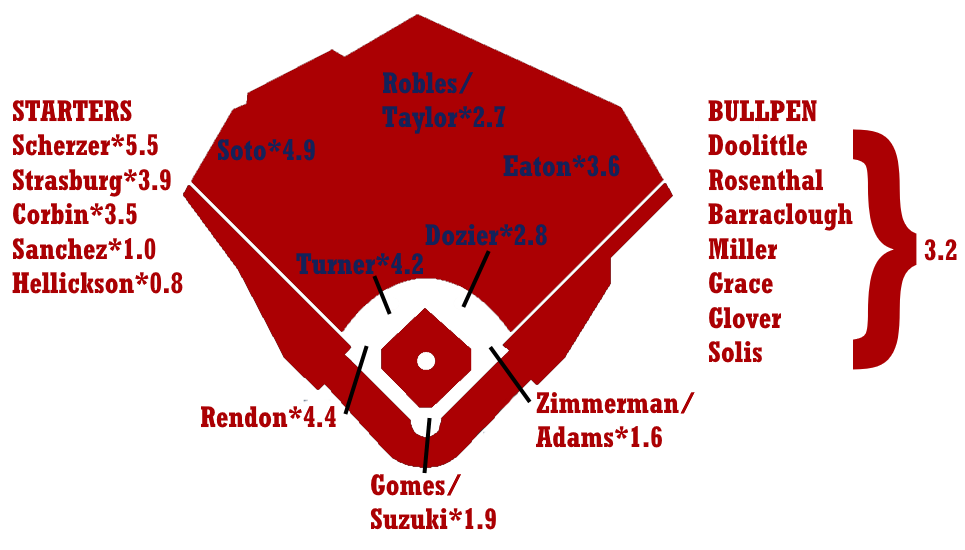
After having typically appeared in the hallowed pages of Baseball Think Factory, Dan Szymborski’s ZiPS projections have now been released at FanGraphs for more than half a decade. The exercise continues this offseason. Below are the projections for the Washington Nationals.
When I saw the Washington Nationals towards the end of the randomly generated ZiPS order back around Thanksgiving, I thought to myself, “There’s no way that Bryce Harper appears in those projections unless he re-signs.” But here we are! Even more surprising is the degree to which ZiPS has fallen in love with Juan Soto, leaving Bryce Harper as merely the second-ranked player on the Nationals’ list. Young players don’t get the Ken Griffey Jr. offensive comp very often. In fact, I think Soto is the first player to get Jr. as his top comp at this early an age. Comps to Griffey in his thirties tend to be more common (Edwin Encarnacion got him as his No. 3 comp).
What you have here is a lineup in which the cream is very…uh…creamy. Soto’s projections rank him the No. 1 left fielder in baseball among the teams whose projections have gone live and I don’t think I’m giving any spoilers away by saying that neither Kyle Schwarber or Brett Gardner will have better projections. Anthony Rendon won’t drop below fifth among third baseman and there’s nobody left to push Trea Turner below the bronze at shortstop. That give the Nationals three players with a mean projection that makes them legitimate stars. The supporting cast is pretty good, too: Eaton’s at the back of the top 10 if he can stay healthy, ZiPS projects a decent bounce back campaign from Brian Dozier, and catcher and first base don’t drag the team down. Victor Robles isn’t projected to make as big a splash as Juan Soto, but is still soothsayed as an above average center fielder as a rookie.
Pitchers
The pitching bears a resemblance with the lineup in that the highs here are very high. You could do a lot worse than your top three starters having Greg Maddux–Bret Saberhagen–Andy Pettitte as a set of comps. And as weird as it sounds, ZiPS may even be slightly underrating Patrick Corbin; if I used a beta version of ZiPS that is probably a year away from going live, Corbin’s 3.63 ERA would drop to 3.42 and he’d go from the 16th pitcher ranked so far to the 12th. The difference is the full implementation of plate discipline data, which shows Corbin was the second-hardest starting pitcher (min. 100 innings) to make contact against in 2018. It’s easy to cruise on your team’s defense or a lucky BABIP; it’s much harder to cruise by fooling batters, and Corbin doesn’t use a novel trick that might cause him to have a short shelf life.
After the top three starters, ZiPS is unimpressed with Anibal Sanchez and Jeremy Hellickson. ZiPS would actually slightly prefer that the Nats use Erick Fedde and Joe Ross in those slots, but none of them are all that exciting. Ross was at one point, and he’s young enough to still recover, but his career was waylaid considerably by injury.
The bullpen is pretty much the same story. After Sean Doolittle (who has the 7th best projected ERA+ in baseball so far, though Yankees ‘pen is still to come) and Trevor Rosenthal, there’s a whole lot of meh going on. The only relief pitcher who really makes the computer feel a little flush is Austin Adams (there are two Austin Adami), a reliever with the classic mid 90s-fastball/slider combo and another classic trait of many hard-throwing minor league relievers: frequent control issues. Last year, Adams made real progress with his control, getting his walk rate under four in Triple-A while striking out 15 batters per nine innings, though Washington showed little interest in seeing what Adams can do. Washington never really seemed to have much faith in Felipe Vazquez or Blake Treinen either. One would think they’d have learned their lessons about not being more curious about hard-throwing strikeout machine relievers with command issues.
Bench and Prospects
ZiPS has the Nationals with the most WAR in the NL East, but does not similarly project them to be the first-place team. Simply put, ZiPS is unimpressed with team’s depth overall. This is due both to the reserves and the back of the bullpen, but also a minor league system that is likely to provide little in the way of additional reinforcements. Now, Robles is still technically a prospect, but he’s already considered here as a starter, not a reinforcement, and of the center field time split in the depth chart WARtoon, it’s Robles who makes up the bulk of the value rather than Michael Taylor.
The one exception is Carter Kieboom, a player who ZiPS thinks could backstop an injured infielder quite adequately, and certainly be an upgrade from Wilmer Difo, who would be the likely replacement if injury strikes a Turner or a Rendon (something which has happened before). Long-term, ZiPS projects a lot of power upside from Kieboom, thinking he’ll get into the twenties in home runs a year fairly easily, with peak WARs that suggest multiple All-Star appearances.
After that, there’s very little in short-term value. The next-best position player in the minors for the Nats, at least in terms of how ZiPS views 2019, is catcher Tres Barrera, projected to hit .228/.287/.355 for a 0.3 WAR in just under 300 plate appearances (which will almost certainly all be in the majors in 2019). And really, if a catcher was injured, whichever of Kurt Suzuki and Yan Gomes is healthy is likely to simply take over most of the additional playing time.
One pedantic note for 2019: for the WAR graphic, I’m using FanGraphs’ depth chart playing time, not the playing time ZiPS spits out, so there will be occasional differences in WAR totals.
Disclaimer: ZiPS projections are computer-based projections of performance. Performances have not been allocated to predicted playing time in the majors — many of the players listed above are unlikely to play in the majors at all in 2019. ZiPS is projecting equivalent production — a .240 ZiPS projection may end up being .280 in AAA or .300 in AA, for example. Whether or not a player will play is one of many non-statistical factors one has to take into account when predicting the future.
Players are listed with their most recent teams, unless I have made a mistake. This is very possible, as a lot of minor-league signings go generally unreported in the offseason.
ZiPS’ projections are based on the American League having a 4.29 ERA and the National League having a 4.15 ERA.
Players who are expected to be out due to injury are still projected. More information is always better than less information, and a computer isn’t the tool that should project the injury status of, for example, a pitcher who has had Tommy John surgery.
Both hitters and pitchers are ranked by projected zWAR — which is to say, WAR values as calculated by me, Dan Szymborski, whose surname is spelled with a z. WAR values might differ slightly from those which appear in full release of ZiPS. Finally, I will advise anyone against — and might karate chop anyone guilty of — merely adding up WAR totals on a depth chart to produce projected team WAR.
We’ve officially entered extension season. This happens every year around the start of spring training, with arbitration hearings ending and with opening day coming up. Some expect that this particular extension season will be unusually busy, given the concerns players have about the state of the free-agent market. Aaron Nola just signed an extension with the Phillies. Jorge Polanco just signed an extension with the Twins. And Max Kepler has also just signed an extension with the Twins. Nothing against Polanco, but I find the Kepler move more interesting.
Kepler was already looking at a 2019 salary of $3.125 million, in the first of four arbitration years. He’d qualified as a Super Two. That’s wiped out now, with Kepler and the Twins agreeing to a five-year contract worth $35 million. There’s also a sixth-year club option, worth $10 million. Kepler, therefore, has signed away up to two years of would-be free agency. From Kepler’s own standpoint, he’s now guaranteed his own long-term wealth, as a German kid made good. He wouldn’t have agreed to this if he weren’t happy to do so. At the same time, you wonder what could’ve been. Where is Kepler going to be, as a player, a year from now?
After having typically appeared in the hallowed pages of Baseball Think Factory, Dan Szymborski’s ZiPS projections have now been released at FanGraphs for more than half a decade. The exercise continues this offseason. Below are the projections for the Colorado Rockies.
Amusingly, Colorado’s lack of ambition this offseason may be counteracting their inability to evaluate their offensive talent. The team signed Daniel Murphy to a contract that is eminently reasonable for a player who is projected to be something like a league-average first baseman over the next two years, but has made no other significant moves. The 1.7 WAR projection for Murphy is only over 118 games, reflecting that there is some risk given that injuries limited him to just 91 games in 2018; he’ll turn 34 in April. Murphy obviously isn’t Paul Goldschmidt, but after the allowing the position to act as an Ian Desmond vanity project, leading to a -0.7 WAR and an 81 wRC+ from their starting first baseman, the Rockies should enjoy a larger improvement than most teams would have from signing him.
Speaking of one of the remaining black holes on offense, it appears that Desmond will primarily play center field in 2019, with Charlie Blackmon shifting to left. With the assumption that one is unaware of what a sunk cost is, ZiPS thinks center field is the least-bad place to play Desmond; he wasn’t really a good center fielder in his year in Texas, but he also didn’t see a relative improvement in his defensive numbers when he moved to the easy end of the defensive spectrum. Without bringing dreams of Bryce Harper, who would be an amazing fit at Coors, to fruition, I’d likely go with an outfield of Blackmon, Raimel Tapia, and David Dahl, with Mike Tauchman and Yonathan Daza as the reserves. Or perhaps Colorado could go after Adam Jones. Read the rest of this entry »
When publishing our lists — in particular, the top 100 — we’re frequently asked who, among the players excluded from this year’s version, might have the best chance of appearing on next year’s version. Whose stock are we buying? This post represents our best attempt to answer all of those questions at once.
This is the second year that we’re doing this, and we have some new rules. First, none of the players you see below will have ever been a 50 FV or better in any of our write-ups or rankings. So while we think Austin Hays might have a bounce back year and be a 50 FV again, we’re not allowed to include him here; you already know about him. We also forbid ourselves from using players who were on last year’s inaugural list. (We were right about 18 of the 63 players last year, a 29% hit rate, though we have no idea if that’s good or not, as it was our first time engaging in the exercise.) At the end of the piece, we have a list of potential high-leverage relievers who might debut this year. They’re unlikely to ever be a 50 FV or better because of their role, but they often have a sizable impact on competitive clubs, and readers seemed to like that we had that category last year.
We’ve separated this year’s players into groups or “types” to make it a little more digestible, and to give you some idea of the demographics we think pop-up guys come from, which could help you identify some of your own with THE BOARD. For players who we’ve already covered this offseason, we included a link to the team lists, where you can find a full scouting report. We touch briefly on the rest of the names in this post. Here are our picks to click:
Teenage Pitchers
Torres was young for his draft class, is a plus athlete, throws really hard, and had surprisingly sharp slider command all last summer. White looked excellent in the fall when the Rangers finally allowed their high school draftees to throw. He sat 92-94, and his changeup and breaking ball were both above-average. Pardinho and Woods Richardson are the two advanced guys in this group. Thomas is the most raw but, for a someone who hasn’t been pitching for very long, he’s already come a long way very quickly.
The “This is What They Look Like” Group
If you like big, well-made athletes, this list is for you. Rodriguez was physically mature compared to his DSL peers and also seems like a mature person. The Mariners have indicated they’re going to send him right to Low-A this year. He could be a middle-of-the-order, corner outfield power bat. Luciano was the Giants’ big 2018 July 2 signee. He already has huge raw power and looks better at short than he did as an amateur. Canario has elite bat speed. Adams was signed away from college football but is more instinctive than most two-sport athletes. Most of the stuff he needs to work on is related to getting to his power.
Advanced Young Bats with Defensive Value
This is the group that produces the likes of Vidal Brujan and Luis Urias. Edwards is a high-effort gamer with 70 speed and feel for line drive contact. Marcano isn’t as stocky and strong as X, but he too has innate feel for contact, and could be a plus middle infield defender. Perez has great all-fields contact ability and might be on an Andres Gimenez-style fast track, where he reaches Double-A at age 19 or 20. Ruiz is the worst defender on this list, but he has all-fields raw power and feel for contact. He draws Alfonso Soriano comps. Palacios is the only college prospect listed here. He had three times as many walks as strikeouts at Towson last year. Rosario controls the zone well, is fast, and is a plus defender in center field.
Corner Power Bats
Nevin will probably end up as a contact-over-power first baseman, but he might also end up with a 70 bat. He looked great against Fall League pitching despite having played very little as a pro due to injury. Lavigne had a lot of pre-draft helium and kept hitting after he signed. He has all-fields power. Apostel saw reps at first during instructs but has a good shot to stay at third. He has excellent timing and explosive hands.
College-aged Pitchers
It’s hard to imagine any of these guys rocketing into the top 50 overall. Rather, we would anticipate that they end up in the 60-100 range on next year’s list. Gilbert was a workhorse at Stetson and his velo may spike with reshaped usage. Singer should move quickly because of how advanced his command is. Lynch’s pre-draft velocity bump held throughout the summer, and he has command of several solid secondaries. Abreu spent several years in rookie ball and then had a breakout 2018, forcing Houston to 40-man him to protect him from the Rule 5. He’ll tie Dustin May for the second-highest breaking ball spin rate on THE BOARD when the Houston list goes up. We’re intrigued by what Dodgers player dev will do with an athlete like Gray. Phillips throws a ton of strikes and has a good four-pitch mix.
Bounce Back Candidates
The Dodgers have a strong track record of taking severely injured college arms who return with better stuff after a long period of inactivity. That could be Grove, their 2018 second rounder, who missed most of his sophomore and junior seasons at West Virginia. McCarthy was also hurt during his junior season and it may have obscured his true abilities. Burger is coming back from multiple Achilles ruptures, but was a strong college performer with power before his tire blew.
Catchers
We’re very excited about the current crop of minor league catchers. Naylor is athletic enough that he’s likely to improve as a defender and he has rare power for the position.
Potentially Dominant Relievers
These names lean “multi-inning” rather than “closer.” Gonsolin was a two-way player in college who has been the beneficiary of sound pitch design. He started last year but was up to 100 mph out of the bullpen the year before. He now throws a four seamer rather than a sinker and he developed a nasty splitter in 2017. He also has two good breaking balls. He has starter stuff but may break in as a reliever this year.
No matter what you think about the current market dynamics, one thing is becoming increasingly clear: Free agency is leaving more and more players at best annoyed, and at worst pissed off. Many free agents are signed, of course, and some of them are signed to big, healthy contracts, but other premium players are still without employers, and the messaging has hardly been subtle. Players and the union aren’t pleased. Even if the team side of the equation isn’t doing anything wrong, the state of things is far from harmonious. A greater number of players are talking about what they see as a problem.
Imagine yourself, then, as a player who’s not yet a free agent. You might be inclined to believe you’re exceptional. Maybe you figure things’ll be worked out by the time it’s your turn. But you keep hearing about how free agency isn’t what it used to be. Even if most of the money is still there, nothing happens fast. There’s a lot of uncertainty. The idea of reaching free agency has been somewhat devalued. At least in theory, you’d figure this could lead to an increase in the number of long-term contract extensions.
It’s too early to know if there’s a trend. And no player is going to come out and say “I signed this extension because free agency is bad now.” But Aaron Nola has become the latest player to give up a free-agent year or two. Not for free, obviously. He’s going to get paid. It’s a question of whether he’ll get paid enough. It’s getting harder to calculate what “enough” even is.
Just under two weeks ago, when I was writing a piece connecting the unsigned players from among our Top 50 Free Agents list to teams that appeared to have needs, Wade Miley came off the board by signing a one-year deal with the Astros. A similar thing happened in writing that piece’s sequel, covering a handful of the best of the unranked and unsigned free agents, as Brett Anderson pre-empted the publication by re-signing with the A’s on a one-year deal. He’ll cost a pittance, as he’s guaranteed a modest $1.5 million, with another $1 million possible in undisclosed incentives.
Though it feels like he’s been around forever, Anderson just turned 31 on February 1. That said, the 2006 second-round pick by the Diamondbacks (out of high school in Stillwater, Oklahoma) has already spent parts of 10 seasons in the majors. I should emphasize the word parts there because, well, we’ve rarely seen a whole season from him. As a rookie with the A’s in 2009 — a season in which he entered ranked seventh on Baseball America’s Top 100 Prospects list — he made 30 starts and threw 175.1 innings en route to 3.5 WAR. But only once since then has he started 30 times in a major league season. Hell, only once since then has he even reached 20 starts in the bigs: in 2015, he completed a solid 31-start, 180.1-inning campaign for the Dodgers (3.69 ERA, 3.94 FIP, 1.6 WAR). Read the rest of this entry »
Rocco Baldelli knows Charlie Montoyo well. Not only did they spend the last four seasons together on Tampa Bay’s coaching staff, but Baldelli once played for the 53-year-old Montoyo in the minors. Minnesota’s new manager counts Toronto’s new manager as both a mentor and a friend.
Not surprisingly, Baldelli was effusive in his praise when I asked him about Montoyo. Citing his experience and leadership skills, he opined that the Blue Jays are getting “a tremendous manager and a great person.” Fittingly, Montoyo was hired on October 25, the same day his 37-year-old protege was tabbed by the Twins.
Baldelli wasn’t caught by surprise when he heard the news from north of the border. He knew that Montoyo had interviewed with the Cincinnati Reds, and that he would soon be doing the same with Toronto. The second of those sit-downs obviously went well. Mere days after meeting with him, the Blue Jays announced Montoyo’s hiring.
All told, five candidates went through the interview process in Toronto. Baldelli didn’t want to go on the record as to whether he was one of them, but he did allow that his post-season vacation plans were put on hold for a period of weeks. Multiple teams met with him about their openings. That was to be expected. The “future-manager” tag was assigned to him by myriad members of the media over the course of the 2018 season. Read the rest of this entry »
After having typically appeared in the hallowed pages of Baseball Think Factory, Dan Szymborski’s ZiPS projections have now been released at FanGraphs for more than half a decade. The exercise continues this offseason. Below are the projections for the Tampa Bay Rays.
The Rays are similar to the St. Louis Cardinals in that they’re almost always one of the highest-floor teams in baseball. Since the team’s breakout season in 2008, which saw them reach the World Series, they’ve only really had one season that you could reasonably call lousy, the 68-94 campaign in 2016. Otherwise, Tampa’s been middling at worst, with a stretch of high-70s/low-80s wins that in large part reflects some draft struggles.
Since 2009, the Rays have only really hit on two players in the draft: Kevin Kiermaier and Blake Snell. Now, the jury is still out on some of these drafts, especially the more recent ones, but it’s hard for a team with Tampa Bay’s revenue model — and given some of the surrounding issues, they’re one of the few teams that really does seem to struggle financially — to compete consistently without drafts paying off. Read the rest of this entry »



 iTunes Feed (Please rate and review us!)
 Sponsor Us on Patreon
 Facebook Group
 Effectively Wild Wiki
 Twitter Account
 Get Our Merch!
 Email Us: podcast@fangraphs.com