Twins Get Best Reliever Traded At Deadline

Minnesota’s playoff position has been fairly secure for some time, but Cleveland has edged closer in the standings for the division. While Cleveland didn’t necessarily make themselves better at the deadline, they did fix a couple monstrous holes in their lineup as they hope to get a lift from ace pitchers returning from injury. The Twins have responded with a move to shore up one of their weaknesses in the bullpen. While Sam Dyson might not have been the biggest name on the market, he ended up the best reliever traded this deadline, as Kirby Yates, Felipe Vázquez, and Ken Giles all stayed put. The deal was first reported by Tommy Birch and then confirmed by Dan Hayes. According to Birch, this is the deal:

Twins Receive:

  • Sam Dyson

Giants Receive:

For the Twins, Sam Dyson presents an immediate upgrade and appealing option in high-leverage situations. The right-hander, who is still arbitration eligible next season, is a groundball specialist with just seven walks on the year. His 2.74 FIP and 2.47 ERA speak to how well he’s performed this season, and his 1.1 WAR ranks 19th among 165 qualified relievers. Dyson relies on a low-to-mid-90s sinker and a low-90s cutter that runs in on lefties and away on righties. Those two represent around 70% of Dyson’s pitches, with a four-seamer, change, and slider mixed in the rest of the time.

Dyson was a very good reliever for the Rangers in 2015 and 2016, but a rough start to 2017 saw the Rangers give up on him. The Giants reaped the benefits of letting Dyson work things out in 2017, and he has provided solid performances the past two seasons. With the Twins, Dyson should slide right behind Taylor Rogers as the second-best reliever on the team. For a bullpen looking for some stability, Dyson should provide exactly that.

As for the players sent to San Francisco, we’ve got three players with some pretty high variability when it comes to reaching their potential. Berroa and Teng are both listed as 40 FV on THE BOARD. Prelander Berroa is only 19 years old, has posted some high strikeout rates in the Appalachian League, and was likened to Fernando Rodney in the prospect report this spring. Kai-Wei Teng is only 20 years old and signed for $500,000 out of Taiwan. He’s made it to Low-A and has posted impressive numbers there. Longenhagen and McDaniel had this to say before the season:

His arm action is a little rough, and Teng’s lower slot makes it hard for him to get on top of his curveball consistently, but he’s very well balanced over his blocking leg and otherwise has a smooth delivery. At this age and size, it’s possible no more than the low-90s velo will come, but that might be enough if that curveball matures, because Teng’s changeup is also very good.

As for Jaylin Davis, he’s hit 25 homers this season between Double-A and Triple-A. He’s now 25 years old and there’s a lot of swing and miss to his game, but if he can access his power in-game, he might be able to contribute in the majors.

This deal looks like targeted quantity over quality, with the Giants looking to bring in players with upside they might not reach in hopes they hit on one of them. For the Twins, they got exactly what they needed — even if they didn’t land a starter — while only having to deal from the depth in their system.
Rays Add Catching Depth in Rocky Gale

There’s only one trade deadline this year, and with that, teams have felt increased pressure to make depth-related moves that would normally have occurred in August. The Rays did just that on Wednesday, acquiring catcher Rocky Gale from the Dodgers for cash, as The Athletic’s Robert Murray first reported.

Gale, 31, was outrighted off of the Dodgers’ 25-man roster on July 31. He appeared in five games for the major league club, totaling two hits in 15 at-bats. Gale has caught in four different seasons but has seen limited action in each, posting a .108/.108/.189 (-29 wRC+) slash line across 37 career plate appearances. In 109 PA at Triple-A Oklahoma City this season, he has slashed .250/.303/.370.

The Rays’ catching has been rather solid, especially with the mid-season addition of Travis d’Arnaud (1.7 WAR). Mike Zunino also sits on the 25-man roster, though he has been relegated to the backup job. Michael Perez and Mac James are also potential catching options for Tampa Bay, and Gale will likely slide in alongside them at Triple-A Durham.

If nothing else, today the Rays added a catcher (with a phenomenal name, I might add) to provide depth. While it’s not the most flashy move, it’s one that gives them more options behind the plate. With only one trade deadline this year, these types of acquisitions must be made now, and the Rays did just that.


Phillies Attempt to Fix Outfield Again, Acquire Corey Dickerson

The Phillies signed Andrew McCutchen in the offseason and he played very well before going down with a knee injury in early June. Right before the injury, the club traded for Jay Bruce in part due to Odubel Herrera being placed on leave under the league’s domestic violence policy. Since that time, Herrera has been suspended for the rest of the season while Bruce has landed on the injured list. Again seeking outfield help, the Phillies have now made a deal with the Pirates for Corey Dickerson. Jeff Passan was first with the news.

Phillies Receive:

  • Corey Dickerson

Pirates Receive:

  • ¯\_(ツ)_/¯

After putting up 2.6 WAR and a 115 wRC+ in 2017 for the Rays, the arbitration-eligible Dickerson was traded to the Pirates for Daniel Hudson and his contract. For the Pirates last season, Dickerson put up an identical 115 wRC+ and a 2.7 WAR. He dramatically lowered his strikeouts with the Pirates to make up for a loss of power and only 21 walks all year. A week into this season, Dickerson strained his shoulder and was replaced by rookie Bryan Reynolds, who has been very good for Pittsburgh, though a BABIP over .400 is doing a lot of the work. Dickerson, a free agent at the end of the season, has come back strong from the injury with a 133 wRC+ in 142 plate appearances. He’s kept the gains he made last season on the strikeout front, but he has been a much more patient hitter with a 9% walk rate in limited time. Dan Szymborski recently listed Dickerson as an under-the-radar move this deadline:

Corey Dickerson is unsigned for next season and it’s hard to see the Pirates being gung-ho about bringing him back on a larger, guaranteed contract. Dickerson’s healthy now and is putting up his typical wRC+ around 120. Given that he can actually field his position, I personally think he’s far more interesting a pickup than Nicholas Castellanos would be. The Pirates aren’t technically out of the playoff picture, but as they now have the second-worst record in the National League, the camera can’t see them standing behind the large adult sons.

Dickerson is likely to replace Adam Haseley, who has played fairly well in limited time but doesn’t have the proven bat Dickerson provides. The team went a couple weeks without a Bruce-type hitter, and now they have another one in Dickerson. This is mostly a depth move, but Dickerson provides the Phillies with another solid bat in their lineup and could put Scott Kingery more often in the infield, as Jim Salisbury notes: Read the rest of this entry »


Nationals Add Relief Help in Daniel Hudson

It’s hardly a National secret that Washington is in need of bullpen help. Even as the team has put themselves back into playoff position over the the last month or so, the bullpen has a 4.67 FIP and a 5.06 ERA in July. To help in the late innings, the Nationals have acquired Daniel Hudson of the Toronto Blue Jays, as first reported by Scott Mitchell. The return was first reported by Ken Rosenthal and the trade looks like this:
Nationals Receive:

  • RHP Daniel Hudson

Blue Jays Receive:

After a couple solid years in the Diamondbacks pen in 2015 and 2016, Hudson was near replacement-level for the Pirates in 2017 and then worse than that for the Dodgers a year ago. After signing a minor league contract with the Angels in the offseason, he was released near the end of spring training before the Blue Jays guaranteed him $1.5 million. With Toronto, the 32-year-old righty has been solid, putting up a better-than-average 4.21 FIP along with a very-good 3.00 ERA. His strikeout rate is pretty even from a year ago at 23%, with his walk rate up to 11% this season, but he’s only allowed five homers in 48 innings.

He throws a mid-90s four-seamer around 60% of the time and used his sinker about 10% this season, which might help explain some of his homer-suppressing tendencies. As a result, he’s throwing his slider only a quarter of the time, down from more than 40% last year with the Dodgers. This might not be an impact move for the Nationals, but they needed help and Hudson should be an improvement over what they have in-house. Lefty Roenis Elías from the Mariners should help as well.

As for Johnston, he’s a righty who didn’t make the Nationals prospect list before the season. He was a sixth-round pick in 2017 by Washington and his control problems in college carried over to the pros with double-digit walk rates in his first two minor league seasons. He is repeating High-A this year and just turned 23, but he has turned in a solid season. He’s got a 23% strikeout rate and his walk rate is down to 9% on the season in 20 starts. Over 20% of his fly balls have been infield flies, and his swinging strike rate is very good at 15%. As for a scouring report, Eric Longenhagen adds the following:

Johnston sits 89-94, and touches 97, and he can manipulate the fastball to sink or sometimes cut. He also has an above-average slider in the mid-80s, typically 82-85 but sometimes harder. While he also has a splitter, Johnston doesn’t use it often. He’s a potential reliever.

Johnston still has a ways to go, but there’s enough there to think he has a shot as a bullpen arm in the future. That seems about right for two months of Daniel Hudson.


Rangers Acquire International Slot Money (and Nate Jones)

There are always a few deadline trades made for clerical reasons rather than with a pennant race in mind. This is one of them:

Rangers get:
RHP Nate Jones
$1 million in international bonus space
Cash

White Sox get:
RHP Joseph Jarneski
RHP Ray Castro

The oft-injured Jones, who has a 2020 team option and a mutual option for 2021, will be on the shelf for the rest of 2019 due to forearm surgery performed in late May. It’s possible that a surprisingly competitive Rangers club will keep Jones around in the hopes that his stuff returns from yet another injury. More likely, Texas’ 40-man situation will lead them to decline his option. Read the rest of this entry »


Martín Maldonado Goes Back to Houston

For the second time this month, catcher Martín Maldonado has been traded, and for the second time in just over a year, he’ll join the Astros. The well-traveled backstop, who began this season filling in for the injured Salvador Perez as the Royals’ starter, played just four games with the Cubs after being acquired on July 15.

Astros get:

C Martín Maldonado

Cubs get:

IF/OF Tony Kemp

It’s fair to say that Maldonado, who turns 33 on August 16 and has also spent time with the Brewers (2011-16) and Angels (2017-18), is a consistent hitter — consistently subpar. He’s batting .217/.285/.349 in 276 plate appearances this year, with six homers and a 72 wRC+; that line bears an uncanny resemblance to his career one (.219/.288/.350, 72 WRC+). He actually went hitless (0-for-11 with two walks) in his brief Chicago stint, which began when the Cubs obtained him from the Royals on July 15, complementing their placement of Willson Contreras on the injured list due to a right arch strain. Contreras has since returned, and with young Victor Caratini serving as a useful backup, there wasn’t room for Maldonado. Read the rest of this entry »


Rays Get Much-Needed Right-Handed Bat in Struggling Jesús Aguilar

A year ago, Jesús Aguilar took the starting first base job in Milwaukee away from Eric Thames, hitting 35 homers and posting a 135 wRC+ as the Brewers rolled to a division title. This year, Aguilar’s struggles opened the job back up for Thames; Aguilar has been relegated to the weak side of a platoon. A strong month of July in part-time duty wasn’t enough to play him back into a starting role with the Brewers, but it was enough to get the Tampa Bay Rays interested and willing to part with a pitcher the Brewers can use for their own pennant drive. As first reported by Jeff Passan:

Brewers Receive

Rays Receive

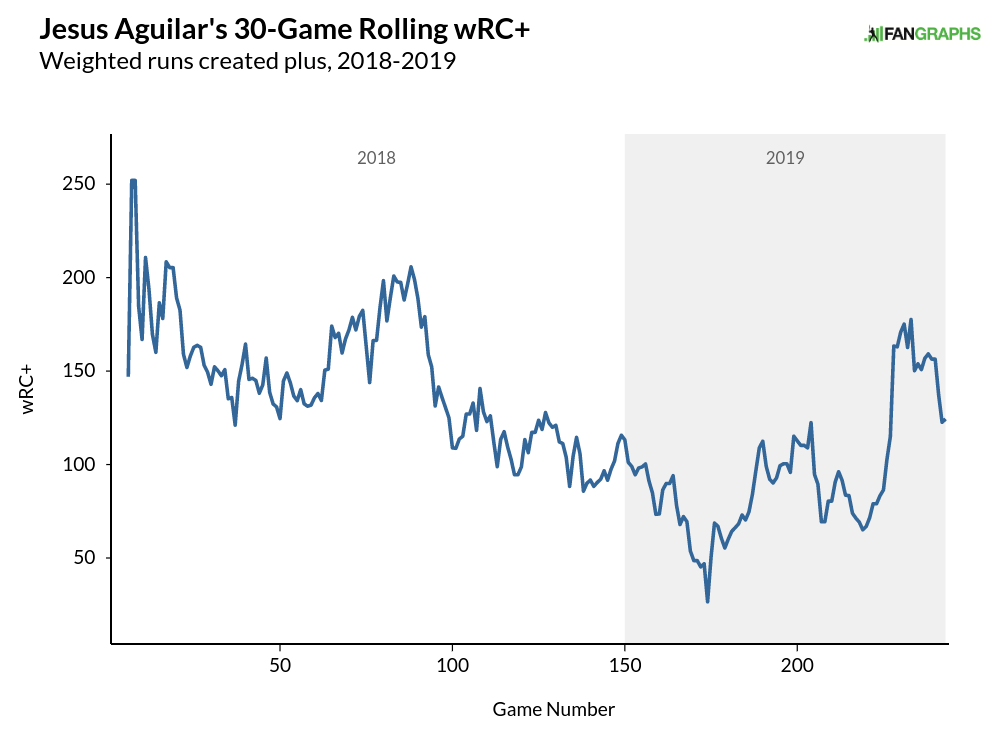
For the Rays, the need for a right-handed bat is obvious. The left-handed Austin Meadows and Nathaniel Lowe have been getting starts at first base and designated hitter against lefties, with Ji-Man Choi only playing against righties and catcher Travis D’Arnaud getting time at first as well. Aguilar and his righty bat should be able to relieve some of the poor matchups the Rays have found themselves in. Aguilar has bad splits against lefties this season, but that’s more likely a product of generally hitting poorly and some randomness than weird reverse platoon splits. And while his 2019 performance has been wanting, with an 82 wRC+, he’s shown some signs of putting things together over the last month, as the rolling wRC+ graph shows.

Read the rest of this entry »


Blake Parker Takes His Services to Philly’s Pen

Blake Parker, who signed with the Phillies as a free agent today for terms not yet disclosed, struck out 33.9% of the batters he faced as an Angel in 2017 and walked just 6.3%. That performance earned him two consecutive one-year, $1.8 million deals: one with the Angels, for 2018, and one with the Twins for this year. Parker wasn’t all that effective in Minnesota, though, posting a 5.35 FIP over 36.1 innings pitched, and he lost Rocco Baldelli’s confidence in July, earning just six appearances after getting 12 in June. Now he’s a Phillie, after the Twins designated him for assignment on July 24 and he cleared waivers three days later.

The problem in 2019 appears on the surface to be velocity, especially on the fastball. That pitch was averaging 93.9 mph just two years ago, then dropped down to 92.8 last year and 92 so far this year. Parker can succeed without a fastball at 94 — he posted a 2.90 FIP over 46 innings with the Cubs in 2013 while it sat at 92.8 — but he threw his curveball nearly a third of the time back then, and that pitch has never been particularly effective. In late 2018, he added a cut fastball that he now throws about 7% of the time, almost entirely at the expense of his four-seamer, but the overall package just hasn’t come together. His strikeout rate and swinging strike rate are both down even as contact against him is up:

Three Years of Decline for Parker
K% BB% Contact% SwStr% Hard%
2017 33.9% 6.3% 70.9% 13.8% 33.8%
2018 25.4% 6.9% 76.6% 10.7% 37.5%
2019 21.7% 10.2% 75.6% 10.6% 47.6%

Read the rest of this entry »


Eric Sogard Takes Nerd Power to Tampa

The Rays and Jays pulled off a minor trade on Sunday, sending utilityman Eric Sogard to Tampa Bay for a player or players to be named later, or a player or players to be named soon.

Sogard is a good example of a player who wrings the most out of limited physical tools. You won’t often see him crushing deep homers with drool-worthy exit velocities. Like David Fletcher of the Angels, Sogard’s game is a bit of a throwback to a more contact-oriented game. Of active players with at least 500 plate appearances, Sogard has been the second-best at making contact with pitches in the strike zone, behind only Michael Brantley.

Contact Rate for Active Players (min. 500 PA)
Rank Name Zone Contact Out-of-Zone Contact
1 Michael Brantley 96.1% 80.8%
2 Eric Sogard 95.8% 79.8%
3 David Fletcher 95.6% 84.8%
4 Martin Prado 95.1% 79.4%
5 Jose Peraza 94.6% 74.2%
6 Daniel Murphy 94.4% 78.8%
7 Joe Panik 94.3% 79.0%
8 Jose Iglesias 94.0% 79.9%
9 Ian Kinsler 93.6% 73.8%
10 Melky Cabrera 93.6% 78.8%
11 Mookie Betts 93.5% 72.4%
12 Brock Holt 93.3% 74.1%
13 Robinson Cano 93.3% 72.8%
14 Dustin Pedroia 93.1% 82.4%
15 Jose Altuve 93.0% 78.1%
16 DJ LeMahieu 92.9% 75.0%
17 Andrelton Simmons 92.7% 77.3%
18 Jacoby Ellsbury 92.7% 73.8%
19 Ender Inciarte 92.6% 80.1%
20 Elvis Andrus 92.5% 71.6%
21 Miguel Rojas 92.5% 73.9%
22 A.J. Pollock 92.5% 65.0%
23 Jorge Polanco 92.3% 72.6%
24 Donovan Solano 92.3% 68.8%
25 Kurt Suzuki 92.2% 74.5%

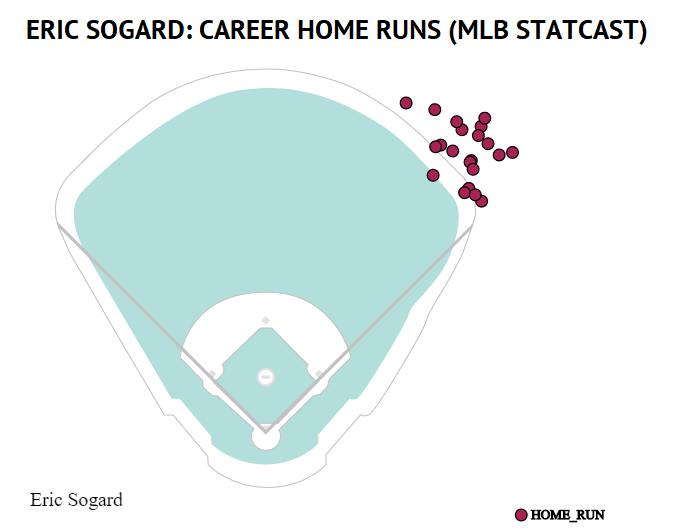
Sogard’s .300/.363/.477 triple-slash line (and 123 wRC+) this season is surprising, though not nearly as surprising as the 10 homers he’s hit. While 10 homers doesn’t exactly put Sogard into Pete Alonso territory, it’s an impressive total through the end of July for a 33-year-old who entered the season with just 11 career round-trippers. He may be an example of a player who is getting the most out of MLB’s different-but-not-different-swears-Rob-Manfred baseball; Statcast’s xSLG number gives Sogard just a .346 slugging percentage. The culprit is that Sogard still isn’t hitting the ball hard, with an 84.4 mph exit velocity and only three barrels. Despite that, more of his balls than usual have snuck over the right field fence.

After knee surgery cost Sogard his 2016 season, he was forced to settle for a minor-league contract and the chance to compete for a bench spot with the Brewers in 2017. Sogard posted pleasantly surprising production while filling in for Jonathan Villar when the latter was dealing with back pain in June of that year; his .273/.393/.378 line was enough to get him a major league contract with the Brewers in 2018, but he played poorly and was released by Milwaukee in July.

Neither Steamer or ZiPS were excited about Sogard coming into 2019, projecting a wRC+ of 79 and 69 respectively. The rest of baseball wasn’t much more excited; Sogard signed a minor-league contract with the Blue Jays in December. The projection systems now see him as a .250-.260 hitter with an OBP around .330 and a high .300s slugging percentage, which is a promising enough line for him to have value for a contender looking for depth. Sogard is an excellent fit for the Rays; they don’t need him to play much shortstop, a position where Sogard is stretched, but with many of the team’s second and third base options currently injured (Brandon Lowe, Yandy Diaz, Daniel Robertson, Christian Arroyo), Tampa will find a lot of use for him in coming weeks. I might be inclined to promote Kean Wong from Triple-A Durham, but this is a short-term addition, and the Rays have good reason to pick the safer option in a pennant race.

The cost for adding Sogard is likely to be a minimal one. While there have been conflicting rumor-inations about the players in return, it strikes me that no matter who’s ultimately identified, it’s likely that we’re talking low-level organizational players. If there were prospects of significance involved, I suspect the Rays would have considered promoting Wong more seriously.

Sogard’s acquisition is a low-key signing, but he’ll provide value to the Rays for the next two months, and the trade seems likely to be reasonable for both sides. While I reserve the right to change my opinion if the Rays give up Wander Franco or Brendan McKay, they’re not going to give up Wander Franco or Brendan McKay.


Job Posting: Minnesota Twins Baseball Systems Data Quality Engineer

Position: Data Quality Engineer, Baseball Systems

Location: Minneapolis, MN

Description:
The Minnesota Twins are seeking a Data Quality Engineer to join the Baseball Research and Development group. This position offers wide-ranging exposure to current programming methods and frameworks in a fast-paced agile environment. With creativity and passion, this candidate will collaborate with the Baseball Operations staff to ensure good data hygiene across a growing set of disparate data sources. This position requires an intuitive and exacting passion for data detective work. By identifying patterns that affect data quality and by working directly with data scientists, the candidate will help to develop, deliver, and maintain tools to enhance model and decision accuracy. This position requires independent curiosity and a commitment to achieving excellence within a team framework. Strong communication and interpersonal skills will enable the candidate to enjoy engaging relationships with product users.

Essential Duties and Responsibilities:

  • Build data quality assurance tools and procedures to identify and correct data inaccuracies.
  • Design, maintain, and support data warehouses for reporting and analysis.
  • Develop, optimize, and automate data workflows and pipelines ensuring data integrity and quality from external data integrations.
  • Support the individuals of the Baseball Operations team by providing assistance and education on best practices when querying the data warehouse.
  • Work with data scientists to ensure models and analyses follow best practice for accessing the data and are properly integrated into scheduled data processing workflows.
  • Explore emerging technologies and recommend new tools and techniques for collecting and processing data.
  • Develop visualization tools and reports that showcase research findings in creative, effective ways for a variety of different end users and use cases.
  • Use an agile software development approach for quick roll-outs combined with incremental improvement process to existing systems and environments.
  • Provide courteous and timely first-level contact and problem resolution for all Baseball Department users.

Qualifications, Skills, and Abilities:

  • Bachelor’s Degree in Computer Science, Data Engineering, or a related field or equivalent work experience.
  • Software development experience, including requirements definition, design, development, testing, implementation, and iterative improvement.
  • Expertise with SQL, relational databases, database design, and data cleaning techniques.
  • Ability to process and transform data from a variety of sources and formats.
  • Experience with C#, Java, Python, R or other similar language that interacts with data.
  • Knowledge of data visualization packages such as Plotly or ggplot is a plus.
  • Proficiency evaluating and improving the performance of SQL queries.
  • Understand software development best practices and long-term maintainability of code.
  • 2+ years of relevant work experience.
  • Strong work ethic, curiosity, initiative, and problem-solving skills.
  • Open mindedness to learn new technologies and embrace different ways of thinking.
  • Passion for baseball is preferred; passion for problem solving is required.

Physical Requirements:

  • Ability to lift and transport items up to 55 lbs.
  • Must be able to sit for extended periods of time.
  • Must be able to move throughout all areas and levels of the ballpark.
  • Ability to relocate to the Twins Cities area.

To Apply:
External applicants should apply using the application found here.

The content in this posting was created and provided solely by the Minnesota Twins.