
2020 ZiPS Projections: Cincinnati Reds
January 14, 2020
After having typically appeared in the hallowed pages of Baseball Think Factory, Dan Szymborski’s ZiPS projections have now been released at FanGraphs for eight years. The exercise continues this offseason. Below are the projections for the Cincinnati Reds.
ZiPS Projections
Batters
Cincinnati’s 2020 offense will likely prove to be an interesting challenge for second-year manager David Bell. There’s the potential for a good offense here, but there’s an equal number of scenarios in which the team simply fails to score runs. Outside of Eugenio Suárez, the incumbent third baseman who I’m still amazed was purloined for Alfredo Simon, practically every player in the lineup has a real upside but also, significant questions about a major aspect of their game.
Does Joey Votto have another comeback season left in him? Votto has had downswings before, but the swoons were never anywhere near as deep his .261/.357/.411 line in 2019. 2020 will also be his age-36 season, which isn’t exactly a point in a career where you see many players come roaring back after a collapse. ZiPS does forecast a moderate 2020 recovery, but Votto the Star may be permanently in the rear-view mirror.
The outfield is a particularly devious puzzle to solve as rather than having two or three outfielders who are head-and-shoulders above the rest, the team has a large collection of average-ish players with wildly varying skillsets. They’re a bit like a giant vat of Legos in which the Star Wars set, the Raiders of the Lost Ark set, and the Requiem for a Dream set have all been tossed together, with some scattered Erector parts thrown in; you’re just trying to build a nice little house but keep finding lightsabers and fedoras. Read the rest of this entry »
Pitch Design: Tyler Glasnow Can Be More Elite in 2020
January 14, 2020
The 2020 Tampa Bay Rays arguably have one of the best front-end starting rotations in the American League, with Charlie Morton, Blake Snell, and Tyler Glasnow as the headliners. Last season, Glasnow flashed moments of brilliance prior to and following a mid-season injury that halted his torrid start in early May and kept him out of the rotation until September. Glasnow already has the ability to be the ace of the Rays staff — in his 60.2 innings, the right-hander was worth 2.3 WAR and posted a 1.78 ERA and 2.26 FIP — but a couple of minor adjustments could vault him into 2020 Cy Young Award discussions.
Glasnow, who avoided salary arbitration last Friday by agreeing to a one-year, $2.05 million deal, operates with three pitches: a straight, backspinning four-seam fastball that has some carry and can sometimes have cutting action; a 12-6 diving curveball; and a hard changeup that exceeds 90 mph.
Let’s start by looking at Glasnow’s four-seamer, one of the straightest in baseball with a good amount of rise:
Rob Manfred Hammers the Astros
Consider the book thrown at the Astros. On Monday, commissioner Rob Manfred announced the results of MLB’s investigation into allegations pertaining to the Astros’ electronic sign-stealing efforts in 2017, the year they won the World Series, and handed down a set of sanctions that together form the most severe punishment administered to a single team since Judge Landis banned eight White Sox players for life in 1921. In this instance, no players were banned or even suspended; instead, Manfred took aim at the Astros’ braintrust, suspending both president of baseball operations Jeff Luhnow and manager AJ Hinch for the 2020 season but deferring punishment for bench coach Alex Cora, the most directly involved non-player, pending the results of a similar investigation into the 2018 Red Sox’s actions. Additionally, the team was stripped of four high draft picks and fined $5 million, the maximum amount allowed under MLB’s constitution. Finally, former Astros assistant general manager Brandon Taubman was placed on baseball’s ineligible list.
In announcing his decision via a 10-page report (PDF here), Manfred confirmed and elaborated upon a November report by The Athletic’s Ken Rosenthal and Evan Drellich that the Astros systematically used their video replay system in an attempt to decode opposing teams’ signs and relay them to the team’s hitters via a trash can-based system of signals. The report was based on interviews with 68 individuals as part of this investigation plus an additional nine interviews related to Taubman’s inappropriate conduct towards female reporters during the team’s ALCS victory celebration.
As I wrote last week, MLB’s failure to anticipate the consequences introduced by the creation of video replay rooms in connection with the adoption of the instant replay review system in 2014 has echoes of the league falling behind in addressing the influx of performance-enhancing drugs in the 1990s. Both issues centered around highly competitive players crossing into gray areas while looking for that extra edge, but because of the key differences in the two issues — mainly the protection of the players’ union and the need for a collectively bargained system of testing and suspensions when it came to PED usage — commissioner Bud Selig never had the chance to bring the hammer down on PED users with the force that Manfred applied here. This is a hefty and impactful set of punishments that asserts the commissioner’s authority and is designed to deter other teams from similar behavior, but it won’t be the last set of them given the investigation into the Red Sox and the possibility of further inquiries. Various decisions within Manfred’s purview on this won’t please everyone, but since when has any commissioner managed to do so?
In the report, Manfred laid out a timeline for the Astros’ gradually more elaborate efforts to steal signs using electronic equipment, a practice broadly prohibited by MLB rules but not strictly enforced at the time, and one that arose with the introduction of reviewable replays. The Astros’ efforts “with the exception of Cora [were] player-driven and player-executed,” and began early in the 2017 season, with a simple system where employees in the team’s video replay room viewed live footage from the center field camera, then decoded and relayed the sign sequence to the dugout. From there it was signaled to a runner on second base, who would transmit the signal to the batter. Soon Cora began calling the replay review room to obtain the signals, and on some occasions the information was delivered via text messages on smart watches or cell phones. Read the rest of this entry »
David Peralta and Miguel Sanó Gain Security With Similar Extensions
by Jake Mailhot

January 13, 2020
There was an unusual flurry of contract extensions handed out last offseason. In March alone, teams guaranteed over $1 billion in new contract extensions to 11 players — Mike Trout’s record-breaking 10-year, $360 million contract was the centerpiece. In all, 26 players signed a new contract extension between the end of the 2018 World Series and the beginning of the regular season with seven more getting ink on the page in early April. It was an unprecedented outbreak of extensions for players young and old (ish). We’ve already seen five contract extensions since the end of the World Series this offseason, including new contracts for Aroldis Chapman, José Abreu, and Luis Robert. Now we have two more to add to the list in David Peralta and Miguel Sanó.
The first was signed on Friday when Peralta agreed to a three-year, $22 million contract extension with the Diamondbacks. The deal buys out the 32-year-old’s final season of arbitration and his first two years of free agency. He won’t receive a raise on his salary from last season ($7 million) like he would have in arbitration, but the guaranteed salary over the next three years makes it a nice trade-off. After suffering an injury to his AC joint in his right shoulder and spending time on the injured list three times in 2019, this contract extension gives Peralta some security if his injury woes continue.
For the Diamondbacks, Peralta represents an important piece of continuity as they enter the second year of their soft reset that started when they traded away Paul Goldschmidt and Zack Greinke. Peralta’s age and injury history precludes him from being considered part of Arizona’s core group of players led by Ketel Marte, but he’s certainly an important part of their roster as they try and compete for the NL Wild Card again. If his shoulder is healthy, his four-win season in 2018 provides a tantalizing glimpse at his potential ceiling. For an average annual value of just over $7 million, this extension could provide some excellent value for the Diamondbacks. It also provides some cost control for the organization in 2021 and 2022 when they have a sizeable group of prospects that could be graduating and the payroll room to supplement their young core with significant free agent additions. Read the rest of this entry »
The Toddfather Heads to Texas
January 13, 2020
The Rangers beefed up their infield depth over the weekend, signing third baseman Todd Frazier to a one-year contract. The former Reds All-Star will be guaranteed at least $5 million, with a base salary of $3.5 million in 2020 along with a $1.5 million buyout if the team doesn’t pick up his $5.75 million option in 2021.
Adding Frazier is just the latest addition to a team that has been slowly reconfiguring its roster for contention over the last 18 or so months. Adding Frazier to the infield gives the team flexibility to deal with their remaining roster questions in ways that the returning Danny Santana does not. With Delino DeShields gone to the Indians in the Corey Kluber trade, Santana figures to get playing time in center field, making him less available on the infield.
Ronald Guzmán as the starting first baseman presents a significant lineup problem, for whom Frazier represents a fallback. Even if Guzmán doesn’t lose his job completely, the fact that he’s hit .179/.242/.315 against lefties in the majors leaves Frazier as a compelling timeshare candidate — he has a.246/.322/.491 career line against lefties. Frazier’s no longer a Gold Glove candidate at third base, but he’s solid enough at the hot corner to give the Rangers a free hand to play Nick Solak at second — Rougned Odor doesn’t have the longest rope — or in the outfield. Read the rest of this entry »
Dodgers Sign Alex Wood, Human Lottery Ticket
by Ben Clemens
January 13, 2020
On July 5, in his last start before the All-Star game, Alex Wood was dealing. The Diamondbacks couldn’t touch him with a thirty-nine-and-a-half foot pole. Over seven dominant innings, he struck out 10 batters, walking only two in a scoreless outing. Wood didn’t start the All-Star game, but he could have; his 2.04 FIP, 30.9% strikeout rate, 1.67 ERA, and 10-0 record had something for every stripe of fan. As he walked off the mound, the crowd at Chavez Ravine roared.
Wait — Chavez Ravine? Oh. Yeah. I left something out. That was July 5, 2017. It’s been a minute since Alex Wood was at his world-devouring best. In the second half of that season, he was ordinary, potentially sub-ordinary. His strikeout rate fell 12 points, his FIP more than doubled, and the Dodgers started managing his workload. The culprit? It can often be hard to pin one down, but in this case, well:
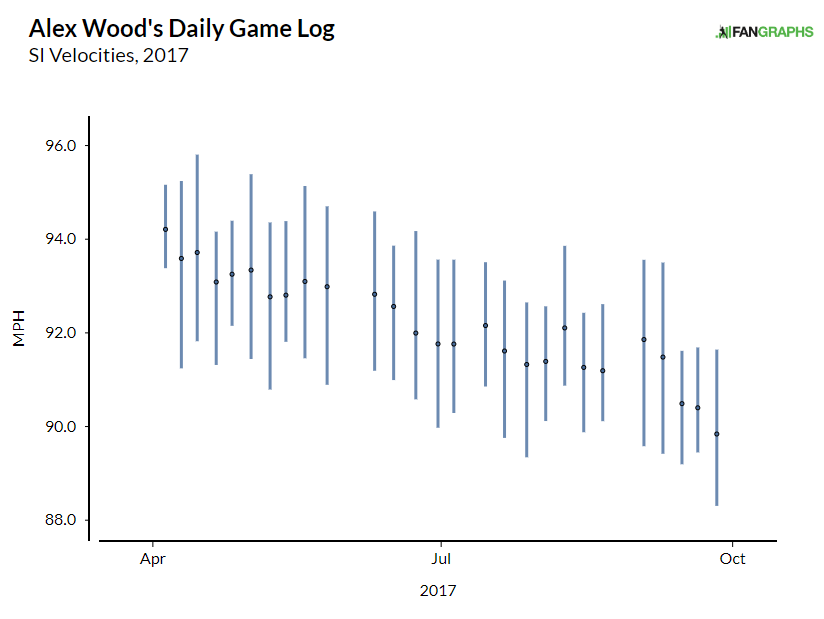
Not what you like to see. The Dodgers skipped his spot in the rotation once, hoping he’d recover, but never put him on the IL. He averaged 90.4 mph on his fastball in the playoffs, and while he was mostly effective, the early-season magic never came back. Read the rest of this entry »
Rays Continue Their Roster Churn
January 13, 2020
For some time, the Rays have approached prospect valuation similarly to other small market clubs like Pittsburgh. The short version is that Tampa has valued their prospects more highly than almost any other club because their small payroll means cheap contributors are worth more because they have the least to spend. In recent years, they have also led the farm system rankings and had among the deepest 40-man rosters, causing them to trade valuable prospects like Nick Solak and
Jesús Sánchez due to these two pressures. This dynamic was also clearly at work in last week’s Matthew Liberatore trade.
Adding cheap, controllable major league talent to one of the best teams in baseball is key to the Rays both being better when their present competitive window is open and allowing the team to keep players who they’ve helped improve and create value, thus avoiding the same fate as they did with Avisaíl García. García signed a one-year make-good deal for 2019 for $3.5 million guaranteed; he then made good and got $20 million from the Brewers. Read the rest of this entry »
Jay Jaffe FanGraphs Chat – 1/13/20
| 12:01 |
 Jay Jaffe: Hey hey folks, happy almost mid-January. Welcome to today’s chat. I’m going to give the queue a few minutes to get stocked. Hot Stove and Hall of Fame questions, ask away Jay Jaffe: Hey hey folks, happy almost mid-January. Welcome to today’s chat. I’m going to give the queue a few minutes to get stocked. Hot Stove and Hall of Fame questions, ask away
|
| 12:03 |
: Can I snatch victory from the JAWS of defeat?
|
| 12:05 |
Jay Jaffe: I certainly hope so! But I’m nervous because this doesn’t look like the election days of Raines and Edgar, both of whom sailed in with like 85% in their final years. The recent projections I’ve seen based upon the tracker and various models have gone both ways — just over the line and just short, but with the odds tilting towards the former. I have to admit I’m quite nervous
|
| 12:05 |
: Hi Jay, what does your crystal ball say about next week’s announcement of the HOF voting results?
|
| 12:06 |
Jay Jaffe: Aside from the nailbiter with Walker, I do think jeter will be unanimous, that Schilling will be in high 60s and Bonds/Clemens in the low 60s.
|
| 12:06 |
: The number of ballots tracked by the HoF Tracker is behind last year’s pace – do you sense a reticence from some voters to reveal their choices before the big reveal itself? Is there a reaction by writers with votes to the vitriol on social media? (The Purdy ratio immediately comes to mind)
|