Free agency begins five days after the end of the World Series. As in other recent seasons, FanGraphs is once again facilitating a contract crowdsourcing project, with the idea being to harness the wisdom of the crowd to better understand and project the 2022-23 free-agent market.
In recent years, we’ve added a few features to these ballots based on reader feedback. You now have the option to indicate that a player will only receive a minor-league contract, or won’t receive one at all. And new this year, if there is a player option, team option, or opt out in a player’s contract, you’ll be able to indicate whether you think he will remain with his current team or become a free agent. Numbers are prorated to full season where noted. The projected WAR figures are from the first cut of the 2023 Steamer600 projections.
Below are ballots for six of this year’s free agents — in this case, another group of outfielders. Read the rest of this entry »
Free agency begins five days after the end of the World Series. As in other recent seasons, FanGraphs is once again facilitating a contract crowdsourcing project, with the idea being to harness the wisdom of the crowd to better understand and project the 2022-23 free-agent market.
In recent years, we’ve added a few features to these ballots based on reader feedback. You now have the option to indicate that a player will only receive a minor-league contract, or won’t receive one at all. And new this year, if there is a player option, team option, or opt out in a player’s contract, you’ll be able to indicate whether you think he will remain with his current team or become a free agent. Numbers are prorated to full season where noted. The projected WAR figures are from the first cut of the 2023 Steamer600 projections.
Below are ballots for six of this year’s free agents — in this case, a group of outfielders. Read the rest of this entry »
Say this for the Cardinals: They do a very good job of keeping the band together. On Wednesday, the news broke that Adam Wainwrightwill return to the team for his 19th and final major league season. On Saturday, St. Louis revealed that Nolan Arenado has declined to exercise the opt-out clause in his contract, meaning that he will remain in the fold through 2027, making $144 million (much of it deferred) for the five-year period.
In his second season with the Cardinals, the 31-year-old Arenado set career highs in WAR (7.3) and wRC+ (151) — numbers that ranked second and fourth in the NL, respectively — and hit .292/.358/.533 with 30 homers. He made his seventh All-Star team and is a finalist to win a 10th Gold Glove; if he does win the award, he’ll tie Mike Schmidt for the second-highest total behind only Brooks Robinson (16). As he also led the NL in bWAR (7.9), and therefore edged teammate Paul Goldschmidt in both versions (Goldy had 7.1 fWAR and 7.8 bWAR), he stands a reasonable chance of winning the NL MVP award. But whether or not he does, the Cardinals couldn’t have asked for anything more from their third baseman.
When Arenado signed his eight-year, $260 million extension with the Rockies in February 2019, his contract included no-trade protection as well as the ability to opt out after the 2021 season. His relationship with the organization began to sour quite quickly after that deal came together, however, and he was traded to St. Louis in February 2021 along with $51 million in guaranteed and conditional payments. As part of the trade, he agreed to defer about $50 million, payable over the 2022–41 timespan; accepted a guaranteed salary of $15 million for 2027; and received an additional opt-out after the 2022 season. By opting out either after last year or this one, he could have saved Colorado about $20.57 million from that $51 million figure, but because he’s staying, his old team is on the hook for that money, which includes $5 million annual payments from 2024 to ’26. He’s the gift that keeps on giving to the Rockies’ beleaguered front office. Via Cot’s Contracts, he’ll receive $35 million for 2023 and ’24, and subsequent salaries of $32 million, $27 million, and $15 million. Read the rest of this entry »
How much should a team’s postseason strategy differ from its regular-season tactics? Overall, probably not that much; if your club makes it to the postseason, it ain’t broke, so to speak. Further, I generally believe the postseason is not the time to experiment with new gameplans that always carry some heightened risk. But historically, there are myriad ways that teams have shaken things up come October.
This especially seems to be the case when a team is down in a series. Take the Yankees in the ALCS this year — that squad went with three different leadoff hitters in four games, moves that had little to do with platoon splits. They faced one lefty starter during the series, Framber Valdez, and had righty Harrison Bader lead off that game, but Bader also led off in Game 4 against fellow righty Lance McCullers Jr.; lefty Anthony Rizzo and righty Gleyber Torres led off the other two games against right-handers. The Yankees also had three different starting shortstops in the series. Read the rest of this entry »
When we released the new FanGraphs app in August, we asked users to tell us which features they wanted to see next. The overwhelming response was to add both articles and leaderboards. We’re still working on how best to integrate the leaderboards, but as of today, we’ve added editorial content to the app. (If you are currently reading this on the app, you might already know all of this!)
If you haven’t already, you can download the app here:
Specifically, we’ve added or updated the following:
The ability to view our articles on the app.
A home screen layout that closely reflects the FanGraphs web homepage.
A blog roll that closely reflects the FanGraphs web blog roll.
Craig Lefferts has a place in San Diego Padres history, and a good story that goes along with it. The 65-year-old veteran of 12 big-league seasons shared it with me prior to a recent Arizona Fall League game.
“My rookie year was 1983, with the Chicago Cubs,” said Lefferts, who is now a pitching coordinator in the Oakland Athletics organization. “We had two left-handers in the bullpen, myself and Willie Hernandez, and the two of us would play catch every day, trying to work on a changeup. We had a right-hander in our pen by the name of Bill Campbell who threw a screwball. He taught, or at least attempted to teach, us how to throw a screwball. Mine was terrible and Willie’s wasn’t very good either. [Pitching coach] Billy Connors told me, ‘I don’t want you to ever use that in a game. I want you to pitch with the stuff that got you here. You’re a rookie, so don’t go out there and try and throw a new pitch.’ So I didn’t, but I kept working on it. After the season, I went to winter ball and perfected it.
“The next year, Willie got traded to the Tigers and I got traded to the Padres,” continued Lefferts. “Both of us threw a screwball as our best pitch. He won the Cy Young Award and I had arguably the best year of my career. I had 10 saves, but was mostly setting up Rich Gossage. Then Willie and I met in the World Series.” Read the rest of this entry »
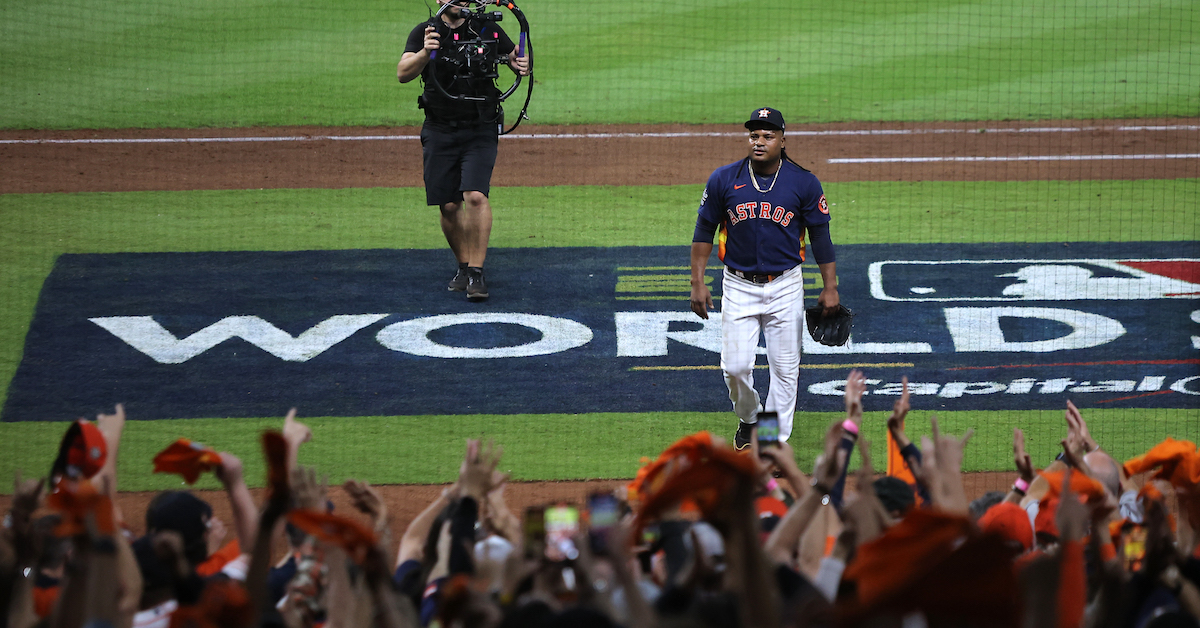
Framber Valdez isn’t the marquee pitcher in this World Series. He’s a solid fourth by reputation, with the top trio some of the brightest pitching lights of the last five years: Justin Verlander, Aaron Nola, and Zack Wheeler. Two games into the series, that top trio have been uniformly bad. Each has given up five runs, hardly the dominant performances they’re known for. Valdez? He stands untouched and mostly unchallenged, allowing a solitary run over 6 1/3 innings to pace the Astros to a 5-2 victory in Game 2.
When Valdez is on his game – and he’s always on his game, setting the major league record for most consecutive quality starts this year – he mixes a snapdragon curveball with a sinker that warps gravity, drawing the ball inexorably downward. He was in fine form Saturday night against a tough Philadelphia lineup. He got awkward swings seemingly at will, weak grounders whenever he needed them, and had a beautiful curveball in his back pocket whenever the opportunity for a strikeout presented itself.
The Phillies have been swinging early and often this postseason. That’s a horrid plan against Valdez; his biggest weakness is an occasional lapse in command. Even tonight, in one of the best performances of his career, he walked three Phillies. If you can lay off his curveball – easier said than done – he’ll sometimes spray a few sinkers and put you on base. Read the rest of this entry »
Through the first three rounds of the playoffs, two competing storylines took shape: The Astros, indomitable, sheared through the American League undefeated. The Phillies, resilient, ebullient, and unpredictable, shocked the National League by dominating the senior circuit’s best.
When these two narratives finally intersected in Houston Friday night, spraying hits and disorder all over the field like debris from a train crash, the result was an instant classic. The Astros dominated early, staking out an early five-run lead that by all rights ought to have demoralized their opposition. But the Phillies, a $255 million monument to not knowing when you’re beaten, struck right back for a historic comeback win:
How historic? The Phillies’ 6-5 win was the biggest comeback by an NL team in the World Series since 1956. When Houston’s win probability peaked with one out in the top of the fourth, they were roughly 16-to-1 favorites to win the game. Instead, the Phillies erased that lead in two innings, hung around long enough for J.T. Realmuto to win the game in the top of the 10th, and survived a Houston rally that came within 180 feet of turning a series-changing Phillies win into a crushing loss. Read the rest of this entry »
David Laurila: Greetings all. Go Astros. Go Phillies. Go baseball.
8:04
David Laurila: I got both a flu shot and a Covid booster yesterday, and am really dragging today, but fortunately I have a few energetic colleagues joining the chat shortly.
8:04
Dan Szymborski: Greetings peoples!
8:04
Justin Choi: Good morning from South Korea!
8:05
Alex Sonty: Man, Justin. I remember us getting up with you in 2020 to play KBO DFS.
In this year’s regular season, games took a pretty pronounced step away from three true outcomes hitting. Home runs dropped from 3.3% of plate appearances in 2021 to 2.9%, walks from 8.7% to 8.2%, and strikeouts — this one in part thanks to replacing nearly 5,000 pitcher plate appearances with designated hitters — fell from 23.2% to 22.4%. All told, the percentage of plate appearances winding up in one of these results dropped 1.7 percentage points, from 35.1% to 33.4% — the most profound drop since 1988.
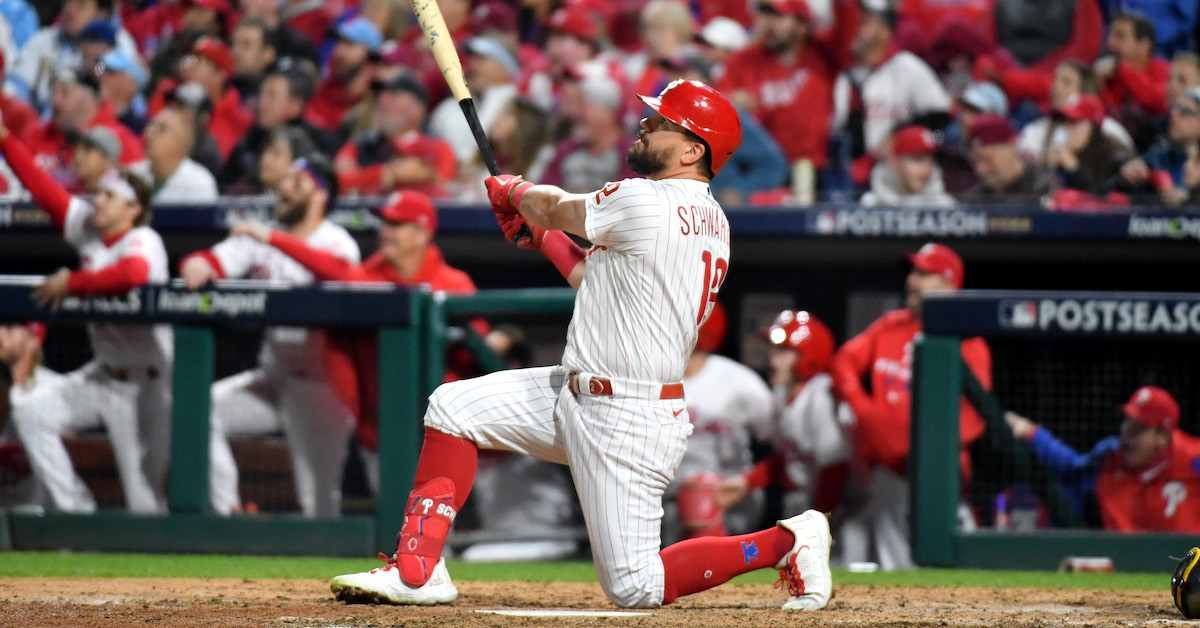
There are a lot of theories as to why this could be happening, from the universal designated hitter to more changes in the balls to humidors, but the fact is, after this figure dropped nearly one percentage point from the pandemic-shortened 2020 season to ’21, this year marks the second of a league-wide trend away from the trio. Which makes it all the more fun that when the Phillies and Astros take the field in Houston tonight for Game 1 of the World Series, it will be National League home run and strikeout champion Kyle Schwarber digging in to lead off the Fall Classic.
In his first season in Philadelphia this year, Schwarber was as much of a three true outcomes hitter as there was. No other player this season finished in the 90th percentile or above in home run rate and walk rate and in the bottom 10th in strikeout rate. That isn’t to say there aren’t other players in that mold; indeed, there are many. Giancarlo Stanton and Eugenio Suárez hit 31 home runs apiece and both finished in the bottom 10% in strikeout rate but landed in the second decile in walk rate. Max Muncy, who led off a World Series in 2018, leans pretty heavily in that direction. Matt Chapman, Daniel Vogelbach, and Joey Gallo all fit the bill to some degree, the latter most prototypically in previous seasons. But in 2022, nobody took it to the extreme that Schwarber did; he hit more home runs than anyone other than Aaron Judge, led the majors with 200 strikeouts, and finished sixth with 86 walks. While about a third of PA league-wide ended in one of the true outcomes, just about half — 49.6% — of Schwarber’s did. Read the rest of this entry »







 David Laurila
 Dan Szymborski
 Alex Sonty