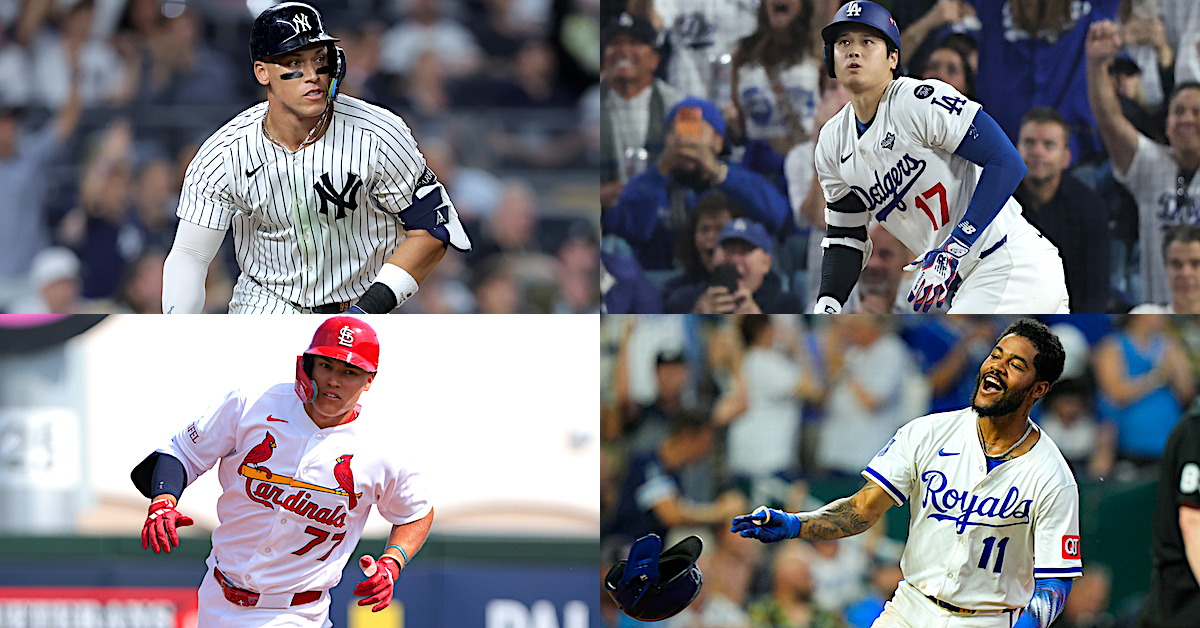
There’s paint on the field, bunting on the steel, and hoopla in our feels. It’s Opening Day no doubt. Well, the third one, at least.
The most iconic trapping of Opening Day is the fleet of excellent starting pitchers who take the mound. Each team sends their best, or at least, their healthiest. For some, it’s the reigning Cy Young winner. For others, it’s a precocious prospect. These starters, true to their name, carry the burden of the new season in their shoulder.
Nine days after the end of the World Baseball Classic, more than three weeks since he was hit by a pitch, and just hours before his team’s Opening Day game, another WBC participant landed on the injured list. Jackson Chourio, who served as the regular center fielder for Venezuela’s championship-winning squad and who is slated to be the starting left fielder for the Brewers, was placed on the IL on Thursday morning due to a fracture in his left hand.
Chourio, who turned 22 on March 11, was hit on the hand by a heater from Clayton Beeter in Venezuela’s exhibition game against the Nationals on March 4. Initial X-rays were negative, and he was diagnosed with a contusion. He sat out Venezuela’s first two games of pool play while the Marlins’ Javier Sanoja started in center field, but Chourio returned to the lineup on March 9, playing the final two pool games and the three knockout round games. For the tournament, he hit just .200/.278/.200 in 19 plate appearances, though he did barrel a few balls.
When Chourio returned to the Brewers, according to manager Pat Murphy, he underwent a scan of some sort — I’d guess a CT scan, which is much quicker than an MRI — but it did not show a fracture. He continued to play regularly, and even homered off the Padres’ Randy Vásquez on March 21, but after he felt pain in his hand during a check swing in an exhibition against the Reds on Tuesday, the Brewers sent him for an MRI, which reportedly revealed a small hairline fracture at the base of his third metacarpal. While the fracture has begun to heal, Murphy said the team is understandably “worried that there could be further injury if he doesn’t take care of it now.” Thus the IL move, which is retroactive to March 25. He’s expected to miss two to four weeks. Read the rest of this entry »
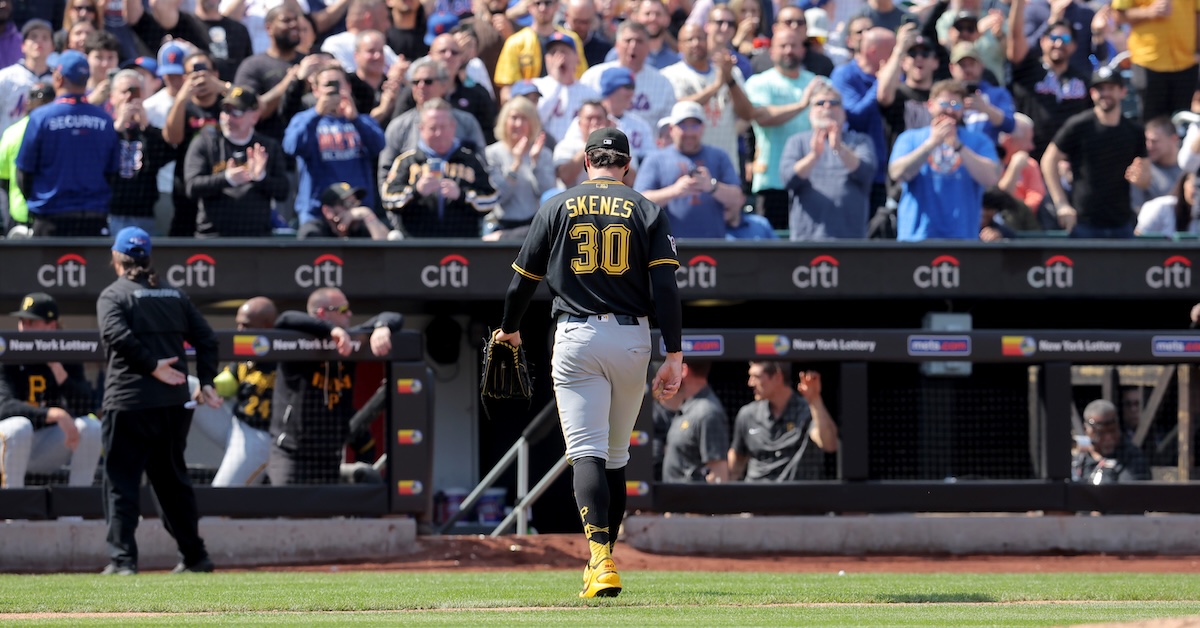
In their Opening Day game against the Mets at Citi Field, the Pirates jumped out to a two-run lead two batters into the game. Their next three batters struck out, but they had National League Cy Young winner Paul Skenes starting for them. It was the first time in his career that Skenes, who entered the game with a 1.96 ERA, took the mound in the first inning with a lead of two or more runs. Heck, it was just the fourth time in his 56 career starts (29 on the road) that he’d thrown his first pitch with any lead at all. Maybe this year would be different after all.
It’s too early to say anything about this year, but this sure was a different game. Just not in the way the Pirates had hoped. For the first time in his career, Skenes did not make it through the first inning. When manager Don Kelly went to the bullpen with two outs in the inning, his ace had thrown 37 pitches, recorded just two outs and allowed five runs. He struck out just one batter, walked two, and hit one with a pitch. The impromptu bullpen game ended about two and a half hours later in an 11-7 Mets win. Read the rest of this entry »
Davy Andrews: Hello everyone and welcome to our Opening Day(ish) chat!
1:10
Davy Andrews: Hello Dan!
1:11
Davy Andrews: Oh no, we’ve used up our entire quota of exclamation marks in the first 45 seconds.
1:11
Jay Jaffe: Hey hey, Happy Opening Day!
1:11
Dan Szymborski: And I’ll be here for more than expected as I my brother-in-law is already home from his procedure, so I don’t have to spend part of Opening Day wrangling a six-year-old and a four-year-old
After an offseason marked by some funky free agent contract structures, a few big trades, and a bunch more handwringing over the Los Angeles Dodgers, the 2026 season is upon us; we made it. And on this, the morning of Opening Day (sorry, Netflix), we engage in our annual tradition of asking our staff to open themselves up to public ridicule by trying to predict the year ahead in baseball. Some of these predictions will prove to be prescient; others will make their forecaster feel a little silly. Such is the prognostication business.
I asked our staff to predict the playoff field, as well as the pennant and World Series winners, and the individual award recipients. Twenty-five of our writers from FanGraphs and RotoGraphs weighed in. Here are the results. Please note that the tables at the end showing the full writer ballots are sortable. Read the rest of this entry »
Mark J. Rebilas and Jayne Kamin-Oncea-Imagn Images
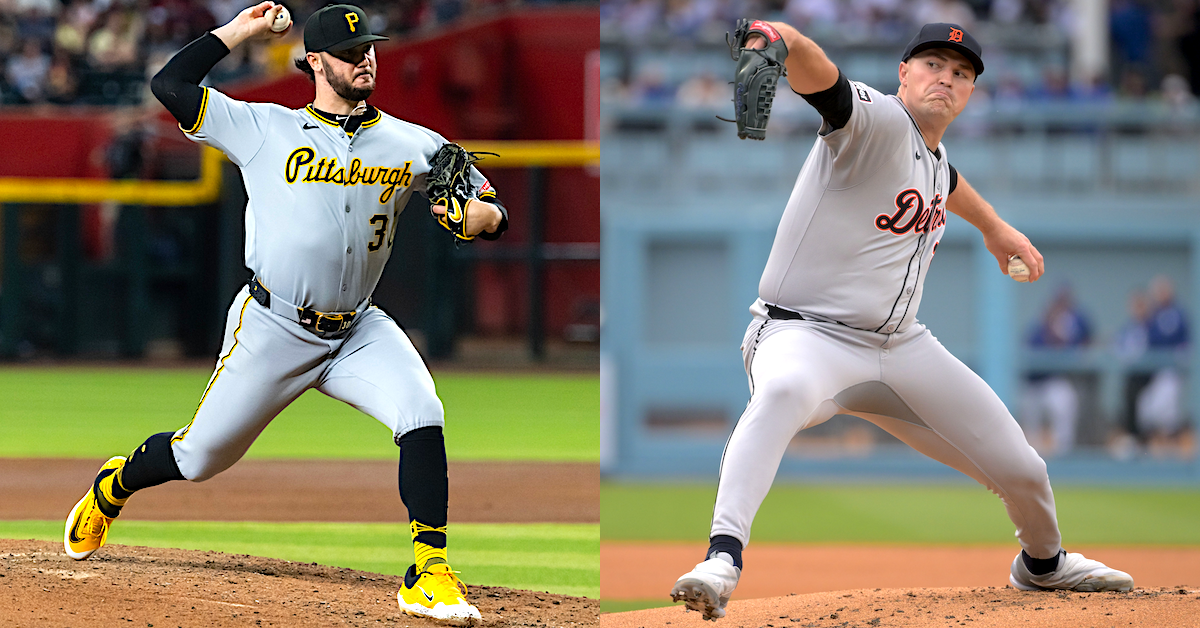
Will three be the magic number for Tarik Skubal? Fresh off back-to-back Cy Young Awards and a record-setting $32 million arbitration win, the 29-year-old lefty will take the ball for the Tigers against the Padres on Thursday afternoon at Petco Park, the third year in a row he’s had the honor of an Opening Day start. He’s vying to become just the third pitcher to win three straight Cy Youngs — after Greg Maddux (1992–95) and Randy Johnson (1999–2002) — and the first American League pitcher to do so.
Though he didn’t repeat as the winner of the AL Pitching Triple Crown, Skubal was actually slightly better in 2025 than in ’24 by most key measures. He trimmed his ERA, FIP, and walk rate slightly, while improving his strikeout rate, innings total, and WAR:
Tarik Skubal, 2024 vs. 2025
Season
W-L
IP
K%
BB%
ERA
FIP
WAR
2024
18-4
192
30.3%
4.6%
2.39
2.49
6.0
2025
13-6
195 1/3
32.2%
4.4%
2.21
2.45
6.6
The major difference between Skubal’s seasons was that his offensive support fell from 5.3 runs per start to 4.5, so his win total dropped. Even so, the Tigers went 21-10 in his starts in both seasons en route to claiming wild card berths. Read the rest of this entry »
And just like that, the end of winter has been heralded, not by a groundhog or the vernal equinox, but by 6 1/3 shutout innings by Max Fried last night at Oracle Park. Today is the official Opening Day in MLB, and as such, it’s time for the ZiPS projections to spit out its final preseason projections. Hopefully, its numbers are graceful and kind, just in case it has to eat them in six months. This is the 22nd such exercise I’ve done with the ZiPS projections, and as with the other 21 times, there’s not much to do but sit back and wait for reality to destroy the expectations. Most of you already know the methodology by now, but for those who don’t, I’ll do a quick rundown. The rest of you can skip straight to the reason you’re here: the standings!
The ZiPS projected standings are the results of a million simulations of the 2026 season, using the ZiPS projections and the actual team schedules. The methodology isn’t identical to the one we use for our playoff odds. So how does ZiPS calculate the season? Stored within ZiPS are the first- through 99th-percentile projections for each player. I start by making a generalized depth chart, using our Depth Charts as a jumping off point. Since these are my curated projections, I make changes based on arbitrary whimsy my logic and reasoning. ZiPS then generates a million versions of each team in Monte Carlo fashion. These projections do reflect the updated post-spring training projections, which were added to the FanGraphs database on Wednesday afternoon. Read the rest of this entry »
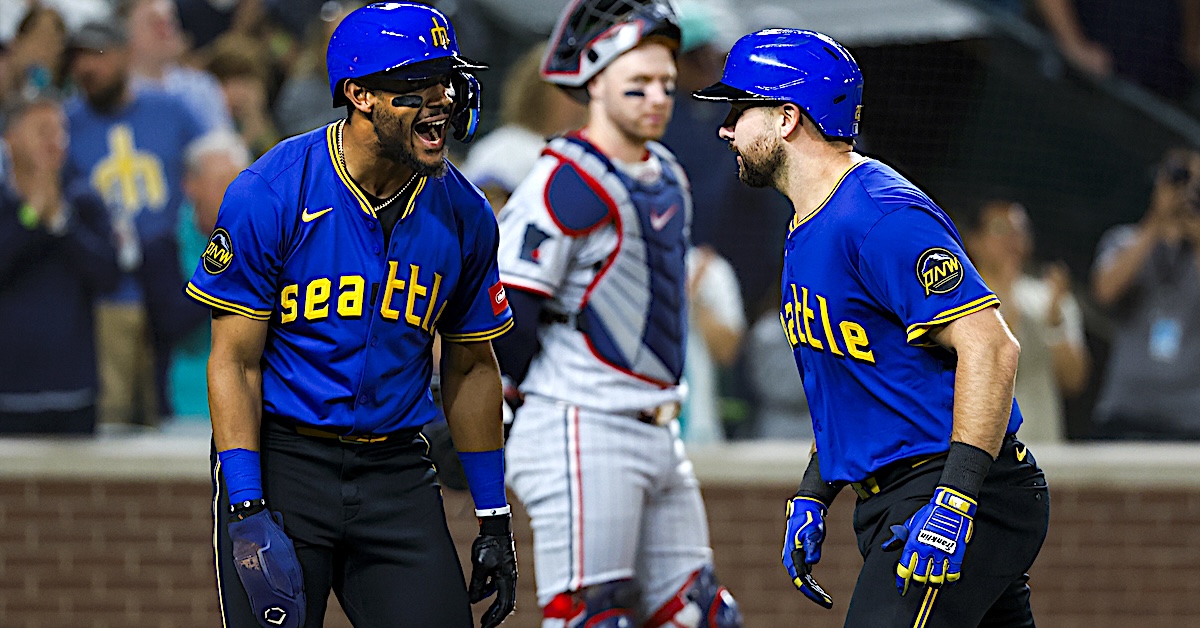
Since their first season together in 2022, Raleigh and Rodríguez have combined for 44.2 WAR. At 11.1 wins per season, that’s “on pace” for the best duo in team history, just ahead of Ken Griffey Jr. and Alex Rodriguez (65.9 WAR over six years), Griffey and Edgar Martinez (119.3 WAR over 11 years), and all sorts of other combinations from the star-studded squads of the 90s. Raleigh and Rodríguez certainly have much more to achieve before approaching these all-time greats, individually or together. But as the Mariners enter their 50th season, it appears the legacy of the franchise may finally be moving beyond its past. Read the rest of this entry »
Brad Penner, Kiyoshi Mio, Jay Biggerstaff, Sam Navarro-Imagn Images
Every year for Opening Day, I ask the FanGraphs staff to predict the season’s award winners, playoff field, and eventual World Series Champion. Those predictions tend to be heavily influenced by our playoff odds, projections, and prospect rankings, and while I appreciate the instinct to lean on data to make our guesses more educated, the results can feel a little chalky at times. That’s why I’ve starting asking our writers to make another prediction — a bold prediction. One that might be a little spicy, or perhaps a little silly. A prediction that eschews the obvious, but is still grounded in reality, even if only by one foot. Nineteen of our writers across FanGraphs and RotoGraphs answered the bell, including me. Will any of these predictions prove to be correct? Who knows! Let’s watch 2,430 games and find out. – Meg Rowley
We’ll See a Front Office Gambling Scandal
I realize this isn’t the most fun prediction you’re going to read here, but this just sort of strikes me as next. We’ve seen coach scandals, player scandals, and interpreter scandals. Well, front offices feature plenty of hyper-competitive people, many of whom are experts in the kind of risk analysis involved in gambling, and I don’t see any particular reason that they’d be immune to a disease that has infected so many other parts of baseball over the last few years. I think it’s more likely that the next scandal we see involves more minor league players, but we’re supposed to go bold here. It would be harder for a front office member to get caught. They’re not subject to the same public scrutiny that players are, and they can’t affect the outcome of a game as directly. They’d probably have to screw up in a bigger way. But it certainly seems possible. – Davy AndrewsRead the rest of this entry »
Over the past week and a half, we’ve published our annual season preview, ranking the league’s players by position and team based on a blend of our projections (a 50/50 split between ZiPS and Steamer) and our manually maintained RosterResource playing time estimates courtesy of Jason Martinez and Jon Becker. If you happen to have missed any of those installments, you can use the navigation widget above to catch up.
Today, I’m going to summarize the results. We’ll look at some tables and pick out a few interesting tidbits in a moment, but first, as I do every year, I’ll remind you that this exercise captures a snapshot of how we project teams to perform now. Teams aren’t static. Since we began publishing our rankings, top prospectsKevin McGonigle (no. 5), JJ Wetherholt (no. 12), and Carson Benge (no. 21) made their respective Opening Day rosters, while no. 1 overall prospect Konnor Griffin was sent down to get a bit more seasoning in the minors. Nationals outfielder Dylan Crews, the second overall pick in the 2023 draft and a former top prospect, was optioned to Triple-A Rochester. And a number of notable pitchers hit the injured list, including Spencer Strider, whose strained oblique will no doubt complicate his efforts to regain his 2023 form. Read the rest of this entry »


 Dan Szymborski
 Jay Jaffe