Archive for Daily Graphings

The Ball Threatens to Overshadow Baseball

With the postponement of Wednesday’s scheduled ALCS Game 4, the de-juiced baseball remained a hot topic of discussion, particularly in New York, where the Yankees appeared to catch a game-changing bad break on Didi Gregorius‘ fifth-inning fly ball that instead of becoming a three-run homer that would have swung the lead in their favor, was caught at the warning track. Players and managers are talking about it, fans are talking about it, analysts are talking about it — here in New York City, even on the 10 pm local news. Like it or not, it’s an issue that won’t go away, in part because of MLB’s stubborn insistence that nothing has changed, even in the face of evidence to the contrary, as well as the reality that the league actually owns about 25% of Rawlings, the manufacturer of the baseball (the other 75% is owned by Seidler Equity Partners, founded by Peter Seidler, the leading investor of the Padres). While none of this invalidates what the players on the field are accomplishing, everybody is suddenly playing or watching a very different game than we’d grown accustomed to during the regular season.

On Saturday, our own Craig Edwards reported that Cardinals manager Mike Shildt said that his team’s analytical department had noted that fly balls are traveling four-and-a-half feet less far than normal. ESPN’s Jeff Passan reported on Wednesday that officials from two unnamed teams (quite possibly those of the Astros and Yankees, since Passan was reporting from New York) “concurred that whatever batch of balls has been used during October is not performing the way the ones in the regular-season did.”

The change concerns the drag on the baseball, which according to the work of Baseball Prospectus’ Rob Arthur has increased sharply relative to the regular season, strongly suggesting that different balls are being used. Arthur estimated that 50% more homers would have been hit if the regular season ball were being used. On Thursday, Arthur published a new piece showing that the postseason baseballs are also affecting pitchers, producing slightly less vertical break (by about 0.4 inches) on curveballs, and that “Sliders are cutting across the zone a little less; sinkers staying a little more buoyant… [The changes] all seem to hover on the border between just large enough that baseball’s tracking system can detect them and just small enough that a major-league hitter probably wouldn’t care.” Read the rest of this entry »

The Astros Need to Solve Masahiro Tanaka’s Slider

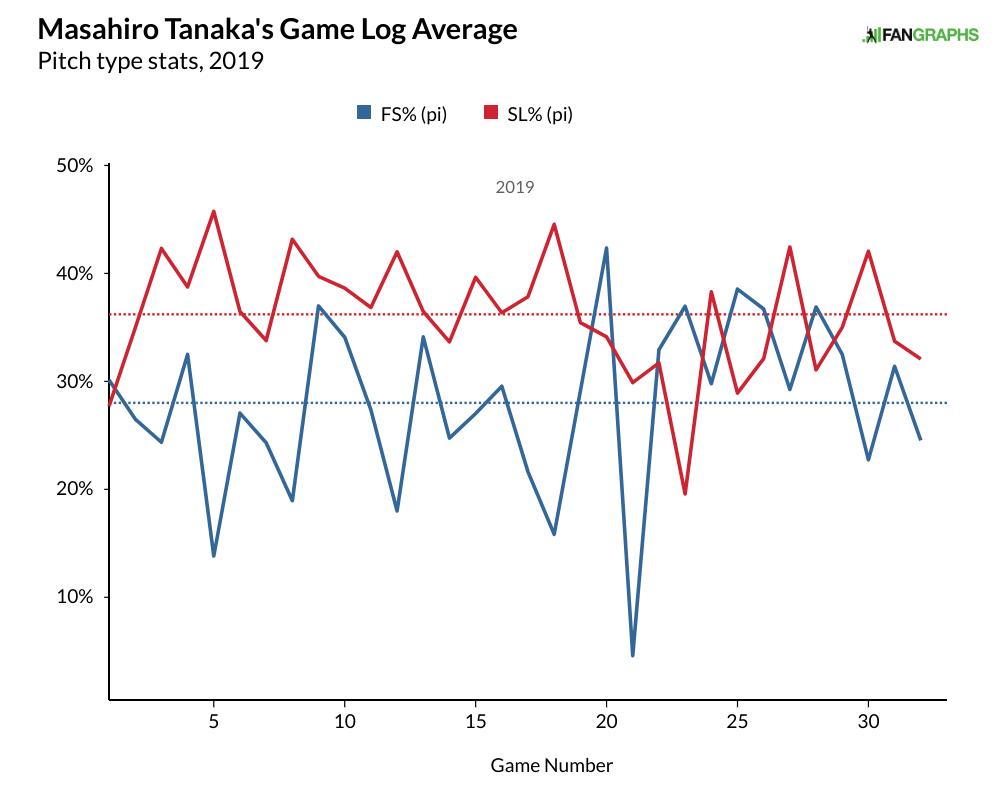
If Masahiro Tanaka has a signature pitch, it’s his slider. When he first came over from Japan in 2014, nearly half of his strikeouts came on the splitter despite throwing it only a quarter of the time. In his first three seasons in the majors, Tanaka threw his splitter more often than any other pitch and batters put up a feeble 37 wRC+ against it, while whiffing on the pitch 19% of the time. But in 2017, Tanaka used his slider more often than the splitter. In 2018, that trend continued; he got better results from his slider than he did with the splitter. This season the disparity in usage and effectiveness grew. Tanaka struggled with his splitter due to changes in the baseball, but even after re-configuring the splitter in July, his slider has remained his best pitch.

Against the Astros in Game 1 of the ALCS, Tanaka got eight swings and misses. Every single whiff came on the slider. Here’s how Tanaka’s usage of his slider has compared to that of his splitter this season:

Read the rest of this entry »


So You Wanna Buy a Baseball Team

In a postseason full of headline-grabbing stories (the ball is de-juiced! Gerrit Cole is a cyborg! The Nationals win in the playoffs now!), a quiet bulletin came out on Wednesday. Bloomberg’s Scott Soshnick reported that Major League Baseball will now allow investment funds to take minority stakes in teams.

The news cycle moved on. The Yankees-Astros game was postponed! What will A.J. Hinch and Aaron Boone do with their rotation flexibility? Did you know Juan Soto isn’t yet 21? There are big baseball things happening right now! Investment mumbo-jumbo has a way of fading to the background.

I’m here to tell you that it matters. Not in an urgent, baseball-ends-today way, but in a way that could change the nature of the sport long-term. This story might not be on everyone’s radar right now, but it’s important to consider the ramifications and conflicts of interest that can arise from a small change.

To understand what this decision means, we’ll need a little background. First, let’s talk about what an investment fund is. It’s a broad term by design, one that encompasses many different ways of pooling together money. Without further comment from MLB, we can’t know the exact specifications of what they’ll allow, but we can make some educated guessed. A college endowment? Definitely. A special purpose fund raising money from 100 rich people to invest in teams? Certainly — one has already been started, and it plans to raise $500 million to purchase minority stakes.

What about a pension fund? Pension funds’ preferred tax status mirrors that of college endowments, and the two invest in very similar ways. A hedge fund? Baseball will have to spell out the rules, but that doesn’t seem so different from letting endowments or pensions own minority shares, and it’s certainly not much different than a special purpose vehicle. Heck, hedge funds are largely specialized investment pools already, and endowments and pensions make up a sizable portion of hedge fund assets under management. Read the rest of this entry »


Anthony Rendon Isn’t Underrated Anymore

In 2017, The Ringer called Anthony Rendon baseball’s “unknown superstar.” A year later, at the conclusion of the 2018 season, Beyond the Box Score described Rendon as “constantly overlooked.” I’m pretty sure there’s a law somewhere that says that when you write about Rendon, you have to describe him using the word “underrated” or one like it. But rules were made to be broken, and this one has run its course. Rendon is too good to be underrated any more. He has a strong case as being the best third baseman in baseball — which is an incredibly deep field — and an even better case as one of the top 10 players in the game overall.

Let’s start with the top-line figures and then get into the mechanics. Here are baseball’s WAR leaders since 2013, when Rendon made his debut for the Nationals:

WAR Leaders, 2013-2019
Player wOBA PA WAR/100 PA WAR
Mike Trout .424 4,499 1.39 62.6
Josh Donaldson .382 4,148 0.98 40.6
Mookie Betts .377 3,629 1.03 37.2
Buster Posey .348 3,898 0.95 36.9
Paul Goldschmidt .391 4,626 0.77 35.8
Christian Yelich .374 4,043 0.83 33.6
José Altuve .363 4,594 0.72 32.9
Anthony Rendon .366 3,927 0.83 32.7
Freddie Freeman .386 4,424 0.73 32.5
Manny Machado .349 4,533 0.71 32.0

Read the rest of this entry »


ALCS Rainout a Mixed Bag for Pitchers

The Yankees and Astros both won over 100 games in the regular season but nobody beats Mother Nature. When a rainstorm causes cool terms like “bomb cyclone” or “explosive cyclogenesis” to be bandied about, you know you’re not expecting a light drizzle. Yankee Stadium is currently dry, but with a system the size of the mid-Atlantic barreling up the coast, it didn’t make sense for MLB to pretend that tonight’s ALCS Game 4 was going to take place. Just look at the radar, courtesy of the National Weather Service:

Yikes. The rain provides the Yankees and Astros with an extra off-day now at the expense of losing an off-day between a possible Game 5 and Game 6. This isn’t a big deal for the hitters, but it will result in some revised pitching plans. In a five-game divisional series, teams can generally muddle through with a three-man rotation. Due to the 2-2-1 format, no team plays on three consecutive days, and while the Game 1 starter would have to pitch Game 4 on short rest, the Game 2 starter can pitch in a possible rubber match on normal rest. This extra rest gives teams the flexibility to either stretch their best three starters or, as the Nationals demonstrated, use starting pitchers in relief more aggressively.

But short of baseball going to some kind of impractical 2-2-1-1-1 format, that doesn’t quite work in a seven-game series. So unless you’re going to have your entire rotation do it 1930-style, you’ll need to use a fourth starter. That isn’t an ideal situation for either the Yankees or the Astros. From a pure projection standpoint, it’s actually doesn’t move the probabilities. The Astros get an immediate benefit in that they avoid a Bullpen vs. Bullpen Game 4; ZiPS takes bullpen depth into consideration and Yankees enjoy a significant projected edge in any such bullpen game. Before the rainout, ZiPS projected the Yankees to have a 56%-44% edge in a home bullpen duel, so it’s a nice game to delay if you’re Houston.

The problem you run into with this model is that the rainout doesn’t really add an extra day of rest, it simply moves it. Since there are only two days of rest for a Game 4 starter to pitch in Game 7 now, both teams end up repeating the dilemma of either using a fourth starter — particularly problematic for the Astros — or going with a bullpen game. Read the rest of this entry »


Howie Kendrick Is the Kind of NLCS MVP You Want to See

This could be the story of a kid with an awkward swing getting cut from his junior college ball team and never playing again, but it isn’t.

This could be the story of a rookie who debuted with the Angels by starting a slick double play, but never learned to hit, got sent back to the minors, and lived out the rest of his baseball days eating peanut butter and jelly and not hearing the phone ring.

But it’s not that either.

This could be the story of a young player who got spread too thin as his team experimented with playing him all over in the infield. “Things happen everyday in baseball,” Howie Kendrick told the L.A. Times in 2006. “One day I might be an outfielder. I’m open to moving anywhere.” And he did. He’s played 190 games in the outfield, so far.

This could be the story of a talented hitter trapped behind a middle infield logjam at the top of the Angels’ farm system. Or buried in their lineup under 700 pounds of struggling sluggers named Albert Pujols, Josh Hamilton, and Mark Trumbo.

Or a debatable starter who became the smiling face on the poster for “Batting Average Doesn’t Tell the Whole Story.” Or a veteran infielder relegated to the corners, sideswiped by strained hamstrings and a sore abdomen.

But it’s not any of things. Not entirely, anyway. Read the rest of this entry »


The Stars Aligned for the Nationals

With their sweep of the St. Louis Cardinals, capped off by a 7-4 win last night, the Washington Nationals are bringing the World Series back to the nation’s capital for the first time since 1933.

No team gets to the World Series without their fair share of luck, and the Nationals certainly have seen things go their way so far this October. But at the end of the day, talent reigns supreme. It shouldn’t come as a surprise to you that the Nationals were a superior team to the Cardinals. They produced 48.3 WAR this season, more than 10 wins above the Cardinals’ aggregate of 37.9. Washington’s hitters produced a wRC+ eight points higher than St. Louis’; their pitchers produced a FIP- six points lower. The Nationals were simply better across the board. What’s arguably most exciting for fans in Washington is that their top talent has stepped up when things have mattered most.

One of my favorite statistics to follow during the postseason is Championship Win Probability added, or cWPA, housed on the website The Baseball Gauge. It’s very similar to WPA in that it calculates how each plate appearance during every game has changed each team’s odds of winning the World Series. The Ringer’s Ben Lindbergh has covered cWPA in the past, such as in this piece about players who made late-season debuts and contributed to a postseason run, or in this one when analyzing the relative “mundanity” of the 2018 World Series. As you might expect, Nationals players are dominating in cWPA this postseason. Four of the top five individual cWPA leaders don the Nationals’ red, white, and blue: Read the rest of this entry »


For the Nationals, a Bumpy Road Led to a Beautiful Place

The Washington Nationals are World Series bound following Tuesday night’s sweep-completing 7-4 win over the St. Louis Cardinals. They couldn’t be much hotter. Since a September 18 loss to the team they just vanquished, the Dave Martinez-managed Nationals have won 18 of their last 21 games.

How remarkable was their turnaround from the 19-31 start that had Martinez firmly in the crosshairs? The 2005 Houston Astros, the 1973 New York Mets, and the 1914 Boston Braves are the only other teams to have made it to the World Series after being 12 games under .500 at any point during the season.

The Cardinals deserve some credit of their own. The Mike Shildt-skippered squad went 47-27 in the second half, then beat the favored Braves in the NLDS. They simply had the misfortune of running into a pitching-rich Nationals team that has now punched its ticket to the Fall Classic.

Here are perspectives from participants on each side, gathered prior to, and after, Games 3 and 4.

———

Following Game 3, I asked Martinez about team’s confidence level, which is undoubtedly the highest it’s been all season. With the early-season struggles in mind, just how important is confidence to a team’s success? Read the rest of this entry »


Let’s Consider a Few More Questionable Intentional Walks

Last week, I wrote about some intentional walk decisions that merited further scrutiny. One of them was pretty bad and one of them was a little bad, but both managers advanced to the NLCS — and now, like clockwork, we have more intentional walk decisions to analyze. Playoff baseball is predictable like that, even as it’s unpredictable in other ways.

Let’s take these two chronologically. The Yankees had their backs against the wall, down 2-0 against Gerrit Cole to start the seventh. It got worse quickly, with two of the first three runners reaching base. That gets us to our situation; second and third, one out, and Alex Bregman at the plate facing Adam Ottavino. Aaron Boone put up four fingers; he chose to face Yuli Gurriel rather than Bregman.

The surface level math on this one doesn’t look that bad for Boone. The trail runner here simply doesn’t matter that much; if Bregman scores, it’s 5-0, and three innings to score five runs is a tall task against Gerrit Cole and the best relievers the Astros can muster. To approximate the lower run-scoring environment they’re facing, I lowered the run environment in our WPA Inquirer to 4.5. The decision hardly hurt the Yankees; their odds of winning fell from 12.3% before the walk to 12.0% afterwards.

When an intentional walk only costs 0.3% of win expectancy when ignoring batters, it’s more often a good one, and a cursory look at Bregman and Gurriel’s wOBA agrees with that. That doesn’t even add in platoon splits; Gurriel has a reverse split in his major league career, and even regressing it back to the mean leaves him only 3% better against lefties than righties. Bregman, meanwhile, clocks in at 6.8% better against lefties than righties post-regression.

Put that all together, and Gurriel’s projected wOBA against Britton (accounting for Britton’s own splits) comes out to .314, while Bregman’s is .372. Given that the Yankees gave up so little win expectancy by putting Bregman on, the back-of-the-envelope math makes the decision obvious. The team would need to face a batter who projected to be at least 31 points of wOBA worse than Bregman to make the decision worth it, and Gurriel is 58 points worse. Good intentional walk! Read the rest of this entry »


Houston Takes 2-1 ALCS Lead as Cole Escapes Jams, Astros’ Bats Reach Orbit

NEW YORK — The Yankees had their chances against Gerrit Cole on Tuesday afternoon, golden opportunities of the type few if any of the 29-year-old righty’s opponents saw this season — the type that can haunt a team if it fails to convert them. The Yankees could not, stranding nine baserunners through the first five innings and going 0-for-6 with runners in scoring position. Though less dominant than usual, the Astros’ co-ace wriggled out of jam after jam, and may have gotten the benefit of a de-juiced baseball when a fifth-inning Didi Gregorius drive that appeared destined to become a Yankee Stadium short porch special — a potential three-run homer that would have erased Houston’s 2-0 lead — died at the wall in right fielder Josh Reddick’s glove. Meanwhile, Reddick and José Altuve each homered off starter Luis Severino, helping to power the Astros to a 4-1 victory in Game 3 of the ALCS, giving them a two games to one lead.

As noted in my piece on Cole, throughout his otherwise incredible season, he was at his most vulnerable in the first inning, allowing 16 runs in 33 starts, a rate of 4.36 per nine innings. As the shadows stretched across the diamond in the Bronx, the Yankees were poised to add to that litany when leadoff hitter DJ LeMahieu singled up the middle on Cole’s fifth pitch, and Aaron Judge followed with a shift-beating single to right field. Through the entire season, Cole had given up just seven hits before recording his first out, and only once (April 20 against the Rangers) allowed back-to-back hits to start a game. Here he recovered to retire Brett Gardner on a routine fly ball and Edwin Encarnación on a popup, then walked Gleyber Torres on four pitches, producing just the ninth bases-loaded situation he faced all year. His first-pitch curve to Gregorius, however, produced a harmless groundout.

The Yankees had another chance in the second inning, when with two outs, Aaron Hicks — starting his first game since August 3 after suffering a right flexor strain that was believed to be season-ending — battled his way to a 10-pitch walk, and LeMahieu smacked the next pitch up the middle for a single. Cole escaped by fooling Judge with a mix of curves and sliders, striking the big slugger out chasing one of the latter, low and away. Eleven batters into his start, the pitcher who punched out 326 hitters this year finally recorded his first K of the day.

“I actually think the beginning of the game he had a hard time finding his stuff and finding his tempo, his rhythm,” said manager A.J. Hinch afterwards. “He was still getting through his outing, made some really big pitches, had some pressure on him.” Read the rest of this entry »