Archive for Daily Graphings

This Week’s Prospect Movers – 7/26/19

Below are some changes we made to The BOARD in the past week, along with our reasons for doing so. There’s more info on all the players below on The BOARD. All hail The BOARD, prostrate yourself before it and bask in its infinite wisdom and benevolence and dynamic farm system rankings.

Note that with the trade deadline upon us, Kiley and I have been focused on seeing and making calls about players from contenders’ systems, since those are the teams most likely to move prospects in the coming days.

Remember these changes are announced as they happen by our Twitter account, @FG_Prospects.

Moved Up

Ryan Jeffers, C, Minnesota Twins:
After amateur scouts were skeptical about Jeffers’ ability to catch long-term, he has turned into a good receiver. He’s an offseason Top 100 candidate.

Bryan Mata, RHP, Boston Red Sox:
Once upon a time, Mata and Cubs righty Jose Albertos were almost identical prospects. Both had been teenagers who had unusually advanced stuff, including swing-and-miss changeups, but concerning control. For a stretch, each of them had stock-altering strike-throwing regressions, from which Mata has emerged and appears beyond, while Albertos’ season is grounded.

Alexander Vargas, SS, New York Yankees:
Vargas had $3 million on the table from Cincinnati but rather than wait until 2019 to sign the deal like the Reds needed him to, he got $2.5 million from the Yankees last year. It’s looking like quite the coup now. Vargas, still 17, was one of a handful of Yankees DSL prospects brought up to the GCL after very few games. He’s a projectable, athletic, switch-hitting shortstop with surprising power for someone his size and age. We moved him up just shy of the FVs of the late first round high school shortstops from this year’s draft. Read the rest of this entry »


The Rays are in Some Trouble

Yesterday, news came out of Tampa Bay that Blake Snell will undergo arthroscopic surgery to remove loose bodies in his arm. While that isn’t the worst-case scenario when it comes to pitcher injuries, he’s expected to miss at least a month. If this injury had occurred in April or May, we probably wouldn’t be too worried about it; missing 15%-20% of the season isn’t a huge deal. But when the injury occurs in late-July, losing a team’s best starting pitcher and best player for half of the season’s remaining games is a big deal. It’s especially important for the Rays, who are sitting just outside of a Wild Card spot.

Snell isn’t the only injury problem Tampa has had of late.

  • Brandon Lowe, still second on the Rays in WAR with 2.5 wins, has been out with a shin injury since the beginning of the month.
  • Kevin Kiermaier, the club’s standout center fielder, went on the injured list on Sunday with a left thumb sprain.
  • Yandy Diaz, the team’s starting third baseman who has put up 118 wRC+, went on the IL on Tuesday with a foot injury.

Those three position players rank second, fifth, and fourth respectively on the Rays in WAR this season. They have put up 5.7 WAR this year, which is 38% of the team’s total from the position player side. Similarly, Snell and the previously injured Tyler Glasnow represent a quarter of the Rays’ 2019 pitching WAR. That’s roughly one-third of the Rays’ production on the injured list right now. While the injuries are relatively minor, for a team fighting for a playoff spot, every game matters. After a great start to the season, Tampa has seen its playoff odds go from near-sure-thing to a coin flip:

Read the rest of this entry »


Eric Longenhagen Chat: 7/26/19

12:02
Eric A Longenhagen: Hi hello good morning

12:05
Eric A Longenhagen: I have one link to share with you for now, that’s the announcement that our farm rankings (which are, aside from the player evals that drive the FV values, objective) are now live on the board at all times.

12:05
Eric A Longenhagen: it’s pretty cool

12:06
Eric A Longenhagen: I’ll have another link for you later in the chat as Meg is working on editing it right now and that’ll just be the weekly ‘propsects who moved’ post

12:06
Eric A Longenhagen: I have a day AZL game today so I’m gonna try to keep this short

Read the rest of this entry »


Broadcasters’ View: Who Have Been the Top Players in the Midwest League?

Who have been the best players in the Midwest League so far this season? I recently posed that question to some of the circuit’s broadcasters, with an important qualifier: I requested that they base their selections on what they’ve seen with their own eyes, and not on players’ reputations. I also asked for snapshot observations on each player named, which the respondents graciously took the time to provide.

As noted in last season’s survey, the Midwest League comprises two divisions, with an unbalanced schedule. Couple that with the fact that this is a midseason look, and the respondents will have seen some players more than others (or not at all). For that reason, notable prospects may not appear on a particular list.

Six broadcasters participated — four from the Eastern Division and two from the Western Division. Their respective lists were put together within the past couple of weeks.

———

Nathan Baliva, Peoria Chiefs (Cardinals)

1. Wander Franco: A generational talent. Hitting and fielding. Sadly we only got to see him for one series with the Midwest League crossover schedules, but you could tell he was special, with baseball instincts and natural ability. Hits the ball hard and has everything you could want. Will be fun to watch him go up the ladder.

2. Alek Thomas: This kid has crushed us all season. Had a series in early July where he was 9-for-10 and very nearly had cycles on back-to-back days. Hit the ball all over Dozer Park with power, using all fields and [showing] his speed. No matter what was tried, we couldn’t get him out that series. Read the rest of this entry »


A Different Way of Looking at Home Run Rate

Recently, I’ve been pondering the strange way I think about HR/FB ratio. On one hand, it’s a way to explain away a hot or cold stretch from a hitter. When Joc Pederson got off to a blazing start this year, I looked at his HR/FB, a spicy 33.3% through the end of April, and told myself it was a small sample size phenomena. That’s the first way I use HR/FB for hitters — as a sanity check.

At the same time, HR/FB is something we’ve all used to explain someone’s power. Joey Gallo is powerful, obviously. How do we know that? Well, he hits the ball really hard, which gets expressed by more of his fly balls turning into home runs. Gallo had a 47.6% HR/FB at the end of April, and even though I didn’t expect that to continue, I was willing to accept high numbers for Gallo’s HR/FB much more easily than I was for Pederson.

This leaves HR/FB in a weird spot. It’s a number we use to see if players are getting lucky or unlucky relative to average, but it’s also a number we use to look for underlying skill. Problems arise when it’s unclear what is noise and what is signal. Is David Fletcher unlucky to have a 5.4% HR/FB? Surely not — he’s a contact hitter. Is Jose Ramirez unlucky to have a 6.5% HR/FB? I assume so, but I only assume so because he hit 39 home runs with a 16.9% HR/FB last year. What if last year was the outlier, not this one?

Another way to think about this conundrum is that HR/FB contains an inherent contradiction we have to work around mentally. Putting fly balls as the bottom of the ratio implies that all fly balls are created equal, and that’s clearly untrue. Gallo is unloading on the ball, crushing many of the fly balls he hits into orbit. Fletcher, meanwhile, sports one of the lowest average exit velocities in the game. Even though a home run counts the same for each, the population of fly balls is tremendously different. How do we handle this contradiction? Read the rest of this entry »


Josh Donaldson Has Finally Settled In

After a surprise first-place finish in the National League East last year, the Atlanta Braves entered this offseason searching for an offensive threat to bolster their lineup. After being shutout twice in their Division Series matchup against the Dodgers, they probably had good reason to be on the lookout for a new bat to add to their roster. They quickly struck a one-year deal with Josh Donaldson worth $23 million in the hopes that he would rekindle some of the magic that made him the second-most valuable player in baseball from 2013-2017.

Through the first two months of the season, it seemed like a worst-case scenario was playing out for the Braves’ biggest offseason acquisition. Through May 31, Donaldson had posted a 118 wRC+ and 1.2 WAR in 217 plate appearances. Above average, yes, but a far cry from his 148 wRC+ he averaged annually in the five years prior to 2018. With a lengthy injury history since at least 2016, you had to wonder if all that wear and tear had caught up with his 33-year-old body.

A shoulder injury sapped him of his power last year, so it was a little worrisome that his ISO was just .186 through the first two months of the season. That would have been his lowest power output since 2012, the year before he broke out with the Athletics. But more concerning was the 28.1% strikeout rate, higher than any other season in his career except for the brief cup of coffee he received way back in 2010. In his prime, he had always been able to combine reasonable strikeout rates with his massive power.

Since June 1, however, Donaldson has put together a vintage performance. He’s matched his previous offensive output exactly, posting a 148 wRC+ and 1.8 WAR across 198 plate appearances. He’s tied for the National League lead in home runs during this period with 16. That puts him on pace to launch more than 30 home runs for the fourth time in five years. So what happened to his power early this season and why has it come on so strong recently? Read the rest of this entry »


Small Adjustments and Glenn Sparkman

This is an unusually sunny era in which to write about player development. Seemingly every other month, someone new finds their power stroke, optimizes their curveball, or writes a best-selling book about how players are embracing technology to improve. I don’t know if any one player embodies the face of the movement, if only because so many people have jump-started their careers with a swing change or weighted ball program.

It’s easy to forget that these kind of career-altering breakthroughs are still somewhat uncommon. Ballplayers are constantly tinkering — a new grip or arm slot here, a different stance or hand position there — and the vast majority of those developments will never break a projection system. Sometimes, they’re just meant to get a struggling player back on track. In many other cases, guys make changes that give them an edge, albeit a fleeting one. These adjustments generally don’t make headlines, but under the microscope, they offer a fascinating window into the game.

Consider the case of Glenn Sparkman. Sparkman, a 27-year-old clinging to a job in Kansas City’s rotation, is the kind of guy who constantly needs to be at the top of his game to succeed. He’s a righty with slightly above average arm strength; his secondaries are competent but unremarkable. His stats are as bland as the previous sentence:

Glenn Sparkman’s Career Numbers
Year Games Innings SO/9 BB/9 HR/9 GB% ERA- FIP-
2018 15 38.1 6.34 3.52 0.7 47% 103 97
2019 19 79 4.9 2.28 1.82 38.50% 100 125

Read the rest of this entry »


The Curious Case of the Rays’ Eighth Inning

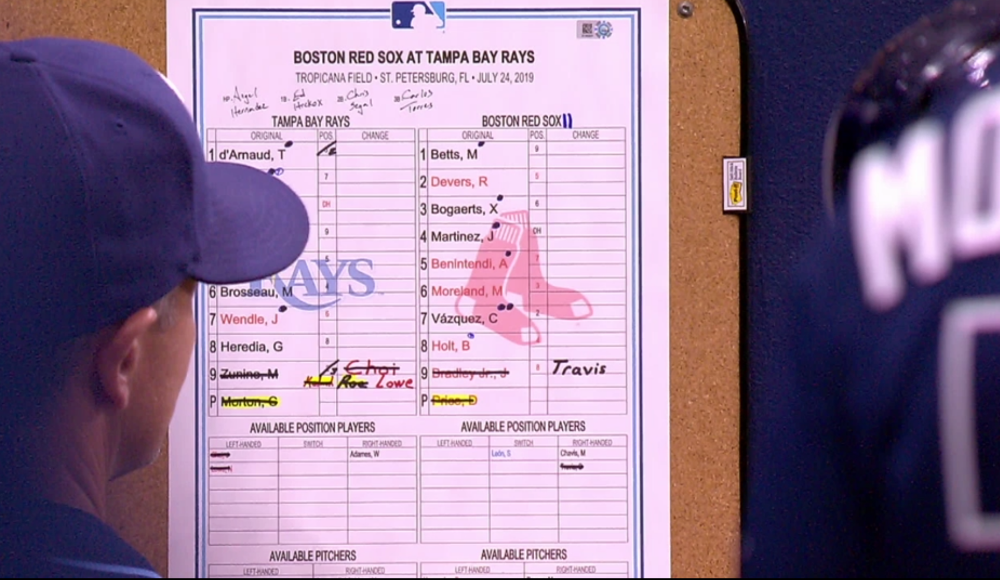
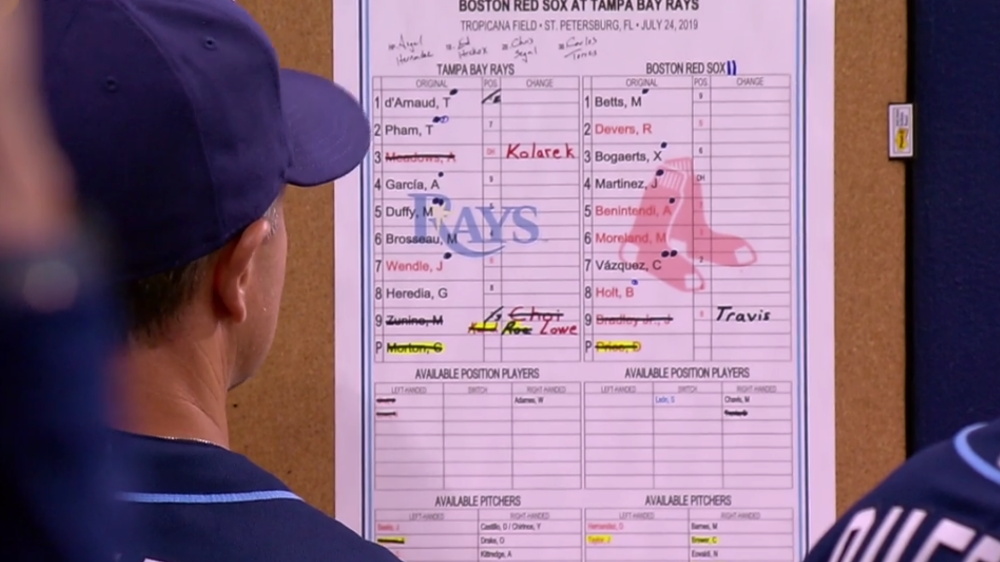
If you looked at the eighth inning play-by-play of Wednesday’s game between the Boston Red Sox and Tampa Bay Rays, you might have spotted something unusual, though not that unusual:

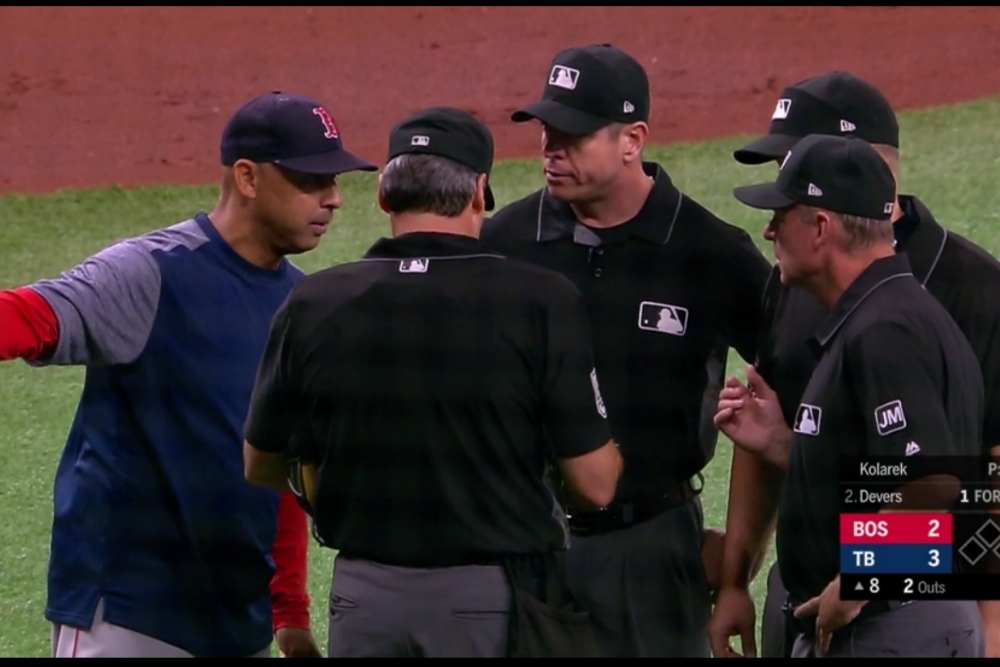
The unusual part is that Adam Kolarek pitched to two batters in the inning but did not do so consecutively. This isn’t that unusual. The Rays have employed a similar strategy before. Joe Madden has done it with the Cubs. Whitey Herzog did it with the Cardinals back in the 1980s. It may be unconventional, but it isn’t against the rules. It should not cause great delays in games. It did, however, cause an issue in this game. After Kolarek had moved to first base, Chaz Roe got Mookie Betts to fly out for the second out of the frame. Then Kolarek moved from first back to the mound, and trouble ensued.

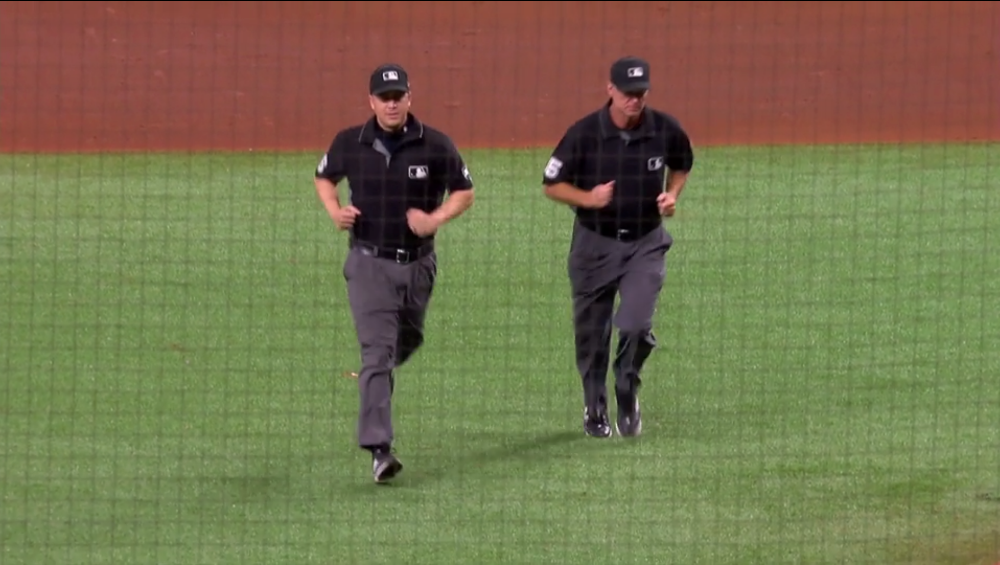
Instead of seeing baseball on their screens, fans saw baseball types standing around.

The umps are befuddled:

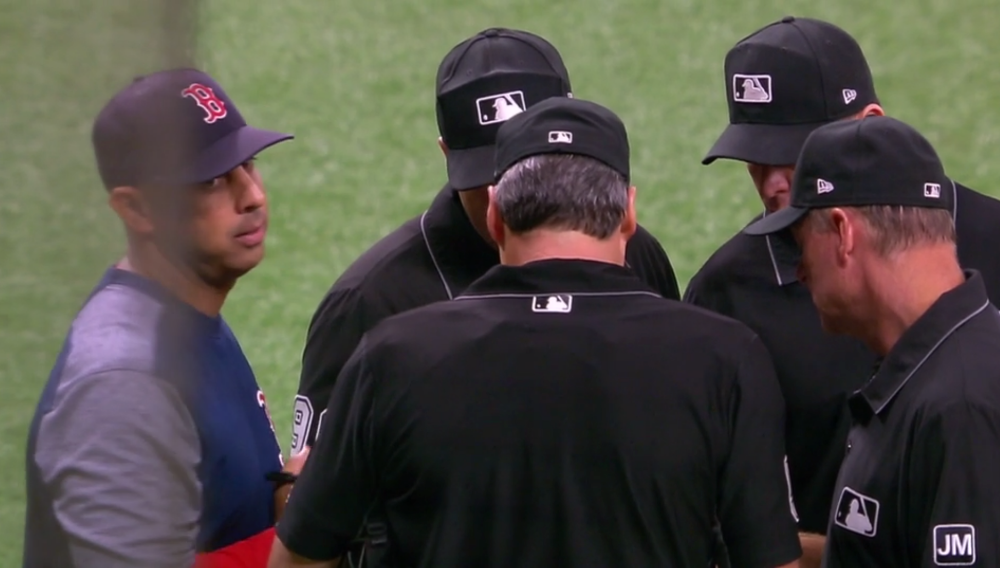
Alex Cora is mad:

Kevin Cash isn’t mad, he’s just disappointed:

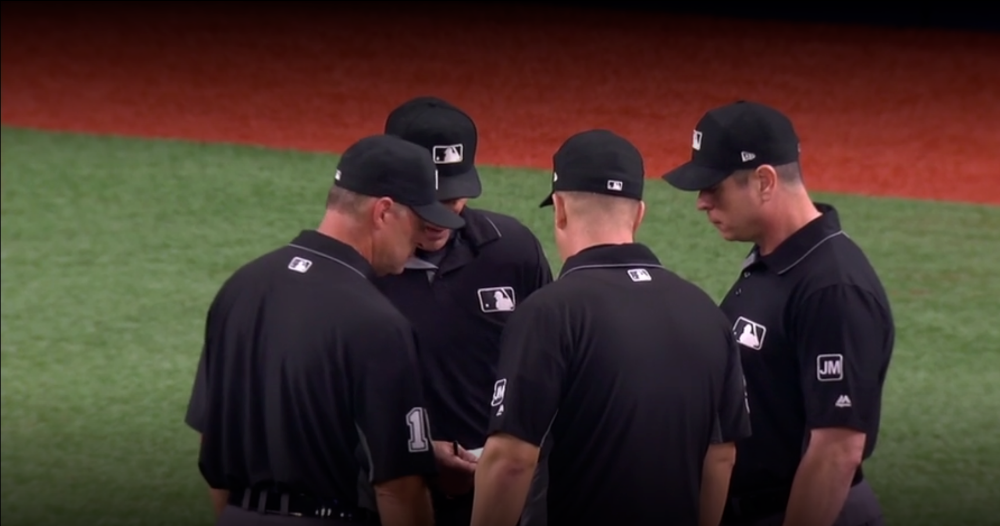
The umps don’t want to hear anymore from either manager and start a silent disco:

Finally, Angel Hernandez goes to the Red Sox dugout to see if Alex Cora really does have BINGO:

The switch was a little tricky, but come on. It shouldn’t have taken this long. To give some sense of how lengthy the delay was, go read my piece where I predicted what will happen at the trade deadline with scenarios for all 30 teams. Back? Good. Now listen to one of your favorite songs of standard radio single length, let’s say “American Girl” by Tom Petty and the Heartbreakers. Finished? Okay, now back to the game action:

One pitch and one out to end the inning. Commercial break and then back to more game action, right? I have bad news:

So what did everyone think of the silent disco?

Some spicy lineup card action:

Someone just asked Alex Cora if his refrigerator was running:

Can I interest you in a different lineup card?

The Rays dugout is absolutely riveted:

Maybe they missed seeing the lineup card the first time?

In the time between when the pitch that ended the top of the eighth was thrown and the action in the bottom of the eighth actually commenced, you could have read Eric Longenhagen and Kiley McDaniel’s announcement that farm system rankings are now on THE BOARD and this Ben Clemens piece on Andrew Miller. In all, fans saw one pitch in about 23 minutes. The delay was not caused by an illegal move per se, but by the umpire’s lineup card not reflecting quickly enough which spot Adam Kolarek was taking in the lineup. That decision would have been up to Kevin Cash if he so chose; otherwise the umpire gets discretion. But Alex Cora believed the umpire didn’t put Kolarek in the lineup at the time of the change and protested the game.

The Rays won 3-2. The rest of us weren’t so lucky.


Escape Artistry: Rare Strikeouts

Watch a baseball game. Pick a side. Now, wait for a pitcher on the team you’re rooting for to fall behind in the count 3-0. It feels pretty bad, doesn’t it? There is, I think, no feeling quite like the helplessness that comes when your team is behind in the count 3-0. There are worse feelings, sure, even within the confines of baseball. There’s the feeling of losing a close game, coughing up a lead, or seeing a favorite player injured. Nothing is quite the same, though, as the long dread of trying to escape from 3-0.

Why does 3-0 feel so uneasy? I think it’s because there are no good quick ways out of the jam. You feel nervous, and you’re going to feel nervous for a while. Next pitch a ball? That’s disappointing for obvious reasons, but at least the tension is over. No, the real problem is that a strike doesn’t feel much better than a ball. So what are you hoping for? You certainly don’t want a swing — swings on 3-0 are tremendous for the batter.

Do you want a take, then? The pitcher grooves a fastball, and the batter watches it fly by? Sure, that’s probably the best outcome you can hope for in the situation, but that’s small consolation. Get a strike, and it’s still 3-1; time for another 30 seconds of watching your team in a tough situation. Even then, what are you hoping for? Batters are producing a .475 wOBA after 3-1 counts this year, better offensive production than any player in baseball’s overall line.

Even if, and this is a huge if, your team gets two straight strikes — now it’s 3-2. This is after a nerve-wracking minute of real time, potentially involving some loud foul contact. You’ve worried about walks for two straight pitches, wondered if the pitcher has it today, and still — 3-2 is a hitter’s count. At the beginning of the at-bat, if I told you it was headed for a 3-2 count, you wouldn’t have been happy. That’s the best case scenario after you reach 3-0. No wonder 3-0 feels so bad. Read the rest of this entry »


The Changing Landscape for Flat Ground Throwing

Spend any time in a big-league ballpark in the hours before first pitch, and you’ll likely see a pitcher standing in short right or left field, throwing a flat ground. He’ll start his delivery just inside the foul line, feet planted on green grass. His catcher will be around 45 or 50 feet away, half-crouched in the shallow part of the outfield usually reserved for soft line drives. The pitcher will wind and deliver eight or nine times, usually at something like 80% effort, before huddling with his catcher and perhaps a coach or two. Then, gloves loose in their hands, the men will walk back to the dugout to continue their pregame routines.

That scene plays out hundreds of times a day in ballparks across the country. But the practice of throwing flat grounds has come under scrutiny recently, as coaches and front office personnel increasingly worry about the risk of an injury. Over the last few months, I asked a dozen or so players, coaches, and executives about flat grounds and how they’re used. After those conversations, I’m confident in two things: One, most teams who’ve thought hard about the practice have concluded that it has a neutral effect at best and could potentially be harmful. And two, that flat grounds probably aren’t going away anytime soon.

First, the case for flat grounds. For the most part, pitchers I asked told me that they just want to get a better sense of how individual pitches feel coming out of their hands. For that, they insisted, it doesn’t matter whether you’re throwing off a mound or on the field, and faced with the choice between schlepping out to a bullpen mound or simply stepping from the dugout into short right or left field, they prefer the latter. Many discounted immediately my theory that the lack of a drop-down from the mound interrupts upper-half timing based on the moment the front foot hits the ground. “I’ve been throwing flat grounds all my life,” said Marco Gonzales, “and I’ve never noticed a difference.”

But a number of coaches I spoke to expressed variations of the same concern: That practicing pitches on flat ground when they will eventually need to be thrown off a mound gives players bad information about what their repertoire will actually look like in-game.

“We’ve found that the feel guys get for the plate isn’t accurate [while throwing flat grounds],” said the Mariners’ Brian DeLunas. “For sliders and split-fingers especially, you’re just not going to get the same break. I have guys out there who’ll try to throw those pitches, and they’ll be like, damn, this pitch isn’t working! But if your slider isn’t breaking on a 50-foot throw, that’s actually good, because it really should be breaking in the last 15 or so feet.”

There are also elements of standard pitching deliveries that have in-game consequences but simply can’t be practiced on flat ground. “With a flat ground,” said Carl Willis, the Indians’ pitching coach, “the risk is that because you’re not able to get as much extension [on the front half], the consistency of work can suffer. Sometimes you’ll see a guy lose his posture as he comes down the slope, and you want to be able to maintain that posture throughout games. The only way you can really know it, and feel it, is to practice it on the mound.”

But the argument for flat grounds has never been that they replicate an in-game environment. The case is that they’re convenient, and require substantially less effort — and therefore presumably create less wear-and-tear for tired arms — than throwing full-speed off a mound. But is that last claim actually true?

In 2017, Driveline Baseball released a study (building off of a 2014 article in the American Journal of Sports Medicine) that suggested that, holding velocity constant, flat ground pitching generates about 6% more stress on elbows and shoulders than throwing off the mound. Critically, the study also found that stress does not decrease linearly with reduced effort, which means that if pitchers are throwing at 80-90% velocity on flat ground, the stress on their arms is likely about the same as it would be throwing full speed off the mound. Internal studies reaching similar conclusions have led the Mariners, at least, to try eliminating the practice altogether throughout their system (though with limited effect). Other teams have not gone quite as far, despite acknowledging the public evidence.

“If you’re talking about these guys throwing high-effort, it’s a proven fact that flat grounds can be more harmful at the same rate of speed than on the mound,” said Oakland’s pitching coach Scott Emerson. “But if you slow it down, it’s ok. They mostly just use it for target practice. And I’m just using it to see how the pitches look coming out of their hands. Nothing more than that.”

“In my experience, the flat ground can take a little bit of stress off of the arm for guys who are trying to recover,” said Willis. “That’s simply because they’re not working down the slope. That foot plant [which comes 4-6 inches above where it would off the mound] does hinder some extension a little bit, but if you can maintain that delivery, sometimes it tends to help with the recovery, coming back to make your next start.”

To my ear, the persistence of the practice league-wide in the face of reasonably sound evidence that its main theoretical benefit (the lower effort required) isn’t actually a benefit at all seems less about arm stress than convenience.

Most big-league teams carry 12-13 pitchers, and most big-league parks are equipped with just five outdoor mounds: two in the bullpen for each team, and one in the center of the diamond. If teams insisted that their pitchers throw exclusively off of mounds, they’d still only have two mounds to use (the mound on the field being, of course, in use for batting practice, and the remaining four divided between two teams). That would add an element of coordination to a pre-game period already rife with competing priorities for players’ time. “Besides,” one coach told me, “most of our players just aren’t going to walk their asses the 150 yards from the dugout to the bullpen to do their work.”

There’s also a degree of inertia: flat grounds persist because they’re something players have always done. This starts in amateur leagues, where the imbalance between mounds available and players using them is even more stark than in the pros, and where there is even less knowledge of the potentially harmful effects. Gonzales’s response to my question, quoted above, was typical of player responses for this story. Most reacted to my questions about flat grounds as if I had asked them if they put their pants on one leg at a time in the morning, or why they eat breakfast before lunch; they just do, and don’t think much about it. “I’d love it if we had six or seven mounds so we could do all our work there,” said Emerson. “But we don’t. For a lot of our guys this is just a part of their daily routines.”

But as conservative as baseball can be about its traditions and routines, the last two decades of constant self-evaluation and reinvention by coaches and front offices demonstrates that even long-held practices can change when they’re no longer deemed useful. “I don’t think that clubs have really thought hard enough about the risks to flat grounds,” said Bobby Evans, the former Giants’ general manager. “I think the assumption is that it’s just a warmup, when it might really be something that can put players at risk of injury. I want to know more.”

I do, too. There’s a benefit to allowing players to continue long-established routines, to be sure, and it’s probably one I underrate as an external observer of the game. But the evidence for flat grounds as a practice seems flimsy, and I’m not sure I’d be all that invested in it even if the evidence were good. At the very least, I’d welcome the opportunity to learn more about its biomechanical effects. For now, I’m with DeLunas: “Can you imagine a golfer going to the range and spending their afternoon hitting the ball with the back of the club over and over? They would never, ever do that. So why do we?”

The wonderful David Laurila contributed reporting by interviewing Cleveland’s Carl Willis.