Archive for Daily Graphings

Red Sox Prospect Tanner Houck Has That Sinking Feeling Again

Tanner Houck is off to a book-ended beginning to his second full professional season. Boston’s first-round pick in the 2017 draft allowed seven runs in his first start, and in his fifth, he allowed five. In between, he authored three beauties. Pitching for the Portland Sea Dogs, the 22-year-old righty held Double-A opponents to 10 hits, and a lone marker, over 16 innings.

Houck relies heavily on a worm-killing two-seamer. It’s the pitch that wowed scouts when he was at the University of Missouri, and while it’s once again his go-to, that wasn’t the case over the first half of last season. The Red Sox had Houck put his signature pitch in his back pocket and primarily throw four-seamers against Carolina League competition. The reasoning was sound, but the results weren’t particularly pretty. A fish out of water without his sinker, Houck got hit around.

Come midseason, the Boston brain trust decided that Houck should go back to his old bread and butter. The news came as a relief. His best pitch back at the forefront of his arsenal, Houck proceeded to reestablish himself as one of the organization’s top prospects.

Houck, who takes the hill today in an 11 a.m. matinee, sat down for an in-depth discussion of his two-seamer, and what he gained from last year’s four-seam experiment, at the outset of the current campaign.

———

David Laurila: How would you describe the transition away from, and back to, your two-seamer?

Tanner Houck: “Honestly, [transitioning back] was just like riding a bike. It was getting back to my staple — back to who I am — and to how my career is going to be going forward. It was enjoyable. At the same time, not having thrown a four-seam in college, learning that side of the coin was really big for me. I’m still throwing one now, and it makes the two-seam that much better. Being able to ride a four-seam through the zone — not sink it — in certain counts has definitely helped. I’m able to give the hitter two different looks with relatively the same pitch.”

Laurila: What kind of movement do you get on your four-seamer? Read the rest of this entry »


Let’s Freak Out About Vladimir Guerrero, Jr.

Big expectations — and building anticipation — can bring out the need for immediate results. Vladimir Guerrero, Jr. had humongous expectations given his lineage, his prospect status, and the utter destruction he wrought on minor league pitching. His name made him known earlier than other prospects without Hall of Fame fathers, but his play declared him ready for the majors last year, with some desiring a May call-up and the player’s union mentioning him by name last September when he remained in the minors. Through 10 games, Vladimir Guerrero, Jr. has not produced, but then, even super-duper prospects who are almost completely unlikely to bust sometimes don’t hit well for 10 games.

Given the expectations, it’s easy to call a .162/.244/.189 slash line with a 23 wRC+ disappointing. It is disappointing. Just like the 29 wRC+ Paul Goldschmidt has put up over the last 14 days. Or the 35 wRC+ from Corey Seager during the same time period. Mitch Haniger’s wRC+ over the last two weeks is a measly 49. Ronald Acuña Jr.’s is barely better at 51, with Jose Altuve just ahead at 56. It’s possible the latter numbers have escaped your attention. It’s okay to have missed them or to even have known about them and ignored them because we know they aren’t an accurate representation of the talent level these players possess. But when a player comes up from the minors for the first time and doesn’t break out immediately, second thoughts can creep into the backs of our minds about can’t-miss prospects who missed.

Read the rest of this entry »


Chris Paddack’s Relentless Attack

As beef goes, the Chris PaddackPete Alonso back-and-forth wouldn’t make the grade for even the sketchiest ballpark hot dog; Monday night’s Petco Park matchup between Paddack and Jacob deGrom was of a choicer cut. In just his seventh big league start, the 23-year-old rookie dominated a flailing Mets lineup and out-dueled the reigning NL Cy Young winner, continuing a run that has produced some eye-opening numbers.

Paddack and deGrom matched zeroes until the bottom of the fifth inning, with the former, consistently attacking high in the zone, having struck out eight to that point while allowing just a pair of singles, and the latter punching out four while allowing just one single. In the bottom of the fifth, Hunter Renfroe — still basking in the glow of Sunday’s walk-off grand slam against the Dodgers’ Kenley Jansen — hit a solo homer. The Mets put two on base in the top of the sixth to no avail, and the slim margin continued until the bottom of the seventh when the Padres scored again on an Eric Hosmer single, a Renfroe double, and a Ty France sacrifice fly. That was deGrom’s last inning, while Paddack continued until yielding a two-out single to Jeff McNeil in the eighth. He departed having struck out a career-high 11 while allowing just four hits and a walk; he went to a three-ball count just twice. The Padres cruised to a 4-0 win. Read the rest of this entry »


Mike Fiers Threw His Second No-Hitter

Last night, Mike Fiers threw his second no-hitter. He no-hit the Reds on 131 pitches, with three batters reaching against him on two walks and an error. It was the 300th no-hitter in major league history, and Fiers became the 35th pitcher in major league history to throw multiple no-hitters.

“You almost get emotional,” he said after the game.

***

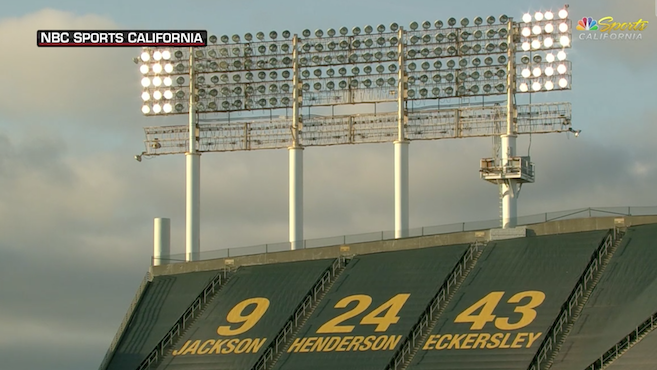
The lights were out. Three panels of them out of five on the tower were non-functioning, looming barren above left field at the Oakland-Alameda County Coliseum. Where usually there were rows of bright lights, a series of illuminations hanging above the names of Jackson, Henderson, Eckersley, there were instead the unimpressive shadows of bare bulbs.

The problem was unanticipated, and clearly not easily fixed. I was watching when the lights went out at Dodger Stadium last year, and that technical issue certainly looked more impressive — one moment I saw a ballpark where a baseball game was happening; the next, a panicky wave of cell phone flashlights cresting a sea of darkness. But while play resumed for the Dodgers in just 20 minutes, it took almost two hours for the scheduled game between the Reds and the A’s to begin. Fifteen more minutes and the game wouldn’t have happened at all. Even as Fiers took the field to begin warming up, the lights still flickered, unsure. Read the rest of this entry »


Brad Hand, Fly Ball Enthusiast

If you don’t look too closely, it’s easy to see Brad Hand at the top of the ERA and WAR leaderboards for relievers and shrug. He’s an excellent reliever, of course; he hasn’t had an ERA above three since adding a slider after the 2015 season. When Cleveland traded Francisco Mejia for him (and Adam Cimber) last summer, they weren’t adding two generic middle relievers; Hand was the hottest commodity on the relief-pitching market for a reason.

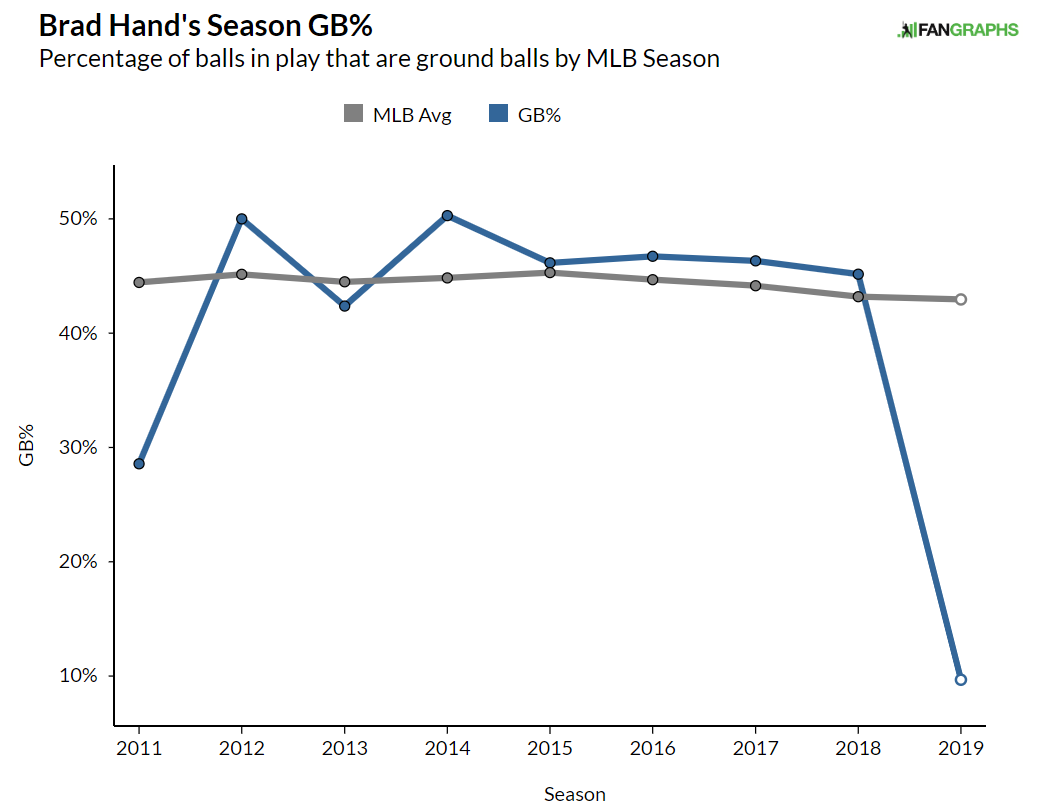
There’s nothing too surprising about a good reliever continuing to be good. Hand struck out 35% of the batters he faced last year; he’s up to 39% this year, which is better but not obscenely so. If you don’t look at Hand’s batted ball data, in fact, you might think nothing has changed. The fact that I wrote that, though, means that you should look at his batted ball data; something jumps out immediately there. Take a look at this graph of Hand’s groundball rate by year:

What the… Brad Hand has the lowest GB% in baseball this year, and it’s the lowest by a lot. His 9.7% mark is less than half the next-lowest rate. The distance between Hand and second-place Jeffrey Springs is the same as that between Springs and 23rd-place Roenis Elias. That’s quite a change for a pitcher who had run a higher-than-average groundball rate the last three years.

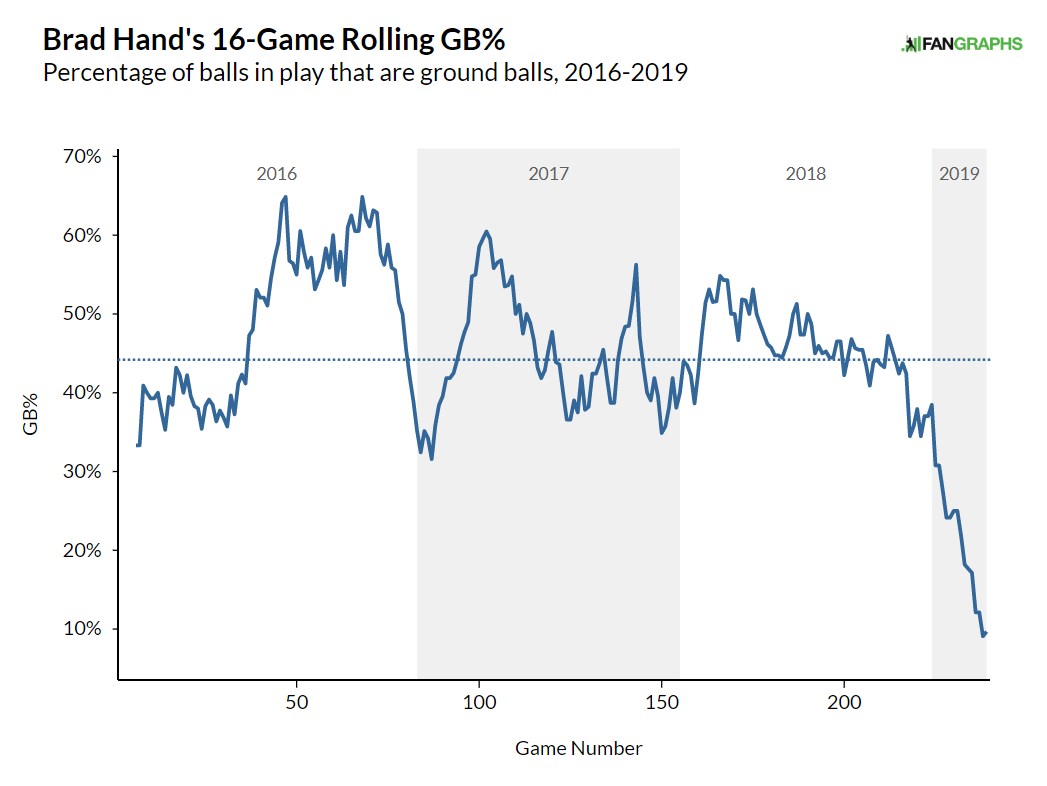
The first thing to ask when seeing a split as extreme as this is “Is it April?” Now, while it’s not April, it’s still early in the season, particularly for a reliever. Hand has appeared in 16 games this year, so let’s take a look at his groundball rate over every 16-game stretch since 2016:

Yeah, okay, something’s up.
Read the rest of this entry »


A Comprehensive Look at Bryce Harper’s Streaky Start

In his first week in Philadelphia, Bryce Harper came out firing on all cylinders. He homered in three of his first four games, including a long blast (and majestic bat flip) in his first game back at Nationals Park, where he was greeted with a chorus of boos.

But since Harper’s first five games of the 2019 season, he’s been hitting like one of the worst hitters in baseball. That is, before he broke out in a big way last night, going 2-for-3 with a single, walk, and grand slam. But, in a much larger sample of 128 plate appearances between when the Nationals series ended and last night, Harper had slashed just .185/.313/.343 with as many home runs (three) as he had in his first 23 plate appearances in those first five games. The 80 wRC+ he put up during that stretch ranked 201st out of the 283 hitters with at least 50 plate appearances. Harper was not only failing to hit like a superstar, he was actually hitting like one of the worst players in the league. Read the rest of this entry »


Looking for Vintage Madison Bumgarner

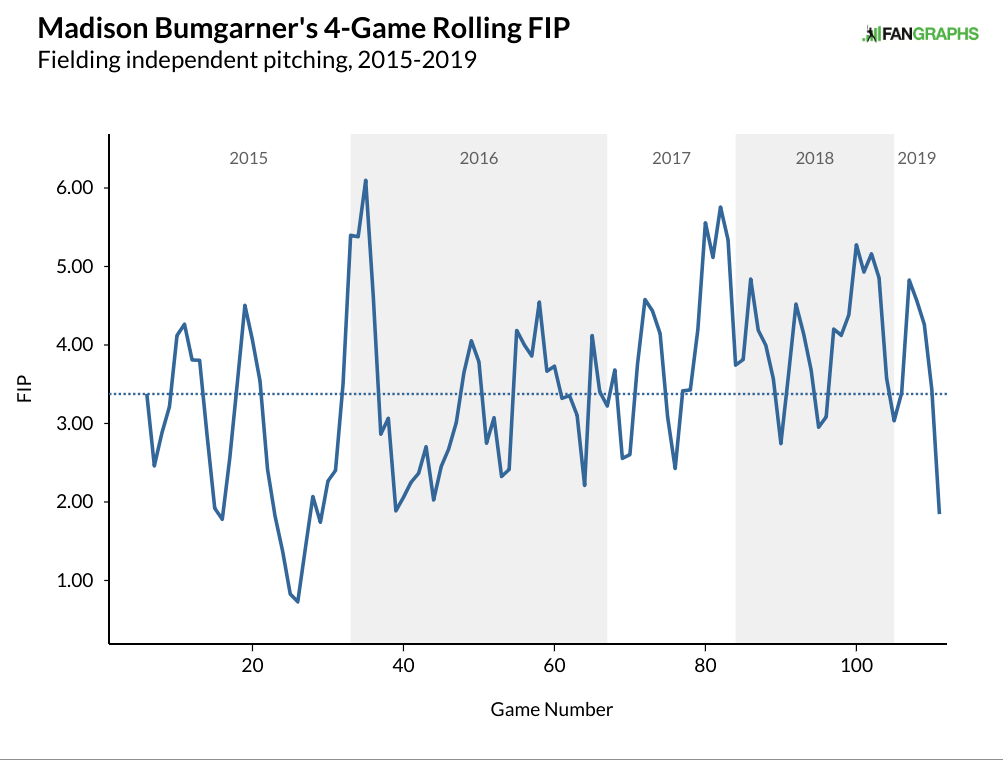
Madison Bumgarner’s reputation as a pitcher wasn’t burnished during the regular season. Bumgarner has been mostly very good as a starter prior to October. From 2011 through 2016, he averaged 212 innings and 3.9 WAR per year. During that time his 23.3 WAR places him ninth among major league starters, which is more a low-level ace than a dominator in the form of a Clayton Kershaw or Max Scherzer. No, it was in three postseasons that Bumgarner forged his reputation, pitching another 100 innings across three playoff seasons and three championships, including earning NLCS and World Series MVP honors in 2014. With the Giants unlikely to contend this season, Bumgarner’s value to the club more likely lies as a trade chip than a bringer of championships. After struggling the last two seasons, Bumgarner is pitching better in 2019, but whether he’s back to his old level of success remains to be seen.

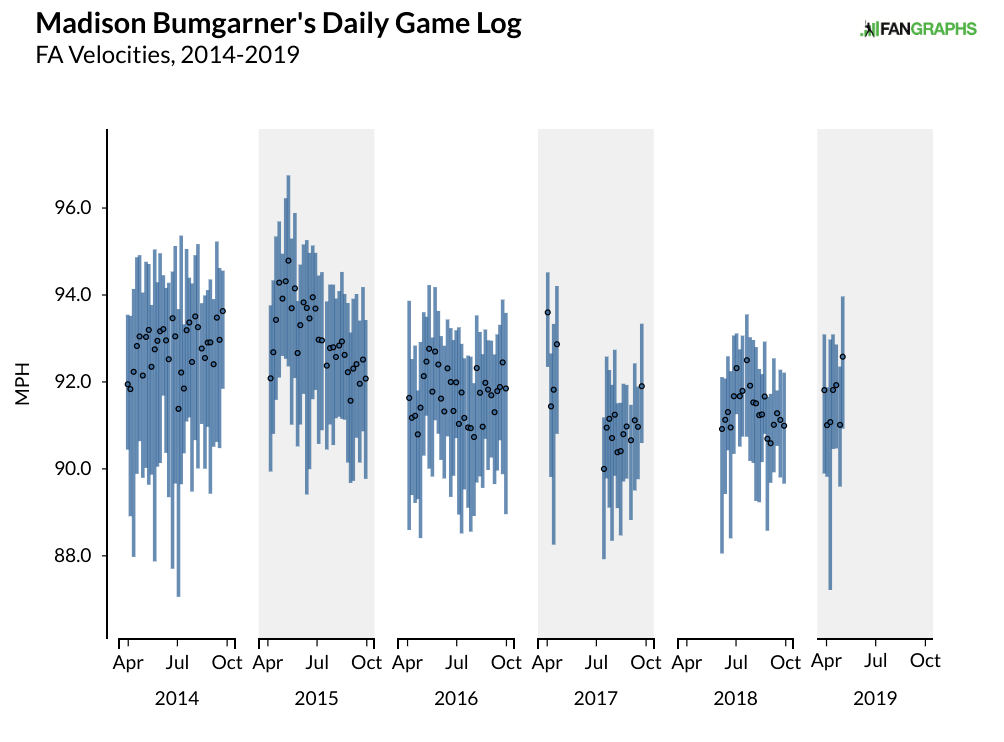
We are still just seven Bumgarner starts into the season, but there is a bit of optimism. In his last start, Bumgarner threw the ball harder than he has in some time on the way to six innings of one-run ball against the Dodgers during which he struck eight against just two walks. The velocity wasn’t just encouraging, it was harder than he’s thrown in years.

Other than a few starts in early 2017 before he was hurt, Bumgarner hasn’t thrown the ball with as much velocity as he did the other night on a regular basis since the 2015 season. And it wasn’t just the last start that Bumgarner has pitched well. While the velocity against the Dodgers was new, in his last four starts, Bumgarner has struck out 27 batters against just three walks in 24.2 innings for a 1.84 FIP. That four-game FIP is the best Bumgarner has put together since the 2015 season and nearly a full run lower than any stretch last year.

Bumgarner is pitching better than the last few seasons, but to get some idea about how much better, let’s take a baseline and compare Bumgarner over three different periods, plus the last four starts as a bonus. First, let’s look at some numbers most readers at FanGraphs should be familiar with. Read the rest of this entry »


Matt Chapman Talks Hitting

Matt Chapman is starting to come into his own as a hitter. Known primarily for his defense — he won a Gold Glove last year in his first full big-league season — the 26-year-old third baseman is slashing .295/.384/.597. He leads the Oakland A’s in all three of those categories, while his nine home runs rank second, behind Khris “Mr. .247” Davis. Moreover, he’s displaying far better discipline than he did a year ago. Along with upping his walk rate, Chapman has nearly halved his K rate. Slowly but surely, he’s becoming an offensive force.

Chapman talked about his offensive approach, which includes looking for pitches middle, middle-away, when the A’s visited Fenway Park last week.

David Laurila: I start a lot of interviews with this question: Do you consider hitting to be more of an art, or more of a science?

Matt Chapman: “Baseball, in general, is kind of like a fine line. So it’s a little bit of both. It’s an art in the sense that everybody is unique — everybody has the things that work for them — and you have to let your natural ability take over. But then there are the mechanics and the numbers. That’s the science part of it. Both are important. You can’t live and die with either.

“For me, the science part is that I see little tiny things in my swing, on video, that need to be mechanically sound. When I’m not feeling as good as maybe I should, I’ll go to the film. I don’t dissect every little thing, but there are a few things I look at. Am I on time? Am I getting in the right hitting position? Sometimes when I struggle, it’s because I’m getting a little too pull-happy. So, is my barrel up, or am I opening up and my barrel is dropping?”

Laurila: Are you looking at more video, and data, than in the past? Read the rest of this entry »


I Wanna Be Like Mike (Trout)

It’s amazing to write about baseball through the lens of a singular player like Mike Trout. The sheer totality of his excellence is fun in a way that just wouldn’t be true if you looked at all of his skills individually. Trout is an above-average outfielder, sure, but that isn’t all that fun by itself. He has great plate discipline — so too, though, does 2019 Jason Heyward, and he doesn’t spark the same kind of joy as Trout. No, the fun is that there’s basically no category you can come up with where Mike Trout isn’t good.

This got me to thinking: would it be fun to have a player who was like Trout, except not to quite the same degree? I don’t mean in the broad player value sense — in a way, every player in baseball is just a worse version of Trout. No, I mean someone who’s good at everything across the board in the same way that Trout is — just, a little less.

Trout hits for power, so our mystery player will need to hit for good (but sub-Troutian) power. Scratch both Joey Gallo and Jose Altuve from the list. They have to have an excellent eye at the plate and be judicious with their swings; sorry, Javier Baez, but the ride ends for you here. They need to be an above average baserunner, but not the best of the best — J.D. Martinez and Trea Turner both fall at this hurdle.

To work out this highly unscientific study, I started with stats from 2017-present for everyone who qualified for the batting title in at least one of the three years. This lets me cast a wide net without picking up someone whose prime isn’t happening now. First, I looked for players who were worse than Trout in a few categories: ISO, OBP, SLG, BsR/PA, BB%, and K%. (At this point in the search, I learned that Trout has a higher ISO than Aaron Judge, and I mean, wow.) Read the rest of this entry »


How Sinclair’s Purchase of Baseball Sports Networks Will Affect You

Near the end of 2017, reports surfaced of a massive deal that would see Disney buy more than $50 billion in FOX assets, including 22 regional sports networks that broadcast the games of about half of the 30 major league baseball franchises. After a bidding war between Comcast and Disney saw the latter win out, moves needed to be made to satisfy antitrust concerns. Given Disney’s already powerful place in the market with its ESPN family of channels, one of those moves included the sale of those regional sports networks. The first domino fell in March when the Yankees agreed to buy back the YES Network at a total valuation of around $3.5 billion dollars. Now, the remaining dominoes appear to have fallen, with the Wall Street Journal first reporting that Sinclair Broadcasting Group has agreed to buy the remaining 21 networks, valued at $10.6 billion.

The networks included in the deal are as follows:

MLB Regional Sports Networks Purchased by Sinclair
Team Network
Angels Fox Sports West
Braves Fox Sports South/Southeast
Brewers Fox Sports Wisconsin
Cardinals Fox Sports Midwest
Diamondbacks Fox Sports Arizona
Indians Fox SportsTime Ohio
Marlins Fox Sports Florida
Padres Fox Sports San Diego
Rangers Fox Sports Southwest
Rays Fox Sports Sun
Reds Fox Sports Ohio
Royals Fox Sports Kansas City
Tigers Fox Sports Detroit
Twins Fox Sports North
Other networks included in this deal are Fox Sports Carolinas, Fox Sports Indiana, Fox Sports New Orleans, Fox Sports Oklahoma, Fox Sports Prime Ticket, and Fox Sports Tennessee. Sinclair has previous reached deals with the Cubs (Marquee Network) and Yankees (YES) for less than a controlling interest.

Read the rest of this entry »