Baseball trades are at their most interesting when they involve players with notable skill sets and teams with widely varying needs. Here, take my Luis Arraez, and I’ll take your Pablo López in return. Your Zac Gallen for my Jazz Chisholm. I suppose the Marlins are, in this way at least, my platonic ideal of a baseball team. But not all trades are like that. Some trades barely care about the skillsets of the players involved and instead depend to an annoying amount on their contracts. Take this one, a trade from last week’s Winter Meetings:
Rule no. 1 of MLB’s Winter Meetings: Beware of water features. Nashville’s Gaylord Opryland Resort & Convention Center, which for the next three days will serve as Vatican City for dudes in quarter zips and running shoes, contains within its expansive halls an artificial river. I’m in the process of putting together a bounty pool to see if we can get a writer to fall in the drink by the end of the week, but so far everyone’s stayed dry.
Nobody has suffered the fate of this legendary unfortunate, who absentmindedly stumbled into a Dallas hotel fountain in 2011, live on MLB Network. I’d like to propose — with the understanding that this might be controversial — that face-planting into a water feature would’ve been a more productive use of Jerry Dipoto’s Sunday evening than what he actually got up to.
The following article is part of Jay Jaffe’s ongoing look at the candidates on the BBWAA 2024 Hall of Fame ballot. It was initially written for The Cooperstown Casebook, published in 2017 by Thomas Dunne Books, and subsequently adapted for SI.com and then FanGraphs. For a detailed introduction to this year’s ballot, and other candidates in the series, use the tool above; an introduction to JAWS can be found here. For a tentative schedule and a chance to fill out a Hall of Fame ballot for our crowdsourcing project, see here. All WAR figures refer to the Baseball-Reference version unless otherwise indicated.
It happened so quickly. Freshly anointed the game’s top prospect by Baseball America in the spring of 1996, the soon-to-be-19-year-old Andruw Jones was sent to play for the Durham Bulls, the Braves’ High-A affiliate. By mid-August, he blazed through the Carolina League, the Double-A Southern League, and the Triple-A International League, then debuted for the defending world champions. By October 20, with just 31 regular-season games under his belt, he was a household name, having become the youngest player ever to homer in a World Series game, breaking Mickey Mantle’s record — and doing so twice at Yankee Stadium to boot.
Jones was no flash in the pan. The Braves didn’t win the 1996 World Series, and he didn’t win the ’97 NL Rookie of the Year award, but along with Chipper Jones (no relation) and the big three of Greg Maddux, Tom Glavine, and John Smoltz, he became a pillar of a franchise that won a remarkable 14 NL East titles from 1991 to 2005 (all but the 1994 strike season). From 1998 to 2007, Jones won 10 straight Gold Gloves, more than any center fielder except Willie Mays. Read the rest of this entry »
The following article is part of Jay Jaffe’s ongoing look at the candidates on the BBWAA 2024 Hall of Fame ballot. Originally written for the 2015 election at SI.com, it has been updated to reflect recent voting results as well as additional research. For a detailed introduction to this year’s ballot, and other candidates in the series, use the tool above; an introduction to JAWS can be found here. All WAR figures refer to the Baseball-Reference version unless otherwise indicated.
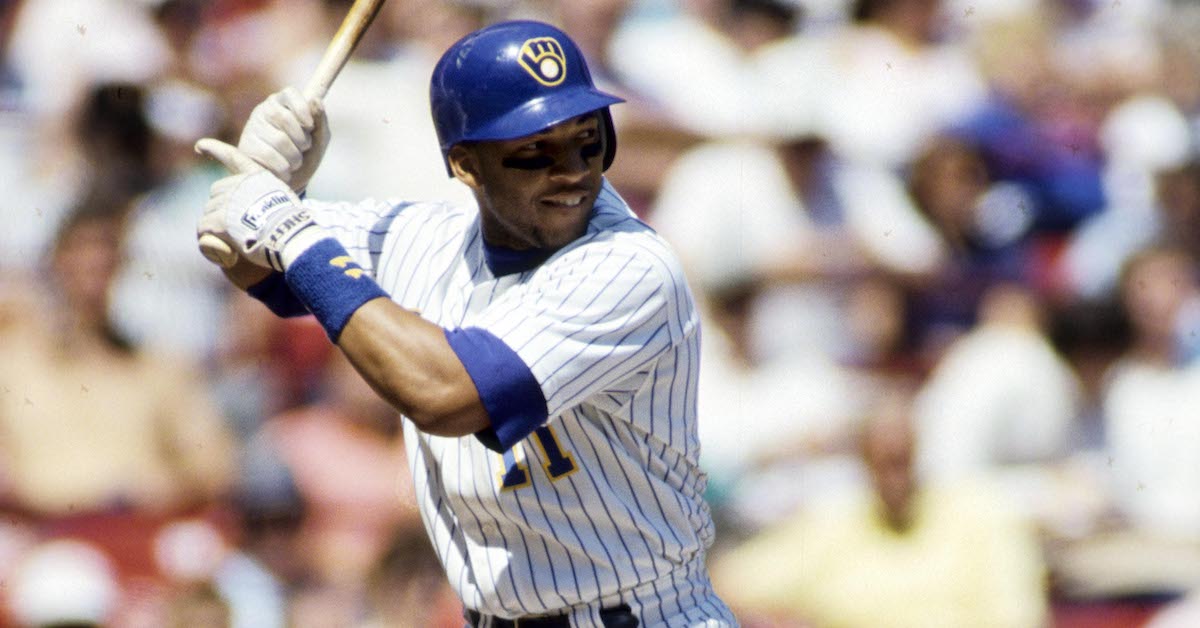
Wherever Gary Sheffield went, he made noise, both with his bat and his voice. For the better part of two decades, he ranked among the game’s most dangerous hitters, a slugger with a keen batting eye and a penchant for contact that belied his quick, violent swing. For even longer than that, he was one of the game’s most outspoken players, unafraid to speak up when he felt he was being wronged and unwilling to endure a situation that wasn’t to his liking. He was a polarizing player, and hardly one for the faint of heart.
At the plate, Sheffield was viscerally impressive like few others. With his bat twitching back and forth like the tail of a tiger waiting to pounce, he was pure menace in the batter’s box. He won a batting title, launched over 500 home runs — he had 14 seasons with at least 20 and eight with at least 30 — and put many a third base coach in peril with some of the most terrifying foul balls anyone has ever seen. For as violent as his swing may have been, it was hardly wild; not until his late 30s did he strike out more than 80 times in a season, and in his prime, he walked far more often than he struck out.
Bill James once referred to Sheffield as “an urban legend in his own mind.” Off the field, he found controversy before he ever reached the majors through his connection to his uncle, Dwight Gooden. He was drafted and developed by the Brewers, who had no idea how to handle such a volatile player and wound up doing far more harm than good. Small wonder then that from the time he was sent down midway through his rookie season after being accused of faking an injury, he was mistrustful of team management and wanted out. And when he wanted out — of Milwaukee, Los Angeles, or New York — he let everyone know it, and if a bridge had to burn, so be it; it was Festivus every day for Sheffield, who was always willing to air his grievances.
Later in his career, Sheffield became entangled in the BALCO performance enhancing drug scandal through his relationship with Barry Bonds — a relationship that by all accounts crumbled before he found himself in even deeper water. For all of the drama that surrounded Sheffield, and for all of his rage and outrageousness, he never burned out the way his uncle did, nor did he have trouble finding work.
Even in the context of the high-scoring era in which he played, Sheffield’s offensive numbers look to be Hall of Fame caliber, but voters have found plenty of reasons to overlook him, whether it’s his tangential connection to PEDs, his gift for finding controversy, his poor defensive metrics, or the crowd on the ballot. In his 2015 debut, he received just 11.7% of the vote, and over the next four years, he gained barely any ground. But from 2019 to ’21, he jumped from 13.6% to 30.5% to 40.6%, with the fifth-largest and third-largest gains on the ’20 and ’21 ballots. After repeating with the same percentage in 2022, he jumped to 55% in ’23, with the cycle’s fourth-largest gain. His share of the vote is now larger than any player who’s been linked to PEDs via BALCO, the Mitchell Report, or a suspension except for Bonds or Roger Clemens. Still, as he enters his final year of eligibility on the writers’ ballot, he’ll need a Larry Walker-like jump to get to 75%. Read the rest of this entry »
The following article is part of Jay Jaffe’s ongoing look at the candidates on the BBWAA 2024 Hall of Fame ballot. Originally written for the 2016 election at SI.com, it has been updated to reflect recent voting results as well as additional research. For a detailed introduction to this year’s ballot, and other candidates in the series, use the tool above; an introduction to JAWS can be found here. All WAR figures refer to the Baseball-Reference version unless otherwise indicated.
Billy Wagner was the ultimate underdog. Undersized and from both a broken home and an impoverished rural background, he channeled his frustrations into throwing incredibly hard — with his left hand, despite being a natural righty, for he broke his right arm twice as a child. Scouts overlooked him because he wasn’t anywhere close to six feet tall, but they couldn’t disregard his dominance over collegiate hitters using a mid-90s fastball. The Astros made him a first-round pick, and once he was converted to a relief role, his velocity went even higher.
Thanks to outstanding lower-body strength, coordination, and extraordinary range of motion, the 5-foot-10 Wagner was able to reach 100 mph with consistency — 159 times in 2003, according to The Bill James Handbook. Using a hard slider learned from teammate Brad Lidge, he kept blowing the ball by hitters into his late 30s to such an extent that he owns the record for the highest strikeout rate of any pitcher with at least 900 innings. He was still dominant when he walked away from the game following the 2010 season, fresh off posting a career-best ERA.
Lacking the longevity of Mariano Rivera or Trevor Hoffman, Wagner never set any saves records or even led his league once, and his innings total is well below those of every enshrined reliever. Hoffman’s status as the former all-time saves leader helped him get elected in 2018, but Wagner, who created similar value in his career, has major hurdles to surmount. There are, though, fewer hurdles than before: over the past four election cycles, his share of the vote has nearly quadrupled, from 16.7% in 2019 to 68.1% in ’23, not only pushing him past the all-important 50% threshold but also within range of election during this cycle. His advantages over Hoffman (and virtually every other reliever in history when it comes to rate stats) provide a compelling reason to study his career more closely. Given how far he’s come, who wants to bet against Billy Wags? Read the rest of this entry »
Last week I covered the American League half of the flurry of transactional activity that occurred as a result of the 40-man roster and non-tender deadlines. Is any one move here as impactful as signing a Yoshinobu Yamamoto or a Matt Chapman? No, but when your favorite team experiences a rash of injuries in June, whether or not they have the depth to scrap and compete is often dictated by the people and processes that surround this day. Below are my thoughts on the National League, with some quick scouting snippets on most of the added players and thoughts about roster construction where I had something to say.
Arizona Diamondbacks
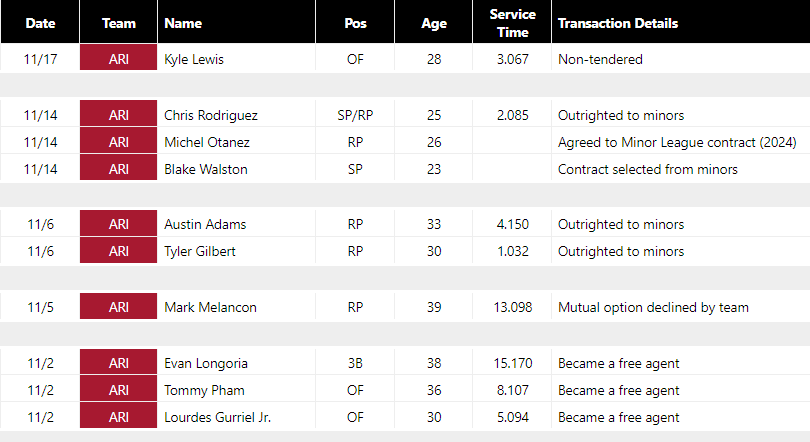
The Diamondbacks lone addition was lefty Blake Walston, a former $2.5 million high school signee who, despite being young for his class and physically projectable as an amateur, has seen his fastball velocity plateau and slightly decline since he signed. He’s had fits and starts where he’s thrown harder, but for the most part, Walston’s fastball still sits 89-92 mph and his performance peripherals took a nosedive in 2023, though part of that was likely because of the PCL hitting environment. The lanky 22-year-old is still a fair long-term prospect because of his age and what one could reasonably hope will still be late-arriving physicality, but for now, I’d consider him at the very back of Arizona’s 40-man starting pitching depth chart. Read the rest of this entry »
Good relief is hard to find. Well, that’s not strictly true. Pretty much every team in baseball has multiple good relievers, random guys who throw 100 mph and snap off ludicrous sliders. But enough good relief pitching is hard to find, because it takes a village’s worth of relievers to get through a season, and the playoffs are even more challenging. As teams go to their bullpen earlier and earlier, they put more pressure on every arm in it, and the penalties to overworking your best few arms areharsh.
Free agency has been ongoing for two weeks now, but for the most part, the big dominoes are yet to fall. While teams certainly have their sights set on the likes of Shohei Ohtani and Cody Bellinger, the early offseason has been defined by smaller moves and signings made around the non-tender and Rule 5 protection deadlines.
The players being exchanged aren’t the most notable members of their respective rosters, yet they’ll still impact the quality of their teams in the upcoming season. We’ll be knocking out many of the more intriguing pitchers who have changed hands in this two-part series. Read the rest of this entry »
The non-tender deadline isn’t usually an event that screams star power. The players involved are pre-free agency, making them cheap and controllable — qualities that appeal mightily to big league GMs. So if there’s even a question about whether a player is worth retaining or trading, as opposed to cutting loose, that usually means the player is neither good nor particularly promising.
Late Thursday night, after the final horn had sounded on the last West Coast NHL game, new White Sox general manager Chris Getz consummated his first trade in his new role, sending sinker-balling lefty reliever Aaron Bummer to Atlanta for a five-player variety pack of “second division” players and reclamation projects. The new White Sox are headlined by 26-year-old 2019 All-Star righty Michael Soroka, 28-year-old infielder Nicky Lopez, and 25-year-old lefty starter Jared Shuster, all of whom can be reasonably expected to impact the 2024 squad. Chicago also acquired 25-year-old infielder Braden Shewmake, who is also on the 40-man roster, and 2023 undrafted free agent starter Riley Gowens, who is more of a developmental project from the University of Illinois. Read the rest of this entry »