Archive for Teams

Scott Kingery’s Royal Improvement

Scott Kingery has had an eventful career.

A second round pick out of the University of Arizona back in 2015, Kingery breezed through Philadelphia’s minor league system. In 2017, he hit .304/.359/.530 with 26 home runs across 603 plate appearances split between Double-A and Triple-A. The next spring, Eric Longenhagen ranked Kingery as the team’s second-best prospect, calling him “a potential star.”

Kingery made national headlines that March when he signed a six-year, $24 million deal, becoming just the second drafted player to sign a multi-year contract before playing in a big league game. Soon after, Sheryl Ring analyzed each side’s motivation for making the move.

“The Phillies and Kingery both walk away with what they needed,” Ring wrote. “For the Phillies, their best chance to win now and, for Kingery, life-changing money. Deals don’t get any better than that.”

In his first taste of the big leagues, Kingery struggled. He played in 147 games, primarily at shortstop (887 innings), though he also saw action at six different positions and even pitched once. But his bat never came around. He slashed just .226/.267/.338 with eight homers and a 62 wRC+. Among batters with at least 400 plate appearances, Kingery was the fifth-worst hitter in baseball. Solid defense (3.4 runs above average) and baserunning (3.4) kept him on the roster, but Kingery was basically a replacement-level performer.

This season, Phillies fans are seeing a rejuvenated Kingery, and not a moment too soon. With Andrew McCutchen on the shelf with a torn ACL, Odubel Herrera on administrative leave after being charged with domestic violence, and Adam Haseley on the injured list after straining his groin, the Phillies’ outfield depth is perilously thin. A trade for Jay Bruce provided reinforcement, but Philadelphia needed someone else to step up, too. Read the rest of this entry »


Joey Gallo Talks Hitting

Joey Gallo is a unique hitter having an outstanding season. Though temporarily sidelined with an oblique injury, he’s slashing .276/.421/.653, with 17 home runs in 214 plate appearances and a 170 wRC+. And when he’s not bopping, he’s usually fanning or walking. The 25-year-old Texas Rangers slugger has the second-highest walk rate, and the second-highest strikeout rate, among qualified major league batters. The antithesis of a singles hitter, Gallo is all about Three True Outcomes.

Gallo sat down for an in-depth discussion of the art and science of hitting earlier this week.

———

David Laurila: Straightforward question to start: What is your hitting approach?

Joey Gallo: “I feel that I have a pretty in-depth thought process at the plate. I always have an approach. I think a lot of people assume I just go up there kind of ‘beer-league-softball,’ and try to crush everything I see. But I have a plan of what I want to do against a certain guy; the pitches I want to look for; who is behind the plate, umpire-wise; who is calling the pitches, catcher-wise; what the environment is; what the situation is. There’s a lot that goes into hitting. It’s not just me trying to put the ball into the seats.”

Laurila: Nuance aside, are you generally hunting fastballs middle, and adjusting from there?

Gallo: “I don’t want to give away exactly what I’m thinking at the plate. Obviously, you’re taught to look fastball and adjust to off-speed, but there are situations where you change that approach and look for different stuff. It changes at-bat to at-bat. Sometimes you’re looking off-speed. Sometimes you’re looking for a certain location. You’re not always just looking fastball, because the guys are so good in this league that you can’t always have exactly the same approach.”

Laurila: Have you made changes this year with either your approach or your mechanics?

Gallo: “I’m trying to stay through the ball a lot more now. That’s something we’ve worked on: I try to stay as short and compact as I can. One thing we talked about when Luis Ortiz was hired [as hitting coach] was that I don’t need to generate any more power. All I have to do is touch the ball; all I have to do is put the barrel to the ball. So we worked on simplifying my swing, throughout the offseason and in spring training. I had too much movement for a big guy. Now I’m just thinking about getting my foot down and putting the barrel to the ball.”

Laurila: Is there any compromise with the shortening up? All hitters have their timing mechanisms. Read the rest of this entry »


Everyone Should Want Marcus Stroman

We are still about seven weeks shy of the trade deadline, but the list of teams trying to add to their rosters (and their counterparts willing to move quality players) is beginning to show its form. And as they are very July, teams are on the lookout for starting pitching, with the list of pitchers who might be available also beginning to take shape: Madison Bumgarner of the Giants, Marcus Stroman and Aaron Sanchez of the Blue Jays, the Rangers’ Mike Minor, the Tigers’ Matthew Boyd, and perhaps Mike Leake and Marco Gonzalez of the Mariners are all potential targets. Inevitably, some of these players will be traded and make a difference for teams down the stretch, but beyond simple availability, it is probably useful to know why a pitcher is desirable in the first place. Marcus Stroman is a good pitcher having a good year, and with another season of team control after this one, he might be the best starting pitcher traded this season.

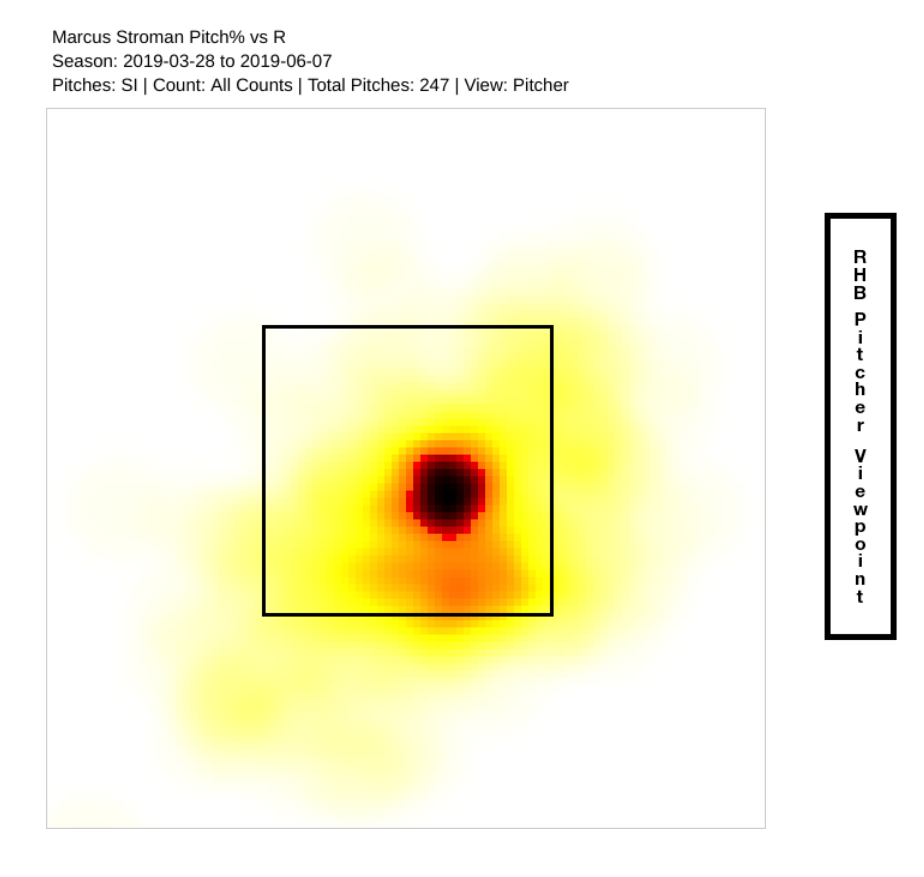
Stroman is a bit of a throwback in today’s game, relying on a sinker and posting pedestrian strikeout totals. He challenges hitters with the sinker, as evidenced by his heatmap against right-handers using the pitch this season:

Read the rest of this entry »


Job Posting: Detroit Tigers Baseball Operations Data Engineer

Position: Data Engineer, Baseball Operations

Location: Detroit, MI

Job Description:
The Data Engineer, Baseball Operations will be responsible for working closely with the Analytics team to maintain the data infrastructure supporting internal baseball systems, reports, and procedures.

Key Responsibilities:

  • Design, maintain, and support data warehouses for reporting and analytics within Baseball Operations.
  • Automate and optimize data workflows and pipelines.
  • Document, troubleshoot, and resolve issues with Baseball Operations data processes.
  • Understand and document data structures, format, definitions, and content of internal and external data feeds.
  • Develop data quality assurance tools to ensure data integrity and system performance.
  • Collaborate with other members of the Baseball Operations team to develop best practices for storing and retrieving baseball data.
  • Recommend new tools and techniques for collecting and processing data.
  • Complete ad-hoc database queries and analysis as directed.

Minimum Knowledge, Skills, and Abilities:

  • 3+ years of related work experience with data management and infrastructure.
  • Degree or equivalent experience in Computer Science, Information Systems, or related technical field.
  • Strong passion for baseball and robust understanding of current baseball research.
  • Expertise with SQL and relational database concepts and design.
  • Experience ingesting and transforming data from a variety of sources and formats.
  • Experience with at least one programming language such as C#, Java, Python, or similar.
  • Experience with R, Shiny, Plotly, or ggplot is a plus.
  • Ability to communicate complex concepts to colleagues possessing a wide range of backgrounds and perspectives.
  • Willing and able to relocate to Detroit.

To Apply:
To apply, please complete the application found here.

The content in this posting was created and provided solely by the Detroit Tigers.


Edwin Jackson and the Abyss

Editor’s note: Brendan has previously written at Baseball Prospectus, The Athletic, and Lookout Landing. He’ll be contributing to FanGraphs a few times a week, and we’re excited to welcome him.

Edwin Jackson is not pitching well. He’s running an 11.90 ERA, with a FIP north of eight and a DRA above 12. Toronto, deep into their rebuild, has no long-term attachment to Jackson, who at 35 years old was never going to be more than a placeholder. Despite everything, Jackson is still scheduled to start today against the Orioles. When asked why, Blue Jays manager Charlie Montoyo quipped “we don’t have anybody else.”

Obviously, that’s not the nicest thing a manager has ever said about his player. It’s more resemblant of Leo Durocher lamenting that his “center fielder can’t catch a f–king ball” than the polished schtick contemporary skippers feed to the local media. It does, however, convey how ineffectively Jackson has pitched in Toronto this year.

The famously nomadic right-hander is on his 14th big-league team. Rachael McDaniel covered some of the more romantic parts of that journey after his first start, a perfectly cromulent five-inning, three-run outing. Since then though, the wheels have fallen off:

Jackson’s Last Four Starts
Opposition IP Runs Strikeouts Walks Home Runs
Boston 5 6 4 1 1
San Diego 4 7 2 1 3
Colorado 2.1 10 4 3 1
New York 3.1 6 3 2 2

Clearly, his opponents have been strong; few pitchers would get through that gauntlet without fluffing up their ERA at least a little bit. One of those starts was in Coors. But even accounting for a small sample size and tough competition, Jackson’s numbers are ghastly. If anything, the stats at the top of the page undersell just how freely hitters are teeing off. Collectively, they’re batting a Bondsian .383/.442/.787. Opponents are hitting .394 on balls in play, which is amazing because they’re not exactly limiting their hard contact to singles and doubles. Among pitchers who have thrown more than 15 innings, Jackson’s 3.66 HR/9 ratio is the second worst in the league.

What makes his collapse so spectacular is not the raw numbers, but the baseline it stems from. Jackson pitched just fine last season: his 3.33 ERA looks a bit rosy relative to his peripherals, but a 4.65 FIP across 92 innings isn’t nothing, particularly for a guy Oakland signed off the scrap heap.

At a glance, not much looks different this year. He’s still averaging a little more than 93 mph on his fastball, as he has for the last two seasons. He’s neither added nor subtracted a pitch, and his mix looks just about the same as it did in 2018. He’s still generating the same number of groundballs as ever.

But baseball is a hard game and there’s a very fine line between adequacy and the abyss. While there could be an infinite number of factors plaguing Jackson this season, two small ones stand out.

The first is velocity. While Jackson is throwing his heater just as hard as in years past, he’s actually lost some juice on his secondary pitches:

Jackson’s Average Velocity
Year Fastball Cutter Slider Curve Change
2017 93.5 91.4 86.8 78.9 87.4
2018 93.2 91.1 86.3 78.9 87.1
2019 93.4 91.2 85.5 77.4 86.2
SOURCE: Brooks Baseball

These aren’t seismic changes in velocity, the kind of drops that would suggest he’s pitching through an injury. But every tick on the radar gun is crucial; all else being equal, less velocity means less sharpness. It’s easier now for hitters to foul off a tough slider, lay off an average changeup, and thwack a bad curve than it was last season. Not surprisingly, batters are swinging and missing at his primary secondaries less often and hitting them harder when they do connect:

Batter Performance 2018 vs. 2019
Pitch Whiff Rate ‘18 Whiff Rate ‘19 BAA ‘18 BAA ‘19 SLG ‘18 SLG ‘19
Change 10.17% 6.25% .091 .250 .136 .500
Slider 19.37% 14.29% .240 .242 .400 .606
SOURCE: Brooks Baseball

It’s not clear whether Jackson has lost arm strength or if he’s doing any of this consciously. Perhaps he’s trying to take something off the ball, or is otherwise experimenting with grips. Regardless, what he’s done thus far hasn’t worked.

The second issue concerns Jackson’s fastballs, which are getting battered as well. His cutter, a late-career addition and his go-to pitch last year, has been hit even harder than the slider or change. Even worse, the sinker that he’s relied on for so long is increasingly a tough pitch to succeed with in the modern game. Batters throughout the league are better at driving balls low in the strike zone than ever before, and this year Jackson’s sinker has both mediocre velocity and less sink than normal. Not surprisingly, batters are torching it: He’s thrown 50 of them, and hitters are hitting .556 with three homers.

Both of those factors are exacerbated by a few things beyond Jackson’s control. He’s no longer pitching in Oakland’s spacious Coliseum, with one of the game’s finest defenses at his back. Four of his five starts this year have been in launching pads, and the Jays are still working out the kinks in the field. Moreover, the rabbit ball seems particularly unkind to guys like Jackson, dinger-prone hurlers without an out-pitch to miss bats with.

You’d have to search hard to find a silver lining in all of this. Watch Jackson’s outings, and there’s no hint that he’s about to turn a corner. Statcast only provides further indignities, revealing that he’s in the very bottom percentiles in both average exit velocity and the percentage of balls that opponents hit hard.

Still, there’s something morbidly compelling about watching someone at the very end of his career. A veteran like Jackson has wowed us before: He’s pitched in All-Star games and the World Series, thrown a no-hitter, and toiled seemingly everywhere. Watching such a durable player fade away is a reminder of our own waning skills.

There’s more to it than that though. One of the decade’s most gut-wrenching moments was watching Ramon Ortiz, a baseball lifer if there ever was one, openly sob after injuring his elbow, seemingly certain that he was leaving a major league mound for the last time. Ortiz was easy to empathize with because his reaction gave such visceral proof to what we all suspect: that big league baseball is not an easy thing to let go of. Knowing that, it’s captivating to watch players claw for their place in the game. As fans, we want the players to care. When Jackson slaps his glove in frustration, or looks bewildered as yet another homer sails into the seats, it’s clear he does.

So long as that last point holds true, there’s no glory in rooting for carnage today; I certainly hope that this isn’t the end of Jackson’s line. If you’re looking for a glimmer of hope, his career demonstrates the folly in declaring that someone is washed up. Jackson sure seemed cooked two years into his tenure with the Cubs — all the way back in 2014 — but a move to the bullpen sparked a return to form. Just last year, he appeared lost to minor league obscurity before reviving his career in Oakland. A start against the Orioles could be just the tonic he needs to get back on track.

But whether Jackson has one start left or 100, everyone’s time is fleeting. Enjoy baseball’s vagabond while you still can.


Franmil Reyes Has Power Everywhere

Hitting the ball over the fence in San Diego can be difficult, though not quite as difficult as it used to be after the team changed the dimensions in 2013. Similarly, hitting the ball out of the park to center and the opposite field is generally a more difficult task for hitters. Around 60% of home runs this season are pulled by batters, while only 15% of dingers are hit to the opposite field. These difficulties have proved to be of little consequence for 23-year-old Franmil Reyes.

The young slugger’s statistics can leave you slightly underwhelmed when compared to his imposing figure and powerful bat. Reyes has a 120 wRC+, which is good but not great, and his defense in the outfield keeps his WAR at 0.8 on the season. Reyes doesn’t walk a ton, he strikes out a bit too much, and he doesn’t add anything on the basepaths, but he can do this:

Fourteen of Reyes’ 19 homers have gone out to center or the opposite field. That figure is the most in baseball and two clear of Christian Yelich and Peter Alonso, and includes five homers to the opposite field. Ten of those 14 homers have come in Petco Park, one of the more difficult stadiums for lefties to hit homers, and they have the advantage over Reyes in being able to pull the ball to right field. Trying to hit homers to the opposite field is generally not advisable, but for a man of Reyes’ size and power, it’s a worthwhile strategy. And when Reyes hits the ball in the air to center or the opposite field, he hits the ball harder than anyone in the game, per Baseball Savant: Read the rest of this entry »


What’s Up With Joey Votto?

On the heels of five straight losing seasons, the last four with at least 94 losses, the Reds are at least relevant and interesting again. Despite a 29-35 record entering Tuesday, their +33 run differential is the league’s fourth-best. Luis Castillo is showing signs of developing into an ace. Derek Dietrich is fighting off bees and retrograde broadcasters. Yasiel Puig is entertaining even when he’s not hitting, Michael Lorenzen sometimes plays the outfield when he’s not pitching, and top prospect Nick Senzel has arrived. And now, finally, Joey Votto is starting to heat up.

For the second season in a row, Votto has started slowly. On the heels of his 36-homer, 6.5-WAR 2017 season, a few frosty weeks to start 2018 (his age-34 season) could be easily dismissed, but the full-season lows Votto wound up setting in batting average (.284), slugging percentage (.419), wRC+ (131), home runs (12), and WAR (3.5) look considerably more ominous in light of his current line (.256/.347/.379, 5 HR, 93 wRC+, 0.2 WAR), which looks bad until you peep at his stats through May 10: .206/.333/.333 with three homers, an 80 wRC+, and -0.1 WAR.

As noted, the now-35-year-old Votto is showing signs of life. In his past 23 games and 106 PA, he’s batting .316/.377/.432 for a 115 wRC+, which isn’t exactly Votto-esque, but it’s a significant uptick within an offense managing just an 81 wRC+, the worst of any non-rebuilding team. Of his 15 multi-hit games this year, nine of them have taken place in that span, including all three of his three-hit games. This past weekend against the Phillies, he went 5-for-12 with a pair of walks, a homer — his first to the opposite field this year, off Zach Eflin — and a game-tying two-run single off Jose Alvarez in Sunday’s victory, Cincinnati’s only one of the three-game series. Here’s the homer:

As Votto noted after that shot, “I’ve been thinking my swing has been coming around since the beginning of May. I know I had some rough stretches, but it’s a very good sign. I haven’t done that yet this year.” Read the rest of this entry »


A Look at Jordan Luplow, a Bright Spot in the Indians’ Lineup

Indians outfielder Jordan Luplow might not be a household name. But he has turned some heads in Cleveland with majestic home runs like this one:

That is quite the blast, but it’s clear the Indians’ Twitter account is being facetious. Luplow isn’t a legitimate Home Run Derby candidate, even with the All-Star Game being played in his home park in Cleveland. (Since 2013, at least one player from the hosting team participated in the Home Run Derby.) Francisco Lindor and Carlos Santana are much better options to serve as the hometown player.

Luplow has experienced something of a breakout this season. He is 25 years old and had just 190 plate appearances to his name prior to 2019. But, this season, he’s playing for an offense that has produced an 82 wRC+ team-wide, allowing him to serve as a bright spot in the order. In 120 plate appearances, Luplow has hit .248/.308/.523 with eight home runs and a 113 wRC+. His .275 ISO leads all Indians hitters, while also ranking in the top 10% of players with at least 100 trips to the plate. Read the rest of this entry »


Rangers Righty Pete Fairbanks on His Memorable Major League Debut

Pete Fairbanks had more than just a memorable major league debut on Sunday. He had a spectacular debut. The 25-year-old Texas Rangers right-hander entered a game against the Oakland A’s in the fifth inning and proceeded to fan the first three batters he faced. He then returned to the mound in the sixth and, with an E-5 sandwiched in between, induced a groundball out and an inning-ending double play. Not bad for a former ninth-round pick who began the season with the Down East Wood Ducks in the High-A Carolina League.

Fairbanks fashioned a 2.35 ERA, with 36 strikeouts in 23 innings between three levels prior to his call-up. The University of Missouri product is a power pitcher. His fastball topped out at 99 mph on Sunday, and his high-80s slider features good tilt. Health had held him back. Fairbanks missed all of last season while recovering from his second Tommy John surgery. He’d also gone under the knife in high school.

Fairbanks discussed his call-up, and the pair of overpowering innings that followed, prior to yesterday’s game at Fenway Park.

———

Pete Fairbanks: “I came into a game against Reno — we were in Reno — in the fourth inning. I threw 12 pitches, then I come out. I’m like, ‘Well, I sure wish I could have finished that inning.’ Our pitching coach walks by and says, ‘Hey, there’s a reason.’ I don’t think anything of it; I just go in the clubhouse and hang out for the rest of the game.

“I’m washing my hands, and Carlos [Olivas], our trainer in Triple-A, says, ‘Hey, come here.’ We walk into the office and he says, ‘Congrats man, you’re going up to the show.’ I’m like, ‘Are you sure?’ He says ‘Yeah, you’re going.’

“At 6:10 the next morning, I get on a flight to Arlington. I sit in a hotel from the time I get there until about five o’clock the next day, because I’m not activated yet. I’m there for a night game, and then for Game One of [Sunday’s] double-header. Around five they call and say, ‘We’re ready for you to come on over.’ I go over and introduce myself to everybody. Read the rest of this entry »


How Does Mike Soroka Do It?

Baseball has changed a lot in the last five years, so much so that watching a game from 2014 already feels like a blast from the past. Offense was low, sinking fastballs were everywhere, and groundballs and defense were the order of the day. 2019 hardly feels like the same game — unless you’re watching Mike Soroka, that is. Though Soroka is only 21 years old, he pitches like he’s from a previous era. In a time of four-seam fastballs, Soroka pitches off of his sinker — he’s throwing only 16% four-seamers this year and 46.3% two-seam fastballs. In a world of exciting high-velocity young aces, Soroka sits around 93 mph. In a world of home runs, he has allowed only one all year. In short, Mike Soroka doesn’t fit in 2019. How does he do it?

As is almost always the case with pitching, Soroka isn’t doing one specific thing that makes him dominant. If it were that straightforward, that easy to reverse engineer, everyone would be doing it. Still, dominant is an apt description of Soroka’s 2019 season. He’s posted a 1.38 ERA over ten starts. His FIP is nearly as jaw-dropping — fifth in baseball at 2.70. Has he been a little lucky that only 2.9% of fly balls hit against him have become home runs this year? Certainly. Still, though, his 3.5 xFIP is no slouch, 20th-best among qualified starters.

Great pitching is always interesting, but the way Soroka is doing it is what makes him unique. His 21.9% strikeout rate is below league average, not the kind of thing you can say about most excellent pitchers. His 6.5% walk rate is better than average, but not absurdly so — it’s merely 38th-lowest among qualified starters. In short, Soroka is an evolutionary Mike Leake, or 2019’s Miles Mikolas. He’s effective in a way that resists categorization, that belies the easy tropes of analysis. Why is Mike Soroka good? He’s good because he gets every little edge he can.
Read the rest of this entry »