Archive for Teams

2019 ZiPS Projections – Toronto Blue Jays

After having typically appeared in the hallowed pages of Baseball Think Factory, Dan Szymborski’s ZiPS projections have now been released at FanGraphs for more than half a decade. The exercise continues this offseason. Below are the projections for the Toronto Blue Jays.

Batters

This is a bit awkward, as the most interesting Blue Jays batters essentially sit in the Bench and Prospects section. Probably the starkest difference between ZiPS and Steamer comes in the form of Lourdes Gurriel, Jr., who has such an unhappy projection from ZiPS that I went back and ran it a second time to make sure I hadn’t goofed anything. From his minor league hit data, ZiPS doesn’t think Gurriel will be able to maintain his minor-league BABIP. And the poor defensive projection isn’t just ZiPS overreacting to Gurriel’s fairly poor BIS and UZR defensive numbers; as rudimentary as even play-by-play minor league defensive measures are, Gurriel’s estimates come in below-average there as well.

The larger problem with the Blue Jay offense is that ZiPS essentially sees little upside remaining among the established players. Tulowitzki and Donaldson were both gone, and while they weren’t stars in 2018 by any stretch of the imagination (and Tulo didn’t even get in a game), they at least represented the possibility of star-level performance going into 2018. Smoak’s 2017 was probably his high-water mark and he’s now a designated hitter on the wrong side of 30, while Devon Travis is another year further away from when he looked like he could be a borderline star. Toronto was 10th in the AL in runs scored in 2018, but outside of the admittedly super-exciting addition of Vladimir Guerrero Jr., I just don’t see much of a hope for this unit doing much more than last year. Read the rest of this entry »


Red Sox Prospect Josh Ockimey Just Wants to Be Himself

Josh Ockimey has developed into one of the more promising hitting prospects in the Red Sox organization, and he’s done so by shunning comparisons. The 23-year-old first baseman resembles a slugger from his home town, but doesn’t emulate him.

“Being from Philadelphia, I always got the Ryan Howard comparison,” Ockimey told me early in 2018. “But I really just try to be Josh Ockimey. I’ve learned that when you try to be somebody else, you’ll never be as good as they are. They’re them and you have to do what makes you you. I focus on that and try to be the best that I can be.”

What makes Ockimey Ockimey is a discerning eye paired with plus power from the left side. A sturdy 235 pounds — “that’s the weight I play best at” — he finished this season with an .811 OPS and 20 home runs in 481 plate appearances between Double-A Portland and Triple-A Pawtucket. Read the rest of this entry »


Top 26 Prospects: Boston Red Sox

Below is an analysis of the prospects in the farm system of the World Series Champion Boston Red Sox. Scouting reports are compiled with information provided by industry sources as well as from our own (both Eric Longenhagen’s and Kiley McDaniel’s) observations. For more information on the 20-80 scouting scale by which all of our prospect content is governed you can click here. For further explanation of the merits and drawbacks of Future Value, read this.

All of the numbered prospects here also appear on The Board, a new feature at the site that offers sortable scouting information for every organization. That can be found here.

Red Sox Top Prospects
Rk Name Age Highest Level Position ETA FV
1 Triston Casas 19.0 R 1B 2022 45
2 Darwinzon Hernandez 22.1 AA LHP 2021 45
3 Michael Chavis 23.4 AAA 1B 2019 45
4 Antoni Flores 18.2 R SS 2023 40+
5 Tanner Houck 22.5 A+ RHP 2019 40+
6 Nick Decker 19.3 R RF 2023 40+
7 Bobby Dalbec 23.5 AA 3B 2020 40+
8 Jay Groome 20.4 A LHP 2021 40+
9 Bryan Mata 19.7 A+ RHP 2021 40
10 Travis Lakins 24.5 AAA RHP 2019 40
11 Durbin Feltman 21.7 A+ RHP 2019 40
12 C.J. Chatham 24.0 A+ SS 2020 40
13 Jarren Duran 22.3 A CF 2022 40
14 Brandon Howlett 19.3 A- 3B 2023 40
15 Gilberto Jimenez 18.5 R CF 2023 40
16 Mike Shawaryn 24.3 AAA RHP 2019 40
17 Denyi Reyes 22.2 A+ RHP 2021 40
18 Brayan Bello 19.6 R RHP 2022 40
19 Daniel Diaz 18.0 R 3B 2023 40
20 Nicholas Northcut 19.6 A- 3B 2022 40
21 Roniel Raudes 21.0 A+ RHP 2020 40
22 Bobby Poyner 26.1 MLB LHP 2019 40
23 Marino Campana 21.1 A RF 2022 35+
24 Jhonathan Diaz 22.3 A+ LHP 2019 35+
25 Eduardo Lopez 16.7 None CF 2024 35+
26 Yoan Aybar 21.5 A LHP 2021 35+

45 FV Prospects

Drafted: 1st Round, 2018 from American Heritage HS (FL) (BOS)
Age 19.0 Height 6′ 4″ Weight 238 Bat / Thr L / R FV 45
Tool Grades (Present/Future)
Hit Raw Power Game Power Run Fielding Throw
25/50 70/80 35/65 40/30 45/55 60/60

Casas was one of the more heavily scouted underclassman high school prospects in recent memory, and stood out hitting in the heart of the lineup for South Florida powerhouse American Heritage and various Team USA squads, and at travel showcases and tournaments. Some of this success was probably because Casas was one of the oldest prospects in the 2019 graduating class, which prompted him to accelerate his schooling in 2017 and reclassify for the 2018 draft. Moving up a year made him age-appropriate for a high schooler in their draft year; at 18.4, he was basically average for a prep player. With the early-career acclaim came a change in the way opposing pitchers approached Casas. They began to pitch around him, and scouts often left Casas games having seen him swing just once or twice because he was constantly walking. Luckily Casas had a long track record of hitting in games, participated in multiple home run derbies during his amateur summers, and posted gaudy exit velocities during team pre-draft workouts, so clubs knew what his offensive potential was. He has good hands and a plus arm that helped him pitch into the low-90’s on the mound, but is a well-below average runner with poor lateral mobility. He played third base after signing (though mostly during instructs, as Casas injured his thumb sliding for a ground ball in June, needed surgery, and barely played during the summer) but expectations are he’ll move across the diamond to first base in 2019 or 2020, where we think he’ll be quite good. Casas’ calling card is his bat and there’s potential for a 60 hit, 70 game power, 80 raw power kind of package. The margin for error for a teenage first base-only types is very small, but we’re very high on Casas’ bat.

Signed: July 2nd Period, 2013 from Venezuela (BOS)
Age 22.1 Height 6′ 2″ Weight 185 Bat / Thr L / L FV 45
Tool Grades (Present/Future)
Fastball Curveball Changeup Command Sits/Tops
70/70 60/60 45/50 40/45 94-97 / 99

We have the scowling Hernandez projected into a relief role and think his stuff is on par with many of the best lefty relievers in baseball. Developed as a starter to this point, he has well-below average control and likely wouldn’t throw enough strikes to go more than two or three innings a game in a big league rotation. In relief though, he could be incredible. His fastball is hard and comes in with tough angle. It has natural cut when Hernandez is locating it to his glove side, and with it, he misses bats away from lefties who swing inside its break. Both of his secondary offerings are capable of missing bats but the same mechanical repetition issues that plague Hernandez’s command cause them to be inconsistent. At times, he’ll flash a plus-plus breaking ball; at others, the pitch isn’t located near enough to the plate to entice hitters. And so, projected roles for Hernandez vary depending on the evaluator’s degree of confidence in his ability to tighten up his command. On stuff, he has a chance to be a high-leverage arm, and one of the top 30 or so relievers in baseball.

Drafted: 1st Round, 2014 from Sprayberry HS (GA) (BOS)
Age 23.4 Height 5′ 10″ Weight 190 Bat / Thr R / R FV 45
Tool Grades (Present/Future)
Hit Raw Power Game Power Run Fielding Throw
40/40 65/65 50/55 40/40 40/45 55/55

Chavis was a well-known Atlanta-area prep prospect, who in high school was a strong statistical performer with easy plus raw power that showed up in games. He didn’t have a clear positional fit as an amateur, and that’s still mostly the case now–he was a shortstop in high school but wasn’t an athletic fit there, tried catching, which didn’t work, and scouts generally projected third base or first base long term. Though he has mostly played third, pro scouts see Chavis as a first base-only type, and he started seeing time there during the 2017 Fall League and again late in 2018. He missed much of 2018 with an 80-game PED suspension, which ominously came after a breakout 2017 campaign during which he hit 31 homers. He has now reached Triple-A, and had a strong half-season after the suspension was up, but scouts are wary of being all-in on a player whose entire profile is dependent on power and who has also had a recent PED suspension. One-dimensional hitters who are limited on defense tend to end up in a first base platoon (and in this case, it’d be the lesser side of one) or as a low-end starter like Kevin Millar. Either way, it seems unlikely a high-payroll, contending club like Boston would wait for a young player with limited upside to break in as an everyday player. We think Chavis is a low-end regular, who may be trade bait once he further establishes his level of performance post-suspension.

40+ FV Prospects

Signed: July 2nd Period, 2017 from Venezuela (BOS)
Age 18.2 Height 6′ 1″ Weight 190 Bat / Thr R / R FV 40+
Tool Grades (Present/Future)
Hit Raw Power Game Power Run Fielding Throw
25/55 45/55 20/50 50/45 45/55 60/60

Flores, who received the second highest bonus in the Red Sox 2017 international class at $1.4 million — just behind Danny Diaz’s $1.6 million — was the buzz of the Southwest Florida instructional league and has exciting potential. After dominating the DSL during the summer, Flores got a late call-up and played two games in the GCL before his summer was shortened by a minor injury. He reminds some scouts of a potential everyday shortstop who takes a few games to grow on you. Unlike many high-bonus July 2nd prospects, Flores doesn’t have loud, flashy tools, or exceptional twitch or physical projection. He’s more of the steady, low-key type of player with excellent feel for defense (common among prospects from Venezuela, where there’s more of a game-focused development) and high-quality contact. He projects to be an above-average bat with average raw power and the swing attributes to have a chance to get to most of it. Deceptively quick for his size, Flores has average speed and the defensive instincts to cover more ground than his raw foot speed indicates, as well as a plus arm. There’s a chance he outgrows shortstop, but he’d likely be at least above-average, if not plus, at third base in that event. It may be a card full of 5’s (except for arm strength) on the 2-8 scale, with very little pro experience, but scouts are excited about what little they’ve seen here and think Flores could be a first division regular if the bat develops enough.

5. Tanner Houck, RHP
Drafted: 1st Round, 2017 from Missouri (BOS)
Age 22.5 Height 6′ 5″ Weight 220 Bat / Thr R / R FV 40+
Tool Grades (Present/Future)
Fastball Curveball Changeup Cutter Command Sits/Tops
50/50 50/55 45/50 55/60 40/50 90-93 / 95

Houck was a projection prep arm from Illinois whose price was just high enough to get him to Missouri. He had a big freshman year there and then had a national coming-out party as the ace of Team USA that summer. Houck continued at about that level for the next two seasons, slinging in a heavy, 91-96 mph sinker from a low slot with a deceptive, crossfire delivery. He threw strikes and had a plus slider. Scouts who weren’t as enthusiastic about Houck’s changeup, or arm slot, or the length of his arm action, saw a reliever. His stuff would flatten out and his command would back up as he fatigued into the late stages of some starts. The Red Sox had Houck change his delivery and arm action for the first half-dozen or so starts in 2018, focusing on a more traditional four-seam fastball approach. It didn’t work, and Boston let Houck go back to what he had been doing later in the year; his dominant final two months of 2018 reflect his comfort with this approach. We think the likely outcome here is a multi-inning power reliever who dominates righties with strikeouts and groundballs, though some see a starter in the mold of Justin Masterson. Either way, Houck should move quickly, especially if he’s only asked to face a lineup once or twice per outing.

Drafted: 2nd Round, 2018 from Seneca HS (NJ) (BOS)
Age 19.3 Height 6′ 0″ Weight 200 Bat / Thr L / L FV 40+
Tool Grades (Present/Future)
Hit Raw Power Game Power Run Fielding Throw
20/50 55/60 25/55 50/45 40/50 55/55

The amateur side of the scouting industry is fearful of prep bats from the Northeast because they face bad pitching during the spring, and are tough to evaluate as hitters. This, coupled with Decker’s slightly advanced age relative to other high schoolers, as well as a deep, late first and early second round group of high school outfielders pushed him into the second round despite having first round physical ability. Decker is a high-effort player with good instincts on the bases and in the field. He probably doesn’t have the pure speed for center but has a small hope of staying there based on his feel. Even when he likely moves to a corner, there’s enough power for Decker to profile as an everyday player provided he hits enough, and early returns on his bat in pro ball (he missed GCL time due to a wrist fracture but played during instructs) are very strong.

Drafted: 4th Round, 2016 from Arizona (BOS)
Age 23.5 Height 6′ 4″ Weight 225 Bat / Thr R / R FV 40+
Tool Grades (Present/Future)
Hit Raw Power Game Power Run Fielding Throw
30/40 70/70 30/55 40/40 50/55 70/70

There isn’t much precedent for sustained big league success when hitters run strikeout rates as high as Dalbec’s (he’s struggled badly with whiffs since college), but his combination of power and defensive ability give him significant upside if he grows into even a 40 bat. Breaking balls especially flummox him, even when they hang and appear hittable. Mike Olt, Juan Francisco, Matt Davidson, and Pedro Alvarez are recent examples of players with offensive skills who struggled to overcome their issues with strikeouts. But Dalbec is also more athletic than most of those low-contact, corner sluggers, and looked great at third base during the Fall League. Realistically, Dalbec’s issues limit him to a bench or platoon role, which is largely enabled by his ability to play third base well. But because there’s superlative power here, the ceiling is sky high if things suddenly click with the bat. Dalbec also spent time pitching in college (he was 91-93 with an average slider), a secondary skill that is of increasing interest to teams, though it’s still just largely considered to be a parlor trick to show off during a blowout.

8. Jay Groome, LHP
Drafted: 1st Round, 2016 from Barnegat HS (NJ) (BOS)
Age 20.4 Height 6′ 5″ Weight 220 Bat / Thr L / L FV 40+
Tool Grades (Present/Future)
Fastball Curveball Changeup Command Sits/Tops
55/55 55/65 45/55 40/50 90-92 / 96

As early as his freshman year of high school, Groome was pegged by those who scouted him as a potential high first round pick. He had a silky smooth delivery and projectable frame, with average big league stuff almost two years before he was even eligible to be drafted. His stuff just ticked up from there, and arguably peaked the summer before his draft year, when Groome would work 92-96 mph in short stints, worked with an easy plus curveball, mixed in an average to above changeup, and did it with that big, athletic frame and a starter’s delivery, all of which led to being a first overall pick favorite at the time. But a myriad of concerns unrelated to Groome’s talent dogged him more than most prep prospects. That, combined with a quickly thickening frame, contributed to his fall out of the top 10 picks of the 2016 draft. Since signing, Groome hasn’t been on the mound much, making just 17 total pro starts due to a back injury and an eventual Tommy John surgery. He’s slated to return to the mound in June or July of 2019. Some scouts are still wary of his high school off-field issues and maxed-out frame, seeing a bunch of 50 or 55 attributes aside from his plus curveball. Those who are still on board note that his changeup was improving and his velo was regularly up to 96 mph prior to surgery, leading them to think that he was just getting back on track. Proponents expect him to pick up where he left off and reach the No. 2 or 3 starter upside he seemed to have at age 17.

40 FV Prospects

9. Bryan Mata, RHP
Signed: July 2nd Period, 2015 from Venezuela (BOS)
Age 19.7 Height 6′ 3″ Weight 175 Bat / Thr R / R FV 40
Tool Grades (Present/Future)
Fastball Curveball Changeup Command Sits/Tops
50/55 50/55 50/55 30/45 92-94 / 96

Mata’s conditioning, velocity, and control all fluctuated wildly throughout 2018, and he ended up walking 58 hitters in 72 innings before his season ended in late July due to back tightness. That’s not to say the industry expected Mata to perform. When he began his season at Hi-A, he was only 18 and the youngest pitcher in the league by a wide margin. He was sent to the Futures Game in July despite these struggles because his stuff is quite good. Mata worked more with a two-seamer in 2018 and his ground ball rate rose to 57%. His low, three-quarters slot creates movement on his changeup that pairs well with the two-seamer and also gives right-handed hitters a tougher look at his loopy curveball. He could have four above-average pitches at peak if you count the four- and two-seamers as two separate offerings, but none of it will matter if Mata’s 2018 strike-throwing is the norm going forward. The consensus is that he has feel for creating effective movement on his pitches but not for locating them yet. Proponents think due to his age that Mata will improve and become a No. 4 starter. Detractors are skeptical of his athleticism, his ability to repeat and throw strikes, or both.

10. Travis Lakins, RHP
Drafted: 6th Round, 2015 from Ohio State (BOS)
Age 24.5 Height 6′ 1″ Weight 180 Bat / Thr R / R FV 40
Tool Grades (Present/Future)
Fastball Curveball Changeup Cutter Command Sits/Tops
55/55 55/60 45/50 55/55 45/45 92-94 / 96

Two elbow fractures halved Lakins’ 2016 and 2017 seasons and caused him to break camp late in 2018. He was quickly moved to the bullpen last year, and had a healthy, successful season that ended with him claiming a spot on the 40-man. Lakins works a lot with a low-90s cutter that has enough length to miss bats away from righties. After peppering his glove side with cutters, he can throw riding, mid-90s four seamers past hitters at the top of the strike zone, which then sets up his 12-6 curveball beneath it. Relievers with four viable pitches are rare, and Lakins has the stuff to play a valuable multi-inning relief role, though single-inning usage might give him the best shot at staying healthy.

Drafted: 3rd Round, 2018 from TCU (BOS)
Age 21.7 Height 6′ 1″ Weight 190 Bat / Thr R / R FV 40
Tool Grades (Present/Future)
Fastball Slider Changeup Command Sits/Tops
70/70 60/60 40/45 45/50 93-97 / 99

If forced to pick one prospect from the 2018 draft to throw a big league inning tomorrow, we might pick Feltman, who has an electric fastball/slider combination. As a junior, Feltman struck out 43 batters and walked just six in 24.1 innings, and tied the TCU school record for saves despite being injured for some of his junior year. His fastball is hard and comes in at a tough angle, while his slider has bat-missing vertical action. Barring injury, Feltman should be a quick-moving reliever and has a chance to turn into a late-inning arm.

Drafted: 2nd Round, 2016 from Florida Atlantic (BOS)
Age 24.0 Height 6′ 3″ Weight 185 Bat / Thr R / R FV 40
Tool Grades (Present/Future)
Hit Raw Power Game Power Run Fielding Throw
35/45 45/45 30/40 50/50 50/55 60/60

Chatham played on Miami-area powerhouse high school team American Heritage with Zack Collins, and stood out defensively for being a long-limbed athlete with a plus arm and above average defensive ability. Collins went to Miami and became a top ten pick while Chatham went to Florida Atlanta and became a second round talent. Over 2.5 seasons, he has played only 156 games due to multiple injuries. He has viable infield defensive ability and above-average bat control with some doubles pop, but also has some clear offensive limitations. He had a mostly healthy 2018 at Hi-A, and should begin 2019 on the doorstep of a big league utility role.

13. Jarren Duran, CF
Drafted: 7th Round, 2018 from Long Beach State (BOS)
Age 22.3 Height 6′ 2″ Weight 200 Bat / Thr L / R FV 40
Tool Grades (Present/Future)
Hit Raw Power Game Power Run Fielding Throw
35/50 55/55 30/45 70/70 40/50 40/40

The trajectory of Duran’s summer and fall rise is unique. During collegiate scrimmages in the fall of 2017, scouts saw a big, athletic second baseman who was just okay defensively, had an all-fields, line drive approach without much pop, and plus to plus-plus speed. Duran had a fine junior spring, but hit for almost no power (which perhaps should be expected in a pitcher-friendly home stadium like Blair Field in Long Beach) and slipped to the seventh round as a nearly-22-year-old with a modest statistical track record. After signing, the Red Sox had Duran change his swing a bit in BP to see if they could tap into something more, and the 6-foot-2, 200-pound Duran started showing above-average pull power. Boston also moved him to center field, where his long-range speed fits better than it did on the infield. He crushed short season and Low-A after signing. For Long Beach State, Duran had 13 extra base hits in 253 PA in 2018; across two pro levels, he had 28 extra base hits in 302 PA, including 11 triples. There are multiple examples of hitters, including Matt Chapman and several of the Stanford guys, who had breakouts after leaving overly-traditional west coast college hitting programs. Duran may be the most recent.

Drafted: 21th Round, 2018 from George Jenkins HS (FL) (BOS)
Age 19.3 Height 6′ 1″ Weight 205 Bat / Thr R / R FV 40
Tool Grades (Present/Future)
Hit Raw Power Game Power Run Fielding Throw
20/50 55/60 35/50 40/40 40/50 50/50

Howlett was a known prospect in Florida for years and was on a trajectory to go in the top five rounds after a strong start to his spring, but he finished poorly, including a brutal NHSI tournament where all 30 teams had multiple scouts on hand. Howlett swung and missed a ton in front of dozens of high level evaluators, when many had pegged him as the sleeper prospect to break out at the event. The Red Sox found after signing him that he had an issue with his contacts, giving him particular trouble in day games (which all of the games at NHSI were), and got him squared away before his pro career began. Howlett hit six homers in 43 pro games with a manageable strikeout rate that surprised many amateur scouts who had discounted his hitting ability earlier that year. He’s often compared to Northcut since they both play third base and were widely-scouted later-round finds for Boston. Howlett has a little better feel to hit and ability to tap into his power in game situations, but is a little behind Northcut defensively.

Signed: July 2nd Period, 2017 from Dominican Republic (BOS)
Age 18.5 Height 5′ 11″ Weight 160 Bat / Thr R / R FV 40
Tool Grades (Present/Future)
Hit Raw Power Game Power Run Fielding Throw
20/55 35/40 20/35 80/80 45/55 45/45

Jimenez is a scout favorite and probably the highest-rated of the true sleepers on this list. The Sox 2017 international signing class is already paying dividends with Flores, Jimenez, Bello and Diaz all among the org’s top 20 prospects while none have played longer than a week in the GCL. Jimenez is described as a running back playing baseball due to his sneaky athleticism in a compact frame, his all-out style, and standout work ethic. Depending on whom you ask, he’s either a 70 or 80 runner, but his instincts on the bases and in the field aren’t up to snuff just yet. Since there isn’t much raw power presently, he plays more of a slap-and-dash, small-ball game that accentuates his speed. This limits his upside a bit, but when you look back at prospects who outplay their projections, scouts will often point to a name and tell you not to underrate plus athletes with plus makeup; we were aggressive in ranking Jimenez for that reason.

16. Mike Shawaryn, RHP
Drafted: 5th Round, 2016 from Maryland (BOS)
Age 24.3 Height 6′ 3″ Weight 225 Bat / Thr R / R FV 40
Tool Grades (Present/Future)
Fastball Slider Changeup Command Sits/Tops
50/50 50/55 45/50 45/50 89-92 / 93

Shawaryn’s prospect stock peaked when he was a dominant college sophomore at Maryland. Injury and a downtick in stuff plagued him as a junior and he fell to the fifth round of his draft. Shawaryn has traversed the whole of the minors as a starter but ultimately might fit best in relief due to some of his stuff’s limitations. He has a funky, low-slot delivery that creates cuttery, horizontal movement on his slider; it’s his best way to miss bats. His changeup and fastball (which was only in the upper-80s for much of his time in the Arizona Fall League) are both fringy on their own but play up a bit due to the deceptive funk in his delivery. Shawaryn fits in a No. 5 starter/swingman relief role, and could be ready in 2019.

17. Denyi Reyes, RHP
Signed: July 2nd Period, 2015 from Dominican Republic (BOS)
Age 22.2 Height 6′ 4″ Weight 209 Bat / Thr R / R FV 40
Tool Grades (Present/Future)
Fastball Curveball Changeup Command Sits/Tops
45/50 45/50 45/50 45/55 88-90 / 92

As rare as complete games have become at the big league level, they’re even rarer in the minors, where developmental caution takes precedence over single-game results. A hyper-efficient strike-thrower, Reyes threw two complete games in 2018 (and needed less than 100 pitches in both) and also had an 8-inning outing against Columbia in July. Though he doesn’t throw that hard, Reyes’ propels himself way down the mound and has super long arms that help him generate big extension, which help his upper-80s fastball play like one in the low-90s. His fastball angle isn’t great for missing bats, but his changeup and curveball are both effective, though not dominant, alternatives. Reyes profiles as an efficient backend starter.

18. Brayan Bello, RHP
Signed: July 2nd Period, 2017 from Dominican Republic (BOS)
Age 19.6 Height 6′ 1″ Weight 170 Bat / Thr R / R FV 40
Tool Grades (Present/Future)
Fastball Curveball Changeup Command Sits/Tops
50/60 50/55 45/55 30/50 91-95 / 96

A hard-throwing, flexible teenage righty who had a strong summer in the DSL, Bello came stateside for a single GCL outing, then later went to instructional league for shorter outings during which he’d flash three above-average pitches. His build and arm action both portend greater, potentially significant velocity. He has No. 4 starter stuff if things come together, but he’s probably several years away.

19. Daniel Diaz, 3B
Signed: July 2nd Period, 2017 from Venezuela (BOS)
Age 18.0 Height 6′ 3″ Weight 200 Bat / Thr R / R FV 40
Tool Grades (Present/Future)
Hit Raw Power Game Power Run Fielding Throw
25/50 55/60 20/50 50/40 40/50 60/60

Diaz was the Red Sox top international signing in 2017, getting $1.6 million, just ahead of now-superior prospect Antoni Flores’ $1.4 million bonus. Diaz was solid in the DSL last year and made his stateside debut during instructional league. He’s already a big kid — scouts estimate 6-foot-3 and 225 pounds or so, much more than where he’s listed — and he’s unlikely to be a third baseman long term, but players this young still have the opportunity to reshape their bodies pretty significantly. He has plus arm strength and raw power, but there’s also some question about how much he’ll hit, due to an aggressive, power-first approach that needs to be dialed in. Diaz is limited to a corner and there are questions about his position and hitting ability, so he’s a wait-and-see case for now, but he has ceiling because of the power and could generate above-average offense as a third baseman.

Drafted: 2nd Round, 2018 from Mason HS (OH) (BOS)
Age 19.6 Height 6′ 1″ Weight 200 Bat / Thr R / R FV 40
Tool Grades (Present/Future)
Hit Raw Power Game Power Run Fielding Throw
25/45 60/60 30/50 45/40 45/55 55/55

Northcut drew wide-ranging takes from scouts in the year leading up to signing with the Red Sox as an 11th rounder from an Ohio high school. He played on the Evoshield Canes, the top travel team in the country, and was scouted often, with a decent but not great glove at third base, above average to plus power, and some feel for hitting and game power, but seemed a mid-round prospect. In the spring and into pro ball, Northcut slimmed up a bit and now projects as at least average at third base, with similar raw power, but some pro scouts questioned his feel to hit. All the elements have been there at some point over the past year and some amateur scouts were really in on Northcut — one said he saw a lot of Austin Riley in him — but didn’t realize his price would end up being as low as it was once he started sliding in the draft.

21. Roniel Raudes, RHP
Signed: July 2nd Period, 2014 from Nicaragua (BOS)
Age 21.0 Height 6′ 1″ Weight 160 Bat / Thr R / R FV 40
Tool Grades (Present/Future)
Fastball Curveball Changeup Command Sits/Tops
45/50 45/50 45/55 40/50 89-91 / 93

After pushing him very quickly at the onset of his pro career, in 2018 the Red Sox throttled down Raudes’ development and had him repeat Hi-A. He regressed statistically (his strikeout rate was down, and his walk rate stayed just below average after regressing in 2017) before he succumbed to a June elbow injury that cost him the remainder of his summer. Raudes started throwing harder in 2018 and remains a projectable, athletic 20-year-old with a great arm action and some changeup feel. That’s still a lot of good stuff, even though other aspects of his profile have either plateaued or gone backward. We hope the fastball control comes back and think Raudes can pitch at the back of a rotation if it does.

22. Bobby Poyner, LHP
Drafted: 14th Round, 2015 from Florida (BOS)
Age 26.1 Height 6′ 0″ Weight 205 Bat / Thr L / L FV 40
Tool Grades (Present/Future)
Fastball Curveball Changeup Cutter Command Sits/Tops
40/40 50/50 55/55 50/50 60/60 88-92 / 93

Oddly, because four-pitch lefties with command typically find their way into a rotation, Poyner has run the pro ball gamut exclusively as a reliever, with a long track record of performance in that role. His changeup is excellent, but the rest of his stuff is largely enabled by his command. He’s a big league-ready middle reliever.

35+ FV Prospects

Signed: July 2nd Period, 2014 from Dominican Republic (BOS)
Age 21.1 Height 6′ 4″ Weight 180 Bat / Thr R / R FV 35+

Campana has strikeout issues that are fed by lever length and mediocre bat control, but he still got to much of his considerable raw power in 2018 and logged 42 extra-base hits as a 20-year-old in full-season ball. A wiry 6-foot-4, Campana could have plus raw power at maturity, which would carry a corner outfield profile if he can hit enough. Successful outcomes for skillsets like this can still be volatile at the big league level, with Domingo Santana and Avisail Garcia as contemporary examples.

Signed: July 2nd Period, 2013 from Venezuela (BOS)
Age 22.3 Height 6′ 0″ Weight 190 Bat / Thr L / L FV 35+
Tool Grades (Present/Future)
Fastball Curveball Changeup Command Sits/Tops
45/45 55/60 45/50 45/55 87-89 / 92

Diaz had a strong 2018 repeating Low-A as a 21-year-old (153 innings, 147 K, 39 BB, 53% GB%). He’s a husky, low-slot, pitchability lefty with a rainbow curveball and average changeup. The changeup may need to get a bit better to keep righties from teeing off on his fastball, but Diaz also hides the ball really well and can throw his curveball for strikes in fastball counts, so perhaps he already does enough to make the lack of velocity matter less. He profiles as an innings-eating No. 5 starter or long reliever.

25. Eduardo Lopez, CF
Signed: July 2nd Period, 2018 from Dominican Republic (BOS)
Age 16.7 Height 6′ 0″ Weight 170 Bat / Thr S / R FV 35+

Lopez was the Red Sox top signing in the 2018 July 2nd period and the club thinks they have one of the safer bets in the class, due to his feel to hit and instincts. Some scouts saw Lopez without much power and with fringy speed and arm strength, but as is the nature of international showcases, often clubs get a look or two at a player when he is 14 or 15 years old, then won’t see him again until instructional league almost 18 months later. Players can change significantly from those limited and early looks, while feel for hitting and defensive instincts are often not obvious unless the club puts in extra work, which not all clubs can do for every player. The Red Sox and rival scouts see an above average bat, average speed, and feel for the game. Some clubs see that as a bat-first left fielder with limited projection, while the Red Sox see a center fielder with a plus bat, a combo that can post a sneaky 3-win season every now and then.

26. Yoan Aybar, LHP
Signed: July 2nd Period, 2013 from Dominican Republic (BOS)
Age 21.5 Height 6′ 2″ Weight 165 Bat / Thr L / L FV 35+

After four fruitless pro seasons as an outfielder, Aybar moved to the mound in 2018. He spent most of his 2018 season in Florida — first in extended spring training, then the GCL, then Instructional League — throwing really hard (94-97, up to 100) and flashing the occasional above-average slider. Without context, Aybar is raw for a 21-year-old but perhaps someone so new to pitching, with this kind of arm strength and fledgling feel for spin, has potential for growth. Aybar is Rule 5 eligible next year.

Other Prospects of Note

Grouped by type and listed in order of preference within each category.

Upper-level Hitters
Brett Netzer, 2B
Josh Ockimey, 1B
Roldani Baldwin, C

Netzer is a Tommy LaStella type: fine at second base, an advanced hit tool with a little bit of power, and probably just a good bench bat. Ockimey shows plus power and patience at the plate, but the average will be low and he’s a 30 athlete who some scouts think is a DH-only, so it’s going to be tough to profile. Baldwin has some pop, but isn’t a lock to catch and he’s had injury issues, including a concussion.

Lower-level Hitters
Kole Cottam, C
Cedanne Rafeala, OF
Tyler Dearden, OF
Bryan Gonzalez, RF
Albert Feliz, OF
Eduardo Vaughan, CF

Cottam, 21, is either short on arm strength or defensive ability behind the plate (maybe both) depending on who you ask, but he has plus power and hit 19 homers for Kentucky last year, so there’s some Mike Napoli type upside if it all works out. Rafaela, 18, is a Curacao-born Ronald Torreyes-type, about 5-foot-8 and a multi-positional plus runner with bat control and sneaky tools. If we’re talking upside, one scout said Dearden, 20, could be Cody Bellinger if it all goes perfectly, with a similar frame and swing, but he’s a raw cold-weather player who hasn’t reached Low-A yet, so he’s a wait-and-see case. Gonzalez and Feliz are 2018 July 2 signees. Both have plus raw power and strong frames now, but Gonzalez has the arm for right and a little better feel to hit at the moment. Vaughan is a very raw projection type with some average current tools, but he’s the sort who could take a big step forward.

Relevant Pitching Depth
Chandler Shepherd, RHP
Josh Taylor, LHP
Colten Brewer, RHP

Brewer was acquired for Esteban Quiroz this winter and relies heavily on a 92-94 mph plus cutter, mixing in a solid curveball. He put up great numbers in Triple-A and might be a middle relief piece. Shepherd is an inventory arm with a standout curveball who’s likely a long reliever in the big leagues. Taylor was acquired from Arizona for Deven Marrero and has a big arm that’s been into the upper-90’s, but the rest comes and goes. He was added to the 40-man this offseason.

Lower-level arms
Alexander Montero, RHP
Thad Ward, RHP
Also Ramirez, RHP
Jake Thompson, RHP

Thompson looked like a real prospect after going in the fourth round in 2017 from Oregon State, hitting 98 mph with a starter look in his pro debut, but everything backed up this year. He’s still throwing pretty hard but hasn’t performed. Ramirez is a 17-year-old Mexican pitcher who would’ve gone to the GCL last summer if not for fatigue; he has advanced feel of a four pitch mix and looks like a potential starter. Ward had a velo jump at UCF this spring, going from 88-91 to 91-95, touching 96 mph, but was used heavily and regressed in his pro debut. There’s a slider that is a consistent 55 and flashes 60, and solid command that should allow him to start for a bit in pro ball, but his skinny frame will likely limit him to relief.

System Overview

This system is bad, though it got that way in part because talent from it was used to build a championship team, which is the very best of reasons to have a bad farm system. Still, this group is more compelling than the one we wrote up last year now that the 2017 IFA group has already had several members who have asserted themselves as the system’s most interesting players to follow. The Red Sox have a strong recent track record in Latin America. Former International Director Eddie Romero was promoted to Assistant GM while former Mets International Director Chris Becerra, who signed several of the Mets’ prospects near the top of our recent audit of that org, was brought in to replace him. The Red Sox domestic talent acquisition is going to be limited as long as they’re fielding a good big league team, but we expect the international talent to keep flowing.


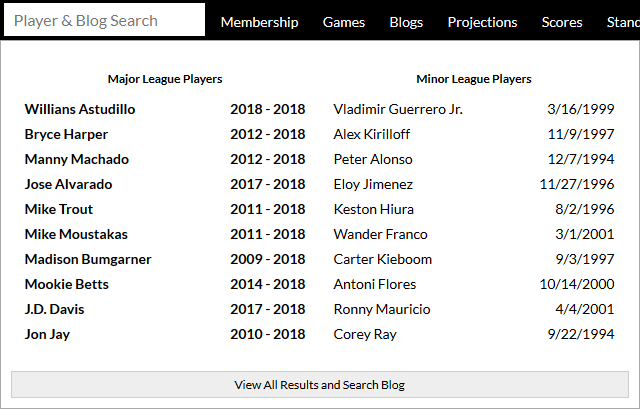
Willians Astudillo and Shooting for History

Some of you might not realize that, if you hover over the search bar up there, you’ll see which player pages have recently been the most popular. Let’s give it a spin, shall we?

Willians Astudillo. Between Astudillo and Vlad, I don’t know which has been more popular, but I strongly suspect it’s the former, and it’s definitely the former among major-league players. People have been losing their minds over Astudillo of late. Now, I did write about him last week. Playing winter ball down in Venezuela, Astudillo has performed like a deserving MVP candidate. But also, there’s a clip that’s been making the rounds. Willians Astudillo hit a home run.

Read the rest of this entry »


Somebody Go Get Will Smith

The Giants don’t project to be a good baseball team in 2019. That doesn’t mean they won’t be a good baseball team in 2019, but the odds are against them. They’re unlikely to be as good as the Dodgers. They’re unlikely to be as good as the Rockies. They might’ve been passed by the Padres, and they might still be worse than the Diamondbacks. With a farm system that’s in similarly mediocre shape, something had to change, and indeed, the Giants are now under new management. Farhan Zaidi and the rest of his front office are in the process of figuring out their next steps.

Some form of rebuild or step back seems inevitable. And the player who’s drawn the most public attention is Madison Bumgarner, on account of his having become a household name. Bumgarner could be traded, but then again, there are certain incentives pushing the Giants to giving him a few months to build up his value. It would also be difficult for Zaidi to make dealing Bumgarner one of his first major decisions. Something that could and should happen sooner is a trade of Tony Watson, and/or a trade of Will Smith. Both of them are veteran lefty relievers. I’m here to advocate for Smith. He’s the one any contender should want to get.

Read the rest of this entry »


By the Way, Jose Alvarado Was Impossible

Let me explain how I landed on Jose Alvarado. Alvarado is a reliever for the Rays. I actually wrote about him last June, but not because of his pitching.

Right. So why Alvarado, on today of all days? It’s not like he’s been showing up in trade rumors. Here’s the explanation: I’m a guy who loves looking at bullpens. I was also looking at the Twins last night, considering them as a possible sleeper. One guy they should be getting back is Michael Pineda. Another guy they already got back is Trevor May. May is going to pitch out of the Minnesota bullpen, and when he returned in 2018, he put up some encouraging numbers. I went into the leaderboards, to see how his numbers stacked up. That’s where I came across Alvarado. That’s what prompted all of this work.

Almost completely off the radar, Alvarado broke out late in the season. There’s no need to be complicated here. This is a very simple table:

2018, August and September
Pitcher K%
Corey Knebel 48.0%
Jose Alvarado 46.7%
Edwin Diaz 46.3%
Kirby Yates 44.6%
Josh Hader 41.1%
Ryan Pressly 40.8%
Dellin Betances 39.6%
Justin Verlander 39.2%
Blake Snell 38.5%
Brad Hand 37.1%
minimum 20 innings

That’s a list of some talented pitchers. Down the stretch, Alvarado struck out almost literally half of his opponents. He struck out the same rate of opponents as Edwin Diaz. I’ve written before about Ryan Pressly’s breakout. I’ve written before about Jose Leclerc’s breakout. What happened with Alvarado? Did anything happen with Alvarado? The answer is yes. He changed on the fly, and became something dominant.

Read the rest of this entry »


Brian Anderson on Hitting: “Home Runs Come With Experience”

Brian Anderson knows who he is as a hitter; he’s less sure of what kind of hitter he’ll be in the years to come. At 25 years of age with just 765 big-league plate appearances under his belt, the fourth-place finisher in last year’s NL Rookie of the Year balloting has a lot of growth in front of him.

Drafted by the Marlins out of the University of Arkansas in 2014, Anderson has displayed reliability, versatility, and a smooth right-handed stroke since arriving in Miami in September 2017. Manning both third base and right field, he finished the 2018 campaign with a .273/.357/.400 slash line and a team-high 34 doubles. Moreover, he was a mainstay in Don Mattingly’s lineup. Anderson was a spectator in just five games.

One thing he didn’t do often was leave the yard. Partly the result of playing in pitcher-friendly Marlins Park, Anderson homered a paltry 11 times. Which circles us back to the “what kind of hitter he’ll be in the years to come?” question. Anderson doesn’t lack raw power. It’s a matter of tapping into it more consistently as he continues to mature as a hitter.

Anderson discussed his gap-to-gap approach, as well as his long-ball potential, when the Marlins visited Fenway Park late last August.

———

Brian Anderson on hitting: “It’s about getting my pitches to hit. More specifically, getting good pitches within my approach and putting a good swing on them. It starts with my work in the cage, and then BP is for working on barreling the ball to all parts of the field. It’s for making sure that I’m hitting the ball the right way.

“Once I’m in the box, it kind of depends on the pitcher. Certain pitchers don’t throw to certain spots, and some pitchers are most vulnerable in certain spots. I like the ball more out over the plate. I like it more down in the zone and middle to middle away. That’s kind of the zone I try to lock in on, and I’ll try to drive that ball to right center. If I get hanging off-speed, or a heater in, then I’m (pulling the ball). Generally speaking, I’m more focused on the middle of the field. Read the rest of this entry »


Elegy for ’18 – Boston Red Sox

It seemed silly to think Mookie Betts would be as good as Mike Trout in 2018, but then he was.
(Photo: Keith Allison)

Now with their fourth World Series ring since 2004, we can safely say that any remaining curse on the Boston Red Sox has been exorcised with extreme prejudice. Surprisingly, their 108-win, 2018 season was the first hundred-win season for the franchise since 1946, back when Julio Franco was about 35.

The Setup

This World Series-winning Red Sox team should probably considered part of a new dynasty, rather than as the final installment of the one that won three World Series championships in the 21st century. Obviously, the players are different; 14 years have passed, and even awesome players are subject to the ravages of time. But the front office also has a very different look.

Theo Epstein has now been gone for nearly a decade, but in the years after his departure — and the brief interregnum featuring a dashing escape from Fenway Park dressed in a gorilla suit — the front office had a distinct flavor of the Epsteinian dynasty, with Ben Cherington, Jed Hoyer, and Mike Hazen all having ties to Epstein.

When Dave Dombrowski took over as President of Baseball Operations at the end of 2015, the ultimate responsibility for the day-to-day decision-making shifted for the first time to someone without ties to the 2004 champions. The Epsteinians ended with less bloodshed than a lot of great dynasties; Hazen getting a job in Arizona is hardly comparable to the violent end of Andronikos I Komnenos. (I swear I’ll stop now before the rest of the article is just me comparing Red Sox transactions to Byzantine battles.)

It’s easy to forget in the wake of a trophy in 2013 — flags fly forever, yada yada yada — but that victory was sandwiched between three last-place finishes in the AL East. To find the last time the Red Sox had consecutive losing seasons, you’d have to look back to around the strike.

The 2016 roster looked very different than the 2013 one. Only two starting position players remained from 2013, Dustin Pedroia and David Ortiz, and the latter was in his grand farewell procession. The 2013 rotation was gone, except for Clay Buchholz, and of the main bullpenniérs, only Koji Uehara remained.

After adding David Price and Chris Sale in consecutive offseasons, the 2017-2018 winter had its own big highlight: the team’s re-signing of Mitch Moreland. OK, we all know that’s a lie; Boston successfully waited out a winter during which many of the other big market teams did little with their cash, and brought in J.D. Martinez on a six-year, $110 million contract. It was the rare signing of a star free agent on Martinez’s side of the defensive spectrum that ZiPS didn’t immediately start digitally laughing at.

With a young offensive core — 30-year-old J.D. Martinez was the old man of the valuable parts of the lineup — and a hopeful return to health and form from David Price, Boston rightly felt that they didn’t have to add too much else. Unlike some of those other high-revenue teams, Boston was on no quest to get under the luxury tax threshold for 2018, already having reset its penalties in 2017 (the Red Sox payroll resulted in a nearly $12 million luxury tax payment).

The Projection

ZiPS projected Boston to be in a close battle with the Yankees going into the season, with a two-win deficit that could evaporate by simply making a slightly different set of assumptions. The computer projected Boston to have a 78% chance of making the playoffs, far better than any projected runner-up, with the next-best being the St. Louis Cardinals at 53%.

ZiPS did see some weaknesses in the team, viewing the catching situation as a bit of a mess and believing Mitch Moreland and Hanley Ramirez to be rather unambitious choices at first base. ZiPS wasn’t super-confident about the depth at the back of the rotation, either, and was concerned the No. 4 and 5 starter situation could unravel very quickly with a few Nasty Surprises in the health department.

The Results

Well, they won 108 games and the World Series, so you could say that there was definitely some more-than-passable adequacy going on. The weird thing about the Red Sox season is that as 108-win teams go, it really wasn’t all sunshine, lollipops, and Mike Trout Everything.

Unusually, you could see a lot of what-ifs scenarios, none of which were all that crazy, in which Boston could have easily finished with even more wins. The catching Cerberus hit like a three-headed hot dog, Moreland and the released Ramirez were in fact rather mediocre at first (though Moreland, as usual, wore his surprise breakout costume for a couple of months), and the back of the rotation did in fact have a couple of Nasty Surprises. Rafael Devers growing from his rookie season instead of regressing from it could have added a couple more wins as well.

The contours of the Red Sox season weren’t surprising, but the magnitude of the good things were. The Twitter Baseballosphere all joked about a specific article written before the season, in which a Boston-area writer said Mookie Betts was as good as Mike Trout (I was one of the sarcastic quippers, naturally). But Betts actually was as good as Trout in 2018, as weird as that claim appeared at the time.

Betts and Martinez gave the team two MVP candidates and Chris Sale was, as usual, a legitimate Cy Young candidate. One could argue that the Boston Red Sox were a bit like a very sunny version of the Colorado Rockies, a team that also had two MVP candidates and a legitimate Cy Young candidate, but surrounded their core with an Ian Demond-Gerardo Parra Imagination Christmas.

Unlike Colorado, Boston never stopped trying to find opportunities to deal with their team’s limited weak spots. Steve Pearce gave the team a legitimate right-handed role player who could do at first base what Hanley proved too inept to accomplish. Ian Kinsler was brought in to patch the hole at second, even if the move failed to be all that profitable. And Nathan Eovaldi solidified the back of the rotation and finished the season having completely resurrected his career.

Boston’s regular-season pummeling of the league continued, with the team steamrolling over the Yankees, Astros, and Dodgers — the majority of the teams ZiPS that thought were better going into the season — and only dropping three games over the entire postseason.

And while he didn’t have a Cy Young-type season, it was nice to see Price eviscerate that laziest of baseball storylines, that of the postseason choke-artist. After a lousy start against the Yankees in the ALDS, Price only allowed seven runs over his remaining 24.1 innings. And after having to make an appearance in that crazy 18-inning Game 3, Price allowed just one run in seven innings, on one day’s rest filling in for Chris Sale, who was hospitalized with a stomach ailment.

What Comes Next?

Over the next few years, the Red Sox will likely have harder decisions to make than their eternal rivals, the New York Yankees. Chris Sale, Rick Porcello, and Xander Bogaerts are free agents after the 2019 season, and if he plays just as well as he did last season, Martinez may very well join them by using his 2019 or 2020 opt-outs. Mookie Betts hits free agency after the 2020 season as well.

That’s a lot of talent to see leave, and keeping that group together will be expensive; the team has already hinted that it will pose a great challenge to sign all of them. This team blew through the luxury tax threshold and that’s with Sale, Betts, and Bogaerts making under $30 million combined. If Martinez doesn’t opt-out, the Red Sox already have a hair under $110 million baked in the 2020 cake for just six players. If you bring back Sale for $30 million, and Bogaerts for $20 million, even with letting Porcello walk, that’s $159 million with 17 roster spots left to fill.

And those spots won’t be cheap to fill. Using the framework developed by Craig Edwards, and the pre-2018 prospect ranks of Kiley McDaniel and Eric Longenhagen, Boston had the second-least value in their farm system, ahead of only the Mariners. While the McDongenhagen analysis for this winter isn’t out yet, I daresay that there weren’t enough victories in the minors (Michael Chavis was suspended, Sam Travis was terrible, and Triston Casas can’t single-handedly turn around the farm system) to drastically change this ranking for the better.

As Boston sees its young core become expensive without easy answers from the farm, the team will have to be creative (or get much more comfortable with the luxury tax) in the coming years to not have a significant down turn in the franchise’s fortunes. Transitioning to the team’s next core without spending $300 million a year may be the biggest challenge for the dynasty of the Dombrowskii.

ZiPS Projection – Mookie Betts

Let’s just bask in the Mookie-y goodness and hail to whatever we find in the sunlight that surrounds him.

ZiPS Projections – Mookie Betts
Year BA OBP SLG AB R H 2B 3B HR RBI BB SO SB OPS+ DR WAR
2019 .299 .379 .528 591 114 177 43 4 28 94 75 91 29 138 18 6.7
2020 .293 .375 .525 570 110 167 43 4 27 91 74 91 26 136 18 6.4
2021 .291 .375 .521 557 108 162 42 4 26 88 74 92 24 135 17 6.1
2022 .288 .374 .516 541 104 156 40 4 25 85 73 88 22 134 17 5.9
2023 .288 .372 .518 527 99 152 39 5 24 82 69 82 22 133 17 5.7
2024 .285 .368 .495 505 93 144 35 4 21 75 65 79 20 127 16 5.0
2025 .280 .361 .482 483 86 135 33 4 19 69 61 73 17 122 16 4.4

I asked ZiPS to give me all Betts’ remaining four-WAR seasons in the projections, and it returned a nice little collection of superstar seasons. All-told, ZIPS sees 52 WAR remaining for Betts, which puts him above 80 WAR, a definite Hall of Fame trajectory. Even if his defense doesn’t age as well as ZIPS thinks it will, knocking off ten runs a year from his defense starting in 2019 would still leave him at nearly 70 wins, and that’s way too harsh and adjustment.

That wraps up the Elegy for ’18 series; next year’s series will commence with the Orioles sometime in late March. Thanks for joining me in my final goodbyes to the 2018 season, even if they went week past when I’d intended!


White Sox Sign Kelvin Herrera as Relief Market Shrinks

The White Sox have made a series of minor moves this offseason to prepare themselves for contention at some point in the future; that might be as soon as next year, but it’s more likely in 2020 or later. The team added Ivan Nova from the Pirates to provide innings in the rotation. They added Alex Colome from the Mariners to help the pen. Chicago acquired Yonder Alonso from Cleveland to improve the offense and let Jose Abreu spend more time at designated hitter. If there was a $7 million to $10 million unwanted player, the White Sox have seemed willing to take on the salary in exchange for a fringe prospect. That strategy took on a different form today, as the team snapped up free agent reliever Kelvin Herrera on a two-year, $18 million deal with a vesting option, per Jeff Passan.

Herrera, not unlike many relievers, has had an inconsistent career. In 2012, 2014, and 2016, he put together very good seasons, with a sub-3.00 FIP and at least one win above replacement. In 2013 and 2015, he was closer to average. In 2017, when he took on closer duties in Kansas City, he just wasn’t very good. Last season, he put together a very good first half, which prompted Kansas City to trade him to Washington at just the right time. In DC, Herrera pitched poorly, and was sidelined with a rotator cuff injury and then a foot problem that ended his season. He’s missed time due to right arm injuries in 2014, 2017, and last year, also not uncommon for a reliever throwing in the high-90s. This is what his velocity looks like by season.

Velocity isn’t everything, and at 29 years old, Herrera is still young, but the drop is concerning. Here’s a similar graph showing his strikeout and walk rates.

Herrera’s walk rate has always been fine aided by a career 60% first strike rate, including 67% last year. It is interesting that his strikeout rate doesn’t necessarily correlate with his fastball velocity. He wasn’t striking out a lot of batters in 2014 and 2015, when he still had great velocity, and then when his velocity first dipped in 2016, he struck out batters at the highest rate of his career. In ranking the Top 50 free agents this offseason, Kiley McDaniel put Herrera 49th overall and 10th among relievers. McDaniel pegged Herrera for a one-year deal at nine million dollars, roughly half the guarantee he ended up receiving. Dan Szymborski wrote Herrera’s report in that post and came to a similar conclusion. Read the rest of this entry »


Cleveland and New York Choose Their Catchers

Earlier this winter, the New York Mets were looking to upgrade their catching situation. The team was dissatisfied with Travis d’Arnaud, Kevin Plawecki, and Tomas Nido as the frontline options, and after rumors of a J.T. Realmuto trade, the team ended up signing Wilson Ramos to give them four, major league-caliber catchers. Cleveland has moved in the opposite direction. The team traded top prospect Francisco Mejia to San Diego for Brad Hand and Adam Cimber over the summer to aid their bullpen. Then, when winter began, Cleveland moved Yan Gomes to the Nationals to save money. That left Cleveland with the ultra-light hitting Roberto Perez and the all-or-nothing Eric Haase, whose projections lean more toward the “nothing” side than the “all.” That made the two teams pretty good trading partners, and this is the result:

Cleveland receives:

  • C Kevin Plawecki

New York receives:

Read the rest of this entry »