Part of Bryce Harper’s Contract May Not Actually Be That Useful

It has been a few weeks now since Bryce Harper’s contract with the Phillies was finalized, and we’ve all mostly moved on with our lives.

I live in the Washington, D.C. area, and most people around here aren’t happy that Harper left for Philadelphia; many were more upset about where Harper chose to sign than the idea of him leaving at all. I was recently listening to local sports talk radio discussing the Harper signing. They did not make the most glowing comments about the city of Philadelphia, and they couldn’t believe that any player would sign a 13-year contract to play there. They were also taken aback by the full no-trade clause and the lack of opt-outs in the deal.

I’ll give them the latter; the lack of opt-outs in Harper’s contract was indeed a surprise to many. But as for the full no-trade clause, it’s not really as impactful as one might otherwise think.

I present to you Article XIX, Section A, Subsection (1) of the Collective Bargaining Agreement, otherwise known as the 10-and-5 rule:

The contract of a Player with ten or more years of Major League service, the last five of which have been with one Club, shall not be assignable to another Major League Club without the Player’s written consent.

Basically, what this is saying is that after a player has accrued 10 years of major league service time, while also spending at least five years with their current organization, they have full no-trade rights. While people made a huge deal about Harper’s willingness to stay in Philadelphia for 13 years, the biggest indication of that willingness did not come through the no-trade clause at all. It’s something that he would have gained after his fifth season with the club. It’s only significant for the first five years of his contract, years during which the Phillies probably had no desire to trade him anyway. And even if the Phillies wanted to trade him, they might have trouble trying to unload his contract either way.

Just for fun, let’s consider how like it is that the Phillies would want to trade Harper within the first five years of his contract.

To start, the first five seasons are likely to be his best five seasons in the deal. He’s only just heading into his age-26 season, so 2019 through 2023 would only take him through age 30. Looking at the basic baseball player aging curve, these are likely to be the most productive seasons of Harper’s contract and potentially of his career.

Here’s how ZiPS projects Harper to produce through 2023:

ZiPS Projections For Bryce Harper, 2019-2023
Year G AB BA OBP SLG HR RBI OPS+ DR WAR
2019 149 516 .271 .407 .537 35 109 146 -4 4.7
2020 147 507 .268 .408 .540 35 109 147 -5 4.7
2021 145 498 .263 .405 .532 34 106 144 -5 4.3
2022 141 482 .266 .409 .529 32 101 144 -5 4.2
2023 136 466 .262 .406 .519 30 96 141 -6 3.8
SOURCE: Dan Szymborski’s ZiPS projections

Harper is projected to hit a total of 166 home runs, maintain an OBP above .400, and produce nearly 22 WAR. Clearly, if Harper even comes close to meeting these projections, there’s no way that the Phillies would want to trade him. That production is exactly what they were looking for when they signed him.

But what if Harper gets injured? Or worse, doesn’t play well?

That would make things a little bit more complicated. Harper’s contract won’t just disappear, and that itself makes him pretty much untradable anyway. Only teams like the Yankees, Red Sox, and Dodgers would likely be willing to take on a contract of that size, and if Harper is not producing or is injured, there’d likely be even less of a desire to want to take on the final eight-plus seasons of his deal.

There is one other scenario in which the Phillies might want to trade a good Bryce Harper. Similar to the Marlins and Giancarlo Stanton (who was in the midst of his $325 million deal), the Phillies could see their rebuild go awry. In this unlikely event, the Phillies might want to shed Harper’s salary and try to trade him. New York, Boston, and Los Angeles again would make sense as Harper’s likeliest potential suitors; another team could theoretically jump in, but his market would still be limited. After all, it was the Yankees that took on Stanton’s huge contract when the Marlins decided they didn’t want it. Still, it is a scenario that Harper — who told The Athletic’s Meghan Montemurro, “[F]or me, it’s about being somewhere for a long period of time, making my family, digging my roots, for the good, for the bad.” — was likely keen to guard against.

Here’s a breakdown of Harper’s payment structure, as outlined by Baseball-Reference:

Bryce Harper’s 13-Year, $330 Million Contract
Age Year Contract
26 2019 $11,538,462
27 2020 $27,538,461
28 2021 $27,538,461
29 2022 $27,538,461
30 2023 $27,538,461
31 2024 $27,538,461
32 2025 $27,538,461
33 2026 $27,538,461
34 2027 $27,538,461
35 2028 $27,538,461
36 2029 $23,538,462
37 2030 $23,538,461
38 2031 $23,538,462
SOURCE: Baseball-Reference

The yellow line designates the season in which Harper would have earned his 10-and-5 rights. In a world where he did not have a no-trade clause and the Phillies tried to trade him before reaching those rights, an acquiring team would be on the hook for eight years and $208 million. Of course, the Phillies could kick in some money, but if Harper was so undesirable that they felt it was necessary to dump him, it might not even be worth dealing him. They’d have no leverage, limited suitors, and an aging, expensive star.

This does not mean that Harper shouldn’t have tried to include a no-trade clause in his contract, however. Harper obviously plans to stay in Philadelphia for all 13 years, and this just adds extra protection so he can achieve that goal.

But in a world where there wasn’t a no-trade clause in Harper’s contract, the odds that the Phillies would have traded him before he reached his 10-and-5 rights seem to be minuscule, which would seem to suggest that Harper’s no-trade clause was mostly just a matter of form.
2019 Positional Power Rankings: Third Base

You’ve read the intro. You’ve read about first basemen and second basemen. You know how to count. You know what time it is. As our positional power rankings continue, let’s talk about third base.


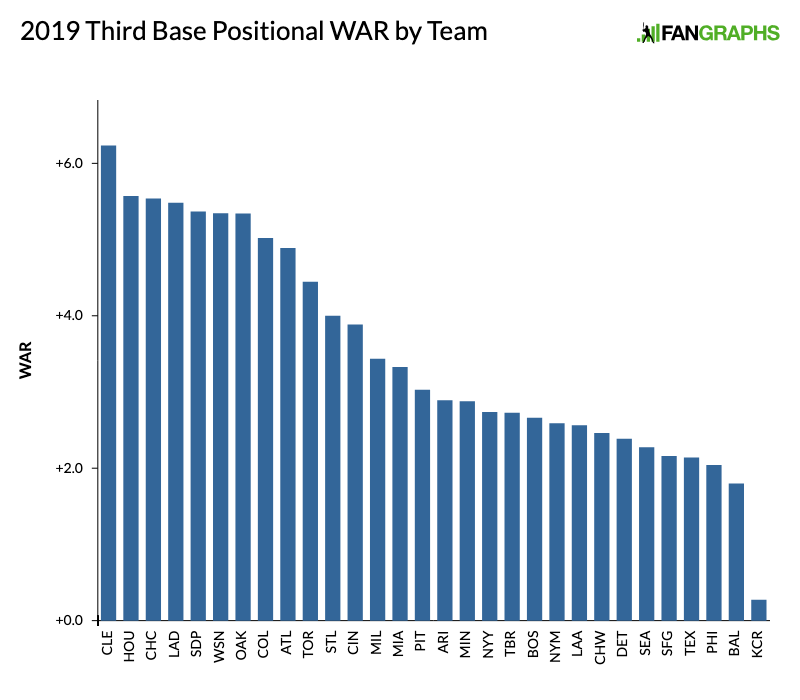
This, friends, is a very good time to like watching baseball men play a good third base. Fully half of the top 10 players by WAR last year were third basemen, and only three of those five men make the top five of our rankings. The 8th-ranked player on this list, Nolan Arenado, is projected for nearly five wins this year, and the 10th-ranked player is the consensus top prospect in the game. Your mileage may vary, but I see roughly four tiers here: An elite No. 1-8, any one of whom can at times threaten to be among the best players in the game; a very strong second tier No. 9-13, the top of which contains players who have been in the past or could be in the future very good; a perfectly solid and mostly indistinguishable third tier running from No. 14 to No. 29, containing every possible diversity of age, experience, upside, and talent; and then the Royals. Let’s dive in. This will be fun. Read the rest of this entry »


Drew Ferguson Talks Hitting

Last week’s ‘Talks Hitting’ interviews featured a pair of prominent big-leaguers. Daniel Murphy and Nolan Arenado have combined to make seven All-Star teams over the past five seasons. Today we feature a far-less-accomplished player. Drew Ferguson, a 26-year-old outfielder currently in camp with the San Francisco Giants, has yet to make his major league debut.

Ferguson has a finance degree from Belmont University, but his true passion is the biomechanics of hitting. He can definitely swing the bat. In 316 plate appearances last year — all but 24 at the Triple-A level — Ferguson slashed .304/.432/.443. He did so in the Houston Astros organization, from which the Giants selected him in December’s Rule-5 draft.

———

David Laurila: I understand that you have a strong interest in analytics.

Drew Ferguson: “I’ve been interested in analytics for many years — dating all the way back to high school — but numbers can only tell you so much. From a player development standpoint, it’s more about the biomechanics of the swing. How does the body move? What are we trying to do as hitters? What are the angles of the pitch versus the swing? What is a good approach based on your swing, based on the pitcher’s repertoire?”

Laurila: Hitting analytics are obviously becoming a big part of the game.

Ferguson: “100%. A lot of [hitting] is intuitive to players — guys describe things in different ways — but with the technology we have to describe a swing … I was just talking to one of my teammates about how angles are going to line up. For example, your posture and the direction of your swing can tell you that you should probably hit four-seam fastballs at the top of the zone easier than a sinker at the bottom of the zone. You can see that by looking at video, and at the metrics of your swing. Read the rest of this entry »


Mike Trout Is Baseball’s $430 Million Man

Have you had your morning coffee yet? Here’s something for you:

In the seven years since his debut as a precocious 19-year-old back in 2011, Mike Trout has been worth 64.9 wins above replacement — nearly 20 more than the next-greatest mark achieved over that period (Buster Posey’s 47.3). If you look since 2012, which eliminates Trout’s 0.7 win 2011, the gulf is just as wide: Trout’s 64.2 wins are as far ahead of second-place Posey (45.4) as Posey is of 21st place Jonathan Lucroy (26.3). Trout holds the record for most WAR through age 21, 22, 23, 24, and 26 (Ty Cobb beat him out for 25). Mike Trout is 23rd all time in career WAR through age 30, and he is only 27 years old. Mike Trout is already an average Hall of Famer, and his career can’t yet drive or buy a drink.

Now he’s also signed the biggest contract in professional sports history, besting in one swoop both Zack Greinke’s $34.4 million AAV (Trout will get $36 million), and, by $100 million, Bryce Harper’s briefly record-setting $330 million contract with the Philadelphia Phillies. Trout will be an Angel for life and he is already the greatest to ever wear that uniform. Craig Edwards will have a much longer post putting this all in context later today, but for now, please take this time to discuss, reflect, and enjoy. Mike Trout is baseball’s greatest player, he should be the game’s biggest star, and he’s finally going to be paid like it.


2019 Positional Power Rankings: Second Base

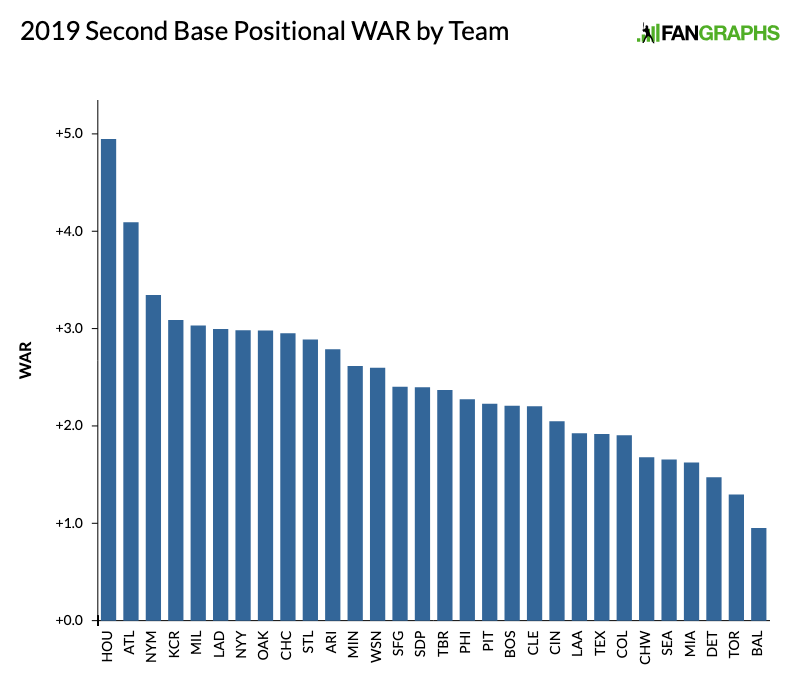
On Monday, Jay Jaffe kicked off our positional power rankings series by evaluating first basemen. If you need a refresher on the process or the concept behind the series, Meg Rowley wrote a handy explainer. Today, we stay on the infield and tackle second base.

The stereotype surrounding second base is that these players aren’t good enough defensive players to man shortstop and aren’t good enough hitters to play third base. There are those that defy those conventions. Jose Altuve is one of the best players in the game. Javier Baez and Ozzie Albies can handle short. Robinson Cano has been one of the better hitters in baseball for a decade. Mike Moustakas probably should be a third baseman, but weirdly won’t be one this year. There are many, however, for whom those traditional designations fit. Only two teams have four-win projections at the position, with a bunch of high-floor three-win types. That doesn’t scream stardom, but there’s a lot of hidden upside in these projections. In addition to Albies, we see possible stars in Gleyber Torres and Luis Urias. Javier Baez only gets partial playing time at second. Scott Kingery, Carter Kieboom, Keston Hiura, Bo Bichette, and Nick Madrigal don’t play a huge role below, but they do represent talented young players who could help their teams to the top of these rankings in the years to come. Read the rest of this entry »


Aroldis Chapman’s Other Best Pitch

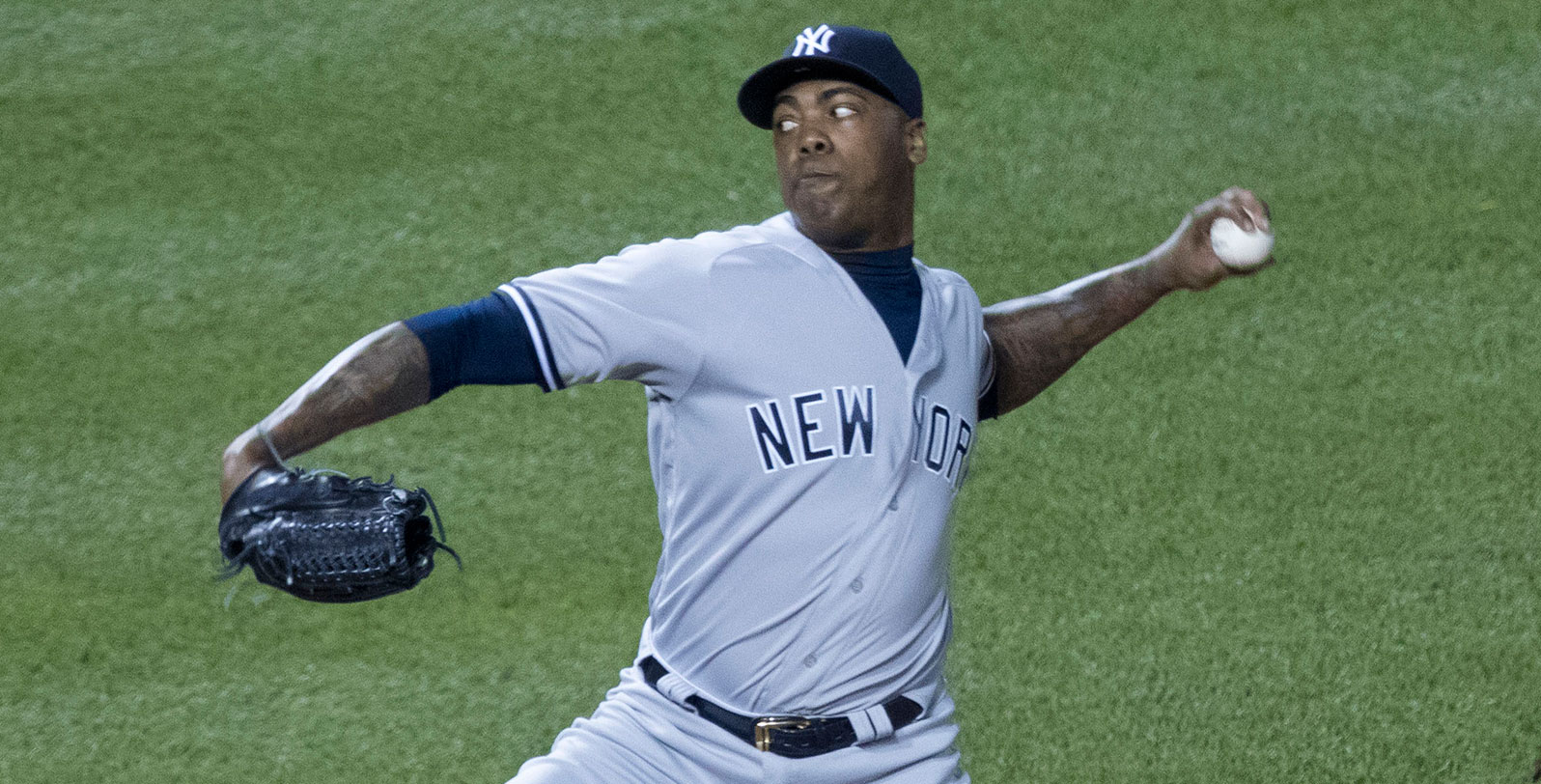
Before the 2017 season, Aroldis Chapman signed a near-record-setting contract to play for the Yankees. The club knew what they were getting, both on and off the field — they had traded Chapman to the Cubs earlier that year, and now they were bringing him back. More broadly, baseball knew what the Yankees were getting — a dominant closer with a dominant fastball. Just how much of an outlier was Chapman’s fastball? Well, when MLB created a fastest pitches leaderboard to show off Statcast, they added a button called the “Chapman filter.” In 2016, Chapman threw the thirty fastest pitches in the majors. It’s not much fun looking at a leaderboard that’s just one guy’s name over and over again.

Fast forward a year, and all the signs were trending downward. Chapman put up a 3.22 ERA and a 2.56 FIP in 2017, both the highest marks since his rookie year. He struck out a career-low 32.9% of the batters he faced (which is still pretty good for a career-low). His average fastball velocity declined by a mile an hour. By early 2018, he’d even been dethroned atop the fastest pitch leaderboard by Jordan Hicks. The human brain is an amazing pattern-matching machine, and we’ve seen this one plenty of times. Closers often break — it’s one of the reasons Chapman’s five-year contract was considered a risk when he signed it. The king has his reign, and then he dies. It’s natural.

Well, a funny thing happened on the way to irrelevance. Aroldis Chapman reinvented himself in 2018, and while he didn’t quite get back to his game-breaking 2014 highs, he recorded a 2.45 ERA and an even more absurd 2.09 FIP. He struck out 43.9% of the batters he faced, the second-highest rate of his career. How did he do it? Did he reach back a little further and take the velocity lead back from Hicks? Not even close, as his average fastball velocity declined another tick in 2018, and he finished a distant third in that category, the first time he wasn’t the hardest thrower in baseball since 2011. Instead, he leaned on his slider — one that may be the best in the game today. Read the rest of this entry »


Jon Gray, Mark Gubicza, and Garrett Richards on Developing Their Sliders

Pitchers learn and develop different pitches, and they do so at varying stages of their lives. It might be a curveball in high school, a cutter in college, or a changeup in A-ball. Sometimes the addition or refinement is a natural progression — graduating from Pitching 101 to advanced course work — and often it’s a matter of necessity. In order to get hitters out as the quality of competition improves, a pitcher needs to optimize his repertoire.

In this installment of the series, we’ll hear from three pitchers — Jon Gray, Mark Gubicza, and Garrett Richards — on how they learned and developed their sliders.

———

Jon Gray, Colorado Rockies

“I started throwing a slider in probably 2012. I first learned how to throw a slurve, and that taught me how to throw a slider. I remember my uncle teaching me to throw one. He was like, ‘Don’t be throwing curves. You need to throw slurves and cutters, so you don’t mess up your arm.’ He didn’t want any action on my wrist.

“I learned how to throw that, a slurve, which is kind of the basics of a slider. In high school, I didn’t really have a grip. I didn’t know how to hold one, I guess. I just kind of made up my own grip and went with it. I didn’t watch baseball growing up — I watched none — so it was kind of hard. Read the rest of this entry »


Ahn Woo-Jin Is Ready to Take on the KBO

Ahn Woo-Jin (photo by Sung Min Kim)

Some would say that Ahn Woo-Jin of the Kiwoom Heroes is the most high-profile pitching prospect in all of the Korea Baseball Organization (KBO). He has been a highly-touted arm since pitching for the Whimoon High School in the Daechi-dong area of Seoul, topping out at 156 kmph (around 97 mph) and showing solid feel for his secondary pitches. He also has the look of a hurler. He’s got the height (around 6-foot-3), a frame that could fill out as he grows, and long limbs. Ahn was drafted by the Heroes in the first round of the 2017 KBO Draft, and signed with a franchise-record six billion won (around $530,000) bonus.

The 19-year-old rookie’s 2018 regular season numbers weren’t pretty. He went 2-4, 7.19 ERA (5.74 FIP) with 46 strikeouts, 28 walks, and six home runs allowed in 41.1 IP. Besides the strikeouts, the numbers indicated a clear rawness from a kid who was the age equivalent of a college freshman. However, after a series of adjustments, he became a formidable force out of the pen in the 2018 postseason. In 15.2 IP, Ahn struck out 18 and walked only one, while allowing just two earned runs and a home run. A 15.2 IP sample size isn’t as big as 41.1 IP, but it seemed clear that the tweaks made a difference.

One of the masterminds of Ahn’s mechanical changes was his pitching coach, Brandon Knight. Knight is a man of ample pitching experience. The right-hander had a cup of coffee with the Yankees in 2001 and 2002, and with the Mets in 2008. He also pitched in Japan, Venezuela, and South Korea, and had a couple of independent league stints. In the KBO, Knight pitched for the Samsung Lions in 2009 and 2010, and the then-Nexen Heroes from 2011 to 2014. He made a solid impression pitching in Korea for the last few years of his pro career, going 48-38, with a 3.84 ERA in six seasons in the KBO. The Heroes hired Knight in late 2015 to be their pitching coordinator for the Futures League team and promoted him to pitching coach for the big league team in the middle of 2017 season. Read the rest of this entry »


2019 Positional Power Rankings: First Base

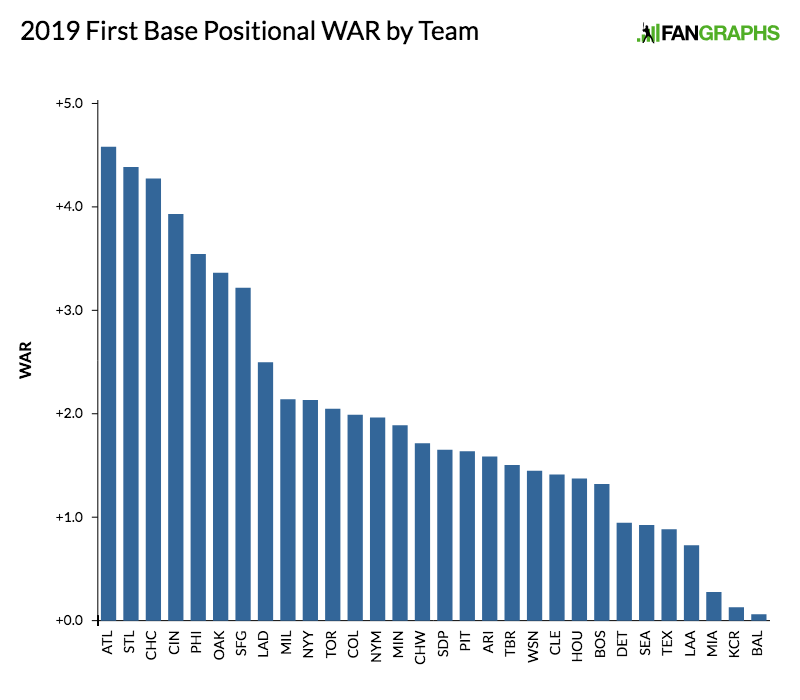
Earlier today, Meg Rowley introduced this year’s positional power rankings. As a quick refresher, all 30 teams are ranked based on the projected WAR from our Depth Charts. Our staff then endeavors to provide you with some illuminating commentary to put those rankings in context. We begin this year’s series with first base.

A year ago, first base looked to be a deep position, with a familiar set of stars occupying the top tier of the rankings, impressive debutantes such as Cody Bellinger and Matt Olson entering their first full major league seasons, and some long-toiling veterans such as Yonder Alonso, Justin Smoak, and Eric Hosmer appearing to have finally figured out how to mash at the level expected for the position. As a group, first basemen had combined for a 117 wRC+ in 2017 (their highest mark since 2011) and 70.2 WAR (their highest mark since 2009).

Things didn’t go as planned for the position’s denizens in 2018. Paul Goldschmidt, Anthony Rizzo, and Joey Votto all got off to slow starts. Bellinger and Olson weren’t quite as impressive as they had been as rookies, with the former spending a lot of time in the outfield to boot. Hosmer, the recipient of the offseason’s biggest free agent contract, was a replacement level dud, and Alonso and Smoak both regressed. Joe Mauer faded after his best season since moving from catcher, Miguel Cabrera got hurt before he could rebound from a subpar 2017, and Chris Davis, who had been mediocre in 2017, turned in a season for the ages — but in the wrong way. And so on and so on. All told, first basemen’s production sank to a collective 108 wRC+ and 46.9 WAR in 2018, their lowest marks by either measure in our splits, which only go back to 2002 for such things. Collectively, their slugging percentage dropped from .487 to .438, and their on-base percentage from .347 to .333. Read the rest of this entry »


2019 Positional Power Rankings: Introduction

Welcome to the 2019 positional power rankings! As is tradition, over the next week and a half, we’ll be ranking every team by position. This is always something of a funny exercise. You read FanGraphs every day (thank you!) and are well-versed in the goings on of the offseason, glacial though they may have been at times. You probably know that Bryce Harper is on the Phillies, and that Manny Machado is a Padre, and that Brian McCann found his way back to Atlanta. You probably recall that Craig Kimbrel, who was tied with Kenley Jansen for the best individual reliever projection in last year’s iteration of this series, is still unsigned. You almost certainly do not remember every 30-something free agent who ended up on the Texas Rangers, but that’s ok. I’m the managing editor of FanGraphs, and I’ve been surprised by a few of those guys while watching spring training action. All of that is to say, you know what’s going on. And yet the anticipation of the season, the sound of wooden bats, and those clear, sunny days, makes you want to read even more about baseball and what it might look like over the next seven months or so. This is our answer to that impulse.

This post serves as an explainer for our approach to these rankings. If you’re new to our rankings, I hope it helps to clarify how they are compiled and what you might expect from them. If you’re a FanGraphs stalwart, I hope it is a useful reminder of what we’re up to. If you have a bit of time, here is the introduction to last year’s series. You can use the handy nav widget at the top to get a sense of where things stood before Opening Day 2018.

Unlike a lot of season previews, we don’t arrange ours by team or division. That is a perfectly good way to organize an exercise like this, but we see a few advantages to the way we do it. First, the positional rankings allow us to cover a team’s roster top to bottom, with stars and role players alike receiving some amount of scrutiny, while also placing those players (and the teams they play for) in their proper baseball context. By doing it this way, you can easily see how teams stack up against each other, get a sense of the overall strength of a position across the league, and spot places where a well-deployed platoon may end up having a bigger impact than an everyday regular who is just ok. We think all of that context helps to create a richer understanding of the state of things and a clearer picture of the season ahead. Read the rest of this entry »