FanGraphs Baseball

A Better Hendriks Suits Up In Oakland

A year ago tomorrow — Wednesday, October 3, 2018 — Liam Hendriks started the American League Wild Card game for the Oakland A’s. Twenty-five pitches and one Aaron Judge home run later, Hendriks hit the showers with his team down 2-0. Three hours after that, the rest of his teammates joined him there. Tonight, the A’s will play in a one-game playoff for the third time in six seasons, and though Hendriks won’t be starting, he’s a big reason his team has a chance to prove an old saying true tonight.

“He’s really been one of our MVPs,” said Scott Emerson, the A’s pitching coach. “Last year, it was Blake [Treinen], and this year it’s been Liam. Last year when he got sent out [to Triple-A in early April], he really transformed his body and got into the long-toss program. That transformation came with a change in mindset and in approach. It didn’t hurt that the velo spiked, and the breaking ball got a whole lot better, too.”

The results have been spectacular. Hendriks was an All-Star in July for the first time in a nine-year career, bringing a 1.22 ERA and 2.06 FIP into that game, and his numbers since the break were, if anything, even better: a 1.60 FIP and a 45.7% strikeout rate. More to the point, he’s found success in the second half without also carrying the 89% strand rate and 0.17 HR/9 mark that led doubters to write off his first half as a run of good luck for an otherwise average pitcher. After the break, Hendriks stranded just 78% of baserunners and allowed 1.08 HR/9 — both much more in line with his career numbers of 70% and 1.04, respectively. Read the rest of this entry »

Twenty-Seven Outs to Go: The Nationals Win a Thriller

Outs are a scarce resource. Of all the insights the sabermetric movement has bequeathed, that one looms largest in a game like this, when an entire season hangs in the balance on every pitch. From the second that Yasmani Grandal’s line drive sailed over the right field wall for a two-run homer in the first, the Nationals were on notice:

You are losing. You only have 27 outs to fix it.

A month ago, Brandon Woodruff seemed an unlikely October hero. Not only were the Brewers fading, but Woodruff’s continued absence helped explain why. The righty went down with a strained oblique in late July, and didn’t return until the season’s final weeks. Even when he climbed back on the bump in September, the Brewers were cautious, limiting him to four innings across two late-season starts.

On the big stage, he could not have looked more in form. His heater, one of the fastest in the game on a normal night, reached triple digits and sat just a tick lower. He was amped from the first pitch, and where Max Scherzer tossed a shaky first inning, Woodruff looked settled. In mere minutes, he induced a groundout, a whiff, and a pop up.

Twenty-four outs to go. Read the rest of this entry »


FanGraphs NL Wild Card Chat

Read the rest of this entry »


Here’s Who Is Going to Win the World Series (Maybe)

Forcing baseball writers to make predictions isn’t particularly nice. People tend to remember the bad picks more than the good ones, and a lot of flukiness can reveal itself in a short stretch of games. Still, I’m a scamp, so I asked my colleagues for their postseason winners. Thirty-two writers from across our family of blogs answered the call. Many of them proved to be Astros and Dodgers believers but some went in less well-worn directions. Below are the results by league and round, as well as each writer’s complete forecast. Happy playoffs!

National League

Wild Card and Divisional Series

National League Wild Card
Winner Votes
Nationals 21
Brewers 11

Braves vs. Cardinals Division Series
Winner Votes
Braves 23
Cardinals 9

Dodgers vs. Wild Card Winner Division Series
Winner Votes
Dodgers 21
Nationals 10
Brewers 1

Read the rest of this entry »


Postseason Preview: The AL Wild Card Game

Talk of low payrolls and stadium issues will be afterthoughts when MC Hammer throws out the first pitch before Wednesday’s American League Wild Card tilt between Tampa Bay and Oakland. Both teams created necessary distance between themselves and Cleveland to take a bit of a breath in the season’s final days, though Tampa’s late-September gauntlet (they played consecutive series against the Dodgers, Red Sox, and Yankees, then flew from Toronto to Oakland for this game) seems fairly exhausting. The reward for winning Wednesday is a Friday date with a juggernaut in Houston.

Oakland has yet to officially announce their starter (10 AM Wednesday is the roster deadline) though it’s expected to be lefty Sean Manaea, who will be on an extra day’s rest after throwing in Seattle on Thursday. Righty Mike Fiers threw on Friday and is also a possibility to start. Tampa Bay has already announced that 6-WAR righty Charlie Morton will take the ball. Let’s take a look at our starters (**denotes out pitch**).

Charlie Morton Scouting Report
Pitch Type Type Use % Velo (mph)
Fastball Mix of 4-seam and 2-seam 49% avg 94, t97
**Curveball** Power/Vertical 37% avg 79
Slider/Cutter Two-plane 11% avg 85
Changeup Split 3% avg 85
Heavy curveball usage. Slider shape can vary into cutter look. For swings and misses works middle away with slider, beneath zone with curveball.

Read the rest of this entry »


What We Did (and Did Not) Get Right About the 2019 Season

Before Opening Day, 32 staff writers and contributors from across our family of blogs made predictions about which teams would make the 2019 playoffs. I compiled the results, which can be found here. On March 19, 15 clubs had playoffs odds of 20% or better by our numbers; the Angels came close at 19.5%. When half the teams in the majors are seen as pre-season also-rans, it’s easy to fret that the next few months will be fairly ho-hum; that with so many divisions seemingly sewn up, the season might fail to deliver its share of thrills. Despite a few bold predictions (two brave souls forecast the Dodgers to miss the postseason entirely), many of our writers showed an unsurprising deference to the preseason projections. But just because the answers seemed obvious doesn’t mean we got everything right. As I’ve said in the past, affecting an air of clairvoyance is a rite of spring; realizing we’re a bunch of goofs is fall business. So before the playoffs begin this evening, let’s spend a moment reckoning with the fact that we’re bad at predicting things, or at least imperfect at it.

First though, we’ll pause to acknowledge those who got things the most right. No one predicted the postseason field in its entirety, but Eric Longenhagen, Paul Sporer, Eli Ben-Porat, and the Brothers Birchwood each anticipated eight of the final 10 teams. Eric, Paul, and the Birchwood Brothers got the American League field right but for Oakland; all three thought the Red Sox were destined for October baseball. And Eli was the closest in the National League; he correctly pegged the three division winners, and Washington as a Wild Card, though he thought the Nationals would be facing the Phillies in Philly.

Number of Correctly Predicted Playoff Teams
Correctly Predicted Playoff Teams Number of Writers
8 4
7 13
6 11
5 4

Read the rest of this entry »


ZiPS Playoff Probabilities Are Live!

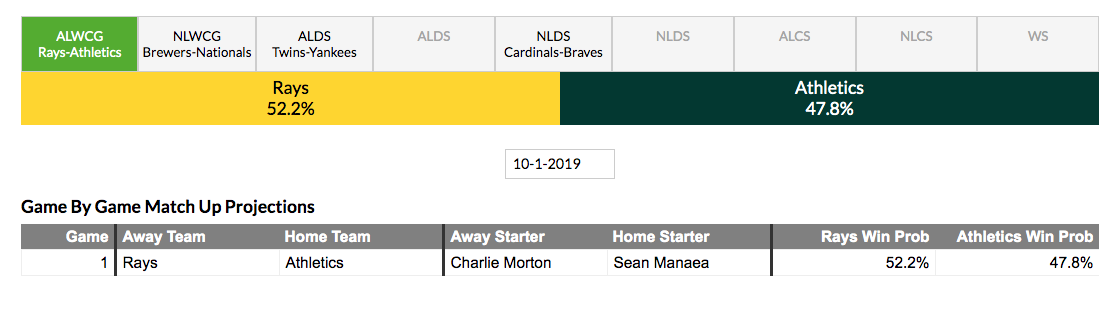
For your prognosticating convenience, we’ve created a new, live section of the playoff odds page to house the ZiPS projections for each game of the postseason. These projections are a supplement to the normal FanGraphs Playoff Odds. They are not a replacement for the existing ones, which combine ZiPS and Steamer. These projections are arrived at similarly to how ZiPS does the roster strength projections during the regular season, only with roster constructions that reflect the very different way players are used during the playoffs. Unlike the regular season model, ZiPS uses projected starters in order to make a more accurate, game-by-game projection; during the regular season, ZiPS uses the actual schedule, but without knowledge of which player will start each game.

To aid in modeling these probabilities, the full model of ZiPS is used, which includes updated split projections in order to (hopefully!) enhance the projections’ accuracy. There’s obviously a great deal of speculation as to who will start these games; these odds will be updated continually as we get closer to first pitch. Projections for the Division Series that will be played against the respective Wild Card winners will populate after the Wild Card games have concluded. For the moment, you’ll see their tabs grayed out. Read the rest of this entry »


Brian Bannister, Andrew Cashner, and Rick Porcello on Developing Their Changeups

Pitchers learn and develop different pitches, and they do so at varying stages of their lives. It might be a curveball in high school, a cutter in college, or a changeup in A-ball. Sometimes the addition or refinement is a natural progression — graduating from Pitching 101 to advanced course work — and often it’s a matter of necessity. In order to get hitters out as the quality of competition improves, a pitcher needs to optimize his repertoire.

In this installment of the series, we’ll hear from three pitchers — Brian Bannister, Andrew Cashner, and Rick Porcello — on how they learned and developed their changeups.

——

Brian Bannister, Boston Red Sox (VP/Pitching Development)

“Everyone starts that journey of trying to throw it slow, and in that process you choke the grip, you drag your back foot, you curl your toes — you do everything you can to make the pitch slower. But Zack Greinke will talk about how we had a teammate [in Kansas City] named Ramon Ramirez who threw his changeup 90 mph. He didn’t even try to throw it slow. We watched him do it successfully. We watched Felix Hernandez do it successfully. We were always watching James Shields dominate with a power changeup. That’s what we used to call it.

“Once we started realizing that your hand pronates more on a changeup than it can on a two-seamer, we could get the depth of an elite two-seamer by throwing our changeups as hard as possible. It added that element where it was almost a Brandon Webb sinker, but you’re holding it with a changeup grip. Read the rest of this entry »


The Patrick Corbin Signing Made the Difference for Washington

The Nationals would not be here today without Patrick Corbin.

In a season with many ups and downs — really, just one “down” and then one much larger “up” — Corbin was a consistent arm in the Nationals’ rotation, especially as the ace of the staff, Max Scherzer, dealt with injuries in the second half and relative (by his standards) ineffectiveness upon his return. He was not the only rock — Stephen Strasburg was also superb — but he was the new rock, the highlight of the Nationals’ offseason, their prized signing.

On December 4, the Nationals inked Corbin to a six-year, $140 million deal, the largest contract given to any starting pitcher the entire offseason. With one full season in the books, it’s clear that Corbin has come to Washington exactly as advertised. As their third ace, Corbin’s presence in the rotation helped put them over the top. A team with three of the best 13 pitchers in baseball likely won’t stay defeated for long, and the Nationals overcame a horrid 19-31 start to win 93 games and clinch the top NL Wild Card spot.

Of course, this turnaround is not solely due to Corbin’s contributions, but having him in the rotation certainly didn’t hurt. He pitched 202 innings this year to the tune of a 3.25 ERA, 3.49 FIP, and 4.8 WAR. He outpitched both Steamer’s (3.3 WAR) and ZiPS’ (3.5) preseason projections. As a result, the Nationals had the best rotation in baseball, and they hope that their top three starters will be the difference here in October: Read the rest of this entry »


Effectively Wild Episode 1437: The Playoff Preview Pod

EWFI
Ben Lindbergh and Sam Miller follow up on banter about Mike Minor’s pop-up do-over and guaranteeing homers, revisit an earlier discussion about whether the 2019 regular season was good, and then preview the postseason, touching on every team in the playoff field, the difficulty of predicting playoff success, the most compelling matchups, the different ways to pick a playoff rooting interest, and more.

Audio intro: Generationals, "Ten-Twenty-Ten"
Audio outro: Boat, "Come With Me We’ll Win"

Link to Dizzy Dean pop-up story
Link to Sam on the pennant races
Link to Ben on the Astros and Dodgers
Link to Sam on the Dodgers and Astros and fastballs
Link to Sam on the Yankees
Link to ESPN playoff preview
Link to order The MVP Machine

 iTunes Feed (Please rate and review us!)
 Sponsor Us on Patreon
 Facebook Group
 Effectively Wild Wiki
 Twitter Account
 Get Our Merch!
 Email Us: podcast@fangraphs.com

01:21:53

