Josh Naylor Reunites With Seattle on a Five-Year Deal

Stephen Brashear-Imagn Images

Technically, the starting gun for the 2025-26 offseason already fired. Back on November 5, Leody Taveras signed a one-year, $2.1 million contract with the Orioles, though you’d be forgiven for missing that news, seeing as it came just days after a transcendent World Series and didn’t even merit a writeup on this august website. So let us consider November 16 the official first day of the offseason. On Sunday evening, Jeff Passan reported that first baseman Josh Naylor and the Seattle Mariners were “finalizing” a five-year deal. (On Monday evening, Ken Rosenthal reported the terms: five years, $92.5 million.) In estimating Naylor’s contract for our annual Top 50 Free Agent ranking (he checked in at no. 11), Ben Clemens anticipated a four-year, $100 million deal, while the median crowdsource projection was four years and $80 million.

The first real move of the offseason, fittingly, is perhaps its most predictable. From the day their season ended, the Mariners’ front office shared its desire to bring Naylor back to the Pacific Northwest.

“It was a great fit and it’s definitely a priority for us this offseason — if not one, I don’t know what else would be, he’s no. 1 right now,” Mariners general manager Justin Hollander told MLB Network Radio on the first day that free agents were allowed to sign with other teams. “I don’t really see a reason, there’s no advantage to hiding the ball, to telling people, ‘It was just fine.’ It wasn’t just fine. It was awesome. It was a great fit for the two months, and we’d like to make it last a lot longer.” Read the rest of this entry »


The Big Questions About the 2026 BBWAA Hall of Fame Ballot

H. Darr Beiser/USA TODAY NETWORK

After a bit of a dry spell — two honorees in three years — the last two BBWAA Hall of Fame ballots have yielded bumper crops, with trios elected each year. Last year, Ichiro Suzuki fell one vote short of unanimity, while fellow newcomer CC Sabathia and 10th-year holdover Billy Wagner were elected as well. In 2024, it was newcomers Adrian Beltré and Joe Mauer, joining holdover Todd Helton. Alas, we’re in for a comparatively slow cycle this time around, as the 2026 BBWAA ballot — which was released on Monday — lacks a single newcomer who’s likely to be elected, at least on this ballot and possibly ever. If the writers are going to honor anyone, it will be a holdover candidate, or perhaps two.

That’s my quick read on the new ballot, which contains 27 candidates (12 newcomers and 15 holdovers). Over the next six weeks, I’ll profile all of the candidates likely to wind up on voters’ ballots ahead of the December 31 deadline, with a handful of profiles — the “one-and-dones” — trickling into January. I’ll be examining their cases in light of my Jaffe WAR Score (JAWS) system, which I’ve used to break down Hall of Fame ballots as part of an annual tradition that as of last January is old enough to drink. The series debuted at Baseball Prospectus (2004-12), then moved to SI.com (2013-18), which provided me an opportunity to go into greater depth on each candidate. In 2018, I brought the series to FanGraphs, where my coverage has become even more expansive.

Today I’ll offer a quick look at the biggest questions attached to this year’s election cycle, but first…

The Basics

To be eligible for election to the Hall of Fame via the BBWAA ballot, a candidate must have played in the majors for parts of 10 years (one game is sufficient to be counted as a year in this context), have been out of the majors for five years (the minors or foreign leagues don’t count), and then have been nominated by two members of the BBWAA’s six-member screening committee. Since the balloting is titled with respect to induction year, not the year of release, that means that this year’s newcomers last appeared in the majors in 2020. Each new candidate has 10 years of eligibility on the ballot, a reduction from the 15-year period that was in effect for several decades. The last candidate grandfathered into getting the full 15 years was Lee Smith, whose eligibility expired in 2017, while the last to have his eligibility window truncated mid-candidacy was Jeff Kent, who fell off after the 2023 cycle. Coincidentally, Kent might be the best bet for election on the 2026 Contemporary Baseball Era Committee ballot, but that’s a whole different process. Read the rest of this entry »


On Review, the Tie Should Go to the Runner

Jayne Kamin-Oncea-Imagn Images

During the playoffs, when it felt like every game involved at least one close play that everyone would be talking about the next day, I tried my hand at breaking down replays. I captured screen recordings of all the replay angles, dragged them into iMovie, and had a ball figuring out the exact moment when a cleat grazed the plate or a glove caught the runner’s elbow. I’d like to think I even got pretty good at it, so if anybody in the Replay Command Center over on Sixth Avenue ever needs a weekend off, I will gladly cover a shift or two. When you break down footage that way, you learn that close plays happen all the time and they’re so much closer than you realize. I’ve started to believe that we could do a better job of handling the closest of those plays. On tags and force plays, which make up roughly three-quarters of all replay challenges, I think it’s time we change the replay rules so that the tie goes to the runner.

Before we get too deep into my reasoning, we need to start by addressing whether or not the tie goes to the runner according to the current letter of the law. While we all learned that rule as children, it’s not how the game operates at the highest level. As David Wade wrote in The Hardball Times in 2010, umpires don’t believe the tie goes to the runner. They’re taught that there’s no such thing as a tie. Either the runner beat the ball or they didn’t, and that’s that. “There are no ties and there is no rule that says the tie goes to the runner,” said now retired umpire Tim McClelland in a 2007 interview. “But the rule book does say that the runner must beat the ball to first base, and so if he doesn’t beat the ball, then he is out.” That’s a major league umpire declaring that the rules say unambiguously the tie goes to the fielder. While it’s true that the Official Baseball Rules don’t mention ties, the rest of the quote is misleading.

Let’s establish that, logically, whenever a runner touches a base, we can split the time into three distinct categories: before, during, and after. That’s what McClelland was saying. The rule he was referring to was 5.06(a)(1), which leads off the section about what it means to occupy a base. It says: “A runner acquires the right to an unoccupied base when he touches it before he is out.” The onus is on the runner to touch the base first before he’s out. But how does the runner become out? Read the rest of this entry »


Job Posting: New York Mets – Associate, International Analyst

Associate, International Analyst

Summary:
The New York Mets Associate International Analyst is responsible for supporting the organization of international amateur data and conducting analysis to support evaluation of a constantly evolving talent pool.

Essential Duties & Responsibilities:

  • Evaluate a high volume of players utilizing a mix of data, video, and in-person scouting and make acquisition recommendations
  • Work to optimize scouting schedules and data collection coverage
  • Support continued education of the scouting group as new tools and data sources are introduced
  • Perform thorough research analysis on the international market to support leadership in decision making
  • Assist the International group in coordinating logistics and administrative tasks for scouts and players
  • Collaborate with Player Development staff on player plans that align with the International group’s evaluations
  • Coordinate with Performance groups in adding new information sources into the evaluation process
  • Construct models and tools that drive strategic decision making
  • Perform ad hoc requests from Baseball Analytics and International Scouting in line with these job responsibilities

Qualifications:

  • Knowledge of baseball technology, including but not limited to Blast Motion, TrackMan, Hawk-Eye, and force plates
  • Strong verbal and written communication skills
  • Interest in collaboration and working within and across teams
  • Demonstrated ability to manage multiple projects simultaneously and execute tasks under time constraints
  • Interest in public baseball research
  • Fluency in Spanish is a strong plus
  • Experience in R, Python, or similar programming languages, and proficiency in SQL
  • Statistical modeling experience is a plus
  • Must be able to travel internationally
  • Must be able to work unconventional hours

At the Mets, we offer Fixed-Term, full-time employees a comprehensive range of benefits and perks designed to support your well-being and professional growth. Join us at the Mets and experience a workplace that values your growth, well-being, and contributions. Here’s what you can expect:

Health Benefits
We offer comprehensive health benefits for employees and their eligible dependents, effective on your first day—no waiting period required. We offer a variety of medical, dental, and vision options to ensure optimal coverage for you and your family.

Additionally, we provide access to our Employee Assistance Program (EAP) for you and members of your household. This program offers confidential, no-cost support for mental, physical, and financial health.

Retirement
Plan for your future with the Mets 401(k) Savings Plan, which includes a match on your contributions (pre-tax and Roth options).

Commuting Program
Save on your commute with the Mets pre-tax commuter benefit plan, which provides tax savings on the cost of traveling to and from our offices.

Other Offerings
As a Mets employee, enjoy exclusive perks, including:

  • Special pricing from selected corporate partners.
  • Game day tickets at Citi Field.
  • Discounts at the Mets Team Store.
  • Gym discounts through Wellhub.

Travel, hotel, and more discounts through Plum Benefits.

The above information is intended to describe the general nature, type, and level of work to be performed. The information is not intended to be an exhaustive or complete list of all responsibilities, duties, and skills required for this position. Nothing in this job description restricts management’s right to assign or reassign duties and responsibilities to this job at any time. The individual selected may perform other related duties as assigned or requested.

The New York Mets value the unique qualities individuals with various backgrounds and experiences can offer the organization. Our continued success depends heavily on the quality of our workforce. The Organization is committed to providing employees with the opportunity to develop to their fullest potential.

Hourly Rate: $20-$25

For technical reasons, we strongly advise to not use an .edu email address when applying. Thank you very much

To Apply
To apply, please follow this link.

The content in this posting was created and provided solely by the New York Mets.


Sunday Notes: Mike Hazen on AZ’s Middle Infield, and More From the GM Meetings

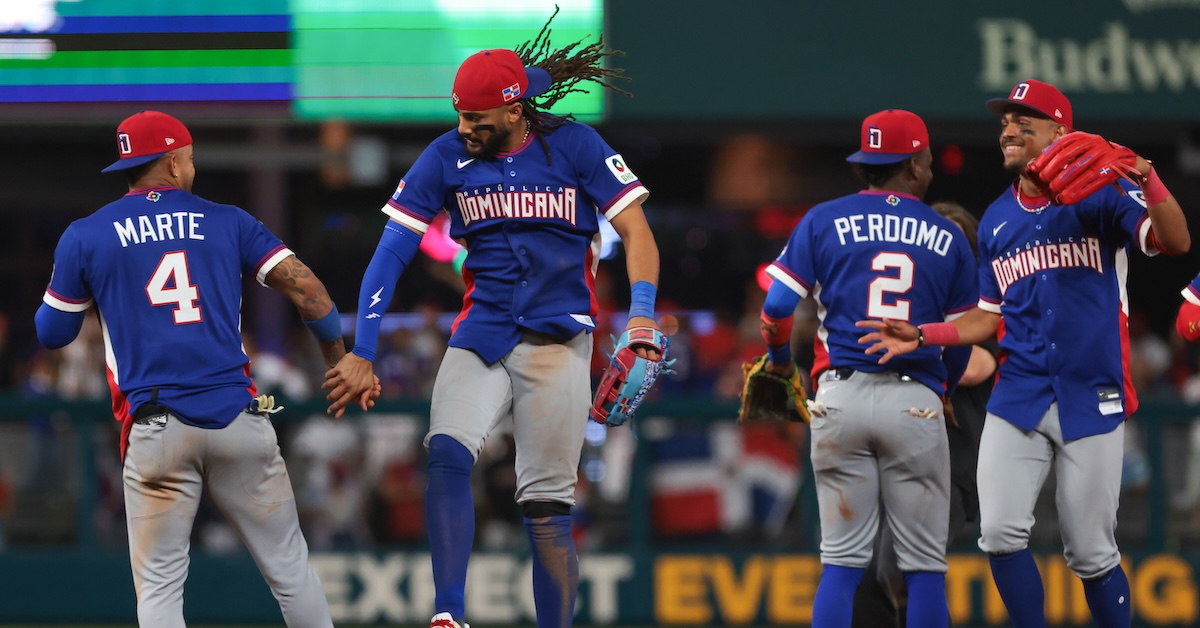
The Arizona Diamondbacks might have the best middle-infield duo in MLB, which is something most people outside of their fanbase probably aren’t aware of. Mike Hazen didn’t disagree when I suggested as much to him in Las Vegas.

“We’ve always dealt with that,” the D-Backs general manager replied. “We play on the West Coast — we play late for the East Coast — and we’re not on national TV a lot, so it comes with the territory. But yeah, [Geraldo] Perdomo probably had a top-five season in all of baseball this year, and [Ketel] Marte does it every year. With those two guys, along with [Corbin] Carroll, I think we have three of the top 25-30 guys in all of baseball.”

That was certainly the case in 2025. Carroll, the club’s right-fielder, ranked seventh-best in MLB with 6.5 WAR, while the keystone combination came in at fifth-best (Perdomo at 7.1) and 24th-best (Marte at 4.6) respectively. Productive bats were a big reason for that. Carroll put up a 139 wRC+, Perdomo was a tick below at 138, and Marte was fourth-highest in the senior circuit at 145.

How long Arizona’s middle infield will remain intact is currently in question. Rumors that Marte — on tap to gain 10-5 rights in the coming season — could be traded have been circulating, and while Hazen has reportedly said that moving the 32-year-old second baseman is “mostly unlikely,” he has also acknowledged a need to listen to offers. Howe many of those he has received to this point is unknown, but given Marte’s résumé — the three-time All-Star has a 140 wRC+ and 15.3 WAR over the past three seasons — the return would be noteworthy. Read the rest of this entry »


FanGraphs Weekly Mailbag: November 15, 2025

David Butler II-Imagn Images

Now that the World Series is over and we’re two weeks into the offseason, the stockpile of questions for our mailbag is getting a little light. For that reason, I’m putting out a request for fresh submissions. I’m sure that if you’re reading this, you have at least some kernel of a question or curiosity noodling around in your noggin, and we are eager to answer it. As you’ll see from the assortment of topics in this week’s column — ranging from the career earnings potentially lost due to gambling allegations all the way to a hypothetical seven-game series between fantasy and sci-fi characters — we are game for almost anything. To ask a question for an upcoming mailbag, please send us an email at mailbag@fangraphs.com.

That said, there are a few questions that we have absolutely no way of answering, even though they are fun and interesting. I’ll include one at the start of this week’s edition and respond to it briefly before we get to the meat of the mailbag.

But first, a quick programming note: I will be on vacation next week, so Meg will be steering the mailbag in my absence. If you have any thoughts about the Seattle Seahawks or the 1997 Robert Zemeckis film Contact, I’m sure she’d love to hear from you as she combs through the emails next week. And, as always, I’d like to remind you all that this mailbag is exclusive to FanGraphs Members. If you aren’t yet a Member and would like to keep reading, you can sign up for a Membership here. It’s the best way to both experience the site and support our staff, and it comes with a bunch of other great benefits. OK, let’s get to it. Read the rest of this entry »


Effectively Wild Episode 2401: Just Awards

EWFI
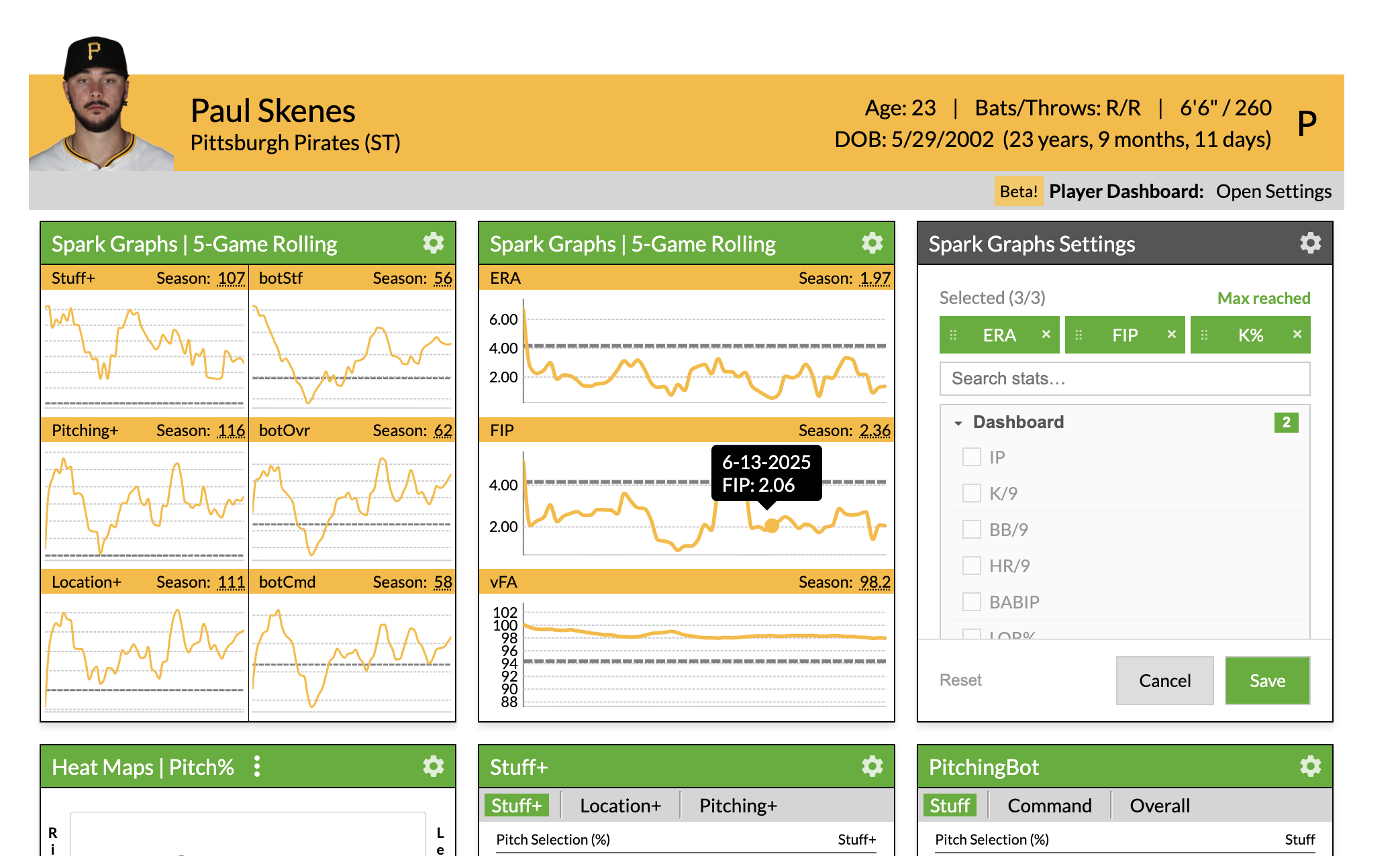
Ben and Meg banter about Based Boras vs. Borscht Belt Boras and a few corny quips they overlooked, then discuss end-of-season awards (Aaron Judge vs. Cal Raleigh, Paul Skenes vs. Cristopher Sánchez, Skenes as a paid pitchman, José Ramírez MVP shares, Shohei Ohtani’s dog vs. Judge’s dogs, repetition among award winners, groupthink among voters, WAR preference, bringing back old-school awards, and more) before touching on the news that Padres ownership is exploring a sale. Then (1:13:43) Michael Mountain joins Ben to Stat Blast about team rivalries.

Audio intro: Josh Busman, “Effectively Wild Theme
Audio outro: Nate Emerson, “Effectively Wild Theme

Link to Boras/exec comments
Link to BP Boras quip ranking
Link to AL MVP results
Link to Ben on Judge and Raleigh
Link to NL MVP results
Link to AL Cy results
Link to NL Cy results
Link to Skenes reaction
Link to Skenes reaction article
Link to Skenes Raising Cane’s spot
Link to Skenes on EW
Link to Posnanski on retro awards
Link to Ohtani dog video
Link to Judge dog video
Link to Baumann on voting and WAR
Link to award share wiki
Link to Ramírez award share
Link to pitch-fixing fallout article
Link to MLBTR on the Padres sale
Link to rivalry scores data
Link to CTV Barger video
Link to Mense hiring
Link to Secret Santa sign-up

 Sponsor Us on Patreon
 Give a Gift Subscription
 Email Us: podcast@fangraphs.com
 Effectively Wild Subreddit
 Effectively Wild Wiki
 Apple Podcasts Feed 
 Spotify Feed
 YouTube Playlist
 Facebook Group
 Bluesky Account
 Twitter Account
 Get Our Merch!


Eric Longenhagen 2025 Arizona Fall League Championship Chat

3:23
Eric A Longenhagen: Hello from Salt River Fields at Talking Stick where the starting lineups for today’s championship game are coming through the PA.

3:24
Eric A Longenhagen: I’ll likely post it periodically in chat, but here is the link through which you can watch the stream of the game. Live Streams | Arizona Fall League | MLB.com

3:25
Eric A Longenhagen: We’re about to get the anthem so I’ll likely step away for, what do we wanna say, over under 1:20 on the anthem?

3:26
Eric A Longenhagen:

National Anthem Length

Over 1:50 (16.6% | 3 votes)
 
Under 1:50 (83.3% | 15 votes)
 

Total Votes: 18
3:27
Eric A Longenhagen: I’ll be taking your questions as we all watch the game and put the 2025 season…not quite to bed because it feels that way already… more like into R.E.M. sleep

3:28
Eric A Longenhagen: Meg is going to time the anthem for us.

Read the rest of this entry »


2025 American League 40-Man Roster Crunch Analysis

Angel Genao Photo: Lisa Scalfaro/USA TODAY NETWORK via Imagn Images

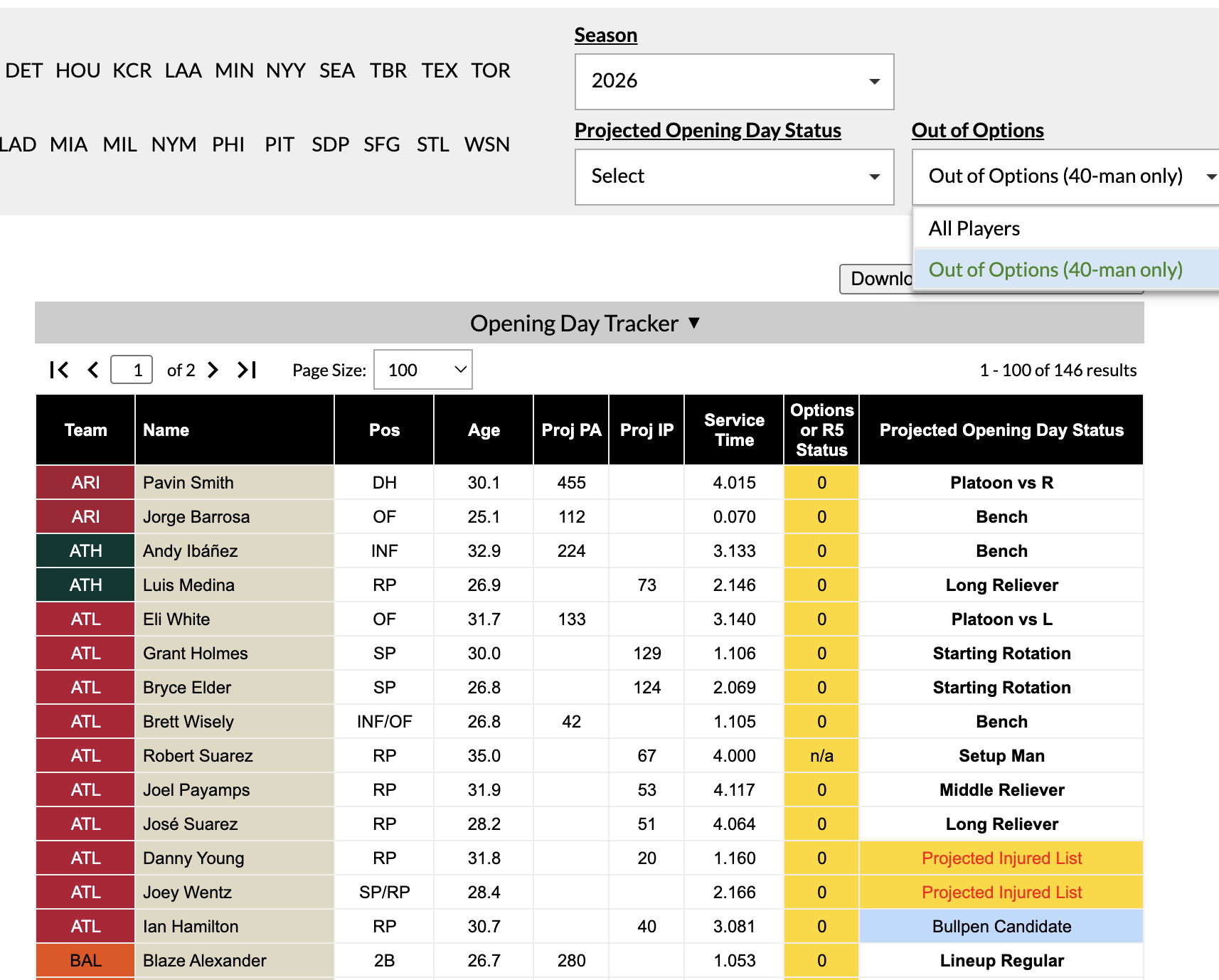
One of my favorite annual exercises is a quick and dirty assessment of every team’s 40-man roster situation. Which prospects need to be added to their club’s 40-man by next Tuesday’s deadline to be protected from the Rule 5 Draft? Which veterans are in danger of being non-tendered because of their projected arbitration salary? And which players aren’t good enough to make their current org’s active roster, but would see the field for a different club and therefore have some trade value? These are the questions I’m attempting to answer with a piece like this. Most teams add and subtract a handful of players to their roster every offseason — some just one or two, others as many as 10. My aim with this exercise is to attempt to project what each team’s roster will look like when the deadline to add players arrives on Tuesday, or at least give you an idea of the names I think are likely to be on the table for decision-makers to consider.

This project is completed by using the RosterResource Depth Charts to examine current 40-man occupancy and roster makeup, and then weigh the young, unrostered prospects who are Rule 5 eligible in December against the least keepable current big leaguers in the org to create a bubble for each roster. The bigger and more talented the bubble, the more imperative it is for a team to make a couple of trades to do something with their talent overage rather than watch it walk out the door for nothing in the Rule 5.

Below you’ll see each team’s current 40-man count, the players I view as locks to be rostered, the fringe players currently on the roster whose spots feel tenuous, and the more marginal prospects who have an argument to be added but aren’t guaranteed. I only included full sections for the teams that have an obvious crunch or churn, with a paragraph of notes addressing the clubs with less intricate roster situations at the bottom. I have the players listed from left to right in the order I prefer them, so the left-most names are the players I’d keep, and right-most names are the guys I’d be more likely to cut. I’ve italicized the names of the players who I believe fall below the cut line. As a reminder, players who signed at age 18 or younger must be added to the 40-man within five seasons to be protected from the Rule 5, while those signed at age 19 or older must be added within four. Brendan Gawlowski examined the National League yesterday, so be sure to check that out too. Let’s get to it. Read the rest of this entry »


2026 Contemporary Baseball Era Committee Candidate: Fernando Valenzuela

Malcolm Emmons-USA TODAY Sports

The following article is part of my ongoing look at the candidates on the 2026 Contemporary Baseball Era Committee ballot. For a detailed introduction to this year’s ballot, use the navigation tool above. An introduction to JAWS can be found here.

Though he won the Rookie of the Year award, a Cy Young, and a World Series all in his first full season while beginning a six-year streak of All-Star selections — the first of those as the game’s starter — Fernando Valenzuela wasn’t just a star pitcher. He was an international icon, the centerpiece of a cultural phenomenon, and a beloved global ambassador who brought generations of Mexican American and Latino fans to baseball while helping to heal the wounds caused by the building of Dodger Stadium, the very ballpark in which he starred.

Roberto Clemente is ‘The Great One,’ but culturally, Fernando Valenzuela has been more significant in terms of bringing a fan base that didn’t exist in baseball,” José de Jesus Ortiz, the first Latino president of the BBWAA, told author Erik Sherman for Daybreak at Chavez Ravine, a 2023 biography of Valenzuela. Sherman himself described the pitcher as “like a composite of the Beatles — only in Dodger blue. His appeal was universal.”

After excelling in a relief role during a September 1980 cup of coffee with the Dodgers — as a 19-year-old in the heat of a playoff race, no less — Valenzuela took the world by storm the following spring. Pressed into service as the Opening Day starter, he threw a five-hit shutout, then reeled off four more shutouts and six more complete games within his first eight starts, a span during which he posted a 0.50 ERA. Despite speaking barely a word of English, the portly portsider (listed at 5-foot-11 and 180 pounds, but generally presumed to be at least 20 pounds heavier) charmed the baseball world with his bashful smile while bedeviling hitters with impeccable command of his screwball, delivered following a high leg kick and a skyward gaze at the peak of his windup.

Read the rest of this entry »