

The Big Questions About the 2026 BBWAA Hall of Fame Ballot
After a bit of a dry spell — two honorees in three years — the last two BBWAA Hall of Fame ballots have yielded bumper crops, with trios elected each year. Last year, Ichiro Suzuki fell one vote short of unanimity, while fellow newcomer CC Sabathia and 10th-year holdover Billy Wagner were elected as well. In 2024, it was newcomers Adrian Beltré and Joe Mauer, joining holdover Todd Helton. Alas, we’re in for a comparatively slow cycle this time around, as the 2026 BBWAA ballot — which was released on Monday — lacks a single newcomer who’s likely to be elected, at least on this ballot and possibly ever. If the writers are going to honor anyone, it will be a holdover candidate, or perhaps two.
That’s my quick read on the new ballot, which contains 27 candidates (12 newcomers and 15 holdovers). Over the next six weeks, I’ll profile all of the candidates likely to wind up on voters’ ballots ahead of the December 31 deadline, with a handful of profiles — the “one-and-dones” — trickling into January. I’ll be examining their cases in light of my Jaffe WAR Score (JAWS) system, which I’ve used to break down Hall of Fame ballots as part of an annual tradition that as of last January is old enough to drink. The series debuted at Baseball Prospectus (2004-12), then moved to SI.com (2013-18), which provided me an opportunity to go into greater depth on each candidate. In 2018, I brought the series to FanGraphs, where my coverage has become even more expansive.
Today I’ll offer a quick look at the biggest questions attached to this year’s election cycle, but first…
The Basics
To be eligible for election to the Hall of Fame via the BBWAA ballot, a candidate must have played in the majors for parts of 10 years (one game is sufficient to be counted as a year in this context), have been out of the majors for five years (the minors or foreign leagues don’t count), and then have been nominated by two members of the BBWAA’s six-member screening committee. Since the balloting is titled with respect to induction year, not the year of release, that means that this year’s newcomers last appeared in the majors in 2020. Each new candidate has 10 years of eligibility on the ballot, a reduction from the 15-year period that was in effect for several decades. The last candidate grandfathered into getting the full 15 years was Lee Smith, whose eligibility expired in 2017, while the last to have his eligibility window truncated mid-candidacy was Jeff Kent, who fell off after the 2023 cycle. Coincidentally, Kent might be the best bet for election on the 2026 Contemporary Baseball Era Committee ballot, but that’s a whole different process.
To be elected, a candidate must receive at least 75% of the ballots cast, and in this case, they don’t round up; 74.9% won’t cut it. Likewise, candidates who don’t receive at least 5% fall off the ballot and can then only be considered for election by the aforementioned Contemporary Baseball Era Committee — but not until what would have been their 10-year run of eligibility expires.
The voters, each of whom has been an active BBWAA member for at least 10 years and is no more than 10 years removed from active coverage, can list as many as 10 candidates on their ballots, a number that became a point of contention a decade ago given the high volume of qualified candidates. In 2015, the Hall tabled a BBWAA proposal to expand the ballot to 12 slots (I was on the committee that recommended the change). Last year, the 10th since the Hall purged the rolls of voters more than 10 years removed from coverage, 394 ballots were cast; the year before that, the number was 385, the fewest of any cycle since 1983. This year’s pool will likely be larger thanks in part to the BBWAA’s 2015 decision to admit MLB.com writers and editors. According to the folks at the Hall of Fame Ballot Tracker, as many as 40 or even 50 new voters could join the rolls, with about 25 of those coming from MLB.com. Closer to home, colleagues Dan Szymborski and Jeff Zimmerman will be among this year’s first-time voters, joining David Laurila and myself among the FanGraphs contingent.
Ballots must be postmarked by December 31 (yes, the BBWAA still does this by mail). Voters may reveal their ballots prior to the announcement, as 55% did last year. You can track the reported ballots using the Ballot Tracker, and if you’re looking to follow along with the Tracker as ballots are revealed, you can follow Ryan Thibodaux on Bluesky. Voters can also check a box on the ballot to authorize the publication of their choices on the BBWAA’s website two weeks after the election results are revealed. Between BBWAA.com and the Tracker, 84.5% of voters revealed their ballots in 2025, the highest share ever.
I’ll be revealing my own ballot here at FanGraphs a few days before the deadline, taking readers through my thought process as I explain which boxes I’ll be checking. This will be my sixth year as a voter, and no, the novelty hasn’t worn off. For those who want to play along at home, registered FanGraphs users will be able to participate via our crowdsource ballot, which we will post soon.
The election results will be announced on MLB Network on January 20. Any players elected will join any honorees elected via the Contemporary Baseball Era Committee ballot, whose results will be announced on December 7, for the Induction Ceremony scheduled for July 26, 2026 on the grounds of the Clark Sports Center in Cooperstown, New York.
Are you going to tell us who’s actually on the ballot?
Hold your baserunners, I’m getting to it. The 12 newcomers are noted in italics:
Bobby Abreu, Carlos Beltrán, Ryan Braun, Mark Buehrle, Shin-Soo Choo, Edwin Encarnación, Gio González, Alex Gordon, Cole Hamels, Félix Hernández, Torii Hunter, Andruw Jones, Matt Kemp, Howie Kendrick, Nick Markakis, Daniel Murphy, Dustin Pedroia, Hunter Pence, Andy Pettitte, Rick Porcello, Manny Ramirez, Alex Rodriguez, Francisco Rodríguez, Jimmy Rollins, Chase Utley, Omar Vizquel, David Wright
Who are the best newcomers?
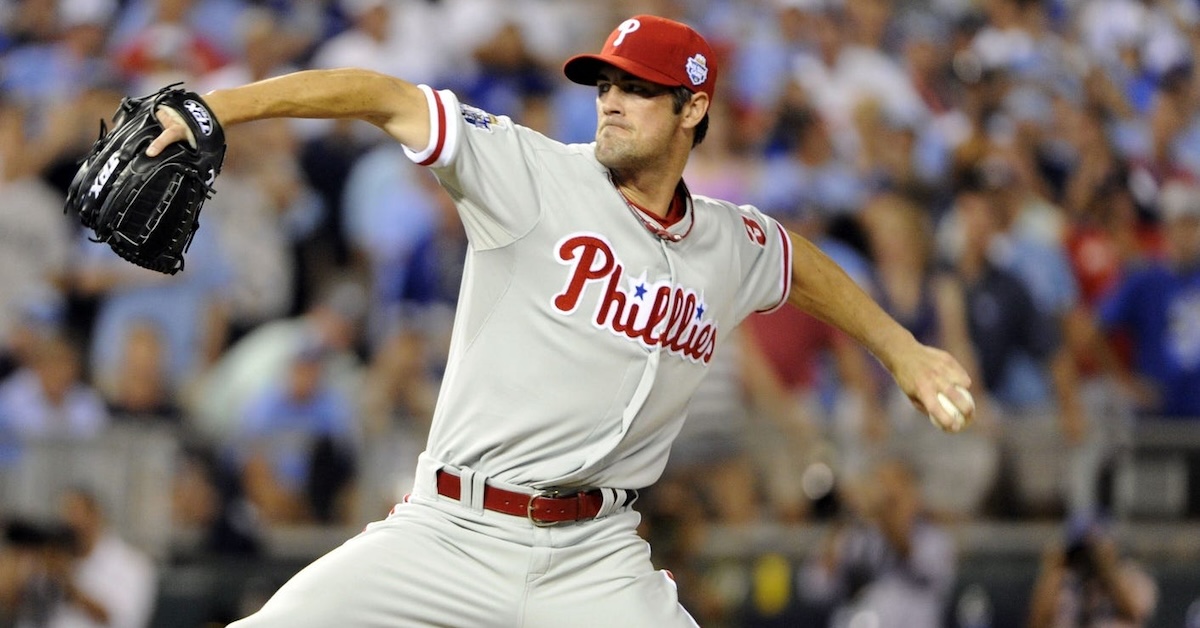
Nobody here is a slam dunk. The best of the newcomers is Hamels, who went 163-122 with a 3.43 ERA (123 ERA+) and 2,560 strikeouts in a 15-year career that was shortened by arm injuries. His last appearance — his only one of the 2020 season, a 3 1/3-inning stint — was in his age-36 season, though if it feels like it hasn’t been that long since you heard about him, you’re not mistaken. He tried a comeback as recently as 2023.
During his career, Hamels totaled 59.0 WAR, with 37.4 peak WAR and a 48.2 S-JAWS. That last mark is the highest of any pitcher on the ballot, higher than either Hernández (44.1), whom I voted for last year, or Pettitte (47.2), whom I included for the first time the year before. While Hamels’ numbers don’t shout “Hall of Famer,” the reality is that we’re not going to see anybody with the types of numbers Sabathia put up save for when Zack Greinke, Clayton Kershaw, Max Scherzer, and Justin Verlander reach the ballot. The only other active pitcher besides Scherzer and Verlander with an S-JAWS higher than Hamels is Chris Sale (49.5), with Jacob deGrom (43.7) and Gerrit Cole (38.8) the next two among active starters. In that light, Hamels starts to look pretty good, and I’m hopeful he gets enough support to remain on the ballot so that the electorate can mull his candidacy as it has those of Hernández, Pettitte, and Buehrle.
The other newcomer who’s particularly of note is Braun, a former Rookie of the Year and MVP who finished second and third in the voting for the latter award as well. In a 14-year career, Braun made six All-Star teams and clubbed 352 homers, leading the NL once and reaching the 30-homer plateau six times. A swift and smart baserunner, he stole 216 bases in his career, and reached the twin plateaus of 30 homers and 30 steals in the same season in both 2011 and ’12. His career was ultimately a short one, as he retired after his age-36 season and fell 37 hits shy of 2,000. His 43.0 JAWS ranks just 25th among left fielders, 10.5 points below the standard, but perhaps his biggest obstacle in terms of voter support is his 65-game suspension for receiving performance-enhancing drugs through the Biogenesis Clinic in 2013 — and that wasn’t even the first time he was suspended. He was previously suspended in December 2011, shortly after being named MVP, but… you know what? We’ll get to that in due time.
Does anyone else stand out to you among the newcomers?
We have a former Cy Young winner in Porcello, a runner-up to Braun in the 2011 NL MVP race in Kemp, and a slugger with over 400 career homers in Encarnación, but the one who catches my eye is Choo. A decade ago, I raised a bit of a stink when Chan Ho Park was left off the ballot, as I felt that a former All-Star who was the first Korean-born player to play in the majors as part of a 17-year career — and still the leader in wins (124) among pitchers born in Asia — was at least worthy of that valedictory. His omission felt like a needless slight of a player who’s revered in his homeland. I raised a similar fuss the following year, when Javier Vazquez — the all-time leader among Puerto Rican pitchers in wins, strikeouts, and WAR — was left off. Since then, the ballots have gotten more inclusive, so I was happy to see Choo make the cut, as he’s the first Korean player to do so. Exempted from military service due to his role in the success of South Korea’s gold medal-winning national team in the 2010 Asian Games (he also played for South Korea’s 2009 World Baseball Classic team, which finished second), he went on to make an All-Star team, start for three playoff teams, and accumulate by far the most hits (1,671), homers (218) and WAR (34.7) of any Korean-born player. He also did something very cool: During the 2020 COVID-19 shutdown, he reportedly donated $1,000 to each of the Rangers’ nearly 200 minor league players to help them with expenses, and made a sizable donation to South Korea’s efforts to combat COVID.
If Nick Markakis had reached 3,000 hits, would he have been elected to the Hall?
One of my favorite silly hypotheticals was being asked if Markakis, who didn’t make an All-Star team until his age-34 season (his only appearance), would reach one of the magic milestones that guarantees induction so long as a player hasn’t been connected to PEDs. It became A Thing — a recurring question in my weekly chats and on social media — because he collected 185 hits in 2018, that All-Star season, and had 2,237 to that point, enough for some to squint and suggest that with just over 150 hits per year for another half decade, he’d get to 3,000, albeit as the least-decorated member of the club. Markakis played just two more seasons and fell short, sparing us that reckoning. I’ll get to all of that within his one-and-done profile.
So is this the weakest ballot ever?
I don’t know about “ever,” but it is pretty weak. The primary way I track ballot strength is by counting how many candidates meet or exceed the JAWS standard at their position, and how many have a JAWS of at least 50.0 (40.0 for catcher). The totals here are two for the former (just Manny and A-Rod) and six for the latter (Abreu, Beltrán, Jones, and Utley are the others). Beltrán is just 0.8 points shy of the standard and Utley 0.1 points shy — negligible amounts, really, and nothing that’s stopped me from voting for them both every time they’ve been eligible, but for accounting purposes, I don’t round up. That’s why I’ve got that second count, which is I think a better big-picture approximation of ballot quality. As for how that stacks up, here’s an overview of the ballots from the past half-century:
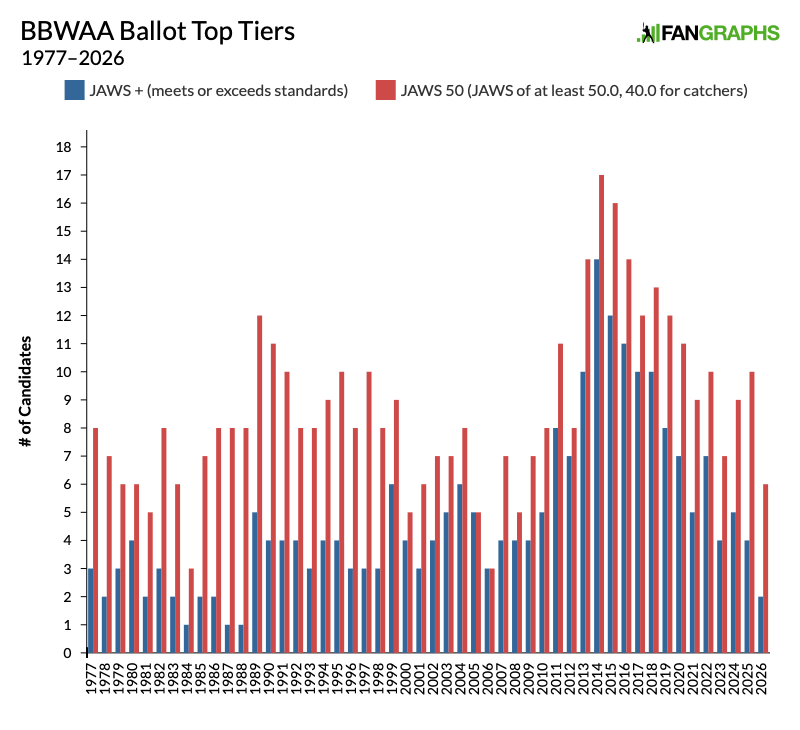
You have to go back to 1988 to find a ballot where two or fewer candidates met the JAWS standards. Ron Santo was the only one who did so that year, and he received just 25.1% of the vote, while Willie Stargell (47.8 JAWS) was the only candidate elected that year. Only nine times in the past 50 years has there been a ballot with either one or two players exceeding the standard, and this is the first one outside the 1978–88 span.
The last time there were six or fewer candidates with a JAWS of 50.0 was 2008, when there were just five, namely Bert Blyleven, Andre Dawson, Mark McGwire, Tim Raines, and Alan Trammell. Rich Gossage, the only candidate elected, was one of four above his position’s standard along with Blyleven, Raines, and Trammell. The 2006 ballot was even weaker, with Blyleven, Trammell, and Dawson the only candidates reaching 50 JAWS, and Blyleven, Trammell, and Gossage the only ones meeting the standards.
Another way to measure ballot strength is by how many first-year candidates even receive the 5% required to remain eligible. The 2023 ballot had just two (Beltrán and Francisco Rodríguez), but at least one of them is strong enough to be a likely honoree. The 2021 ballot had just three (Buehrle, Hunter, and Tim Hudson), none of whom seems likely to be elected. The 2020 ballot also had two, but Derek Jeter was elected, and Abreu remains eligible. The 2012 ballot had just one, Bernie Williams; he received 9.6% and lasted just one more year. Raines was the only first-year candidate to make the cut in 2008, but at least he went on to be elected. In 1987, Bobby Bonds (5.8%) was the only first-year candidate to last to a second year, while in ’84, top first-year candidate Wilbur Wood didn’t even manage that share; despite receiving just 3.5%, he was allowed to stick around as part of a second chance given to 11 candidates who had received less than 5% from 1980–84, a group that included Santo and Dick Allen.
For all of that, this bears repeating: Even if this isn’t a strong ballot, the candidates on it all had impressive careers, and the checkbox next to their names — and the attendant recognition that comes with their presence in this cycle — is itself an honor. I’ll be taking deep dives into all of their careers; some of my favorite profiles to write are of the one-and-done guys, and I know readers enjoy those as well.
Which holdovers have a chance to get elected this year?
Beltrán, who received 70.3% last year, his third of eligibility, is the best bet for election. The quintessential five-tool player, he’s one of eight with at least 300 homers and 300 steals, and owns the highest stolen base success rate (86.4%) of any player with at least 200 attempts. He’s a bit below the career, peak, and JAWS standards at a very top-heavy position, but he’s the best eligible center fielder outside the Hall and one of the top 10 all time. Though he was at the center of the Astros’ illegal sign-stealing scandal, which nipped his managerial career in the bud, voters have generally been supportive of him; he debuted at 46.5% in 2023 and has posted double-digit gains in each cycle since. Since the voters returned to annual balloting in 1966, there have been 26 instances where a modern era candidate received at least 70% but less than 75% and still had eligibility remaining; of those, 22 were elected the following year, with Jim Bunning and Curt Schilling each accounting for two of the four exceptions, the latter by sabotaging his own candidacy in ways we don’t need to rehash here.
Jones, who received 66.2% last year, his eighth of eligibility, has a decent chance as well. The defensive cornerstone of the Braves’ dynasty, he won 10 Gold Gloves and ranks first at the position in fielding runs (+235). He also added 434 home runs despite a career that collapsed at age 31 and ended after his age-35 season, though he went on to play two years in Japan. He’s climbed all the way from a 7.5% debut in 2019. Since 1966, there have been 31 instances where a candidate received between 65% and 70% and still had eligibility remaining (24 candidates, six of whom repeated once and one of whom repeated twice). In 14 of those 31 instances, the candidate was elected the next year, and in 22 of the 31, he was elected within two years. Both of the above counts include Wagner (68.1% in 2023, 73.8% in ’24, 82.5% last year).
Beyond that, the next-highest share of the vote from a returning candidate is Utley, with 39.8%. He’s poised to break the 50% mark, which has long been a harbinger of future election, but he’s too far off to get to 75% this time. More on him below.
How about those PED guys?
Nothing’s changed. Nobody suspended by Major League Baseball either for testing positive or incurring a non-analytic positive (i.e., being identified as a user via a league investigation such as Biogenesis) since testing began in 2004 has been elected. Ramirez received 34.3% in year nine, so he’s in his last go-round in this format, while A-Rod received 37.1% in year four. While I don’t expect folks to change their minds about the guys caught red-handed, I do know at least a few first-time voters who intend to include them, so we’ll see if they gain any traction.
Are there any down-ballot candidates worth keeping an eye on?
Utley’s candidacy is off to a very solid start, as he gained 11 points in his second cycle and is already past the point where future election becomes more likely than not. Since 1966, five candidates have peaked in the 40%–50% range and haven’t been elected; only one crossed the 40% threshold more quickly, namely Steve Garvey, who debuted at 41.6% in 1993 but couldn’t substantially add to that given a combination of the focus on his off-field life and the high-offense environment that arose during his candidacy. He hung around in the high 30s and low 40s for his first five years, maxing out at 42.6% in his fifth year.
The other four lagged behind Utley. Marty Marion reached exactly 40% in his 12th election (1970) out of 15, but backslid from there. Roger Maris crossed the 40% threshold in his 13th year (1986) and maxed out at 43.1% two years later. Maury Wills peaked at 40.6% in his fourth year (1981) but soon bled support due to a brief and dreadful managerial career (1980–81) and a 1983 arrest for cocaine possession. The aforementioned Kent didn’t reach 40% until his 10th and final year (46.5%).
Utley’s coattails could help a couple of other candidates. Rollins is coming off his strongest cycle (still just a modest 18% in his fourth year), but with his double play partner poised to rise, he could benefit given his edge in traditional counting stats and his MVP award. Pedroia, who debuted at 11.9%, could benefit from comparisons to Utley — he did win an MVP award and multiple World Series, for example — and Kent, who as I said might have the best chance of election on that Contemporary ballot.
Like the vast majority of other voters, I’ve never been particularly convinced when it comes to Buehrle, whose fifth-year share was just 11.4%. That said, his 214 career wins and 47.2 JAWS fit snugly within the context of the other starters I’ve mentioned, and there’s a chance all of them benefit from increased attention. I’m also very interested to see how Hernández fares after a stronger-than-expected debut (20.6%) given the influx of new voters.
While I still have two candidates to cover on the Contemporary Baseball ballot, profiles of these candidates should begin rolling out soon, and I’ll publish a preliminary schedule when our crowdsource ballot goes live.
Brooklyn-based Jay Jaffe is a senior writer for FanGraphs, the author of The Cooperstown Casebook (Thomas Dunne Books, 2017) and the creator of the JAWS (Jaffe WAR Score) metric for Hall of Fame analysis. He founded the Futility Infielder website (2001), was a columnist for Baseball Prospectus (2005-2012) and a contributing writer for Sports Illustrated (2012-2018). He has been a recurring guest on MLB Network and a member of the BBWAA since 2011, and a Hall of Fame voter since 2021. Follow him on BlueSky @jayjaffe.bsky.social.
It just dawned on me that this is the COVID-season retirements, which means that the end of the pandemic season was five years ago now. Nothing particularly special there except to say that the passage of time remains undefeated.
Looking at this list of names and thinking of peak COVID times, it feels like both of these things are true: these guys all just retired, and also they haven’t played in a million years. Porcello being hall-eligible just blows my mind.
To further emphasize your point, I was blown away that Porcello was only just now becoming eligible