As is tradition at FanGraphs, we’re using the lead-up to the trade deadline to take stock of the top 50 players in baseball by trade value. For a more detailed introduction to this year’s exercise, as well as a look at the players who fell just short of the top 50, be sure to read the Introduction and Honorable Mentions piece, which can be found in the widget above.
For those of you who have been reading the Trade Value Series the last few seasons, the format should look familiar. For every player, you’ll see a table with the player’s projected five-year WAR from 2027-2031, courtesy of Dan Szymborski’s ZiPS projections. The table will also include the player’s guaranteed money (exclusive of any signing bonus), if any, the year through which their team has contractual control of them, last year’s rank (if applicable), and then projections, contract status, and age for each individual season through 2031 (assuming the player is under contract or team control for those seasons, or has a player or vesting option). Last year’s rank includes a link to the relevant 2025 post. Thanks are due to Sean Dolinar for his technical wizardry. At the bottom of the page, there is a grid showing all of the players who have been ranked up to this point. Read the rest of this entry »
There’s still a chance Tarik Skubal pitches for the Detroit Tigers in the postseason this year.
Trading Skubal before the 2026 deadline makes sense for the Tigers. I think that’s pretty well established. Detroit has a losing record, less than one-in-three odds to make the playoffs per our odds, and one of the best players in the league on an expiring deal. This is the ideal trade deadline scenario.
But things have become more muddled in recent weeks. The Tigers are hot, having gone 25-16 since June 1. They finally look like the team we projected to win the AL Central before the season began. Still, they’d need to go 9-2 to even reach the deadline with a .500 record, underscoring the depth of the hole they dug early in the year. With less than two weeks before this crucial decision point, the Tigers have stumbled upon a universal truth: Being alive is complicated.
The Tigers’ season started well enough. They snuck out of April with an even 16-16 record and a positive run differential. They even began May by taking two of three from the Rangers. But on May 4, Skubal landed on the IL with loose bodies in his elbow, the latest in a string of injuries to the rotation. They lost that night and began a brutal 4-21 stretch that saw them sink to the worst record in baseball by the end of the month.
It wasn’t really the absence of Skubal that was the issue, as Jay Jaffe wrote at the time. In May, their batters posted a league-worst 69 wRC+ — nobody hit fewer homers, and only the Angels struck out more. When the offense did manage a lead, it was quickly given up by a shallow bullpen, which turned in 24 meltdowns in May. There aren’t many enjoyable brands of losing baseball, but slogging through a 1-0 game only to implode at the end is among the most frustrating. Attention understandably turned to Skubal’s return, and his seemingly inevitable departure at the deadline.
Then the calendar flipped to June. The Tigers began the month with a sweep of the first-place Rays, scoring 25 runs on 10 homers in three games, and they haven’t cooled since. Their 109 wRC+ in the last 41 games is top 10 in baseball, and their 72 homers are the most of any team. The lineup now has one of the best trios in the majors. Dillon Dingler (4.6) and Kevin McGonigle (4.0) each rank in the top 10 by WAR, and Riley Greene (2.8) ranks in the top 30. Colt Keith is on a hot streak, smacking eight homers since June 1 after going the first two months of the season without hitting any. The Tigers also just got Gleyber Torres and his 127 wRC+ back from an oblique injury on Monday. It’s suddenly a good, competitive lineup.
The bullpen has also been better of late. Their 3.19 ERA since June 1 is fifth in the majors. It’s a shallow group, and the end of games can still feel a bit dicey while closer Kenley Jansen runs a walk rate (14.7%) nearly double his career mark (7.9%). But the offense finally scoring a few runs has helped alleviate some of the pressure. In May, the Tigers bullpen faced the sixth-highest Leverage Index when entering games; since June 1, they’ve faced the lowest of any team. Again, it’s not a great bullpen, and this is likely the area the Tigers will want to address at the deadline assuming they add. But they’re asking less of them these days.
A competitive lineup and bullpen is all the Tigers should need with their rotation, which has allowed the fewest runs in the majors over this hot stretch. But that’s where the narrative of this article and the Tigers’ season recently became more complicated. Casey Mize pitched on Sunday, looking to continue his breakout season (his 2.79 ERA and 2.62 FIP would each be career bests), but he left the game early with the same groin tightness that’s landed him on the IL twice this year; he’s now day-to-day. Jack Flaherty pitched on Monday, hoping to build on a month-long hot streak (a 2.67 ERA and 3.25 FIP in seven starts since the beginning of June); he pitched poorly and was placed on the injured list with right flexor inflammation after the game. On Tuesday, Framber Valdez couldn’t make it out of the first inning in what ended up being an 11-2 blowout loss to the Cubs; he’s not known to be hurt, but he’s having the worst full season of his career, with a 4.57 ERA and 4.16 FIP in 20 starts.
Still, this has been one of the best rotations in the majors all season, even as they’ve dealt with injuries and inconsistency. They could still be that going forward… assuming Skubal remains their ace. He’s been great. He had solid numbers in seven starts before the IL stint (2.70 ERA and 2.11 FIP), he’s had solid numbers in seven starts after the IL stint (2.97 ERA and 3.66 FIP), and I assume he’ll have solid numbers the rest of the year, regardless of who he’s pitching for. He has been a little homer-prone, allowing 1.09 per nine innings, compared to 0.71 between 2022 and 2025. But his stuff and command metrics look the same as ever, and he hasn’t given up more hard contact or barrels overall. I’ll give him the benefit of the doubt and assume it’s a sample-size blip, though it’ll certainly be something teams assess ahead of the deadline.
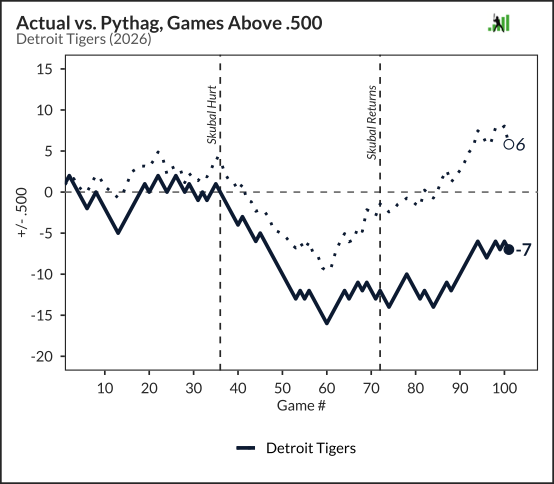
Again, while Skubal’s absence wasn’t the Tigers’ main issue in May, we can see they’ve largely played like a playoff-bound team the days he’s been on the active roster:
We can also see the Tigers have maybe been a bit unlucky to this point. They are six games under their pythagorean record — the largest discrepancy in the majors this year. That’s driven in part by a 10-17 record in one-run games. In games decided by more than one run, they’re an even 37-37 with a +31 run differential; they’re 20-12 with a +62 run differential since June 1. And so the Tigers seem to be better than their record would indicate, and they are indeed gaining ground. But at 6 1/2 back of the Guardians and White Sox in the Central, and five back of the Red Sox for the third Wild Card, they’re running out of time to make this a legitimate playoff push.
The Tigers must weigh what that long-shot postseason push is worth. They have a young, team-controlled core that could be competitive for years to come. Trading Skubal could obviously help add to their future ambitions. They also don’t technically need Skubal to get to the 2026 postseason. They’d still have an above-average rotation without him (depending on the health of Mize and Flaherty), and some of the players they’d get back in a trade could potentially help them this year. Plus, even if they do get to October with Skubal, it doesn’t guarantee they’ll advance — the Tigers lost both games he pitched in last year’s ALDS. Holding on to such a potentially valuable trade chip only to narrowly miss the postseason or suffer an early exit could generate some hard feelings and hot seats.
Still, this is a legitimate chance for the Tigers. This is the bird in the hand. It’s a fairly important bird, too. Skubal probably doesn’t have the longevity in Detroit to be considered the “best” pitcher in franchise history, but he’s the rare, era-defining player — one still largely in the prime of his career. This is the type of chance a front office typically builds toward, not away from. A late-season comeback and a deep playoff run on the shoulders of a franchise icon has to be worth something beyond long-term efficiencies in team building. And the Tigers will likely extend Skubal a qualifying offer this offseason, meaning they’d at least receive an extra draft pick should he sign elsewhere (assuming the system remains the same under the new CBA, of course). Sure, their midseason stumble raises questions about the team’s potential in 2026, but it should also raise questions about its potential in 2027 and 2028 and 2029. Nothing is guaranteed in baseball, especially when a player like Skubal walks out the door.
Last month, Ben Clemens declared 2026 to be The Year of the Bunt. “Bunts are making a comeback,” he wrote, and then he backed that contention up with numbers and graphs and such, because while the FanGraphs style guide doesn’t have a hard target for words per article, we’re generally expected to use more than five. Ben was right, of course. That’s what the graphs and the words were for. Bunts have gone from 0.7% of plate appearances in 2025 to 0.9% in 2026. We’re talking about very small numbers here, but that’s still a year-over-year increase of nearly 23%.
Not only are teams bunting more often, but they’re also bunting in optimal situations and laying them down more successfully. This year’s bunts have a .533 batting average, compared to .468 last year. Unsuccessful bunts, which result in neither a hit nor a sacrifice, are down from 22% to 19%. According to Baseball Savant’s Run Values, last year’s bunts were worth 13 runs. This season’s bunts are already at 50 runs, and we’ve still got a couple months left! Over the winter, the whole league seems to have finally figured how and when to bunt. But not the Detroit Tigers.
The Tigers have laid down eight bunts this year. Eight. That works out to just under one bunt every 12.5 games. In this article, I will show you all eight of them. It will not take long. The Tigers have more triples than bunts. The Rays have bunted 10 times more than the Tigers. Every team except the Phillies has bunted at least twice as often as the Tigers. Twenty different individual players have bunted more than the Tigers. The Tigers recognize The Year of the Bunt as a fad, and they want no part of such ephemeral frivolities. They didn’t attempt to bunt for the first time until May 4, their 36th game of the season. It, uh, did not go well.
PHILADELPHIA — Before the Futures Game and All-Star Game, I asked a few players if there was anyone in the other dugout they were either looking forward to facing or hoping to avoid. Almost everyone — probably wisely, I must concede — declined the opportunity to give a potential World Series opponent bulletin board material.
“I’m trying to think of who has my number so far,” he said. “I gave up a homer to [Bryce Harper] in 2024. Ohtani would be cool, but he’s not playing. [Corbin Carroll], actually, I like facing him. He’s just a competitive at-bat. But probably Harper is the guy I hope I don’t face. With the hometown Philly crowd, [if I give up a home run to him] that bell is going to be ringing for, like, three minutes.” Read the rest of this entry »
As is tradition at FanGraphs, we’re using the lead-up to the trade deadline to take stock of the top 50 players in baseball by trade value. For a more detailed introduction to this year’s exercise, as well as a look at the players who fell just short of the top 50, be sure to read the Introduction and Honorable Mentions piece, which can be found in the widget above.
For those of you who have been reading the Trade Value Series the last few seasons, the format should look familiar. For every player, you’ll see a table with the player’s projected five-year WAR from 2027-2031, courtesy of Dan Szymborski’s ZiPS projections. The table will also include the player’s guaranteed money (exclusive of any signing bonus), if any, the year through which their team has contractual control of them, last year’s rank (if applicable), and then projections, contract status, and age for each individual season through 2031 (assuming the player is under contract or team control for those seasons, or has a player or vesting option). Last year’s rank includes a link to the relevant 2025 post. Thanks are due to Sean Dolinar for his technical wizardry. At the bottom of the page, there is a grid showing all of the players who have been ranked up to this point. Read the rest of this entry »
Ben Lindbergh and Meg Rowley banter about Ben’s ongoing jury service and meet major leaguers Zac Thornton and Tyron Guerrero, who used to be—but also never really were?—named Zach Thornton and Tayron Guerrero, respectively. Then (35:29) they attempt to diagnose Cal Raleigh’s offensive ills, check in on Patrick Bailey’s bat, examine how the Red Sox and Phillies wound up where they were supposed to be by a very roundabout route, assess the state of trade-deadline speculation, and consider where they would want a few top trade candidates to go.
Welcome to “Wait, What?!,” a series in which I’ll take a look at some of the players whose performance has most surprised me this season. These will all be guys I covered as part of this season’s list cycle. It’s important to reflect on previous work, and in cases where the numbers don’t match the scouting report, there’s often a lesson to be learned, or at least something to keep in mind going forward.
While it can be useful to let a report marinate for a couple years before looking back, sometimes a player’s production prompts a quicker postmortem. Such is the case with Blue Jays catcher Brandon Valenzuela, who has accumulated 1.6 WAR in his first 59 career games mere months after I projected him as a glove-first backup on Toronto’s farm system overview. Let’s take a deeper look at how we got from A to B, evaluate whether I should have seen this kind of production coming, and reflect on whether Valenzuela’s breakout warrants a re-evaluation. Perhaps we’ll even learn something, something to think about when it comes time to evaluate the next upper-level catcher who looks like a defense-first reserve. We’ll begin with a look at Valenzuela’s tool grades and scouting report from January, which I’ve reproduced below:
Signed: July 2nd Period, 2017 from Mexico (SDP)
Age
25.3
Height
6′ 0″
Weight
225
Bat / Thr
S / R
FV
40
Tool Grades (Present/Future)
Hit
Raw Power
Game Power
Run
Fielding
Throw
30/40
45/45
30/40
30/30
50/55
60
A glove-first catcher, San Diego traded Valenzuela to Toronto last summer in a deadline deal for Will Wagner. The 25-year-old has kicked around the mid-to-upper levels for a couple years now and heads into the 2026 season as the club’s third catcher. Read the rest of this entry »
Brendan Gawlowski: In about 30 minutes, I also have a new series starting where I take a look at the guys whose performance has most deviated from where I had them projected this offseason
2:02
Brendan Gawlowski: I’m pretty excited about this. First up is Brandon Valenzuela, I’ll link out to it when it goes live
2:02
Brendan Gawlowski: I’ve also got a Braves trade deadline/prospect list re-order in the hopper, that should run tomorrow or Thursday
NEW YORK — Earlier this season, Shohei Ohtani appeared to have a legitimate shot at adding a Cy Young Award to a trophy case that already includes four MVP honors plus the AL Rookie of the Year. Fully recovered from his late-2023 ulnar collateral ligament reconstruction, he consistently pitched deep into games and carried an ERA below 1.00 into June. Yet, after being knocked around a bit last month, he was scratched from his final start before the All-Star break, and bypassed the All-Star Game itself in favor of receiving an injection of lubricant in his left knee. Prior to the opener of Sunday’s doubleheader at Yankee Stadium, Dodgers manager Dave Roberts revealed that Ohtani — who wasn’t scheduled to pitch during the three-game series in the Bronx — would be scratched from his upcoming start and would take an indefinite break from pitching.
“Where we’re at right now, how we’re proceeding, I would say that it’s going to be some time,” Roberts said. “I’d say that it’s not going to be a day-to-day thing.”
The break from pitching will not affect Ohtani’s availability as a designated hitter. His left knee is his landing leg for pitching, which he does right-handed, but it’s his back leg for hitting, which he does left-handed. “It’s the pitching and the torque on landing on that leg that kind of gets it upset,” the manager said. “The hitting doesn’t do that.” Read the rest of this entry »
Jay Jaffe: Howdy, folks! Apologies for the late notice on today’s chat. I was wrapping up a piece on Shohei Ohtani’s pause from pitching and had some away-from-keyboard responsibilities that prevented me from putting together the nuts and bolts for this chat.
12:05
Jay Jaffe: It’s been a few weeks since I was able to pull one of these off due to my annual trip to Cape Cod (which was lovely) and then being buried neck-deep in my annual Replacement-Level Killers series spotlighting the most glaring holes on contending teams. That series wrapped up yesterday with the entry on designated hitters (https://blogs.fangraphs.com/the-2026-replacement-level-killers-designa…). You can use the navbar atop the article to find the other five entries of the series.
12:07
Jay Jaffe: I had a lot of fun this past weekend at Yankee Stadium for the biennial Dodgers-Yankees regular season series. I went on Friday night as a fan and saw Roki Sasaki pitch well and Max Muncy ruin the nights of Gerrit Cole and Aaron Boone, then returned on Sunday for the doubleheader after rain washed away Saturday night’s game. It was a split-admission doubleheader; I was at the ballpark for just over 12 hours and watched most of the World Cup final between games while plugging away at those DHs.
12:07
Jay Jaffe: Anyway, the question queue is still filling up due to the late notice of this chat, but i’ll dive in.
12:07
daml91: Nolan Arenado, the newest member of the 2,000 hit club. Is he in for you?







 Sponsor Us on Patreon
 Give a Gift Subscription

 Effectively Wild Subreddit
 Effectively Wild Wiki
 Apple Podcasts Feed
 Spotify Feed
 YouTube Playlist
 Facebook Group
 Bluesky Account
 Twitter Account
 Get Our Merch!


 Jay Jaffe

