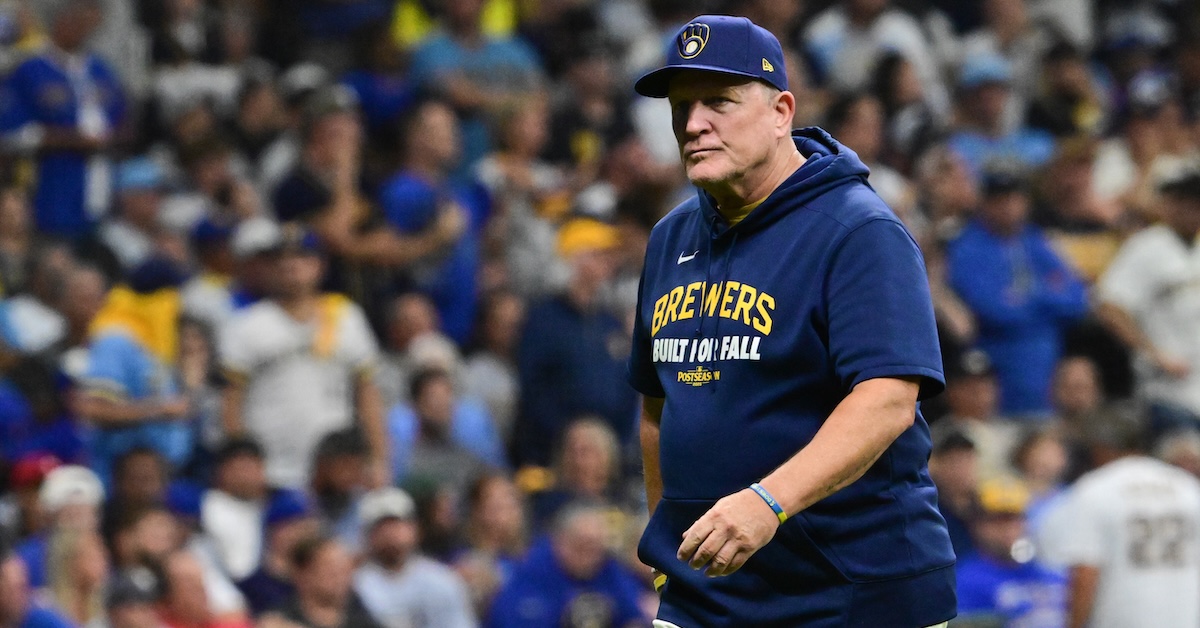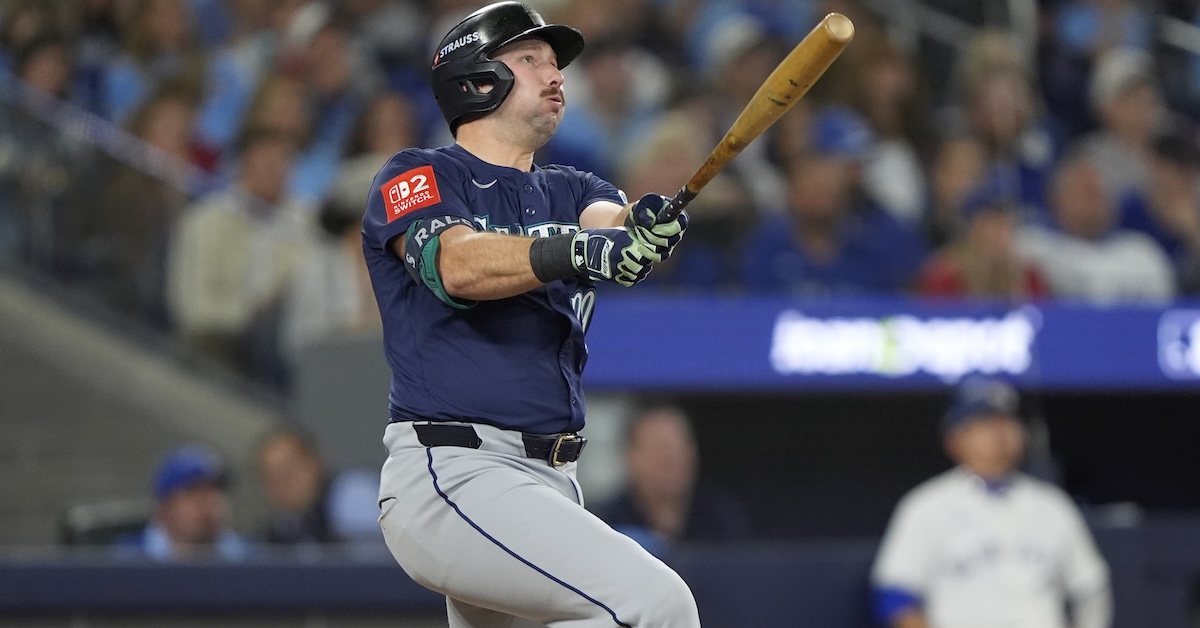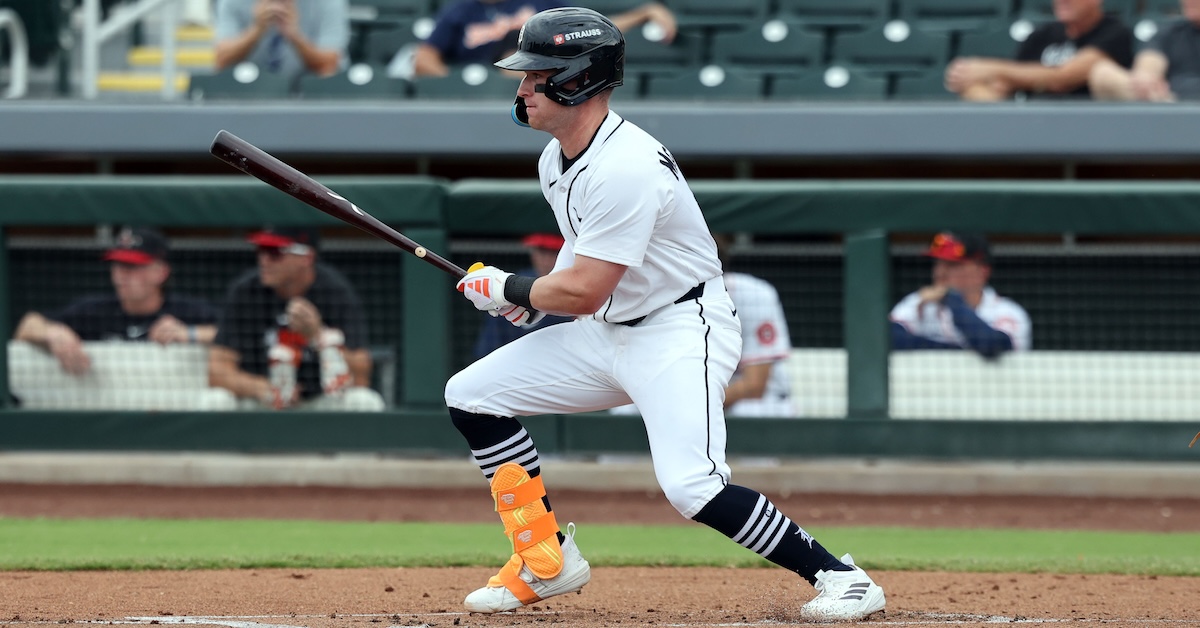
Kevin McGonigle is an elite prospect, and his bat is a big reason why. Playing across three levels in the Detroit Tigers organization — topping out at Double-A — the 21-year-old shortstop/third baseman slashed .305/.408/.583 with 19 home runs and 182 wRC+ over 397 plate appearances in 2025. Ranked third on The Board behind only Konnor Griffin and Jesús Made, McGonigle has been described by Eric Longenhagen as having “real juice in his hands” and a swing that is “geared for launch.” Built to bash baseballs, McGonigle’s left-handed stroke is both compact and lethal.
Currently with the Arizona Fall League’s Scottsdale Scorpions — he’s in the desert primarily to work on his defense — McGonigle has a bright future regardless of where he ends up in the infield. Longenhagen feels that his best fit might be second base. But again, there is juice in his hands. The bat is McGonigle’s carrying tool, and it promises to carry him a long way.
McGonigle sat down to talk hitting prior to a recent game at Scottsdale Stadium.
———
David Laurila: How have you evolved as a hitter? For instance, if I looked at video from the time you signed and compared it now, would I see the same guy?
Kevin McGonigle: “You’d see the same swing. I’m a little bit bigger now, obviously, but the swing hasn’t changed. It’s been the same since I was 10 years old, to be honest with you. That’s the way my body naturally wants to move, and the best way I can explode on a baseball, so I try to keep doing the same thing I’ve done since I was younger.”
Laurila: How does your body naturally move?
McGonigle: “I’ve got the toe tap, and I’m in my legs more than a lot of guys are at the plate. I pretty much see ball, hit ball, and try to… not take the same swing. I feel that you’re going to have a different swing on every pitch. But I try to keep the same toe tap, the same everything.”
Laurila: While you’re continuing to do what comes naturally, you also have talented hitting instructors to work with. How are you balancing that?
McGonigle: “What I like about the Tigers is that they’re not really hands-on unless you have questions. I go to them for little pieces, like routines or drills that I want to do. One big thing for me was bat speed, so they put me on a bat-speed program last offseason. That really helped me with power this year. Bat-to-ball, of course. Gap-to-gap power. I’m trusting in them — the Tigers and all the coordinators — because they’re there to help you get better and better each day.”
Laurila: What is your approach in terms of where you’re looking to hit the ball?
McGonigle: “It depends on who is on the mound. If a good lefty is out there, I’ll think left-center gap and then just react to his offspeed and pull it. Same thing with right-handers. If it’s a guy throwing really hard, like upper-90s, maybe I’ll think right-center. That’s the farthest I’ll go with a heater. Then, changeup, curveball — whatever secondary he throws — pull it down the line. Top hook it in the corner is what I like thinking.
“When I’m on, I’m mostly hitting balls hard in the right-field gap or down the right-field line. That’s even with pitches dotted away. I’ll still be able to get under it and pull it. There does comes a time and place when I want to let the ball travel, though. With two strikes, I try to use all parts of the field.
“I’m also always sitting on fastballs and reacting to offspeed from there. I don’t like sitting on other pitches, really. If it’s a lefty that just spams sweepers, I’ll sit sweeper, but that’s about it. For me, it’s mostly all reaction.”
Laurila: My impression is that you fit into the KISS category — Keep It Simple, Stupid — yet you think about hitting quite a bit. Is that accurate?
McGonigle: “Definitely. I mean, if I’m hitting the ball hard and it’s going right at somebody, there’s nothing you can do about it. So, my main thing is to just find the barrel. That’s it. If you find the barrel, it’s a win. If you don’t, then get him next time.”
Laurila: Coming up from amateur ball and and through different levels of pro ball, you’re basically the same guy, but with more reps under your belt…
McGonigle: “Yeah, just seeing more pitching. In high school, I didn’t really see 95 [mph] really at all. Once I got a feel for that, I had to get used to guys having better offspeed. They like to throw it in leverage counts, and that’s one thing I really needed to work on this year. Last year I got a lot of fastballs to hit, and this year they’re flipping in 3-0 sliders, 3-1 sliders, changeups in 0-0 counts.
“Getting my hack off on 0-0 counts when I get offspeed that is middle-middle, or it’s a get-me-over offspeed… if I swing and miss, so what? I’m down 0-1. But if I put a barrel on it, then it’s a win. I’m more aggressive now than I was last year.
“If he’s a fastball-changeup guy who throws a lot of changeups, I’ll still sit fastball. A lot of times I’m going to look up. The changeup is going to start there, then have a little bottom to it and go to the heart of the plate. I’m kind of tunneling where I want the pitch to start.”
Laurila: Has bat-speed training helped you react better to heaters when you’ve been expecting something offspeed?
McGonigle: “Yeah. I’d say there were a few times this year that I was sitting offspeed, a guy threw a heater down the middle, and I was still was able to hit it hard to left field. Having a quicker bat has definitely helped. I’m able to protect on two-strike counts. If I’m beat on a fastball, I can at least get a bat on it and foul it off, give myself life to hopefully win that two-strike count.”
Laurila: How much do strikeouts matter? That was something Riley Greene struggled with this year, even while putting up good numbers.
McGonigle: “It’s not a great feeling. I mean, Riley Greene is a great baseball player. I’m looking forward to hopefully one day sharing a field with him. He wouldn’t be in the spot he is right now if it wasn’t for the way he plays baseball, and the way he hits. Strikeouts aren’t the best thing in the world, but he also performed in all the different aspects of the game. The whole strikeout thing… I think it is a big deal, but not as big as everyone thinks it is.”
Laurila: Outside of defense, what do the Tigers want you to work on this coming offseason?
McGonigle: “We have exit meetings with our hitting coordinators — mine will be after [the AFL] — and off the top of my head, I don’t know exactly. But the curveball is one pitch that I struggled with this year. I was either under it, or on top of it.”
Laurila: Why was that?
McGonigle: “Some of it was timing, but some of it was swinging at the wrong curveballs. If it’s low, that’s where the pitcher wants it, and the high ones would kind of fool me. A pitcher would go up top with a curveball, and I would clip it back, whereas that’s a pitch you want to hammer. I’m so used to training it down in the zone, where pitchers usually want to get it, but now some guys are trying to get it up top. I need to work on that, on hitting offspeed up top.”
Laurila: Any final thoughts on hitting?
McGonigle: “There’s not a perfect swing. Every swing is going to be different. If it’s a low pitch, if it’s a high pitch, if it’s away… but you see a lot of guys trying to chase that perfect swing. That’s hard to do when you have a guy throwing 99 and it’s running 20 inches, or sinking 20 inches. My thought is just, ‘Go up there and get the bat to the ball.’ Keep it that simple. Don’t try to chase the perfect swing. I want my swing to be adjustable. Simple and adjustable.”
——
Earlier “Talks Hitting” interviews can found through these links: Jo Adell, Jeff Albert, Greg Allen, Nolan Arenado, Aaron Bates, Jacob Berry, Alex Bregman, Bo Bichette, Justice Bigbie, Cavan Biggio, Charlie Blackmon, JJ Bleday, Bobby Bradley, Will Brennan, Jay Bruce, Triston Casas, Matt Chapman, Michael Chavis, Garrett Cooper, Gavin Cross, Jacob Cruz, Nelson Cruz, Paul DeJong, Brenton Del Chiaro, Josh Donaldson, Brendan Donovan, Donnie Ecker, Rick Eckstein, Drew Ferguson, Justin Foscue, Michael Fransoso, Ryan Fuller, Joey Gallo, Paul Goldschmidt, Devlin Granberg, Gino Groover, Matt Hague, Andy Haines, Mitch Haniger, Robert Hassell III, Austin Hays, Nico Hoerner, Jackson Holliday, Spencer Horwitz, Rhys Hoskins, Eric Hosmer, Jacob Hurtubise, Tim Hyers, Walker Jenkins, Connor Joe, Jace Jung, Josh Jung, Jimmy Kerr, Heston Kjerstad, Steven Kwan, Shea Langeliers, Trevor Larnach, Doug Latta, Dillon Lawson, Brooks Lee, Royce Lewis, Evan Longoria, Joey Loperfido, Michael Lorenzen, Mark Loretta, Gavin Lux, Dave Magadan, Trey Mancini, Edgar Martinez, Don Mattingly, Marcelo Mayer, Hunter Mense, Owen Miller, Paul Molitor, Colson Montgomery, Tre’ Morgan, Ryan Mountcastle, Cedric Mullins, Daniel Murphy, Lars Nootbaar, Logan O’Hoppe, Vinnie Pasquantino, Graham Pauley, David Peralta, Luke Raley, Julio Rodríguez, Brent Rooker, Thomas Saggese, Anthony Santander, Drew Saylor, Nolan Schanuel, Marcus Semien, Giancarlo Stanton, Spencer Steer, Trevor Story, Fernando Tatis Jr., James Tibbs III, Spencer Torkelson, Mark Trumbo, Brice Turang, Justin Turner, Trea Turner, Josh VanMeter, Robert Van Scoyoc, Chris Valaika, Zac Veen, Alex Verdugo, Mark Vientos, Matt Vierling, Luke Voit, Anthony Volpe, Joey Votto, Christian Walker, Jared Walsh, Jordan Westburg, Jesse Winker, Bobby Witt Jr. Mike Yastrzemski, Nick Yorke, Kevin Youkilis



 Sponsor Us on Patreon
 Give a Gift Subscription
 Effectively Wild Subreddit
 Effectively Wild Wiki
 Apple Podcasts Feed
 Spotify Feed
 YouTube Playlist
 Facebook Group
 Bluesky Account
 Twitter Account
 Get Our Merch!