Archive for Daily Graphings

MLB Is Testing Ideas in the Atlantic League

Last week, Major League Baseball and the independent Atlantic League announced a partnership to test certain rule changes that could be coming to MLB. This deal is noteworthy for a few reasons. First, the introduction of an automatic strike zone suggests that the role of big league umpires could be changing. Second, the rule changes themselves, which range from the interesting to the just plain weird, suggest a continued emphasis on more balls being put in play, and greater action on the field. Third, the Atlantic League will become the first unaffiliated league with access to Trackman data, creating a more robust way of seeing potential differences between the leagues’ talent levels, and potentially creating a new pipeline for prospective major leaguers.

Let’s start with the rule changes themselves.

The following new rules will be in place for the 2019 Atlantic League Championship Season:

  • Home-plate umpire assisted in calling balls and strikes by a TrackMan radar tracking system
  • No mound visits permitted by players or coaches other than for pitching changes or medical issues
  • Pitchers must face a minimum of three batters, or reach the end of an inning before they exit the game, unless the pitcher becomes injured
  • Increase size of first, second and third base from 15 inches square to 18 inches square
  • Require two infielders to be on each side of second base when a pitch is released (if not, the ball is dead and the umpire shall call a ball)
  • Time between innings and pitching changes reduced from 2:05 to 1:45
  • Distance from pitching rubber to home plate extended 24 inches, in the second half of the season only; with no change to mound height or slope.

Robot umpires? Robot umpires! We’ve talked before about how, given the way the ball and strike rules are currently worded, introducing robot umps would require pretty significant rule changes. Now some umpires have been maligned (often fairly) for the eccentricities of their unique strike zones. Joe West and Angel Hernandez certainly come to mind. But while having an automated ball and strike system might help, the difference might be less than you think. Read the rest of this entry »


Tony Barnette, Ryne Stanek, and Nick Tropeano on Developing Their Splitters

Pitchers learn and develop different pitches, and they do so at varying stages of their lives. It might be a curveball in high school, a cutter in college, or a changeup in A-ball. Sometimes the addition or refinement is a natural progression — graduating from Pitching 101 to advanced course work — and often it’s a matter of necessity. In order to get hitters out as the quality of competition improves, a pitcher needs to optimize his repertoire.

In this installment of the series, we’ll hear from three pitchers — Tony Barnette, Ryne Stanek, and Nick Tropeano — on how they learned and developed their split-finger fastballs.

———

Tony Barnette, Chicago Cubs

“When I was in Japan, I had a changeup as a starter. It was getting hit. Working on it in bullpens, I remember a couple of Japanese coaches, through a translator, asking me, ‘Why do you throw that pitch?’ I told them that I needed something off-speed, something to use away to lefties. They were like, ‘You’re right, you do. But that’s not it. It’s awful. You need to get rid of it.’

“A lot of guys in Japan throw a split, so they got me on that. I started playing with different grips, and found one that worked for me. If you look at a baseball, the seams are crazy. They go all over. Basically, you split your fingers and find seams. You find seams that fit your hand. Then, one day you have that ‘aha’ moment where it’s ‘Oh my god, this works.’ From there, you working on it more. Read the rest of this entry »


Sunday Notes: Brad Ausmus Embraced Analytics, Aced His Angels Interview

The majority of Mike Scioscia’s coaches accompanied him out the door when the Angels made a managerial change after last season. Their replacements came both from other organizations — pitching coach Doug White (Astros) being notable — and from internal promotions.

I’m not privy to the conversations GM Billy Eppler and/or new manager Brad Ausmus had with the outgoing staff members, but they likely uttered some form of “We’ve decided to go in another direction” when passing out the pink slips.

According to Eppler, the revamping of the staff wasn’t reflective of a philosophical shift. The decisions were driven by a desire to travel north in the standings.

“I wouldn’t say that anything changed,” Eppler told me recently. “When we came over here in 2015, we implemented philosophies throughout the organization — how we’re valuing players, how we want to coach players, and so forth. Nothing new was implemented this year.”

The characteristics Eppler is looking for — not just on the coaching staff, but throughout the organization — can be encapsulated in a single, hyphenated sentence: Read the rest of this entry »


FanGraphs Scottsdale Meetup: Tonight!

FanGraphs is headed to Arizona for spring training, and we want to share a few drinks and some baseball talk with our readers. So come join us today, Friday, March 8 from 7 to 10 pm at the Two Brothers Scottsdale Tap House & Brewery. We’ve reserved the upstairs loft, and will have appetizers for everyone. It’s a great chance to meet other baseball fans and chat with a bunch of your favorite FanGraphs writers.

If you plan on joining us, we would appreciate you RSVPing using this handy Google form, so we know how much food to order.

Details
Friday, March 8 from 7 to 10 pm
Two Brothers Scottsdale Tap House & Brewery, upstairs loft
4321 N. Scottsdale Rd, Scottsdale

FanGraphs/RotoGraphs Attendees

  • David Appelman
  • Alex Chamberlain
  • Sean Dolinar
  • Craig Edwards
  • Dylan Higgins
  • Jay Jaffe
  • Brad Johnson
  • David Laurila
  • Eric Longenhagen
  • Kiley McDaniel
  • Al Melchior
  • Meg Rowley
  • Paul Sporer
  • Rian Watt
  • Jeff Zimmerman

We hope to see you there!


Rowan Wick Has a Short, Quick Arm and a Good Backstory

Rowan Wick has a short, quick arm and plus velocity. He also has a good backstory. The 26-year-old right-hander didn’t begin pitching until 2015, three years after he was drafted by the St. Louis Cardinals. Four years and two organizations later, he’s currently competing for a spot in the Cubs bullpen. Chicago’s North Side club acquired Wick from San Diego over the offseason in exchange for Jason Vosler.

A lack of power isn’t why he failed to make the grade as a position player. The problem was contact. In 2014, Wick swatted 20 home runs in just 298 plate appearances between short-season State College and Low-A Peoria, but he also fanned 94 times. He then ventured even further into blind-squirrel territory the following year. Prior to being converted, Wick went down by way of the K a staggering 50 times in just 133 plate appearances.

Midway through May of that 2015 season, Wick was informed that he would henceforth be standing on a bump. Given his travails with the stick, he was in no position to argue.

“When they told me I was going to pitch, it was kind of, ‘OK, this is my last shot,’” Wick recalled thinking. “At that point, you’ve got to buy in, right? I’d started as a catcher, then went to the outfield, and now I was a pitcher. After that, you really can’t make any more moves. It was either pitch or go home.” Read the rest of this entry »


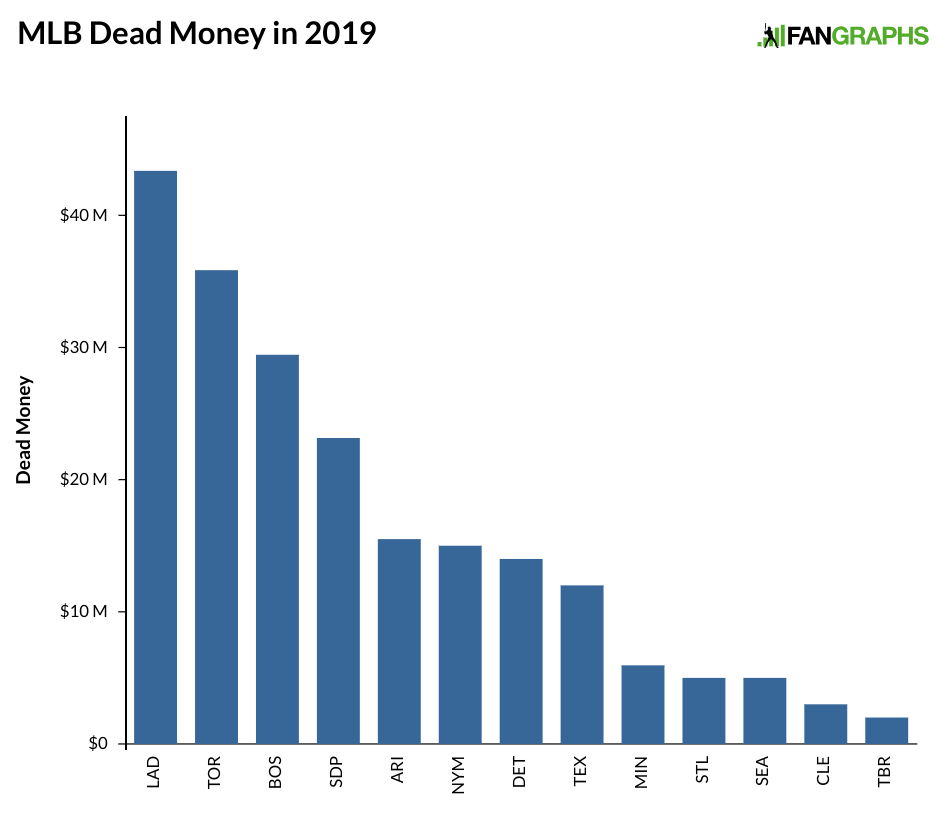
MLB Teams with the Most Dead Money in 2019

Sunk costs are difficult for all of us. We might keep a gym membership longer than we should hoping to get some value out of it despite not going for months. We might finish a meal that was terrible from the start because we cooked it or paid for it. We finish movies and books we know we will not enjoy. Once some of our money or time has been spent, there is a pull to keep spending or wasting that time and potential enjoyment because we’ve already started. Sometimes, baseball teams are just like us. Once a big contract is handed out, teams feel compelled to continue to provide playing time past the point of utility or give a roster spot to a player whose play doesn’t merit it. That’s not always the case, though. Sometimes teams move on, and when they do, they end up with dead money on their payroll.

This is my fourth year tracking dead money on payrolls and while the amount fluctuated greatly from 2016 to 2017, going from under $150 million to $300 million, last year it was back around $200 million, and it remains the same this season. As to what counts as dead money, this is what I said in last year’s post:

Dead money is generally any money a team is paying out to a player who no longer appears on their 40-man roster. There are three types of dead money:

  1. Money paid to players who have been released. Those players are free to sign with other teams, but the team releasing the player still owes the money remaining on the contract.

  2. Money paid to other teams as compensation for players who have been traded. Generally, we see teams cover a portion of a contract to receive a better return in trade.

  3. Money paid to players who are still in the organization, but who have been removed from the 40-man roster. Any team could have claimed these players if they were willing to take on the contract, and the player probably could have elected fee agency, but then he would forfeit his right to the guaranteed money.

While Jacoby Ellsbury’s salary sits on the Yankees payroll with no expected contribution, that money is only mostly dead. As far as which team has the most money this season, that honor, or dishonor, goes to the Los Angeles Dodgers. These numbers were compiled from Cot’s Contracts.

The Dodgers have been first or second on this list every year I’ve done this exercise, spending close to $140 million since 2016 on players not on their roster. This year’s big expenditure comes in the form of Homer Bailey, who the team acquired from the Reds in order to move Matt Kemp’s contract as well as acquire a few prospects in the deal that sent Yasiel Puig and Alex Wood to Cincinnati. The Blue Jays come in just behind the Dodgers as the team that decided to cut bait with the oft-injured Troy Tulowitzki as well as trade Russell Martin to the Dodgers. The moves by the Dodgers and Blue Jays illustrate contrasting styles when it comes to dead money on the roster. Los Angeles acquired Homer Bailey to drop him in a move designed to save tax space as they exchanged Kemp’s bad contract. For the Blue Jays, who are not expected to compete for the division this season, giving playing time and roster spots to aging veterans doesn’t help the club’s future as those resources can be better utilized by providing meaningful experience to younger players. Nearly one-third of Toronto’s payroll won’t even be on the team and the club’s on-field roster is set to make under $80 million this season.

Breaking the money down, here are the players who have been released by their teams.

Released Players on the Payroll
Player Old Team Current Team Money Owed in 2019
Homer Bailey Dodgers Royals $23 M
Troy Tulowitzki Blue Jays Yankees $19.45 M
Pablo Sandoval Red Sox Giants $18.45 M
David Wright Mets None $15 M
Prince Fielder Rangers None $9 M
Phil Hughes Padres None $7.25 M
Hector Olivera Padres None $7.5 M
Austin Jackson Rangers None $3 M
Dian Toscano Dodgers None $200,000

In Prince Fielder’s case, the Tigers are paying some of his salary and a discount for insurance proceeds has been taken. It would be useful to do the same with David Wright, though those numbers are a bit more murky. We know that Wright restructured his contract with some deferrals so that he will make $9 million this year. It’s possible that insurance proceeds, estimated at $12 million by Ken Davidoff over the next two seasons might mean the Mets aren’t actually paying any money to Wright this season. The Padres essentially bought a draft pick by taking on some of Phil Hughes’ salary last year, while also taking on Olivera, who they immediately released, allowed them to get out from under Matt Kemp’s money.

As for trades, here are the players for whom teams are paying some or all of their salaries this season. There are a few repeat names from the list above.

Traded Players Still on the Payroll
Player Old Team New Team Money Sent for 2019
Russell Martin Blue Jays Dodgers $16.4 M
Matt Kemp Dodgers Padres and Reds $10.5 M
Justin Verlander Tigers Astros $8 M
Prince Fielder Tigers Rangers $6 M
Phil Hughes Twins Padres $5.95 M
Robinson Cano Mariners Mets $5 M
Mike Leake Cardinals Mariners $5 M
Jedd Gyorko Padres Cardinals $5 M
Hector Olivera Dodgers Braves $4.66 M
Edwin Encarnacion Indians Mariners $3 M
Evan Longoria Rays Giants $2 M
Clayton Richard Padres Blue Jays $1.5 M

Most of these deals are pretty straightforward, with the old team offsetting some salary to get a deal done or receive a better prospect return. The Edwin Encarnacion situation is a bit complicated. Cleveland and Seattle swapped Carlos Santana and Encarnacion with Seattle actually sending a couple million dollars to Cleveland for this season and $4 million next year. That was not the entirety of the deal; Tampa Bay sent $5 million to Seattle as part of the deal with Cleveland that sent Jake Bauers to the Indians for Yandy Diaz and Cole Sulser. It’s fair to think of that $5 million as shipped through Cleveland, which is how Encarnacion ends up with $3 million from Cleveland this season.

There are just a few more players with payroll qualifying for dead money.

Players Off the Roster Still on the Payroll
Player Team Money Owed in 2019
Yasmany Tomas Diamondbacks $15.5 M
Rusney Castillo Red Sox $11 M
Yaisel Sierra Dodgers $5 M
Kazuhisa Makita Padres $1.9 M

We have multiple, big contracts for Cuban players who haven’t quite worked out. Tomas’ deal couldn’t even be made under the current rules, while Castillo suffers, in part, because adding him back on the roster would result in more competitive balance tax payments. Tomas didn’t make enough contact despite swinging a lot. Castillo has played well in the minors though still wouldn’t be a starter for Boston even if they did bring him up to the majors. Sierra is still in the Dodgers’ system and could be a reliever at some point.

Having a bunch of money on the payroll devoted to players who won’t contribute to the MLB team isn’t a great situation to consider; most of the decisions made above were done to help teams reach some goal, now or in the future. Teams have finite roster space and using that space on players who can contribute is better than using it on a player just because they have an expensive contract. Sometimes teams save money in the present, but have a bigger cost later on. While teams have gotten more frugal about long-term deals, we haven’t yet seen the amount of dead money on MLB rosters decrease significantly.


Leclerc, Rangers, Ink Relationship in Permanent Marker

On Wednesday, the Texas Rangers agreed to a four-year contract extension with closer Jose Leclerc worth $14.75 million with two additional option years worth $6 million and $6.25 million, respectively. Leclerc, 25, was one of the most pleasant surprises on a rather dismal Rangers team in 2018 and ranked fourth in baseball among in relievers in WAR, behind only Blake Treinen, Edwin Diaz, and Josh Hader. Among all pitchers with 30 innings pitched in 2018, Leclerc ranked fifth in ERA (1.56), fifth in FIP (1.90), and 11th in strikeout percentage (38.1%).

Given Leclerc’s lack of leverage with four years until free agency, the contract is unsurprisingly not for a princely sum, and isn’t even in the same galaxy as the four-year, $42 million extension Craig Kimbrel signed with the Braves before the 2014 season. The extension buys out all of Leclerc’s arbitration years, possibly resulting in a six-year deal with the options. These types of arbitration year extensions may be rarer for relievers than you think; to my surprise, after a quick perusal of contracts, I only found seven pre-free agency relievers whose current contract involved a multi-year extension with option years: Brad Hand, Nate Jones, Chris Devenski, Sean Doolittle, Jeremy Jeffress, Tony Barnette, and Felipe Vazquez. While it’s certainly possible I missed a contract or two, showing this type of commitment to a reliever prior to free agency is not a run-of-the-mill occurrence.

[Adam Morris of has reminded me that Tony Barnette signed as as free agent from Japan – DS]

One thing notable about Leclerc is how quickly he went from being an interesting-but-very-wild pitcher to one of the elite relievers in baseball. The ZiPS projection for Leclerc going into 2018 was a 4.22 ERA, 107 ERA+ season with an abysmal 51 walks in 70 1/3 innings, and ZiPS was not an outlier here. Now, in a sense it’s impressive that a pitcher forecast for that many walks could still have a projection that placed them around league-average, but baseball history is full of hard-throwing young relievers who never get over their propensity to issue free passes. A 5.1 BB/9 in the minors isn’t generally conducive to a long major league career. Read the rest of this entry »


Kyle Freeland Has a New Trick Up His Sleeve

Kyle Freeland isn’t satisfied with last year’s breakout season. That’s bad news for opposing hitters. The 25-year-old Colorado Rockies southpaw is coming off a 2018 campaign where he finished fourth in the NL Cy Young Award voting after going 17-7 with a 2.85 ERA and a 3.67 FIP. His 202.1 innings pitched — a workhorse total by today’s standards — were fifth-most in the senior circuit.

Continuing to get better is every player’s goal, so while Freeland isn’t looking to reinvent himself — that would be senseless— he does have a few new tricks up his sleeve. While his repertoire will remain static, where his talented left arm aims those offerings will have more variance than in the past.

“I’ve been working on new locations for pitches, kind of different ways to attack hitters,” explained Freeland. “I’m working on getting comfortable throwing left-on-left changeups, and on throwing a two-seamer inside to righties — that front hip shot. Throwing those two pitches will expand my arsenal a little more.”

The Denver native spoke primarily of his same-sided approach when describing the planned changes: “If you look at video from last year, you’re going to see a heavy amount of fastballs and sliders down and away to lefties. That’s the book on me. We feel that giving them another look won’t allow them to sit on that so much.” Read the rest of this entry »


The Separate Paths of Craig Kimbrel and the Red Sox

With just over three weeks before Opening Day, Craig Kimbrel remains a free agent, and the Red Sox, whom he helped win the World Series last fall, don’t have a bona fide closer. For as sensible as a reunion might seem, it’s unlikely to happen, as the Red Sox appear more willing to experiment with late-inning roles among relatively untested pitchers than to invest heavily in a dominant pitcher who nonetheless showed signs of decline last year, or to increase their considerable tax bill. It’s a set of choices that’s very 2019, to say the least, though the bullpen will need a breakout performance or two for their plan to succeed.

Kimbrel, who turns 31 on May 28, is coming off a season in which he saved 42 games, his highest total since 2014, and made his seventh All-Star team. But he struggled after the All-Star break (4.57 ERA and 3.58 FIP in 21.2 innings), and finished with the highest FIP (3.13) and home run rate (1.01 per nine) of his career and the second-highest ERA (2.74) and walk rate (12.6%). While his knuckle-curve remained unhittable (20.9% swinging strike rate, with batters “hitting” .082/.176/.098 on 68 PA ending with the pitch), the average velocity of his four-seam fastball slipped to 97.5 mph, his lowest mark since 2011, and the pitch was hit comparatively hard (.171/.292/.388) while accounting for all seven of the homers he yielded. In the postseason, he surrendered runs in his first four appearances before discovering that he was tipping his pitches; he corrected the problem by setting up with his glove at his waist, and was scored upon in just one of his final five October outings.

Fixed though he may be, Kimbrel has produced just one season out of the past four (2017, when he posted a 1.43 ERA and 1.42 FIP) that’s in the ballpark of his 2011-14 stretch, when he was the game’s top reliever (1.51 ERA, 1.52 FIP, 11.1 WAR). He entered the winter reportedly seeking a six-year deal worth over $100 million, a price tag that might have been a pipe dream even without his relatively shaky platform season given the frosty turn of the free agent market.

Not helping matters is that three of the majors’ highest-spending teams are already rather spent in the closer market, namely the Yankees (who signed Aroldis Chapman to a five-year, $86 million deal in December 2016), Dodgers (who re-signed Kenley Jansen to a five-year, $80 million deal in January 2017), and Giants (who signed Mark Melancon to a four-year, $62 million deal in December 2016). According to Forbes’ end-of-year figures, those teams are respectively ranked sixth, fourth, and third in payroll, with the two teams ahead of them, the Nationals and Red Sox, the only ones who actually exceeded the $197 million Competitive Balance Tax Threshold. More on both of those teams momentarily.

While a recent rumor that Kimbrel was willing to sit out the season if no team met his price was quickly debunked, he remains unsigned, and interest from teams like the Phillies and Braves has hinged on short-term deals. The latter, the team that drafted and developed Kimbrel, hasn’t done anything substantial to fix a bullpen that was below average last year, beyond hoping that midseason acquisition Darren O’Day, acquired as a poison pill in the Kevin Gausman trade, has recovered from season-ending right hamstring surgery. The unit’s current projection of 2.6 WAR ranks 16th out of 30 teams. The Phillies’ bullpen, which most notably added free agent David Robertson as well as former Mariners Juan Nicasio and James Pazos, are projected for 4.2 WAR.

The Nationals, who according to Cot’s Contracts are projected to be $10.5 million below this year’s $206 million CBT threshold, have maintained interest in Kimbrel, and given their recent bullpen debacles and their current reliance on oft-injured Sean Doolittle and Tommy John surgery returnee Trevor Rosenthal, they appear to have need for the fireballer. They would likely need to make a salary-cutting move or two to give themselves some breathing room under the tax threshold, particularly given that as three-time offenders, they will pay a 50% marginal tax rate on the overages.

And then there’s the Red Sox, who according to Cots are already [puts on special payroll-viewing goggles] nearly $31.6 million over the threshold, facing not only a 30% marginal tax rate as second-time offenders but also a 12% surtax for being between $20 million and $40 million over. Re-signing Kimbrel to even a one-year, $9 million deal would not only push them out of that range and into one that, if I’m reading this correctly, boosts their surtax to 42.5%; it would also mean that they would also have their top pick in the upcoming June amateur draft moved back 10 places. All of which seems rather draconian. MLB Trade Rumors, which uses slightly different payroll figures via Roster Resource, estimated that to pay Kimbrel a one-year, $17.5 million salary (thus exceeding Wade Davis‘ $17.33 million to set an AAV record for relievers) would cost an additional $11.564 million in taxes. Woof.

So that’s not happening, and while we wait for some other team to meet Kimbrel’s price — my money is still on Atlanta — Boston’s bullpen is worth a closer look. Last year, with Kimbrel in tow, the unit ranked a modest sixth in the AL in WAR (4.9), but third in FIP- (92), fourth in ERA- (83), and fifth in K-BB% (15.3%). In losing Kimbrel and the often erratic Joe Kelly, who after leading the team with 65.2 relief innings signed a free agent deal with the Dodgers, the team has shed a pair that accounted for 21.8% of their bullpen’s innings and 44.9% of their WAR (1.5 for Kimbrel, 0.7 for Kelly).

Nobody new of any note has come into the fold besides Jenrry Mejia, who signed a minor league deal in January after being reinstated from a PED-related, lifetime ban that cost him the past 3 1/2 seasons. Via our depth charts, the primary pool of relievers appears to consist of lefties Brian Johnson and Bobby Poyner, and righties Matt Barnes, Ryan Brasier, Heath Hembree, Tyler Thornburg, Hector Velazquez, Marcus Walden, and Brandon Workman, with knuckleballer Steven Wright coming along slowly after arthroscopic surgery on his left knee [update: and also suspended for 80 games due to a PED violation] and Carson Smith not available until sometime in midseason as he works his way back from last June’s shoulder surgery.

None of those pitchers besides Mejia, who saved 28 games in 2014 but did not even get a non-roster invitation to Boston’s big league camp, has much major league closing experience. Thornburg owns 13 career saves, all from 2016 with the Brewers, before he was traded (for Travis Shaw) and missed all of 2017 and half of ’18 due to surgery to correct thoracic outlet syndrome. Barnes owns two saves, Waldman and Wright one apiece, and that’s it, though some of the aforementioned pitchers did close in the minors. This apparently does not faze the Red Sox, who may not anoint a single pitcher for ninth-inning duties. From the Boston Globe’s Alex Speier:

As the Red Sox contemplate how they’ll handle ninth-inning responsibilities in a post-Kimbrel world, the team seems increasingly open to the possibility of taking a flexible approach to the later stages of the game rather than making an unwavering commitment to one person for the last three outs.

Manager Alex Cora reiterated on Sunday morning that he has “a pretty good idea of what I want to do” with the ninth inning, but that the topic is one that is currently subject to organizational debate — a conversation driven less by how individual pitchers perform in spring training than by what the organization is willing to do with them. He opened the door to the possibility of using matchups to dictate the back end of the bullpen structure.

“We know who [the relievers] are. We know the stuff. It’s just about the plan. The plan will be out there on March 28th,” Cora said, referring to the Opening Day date against the Mariners. “It’s just a matter of, see what we’re going to do as an organization, what plan we’re going to do, how comfortable are we with a closer or mixing it up, or getting people out in certain situations? We still have a lot of days to see how we feel about it.”

Those well-versed in Red Sox history may recall the team’s ill-fated 2003 “closer by committee” plan, which fared poorly and ultimately led to the late May acquisition of Byung-Hyun Kim from the Diamondbacks. As Speier points out, current pitching coach Dana LeVangie was that team’s bullpen coach. But those were different times, and the past few years have seen teams show more open-mindedness about late-inning reliever usage, with roles — including who finishes the ninth — less rigidly defined. Ninth-inning-wise, think the 2016-18 Indians, with Andrew Miller (or, when Miller was hurt in 2018, Brad Hand) occasionally taking save chances instead of Cody Allen; or last year’s Cubs, with Pedro Strop, Steve Cishek, and Jesse Chavez all used to cover for the second-half absence of Brandon Morrow; or last year’s Brewers, who had three pitchers (Corey Knebel, Jeremy Jeffress, and Josh Hader) save at least 10 games without manager Craig Counsell relying upon any one of them as his main guy.

There’s no reason why the Red Sox, an organization as analytically inclined as those teams, couldn’t get away with a similar approach, given a manager who’s comfortable with such an arrangement and talented pitchers who can boil the job down to “go in and get outs,” as Hader described his role last year. Cora, who as a rookie manager piloted the Red Sox to a franchise-record 108 wins and a World Series victory over the Dodgers, appears quite qualified and game for the challenge. Barnes and Brasier, the two pitchers most likely to figure into a late-game plan, both sound receptive and upbeat via Speier’s reporting. We’re a far cry from 2015, when Angels closer Huston Street declared that he’d rather retire than be used in high-leverage situations outside of the ninth.

Of course, the success of such a plan isn’t just dependent upon player buy-in but also execution, and it’s there that the Red Sox may have more to worry about. With the personnel on hand, the team’s bullpen projects to rank 23rd in the majors in WAR. Here’s how the key individuals that I mentioned stack up with regards to 2018 performance and 2019 projections:

Red Sox Bullpen, 2018-19
Name IP K% BB% ERA FIP WAR Proj IP Proj ERA Proj FIP Proj WAR
Matt Barnes 61.2 36.2% 11.7% 3.65 2.71 1.3 65 3.42 3.32 1.1
Ryan Brasier 33.2 23.4% 5.7% 1.60 2.83 0.7 65 3.87 3.92 0.6
Heath Hembree 60.0 29.2% 10.4% 4.20 4.19 0.2 60 3.95 3.93 0.4
Bobby Poyner 22.1 25.8% 3.2% 3.22 4.01 0.2 50 4.43 4.53 0.0
Hector Velazquez 54.2 12.8% 5.6% 2.63 3.53 0.5 50 4.48 4.57 -0.1
Marcus Walden 14.2 23.7% 5.1% 3.68 2.07 0.3 50 4.31 4.25 0.0
Steven Wright 29.2 20.5% 13.1% 1.52 4.07 0.1 50 4.44 4.62 -0.1
Tyler Thornburg 24.0 19.6% 9.4% 5.63 6.04 -0.3 50 4.84 4.90 -0.2
Brandon Workman 41.1 22.2% 9.6% 3.27 4.42 0.0 30 4.35 4.35 0.0
Brian Johnson* 38.2 20.5% 9.0% 4.19 3.91 0.2 19 4.99 5.01 0.1
2018 statistics are for relief usage only. * = projection based upon usage as a starter.

Much depends upon the continued success of Barnes and Brasier, however they’re deployed. Barnes, a 2011 first-round pick who has spent virtually all of the past four seasons in Boston’s bullpen, more or less ditched his slider in favor of further emphasizing his curve, which generated a career-best 18.0% swing-and-miss rate (up from 12.5% to 13.5% from 2015-17); his 36.2% K rate ranked ninth among the 151 relievers with at least 50 innings last year, while his 2.71 FIP ranked 22nd.

Brasier didn’t join the Red Sox bullpen until July 9 last year, his first major league appearance since September 27, 2013, with the Angels, for whom he made seven appearances that season. In the interim, he lost a year and a half to Tommy John surgery, spent a year and a half in the A’s chain and then a season in Japan, and finally spent half a season closing in Pawtucket, where he pitched his way to the Triple-A All-Star Game on the back of a 1.34 ERA and a 40/8 K/BB ratio in 40.1 innings before getting called up and carrying over a similarly effective performance to the majors. Both pitchers came up big in October, which should lessen fears about whether they can handle the pressure of the ninth inning during the regular season, even if the usage pattern is less regular than your average ninth-inning guy.

It’s the rest of the cast that carries the bigger question marks; most of them project to be more or less replacement level, and they’ll need a few somebodies to step up — perhaps Thornburg rediscovering his pre-surgical form, Hembree avoiding the gopher balls (1.5 per nine over the past two seasons), Smith giving the team a midseason shot in the arm, and so on. Maybe Mejia shakes off the rust and pitches his way to an unlikely comeback. Maybe rookies like Poyner and Travis Lakins (10th on the team’s prospect list) break through. Perhaps president of baseball operations Dave Dombrowski can augment this core with an inexpensive signing or a judicious trade, if not in March then by midseason. There’s little doubt that the Sox, even without Kimbrel, have the talent and firepower to repeat as division winners. But particularly if they hope to do so as champions, somewhere within this group, they’re going to have to get a little lucky.


Addressing Tanking Through Revenue Sharing

The title of this post suggests that tanking is a problem in major league baseball, and one that needs addressing. It’s worth noting that “tanking” might be a bit of a misnomer. While definitions may vary slightly, if we consider tanking to be intentionally losing for a period of time in order to save money and horde talent for a later run of success, there aren’t actually a lot of examples. There are several issues with that model, but one of the most significant, both in perception and in reality, is waning competition. There is less parity in baseball as more teams head to the extremes and fewer occupy the middle. It’s so bad in the American League that a good team like the Cleveland Indians can actively try to get worse and still be favored to win their division because of the state of the rest of the AL Central. With the Yankees, Red Sox, and Astros all so good, the rest of the AL looks up and sees few avenues to a playoff spot and one that almost assuredly only buys a team one game. The motivation to get a few wins better is lacking at the top, with so few contending teams, and at the bottom, where a few extra wins likely won’t meaningfully change a team’s playoff odds. These aren’t “tanking” issues, but problems with the current landscape’s competitive level.

These issues are exacerbated by the recent windfall from BAMTech sales, which have netted every team more than $50 million, national television deals that have continued to go up in value, and local cable television deals that provide higher guarantees. Ticket sales are still important to a team’s bottom line, but they are slightly less important to turning a profit, which serves to make winning slightly less important. Revenue sharing might provide an avenue to placing a greater emphasis on winning.

Revenue sharing is a fairly simple process, in which every team takes 48% of their net local revenue (revenue minus stadium operating expenses), then puts it in a big pile and divides it evenly among the league’s 30 teams. Clubs like the Yankees and Red Sox put more in than they get out while teams like the Marlins and Pirates get a lot more back than they put in. The teams on the lower end of the revenue spectrum are supposed to spend the funds they receive on the field. Last year, the Major League Baseball Players Association filed a grievance alleging that the A’s, Marlins, Pirates, and Rays were not doing so. The players aren’t the only group that have been upset about revenue sharing; the Yankees have complained about the system for years. Read the rest of this entry »