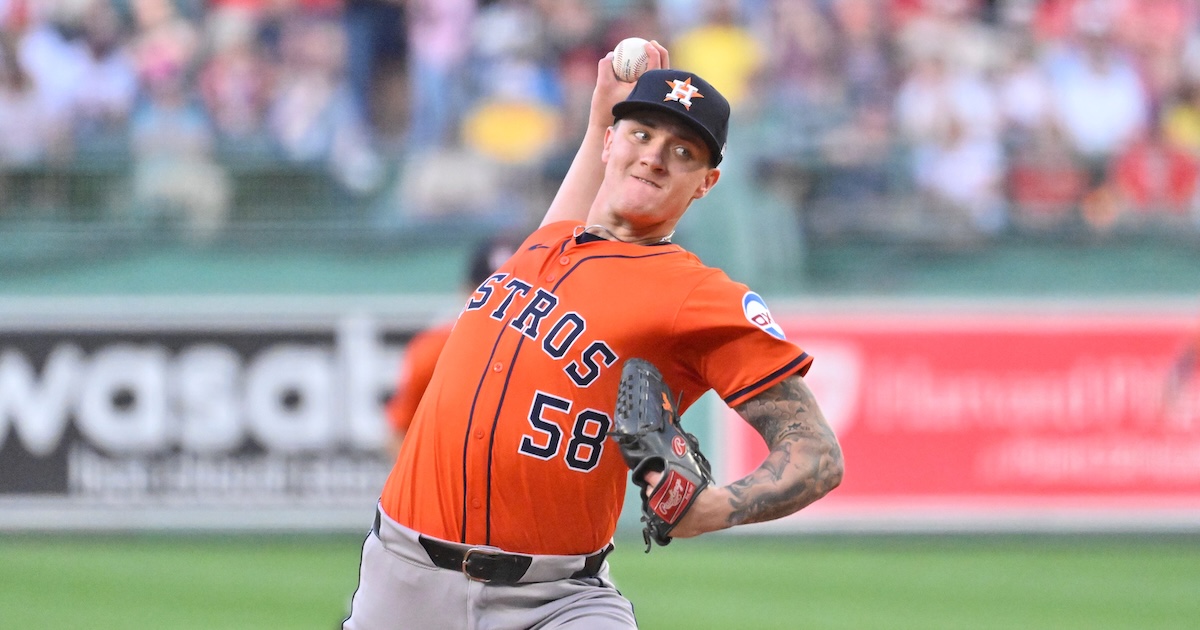
When Hunter Brown takes the mound tonight, he’ll do so with some of the best numbers in the junior circuit. Among qualified pitchers, the Houston Astros right-hander ranks third behind Tarik Skubal and Garrett Crochet in WAR, ERA, FIP, and strikeout rate. An All-Star for the first time this season, the 26-year-old Wayne State University product has established himself as a top-shelf starter.
When he was first featured here at FanGraphs in April 2021, Brown was still a prospect; our initial conversation centered around his background and repertoire. When I next caught up with him in August 2023 (Brown had made his major league debut in September 2022), we covered a recent change to his delivery.
What did we discuss when I sat down with Brown in Fenway Park’s visiting dugout during the Astros’ trip to Boston earlier this month? The answer lies below.
———
David Laurila: We last talked two summers ago. What has changed since then?
Hunter Brown: “Two years ago would have been before I started throwing a two-seam sinker and before I started throwing both cutters and sliders. That’s probably the biggest change.” Read the rest of this entry »
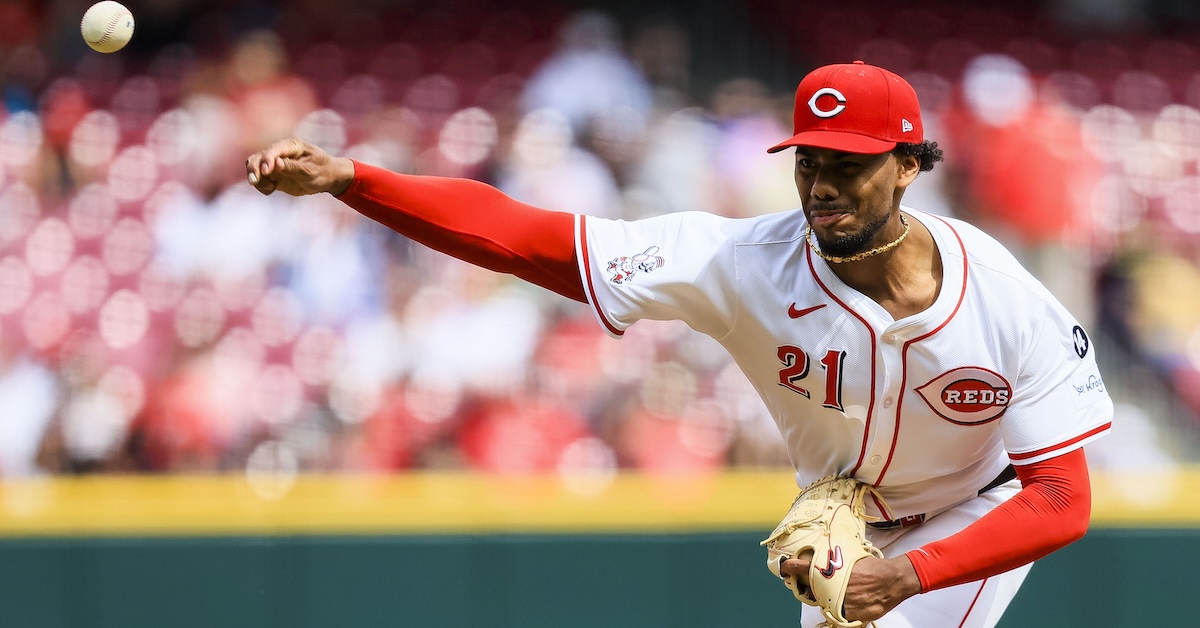
For most of the first two months of the 2025 season, Cincinnati Reds right-hander Hunter Greene looked liked one of the NL Cy Young favorites. Alas, similar to the fate of protagonists in funny YouTube videos, groin injuries came to pass, and after first missing two starts in May before returning for three, Greene has been on the shelf since the start of June. In yet another example of correlation not meaning causation, the Reds played their best ball of the year without their ace, going 33-26 since Greene’s last start. While they wouldn’t make the playoffs if the season ended today, the New York Mets, one of the teams Cincinnati is looking up at, have been reeling since the trade deadline and proceeded to lose seven games in a row. The Reds are just two games behind the Mets in the standings, so now is as good a time as any to get Greene back in the rotation. And would you look at that? He is scheduled to start on Wednesday against the Phillies.
Now in his fourth season, Greene has developed from a gifted, but relatively raw prospect into a bonafide ace. His repertoire is generally unchanged, and he remains a mostly fastball-slider pitcher; the biggest difference is he’s phased out his changeup in favor of a nasty splitter, though he uses that pitch rather sparingly. How terrific is his stuff? Well, if you’re not convinced by watching him for yourself, his three pitches rank so highly in Stuff+ that you might think he were secretly sending Eno Sarris truckloads of exotic beers to try to tip the scales in his favor. Of the 138 pitchers with 150 innings since the start of 2024, Greene’s slider ranks fourth in Stuff+, his splitter ninth, and his fastball 11th. His arsenal has an overall Stuff+ rating of 116 — the highest in the majors. Pitchingbot is not quite that complimentary of Greene, but it also holds him in high regard; his botStf of 57 ranks 21st during that same span (min. 150 innings).
The slider is not only a particularly nasty pitch, but he uses it a bit differently than most starters. Despite having a viable splitter, Greene aggressively uses his slider against lefties. With its velocity and bite, he almost uses it like a cutter that threatens to take out the batter’s lead kneecap. There have been 106 starting pitchers since the start of 2024 who have thrown at least 100 sliders, and none of them has had a more whiffable one in cross-platoon situations than Greene.
This slider is what has enabled Greene to survive as a very heavy fastball-slider pitcher, something you see far more often with relievers. In this way, he is comparable to Kevin Gausman — though swapping splitter and slider — who also relies heavily on two pitches, happily using his splitter against righties, locating it in the same way another pitcher would use a slider. But Greene appears to have mastered this even more quickly than Gausman did.
Of course, Greene has done more than just survive. He has knocked another walk per nine off his numbers this year, something consistent with his elite 74.3% first-strike percentage. His FIPs over the last two seasons (3.47 in 2024, 3.42 this year) back up his development into a frontline starter, and the Reds would surely be happy enough if that’s where his actual outcomes ended up, too. However, you’ll notice that his ERAs (2.75 last year, 2.72 in 2025) are even better than that. Some of that, of course, has been fueled by low BABIP numbers, but in his case, we shouldn’t be all that skeptical of the legitimacy of his performance. The Reds have ranked 25th in FRV since the start of 2024, so he’s running those low BABIPs despite having a shoddy defense behind him.
Immediately after the trade deadline, the ZiPS projection system saw the Reds as having a 12.5% chance of making the postseason. The division appeared out of reach — and it definitely is now with the Brewers surging — and ZiPS saw Cincinnati’s competition for the three Wild Card spots, the Padres, Mets, and Cubs, as clearly stronger clubs overall. Despite the Mets’ struggles, ZiPS has only pumped the Reds’ playoff probability up to 14.2%. The thing is, even though these projections reflect Greene’s pending return, there is still room for their odds to rise if he comes back smoothly; the full ZiPS model is particularly skeptical of the workloads that pitchers will carry coming off an injury, so this projection assumes Greene will throw only 31 innings over the rest of the season. However, if we also include the 11 additional innings that our Depth Charts projects for Greene, and use his ZiPS projected performance as of May 1, just before he first hurt his groin, Cincinnati’s playoff probability jumps to 21.3%. That may seem relatively modest in absolute terms, but that difference is a larger playoff boost than any team got for any trade deadline acquisition this year. The Reds are right at the cusp of the playoff picture, where additional wins are most important, and his return could be the most impactful in the league.
Having Greene at full strength would be similarly crucial for the Reds in the postseason if they get there. ZiPS sees Cincinnati as a below-average playoff team regardless of whether Greene is healthy and performing well, but at his best, he boosts the club’s projected postseason winning percentage by seven points. Elly De La Cruz is the only Reds player who makes a greater effect with his presence alone.
The return of Greene also provides the Reds a little more insurance in the event that Nick Lodolo, who landed on the 15-day IL with a blister on his index finger last week, takes a bit longer than expected to recover, as blisters can sometimes be difficult to shake in the short term. Also, ZiPS remains down on the Cincinnati offense. It expects the lineup to be below average (95 wRC+) the rest of the way. In all likelihood, the Reds will go only as far as their pitching can take them.
The Mets probably won’t go winless the rest of the year — I say “probably” because of how often their seasons end similarly to a German fairy tale — so the Reds have an uphill battle to play some bonus baseball this fall. If that’s going to happen, they’ll need Greene to return at the top of his game.
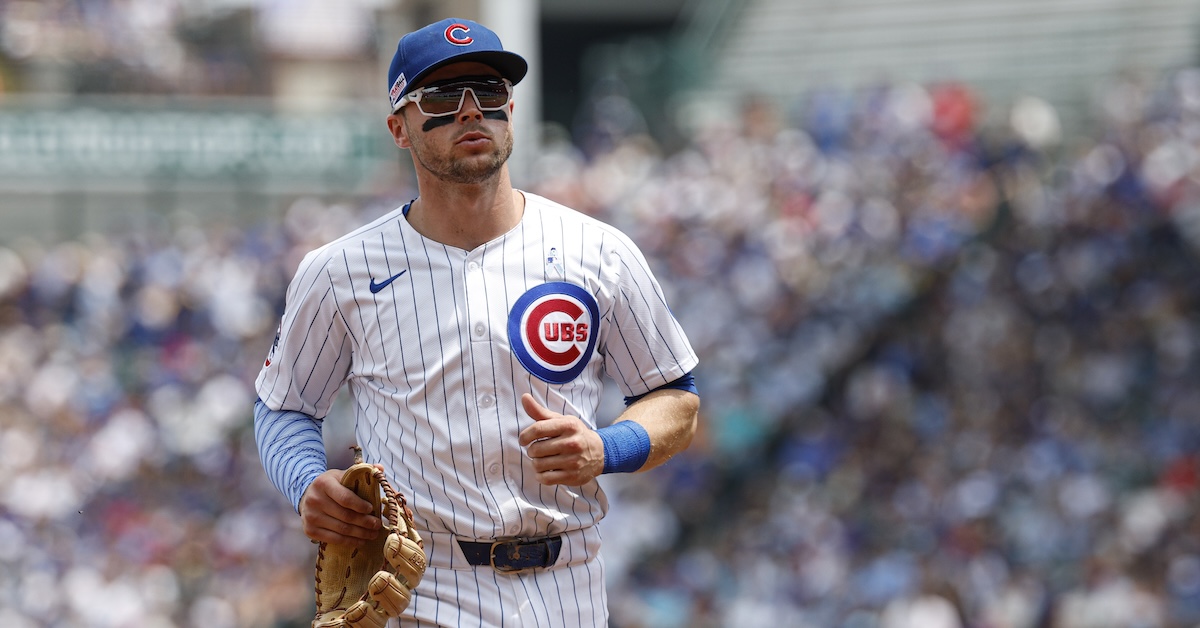
Before they fell into the turbulent wake of the white-hot Brewers, the Cubs were flirting with the best record in baseball for much of the season. You know the highlights: Pete Crow-Armstrong flies through the air and smacks homers. Kyle Tucker is a superstar making a name for himself before hitting free agency. Michael Busch is having a mini-breakout of his own. Seiya Suzuki is a consistent power threat. Dansby Swanson is a metronome in the form of a glove-first shortstop.
You can keep naming names for quite a while, in fact, before you get to the Cubs’ two longest-tenured hitters. Ian Happ debuted way back in 2017. He’s transitioned from a superutility role to the corner outfield while featuring in the middle of the lineup for nearly a decade, a first-division regular though rarely an All-Star. He’s not the focus of today’s article, though. That would be the other longest-tenured Cub, Nico Hoerner.
Hoerner got a cup of coffee at the end of the 2019 season, played a bench role in 2020, and got injured repeatedly just as he seemed to be settling in as a starter in 2021. He’s been a locked-in everyday guy ever since, at shortstop for a year and then at second after Swanson signed with the team in free agency. And between a succession of newer and more exciting Cubs debuting and the jack-of-all-trades nature of his game, Hoerner’s stardom is often overlooked. But overlooked or not, Hoerner is a star, and so I thought I’d examine his consistent excellence as he churns through yet another quietly outstanding season. Read the rest of this entry »
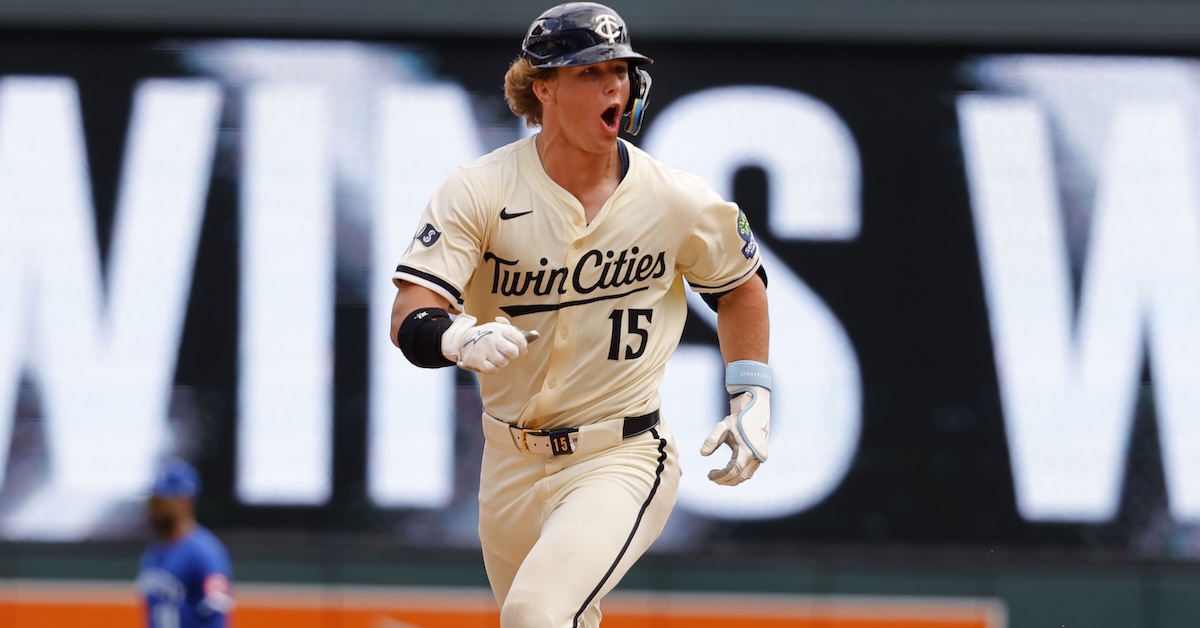
I owe Luke Keaschall an apology. Last night, the 22-year-old second baseman put up the first oh-fer of his brief and brilliant major league career, the predictable result of my decision to write about him today. In the series opener in the Bronx, the Yankees beat the Twins, 6-2, and Keaschall watched from the on-deck circle with an 11-game hitting streak on the line as Ryan Jeffers struck out to end the game. This is my fault. I knew that by pitching an article about Keaschall, I was condemning him to this fate. I really do feel bad about jinxing him, but it was time to highlight just how impressive his start has been. Keaschall will turn 23 on Friday, which makes him exactly three years older than FanGraphs.
Permit me to exclude Monday’s stats momentarily for the sake of painting a picture. Through the first 12 games of his career, Keaschall ran a 234 wRC+, slashing .415/.500/.707, homering twice, and stealing five bases. He’s one of just 10 players in the last 30 years – a list that also includes his manager, Rocco Baldelli – to start his career with an 11-game hitting streak. Keaschall also started his career with a 12-game on-base streak. Yes, that is possible; I’ll explain in a moment. With a nice round 1.0 WAR (which dropped to 0.9 on Monday; again, I’m so sorry, Luke), he ranks eighth among Minnesota’s position players. He has five multi-hit games. He was just named AL Player of the Week in his second week as a big leaguer. On Sunday, he achieved his first three-hit game with a walk-off homer against the Royals in the 11th inning. Read the rest of this entry »
The Mets had the day off on Monday, and thank God. In any other line of work, they’d have called in sick with one of those mysterious 24-hour stomach bugs after the week they had. Close the blinds, get some sleep, hope everyone at the office has forgotten you existed by the time you clock in on Tuesday.
See, the Mets have spent the past two months in a real doozy of a race for the NL East title. On June 16, the Phillies beat the Marlins 5-2 while the Mets were idle, cutting New York’s lead in the division to two games. From that day until Tuesday, August 5, the division lead swung back and forth, but neither team could forge an advantage of more that two games. Read the rest of this entry »
Pitching analyst Lance Brozdowski has been on Brandon Woodruff since the Brewers right-hander returned from a 2023 shoulder surgery on July 6. Brozdowski has written about Woodruff twice, first breaking down the ways that he looks like a different pitcher this season. His second piece was titled “How Is Brandon Woodruff Doing This?” I’d like to really dig in and answer that question, both because when Brozdowski asks a question it’s usually a good one and because Woodruff’s numbers really are confusing. As Michael Baumann noted a few weeks ago, Woodruff’s return coincided almost exactly with Milwaukee’s recent unbeatable stretch. “If Woodruff is well and truly back,” Baumann wrote, “for my money he’s a bigger add than any starter who’s likely to get moved at the deadline.” Woodruff has gone 4-0 with a 2.29 ERA, a 3.73 FIP, and a 34.9% strikeout rate over his six starts, and he’ll likely be a huge part of the team’s playoff rotation, but whether he’s back is still very much an open question.
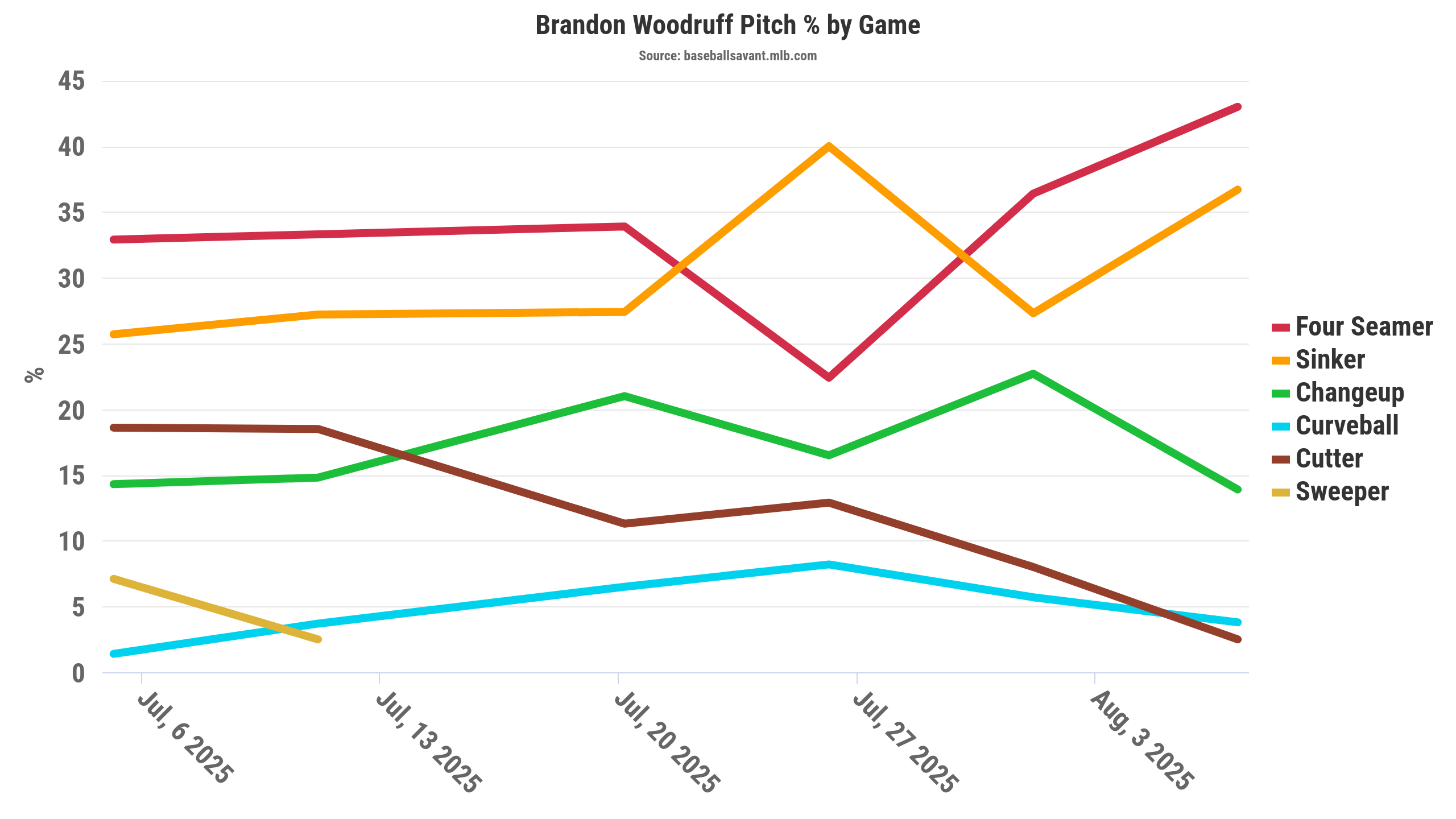
Before we get into everything, we should talk about Woodruff’s arsenal, which at least for a little while looked pretty different this season. A month ago at Brewer Fanatic, Matthew Trueblood analyzed Woodruff’s repertoire during his minor league rehab assignment, and wrote that in order to be successful, “Woodruff will need to reinvent himself.” The pitcher seemed to agree, at least at first. This season in the majors, he has thrown a four-seamer, sinker, changeup, cutter, curve, and sweeper. The cutter is new, with the sweeper replacing his traditional slider. However, he hasn’t thrown the sweeper since his second start (likely because it was the second game in a row the other team homered on the pitch), and he’s also drastically reduced his cutter usage over his last two starts. He’s also nearly evened out his fastball usage. In recent years, Woodruff led with his four-seamer, but now he’s throwing it 34% of the time and his sinker 31%, leading with the sinker against righties and the four-seamer against lefties. His curveball is down to 5% and his changeup has held steady at 17%. In other words, Woodruff is throwing a fastball 65% of the time, and that number jumps to 77% of the time if you count the cutter:
Let’s start with the reasons for suspicion, and please note that this section makes up five full paragraphs. Luck is a big component here. Woodruff is currently running a .143 BABIP and a 100% strand rate. Eight of the nine earned runs he’s allowed have come on home runs. Those are massively unsustainable numbers. The league averages a .289 BABIP and 72.5% strand rate. Even though he’s spent his entire career pitching in front of an excellent Milwaukee defense, Woodruff has never run a BABIP below .269 or a strand rate above 82% (except in 2023, when he only made 11 starts). No matter what else happens, we should expect his BABIP to add at least 100 points and his strand rate to drop by at least 20% going forward. Read the rest of this entry »
There’s no such thing as a perfect pitcher. There are guys with an incredible ability to spin the ball, but nothing to throw for whiffs at the top of the zone. (Mitch Keller and Matt Brash come to mind.) Some pitchers pump backspin four-seamers, but never settle on a reliable secondary. (Ryne Nelson, I’m looking at you.) Excelling at one thing often means being deficient at another.
Still, even if there are no perfect pitchers, there are some who come closer than others. Prime Gerrit Cole featured a carry heater and a firm slider with meaningful horizontal break. Jacob deGrom? Same deal. Some guys break our general understanding of the tradeoffs between certain pitch types. Most of those guys are aces. One of them is Ryan Bergert — at least potentially.
If that name rings a bell, it’s likely because Bergert featured in a deadline deal that brought him to Kansas City (along with Stephen Kolek, a rock-solid fifth starter type) in exchange for backup catcher Freddy Fermin. In these early days following the trade, Fermin is acquitting himself well, lining a bunch of base hits and striking out just once so far.
Fermin is valuable — especially to the catcher-deprived Padres — though not particularly exciting. He’s under team control for the rest of the decade, but he’s firmly locked into the “light-hitting backstop with excellent defensive skills” archetype. Bergert, on the other hand, strikes me as a guy with serious upside. Read the rest of this entry »
Jack Dreyer has been one of the top performers on a Los Angeles Dodgers pitching staff that includes no shortage of better-known hurlers. Amid relative obscurity, the 26-year-old rookie left-hander has logged a a 2.98 ERA and a 2.95 FIP over 46 appearances comprising 57-and-a-third innings. Moreover, only Yoshinobu Yamamoto has been worth more WAR (3.5) than has the 2021 non-drafted free agent out of the University of Iowa (1.3).
Our lead prospect analyst was early to the bandwagon. When our 2025 Dodgers Top Prospects list was published in late April, Eric Longenhagen described Dreyer as “incredibly deceptive,” adding that his whippy arm action delivers a fastball that has “20 inches of due north vertical break as it explodes toward the plate.”
The southpaw’s signature pitch wasn’t seen as plus during his injury-marred Iowa Hawkeyes days.
“In college, I was always told that I have average spin rate, so I can’t really throw my fastball at the top of the zone,” recalled Dreyer, who missed much of the 2019 season with a shoulder injury, then all of 2021 after undergoing Tommy John surgery. “I was told that I had a very average fastball. I kind of believed that, but then I got to the Dodgers and they were like, ‘No, actually, your stuff is really, really good. You can live at the top of the zone because of how your pitch moves.’ So, that’s kind of how I’ve adapted my pitching, using heaters at the top, which opens up my other pitches.”
Dreyer’s secondaries comprise a curveball that he’s thrown at a 10.8% clip this season, and a “bad slider” that he’s thrown far more frequently at 45.2%. More on the latter in a moment. Read the rest of this entry »
Welcome to another edition of Five Things I Liked (Or Didn’t Like) This Week. Between a vacation, the All-Star break, the Trade Value Series, and the trade deadline, Five Things has been on a bit of a summer hiatus. Baseball itself doesn’t stop, of course; weird and delightful things happen whether I’m documenting them or not. But I still couldn’t shake the feeling that this week had an extra helping of whimsy. Balls took funny hops. Good pitchers got shelled in unexpected ways. Balks took center stage. Leads changed hands late, defenders kicked things into high gear – there was so much delightful baseball this week that I struggled to narrow it down to five things. Seven things just doesn’t have the same ring to it, though, so let’s quickly nod to Zach Lowe of The Ringer for the column inspiration and get going.
1. The True King of Contact
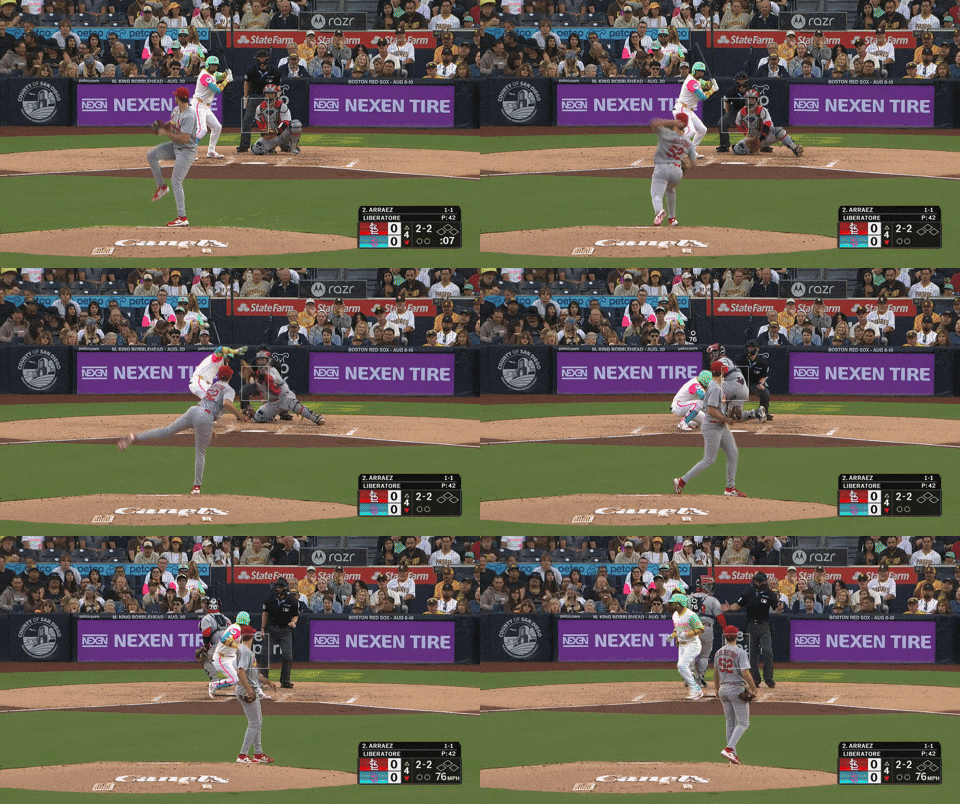
Writing about Luis Arraez can be a bummer sometimes. Not because he’s bad – he’s emphatically not – but because merely mentioning his name reinvigorates the age-old argument between those who say there are too many strikeouts and those who insist that slug is in the air. Should everyone be doing what Arraez is doing? Is he an anachronism? Is he underrated? Overrated? He’s so good at what he does – and what he does is so different from what most good baseball players do – that these questions are frustratingly omnipresent in any discussion about Arraez.
That said, I think I found an Arraez play that won’t divide the audience. The key is for it not to involve a ball in play, a walk, or a strikeout. Take a look at this beauty:
Since July 1, three major league offenses have been head and shoulders above the rest of the field. First, the Toronto Blue Jays, who have benefited not only from a white-hotBo Bichette, but from having the opportunity to slather a hapless Rockies pitching staff in runs this week. Third in wRC+ but second on this list for editorial purposes: The Athletics, whose offensive run is mostly Nick Kurtz. That’s an exaggeration, but not by much; Kurtz alone is responsible for 2.6 of the vagabonds’ 6.7 position player WAR since July 1, and 39 of their 165 weighted runs created.
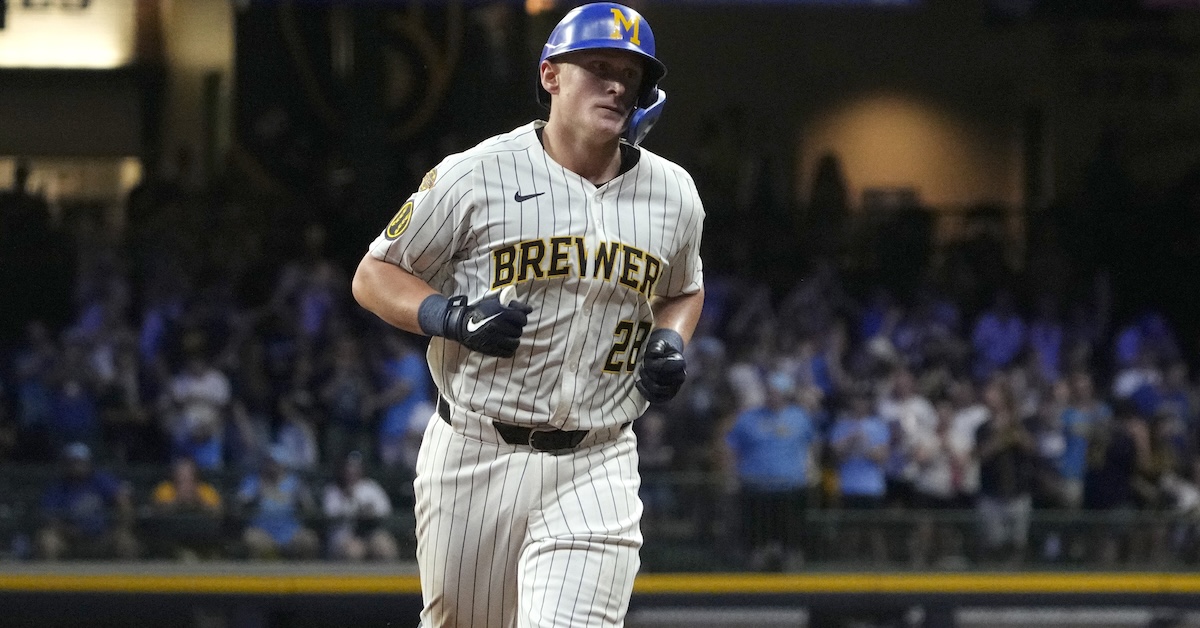
Here’s one of those other things propping up Milwaukee’s offense: Andrew Vaughn, one of the greatest college hitters of the 2010s and a former top-three pick, but also a legendary draft bust as of eight weeks ago. Read the rest of this entry »