Archive for Pirates

Who Framed Victor Caratini?

It’s still April, so it may be premature to talk about the year’s most extreme events. If a home run was hit on a high pitch, there will likely be a higher pitch that gets hit for a home run later on. Think an umpire called a perfect pitch a ball? We’ve got plenty more time for an even better pitch to be missed. However, I think we may have already seen the best pitch frame of the year.

I don’t mean the pitch furthest outside the strike zone that gets called a strike — there’s still plenty of time for that to change. I’m talking about full dedication to the craft of pitch framing. Francisco Cervelli sold a pitch against the Cubs not just with his glove and his positioning, but with his whole being. You’ll probably see worse pitches sold for strikes this year. Heck, you might see Cervelli get more egregious calls than this. You won’t see better framing, though — I can pretty much guarantee it. Read the rest of this entry »


Daily Prospect Notes: 4/22/19

These are notes on prospects from lead prospect analyst Eric Longenhagen. Read previous installments here.

Yordan Alvarez, 1B, Houston Astros
Level: Triple-A   Age: 21   Org Rank: 7   FV: 50
Line: 2-for-4, HR, 2B

Notes
It’s important that we look at Triple-A statistical performances (especially in the PCL) in a different light given what is transpiring with the baseball itself, but we can still appreciate Alvarez’s blistering start with that in mind. After a little over two weeks, he’s slugging .870; nine of his 17 hits have been home runs, and he has one more walk than strikeout thus far. He’s played eight games in left field, five at DH, two at first base, and one in right field. Most all of Houston’s big league hitters are mashing right now (Tyler White is hitting lefties, at least), so there’s not an obvious short-term path to big league playing time here. If anyone goes down though, perhaps Alvarez will get the call instead of a struggling Kyle Tucker. Read the rest of this entry »


Sunday Notes: Tucker Barnhart is Embracing Data, Because Now He Can

The Cincinnati Reds were behind the curve in terms of analytics. And while the club’s primary catcher wasn’t fully aware of that — he did have an inkling — he’s certainly aware now. A lot changed when David Bell was hired as manager, and Derek Johnson, Lee Tunnell, and Caleb Cotham came on board to lead the pithing staff.

These aren’t your father’s Reds, and quite frankly they aren’t your older brother’s [or older sister’s] either. That became clear when I asked Tucker Barnhart how his conversations with coaches compare to previous seasons’.

“I would say they’re more numbers-driven now,” the backstop told me. “They’re more percentage-driven, and more based on exit velocities and probable outcomes. Things like that. I still trust my eyes, but in the back of my mind there are always the percentages of what’s supposed to work. You’d be naive not to fall back on that, especially if you’re stuck calling a pitch.”

With the caveat that we’re dealing with a small sample size, and cause and effect can be difficult to determine, the results have been positive. Last year’s 4.65 team ERA ranked seventh from the bottom in MLB. So far this season, it ranks third from the top, at 3.16. And while Sonny Gray and Tanner Roark are new additions, it’s not as though we’re talking about Jose Rijo and Mario Soto. Read the rest of this entry »


Chris Archer, Kyle Crick, and Jameson Taillon Ruminate on Their Sliders

Pitchers learn and develop different pitches, and they do so at varying stages of their lives. It might be a curveball in high school, a cutter in college, or a changeup in A-ball. Sometimes the addition or refinement is a natural progression — graduating from Pitching 101 to advanced course work — and often it’s a matter of necessity. In order to get hitters out as the quality of competition improves, a pitcher needs to optimize his repertoire.

In this installment of the series, we’ll hear from three pitchers — Chris Archer, Kyle Crick, and Jameson Taillon — on how they learned and developed their sliders.

———

Chris Archer, Pittsburgh Pirates

“In [high school], I was dating this girl whose brother played in the minor leagues with the Red Sox. His name is David Penny. He had some shoulder issues and didn’t make it beyond Low-A, but he was a prominent figure, baseball-wise, in my hometown [Clayton, North Carolina]. He thought that I had the right arm slot for a slider — at the time I was only throwing a curveball — and taught it to me.

“When I got drafted, the Indians scrapped it. I didn’t throw one slider in 2006, ’07, or ’08. What happened was … it was interesting. First day, I was with the rookie-ball pitching coach, and he saw all four of my pitches. He was like, ‘OK, we need to develop your fastball command and your changeup.’ He said the only way to do that would be by eliminating one of my pitches, which would force me to throw the other ones. That particular bullpen, my curveball appeared to be better than my slider, so he said, ‘Curveball, fastball, changeup — that’s it.’ So for those three seasons, I was curveball-fastball-changeup. Read the rest of this entry »


Daily Prospect Notes: 4/11/19

These are notes on prospects from lead prospect analyst Eric Longenhagen. Read previous installments here.

Cole Tucker, SS, Pittsburgh Pirates
Level: Triple-A   Age: 22   Org Rank: 5   FV: 50
Line: 3-for-5, HR, 2 SB

Notes
Readers are often looking for a prospect outside the top 50 who might break out and move near the top of our overall list. My answer to that question is typically some big, projectable teenager who I expect to experience sizable physical growth. Tucker is rare in that he’s also a viable answer to this question even though he turns 23 this summer. Having answered once-relevant, shoulder-related questions about his arm strength, Tucker is now seen as a plus-gloved shortstop who has good feel for contact. But because he still has this big, seemingly unfinished frame on him, we think it’s possible that he comes into power a little late, and he might take a sizable leap. A source indicated to me that Tucker looks noticeably bigger and stronger this year. He hit for power during the first week of the season, and his batted ball data should be monitored for a possible indicator that he’s made a mechanical adjustment, too.

Tarik Skubal, LHP, Detroit Tigers
Level: Hi-A   Age: 22   Org Rank: HM   FV: 35
Line: 6 IP, 2 H, 1 BB, 1 R, 6 K

Notes
Kiley saw Skubal last night and had him up to 97, with an average breaking ball. A possible second or third rounder as a college underclassman, Skubal’s amateur career was derailed by an elbow injury that required Tommy John. He missed his junior year, instead throwing side sessions in front of scouts close to the draft. Nobody was confident enough to pull the trigger on drafting him, and he went back to school and couldn’t throw strikes. The Tigers signed him after his redshirt junior year for $350k and he threw almost all fastballs during his first pro summer. Things seemed to have clicked a bit.

Michael Baumann, RHP, Baltimore Orioles
Level: Hi-A   Age: 23   Org Rank: 28   FV: 35+
Line: 5 IP, 1 H, 0 BB, 0 R, 10 K

Notes
Orioles pitching prospects should be considered potential movers this year as the new front office applies the player dev philosophy that seems to be working in Houston. Baumann already has some components Houston might have otherwise tried to install; he has a vertical release point that looks like it creates backspin, he throws hard, and he works up in the zone. Maybe that just means he has less to fix and is likely to improve more quickly than others in the system. He was up to 96 last night.

Brendan McKay, LHP, Tampa Bay Rays
Level: Double-A   Age: 23   Org Rank: 2   FV: 60
Line: 4.2 IP, 2 H, 1 BB, 3 R, 11 K

Notes
McKay’s stuff is not especially nasty — he was 91-95 last night — but his fastball plays up because of good extension. All of his pitches look the same coming out of his hand, and he has shockingly good feel for pitching even though his attention has been split between the mound and the plate for much of his career. If he keeps dominating Double-A hitters like this, it’s fair to start considering him as a potential big league option sometime this year.

Shed Long, 2B/3B/LF, Seattle Mariners
Level: Triple-A   Age: 23   Org Rank: 6   FV: 50
Line: 4-for-5, BB, walk-off HR

Notes
Shed’s defensive assignments mimic what we saw during spring training. He remains a 40 glove at second base who survives through a combination of athleticism and will, but he’s going to mash enough that you want him in your lineup every day. I tend to think of multi-positional players as individuals who excel defensively at various spots, but maybe it’s time to consider if players who can really hit can be barely playable at several positions and just spend each game at a different spot in the field, wherever they’re the least likely to touch the ball that day. Willians Astudillo would seem to be another candidate for a role like this, and perhaps it could be taken to a batter-by-batter extreme. Hiding your worst defensive player is old hat in other sports; maybe there’s a better way to do it in ours.

A Quick Rehabber Update
I saw Angels lefty Jose Suarez rehab in Tempe yesterday. He looked good, sitting 91-93, with command and an above-average curveball (it’s slow but has good bite, and he commands it), and some plus changeups. He didn’t break camp due to a sore shoulder, which is kind of scary, but the stuff looks fine. The Angels rotation has struggled with injuries, so Suarez might see the big leagues this year. He’s in our top 100.

On Pedro Avila
Padres righty Pedro Avila makes his big league debut tonight against Arizona. Expect him to sit 90-94 and touch 96, have scattered fastball command, and try to work heavily off secondary stuff — a change and curveball — that is consistently plus. His long term role may ultimately be in the bullpen, especially since three-pitch relievers may become more necessary due to forthcoming rule changes.


Trevor Williams is Executing Plan-A With Aplomb

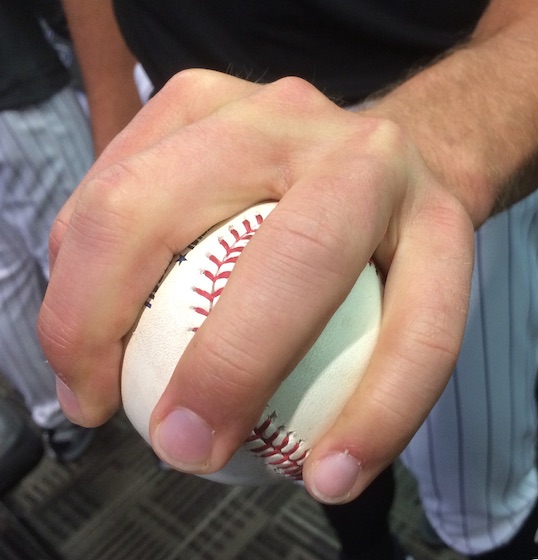
This past Sunday’s notes column included Trevor Williams on the subject of pitcher won-lost records. As was pointed out in the piece, the Pittsburgh Pirates righty probably deserved better than last season’s 14-10 mark. On eight occasions he got either a loss or a no-decision despite allowing three-or-fewer earned runs.

His wins weren’t gift-wrapped. Not by a long shot. Ten times he went at least six innings without allowing a run — that was the most in the majors — and he was nearly as stingy in the others. Only five of the enemy combatants who crossed the plate in Williams’ 14 W’s went onto his ledger. At season’s end, his 3.11 ERA stood seventh-best in the senior circuit (min. 170 innings).

Not bad for an 26-year-old hurler who, for all intents and purposes, was acquired in exchange for a pitching instructor.

As Pirates fans are well aware, his ascent began in July. Williams went into last season with a 4.36 ERA in 163 big-league innings, and through 19 starts he was holding that form to a T. His ERA was exactly what it was on Opening Day. Then he morphed into Greg Maddux. Over his final baker’s-dozen outings, Williams allowed just 11 runs — four of them in his lone clunker — in 71.1 frames. Read the rest of this entry »


Tyler Anderson, Steven Brault, and Mike Leake on Learning Their Changeups

Pitchers learn and develop different pitches, and they do so at varying stages of their lives. It might be a curveball in high school, a cutter in college, or a changeup in A-ball. Sometimes the addition or refinement is a natural progression — graduating from Pitching 101 to advanced course work — and often it’s a matter of necessity. In order to get hitters out as the quality of competition improves, a pitcher needs to optimize his repertoire.

In this installment of the series, we’ll hear from three pitchers — Tyler Anderson, Steven Brault, and Mike Leake — on how they learned and developed their change-of-pace pitches.

———

Tyler Anderson, Colorado Rockies

“In high school, I tried to learn how to pitch by watching other people. And I was doing all kinds of stuff. I was dropping down, throwing from all arm angles, throwing sliders. Then I got to college. At the University of Oregon, they preached fastball-changeup. Not only that, in the fall you weren’t allowed to throw breaking pitches; you had to go fastball-changeup only. Then, just before the season started, you could start mixing in curveballs and sliders.

Tyler’s Anderson’s changeup grip.

“Before that, I’d thrown a palm ball. Honestly. I would hold it in my palm and throw a palm ball. It was slower. My dad knew about it from back in the day — it’s an old-school pitch — and mine was actually pretty good. It didn’t have a lot of spin, and as you know, limited spin creates drop. Mine would drop a lot, but it was too hard to control. Read the rest of this entry »


Sunday Notes: Griffin Canning Has an Artistic Thumb Print

Griffin Canning on is on the fast track after a delayed start. Drafted 47th-overall by the Angels in 2017, the righty didn’t made his professional debut until last April. By June he was taking the mound for the Triple-A Salt Lake Bees. That’s where the 22-year-old UCLA product is to begin the current campaign, one rung below the majors, with a chance to reach Anaheim in the not-too-distant future.

When the call-up comes, Halos fans can expect to see a pitcher who combines power and pitchability. His approach to his craft is a mixture of art and science.

“I think you can find a middle ground on the two,” said Canning, who ranks fourth on our Angels Top Prospects list. “For me it’s moe of an art — I’ve kind of always thought you can be born with it — but at the same time, you can use those science tools to help you get better.”

When I talked to him during spring training, I asked the youngster what type of artist he envisions himself as. I wasn’t looking for a Monet or van Gogh comp, but I was wondering about his thumb print on the mound. Read the rest of this entry »


Picks to Click: Who We Expect to Make the 2020 Top 100

When publishing our lists — in particular, the top 100 — we’re frequently asked who, among the players excluded from this year’s version, might have the best chance of appearing on next year’s version. Whose stock are we buying? This post represents our best attempt to answer all of those questions at once.

This is the second year that we’re doing this, and we have some new rules. First, none of the players you see below will have ever been a 50 FV or better in any of our write-ups or rankings. So while we think Austin Hays might have a bounce back year and be a 50 FV again, we’re not allowed to include him here; you already know about him. We also forbid ourselves from using players who were on last year’s inaugural list. (We were right about 18 of the 63 players last year, a 29% hit rate, though we have no idea if that’s good or not, as it was our first time engaging in the exercise.) At the end of the piece, we have a list of potential high-leverage relievers who might debut this year. They’re unlikely to ever be a 50 FV or better because of their role, but they often have a sizable impact on competitive clubs, and readers seemed to like that we had that category last year.

We’ve separated this year’s players into groups or “types” to make it a little more digestible, and to give you some idea of the demographics we think pop-up guys come from, which could help you identify some of your own with THE BOARD. For players who we’ve already covered this offseason, we included a link to the team lists, where you can find a full scouting report. We touch briefly on the rest of the names in this post. Here are our picks to click:

Teenage Pitchers
Torres was young for his draft class, is a plus athlete, throws really hard, and had surprisingly sharp slider command all last summer. White looked excellent in the fall when the Rangers finally allowed their high school draftees to throw. He sat 92-94, and his changeup and breaking ball were both above-average. Pardinho and Woods Richardson are the two advanced guys in this group. Thomas is the most raw but, for a someone who hasn’t been pitching for very long, he’s already come a long way very quickly.

Eric Pardinho, RHP, Toronto Blue Jays (full report)
Lenny Torres, Jr., RHP, Cleveland Indians
Simeon Woods Richardson, RHP, New York Mets (full report)
Adam Kloffenstein, RHP, Toronto Blue Jays (full report)
Grayson Rodriguez, RHP, Baltimore Orioles (full report)
Owen White, RHP, Texas Rangers
Mason Denaburg, RHP, Washington Nationals (full report)
Tahnaj Thomas, RHP, Pittsburgh Pirates (full report)

The “This is What They Look Like” Group
If you like big, well-made athletes, this list is for you. Rodriguez was physically mature compared to his DSL peers and also seems like a mature person. The Mariners have indicated they’re going to send him right to Low-A this year. He could be a middle-of-the-order, corner outfield power bat. Luciano was the Giants’ big 2018 July 2 signee. He already has huge raw power and looks better at short than he did as an amateur. Canario has elite bat speed. Adams was signed away from college football but is more instinctive than most two-sport athletes. Most of the stuff he needs to work on is related to getting to his power.

Julio Rodriguez, RF, Seattle Mariners
Marco Luciano, SS, San Francisco Giants
Alexander Canario, RF, San Francisco Giants
Jordyn Adams, CF, Los Angeles Angels
Jordan Groshans, 3B, Toronto Blue Jays (full report)
Jhon Torres, OF, St. Louis Cardinals (full report)
Shervyen Newton, SS, New York Mets (full report)
Kevin Alcantara, CF, New York Yankees (full report)
Freudis Nova, SS, Houston Astros
Brice Turang, SS, Milwaukee Brewers (full report)
Connor Scott, CF, Miami Marlins (full report)

Advanced Young Bats with Defensive Value
This is the group that produces the likes of Vidal Brujan and Luis Urias. Edwards is a high-effort gamer with 70 speed and feel for line drive contact. Marcano isn’t as stocky and strong as X, but he too has innate feel for contact, and could be a plus middle infield defender. Perez has great all-fields contact ability and might be on an Andres Gimenez-style fast track, where he reaches Double-A at age 19 or 20. Ruiz is the worst defender on this list, but he has all-fields raw power and feel for contact. He draws Alfonso Soriano comps. Palacios is the only college prospect listed here. He had three times as many walks as strikeouts at Towson last year. Rosario controls the zone well, is fast, and is a plus defender in center field.

Xavier Edwards, SS, San Diego Padres
Antoni Flores, SS, Boston Red Sox (full report)
Jose Devers, SS, Miami Marlins (full report)
Tucupita Marcano, SS, San Diego Padres
Wenceel Perez, SS, Detroit Tigers
Esteury Ruiz, 2B, San Diego Padres
Richard Palacios, SS, Cleveland Indians
Antonio Cabello, CF, New York Yankees (full report)
Cole Roederer, LF, Chicago Cubs (full report)
Jeisson Rosario, CF, San Diego Padres
Luis Garcia, SS, Philadelphia Phillies (full report)
Simon Muzziotti, CF, Philadelphia Phillies (full report)

Corner Power Bats
Nevin will probably end up as a contact-over-power first baseman, but he might also end up with a 70 bat. He looked great against Fall League pitching despite having played very little as a pro due to injury. Lavigne had a lot of pre-draft helium and kept hitting after he signed. He has all-fields power. Apostel saw reps at first during instructs but has a good shot to stay at third. He has excellent timing and explosive hands.

Grant Lavigne, 1B, Colorado Rockies
Sherten Apostel, 3B, Texas Rangers
Triston Casas, 1B, Boston Red Sox (full report)
Dylan Carlson, RF, St. Louis Cardinals (full report)
Moises Gomez, RF, Tampa Bay Rays (full report)
Elehuris Montero, 3B, St. Louis Cardinals (full report)
Nathaniel Lowe, 1B, Tampa Bay Rays (full report)
Tyler Nevin, 1B, Colorado Rockies

College-aged Pitchers
It’s hard to imagine any of these guys rocketing into the top 50 overall. Rather, we would anticipate that they end up in the 60-100 range on next year’s list. Gilbert was a workhorse at Stetson and his velo may spike with reshaped usage. Singer should move quickly because of how advanced his command is. Lynch’s pre-draft velocity bump held throughout the summer, and he has command of several solid secondaries. Abreu spent several years in rookie ball and then had a breakout 2018, forcing Houston to 40-man him to protect him from the Rule 5. He’ll tie Dustin May for the second-highest breaking ball spin rate on THE BOARD when the Houston list goes up. We’re intrigued by what Dodgers player dev will do with an athlete like Gray. Phillips throws a ton of strikes and has a good four-pitch mix.

Logan Gilbert, RHP, Seattle Mariners
Zac Lowther, LHP, Baltimore Orioles (full report)
Brady Singer, RHP, Kansas City Royals
Bryan Abreu, RHP, Houston Astros
Daniel Lynch, LHP, Kansas City Royals
Wil Crowe, RHP, Washington Nationals (full report)
Josiah Gray, RHP, Los Angeles Dodgers
Jordan Holloway, RHP, Miami Marlins (full report)
Tyler Phillips, RHP, Texas Rangers

Bounce Back Candidates
The Dodgers have a strong track record of taking severely injured college arms who return with better stuff after a long period of inactivity. That could be Grove, their 2018 second rounder, who missed most of his sophomore and junior seasons at West Virginia. McCarthy was also hurt during his junior season and it may have obscured his true abilities. Burger is coming back from multiple Achilles ruptures, but was a strong college performer with power before his tire blew.

Michael Grove, RHP, Los Angeles Dodgers
Jake McCarthy, CF, Arizona Diamondbacks
Jake Burger, 3B, Chicago White Sox
Thomas Szapucki, LHP, New York Mets (full report)

Catchers
We’re very excited about the current crop of minor league catchers. Naylor is athletic enough that he’s likely to improve as a defender and he has rare power for the position.

Ivan Herrera, C, St. Louis Cardinals (full report)
Bo Naylor, C, Cleveland Indians
Payton Henry, C, Milwaukee Brewers (full report)

Potentially Dominant Relievers
These names lean “multi-inning” rather than “closer.” Gonsolin was a two-way player in college who has been the beneficiary of sound pitch design. He started last year but was up to 100 mph out of the bullpen the year before. He now throws a four seamer rather than a sinker and he developed a nasty splitter in 2017. He also has two good breaking balls. He has starter stuff but may break in as a reliever this year.

Trent Thornton, RHP, Toronto Blue Jays (full report)
Darwinzon Hernandez, LHP, Boston Red Sox (full report)
Dakota Hudson, RHP, St. Louis Cardinals (full report)
Sean Reid-Foley, RHP, Toronto Blue Jays (full report)
Colin Poche, LHP, Tampa Bay Rays (full report)
Trevor Stephan, RHP, New York Yankees (full report)
Vladimir Gutierrez, RHP, Cincinnati Reds (full report)
Dakota Mekkes, RHP, Chicago Cubs (full report)
Tony Gonsolin, RHP, Los Angeles Dodgers
Mauricio Llovera, RHP, Philadelphia Phillies (full report)


Effectively Wild Episode 1333: Season Preview Series: Rockies and Pirates

EWFI
Ben Lindbergh and Jeff Sullivan banter about a bunch of proposed rules changes, FanGraphs readers’ responses to them, and the general desirability of change of some sort, then preview the 2019 Colorado Rockies (19:57) with former Rockies outfielder and current AT&T SportsNet Rockies analyst Cory Sullivan, and the 2019 Pittsburgh Pirates (46:20) with the Pittsburgh Post Gazette’s Stephen J. Nesbitt, plus a closing note on J.T. Realmuto.

Audio intro: The Bevis Frond, "Time to Change"
Audio interstitial 1: Louis Armstrong and Bing Crosby, "Rocky Mountain Moon"
Audio interstitial 2: Oasis, "The Importance of Being Idle"
Audio outro: Guster, "Two at a Time"

Link to rules change survey responses
Link to Sam on Marlins trades
Link to SABR Award voting
Link to preorder The MVP Machine

 iTunes Feed (Please rate and review us!)
 Sponsor Us on Patreon
 Facebook Group
 Effectively Wild Wiki
 Twitter Account
 Get Our Merch!
 Email Us: podcast@fangraphs.com