Pitchers learn and develop different pitches, and they do so at varying stages of their lives. It might be a curveball in high school, a cutter in college, or a changeup in A-ball. Sometimes the addition or refinement is a natural progression — graduating from Pitching 101 to advanced course work — and often it’s a matter of necessity. In order to get hitters out as the quality of competition improves, a pitcher needs to optimize his repertoire.
In this installment of the series, we’ll hear from three pitchers — Tyler Anderson, Steven Brault, and Mike Leake — on how they learned and developed their change-of-pace pitches.
———
Tyler Anderson, Colorado Rockies
“In high school, I tried to learn how to pitch by watching other people. And I was doing all kinds of stuff. I was dropping down, throwing from all arm angles, throwing sliders. Then I got to college. At the University of Oregon, they preached fastball-changeup. Not only that, in the fall you weren’t allowed to throw breaking pitches; you had to go fastball-changeup only. Then, just before the season started, you could start mixing in curveballs and sliders.
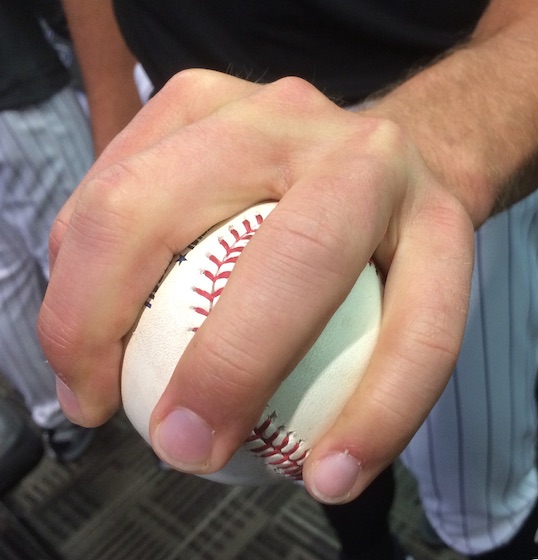
Tyler’s Anderson’s changeup grip.
“Before that, I’d thrown a palm ball. Honestly. I would hold it in my palm and throw a palm ball. It was slower. My dad knew about it from back in the day — it’s an old-school pitch — and mine was actually pretty good. It didn’t have a lot of spin, and as you know, limited spin creates drop. Mine would drop a lot, but it was too hard to control. Read the rest of this entry »
Griffin Canning on is on the fast track after a delayed start. Drafted 47th-overall by the Angels in 2017, the righty didn’t made his professional debut until last April. By June he was taking the mound for the Triple-A Salt Lake Bees. That’s where the 22-year-old UCLA product is to begin the current campaign, one rung below the majors, with a chance to reach Anaheim in the not-too-distant future.
When the call-up comes, Halos fans can expect to see a pitcher who combines power and pitchability. His approach to his craft is a mixture of art and science.
“I think you can find a middle ground on the two,” said Canning, who ranks fourth on our Angels Top Prospects list. “For me it’s moe of an art — I’ve kind of always thought you can be born with it — but at the same time, you can use those science tools to help you get better.”
When I talked to him during spring training, I asked the youngster what type of artist he envisions himself as. I wasn’t looking for a Monet or van Gogh comp, but I was wondering about his thumb print on the mound. Read the rest of this entry »
When publishing our lists — in particular, the top 100 — we’re frequently asked who, among the players excluded from this year’s version, might have the best chance of appearing on next year’s version. Whose stock are we buying? This post represents our best attempt to answer all of those questions at once.
This is the second year that we’re doing this, and we have some new rules. First, none of the players you see below will have ever been a 50 FV or better in any of our write-ups or rankings. So while we think Austin Hays might have a bounce back year and be a 50 FV again, we’re not allowed to include him here; you already know about him. We also forbid ourselves from using players who were on last year’s inaugural list. (We were right about 18 of the 63 players last year, a 29% hit rate, though we have no idea if that’s good or not, as it was our first time engaging in the exercise.) At the end of the piece, we have a list of potential high-leverage relievers who might debut this year. They’re unlikely to ever be a 50 FV or better because of their role, but they often have a sizable impact on competitive clubs, and readers seemed to like that we had that category last year.
We’ve separated this year’s players into groups or “types” to make it a little more digestible, and to give you some idea of the demographics we think pop-up guys come from, which could help you identify some of your own with THE BOARD. For players who we’ve already covered this offseason, we included a link to the team lists, where you can find a full scouting report. We touch briefly on the rest of the names in this post. Here are our picks to click:
Teenage Pitchers
Torres was young for his draft class, is a plus athlete, throws really hard, and had surprisingly sharp slider command all last summer. White looked excellent in the fall when the Rangers finally allowed their high school draftees to throw. He sat 92-94, and his changeup and breaking ball were both above-average. Pardinho and Woods Richardson are the two advanced guys in this group. Thomas is the most raw but, for a someone who hasn’t been pitching for very long, he’s already come a long way very quickly.
The “This is What They Look Like” Group
If you like big, well-made athletes, this list is for you. Rodriguez was physically mature compared to his DSL peers and also seems like a mature person. The Mariners have indicated they’re going to send him right to Low-A this year. He could be a middle-of-the-order, corner outfield power bat. Luciano was the Giants’ big 2018 July 2 signee. He already has huge raw power and looks better at short than he did as an amateur. Canario has elite bat speed. Adams was signed away from college football but is more instinctive than most two-sport athletes. Most of the stuff he needs to work on is related to getting to his power.
Advanced Young Bats with Defensive Value
This is the group that produces the likes of Vidal Brujan and Luis Urias. Edwards is a high-effort gamer with 70 speed and feel for line drive contact. Marcano isn’t as stocky and strong as X, but he too has innate feel for contact, and could be a plus middle infield defender. Perez has great all-fields contact ability and might be on an Andres Gimenez-style fast track, where he reaches Double-A at age 19 or 20. Ruiz is the worst defender on this list, but he has all-fields raw power and feel for contact. He draws Alfonso Soriano comps. Palacios is the only college prospect listed here. He had three times as many walks as strikeouts at Towson last year. Rosario controls the zone well, is fast, and is a plus defender in center field.
Corner Power Bats
Nevin will probably end up as a contact-over-power first baseman, but he might also end up with a 70 bat. He looked great against Fall League pitching despite having played very little as a pro due to injury. Lavigne had a lot of pre-draft helium and kept hitting after he signed. He has all-fields power. Apostel saw reps at first during instructs but has a good shot to stay at third. He has excellent timing and explosive hands.
College-aged Pitchers
It’s hard to imagine any of these guys rocketing into the top 50 overall. Rather, we would anticipate that they end up in the 60-100 range on next year’s list. Gilbert was a workhorse at Stetson and his velo may spike with reshaped usage. Singer should move quickly because of how advanced his command is. Lynch’s pre-draft velocity bump held throughout the summer, and he has command of several solid secondaries. Abreu spent several years in rookie ball and then had a breakout 2018, forcing Houston to 40-man him to protect him from the Rule 5. He’ll tie Dustin May for the second-highest breaking ball spin rate on THE BOARD when the Houston list goes up. We’re intrigued by what Dodgers player dev will do with an athlete like Gray. Phillips throws a ton of strikes and has a good four-pitch mix.
Bounce Back Candidates
The Dodgers have a strong track record of taking severely injured college arms who return with better stuff after a long period of inactivity. That could be Grove, their 2018 second rounder, who missed most of his sophomore and junior seasons at West Virginia. McCarthy was also hurt during his junior season and it may have obscured his true abilities. Burger is coming back from multiple Achilles ruptures, but was a strong college performer with power before his tire blew.
Catchers
We’re very excited about the current crop of minor league catchers. Naylor is athletic enough that he’s likely to improve as a defender and he has rare power for the position.
Potentially Dominant Relievers
These names lean “multi-inning” rather than “closer.” Gonsolin was a two-way player in college who has been the beneficiary of sound pitch design. He started last year but was up to 100 mph out of the bullpen the year before. He now throws a four seamer rather than a sinker and he developed a nasty splitter in 2017. He also has two good breaking balls. He has starter stuff but may break in as a reliever this year.
Ben Lindbergh and Jeff Sullivan banter about a bunch of proposed rules changes, FanGraphs readers’ responses to them, and the general desirability of change of some sort, then preview the 2019 Colorado Rockies (19:57) with former Rockies outfielder and current AT&T SportsNet Rockies analyst Cory Sullivan, and the 2019 Pittsburgh Pirates (46:20) with the Pittsburgh Post Gazette’s Stephen J. Nesbitt, plus a closing note on J.T. Realmuto.
After having typically appeared in the hallowed pages of Baseball Think Factory, Dan Szymborski’s ZiPS projections have now been released at FanGraphs for more than half a decade. The exercise continues this offseason. Below are the projections for the Pittsburgh Pirates.
The depth chart graphic for the Pirates (as seen below) pulls off a neat little trick. In this case, it manages to highlight both the strengths and weaknesses of the Pirates in one bite-sized scoop. Pittsburgh is excellent at finding just below average to average talent for peanuts, and average or better talent for whatever is a little bit better than that (perhaps Chex Mix?). It keeps the Pirates from ever truly returning to the Kingdom of Reekdom they reigned over from 1993 to about 2010. Having a roster Ryanfull of free one-win players, two-win players who are paid like one-win players, and three-win players who are paid like two-win players means you have a highly efficient roster. But it’s a highly efficient roster that will generally win between 77-85 games.
What the Pirates missed in their best days, and largely are missing today, was the willingness to add stars. The low payrolls of the rebuilding era never really gave way to short-term payroll ceilings well above the team’s long-term comfort levels. Everyone who has read me over the last five years knows I’m not a Royals apologist, but Kansas City did do this one thing much better than the Pirates did, even if the players Kansas City chose weren’t exactly my favorite. Chris Archer has star upside, but the Pirates had to trade players with star potential to bring him in. If the small market model doesn’t have a path to league-average payrolls, it necessitates an immense amount of success on the player development side. Sometimes, you just need to spend money instead of prospects.
There aren’t a lot of surprises in the hitting projections, but it is a very deep group. ZiPS has an amusing tendency with Pittsburgh to pick unnecessarily cruel, Pirates-related comps. Jung Ho Kang and Kevin Kramer are projected to be able to replace any injured Pirates infielders without the team losing a beat, and ZiPS remains a fan of Starling Marte over the long haul. This team may have the smallest gap between their ideal starting lineup and a starting lineup comprised of their Plan B’s of any team in baseball.
Pitchers
ZiPS is still optimistic about Chris Archer, but it’s now at the point where it expects him to fall short of his projected FIP. He’s only underperformed by 0.22 runs of ERA over his career, but ZiPS believes that given his defenses, he should have been over-performing his FIP, not falling short of it. The projections are increasingly optimistic about Trevor Williams, believing that he’ll continue to do better with home runs than most pitchers do with his hit profile. But it’s understandably not buying his .261 BABIP allowed in 2018 as near his actual ability.
Of the low-key reliever breakouts from 2018, ZiPS is a believer in Richard Rodriguez, a skeptic about Edgar Santana, and on the fence about ex-Giant Kyle Crick. The computer still does not understand why Michael Feliz isn’t much better at preventing the other team from scoring than his results to date have been.
Bench and Prospects
ZiPS uses a Total Zone-esque approach for minor-league defense, and it continues to back up the scouting reports for Ke’Bryan Hayes that rave about his defense. It doesn’t show up in the projections yet, but ZiPS sees a strong probability that Cole Tucker develops into a 10-12 home run hitter just as Royce Clayton, his top comp, did for awhile. Ryne Sandberg and Eric Young, Classic Edition, round out his top three. No, he doesn’t actually have a one-in-three chance of becoming a Hall of Famer. As sleepers go, the favorite of ZiPS may be Dario Agrazal, a well-built righty with a hard sinker but no real pitch that puts away batters (strikeouts are better than grounders). He’s not really on the prospect radar — the Pirates would not have snuck him off the 40-man roster if he were — but he does interest ZiPS and remains worth keeping an eye on. Groundball pitchers with hard sinkers who don’t strike guys out sometimes work out surprisingly well.
One pedantic note for 2019: for the WAR graphic, I’m using FanGraphs’ depth chart playing time, not the playing time ZiPS spits out, so there will be occasional differences in WAR totals.
Disclaimer: ZiPS projections are computer-based projections of performance. Performances have not been allocated to predicted playing time in the majors — many of the players listed above are unlikely to play in the majors at all in 2019. ZiPS is projecting equivalent production — a .240 ZiPS projection may end up being .280 in AAA or .300 in AA, for example. Whether or not a player will play is one of many non-statistical factors one has to take into account when predicting the future.
Players are listed with their most recent teams, unless I have made a mistake. This is very possible, as a lot of minor-league signings go generally unreported in the offseason.
ZiPS’ projections are based on the American League having a 4.29 ERA and the National League having a 4.15 ERA.
Players who are expected to be out due to injury are still projected. More information is always better than less information, and a computer isn’t the tool that should project the injury status of, for example, a pitcher who has had Tommy John surgery.
Both hitters and pitchers are ranked by projected zWAR — which is to say, WAR values as calculated by me, Dan Szymborski, whose surname is spelled with a z. WAR values might differ slightly from those which appear in full release of ZiPS. Finally, I will advise anyone against — and might karate chop anyone guilty of — merely adding up WAR totals on a depth chart to produce projected team WAR.
Twitter can be an awfully contentious place. After noting NL Central payrolls in a tweet over the weekend, I received a barrage of replies and quote tweets loudly complaining about the Pirates’ failures to invest in the team. And it’s not just folks who are mad online causing a stir. Pirates fans have spoken with their wallets as well; attendance has dwindled since the team made three straight playoff appearances earlier this decade. The Pirates have a decent team, but have done almost nothing this offseason to improve it, and seem likely to enter 2019 with payroll at it’s lowest point in the last five seasons.
PNC Park opened in Pittsburgh in 2001, and despite a 100-loss team, nearly 2.5 million fans showed up to watch the Pirates play. The team averaged 93 losses and attendance of 1.75 million fans over the next 11 seasons. After topping two million fans in 2012 — as the club approached a .500 record for the first time since Barry Bonds left for San Francisco — Pittsburgh made the playoffs each year from 2013 to 2015 and averaged 2.4 million in attendance per season. The 2016 season was a losing one, and attendance waned as the summer wore on, but positive expectations kept it at a reasonably high 2.25 million fans. Expectations were lowered in 2017; attendance dropped below two million. After trading Andrew McCutchen and Gerrit Cole, confidence in the club among fans seemed to drop to a new low as attendance dipped below 1.5 million despite a winning record.
The Pirates actually put together a decent team a year ago, but losing their two stars meant that the club’s surprising start didn’t translate in to people at the gate. At the All-Star break, Pittsburgh was averaging just 18,155 fans per game. Contention and the acquisition of Chris Archer breathed some excitement into the franchise, and in the month after the All-Star Break, the team averaged 25,357 fans per game, a two-million-plus pace over the course of the season. But as the Pirates fell out of the race, attendance plummeted again.
Last June, Pirates President Frank Coonelly acknowledged that fans had lost some of their faith in the team, faith the team would need to earn it back.
“We are genuinely focused on those great Pirates fans who are coming out to PNC Park and how much we appreciate their support,” Pirates President Frank Coonelly said in a statement responding to a request for comment. “At the same time, we appreciate that we have work to do to bring back fans who are not joining us at the park this year. Our television ratings remain in the top five in MLB, so we know that Pirates fans are following the team. We understand that we need to provide a compelling reason for all of our fans to come to the best ballpark in baseball.”
It was perhaps with those sentiments in mind that Pittsburgh pursued Chris Archer and Keone Kela, players who might have helped them if they had continued to contend in 2018, but who also could improve the club in future seasons. Given that Archer’s contract, assuming the team picks up his option years, runs through 2021 — a timeline that coincides with that of their best player, Starling Marte — it would be reasonable to assume the Pirates see a window of contention during that stretch.
This is what the Pirates have done so far this offseason:
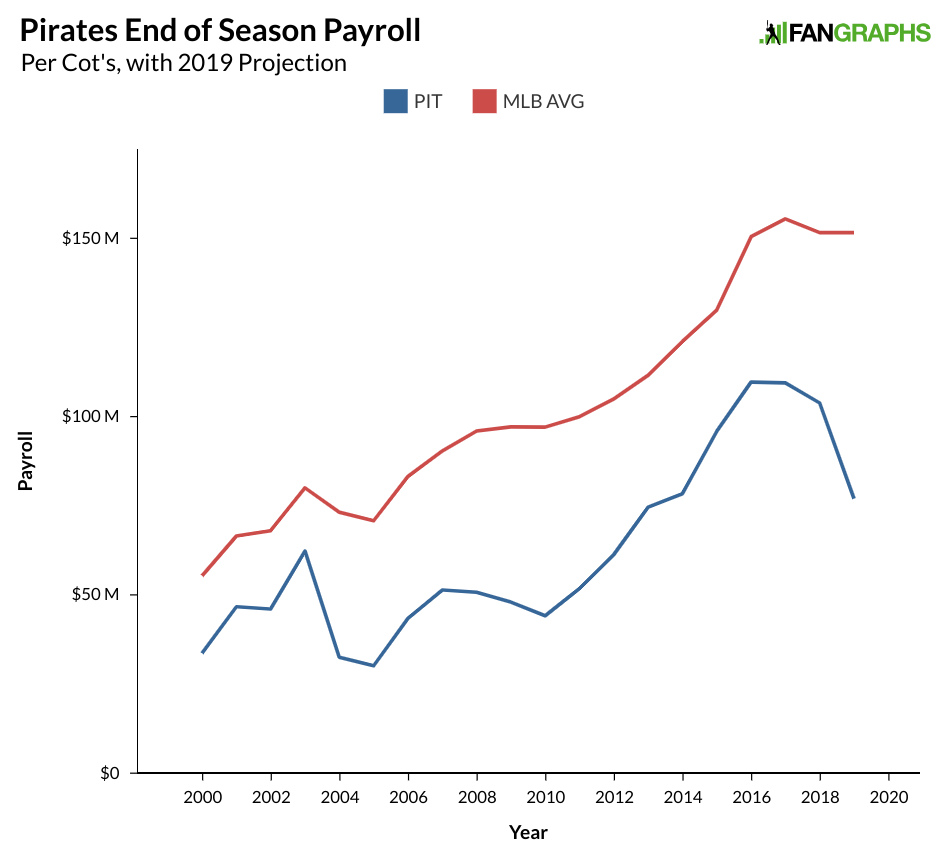
The team has also made the typical MLB teams minor league signings; among those, Tyler Lyons is the most interesting and promising. They also let Jordy Mercer go in free agency and declined Josh Harrison’s team option, though those weren’t big losses. The issue is the lack of progress on the major league roster from a team that, as Jeff Sullivan noted earlier this week, isn’t far from a playoff spot but currently has a projected Opening Day payroll of roughly $68 million. Only the Tampa Bay Rays have a lower projected payroll at the moment. This is how Pirates payroll has progressed over the years compared to MLB averages.
The first thing we might note is that the Pirates have always been a good bit below league average when it comes to spending. Given that the team plays in a smaller market, that’s not too surprising. The most obvious complaint for Pirates’ fans is the huge downturn in 2019 payroll we see as of now despite competing in 2018, losing no significant contributors this offseason, and gaining a full season of Chris Archer and Keone Kela. But that’s not where the angst regarding the Pirates’s spending really begins. If we were to look at graphs like the ones above for teams from similarly small markets like Milwaukee, Cleveland or Kansas City, we would expect to see similar graphs. What we would actually see, though, is that when those teams became competitive, they immediately invested more money into the roster to capitalize on that excitement, and ran close to (Cleveland) or above league-average payrolls (Milwaukee and Kansas City).
It’s that failure to invest that has disillusioned fans, and created a need for the team to somehow draw them back to the ballpark. Trading for Archer and Kela was a very good start, but at this point in the offseason, it’s hard to see how much more the Pirates can do given the remaining options and their purported budget constraints. They have mostly let the offseason pass them by, leaving deficiencies in the middle infield and in their rotation depth largely unaddressed.
In the middle infield, the team has options like Adam Frazier, Kevin Newman, Kevin Kramer, and Erik Gonzalez, but in a free agent market with a glut of reasonably priced options at second base, it’s hard not to think an opportunity was missed.
In the rotation, Mitch Keller might be ready to take a spot, but further depth would have raised the floor — and potentially the ceiling — for a team still close to contention. There are still some starters out there who could help, like Wade Miley, Gio Gonzalez, and of course, Dallas Keuchel, but it is possible the Pirates missed the boat on a better fit earlier in the offseason.
The Pirates had an opportunity this offseason to continue repairing their relationship with their fans. But an approach that looked so promising at the trade deadline has left much to be desired this winter. In order to win back the fans — and potentially gain back close to a million attendees a season — the team will have to win consistently, or at least offer a reasonable expectation that they might. There are lots of teams with built-in buffers that help keep their attendance from falling too far. The Pirates are not one of those. Their quiet offseason isn’t likely to attract more fans to the park on Opening Day, and their lack of additions might also hurt them at the end of the season in the standings.
In 2018, I once again had the pleasure of interviewing hundreds of people within baseball. Many of their words were shared in my Sunday Notes column, while others came courtesy of the FanGraphs Q&A series, the Learning and Developing a Pitch series, the Manager’s Perspective series, and a smattering of feature stories. Here is a selection of the best quotes from this year’s conversations.
———
“My slider will come out and it will be spinning, spinning, spinning, and then as soon as it catches, it picks up speed and shoots the other way. Whoosh! It’s like when you bowl. You throw the ball, and then as soon as it catches, it shoots with more speed and power. Right? “ — Sergio Romo, Tampa Bay Rays pitcher, January 2018
“One of the biggest lessons we learn is that iron sharpens iron. That is 100% how we try to do things with the Rockies — hiring people that are smarter than we are, and more skilled, and have different skills that can complement, and train people to be better at their jobs than I am at my job. That’s how you advance an organization.” — Jeff Bridich, Colorado Rockies GM, January 2018
“We could split hairs and say, ‘Hey, you’re playing in front of a thousand drunk Australians instead of 40,000 drunk Bostonians, and you’re living with a host family instead of at a five-star hotel.’ But The Show is The Show, and in Australia the ABL is The Show.” — Lars Anderson, baseball nomad, January 2018
“Baseball is heaven. Until our closer blows the game.” — Michael Hill, Miami Marlins president of baseball operations, January 2018Read the rest of this entry »
The following article is part of Jay Jaffe’s ongoing look at the candidates on the BBWAA 2019 Hall of Fame ballot. Originally written for the 2013 election at SI.com, it has been updated to reflect recent voting results as well as additional research. For a detailed introduction to this year’s ballot, and other candidates in the series, use the tool above; an introduction to JAWS can be found here. For a tentative schedule, and a chance to fill out a Hall of Fame ballot for our crowdsourcing project, see here. All WAR figures refer to the Baseball-Reference version unless otherwise indicated.
If Roger Clemens has a reasonable claim as the greatest pitcher of all time, then the same goes for Barry Bonds as the greatest position player. Babe Ruth played in a time before integration, and Ted Williams bridged the pre- and post-integration eras, but while both were dominant at the plate, neither was much to write home about on the base paths or in the field. Bonds’ godfather, Willie Mays, was a big plus in both of those areas, but he didn’t dominate opposing pitchers to the same extent. Bonds used his blend of speed, power, and surgical precision in the strike zone to outdo them all. He set the single-season home run record with 73 in 2001 and the all-time home run record with 762, reached base more often than any player this side of Pete Rose, and won a record seven MVP awards along the way.
Despite his claim to greatness, Bonds may have inspired more fear and loathing than any ballplayer in modern history. Fear because opposing pitchers and managers simply refused to engage him at his peak, intentionally walking him a record 688 times — once with the bases loaded — and giving him a free pass a total of 2,558 times, also a record. Loathing because even as a young player, he rubbed teammates and media the wrong way and approached the game with a chip on his shoulder because of the way his father, three-time All-Star Bobby Bonds, had been driven from the game due to alcoholism.
As he aged, media and fans turned against Bonds once evidence — most of it illegally leaked to the press by anonymous sources — mounted that he had used performance-enhancing drugs during the latter part of his career. With his name in the headlines more regarding his legal situation than his on-field exploits, his pursuit and eclipse of Hank Aaron’s 33-year-old home run record turned into a joyless drag, and he disappeared from the majors soon after breaking the record in 2007 despite ranking among the game’s most dangerous hitters even at age 43. Not until 2014 did he even debut as a spring training guest instructor for the Giants. The reversal of his felony obstruction of justice conviction in April 2015 freed him of legal hassles, and he spent the 2016 season as the Marlins’ hitting coach, though he was dismissed at season’s end.
Bonds is hardly alone among Hall of Fame candidates with links to PEDs. As with Clemens, the support he has received during his first six election cycles has been far short of unanimous, but significantly stronger than the showings of Mark McGwire, Sammy Sosa, and Rafael Palmeiro, either in their ballot debuts or since. Debuting at 36.2% in 2013, Bonds spun his wheels for two years before climbing to 44.3% in 2016 and 53.8% in 2017 thanks to a confluence of factors. In the wake of both Bonds and Clemens crossing the historically significant 50% threshold, the Hall — which in 2014 unilaterally truncated candidacies from 15 years to 10 so as to curtail debate over the PED-linked ones — made its strongest statement yet that it would like to avoid honoring them in the form of a plea to voters from vice chairman Joe Morgan not to honor players connected to steroids. The letter was not well received by voters, but Bonds gained just 2.6 percentage points. Like Clemens, he needs to recapture his momentum to have a shot at reaching 75% by the time his eligibility runs out in 2022.
The Pirates have made official a move that first popped up last week. I’d wanted to write something about their low-cost pickup of free-agent Jordan Lyles, but it was a low priority, and it got lost in the chaos of being in attendance at the winter meetings. This post, then, is a little delayed, but something that’s happened in the meanwhile is that the Dodgers signed Joe Kelly for three years and $25 million. The Pirates signed Lyles for one year and $2.05 million. This seems like a good job by the Pirates.
Based on some early indications, the free-agent market hasn’t cratered, and it might even be a bit healthier than it was a year ago. Kelly got paid over three years. Jeurys Familia got paid over three years. Andrew McCutchen got paid over three years. Lance Lynn got paid over three years. There’s money out there, and there’s interest in pitchers, and that’s the context in which the Pirates made this Lyles acquisition. I know that Lyles isn’t likely to win the Cy Young, and I know the Pirates aren’t likely to win the World Series, but I’d at least like to dedicate a few paragraphs to Lyles’ quiet emergence in 2018. This is a guy who’s still only 28 years old.
The major-league phase of Thursday’s Rule 5 Draft began with its annual roll call of clubs confirming the number of players currently on their 40-man rosters and ended with a total of 14 players being added to new big-league clubs. Dan Szymborski offered ZiPS projections here for the players taken earlier today. Below are brief scouting reports on the players selected, with some notes provided by Kiley McDaniel.
But, first: Our annual refresher on the Rule 5 Draft’s complex rules. Players who signed their first pro contract at age 18 or younger are eligible for selection after five years of minor-league service if their parent club has not yet added them to the team’s 40-man roster. For players who signed at age 19 or older, the timeline is four years. Teams with the worst win/loss record from the previous season pick first, and those that select a player must not only (a) pay said player’s former club $100,000, but also (b) keep the player on their 25-man active roster throughout the entirety of the following season (with a couple of exceptions, mostly involving the disabled list). If a selected player doesn’t make his new team’s active roster, he is offered back to his former team for half of the initial fee. After the player’s first year on the roster, he can be optioned back to the minor leagues.
These rules typically limit the talent pool to middle-relief prospects or position players with one-dimensional skillsets, though sometimes it involves more talented prospects who aren’t remotely ready for the majors. This creates an environment where selections are made based more on fit and team need than just talent, but teams find solid big-league role players in the Rule 5 every year and occasionally scoop up an eventual star. Let’s dive into the scouting reports on this year’s group.
First Round
1. Baltimore Orioles Richie Martin, SS (from A’s) – Martin was a 2015 first rounder out of the University of Florida, drafted as an athletic shortstop with some pop who was still raw as a baseball player. Martin had really struggled to hit in pro ball until 2018, when he repeated Double-A and slashed .300/.368/.439.
He has average raw power but hits the ball on the ground too often to get to any of it in games. Houston has been adept at altering their players’ swings, so perhaps the new Orioles regime can coax more in-game pop from Martin, who is a perfectly fine defensive shortstop. He should compete with incumbent Orioles Breyvic Valera and Jonathan Villar, as well as fellow Rule 5 acquisition Drew Jackson, for middle infield playing time. But unless there’s a significant swing change here, Martin really only projects as a middle infield utility man.
2. Kansas City Royals Sam McWilliams, RHP (from Rays) – McWilliams was an overslot eighth rounder in 2014 and was traded from Philadelphia to Arizona for Jeremy Hellickson in the fall of 2015. He was then sent from Arizona to Tampa Bay as one of the players to be named later in the three-team trade that sent Steven Souza to Arizona. McWilliams is pretty raw for a 23-year-old. He spent two years in the Midwest League and posted a 5.02 ERA at Double-A when the Rays pushed him there after the trade.
He has a big fastball, sitting mostly 93-94 but topping out at 97. He’ll flash an occasional plus slider but it’s a rather inconsistent pitch. The industry thought McWilliams had a chance to grow into a backend rotation arm because his stuff is quite good, but he has a much better chance of sticking as a reliever right now.
3. Chicago White Sox (Traded to Rangers) Jordan Romano, RHP (from Blue Jays) – Romano is a 25-year-old righty who spent 2018 at Double-A. He’s a strike-throwing righty with a fastball in the 91-93 range and he has an average slider and changeup, both of which reside in the 80-84 range. His command is advanced enough that both of his secondaries play up a little bit. He likely profiles as a fifth starter or rotation depth, but the Rangers current pitching situation is quite precarious and Romano may just end up sticking around to eat innings with the hope that he sticks as a backend starter or swingman when they’re competitive once again.
4. Miami Marlins Riley Ferrell, RHP (from Astros)- Ferrell was a dominant college closer at TCU and was consistently 93-97 with a plus slider there. He continued to pitch well in pro ball until a shoulder aneurysm derailed his 2016 season. Ferrell needed surgery that transplanted a vein from his groin into his shoulder in order to repair it, and the industry worried at the time that the injury threatened his career. His stuff is back and Ferrell is at least a big league ready middle reliever with a chance to be a set-up man.
5. Detroit Tigers Reed Garrett, RHP (from Rangers)
Garrett’s velo spiked when he moved to the bullpen in 2017 and he now sits in the mid-90s, touches 99 and has two good breaking balls, including a curveball that has a plus-plus spin rate. He also has an average changeup. He’s a fair bet to carve out a bullpen role on a rebuilding Tigers team.
6. San Diego Padres
No Pick (full 40-man)
7. Cincinnati Reds Connor Joe, 3B (from Dodgers) – The Reds will be Joe’s fourth team in two years as he has been shuttled around from Pittsburgh (which drafted him) to Atlanta (for Sean Rodriguez) to the Dodgers (for cash) during that time. Now 26, Joe spent 2018 split between Double and Triple-A. He’s a swing changer who began lifting the ball more once he joined Los Angeles. Joe is limited on defense to first and third base, and he’s not very good at third. He has seen a little bit of time in the outfield corners and realistically projects as a four-corners bench bat who provides patience and newfound in-game pop.
8. Texas Rangers (Traded to Royals) Chris Ellis, RHP (from Cardinals)- Ellis, 26, spent 2018 split between Double and Triple-A. One could argue he has simply been lost amid St. Louis’ surfeit of upper-level pitching but his stuff — a low-90s sinker up to 94 and an average slider — did not compel us to include him in our Cardinals farm system write up. The Royals took Brad Keller, who has a similar kind of repertoire but better pure stuff, and got more out of him than I anticipated, so perhaps that will happen with Ellis.
9. San Francisco Giants Travis Bergen, LHP (from Blue Jays)- Bergen looked like a lefty specialist in college but the Blue Jays have normalized the way he strides toward home, and his delivery has become more platoon-neutral in pro ball. He has a fringy, low-90s fastball but has two good secondaries in his upper-70s curveball and tumbling mid-80s change. So long as he pitches heavily off of those two offerings, he could lock down a bullpen role.
10. Toronto Blue Jays Elvis Luciano, RHP (from Royals)- Luciano turns 19 in February and was the youngest player selected in the Rule 5 by a pretty wide margin. He was acquired by Kansas City in the trade that sent Jon Jay to Arizona. Though he’ll touch 96, Luciano’s fastball sits in the 90-94 range and he has scattershot command of it, especially late in starts. His frame is less projectable than the typical teenager so there may not be much more velo coming as he ages, but he has arm strength and an above-average breaking ball, so there’s a chance he makes the Jays roster in a relief role. He has no. 4 starter upside if his below-average changeup and command progress. If he makes the opening day roster, he’ll be the first player born in the 2000s to play in the big leagues.
11. New York Mets Kyle Dowdy, RHP (from Indians)
Dowdy’s nomadic college career took him from Hawaii to Orange Coast College and finally to Houston, where he redshirted for a year due to injury. He was drafted by Detroit and then included as a throw-in in the Leonys Martin trade to Cleveland. He’s a reliever with a four-pitch mix headlined by an above-average curveball that pairs pretty well with a fastball that lives in the top part of the strike zone but doesn’t really spin. He also has a mid-80s slider and changeup that are fringy and exist to give hitters a little different look. He could stick in the Mets bullpen.
12. Minnesota Twins
No Pick (full 40-man)
13. Philadelphia Phillies (Traded to Orioles) Drew Jackson, SS (from Dodgers)- Jackson is a plus runner with a plus-plus arm and average defensive hands and actions at shortstop. He’s not a great hitter but the Dodgers were at least able to cleanse Jackson of the Stanford swing and incorporate more lift into his cut. He had a 55% ground ball rate with Seattle in 2016 but that mark was 40% with Los Angeles last year. He also started seeing reps in center field last season. He projects as a multi-positional utility man.
14. Los Angeles Angels
No Pick (team passed)
15. Arizona Diamondbacks Nick Green, RHP (from Yankees)- Green has the highest present ranking on The Board as a 45 FV, and we think he’s a near-ready backend starter. Arizona lacks pitching depth, so Green has a pretty solid chance to make the club out of spring training. He induces a lot of ground balls (65% GB% in 2018) with a low-90s sinker and also has a plus curveball.
16. Washington Nationals
No Pick (team passed)
17. Pittsburgh Pirates
No Pick (team passed)
18. St. Louis Cardinals
No Pick (full 40-man)
19. Seattle Mariners Brandon Brennan, RHP (from Rockies)- Brennan is a 27-year-old reliever with a mid-90s sinker that will touch 97. He has an average slider that relies heavily on it’s velocity more than movement to be effective. The real bat-misser here is the changeup, which has more than 10 mph of separation from Brennan’s fastball and dying fade.
20. Atlanta Braves
No Pick (team passed)
21. Tampa Bay Rays
No Pick (full 40-man)
22. Colorado Rockies
No Pick (team passed)
23. Cleveland Indians
No Pick (team passed)
24. Los Angeles Dodgers
No Pick (full 40-man)
25. Chicago Cubs
No Pick (team passed)
26. Milwaukee Brewers
No Pick (team passed)
27. Oakland Athletics
No Pick (team passed)
28. New York Yankees
No Pick (full 40-man)
29. Houston Astros
No Pick (team passed)
30. Boston Red Sox
No Pick (team passed)
Second Round
San Francisco Giants Drew Ferguson, OF- Ferguson is a hitterish tweener outfielder with a good combination of bat-to-ball skills and plate discipline. He has a very short, compact stroke that enables him to punch lines drives to his pull side and he’s tough to beat with velocity. Ferguson doesn’t really run well enough to play center field and lacks the power for a corner, so his likely ceiling is that of a bench outfielder.



 iTunes Feed
 Sponsor Us on Patreon
 Facebook Group
 Effectively Wild Wiki
 Twitter Account
 Get Our Merch!