
FanGraphs Baseball
The AL Wild Card Mess Is Competitive Balance, and It’s Not Pretty

In 1981, when a seven-week players’ strike split the season into two “halves,” and in 2020, when the coronavirus pandemic shortened the season to 60 games, teams with sub-.500 records snuck into the postseason via expanded playoff formats created to accommodate the unique and extraordinary circumstances. No team finishing below .500 over the course of a full schedule has received a playoff berth, but the possibility looms large this year. With five and a half weeks and about 35 games per team still to play, the American League has just five teams above .500, including one — the AL West-leading Astros — that entered Wednesday right at that mark before beating the Angels. It’s not out of the question that two sub-.500 teams could make the playoffs, but for all of the owners’ carping about a lack of competitive balance, messy free-for-alls such as this are just what Major League Baseball wants.
If the postseason were to start today, the Rays (76-50) would win the AL East by five games and White Sox (66-60) the AL Central by four games, with both earning first-round byes. The Yankees (71-55) and Red Sox (68-59) would qualify as the top two Wild Card winners; as the fourth and fifth seeds, they would square off in a best-of-three Wild Card Series as they did last season. But from there, things get ugly. The Astros (64-63) are currently clinging to a two-game lead over the Rangers (62-65) atop the AL West, but with a projected win total of 82 wins according to our Playoff Odds, they don’t have much margin for error when it comes to clearing the .500 bar, and could join or surpass the 2005 Padres (82-80) and 1973 Mets (82-79) in terms of mediocre division winners. The 1994 Rangers were a whopping 10 games below .500 at 52-62 but one game ahead of the A’s (51-63) when the players’ strike put them both out of their misery, though MLB does not consider any first-place teams from the shortened season to be official division winners. That’s how the Braves, who trailed the NL East-leading Expos by six games when the strike hit, are still considered to have won 14 consecutive division titles from 1991–2005 (an assertion I take issue with, but that’s an argument for another day). Read the rest of this entry »
Arsenal Included, ChiSox Southpaw Noah Schultz Remains a Work In Progress

Noah Schultz remains a work in progress. Fifteen outings and 65 1/3 innings into his major league career, the recently-turned-23-year-old southpaw has a 3-9 record to go with a 6.06 ERA and a 4.86 FIP since debuting in April. Ranked second in the Chicago White Sox system coming into the season, Schultz is currently doing more fine-tuning in Triple-A, having been sent down to Charlotte earlier this month.
Two days before his August 8 demotion, I caught up to the 6-foot-10, high-ceiling hurler to ask how much he has learned about pitching since being drafted 26th overall in 2022 out of an Oswego, Illinois high school.
“A ton,” Schultz replied. “I didn’t know anything when I signed. I didn’t know anything about metrics. I knew that spin rate was good — I knew that I spun the ball well — but that was about it. Velo and spin rate. So, I’ve definitely picked up a ton over the past few years.”
Enough that he would now consider himself a data nerd? Read the rest of this entry »
Dan Szymborski FanGraphs Chat – 8/20/26
August 20, 2026
| 11:59 |
 Dan Szymborski: Frivolity may now commence. |
| 12:00 |
: Not going to lie I expected Baez 2.0 with PCA. Are there any examples of players that dramatically improved their plate discipline and increased their walk rates like PCA has?
|
| 12:00 |
Dan Szymborski: Morandini
|
| 12:01 |
Dan Szymborski: Votto wasn’t born the plate discipline god either
|
| 12:03 |
Dan Szymborski: Jose Bautista too, but it could also be the rushed nature of being rule 5
|
| 12:03 |
Dan Szymborski: I would suspect Sosa too, but we don’t really have out-of-zone data for him
|
CJ Abrams Isn’t Long for Short

CJ Abrams’ ambitions as a fielder have fallen short, but the future remains bright for the Nationals star.
Washington over the weekend announced Abrams will move from shortstop to second base. That’s not a surprise. Abrams has been terrible at shortstop for his career, ranking as one of the worst fielders ever recorded by Baseball Savant’s fancy player-tracking technology. What is a surprise, however, is that a minor-career update for Abrams is newsworthy enough to justify an article, a testament to his tremendous breakout at the plate in 2026.
Abrams this year has posted -17 Outs Above Average at shortstop, which is the worst mark in the majors at any position. This isn’t an outlier for him. Since his debut in 2022, Abrams has played almost exclusively shortstop, putting up OAA marks (chronologically) of -8, -9, -18, and -11 before the -17 mark so far in 2026. His career -64 OAA makes him the sixth-worst fielder — at any position — ever recorded by the system, which dates back to 2016. Read the rest of this entry »
We Can’t Let Baseball’s Fun-Hating Dorks Kill the Stolen Base Again

As an inveterately unhappy middle-aged man, I don’t like pointing out when things get better. So when I say that the 2023 MLB rule changes massively improved baseball as a spectator experience, you can rest assured that I’m not making that assertion lightly.
You know what I’m talking about: The shift ban, the pitch clock, and the pizza box bases. Back in the olden days, a sufficiently daring and athletic ballplayer could rack up 50, 60, or even 100 steals in a season. But the response to that era has been a gradual tightening up of baserunning tactics.
First, the roided-up giants of the 1990s got too stiff and meaty to run and slide. Even those athletes who maintained their springiness didn’t want to run into an out when the guy at the plate could use his 25-inch forearms to drive them in from anywhere. In the 2000s, an army of Theo Epstein wannabes took over baseball operations en masse. These men, with their locust-like commitment to efficiency, discouraged risky baserunning behavior even further. While their Harvard MBA classmates were killing the American housing market, they killed the stolen base. Read the rest of this entry »
Effectively Wild Episode 2520: Catch 22–0
August 20, 2026

Ben Lindbergh and Meg Rowley banter about the Brewers’ record-tying shutout/blowout of the Mariners (warning: profanity), Bryce Rainer and the continued absence of a post-Ohtani two-way wave, the latest manifestation of Paul Skenes’s protracted struggles, the tater turnaround of Fernando Tatis Jr., the reason(s) for the diminishing viewership of “MLB at Field of Dreams,” and which baseball figure (or feature) could extend the Vin Scully/Connie Mack fun fact.
Audio intro: Ian H., “Effectively Wild Theme”
Audio outro: Tom Rhoads, “Effectively Wild Theme”
Link to Mariners vs. Brewers box score
Link to biggest blowouts
Link to Julio mistake
Link to Mount Rainier wiki
Link to Laurila on Rainer
Link to article on Rainer’s signing
Link to The Board at FG
Link to Sam on Ohtani’s two-way balance
Link to best past two-way prospects
Link to Olerud pitching retrospective
Link to article on Jobe vs. Skenes game
Link to Tigers vs. Pirates game data
Link to Tigers vs. Pirates box score
Link to Stumpf on Skenes
Link to Sawchik on Skenes
Link to Oler on Skenes
Link to Verducci on Skenes 1
Link to Verducci on Skenes 2
Link to Skenes photos
Link to Skenes gamelog
Link to Ashcraft gamelog
Link to P/IP leaders
Link to Tatis before
Link to Tatis after
Link to BP on Tatis
Link to MLB at Field of Dreams wiki
Link to article on Hall of Famers
Link to article on audience size
Link to EW Field of Dreams episode
Link to MLB Speedway Classic wiki
Link to Sam’s Scully/Mack piece
Link to Ben’s comment
 Sponsor Us on Patreon
 Give a Gift Subscription
 Email Us: podcast@fangraphs.com
 Effectively Wild Subreddit
 Effectively Wild Wiki
 Apple Podcasts Feed
 Spotify Feed
 YouTube Playlist
 Facebook Group
 Bluesky Account
 Twitter Account
 Get Our Merch!
Podcast: Play in new window | Download
Subscribe: RSS
WPBL Week Three: The Firebells of the Ball
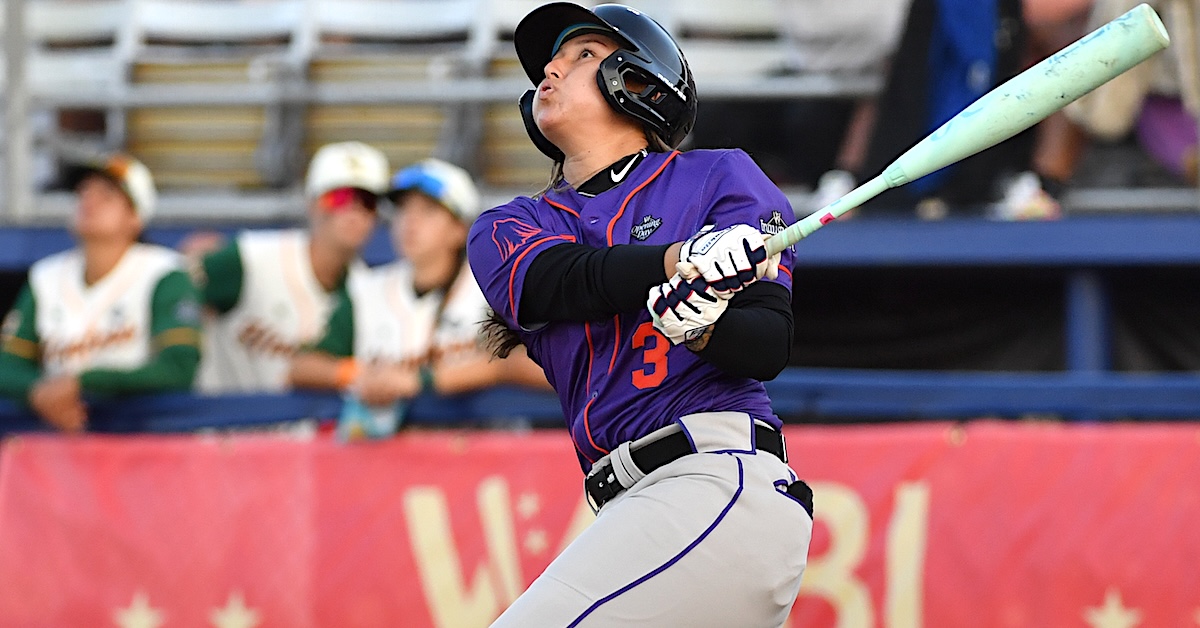
Week Three has concluded in the WPBL, and as such, let’s get to recapping. As a reminder, these weekly roundups are designed to cover each week’s action by highlighting the most notable players, moments, and anything else I deem worthy of further commentary. For each edition of the recap, I re-license the naming rights to this list of highlights to whichever team I feel has won the week. And how does a team win the week? Well, unlike actual wins and losses in baseball, this type of win is purely subjective and will operate under the time-honored tradition of making it up as we go along.
Along with the list of highlights, the Unforced Errors list discusses the more confounding aspects of the prior week because good faith criticism is a necessary component of continuing progress. Rounding things out are the Historic Firsts of Lesser Renown. The league’s momentous firsts will obviously get their shine, but there’s something to be said for the more strange and mundane firsts, the smaller day-to-day occurrences that make a new league feel familiar and complete. Think of these firsts as the knickknacks on a shelf that make a new house feel like a home. Baseball fans won’t really feel settled into their new league until the first time a player on their favorite team commits a TOOTBLAN.
If you need a refresher on the league’s structure and mechanics, check out the Week One recap.
Without any further ado, your Week Three winner is the San Francisco Firebells. The Firebells went 3-0 on the week with two decisive wins over the second-place team in the standings (the Los Angeles Queens), and team captain Kelsie Whitmore issued a temporary moratorium on the Denae Benites MVP chatter. Read the rest of this entry »
New FanGraphs Lab Feature: Count Progression Tool
by Ben Clemens

August 19, 2026
After taking a few months off from releasing new experimental data visualization options in the FanGraphs Lab, I’m happy to announce that we’re back at it. Meet the Count Progression tool:

With the advent of the ABS challenge system, this year’s league-wide walk rate has been in the news. The first month of the season featured a huge number of walks, and while subsequent months haven’t been quite as extreme, we’re still tracking for the highest full-season walk rate of the 21st century (2020 was weird, naturally). When I was tracking down where those extra walks were coming from back in May, I came up with the idea of looking at each count in isolation to hunt for changing behavior. This tool is an offshoot of that line of research. Read the rest of this entry »
The Derek Hill All-Stars

I say this with nothing but charity in my heart: It’s generally not a good sign when your team has a load-bearing Derek Hill. When the Phillies traded for Hill in June, he was arguably less valuable than the international bonus money they picked up in the same deal.
Hill is a career fifth outfielder with a strikeout rate (31.5% in 806 career plate appearances) that would make almost any hitter unplayable, especially a hitter with a career .281 on-base percentage and a career .132 ISO. But he can run, he can play center field, and he can hit lefties a bit. Best of all — and again, I’m not trying to be unkind here — Hill could not have dreamed up a scenario in which the bar for success was lower. Read the rest of this entry »

