This week’s episode is a bittersweet one, as your favorite podcast producer (that’s me!) tells his story before saying goodbye.
Dialing in from the snowy slopes of France, Ben Clemens interviews me, Dylan Higgins, for the latest edition of FanGraphs Backstories. Ben and I talk about the gateway drug that was Moneyball, how I hopped from internship to internship, and the summer I spent in an office with Branch Rickey III. I also tell Ben about my adventures working in the Australian Baseball League, finding myself in a sticky championship celebration, and eventually finding my people at FanGraphs.
To purchase a FanGraphs membership for yourself or as a gift, click here.
To donate to FanGraphs and help us keep things running, click here.
Don’t hesitate to direct pod-related correspondence to @dhhiggins on Twitter.
Ben Lindbergh and Meg Rowley banter about the exciting beginning of the WBC, early indications in spring training that MLB’s rules changes are having the intended effects, and a classic unprecedented occurrence in a baseball game, then continue their 2023 season preview series by discussing the Houston Astros (17:49) with Chandler Rome of The Houston Chronicle, and the Pittsburgh Pirates (59:39) with Jason Mackey of the Pittsburgh Post-Gazette, plus a Past Blast from 1979 (1:30:38), preview trivia answers (1:37:36), and a farewell to editor Dylan Higgins.
In a winter that didn’t lack for shocking free agent moves — and even more shockingplottwists — the Rangers’ signing of Jacob deGrom was as eye-opening as any of them. After opting out despite two injury-shortened seasons, the 34-year-old righty left the Mets to sign a five-year, $185 million deal with the Rangers. The move was surprising not only because deGrom bolted from the team with which he’d spent his entire professional career, but also because he chose a club that won 68 games in 2022 over one that won 101.
The Rangers didn’t stop at adding deGrom when it came to addressing a rotation that was among the majors’ worst last year, ranking among the bottom seven in ERA, FIP, and WAR. In addition to retaining All-Star Martín Pérez and trading for Jake Odorizzi, they added both Nathan Eovaldi and Andrew Heaney via two-year free agent deals of $30 million and $20 million, respectively. Thanks to those additions plus holdovers Pérez and Jon Gray, Texas’ rotation ranks second in projected WAR via our Depth Charts, behind only the Yankees (who got some bad news on Thursday, as Carlos Rodón has suffered a mild forearm strain, cutting into the depth already compromised by Montas’ injury). The Rangers lead the majors when I compare the actual production of last year’s rotations to the projected production of this year’s units — though not without some caveats. Read the rest of this entry »
Anthony Volpe has a chance to be a star, and his bat is one of the reasons why. No. 11 on our Top 100, and No. 1 on our New York Yankees list, the 21-year-old infield prospect is on the doorstep of the big leagues thanks in part to a re-engineered swing that our own Eric Longenhagen has described as being like a right-handed version of Juan Soto’s. Playing at Double-A Somerset and Triple-A Scranton/Wilkes-Barre last year, Volpe slugged 21 home runs while logging a 117 wRC+.
Volpe discussed his evolution as a hitter at Yankees camp earlier this week.
———
David Laurila: How do you approach hitting? Are you a hitting nerd or more of a keep-it-simple guy?
Anthony Volpe: “Probably a little bit of both. During the season I definitely try to keep it simple. We have a great hitting department here with the Yankees that helps us set our routines so that during games we can just go out there and play. There is obviously a lot that goes into it, but at the end of the day it’s about staying simple and performing in the game.” Read the rest of this entry »
Below is an evaluation of the prospects in the Colorado Rockies farm system who readers should consider “imminent big leaguers,” players who might reasonably be expected to play in the majors at some point this year. This includes all prospects on the 40-man roster as well as those who have already established themselves in the upper levels of the minors but aren’t yet rostered. Any Top 100 prospects, regardless of their ETA, are also included on this list. Reports, tool grades, and scouting information for all of the prospects below can also be found on The Board.
This is not a top-to-bottom evaluation of the Rockies farm system. I like to include what’s happening in minor league and extended spring training in my reports as much as possible, since scouting high concentrations of players in Arizona and Florida allows me to incorporate real-time, first-person information into the org lists. However, this approach has led to some situations where outdated analysis (or no analysis at all) was all that existed for players who had already debuted in the majors. Skimming the imminent big leaguers off the top of a farm system will allow this time-sensitive information to make its way onto the site more quickly, better preparing readers for the upcoming season, helping fantasy players as they draft, and building site literature on relevant prospects to facilitate transaction analysis in the event that trades or injuries foist these players into major league roles. There will still be a Rockies prospect list that includes Pick to ClickJordy Vargas, Yanquiel Fernandez, and all of the other prospects in the system who appear to be at least another season away. As such, today’s list includes no ordinal rankings. Readers are instead encouraged to focus on the players’ Future Value (FV) grades. Read the rest of this entry »
Ben Lindbergh and Meg Rowley welcome back former co-host Sam Miller to banter about his return to public baseball writing, his current relationship with baseball, and his new Substack, Pebble Hunting. Then (17:10) Ben, Meg, and Sam talk about a 1913 article about unprecedented events at the ballpark, the cliché about seeing something new at every game, the supreme examples of that phenomenon from any point in baseball history, games they attended, and games they paid attention to, and examples they hope to see in 2023. After that (1:18:27), Ben and Meg talk to WBC Central host Shawn Spradling about the biggest storylines of the World Baseball Classic, including the format and schedule, the favorites and dark horses, the surprising players, the challenge of putting on an international baseball tournament, how and when to watch, and more, followed by (1:56:57) a Past Blast from 1978.
Monday offered a rare sighting, as Chris Sale took the mound in a game for the first time since last July 17 — even if it was only a Grapefruit League game against the Tigers. Limited to just 11 starts over the past three seasons due to injuries, the soon-to-be-34-year-old lefty took his first step towards both reestablishing his spot among the game’s top pitchers and helping to support a promising but rickety rotation that may be the Red Sox’s best hope for respectability this year.
Once upon a time, Sale ranked among the game’s most durable pitchers. From 2012-17, only Max Scherzer, R.A. Dickey and Jeff Samardzija threw more innings than his 1,230. Sale was limited to 27 starts in 2018 due to left shoulder inflammation, though he wobbled through the postseason while helping the Red Sox win the World Series. It’s been downhill ever since, as he pitched to a 4.40 ERA and missed the last seven weeks of the 2019 season due to left shoulder inflammation, then tore his ulnar collateral ligament the following spring and had Tommy John surgery. The Red Sox took a slow, deliberate approach to his rehab. He didn’t return to the majors until August 14, 2021, nearly 17 months after his surgery and two years and a day since his last regular season outing.
Sale made nine starts with mostly good results in 2021, posting a 3.16 ERA and 3.69 FIP while striking out 28.4% of hitters, but hopes that that performance would carry over into 2022 didn’t last long. About a week after the lockout ended, the Red Sox revealed that Sale had suffered a stress fracture in his right rib cage while throwing batting practice at Florida Gulf Coast University in mid-February; he wasn’t allowed to tell the team until the lockout ended. He finally made his first of four rehab starts on June 20, and returned to the Sox after a frustrating five-walk outing that was capped by him destroying a television and other equipment in what he later called “a 7-year-old temper tantrum.” On July 12 he finally took the mound for Boston, throwing five shutout innings against the Rays, but five days later, he didn’t make it out of the first inning against the Yankees, as a 106.7-mph Aaron Hicks line drive hit his left hand, fracturing his pinky. Around three weeks later, while the pinky was still healing, he broke his right wrist in a bicycle accident and needed season-ending surgery. Woof. Read the rest of this entry »
With the World Baseball Classic in progress this week, now feels like a good time to steal an idea from another sport. In baseball, the international game is a bit vestigial. There has never been a consistent international best-on-best tournament on par with the FIFA World Cup or Olympic ice hockey, in which players desire success with the national team as much as they would success with their club teams.
Baseball hasn’t had that; the Olympics, taking place as they do within the MLB regular season, never featured best-on-best competition. And that’s when the Olympic program includes baseball to begin with. The World Baseball Classic hasn’t been around long enough to gain the kind of legitimacy the World Cup has, and it’s administered in part by Major League Baseball.
The biggest obstacle to a serious international game in baseball is pitcher usage. Pitcher workloads are so tightly monitored, few players and even fewer teams are willing to loan out a fragile and valuable arm to a tournament that’s widely viewed as an exhibition. The second-biggest obstacle is the lack of a powerful independent governing body for the sport; for most of the history of baseball, MLB has been its driving force. Even as various major leagues popped up around the world and the sport flourished at the amateur level, baseball has been centralized in the way hockey, soccer, and basketball never were, and the WBSC isn’t powerful enough to dictate a truly independent prestigious international competition. Read the rest of this entry »
Andrew Baker has some of the best raw stuff in the Philadelphia Phillies system. He also has one of the best backstories. A 22-year-old right-hander with a high-octane heater and a breaking ball that’s arguably better, Baker converted from catcher to pitcher in junior college and initially hated it. Moreover, he’d once been scared to take the mound.
Baker — an 11th-round pick in 2021 who finished last year in Double-A — is currently in big-league camp with the Phillies. He discussed his atypical path to prospect prominence over the weekend.
———
David Laurila: You were a high school catcher and didn’t become a pitcher until college. Is that correct?
Andrew Baker: “Yes. I did the full switch at the beginning of my freshman year in 2019, so I’ve really only been pitching seriously for about four years.” Read the rest of this entry »
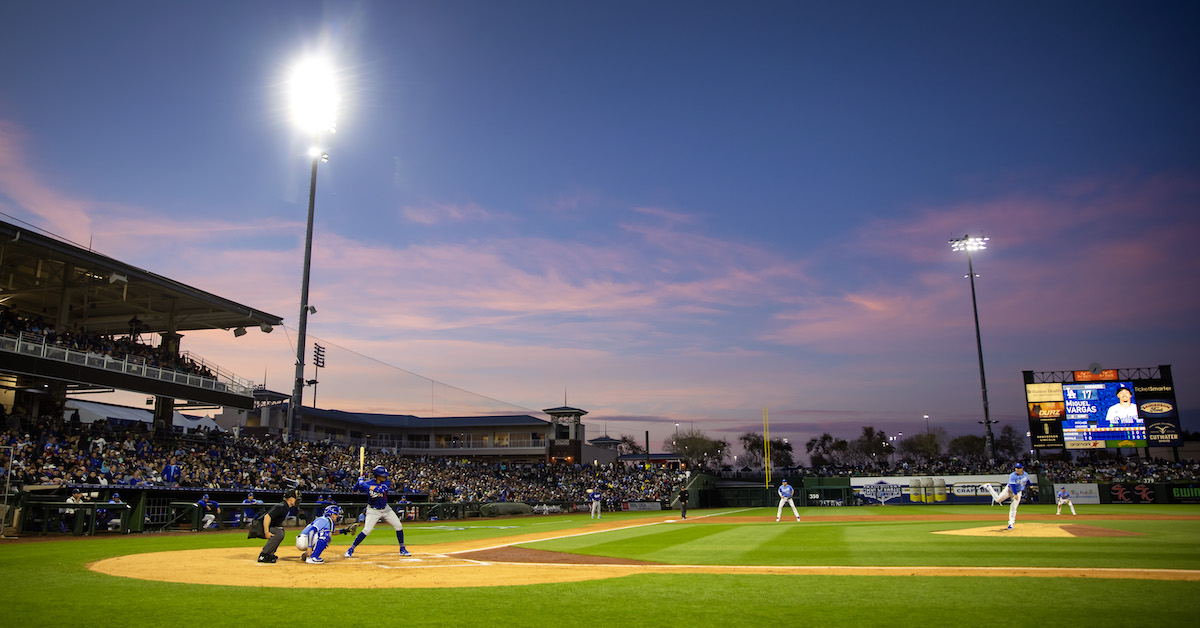
Miguel Vargas will take his first swing of spring training today. That wouldn’t be that notable, except that Vargas has already played in six spring training games and had 11 spring training plate appearances. He just hasn’t swung yet. That’s been necessary because of a hairline fracture in his right pinkie he suffered while taking groundballs. Vargas is the Dodgers’ fifth-ranked prospect, and with Gavin Luxout for the season and Messieurs Turner and Turner off to Boston and Philadelphia, Los Angeles needs him at second base. The Dodgers want Vargas getting game reps at the keystone and seeing live, competitive pitches. So there he is, playing despite the fact that he’s not medically cleared to swing the bat in a game.
Just seeing pitches is plenty important. You don’t need to swing to track pitches and work on your timing. Take Kyle Schwarber, whose heroics in the 2016 World Series came after a horrific knee injury cost him most of that season. After acing his six-month checkup and being cleared to hit, Schwarber flew out to the Arizona Fall League, where he could see as many pitches as possible before the Series. He played in two real games and two simulated ones, but the real work happened in the cage, much of it with the bat on his shoulder. Per Tom Verducci, “Schwarber hit or tracked 1,300 pitches in four days — many out of a pitching machine that fired major-league quality breaking pitches, some from two Class A pitchers the Cubs brought in to pitch to him in the simulated games and some from coaches.” Read the rest of this entry »



 Sponsor Us on Patreon
 Facebook Group
 Twitter Account
 EW Subreddit
 Effectively Wild Wiki
 iTunes Feed
 Get Our Merch!