Archive for Daily Graphings

Nestor Cortes Jr, Randy Flores, and Vince Velasquez on Learning to Manipulate Their Sliders

Pitchers learn and develop different pitches, and they do so at varying stages of their lives. It might be a curveball in high school, a cutter in college, or a changeup in A-ball. Sometimes the addition or refinement is a natural progression — graduating from Pitching 101 to advanced course work — and often it’s a matter of necessity. In order to get hitters out as the quality of competition improves, a pitcher needs to optimize his repertoire.

In this installment of the series, we’ll hear from three pitchers — Nestor Cortes Jr., Randy Flores, and Vince Velasquez — on how they learned and developed their sliders.

———

Nestor Cortes Jr., New York Yankees

“When I first got drafted, I was just fastball-curveball-changeup. One of my pitching coaches in Rookie ball, Jose Rosado, told me I needed [a slider]. I was throwing a bullpen and he was, ‘Hey, you’ve got the slow curveball, and you’ve got your heater. There’s about a 15 mph difference, so you need something in between.’ We started messing around with the grip.

“It’s come a long way since then, but there’s still a lot of room to improve it. It’s basically like a cutter, and I’m trying to get more depth to it. I’ve tried to make it better, but I haven’t been able to get the result I wanted, so when I was back in Triple-A this year I went back to the one that’s more like a cutter. But I still call it a slider. It’s bigger and slower than a true cutter.

“I’m trying to create more spin with it. I’m substituting the velo for spin, trying to get more break. I’m also kind of messing around with the grip. I’m keeping it the same to where I can feel I’m ripping through it, but I’m maybe getting more on top of it, to where I can create the angle of my fastball. I think my fastball angle is good with the slider from that slot. Read the rest of this entry »


RosterResource Free Agency Roundup: NL West

This is the last of a six-part series — the AL East, AL Central, AL West, NL East, and NL Central pieces have been published — in which I’m highlighting each team’s most notable free agents and how it could fill the resulting void on the roster. A player’s rank on our recently released Top 50 Free Agents list, along with Kiley McDaniel’s contract estimates from that exercise, are listed where relevant. In some cases, the team already has a capable replacement ready to step in. In others, it’s clear the team will either attempt to re-sign their player or look to the trade or free agent markets for help. The remaining cases are somewhere in between, with in-house candidates who might be the answer, but aren’t such obvious everyday players to keep the team from shopping around for better options.

Here’s a look at the National League West.

Arizona Diamondbacks | Depth Chart | Payroll

Wilmer Flores, INF

Flores could still fit on the Diamondbacks’ roster in 2020, but in what capacity depends on how the team plans on using Ketel Marte, who made 89 starts in center field and 45 starts at second base last season.

If Marte moves to the outfield full-time, Flores would have more value to the team as a semi-regular at second base while filling in occasionally at either corner infield spot. There are several other middle infield options, however, including Domingo Leyba, Josh Rojas, Ildemaro Vargas, and Andy Young, which could be why the team declined Flores’ $6 million club option despite his career-high 120 wRC+ in 285 plate appearances. Read the rest of this entry »


The Big Questions About the 2020 BBWAA Hall of Fame Ballot

On Monday, the Baseball Writers Association of America released its 2020 Hall of Fame ballot, with 14 holdovers, four of whom received at least 50% last year, joined by a group of 18 newcomers headlined by Derek Jeter. Lately, the writers have been working through a massive backlog of candidates, producing an unprecedented flood of 20 honorees in the past six cycles, including four apiece in each of the past two years. The flood is about to begin receding, however. If not for Jeter, this would rate as the weakest ballot for first-time candidates since 2012, when Bernie Williams was the only first-year candidate who even broke 5%. This year’s two top returnees, Curt Schilling (60.9%) and Larry Walker (54.6%), the latter in his final year of eligibility, are hardly slam dunks for immediate election.

Over the next six weeks, I’ll profile all 32 candidates, either at length or more in brief, examining their cases in light of my Jaffe WAR Score (JAWS) system, which I’ll be using to break down Hall of Fame ballots in an annual tradition that began at Baseball Prospectus (2004-12), then moved to SI.com (2013-18), which gave me an opportunity to go into greater depth on each candidate; last year, I brought the series to FanGraphs. The candidate profiles will begin later this week, after I complete my series covering the Modern Baseball Era Committee ballot. Today I’ll offer a quick look at the biggest questions attached to this year’s election cycle.

First, a review of the basics. To be eligible for election to the Hall of Fame via the BBWAA ballot, a candidate must have played in the majors for parts of 10 years (one game is sufficient to be counted as a year in this context), been out of the majors for five years (the minors or foreign leagues don’t count), and then been nominated by two members of the BBWAA’s six-member screening committee, which is usually a formality but can create some head scratching omissions down the ballot. Since the balloting is titled with respect to induction year, not the year of release, the current slate of players will have last appeared in the majors in 2014. Each new candidate has 10 years of eligibility, a reduction from the 15-year period that was in effect from 1936-2014. The last candidate grandfathered into the full run was Lee Smith, whose eligibility expired in 2017; six current candidates (Walker, Schilling, Barry Bonds, Roger Clemens, Jeff Kent, and Sammy Sosa) had their tenures unilaterally reduced mid-candidacy by the Hall.

To be elected, candidates must receive at least 75% of the ballots cast, and in this case, they don’t round up; 74.9% won’t cut it. Likewise, candidates who don’t receive at least 5% fall off the ballot and can then only be considered for election by the Today’s Game Committee, an entirely separate process — but not until what would have been their 10-year run of eligibility expires. Read the rest of this entry »


Can John Means Build on a Strong Rookie Season?

26-year-old southpaw John Means put together an impressive rookie season for the Baltimore Orioles. As the most valuable pitcher on a team that placed at the bottom of the league in 2019 for pitching WAR, Means was one of only three Orioles starters to exceed 100 IP. The runner up to Yordan Alvarez for American League ROY, Means managed 16 second-place votes on the back of a 3.00 WAR campaign. His 3.60 ERA was the lowest of any Orioles pitcher (minimum 100 IP) since Wei-Yin Chin put up a 3.34 in 2015. Means also led the team in wins (12) and had the pitching staff’s lowest hard-hit rate (27.5%). Granted, the Orioles were one of the worst teams in baseball, so that alone doesn’t mean much, but when compared to the 75 other pitchers who threw at least 150 innings in 2019 (the cutoff used for all the stats to follow), his chase rate was the seventh-lowest, his zone contact rate was the 24th-lowest, and Means fell just outside of the top-50 in swinging strike rate.

Means hasn’t shown he has the stuff to blow hitters away. His 19% strikeout rate was well below the league average of 23%, though his walk rate (6%) ratioed well with his strikeouts when compared to other starters. Means does, however, surrender quite a lot of fly ball contact, the vast majority coming from his changeup (45%) and four-seam fastball (40%). Still, he managed to keep his FB/HR rate stunted enough to be one of the five lowest in baseball.

Regardless of the kind of contact Means surrendered, his hard-hit rate topped all other pitchers by a fair amount. Messing with hitter’s timing through good sequencing, command, and control work just as well as an elevated strikeout rate. Read the rest of this entry »


Baseball’s Competitive Balance Problem

The current landscape of the game might charitably be called an era of superteams. Last year, the Yankees, Astros, Twins, and Dodgers all won more than 100 games. In 2018, it was the Red Sox, Astros, and Yankees; the year before that, the Dodgers, Indians, and Astros all won at least 100 times. The Cubs won 103 on their way to a World Series title, bringing the total number of 100-win teams over the past four seasons to 11. In the 10 years heading into 2016, only four teams hit the 100-win mark, and only the 2009 Yankees and 2011 Phillies won more than 100 games. Superteams are made possible by great players and smart organizations, but they are also made possible by having a bunch of bad teams to beat up on. The lack of competitive balance in today’s game is worse than it’s been in more than 60 years, back when there were only 16 teams and the reserve clause kept players from ever choosing their own employer.

One way to test baseball’s competitive balance is simply to take every team’s winning percentage in a single year and find the standard deviation. The smaller the standard deviation, the more teams are bunched toward the middle in a more competitive atmosphere. The bigger the standard deviation, the more teams are spread apart. Going back to 1903, this is what the standard deviation for team winning percentage looks like:

Read the rest of this entry »


Sunday Notes: The White Sox Wanted Rafael Devers (and the Elbow Gods Got Their Revenge)

When the White Sox traded Chris Sale to Boston, they received a pair of top-shelf prospects in return. Yoan Moncada was seen as possessing superstar potential, while Michael Kopech was a first-round pick who pumped 100-mph gas. Also coming to Chicago in the deal were a pair of midrange prospects, Luis Alexander Basabe and Victor Diaz.

Which team got the better of the December 2016 blockbuster? It’s too early to say, but one thing is certain: The Red Sox dodged a bullet. Basabe and Diaz became part of the package only after then GM Dave Dombrowski balked on including a 20-year-old corner infielder who’d yet to advance beyond A=ball.

“At one point, I asked for Rafael Devers,” acknowledged White Sox GM Rick Hahn, when asked about the trade. “Marco Paddy, who runs our international operation, had mentioned him back when he originally signed with Boston [in 2013], and our pro scouts had obviously seen him in Greenville and Salem. Joe Butler, Joe Siers, and John Tumminia — John has since retired — were all high on him, and made sure he was in the mix. The reason we liked Devers so much was because of those guys.”

As for Kopech, the 23-year-old right-hander is currently recovering from Tommy John surgery. A pair of other notable White Sox pitching prospects are, as well. I asked for an update on all three. Read the rest of this entry »


RosterResource Free Agency Roundup: NL Central

This is the fifth of a six-part series — the AL East, AL Central, AL West, and NL East pieces have been published — in which I’m highlighting each team’s most notable free agents and how it could fill the resulting void on the roster. A player’s rank on our recently released Top 50 Free Agents list, along with Kiley McDaniel’s contract estimates from that exercise, are listed where relevant. In some cases, the team already has a capable replacement ready to step in. In others, it’s clear the team will either attempt to re-sign their player or look to the trade or free agent markets for help. The remaining cases are somewhere in between, with in-house candidates who might be the answer, but aren’t such obvious everyday players to keep the team from shopping around for better options.

Here’s a look at the National League Central.

Chicago Cubs | Depth Chart | Payroll

Nicholas Castellanos, OF
FanGraphs Top 50 Free Agent Ranking: 11
Kiley McDaniel’s contract projection: 4 years, $56M

Castellanos had been an above-average hitter for a few seasons, although his fielding has left much to be desired. But for the two months following a trade from the Tigers to the Cubs, he was the kind of hitter — 154 wRC+, 16 home runs in 225 plate appearances — whose bat could more than make up for his defensive inadequacies.

Since the Cubs were the team to witness the 27-year-old at his best, especially at Wrigley Field where he slashed .384/.412/.750 in 119 plate appearances, they would have to at least be open to bringing him back. But with the current state of the roster, that does not appear likely unless they trade Kyle Schwarber. Read the rest of this entry »


Cole Hamels’ Vintage Changeup Returned in 2019

There’s a lot of starting pitching on the free agent market this offseason. There’s Gerrit Cole, Stephen Strasburg, Madison Bumgarner, Zack Wheeler, Dallas Keuchel, and Hyun-Jin Ryu, among many others. But one guy who has always piqued my personal interest is left-hander Cole Hamels, who is entering free agency for the first time in his 14-year major league career.

Hamels ranked as the 19th-best free agent on the FanGraphs’ Top 50 released earlier this month. Kiley pegged him for a two-year, $28 million contract, and the median (two-years, $30 million) and average (1.93-years, $28.2 million) crowdsource values were pretty close to that. Per his agent, John Boggs, he’s already generated interest from 13 different teams; according to Boggs, Hamels plans to pitch “at least five more seasons.”

Whether or not Hamels can actually pitch for another five years remains to be seen, but what is certain is that he still had plenty left in the tank in 2019. Hamels pitched 141 and two-thirds innings this season, to the tune of a 3.81 ERA and a 4.09 FIP. He struck out 23% of hitters and walked just 9%. Hamels was worth 2.5 WAR over his 27 starts, a solid figure, especially for the middle-of-the-rotation starter Hamels is now. Shoulder and oblique injuries kept him from making a full season’s worth of starts, but when he was on the mound, he was solid.

Driving much of this success was Hamels’ changeup, which experienced a resurgence in 2019. Check out his weighted runs above-average on the pitch by year:

Hamels’ wCH by Year
Season wCH
2006 14.5
2007 17.4
2008 23.4
2009 11.8
2010 6.2
2011 29.3
2012 13.8
2013 28.6
2014 19.7
2015 17.2
2016 0.9
2017 7.0
2018 0.9
2019 11.6

Read the rest of this entry »


Mike Trout’s Third MVP Is His Latest Step Into Elite Company

When I was a little kid, I used to love reading Guinness World Records books. My childhood bookshelf at my parents’ house reflects this admittedly odd curiosity: There are several of the, I don’t know, adult(?) versions of the book from the mid-2000s — the ones that are text-heavy and include bummer-ish topics like war and crime. But then there are the “kids” versions, the ones whose pages are filled with large portraits of record-breakers, with little bar graphs in the corner to show what their performance looks like against the competition.

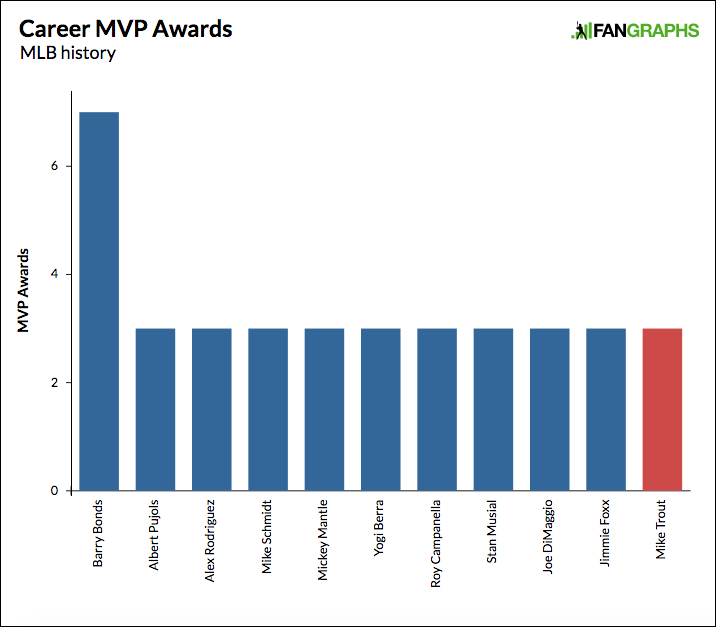
One of those kids’ books I had included a page dedicated to “Most MVP Awards” won in baseball. I remember seeing Barry Bonds‘ big smile, resting vibrant next to one of those graphs that showed just how transcendent he was. He’d won seven by the time this book published; the other names listed had won just three each. I knew Bonds, because I’d watched him often. The other names, I knew only from history books — names like Mantle, DiMaggio and Foxx. Pujols and Rodriguez hadn’t yet joined this class of three-time winners, hadn’t gotten the privilege of being immortalized as one of those short, stubby bars next to the tall structure looming above Bonds’ name on the tiny illustration intended to tell me who was the best ever at playing my favorite sport.

At the time I picked up this particular 2005 edition of my beloved book series, Mike Trout was just 13 years old. On Thursday, at the age of 28, Trout received the honor of joining this very silly-looking bar graph:

Read the rest of this entry »


Wild, Wild East: The Braves Sign Will Smith

It seems like only last week, I was jamming 14 Will Smith movies into a single paragraph of free agent hype, taking an obvious joke well past its logical conclusion. What would I do when Will Smith actually signed? Use the same movie jokes again? I wasn’t too worried about it. Free agents take months to sign! The Giants had made Smith a qualifying offer. No less a reliever than Craig Kimbrel had languished on the vine until after the amateur draft in similar circumstances. The same jokes could be funny again in a few months.

Well, the joke’s on me, because Smith signed a three-year, $40 million contract with the Braves yesterday. What follows is a level-head, straightforward analysis of that transaction. Just know that, if it weren’t so close in time, I’d probably have written another article of movie names.

The Braves fit a classic archetype of team that looks for free agent help. Their young core gelled impressively in 2019. Ronald Acuña Jr. and Ozzie Albies keyed the offense, while Mike Soroka, Max Fried, and Mike Foltynewicz provided the starting pitching. The team had veteran help, of course: Freddie Freeman chipped in his usual stellar offense, Josh Donaldson was superb in a bounce back year, and Dallas Keuchel provided much-needed innings on his own one-year deal.

They also have payroll room. With Donaldson and Keuchel re-entering free agency, they only had $100 million in expected commitments for 2020 before the Smith signing. With Acuña and Albies signed long-term to (some would say exceedingly) team-friendly contracts, it makes perfect sense to spend on the rest of the roster, maximizing their playoff chances while they have a strong foundation to build from. Read the rest of this entry »