Archive for Daily Graphings

Are Plate Discipline Breakouts for Real?

Earlier this month, I noted that hitters are chasing fewer pitches and seeking out fastballs in the zone. It’s one thing batters can do to fight back against the rising pitching talent and increased strikeouts. It seemed to me that every time I looked into a hitter potentially breaking out this season, I saw the same pattern: fewer swings on pitches outside the zone and a rising wRC+.

There comes a point when writing about the same thing over and over again becomes presumptuous if we can’t quite be sure that the benefits will last. To that end, I first went through plate discipline numbers from this season to determine if chasing fewer pitches seemed to help batters like I think it should. First, I looked at all hitters with at least 300 plate appearances in 2018 who were also qualified for the batting title as of May 13 of this year. While we can presume that taking pitches outside the strike zone is a skill, and one that stabilizes pretty quickly based on previous research, here’s how the numbers from last season and this one match up as of Tuesday’s data. Read the rest of this entry »
Marcus Walden on the Slider that Resurrected His Career

Marcus Walden is a 30-year-old rookie with a 5-0 record, a 1.46 ERA, and a spiked-grip slider that helped rescue him from minor-league purgatory. The story behind the pitch is one of avoidance-turned-desperation, with a healthy dose of studiousness thrown in for good measure. Walden has thrown his slider 41.6% of the time this year in 24.2 innings out of the Boston bullpen.

The righty’s journey to the big leagues was a meandering one. Drafted by the Blue Jays in 2007, Walden subsequently saw time in the A’s, Reds, and Twins organizations. He also spent a summer toiling in the independent Atlantic League. The Red Sox signed him off the scrap heap prior to the 2017 season, but even then his prospect status was tenuous at best. Twenty-six pitchers saw action for the AL East club that year, yet Walden remained in Triple-A.

Walden finally made his MLB debut last April, but his time at the top was short-lived. Sent down in May, he stayed on the Pawtucket roster throughout the remainder of the campaign. This year has been a different story. Walden has been one of Boston’s best relievers — his aforementioned numbers are augmented by a 10.95 K/9 and a 2.46 FIP — and again, his slider is a big reason why. I talked to Walden about his signature offering prior to a recent game.

———

David Laurila: Your go-to pitch is a slider. What is the story behind it?

Marcus Walden: “I didn’t start pitching until my senior year of high school. My freshman year [at Fresno City College] — the one year I went to school — I was throwing a four-seam fastball and a slider. Now I’ve gone back to that same style of a slider, although with a little bit different grip that I learned from Chandler Shepherd, in 2017. And watching Craig Kimbrel was a big help. I watched him closely, especially in spring training of ’17 and ’18 when he was throwing his live BPs. I talked to him a little. It was, ‘All right. What kind of shape are we trying to make with this pitch?’ He throws a knuckle slider, and that’s what I throw now.”

Laurila: Why did you start spiking your slider? Read the rest of this entry »


Marcus Semien Is Getting Better at This

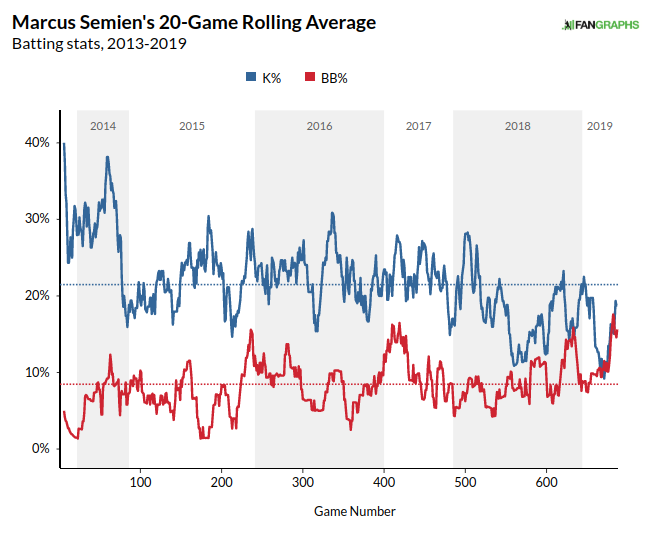
Here’s the chart that got me interested in what Marcus Semien is up to:

Marcus Semien’s Year of Discipline
Season(s) PA wOBA BB% K%
2012-2018 1,934 0.311 7.9 23.2
2019 198 0.335 13.1 15.2

It’s the last two columns that should grab your attention. Semien is walking nearly two-thirds more often this year than he’s ever walked before, and striking out less, too. Those are good things for hitters to do, and they’ve resulted in a 24-point increase in Semien’s wOBA (.335) compared to what had been his career mark (.311). If that figure holds, it will be the best of Semien’s career by 20 points.

Semien has experienced stretches of similar success before. For a brief period at the beginning of the 2017 season, before being put out of commission by a wrist injury, Semien was walking nearly 17% of the time — but also striking out in something like 27% of his plate appearances. He brought that number down beginning in early 2018, to something like its current levels, but saw his walk rate drop back down below 5% as he did so. Not until the early part of this 2019 season have we seen a Semien who is both walking a lot and not striking out that much:

Read the rest of this entry »


Further Adventures In Starting vs. Relieving

Last week, I investigated the changing performance of starters relative to relievers. There’s nothing too crazy about that — FanGraphs is a baseball analysis website, after all, and the starter/reliever divide is a rich topic for analysis. I have to confess, though, that the reception of the article was pretty exciting for me. You see, I got into baseball statistics when a friend recommended The Book to me, and there was Tom Tango, writing about my piece.

Aside from making me feel validated, Tango went over a few methodological improvements I could make to strip a little more noise out of the data. That, in essence, is what all of this analysis is doing — removing noise piece by piece, hoping to find the sweet, sweet signal underneath it all. In my initial article, I covered three topics: pitchers the first time through the order, starters vs. relievers but only using good pitchers, and swingmen. Today, I’d like to look at each of the three with a slightly different aim.

First, let’s talk about performance the first time through the order. Focusing on this consistent set of data (first time through the order, batters 1-7) for both starters and relievers lets us strip out distributional effects from starter workload changes. Merely looking at these splits, however, left out one key factor: home vs. away performance. Mitchel Lichtman has found that home field advantage isn’t a constant — it’s highest in the first inning. Road batters have a pronounced disadvantage relative to home batters in the first inning, which fades away somewhat afterwards. Credit it to having to hit cold, or go the other way and say that road starters are off their game in the first inning, but it’s worth exploring home and away splits to see if there’s anything there. Read the rest of this entry »


There is a Glimmer of Hope for Ian Desmond

When the Rockies signed Ian Desmond to a five-year, $70 million deal in December of 2016, they did so with the intention that he’d be their first baseman for the foreseeable future.

At the introductory press conference, general manager Jeff Bridich expressed his excitement to bring the two-time All-Star aboard.

“A couple of years ago, we started talking about versatility and athleticism becoming a priority for this organization, along with getting veterans of character,” Bridich had said at the time, per Thomas Harding of MLB.com. “[Desmond] represents all of that, and that is the exciting thing.”

Unfortunately, in Desmond’s first two seasons with Colorado, the results weren’t there. In 2017, Desmond hit .274/.326/.375 and a 69 wRC+ across 373 plate appearances. Despite being signed for the purpose of playing first, Desmond spent the majority of his inaugural season with the Rockies in left field, where he struggled to post positive results (-4.7 UZR in 557.1 innings). All in all, he was worth -0.8 WAR.

The following season told a similar story. Over 619 plate appearances, the slash line (with a particular emphasis on power) was slightly improved at .236/.307/.422 and a 81 wRC+, but officially sliding into a full-time role at first base was not helpful (-2.5 UZR in 1,158 innings). That, plus a poor positional adjustment, killed Desmond’s overall output for a second consecutive season. He put up -0.7 WAR.

Those two paragraphs represent a brief summary of Desmond’s first two seasons with the Rockies. Clearly, they haven’t been great. And, after a quick look at his 2019 numbers, it appears we are seeing more of the same. Through games on Tuesday, Desmond has had 132 trips to the plate this year, slashing .208/.273/.400 with a 62 wRC+. If anything, Desmond’s offensive production looks more substandard than it has been over the past two years. Considering the numbers we’ve seen already, to think that he could be even worse is alarming. Read the rest of this entry »


Chris Sale is Sort of Back

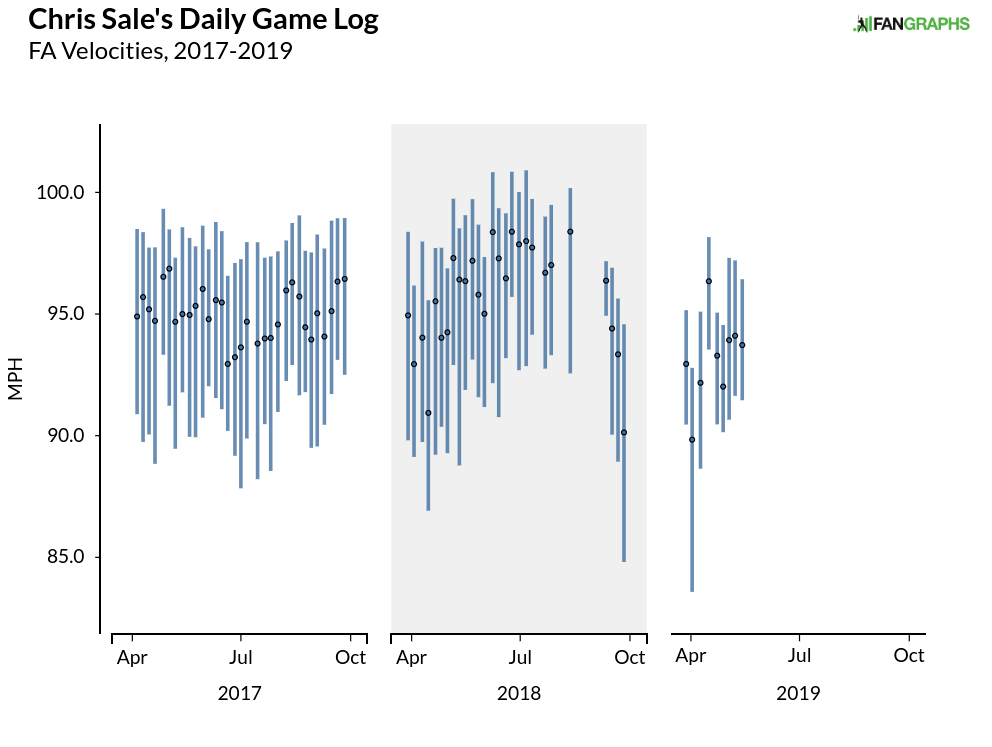
There was a fair bit of consternation regarding Chris Sale at the start of the season. In his first start of the year, he gave up three homers in three innings against the Mariners. Concern mounted when his fastball averaged 89 mph against Oakland in his next start and he struck out just a single batter. The Red Sox told everyone not to worry because dialing back was part of a plan. Sale did nothing to help his cause with a lackluster start against the Blue Jays the next time out, but his fastball averaged over 95 mph against the Yankees in his fourth outing, and over Sale’s last six starts, he’s got 65 strikeouts against seven walks in 38 innings with a 1.92 FIP and a 2.61 ERA. He’s struck out 31 batters in his last two starts, including 17 Rockies in just seven innings on Tuesday. Chris Sale, ravager of batters is back, but his velocity is still down, so he’s adjusted how he attacks hitters.

The game against the Yankees could be looked at as the turning point in Sale’s season thus far — the results certainly back that point up — but that was more of an isolated incident when it comes to the velocity we’ve grown accustomed to the past few years. The graph below shows Sale’s fastball velocity in each start over the past few seasons as well as a band which shows the max velocity for Sale in any given start.

When the Red Sox indicated they had a plan for Sale at the beginning of the year amidst his struggles, pointing to 2018 was the biggest piece of evidence. Sale started the 2018 season with lower velocities and then ramped it up as the season wore on before Sale wore out. This season might require a slower, less inclined ramp to make sure that Sale is still pitching strongly at the end of the season. Where skepticism might remain is whether Sale can be anything close to his prior great self if he spends half the season at 92-93 mph instead of a few ticks higher. If the last few starts are any indication, Sale will be just fine. Read the rest of this entry »


Tommy La Stella is Doing Mike Trout-like Things

Just as we all predicted in spring training, Tommy La Stella has taken over the Angels’ lead in home runs, surpassing Mike Trout. Wait, what?

You’re forgiven if you haven’t been paying much attention to the Angels, who are 20-22, haven’t been more than a game above .500 all season, and are now more than a month removed from their last time at that plateau. Trout was impossibly hot to start the season, but he cooled off, and Shohei Ohtani only made his 2019 debut last week, albeit without the novelty of double duty due to his Tommy John surgery. The Ohtani-less rotation has been dead-last dreadful, with practically everybody carrying ERAs and FIPs in the 5.00s, 6.00s, and 7.00s, or else on the injured list, and there’s been no heroic career turnaround for Matt Harvey, to say the least. Albert Pujols just passed the 2,000 RBI milestone, but he’s a shadow of his former self, and who cares about RBI, right?

Into this less-than-compelling spotlight has stepped La Stella, a 30-year-old lefty-swinging infielder who entered this season best known for his pinch-hitting prowess (.278/.397/.386 in 193 PA) and the Cubs’ gentle handling of his mid-2016 walkabout, the kind of thing that could have ended his career. The Angels acquired him last November 29 in exchange for a player to be named later (lefty reliever Conor Lillis-White) who has yet to throw a competitive inning in 2019, and are paying him all of $1.35 million. In our preseason Positional Power Rankings, we forecast La Stella to receive just 77 plate appearances as the Angels’ second baseman behind David Fletcher, with another 105 at third base behind Zack Cozart, and 14 at designated hitter. Given that he’d hit just 10 homers and produced a 96 wRC+ (.264/.345/.366) and 2.0 WAR in 947 career plate appearances — including just one homer and an 86 wRC+ in 192 PA last year — he wasn’t on anybody’s radar as a potential impact player.

Read the rest of this entry »


Appreciating Kirby Yates

The title gives the suspense of this one away, I know. I thought about leaving it as a mystery, a tease. “Five great MLB relievers — you won’t believe number four!” After thinking about it for a bit, though, I decided suspense was overrated. Kirby Yates has been great the past two years. Like, really great. Even if you think that Kirby Yates has been great, you probably are underestimating just how great he’s been. Here, guess the top five relievers of the past two years by FanGraphs’ WAR.

Top Relievers, 2018-2019
Player ERA FIP WAR
Blake Treinen 1.17 2.09 4.2
Edwin Diaz 2.02 1.92 3.7
Josh Hader 2.5 2.31 3.4
Kirby Yates 1.95 2.15 3.1
Felipe Vazquez 2.23 2.21 3

Now, I don’t know about you, but I got four of the five names. Given that you’re reading an article about Kirby Yates, you presumably didn’t make the same mistake that I did. Context clues and all. Maybe you read Matthew Trueblood’s article about him at Baseball Prospectus yesterday and had him on the brain. Still, though, even FIP can be fluky. How about the best K-BB rates over the last two years?

Top Relievers by K-BB, 2018-2019
Player K% BB% K-BB%
Josh Hader 48.7 9.8 38.9
Edwin Diaz 43.3 6.4 36.9
Nick Anderson 43.5 7.3 36.2
Dellin Betances 42.3 9.6 32.7
Kirby Yates 38.3 7.5 30.7

Hey Nick Anderson, looking good. And there, again, is Yates, striking out the world and walking no one. Read the rest of this entry »


Mitch Haniger Talks Hitting

Hitters deploy their craft in different ways. Not all have the same mechanics, nor do they employ the same approaches. Another thing that differs is the way they articulate their ideas. Proof in that pudding can be found in six similar-themed interviews that have run here at FanGraphs over the past two months. Daniel Murphy, Nolan Arenado, Drew Ferguson, Michael Lorenzen, Jesse Winker, and Matt Chapman have all expounded on the art (or is it a science?) of hitting, and each of their perspectives has been unique.

Mitch Haniger’s is unique, as well. The Mariners outfielder once told me that his hitting approach is complex, which made circling back to gain further insight on what makes him tick a veritable no-brainer. I caught up with the 28-year-old Cal Poly product when Seattle visited Fenway Park this past weekend.

———

David Laurila: When we spoke in 2013 — you were playing in the Arizona Fall League at the time — you called your hitting approach “pretty complex.” How would you describe it now?

Mitch Haniger: “It’s simple to me. It’s not simple to explain. There are so many factors that go into your approach, based on who you’re facing and what the situation is. How many outs are there? Where in the game are you? Are you facing a starter or a reliever? Not every at-bat is the same. That said, my main focus is essentially to get a good pitch, and hit the ball as hard as possible while taking a nice easy swing.”

Laurila: Getting a good pitch to hit is Hitting 101. How do you balance the simplicity of that approach with the multiple factors you referred to?

Haniger: “I look at pitchers’ tendencies and see how they try to pitch guys. For instance, most pitchers drastically change with runners in scoring position. I’ll look at previous at-bats against a guy and see what he’s typically doing. But really, the overwhelming majority of the time I’m looking for a fastball and trying to stay in the center of the field.”

Laurila: Can you elaborate on “most pitchers drastically change with runners in scoring position”? Read the rest of this entry »


The Elbow Gods Punish the White Sox Again

On Tuesday, the White Sox announced that Carlos Rodón will undergo Tommy John surgery, prematurely ending his 2019 season. With a 12-to-16 month rehabilitation period generally the norm for pitchers undergoing TJ, even a sunny scenario for Rodón would put a serious dent in his 2020 season; a cloudier one makes it unlikely he returns to Chicago until his 2021 season.

For Rodón, it’s obviously a disaster, another setback in a career that had already been largely derailed by injuries in 2017 and 2018. Rodón was drafted third in the 2014 draft out of NC State. At the time, one of the things about Rodón that interested the White Sox was that he was quite polished, even for a top college pitcher, and as a result, was likely to get to the majors very quickly.

The White Sox were correct in this analysis. Rodón’s major league debut, a relief appearance against the Cleveland Indians early in 2015, was only his 12th game as a professional. Three relief appearances later — including two rather lengthy ones at 60 and 63 pitches — Rodón entered the rotation. He acquitted himself quite well as a rookie, with a 3.87 FIP in 139.1 innings, good enough for 1.8 WAR, even as he was a little lucky in his homers allowed. He showed continued progression in 2016, dropping over a walk a game, and ended up with a 4.04 ERA, a 4.01 FIP, and 2.8 WAR.

Since mid-2016, Rodón has racked up an unfortunate injury history. First, he missed a month in 2016 slipping on the dugout steps, spraining his wrist. Sadly, this is a story I know all too well, having been forced to wear a wrist brace about a decade ago after a similar fall on my stairs; there was feline involvement. Read the rest of this entry »