Archive for Essential

2019 Trade Value: #1 to #10

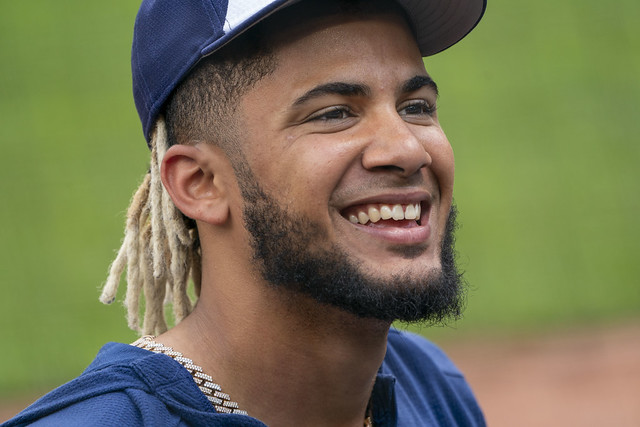
Fernando Tatis Jr. rocketed onto this year’s list and into the top 10. (Photo: Keith Allison)

As is the annual tradition at FanGraphs, we’re using a week around the All-Star Game — when the industry pauses to take a metaphorical breather — to take stock of the top-50 trade chips in the sport. For more context on exactly what we’re trying to do here, see the Honorable Mentions post linked at the top of the page.

For this post, I’ll present a graphic (by way of the wizard Sean Dolinar) breaking down each player’s objective skill level (represented, in this case, by a five-year WAR projection from ZiPS), contract/team-control details, rank in last year’s series, and then year-by-year details of age, WAR, and contract through the end of 2023, although a couple players have control beyond those five years, and some, you’ll notice, show projections for fewer years to reflect when those players reach free agency. For those readers who are partial to spreadsheets rather than blocks of text, I’ll also include all of the players we’ve ranked so far in grid format at the bottom of the post.

It should be noted that the ZiPS WAR forecasts influenced the rankings a bit. For players who were bunched together, it acted as an impartial tiebreaker of sorts, but the industry opinions I solicited drove the rankings.

With that said, let’s get to the final 10 spots on this year’s Trade Value list.

Five-Year WAR +22.1
Guaranteed Dollars –
Team Control Through 2025
Previous Rank #18
Year Age Projected WAR Contract Status
2020 21 +3.3 Pre-Arb
2021 22 +3.8 Pre-Arb
2022 23 +5.0 Arb1
2023 24 +5.1 Arb2
2024 25 +4.9 Arb3
Pre-Arb
Arb

Vladito hasn’t been the otherworldly hitter many were hoping for or expected during his first taste of the big leagues, but no one I spoke with is worried. First of all, he’s running a .270 BABIP and underperforming his xwOBA by 17 points, suggesting he “deserves” to have a wRC+ over 100, which is still below his lofty pre-season projections, but not by much. And also, it’s been 66 games and he’s 20 years old.

Given his size and eventual move to first base, Vlad needs to mash, so his profile will be more sensitive to offensive performance than others might be, but the track record of the “that guy looks like a generational hitter” and “gets to the big leagues at 20” profiles is really strong. Vlad has an extra year of control over Gleyber Torres and Walker Buehler, so the projected five-win peak seasons are a push, and I lean to the extra year. Interestingly, there were concerns raised by executives about how all three of these guys will age; history tells us (I mean it feels like it does?) that at least one of them will turn out a good bit worse than we’re expecting. Read the rest of this entry »


There’s a Whole Page Now Just for Our Prospect Coverage

Whatever their flaws as human people — and there are too many to catalog in this brief post — lead prospect analyst Eric Longenhagen and lead prospect analyst emeritus Kiley McDaniel have nevertheless acquitted themselves well in their attempts to analyze all prospects.

Within the last year, they have evaluated every player with a 40 FV or better, ranked and re-ranked the top rookie-eligible players in the game, examined the next three draft classes in as much depth as is reasonable, provided daily notes on in-season developments for pro prospects, both introduced and updated THE BOARD, and (most recently) launched a weekly podcast dedicated to prospect evaluation and air-horn sound effects.

Given the volume of content produced by Messrs. Longenhagen and McDaniel, it makes sense to create a space where readers can find it. Accordingly, we’re introducing today the FanGraphs Prospects landing page.

From the Prospects page, one can access the site’s most recent prospect-related posts, podcast episodes, and rankings. Accompanying the addition of the Prospects page are also a couple new features — namely, a statistical leaderboard featuring only those players who have appeared on a prospect list, a graduation tracker to monitor which players are about to exhaust (or have recently exhausted) their status as a prospect, and a miniature version of THE BOARD.

In addition to hyperlinks like this one, the FanGraphs prospects page is also accessible via the Blogs drop-down menu on FanGraphs’ main page.

Finally, it would be foolish and also very rude not to mention the contributions of Sean Dolinar to the construction of the Prospects page. Dolinar’s work on the project has been invaluable.


2018 Trade Value: #1 to #10

Jose Ramirez has considerable value even without his bat.
(Photo: Keith Allison)

As is the annual tradition at FanGraphs, we’re using the week of the All-Star Game — while (some of) the industry pauses for a metaphorical breather — to take stock of the top-50 trade assets in the sport. For more context on exactly what we’re trying to do here, see the honorable-mentions post linked at the top of the page.

For this post and the others in this series, I’ve presented a graphic (by way of the wizard Sean Dolinar) breaking down each player’s objective skill level (represented, in this case, by a five-year WAR projection from ZiPS), contract/team-control details, rank in last year’s series, and then year-by-year details of age/WAR/contract through 2023, although a couple players have control beyond those five years. For those readers who are partial to spreadsheets rather than blocks of text, I’ve also included all the players we’ve ranked so far are in grid format at the bottom of the post.

The ZiPS WAR forecasts did influence the rankings a bit: for players who were bunched together, it acted as an impartial tiebreaker of sorts, but the industry opinions I solicited drove the rankings.

With that said, let’s get to the top 10 spots on the Trade Value list this year.

Five-Year WAR +26.3
Guaranteed Dollars –
Team Control Through 2022
Previous Rank #35
Year Age Projected WAR Contract Status
2019 25 +5.3 Arb1
2020 26 +5.5 Arb2
2021 27 +5.5 Arb3
2022 28 +5.0 Arb4
Arb

Severino bests Kluber for the top spot amongst pitchers on this year’s list. He is eight years younger than Kluber with an additional year of control and has been at least as good as the Cleveland right-hander this season, depending on how you measure it. Predictably, though, execs are concerned — as they are with basically any pitcher — that Severino’s next pitch could lead to a year-long DL stint and uncertainty after that. As a 24-year-old who averages 97.7 mph on his fastball, Severino is still a bit of a risky bet compared to comparable hitters. There’s a tier here from Nos. 7 to 13 that you could shuffle in a few different orders depending on your personal preferences or evals of these players.

Read the rest of this entry »


2017 UZR Updates!

For the 2017 season, Mitchel Lichtman has made some improvements to the UZR methodology!

– UZR now uses hit timer data (hang time) rather than hit type designations, which is an improvement on the methodology and thus the results.

– The methodology has changed a little that allows UZR to account for some of the noise associated with imperfect data. The net result of this change is that extreme UZR’s, which were likely caused by, to some extent at least, noise in the data, rather than extreme performance, will be slightly ‘dampened.’ We think that these new values, while very close to the old ones in most cases, more accurately reflect the actual performance of the players in question.

These changes in UZR are currently active for 2017, and will also be rolled out for 2012 – 2016 data in the near future.


Introducing Team Pages!

We now have landing pages for all 30 Major League Baseball teams. These pages can be accessed through the Teams menu on the navigation bar above, simply by clicking on a team’s name. You can also access the pages directly, like so (no spaces in team names):

fangraphs.com/teams/bluejays

Many of the stats and features on the team pages are available in similar forms elsewhere on the site. We’ve now collected them into one place, however, so that readers can more quickly access team-specific information and analysis. As with any new addition to FanGraphs, we plan on expanding and adding features to the team pages as time goes on.

There are five different tabs on each page: Summary, Stats, Schedule, Pitcher Usage, and Depth Chart.

Summary

This is a quick overview of the team’s season. It includes boxes for the next and most recent games, division standings, team stats, depth chart, and roster notes.

Read the rest of this entry »


Valuing the 2017 Top 100 Prospects

Earlier this morning, Eric Longenhagen rolled out his list of the top-100 prospects in baseball, with Red Sox-turned-White Sox prospect Yoan Moncada at the top of his rankings. Helpfully, Eric’s rankings include the FV grade for each player, so that we can see that he really does see a difference between Moncada and the rest of the pack, as Moncada was the only prospect in the sport to garner a 70 grade.

As Eric notes in his piece, the grade is really the more important number here, as the ordinal ranking can create some false sense of separation, where players might be 20 or 30 spots apart on the list but offer fairly similar expected future value. The FV tiers do a good job of conveying where the real differences lay, highlighting those instances when Eric actually does see a significant difference between players, versus simply having to put a similar group of prospects in some order regardless of the strength of his feelings about those rankings.

But while the FV scale is helpful in binning players, it doesn’t do much to convey the differences between the tiers themselves. How much more valuable is a 60 than a 55? Or is a team better off with one elite 65 or 70 FV prospect or a multitude of 50-55 types? These are interesting questions, and ones that teams themselves have to answer on a regular basis.

Read the rest of this entry »


2017 Top 100 Prospects

Below is my list of the top-100 prospects in baseball. Each prospect has a brief scouting summary here with links to the full team reports embedded in their names where applicable. Those without links will have them added as I cover the remaining farm systems. Scouting reports are compiled with information provided by industry sources, as well as from my own observations. For more information on the 20-80 scouting scale by which all of my prospect content is governed, you can click here. For further explanation of the merits and drawbacks of Future Value, read this.

Note that prospects below are ranked overall and that they also lie within tiers demarcated by their FV grades. I think there’s plenty of room for argument within the tiers, and part of the reason I like FV is because it can illustrate how an on-paper gap that seems large may not actually be. The gap between prospect No. 3 on this list, Amed Rosario, and prospect No. 33, Delvin Perez, is 30 spots but the difference between their talent/risk/proximity profiles is quite large. The gap between Perez and prospect No. 63, Kyle Tucker, is also 30 numerical places but the gap in talent is relatively small. Below the list is a brief rundown of names of 50 FV prospects who didn’t make the 100. This same comparative principle applies to them.   -Eric Longenhagen

70 FV Prospects

Signed: July 2nd Period, 2015 from Cuba
Age 22 Height 6’2 Weight 205 Bat/Throw B/R
Tool Grades (Present/Future)
Hit Raw Power Game Power Run Fielding Throw
30/60 60/60 40/60 70/70 40/50 70/70

Scouting Summary
The tools are deafening. Moncada is a plus-plus runner with plus-plus arm strength, plus raw power and an advanced idea of the strike zone. He’s going to strike out, and there are some within the industry concerned about how much. That said, I think it’s important to consider that while Moncada was K-ing a lot late last year he was also a 21-year old who had played for just a month and a half above A-ball and, during a large chunk of that time, was learning a new position. The stat-based projection systems, KATOH and otherwise, seem comfortable with it, and so am I. I think he’ll provide rare power and patience while playing a premium position — he’s looked fine at second base in my looks this spring — and, while it might take adjustment at the big-league level, I think he’ll eventually be the best of this crop of minor leaguers.

Read the rest of this entry »


Introducing FanGraphs Residency

Over the last few years, the quantity of terrific baseball writing has exploded online, with a widening variety of publishers putting out interesting commentary and analysis about the game we all love. While we are proud of the work we do here at FanGraphs, there are a lot of people putting out fantastic pieces at other outlets, and we’ve long had a desire to connect some of these great baseball writers with our audience, and help you guys discover other talented scribes to whom you may not have been exposed before.

So, today, we’re proud to announce the FanGraphs Residency program. We’ve reached out to a number of writers we like, and will be giving them an opportunity to publish their work here on FanGraphs during a given month. The number and types of articles they publish will vary, as we’ll mix in research, analysis, and commentary, and our hope is that the different voices to which the program will give a platform will help provide a wide array of content. With different kinds of writers taking turns, we think there’s a good chance everyone will find a new voice to follow, and that this program will help provide some additional exposure to those who have been doing good work at outlets who might not get as much traffic as FanGraphs does.

We’re excited to launch this program by announcing our Resident for the month of March: Kate Preusser. Kate is currently the Managing Editor at Lookout Landing, and if you purchased the 2017 Hardball Times Annual, you likely enjoyed her AL West review, which was highlighted by Paul Swydan as one of his favorite chapters in the book. She also co-hosts the Icosahedron Podcast, and we think you’re going to enjoy getting to read more of her work here during the month of March.

Along with the written articles, each resident will also be joining Carson for an episode of FanGraphs Audio during their month with us, so you’ll get to hear their voices, as well as read their work, during their time here. We hope that this combination will allow you to get to know writers of whom you may not previously have been aware, and hopefully you follow them at their other outlets after their residency here is finished.

We should note that we’re using the residency term more to describe the short-term nature of this position, and won’t be working our residents to the bone in the way that medical residents are sometimes used. These are also paid positions, so we’re not simply asking these writers to provide content to us in exchange for exposure; we believe they are quality writers who deserve larger audiences, and we simply want to give them that opportunity.

We’re excited about this program, and hope that you guys enjoy what each resident brings to the site, as well. Some of the names who are lined up for this summer will already be familiar to you, while others will likely be new, and we think this mix of voices and perspectives will help round out the content that our staff currently provides on a daily basis.

If you have someone you’d like to nominate for a residency position, we’d love to hear about them; you can email residency@fangraphs.com to suggest a writer for a future spot here. This position is designed primarily for those who already have shown that they can provide quality published content, but if you know someone who may not yet have had an opportunity to publish their work but has interesting and insightful things to say about baseball, we’d be happy to consider them as well. If you’re a writer who is interested in a spot, we will ask that you do not nominate yourselves for a residency position, but instead be referred by someone who has enjoyed your work and thinks you would benefit from access to a wider audience.

A few hours from now, you’ll be reading Kate’s first piece here on FanGraphs, and we think you’ll enjoy getting to know her (or know her writing a bit more) over the next month. We hope this program can be a win for both interesting writers and our audience, and look forward to connecting you all with people we think you might really enjoy.


FanGraphs and InstaGraphs Articles Are Now Mobile-Friendly

If you’re reading this on your phone, it might look a little different than it did yesterday. (And if not, you should check it out!) The FanGraphs and InstaGraphs blogs are now responsive and mobile-friendly. (RotoGraphs will be soon, as well.) We wanted to give you a heads up that we are in the process of incrementally updating parts of the site so that it fits better on your phone.

We are also working on improving our navigation by updating the menu system.

We are designing the site to work on newer browsers, so it might not render properly on Internet Explorer 10 or earlier, Safari 6 or earlier, along with pre-2014 builds of Chrome or Firefox.

If you notice any bugs, please let us know either in the comments below or on Twitter.


FanGraphs on Tour With Pitch Talks 2017

Last year, we joined up with the Pitch Talks crew for a three-city U.S. tour, and had a blast in Boston, San Francisco, and Chicago. The response was clear, so instead of just hitting up a few cities this year, the tour is expanding to 16 dates, and we’re covering a good chunk of the country from April through August. Here’s the current tour schedule.

Read the rest of this entry »