Archive for Featured

Paul DeJong, Nick Senzel, and the Future of Unlikely Shortstops

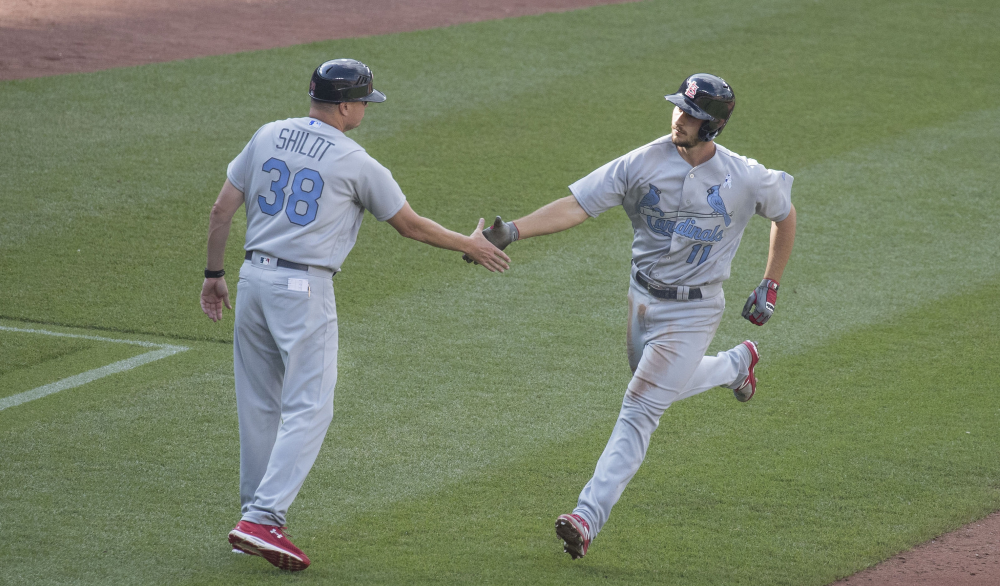
“Hello, I’m Paul DeJong.” (Photo: Keith Allison)

The St. Louis Cardinals selected Paul DeJong in the fourth round of the 2015 draft. DeJong was taken more for his bat than his defense. According to his alma mater Illinois State, for example, DeJong spent time at “second base, third base, catcher, right field, and as the team’s designated hitter” during his third and final season with the Redbirds. While suggestive of positional flexibility, that’s not the usual path of a defensive wizard. During that same campaign, however, DeJong also slashed .333/.427/.605 in 246 plate appearances. That kind of offensive performance can play at multiple positions.

The Cardinals used DeJong mostly third base after drafting him. He played 62 games at the hot corner in his first pro season and followed that up with 112 more starts at third in 2016 — but also 11 starts at shortstop. After some more work at short in the Arizona Fall League and a couple months in Triple-A, DeJong became the starting shortstop for the actual Cardinals, a contending major-league club. He finished second in balloting for the National League Rookie of the Year.

Minor-league third basemen don’t generally develop into major-league shortstops. If playing first base is incredibly hard, playing an adequate shortstop is nearly impossible. Even so, MLB is a copycat league. If an experiment works once, others will try it. Which brings us to the Cincinnati Reds and top prospect Nick Senzel.


Read the rest of this entry »


D-backs Continue Outfield Makeover in Deal with Rays, Yankees

The Yankees entered the offseason determined to stay under the luxury-tax threshold. The Rays, meanwhile, have appeared intent recently on cutting payroll. As for the Diamondbacks, their moves this winter seem to indicate a club looking to quietly build on its first postseason appearance in six years.

On Tuesday night, the aforementioned organizations came together to accomplish their individual objectives in a three-team trade. Nick Piecoro reported on the most notable players involved in the deal.

Steven Souza Jr. should immediately assume Arizona’s starting right-field job, while Brandon Drury represents an option at second and third base for a club that lacks experience at both positions. With regard to Tampa Bay, they both shed Souza’s $3.6 million salary and land a small collection of prospects, including Nick Solak from the Yankees and Anthony Banda and two PTBNL from Arizona. Another prospect, Taylor Widener, goes from New York to Arizona. Our own Eric Longenhagen evaluates the merits of the prospects involved here. It’s not a franchise-altering return for Tampa.

So what to make of all this?

Read the rest of this entry »


Scouting Anthony Banda, Nick Solak, and Taylor Widener

Below are scouting reports on the prospects who changed hands in the three-team trade on Tuesday night that sent OF Steven Souza, Jr. from Tampa Bay to Arizona and INF Brandon Drury from Arizona to the Yankees.

Prospects Acquired by Rays
Name Position Future Value ETA
Anthony Banda LHP 50 2018
Nick Solak 2B 45 2019
PTBNL — — —
PTBNL — — —

Anthony Banda, LHP
In 2017, Banda struggled at notoriously unforgiving Triple-A Reno, where he posted a 5.39 ERA. He made a spot start in Arizona in July and then was up again in August for a three-start look before he finished the year in the D-backs bullpen. Despite his poor on-paper production in 2017, his stuff remains intact and he profiles as a No. 4 starter. Banda sits 92-95 and will touch 96 with his fastball. He has an above-average changeup that he should probably throw more often and an average curveball in the 77-82 mph range. In light of what’s going on with Tampa Bay right now, he’ll probably exceed rookie limitations in 2017. He’s a 50 FV prospect who appeared within the honorable-mention section of our top-100 list.

Read the rest of this entry »


Red Sox Make Offseason’s Most Obvious Splash

The only thing that could’ve stopped this would’ve been a mystery team, and such a team never came out of the woodwork. From day one, the Red Sox were the favorites to sign J.D. Martinez as a free agent. The Sox just struggled to hit home runs in the absence of David Ortiz, and Martinez went deep a career-high 45 times. Boston had the desire, the money, and the roster space. Oh, sure, the Diamondbacks were in there somewhere, having fallen in love with what Martinez brought to them down the stretch, but they just had the desire and the space, and not so much the funds. They couldn’t have been considered a legitimate threat. And so there was no legitimate threat. Martinez and the Red Sox just needed to accept the circumstances.

Martinez wasn’t going to hold out much longer. But some late give by Boston compelled an actual agreement. The terms: five years, and $110 million. It’s more complicated than that, however, because Martinez can opt out after two years and $50 million, or after three years and $72 million. As such, what we’re seeing is a front-loaded deal that essentially has consecutive multi-year player options. This is more valuable than $110 million, in other words. Given the market, it’s a good deal for Martinez and it’s a good deal for Scott Boras. The final few years are like a safety net.

The Red Sox being a Dave Dombrowski operation, the future can figure itself out when it gets here. We can talk about Martinez’s contract deeper down. For now, for right now, the Red Sox have one of the best hitters in baseball. They’re not going to give the division to the Yankees without a fight.

Read the rest of this entry »


The White Sox’ Rotation Could Be Anything

The Chicago White Sox are projected to win 65 games in 2018 and lose 97. That’s fewer projected wins, and more losses, than are forecast for any other team in the league — including the majors’ new go-to bogeyman, the Miami Derek Jeters Marlins. The 2018 White Sox are projected to be the worst team in baseball.

But pretty soon, the White Sox are going to be pretty good. That’s not just me saying so; you believe it, too. A few weeks ago, when Jeff Sullivan asked readers to project out each team’s next five years, you collectively gave the Sox a little over 81 wins a year for each of the next five years — and that includes 2018, during which you presumably expect the Sox to be terrible.

It’s not that 81 wins is a tremendously impressive total on its own. It does, however, represent the 14th-highest figure readers gave to any of the 30 teams. For the next five years, you expect the Sox to be just above average. And, more than that, you expect the White Sox to trail only the Astros and the Phillies in terms of their performance over the next five years relative to their performance over the last five.

And I agree with you. Since kicking off their rebuild last winter with the Chris Sale trade, the Sox have managed to turn their star pieces of yesterday into a tremendous collection of young talent for tomorrow, sufficient to give them (according to Baseball America) the fifth-best farm system in the game and (according to Kiley and Eric) six of the top-100 prospects in all of baseball. So far, so good.

Read the rest of this entry »


The Padres Must Think That They’re Not Far Away

The last time the Padres won at least half of their games was 2010. Last year’s team finished with 71 wins and 91 losses, and, according to the underlying numbers, the club was actually even worse than that. Looking immediately ahead, the picture doesn’t look much better. Steamer thinks the Padres are the worst team in the NL West. PECOTA agrees. We don’t have everything we need from the ZiPS projections yet, but that system’s probably in agreement with the others. The 2018 Padres almost certainly aren’t going to make the playoffs. They’re just another organization that’s tried to rebuild.

The 2018 Padres are also going to play Eric Hosmer just about every day. News came out Saturday evening that Hosmer finally decided between the Padres and the Royals. The terms from San Diego, given to the 28-year-old first baseman: eight years, $144 million. There’s an opt-out after year five. Hosmer will get $105 million over the first five years, with the last three worth $39 million, in the event Hosmer sticks around. Reports recently had the Padres offering seven years, while Scott Boras wanted nine. These things so often end up with the obvious compromise.

Hosmer has been out there so long, and he’s been polarizing so long, that there’s hardly even anything new to say. If you’re a regular reader of FanGraphs, you know what Hosmer is, and what he isn’t. I wrote about the idea of Hosmer signing a big contract with the Padres back in the middle of December. Everything I said then still applies. This is an interesting deal, of course; Hosmer is admittedly fascinating. But what might be even more interesting is the signal this sends. The biggest contract of the offseason was given by a last-place team. That last-place team clearly has no intention of remaining there very much longer.

Read the rest of this entry »


The Best of FanGraphs: February 12-16, 2018

Each week, we publish in the neighborhood of 75 articles across our various blogs. With this post, we hope to highlight 10 to 15 of them. You can read more on it here. The links below are color coded — green for FanGraphs, brown for RotoGraphs, dark red for The Hardball Times and blue for Community Research.
Read the rest of this entry »


Blue Jays Continue Sneaky-Good Offseason with Jaime Garcia

Around the same time the Orioles were finalizing a two-year deal for Andrew Cashner, the Toronto Blue Jays signed a better pitcher at about half the cost. After multiple arm and shoulder surgeries, Jaime Garcia isn’t what he once was, but the 31-year-old was an average starter last year and should repeat that level of production in the coming season. For $8 million over one year plus a $2 million buyout on a $10 million option for 2019, the Blue Jays are paying for less than average.

Garcia fits the mold of many of the Blue Jays’ moves this offseason. In addition to other formers Cardinals Aledmys Diaz and Randal Grichuk, the Blue Jays have also acquired multiple low-cost, quality players like Curtis Granderson and Yangervis Solarte, allowing for the possibility of catching lightning in a bottle to make a run for the playoffs. On the other hand, if the season goes south, the team has plenty of flexibility to take the franchise in a different direction and try to reload as Bo Bichette and Vladimir Guerrero Jr. get closer to the majors.

Injuries took away the bulk of Jaime Garcia’s prime. He barely pitched in 2013 and 2014, and wasn’t ready at the start of 2015, either. He had a resurgence in 2015, though, making 20 starts and pitching like a top-of-the-rotation starter, with a 3.00 FIP and 2.43 ERA. Garcia was more good than ace for the first part of 2016, but still showed some flashes of greatness before falling apart at the end of the season. The Cardinals traded him to the Braves, and he had a roughly average season, putting up a 4.25 FIP, 4.41 ERA, and 2.1 WAR over 157 innings for a combination of the Braves, Twins, and the Yankees.

The lefty pitched better for the Braves than he did with the Yankees. In New York, struggled to throw strikes, pitching in the zone just 40% of the time — well below his career average of 48% — and experiencing a similar dip in first-strike percentage. Even with those issues, he was only slightly below average as a starter for the Yankees. Assuming his 21% HR/FB rate was more a reflection on the small 37.1-inning sample and not his true talent level, he didn’t pitch too poorly. 

Read the rest of this entry »


Shohei Ohtani and the Angels’ Six-Man Rotation

The Los Angeles Angels struck gold this offseason. The addition of Zack Cozart and Ian Kinsler to a core that already included Justin Upton (re-signed to a five-year deal in November), Andrelton Simmons, and the incomparable Mike Trout has created a collection of position players few other clubs can rival. Nor does this even acknowledge the club’s greatest stroke of fortune this winter — namely, the signing of coveted two-way player Shohei Ohtani.

Understandably, the team wants to protect its new 23-year-old star. Ohtani joins a rotation composed mostly of damaged limbs. Because of the fragility present here, the Angels are going to try something novel — namely, to employ a six-man rotation. Unfortunately, it probably won’t work.

There are good reasons for a six-man rotation, and Angels’ starters meet several of the relevant criteria for experimenting with one. First of all, the club lacks a true ace. Despite having never faced a major-league batter, Ohtani is probably the club’s best pitcher. Given his unique position, however, it makes sense that the Angels wouldn’t expect him to carry the load of a No. 1 starter.

Beyond Ohtani, the Angels don’t possess a pitcher who needs to start every fifth day. Allocating five of Clayton Kershaw‘s or Corey Kluber‘s or Max Scherzer’s to another pitcher would be bad for a team trying to win baseball games. The Angels don’t have a pitcher of that class, though. That makes a six-man rotation more feasible from a competitive standpoint.

Read the rest of this entry »


Top 14 Prospects: Seattle Mariners

Below is an analysis of the prospects in the Seattle Mariners farm system. Scouting reports are compiled with information provided by industry sources as well as from our own (both Eric Longenhagen’s and Kiley McDaniel’s) observations. For more information on the 20-80 scouting scale by which all of our prospect content is governed you can click here. For further explanation of the merits and drawbacks of Future Value, read this.

Mariners Top Prospects
Rk Name Age Highest Level Position ETA FV
1 Kyle Lewis 22 A+ OF 2020 45
2 Sam Carlson 19 R RHP 2022 45
3 Evan White 21 A- 1B 2020 45
4 Julio Rodriguez 17 R RF 2023 40
5 Braden Bishop 24 AA CF 2019 40
6 Max Povse 24 MLB RHP 2018 40
7 Nick Rumbelow 26 MLB RHP 2018 40
8 Matt Festa 24 A+ RHP 2018 40
9 Art Warren 24 A+ RHP 2018 40
10 Wyatt Mills 23 A RHP 2020 40
11 Luis Liberato 22 AA OF 2020 40
12 Mike Ford 25 AAA 1B 2018 40
13 Dan Vogelbach 25 MLB 1B 2018 40
14 Joe Rizzo 19 A+ 3B 2020 40

45 FV Prospects

1. Kyle Lewis, OF
Drafted: 1st Round, 2016 from Mercer
Age 21 Height 6’4 Weight 210 Bat/Throw R/R
Tool Grades (Present/Future)
Hit Raw Power Game Power Run Fielding Throw
30/50 55/60 40/55 45/40 45/50 60/60

Lewis’s pro career just cannot get off the ground. After signing in 2016, he was sent to short-season Everett — a pretty cushy assignment for a top college draftee, but not unusual for a small-school prospect — where he played for a month before tearing his right ACL in late July. When Lewis got back into games during extended spring training in Arizona the next year, he didn’t look ready. His bat speed was intact, but he was noticeably hobbled in a way that scouts thought impacted him on both sides of the ball. They suspected he was rushing back too quickly.

Read the rest of this entry »