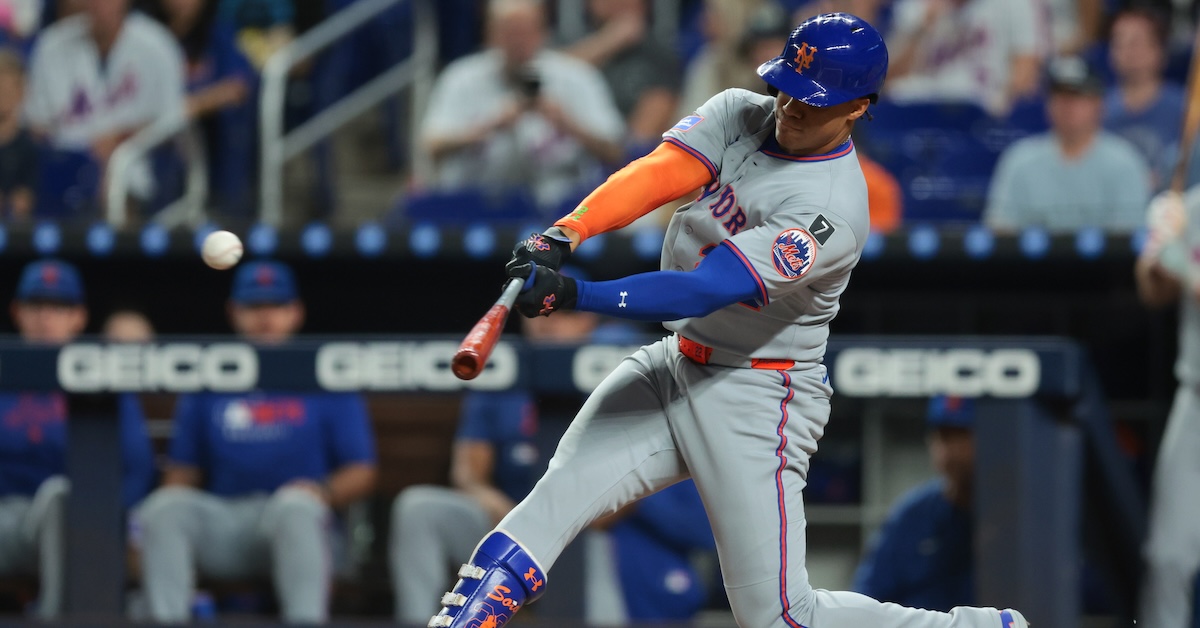
The Mets had the day off on Monday, and thank God. In any other line of work, they’d have called in sick with one of those mysterious 24-hour stomach bugs after the week they had. Close the blinds, get some sleep, hope everyone at the office has forgotten you existed by the time you clock in on Tuesday.
See, the Mets have spent the past two months in a real doozy of a race for the NL East title. On June 16, the Phillies beat the Marlins 5-2 while the Mets were idle, cutting New York’s lead in the division to two games. From that day until Tuesday, August 5, the division lead swung back and forth, but neither team could forge an advantage of more that two games. Read the rest of this entry »
Last week, I took a peek at which offenses have exceeded (or missed) expectations this year. I did that by taking every player’s preseason projection and actual playing time to create a projected wOBA for the entire offense. I compared that to what has actually happened. The difference? That’s what we’re looking for, how much a team has surprised to the good or bad in 2025.
I couldn’t leave it at just one phase of the game, though. Pitching can be measured the same way (ish, see methodological notes below if you’re interested in the nitty gritty). I didn’t want to compare ERA (too noisy) or FIP (too regressed, aka not noisy enough). I settled on wOBA as a good representation of how well a pitching staff is doing overall. It’s a middle point between the two other options, so we are neither ignoring what happens on balls in play, nor caring too much about sequencing. Here, for example, are the Texas Rangers, the biggest overachievers of the season:
Right away, you can see why they’ve beaten expectations by so much. Four-fifths of their starting rotation, four of the five pitchers who have faced the most batters, have performed meaningfully better than their preseason projections. The fifth is Jacob deGrom, who had one of the best projections in baseball coming into the season and has hit it on the nose. Even their most-used bullpen arms have been pleasant surprises. That’s how you allow the fewest runs in baseball by a mile, apparently. Read the rest of this entry »
There’s no such thing as a perfect pitcher. There are guys with an incredible ability to spin the ball, but nothing to throw for whiffs at the top of the zone. (Mitch Keller and Matt Brash come to mind.) Some pitchers pump backspin four-seamers, but never settle on a reliable secondary. (Ryne Nelson, I’m looking at you.) Excelling at one thing often means being deficient at another.
Still, even if there are no perfect pitchers, there are some who come closer than others. Prime Gerrit Cole featured a carry heater and a firm slider with meaningful horizontal break. Jacob deGrom? Same deal. Some guys break our general understanding of the tradeoffs between certain pitch types. Most of those guys are aces. One of them is Ryan Bergert — at least potentially.
If that name rings a bell, it’s likely because Bergert featured in a deadline deal that brought him to Kansas City (along with Stephen Kolek, a rock-solid fifth starter type) in exchange for backup catcher Freddy Fermin. In these early days following the trade, Fermin is acquitting himself well, lining a bunch of base hits and striking out just once so far.
Fermin is valuable — especially to the catcher-deprived Padres — though not particularly exciting. He’s under team control for the rest of the decade, but he’s firmly locked into the “light-hitting backstop with excellent defensive skills” archetype. Bergert, on the other hand, strikes me as a guy with serious upside. Read the rest of this entry »
Jack Dreyer has been one of the top performers on a Los Angeles Dodgers pitching staff that includes no shortage of better-known hurlers. Amid relative obscurity, the 26-year-old rookie left-hander has logged a a 2.98 ERA and a 2.95 FIP over 46 appearances comprising 57-and-a-third innings. Moreover, only Yoshinobu Yamamoto has been worth more WAR (3.5) than has the 2021 non-drafted free agent out of the University of Iowa (1.3).
Our lead prospect analyst was early to the bandwagon. When our 2025 Dodgers Top Prospects list was published in late April, Eric Longenhagen described Dreyer as “incredibly deceptive,” adding that his whippy arm action delivers a fastball that has “20 inches of due north vertical break as it explodes toward the plate.”
The southpaw’s signature pitch wasn’t seen as plus during his injury-marred Iowa Hawkeyes days.
“In college, I was always told that I have average spin rate, so I can’t really throw my fastball at the top of the zone,” recalled Dreyer, who missed much of the 2019 season with a shoulder injury, then all of 2021 after undergoing Tommy John surgery. “I was told that I had a very average fastball. I kind of believed that, but then I got to the Dodgers and they were like, ‘No, actually, your stuff is really, really good. You can live at the top of the zone because of how your pitch moves.’ So, that’s kind of how I’ve adapted my pitching, using heaters at the top, which opens up my other pitches.”
Dreyer’s secondaries comprise a curveball that he’s thrown at a 10.8% clip this season, and a “bad slider” that he’s thrown far more frequently at 45.2%. More on the latter in a moment. Read the rest of this entry »
My favorite baseball questions are the ones that require both quantitative data and subjective analysis to answer. Who is the greatest baseball player of all time? Well, I could pull up the career WAR leaderboards, say Babe Ruth, and call it a day, but that wouldn’t a satisfying way to reach a conclusion. All of us know that the essence of Ruth — his vast accomplishments and legend — cannot be encapsulated by how many Wins Above Replacement he was worth.
What about Barry Bonds? He ranks second with 164.4 WAR, less than three wins behind Ruth (167.0), while playing against better competition; after all, Bonds wouldn’t have been allowed to play during Ruth’s career. Good point, but there’s the whole steroids thing clouding his legacy. For a while, Mike Trout looked like a worthy answer because of how much better he was than everybody else at a time when sabermetrics were becoming more mainstream. We would use the data to quantify his excellence and then, whenever the numbers alone weren’t convincing, we would say something about the superior talent level in the game today. Now, of course, the overwhelming majority of us would probably answer Shohei Ohtani because of his two-way exploits. We could cite his statistics, but we’d have to include so many qualifications, most of which would relate to the fact that he’s pitching and hitting.
I am not going to reveal my answer in this week’s mailbag because none of you asked for it. Instead, I bring this up because it relates to a different question that a reader named Derek submitted, which we’ll get to in a moment. But before we do, I’d like to remind all of you that while anyone can submit a question, this mailbag is exclusive to FanGraphs Members. If you aren’t yet a Member and would like to keep reading, you can sign up for a Membership here. It’s the best way to both experience the site and support our staff, and it comes with a bunch of other great benefits. Also, if you’d like to ask a question for an upcoming mailbag, send me an email at mailbag@fangraphs.com. Read the rest of this entry »
We’re 10 years or so into the launch angle revolution, and the reasoning behind it hasn’t changed much. Groundballs have a .228 wOBA this season, while all other balls in play are at .462. Hit the ball on the ground, and you’re Christian Vázquez. Hit it in the air, and you’re Aaron Judge. Players are gearing their swings for damage in the air. They’re optimizing their bat path for an upward trajectory. They’re meeting the ball farther out in front. They’re looking to hit the bottom third of the ball. Knowing all this, I doubt you’d be surprised to learn that 2025 is shaping up to set the record for lowest groundball rate since 2002, when Sports Info Solutions first started tracking such things. But you might be surprised to learn just how extreme the shift has been.
So far, I’ve talked about all the reasons that batters have tried to put the ball in the air more, but that’s only half the story. Five years ago, Ben Clemens wrote a great article in which he tried to determine whether batters or pitchers exert more control over groundball rates. After separating the batters from the pitchers, he split each group into quartiles based on their 2018 groundball rates and then looked at the results when each group faced off in 2019. He found that the effect was nearly identical. When you moved the batter up one quadrant, the groundball rate of the new pairing went up by an average of 5.2 percentage points. When the pairing moved up a quadrant in the pitcher pool, the groundball rate went up by 4.8 percentage points. Knowing that, let’s not blame this all on the batters. Are pitchers as responsible as batters for the shrinking groundball rate across the majors? Let’s start by updating my 2023 league-wide update on pitch mix.
Since July 1, three major league offenses have been head and shoulders above the rest of the field. First, the Toronto Blue Jays, who have benefited not only from a white-hotBo Bichette, but from having the opportunity to slather a hapless Rockies pitching staff in runs this week. Third in wRC+ but second on this list for editorial purposes: The Athletics, whose offensive run is mostly Nick Kurtz. That’s an exaggeration, but not by much; Kurtz alone is responsible for 2.6 of the vagabonds’ 6.7 position player WAR since July 1, and 39 of their 165 weighted runs created.
Here’s one of those other things propping up Milwaukee’s offense: Andrew Vaughn, one of the greatest college hitters of the 2010s and a former top-three pick, but also a legendary draft bust as of eight weeks ago. Read the rest of this entry »
Friends, Red Sox fans, FanGraphs readers, lend me your ears,
I come to analyze the contract extension, not to bemoan it.
The free agency status that teams despise lives after them,
The good is oft interred with their luxury tax penalties.
So let it be with Anthony. The noble Red Sox
Hath told you that Rafael Devers was ambitious;
If it were so, it was a grievous fault,
And grievously hath the lineup answer’d it.
Here, under leave of Meg and the rest,
For they are honorable editors,
Come ZiPS to speak at Anthony’s signing,
It is my computer, faithful and just to me.
While the Red Sox have quite the mixed record of letting players leave in free agency or trading them before they can sign elsewhere, the organization has been fairly aggressive at signing players with limited service time in order to buy out free agent years in advance. Brayan Bello is signed through 2030, at least if a club option is picked up, and both Kristian Campbell and Ceddanne Rafaela, well short of arbitration status, are under club control into the 2030s. When the Red Sox acquired Garrett Crochet, they didn’t muck around either, making sure he’d be kept in town on a six-year, $170 million contract extension that he signed a few months after the trade.
Now it’s Roman Anthony’s turn. The guaranteed portion of the contract calls for $130 million over eight years, beginning next season, with $125 million total in salary through the 2023 campaign and a $5 million buyout on a $30 million club option for 2034. If the Red Sox pick up the option, the total value of the deal would be nine years and $155 million. There is also a Halloween bucket full of various incentives that could net Anthony a maximum $230 million over the next nine years. However, that high-end figure will be quite hard to meet. As MassLive’s Chris Cotillo points out, for Anthony to earn that $230 million maximum, he would have to finish top two in the Rookie of the Year voting this season, make the All-Star team in all eight seasons of the extension and also in the option year, and win the next nine MVP awards — one for every year of the extension, plus the option season. Nobody has ever won nine MVPs; Barry Bonds has the most, with seven. So, in order to hit every incentive in his new contract, Anthony would have to become, without exaggeration, the best baseball player ever. If, in the pretty-much-impossible event that this happens, the Red Sox would be getting literally the greatest of all time for less money than the Angels are paying Anthony Rendon. Read the rest of this entry »
If you’re a fan of a large-market team that has recently been struggling to score runs, you may be eligible for compensation. Wait, no – that’s not right. You may be eligible to complain about your team in my weekly chat? Not quite it, either. Let’s try it one more time… If you’re a fan of a large-market team that has recently been struggling to score runs, you are eligible to read this article and see to what extent your team has let you down and to what extent it’s just a narrative.
The Yankees and Mets have been having a tough time of late, which always brings out doubters, both fans and rivals. I don’t quite know what to tell those grumpy souls. You’re upset with the Yankees offense? Well yes, sure, absolutely, carry on, but they do have the highest team wRC+ in baseball. The Mets let you down? Without a doubt, they’re the Mets, so on and so forth – but they’re top 10 in baseball in wRC+, too. Orioles offense bumming you out? Yeah, I mean, they’ve been a bummer, but they’ve also been impacted by injuries, which seems hard to blame them for.
I came up with a quantitative test for how much teams have disappointed relative to preseason expectations. I took the actual playing time that each team has allocated so far. Then, I used preseason projections to come up with the offensive numbers we’d expect from each team given who has played and how good we projected them to be. I compared that to how good the team has actually been. The difference between those two numbers is the aggregate overachievement or underperformance that can’t be attributed to injury. Read the rest of this entry »
I used to have a bit that one of the joys of the postseason was watching the wider baseball-watching public discover a previously unknown Rays pitcher when he mowed down the Astros in the first nationally televised game of his career.
It’s a little harder to pull that off as a position player: Go from complete unknown to key regular on a playoff team. In fact, a lot of the most important position players in this pennant race — Shohei Ohtani, Kyle Schwarber, Manny Machado — were names before they even joined their current teams.