Liam Hendriks Finally Faltered

Liam Hendriks
Gregory Fisher-USA TODAY Sports

Liam Hendriks got shelled last night. After it looked like the White Sox had put the game away — they led 8–2 after the bottom of the eighth inning — the Guardians made things interesting by stringing together hits, errors, and walks to trim the deficit to 8–4. With two outs, Tony La Russa called for Hendriks, who promptly surrendered a single and a grand slam to tie the game.

It was the the first blemish on what otherwise would have been a sterling week for Hendriks. From May 2 to May 7, he’d been an absolute workhorse, making five appearances in six days without allowing a run. We’ll probably never know whether Monday’s game — his sixth in eight days — was affected by fatigue; Hendriks wouldn’t likely admit that even if it were the case. But it’s reasonable to wonder whether something could have gone differently, somewhere in the sequence of events, that gave the White Sox a better chance of hanging on last night.

Six games in eight days is an effective cap on reliever usage these days. No reliever has thrown seven games in eight days in the past three years; six games in eight days has happened 23 times over that same stretch. Hendriks himself accounts for three of those, with the rest a hodgepodge mix of closers and low-leverage middle relievers and Raisel Iglesias as the only other pitcher with multiple entries.
Read the rest of this entry »


The Red Sox Are Once Again Disappointing

© Gregory Fisher-USA TODAY Sports

The Red Sox may not be as catastrophically awful as the Reds, but at 10-19 they’re running last in the AL East and own the league’s second-worst record ahead of only the Tigers (8-20). Cripes, they’re looking up at the 12-17 Orioles, losers of at least 108 games in each of the last three full seasons. But while Baltimore is in the midst of a seemingly interminable rebuilding effort, Boston is coming off a season in which it won 92 games and fell just two wins short of a World Series berth, and its payroll — $236.6 million for Competitive Balance Tax purposes — is over the tax threshold. At the moment, the Red Sox look like the worst team that money can buy.

You’re forgiven if this feels somewhat familiar, because the Red Sox have made precipitous falls something of a specialty. In 2011, they won 90 games, then crashed to 69 wins the following year while carrying a $175 million payroll, second only to the Yankees. They followed that with a 97-win rebound and their third championship in a decade in 2013… only to plummet to 71 wins a year later. They fell even further from 2018 (108 wins) to ’19 (84) than from ’11 to ’12, but they at least finished above .500 in the latter campaign before plummeting to 24-36 — and last place in the division — during the pandemic-shortened 2020 season.

Here’s a quick look at where this start fits in among expansion-era Red Sox teams:

Red Sox Teams With Worst Records Through 29 Games
Year W L Win% W L Win%
1966 8 21 .276 72 90 .444
2020 9 20 .310 24 36 .400
1996 10 19 .345 85 77 .525
2022 10 19 .345 NA
1972 11 18 .379 85 70 .548
1961 12 17 .414 76 86 .469
1964 12 17 .414 72 90 .444
1984 12 17 .414 86 76 .531
2012 12 17 .414 69 93 .426
2019 12 17 .414 84 78 .519
SOURCE: Baseball-Reference
Since 1961.

This current team is tied with the 1996 edition for the third-worst record to this point. While some of the above squads were able to scramble back above .500, none of them made the playoffs; the slow start cost the 1972 team a spot in the strike-shortened season. No team that has started 10-19 since the playoffs last expanded in 2012 has even claimed a Wild Card spot, though an 11-18 Pirates team did in ’14, and five other 11-18 teams did so from 1995-2011, when each league only awarded one Wild Card spot. Read the rest of this entry »

What Is an Analytics Coordinator? The White Sox Shelley Duncan Tells Us.

© Kamil Krzaczynski-USA TODAY Sports

Shelley Duncan has a job befitting a longtime FanGraphs reader with deeps roots in the game. A big league outfielder/first baseman from 2007-13, the 42-year-old son of legendary pitching coach Dave Duncan is the Analytics Coordinator for the Chicago White Sox. Hired for the in-uniform position in November 2020, Duncan previously managed in the Arizona Diamondbacks system and served as both a field coordinator and a special assistant of baseball operations with the Toronto Blue Jays.

Duncan discussed his current role, and the way analytics are changing the way teams game plan, when the White Sox visited Fenway Park over the weekend.

———

David Laurila: Your title is Analytics Coordinator. What does the role entail?

Shelley Duncan: “It’s a position that is starting to become more popular with some teams, to have somebody in the dugout that can help other staff members, and players, with information. You can translate information and be an intermediary between them and the analytics part of the front office. You’re not replacing any of the relationships, or any of the jobs, just being a source for everyone.

“There are so many areas of focus on a baseball field that involve information. Whether it’s players knowing stuff about themselves, about the opponent, decision-making during games, advance work… half of the advance work is digging into numbers and information, and then blending video. One guy can’t do all that — I can’t do all that — but what I can do is support everybody with my experience and knowledge, including the work I do with the analytics department.”

Laurila: I assume you’re consulting with the analytics department on a regular basis… Read the rest of this entry »


Home Runs and Drag: An Early Look at the 2022 Season

© Charles LeClaire-USA TODAY Sports

The month of April is now complete and the verdict is in: The in-play home run rate for the 2022 season is down from recent seasons, as shown in Figure 1. Much has already been written about this feature by a variety of authors, including Jim Albert, Rob Arthur, Eno Sarris and Ken Rosenthal, and Bradford Doolittle, Alden Gonzalez, Jesse Rogers and David Schoenfield, and various reasons have been proposed for the relative dearth of home runs. Some argue that the baseball has been deadened, resulting in lower exit velocities and therefore fewer home runs. Others have suggested that the drag on the baseball has increased, perhaps due to higher seams. Yet others have argued that it is the effect of the universal humidor.

Figure 1

In this article, we will address the issue of reduced home run rates and hopefully add more light to the discussion. Specifically, we will examine home run rates during the month of April for the 2018-22 seasons, excepting the ’20 season for which there was no major league baseball in April. Here is our approach. Read the rest of this entry »


Hey, the Reds Won a Series!

© Katie Stratman-USA TODAY Sports

The Reds won a series this weekend, beating the Pirates in two out of three games. Ordinarily, this wouldn’t rate as news, but it’s the first time since they swept the Nationals last September 24-26 that they could claim such an accomplishment, and the first time all season that they came from behind to win a game. They entered Friday with a 3-22 record — a standard of futility surpassed by only one team since 1901 — and had won just one of their previous 21 games in the wake of president Phil Castellini’s now-infamous “Where are you gonna go?” speech before the team’s April 12 home opener. Even with the series win, which came at the expense of the garden-variety bad Pirates (now 11-16), this undermanned team has been unsightly so far.

After making the expanded playoffs with a 31-29 record in 2020, the Reds went 83-79 last year, but missed out on the postseason thanks to their payroll slashing and then gutted the roster even further. With general manager Nick Krall euphemizing the teardown by telling reporters, “We must align our payroll to our resources and continue focusing on scouting and developing young talent from within our system” in November, the team was similarly aggressive in slashing payroll this past winter. They let lefty Wade Miley — on whom they held a $10 million club option after a solid, 2.9-WAR season that even included a no-hitter — escape via waivers to the Cubs, made no attempt to retain Nick Castellanos after he opted out, and traded Tucker Barnhart to the Tigers, though at least they had a ready successor to him in Tyler Stephenson. Once the lockout ended, they quickly dealt away Sonny Gray, Jesse Winker, Eugenio Suárez, and Amir Garrett. They did sign four free agents to major league deals, though all were for a single year, and only those for Donovan Solano ($4.5 million) and Tommy Pham ($7.5 million) came in north of $2 million. In fact, only two players, Joey Votto and Mike Moustakas, are signed to guaranteed deals beyond this season. Read the rest of this entry »


Ben Clemens FanGraphs Chat – 5/9/22

Read the rest of this entry »


An Overdue Barrel Rate Refresher

© Richard Mackson-USA TODAY Sports

Before the 2020 season, I wrote a series of articles that looked at how much control batters and pitchers exerted over various outcomes: home runs, strikeouts and walks, fly balls, that kind of thing. I found the conclusions helpful, if mostly as expected: batters have more to say about home runs and line drives, but both sides have input on strikeouts, walks, grounders, and fly balls.

I decided to apply the same methodology – which I’ll detail below – to check on something that I thought I already knew the answer to: do pitchers exert any control over barrel rate, and how much do hitters do the same? Barrels are essentially batted balls hit extremely hard and at dangerous angles; I think they’re a great way of thinking about hard contact.

There’s already been plenty of research on the year-over-year stability of batter barrel rate. There’s been plenty on the fact that pitchers don’t do the same. Here’s a preview of my findings: I didn’t find anything that disputes that. I still think it’s useful confirmation, however, and I’m also pretty proud of the method. Thanks to Tom Tango, there’s even a rough rule of thumb to use if you want to estimate future barrel rates. Without further ado, let’s get to it. Read the rest of this entry »


FanGraphs Power Rankings: May 2–8

Due to the delayed start to the season, we’ve only now finished one month of play in the regular season. And while there are still plenty of games left, we’re already seeing the best teams pull away from their competition as a few disappointing teams continue to dig themselves into a hole.

A reminder for how these rankings are calculated: first, we take three most important components of a team — their offense (wRC+), and their starting rotation and bullpen (a 50/50 blend of FIP- and RA9-, weighted by IP share) — and combine them to create an overall team quality metric. New for this year, I’ve opted to include defense as a component, though it’s weighted less than offense and pitching. Some element of team defense is captured by RA9-, but now that FanGraphs has OAA/RAA from Statcast available on our leaderboards, I’ve chosen to include that as the defensive component for each team. I also add in a factor for “luck” — adjusting a team’s win percentage based on their expected win-loss record. The result is a power ranking which is then presented in tiers below.

Tier 1 – The Best of the Best
Team Record “Luck” wRC+ SP- RP- RAA Team Quality Playoff Odds
Yankees 19-8 -1 118 78 72 -1 176 95.1%
Dodgers 19-7 -3 110 65 68 -3 156 97.9%
Mets 20-10 1 117 81 91 2 161 89.8%

The Yankees’ win streak was snapped at 11 games on Wednesday, and their weekend series against the Rangers was interrupted by the bad weather that disrupted games all along the East Coast, with a doubleheader on Sunday and the third game rescheduled for Monday afternoon. Those two rainouts mean the Yankees will play 23 games in 22 days; as easy as their early schedule has been, this stretch will really test their depth and endurance.

The rain disrupted the Mets, too. They already had a weird week with a scheduled doubleheader against the Braves on Tuesday, a makeup for the games missed due to the lockout. Then, on Thursday, New York had its signature win for the season so far, rallying against the Phillies and scoring seven runs in the ninth inning to erase a 7–1 deficit. Games on Friday and Saturday were canceled, giving the team two days to bask in the glory of the comeback victory before splitting a doubleheader on Sunday.

The Dodgers swept the banged-up Giants in two games, then finished the week by taking three straight against the Cubs in Chicago, outscoring those two teams 32–5. Mookie Betts has finally awoken from a slow start to lead the offense, collecting three home runs during his current nine-game hitting streak. Even more encouraging is Cody Bellinger’s bounce-back campaign after an injury-riddled 2021 season. Read the rest of this entry »


Edmundo Sosa, Future Hit by Pitch King?

Edmundo Sosa
Katie Stratman-USA TODAY Sports

Chances are you haven’t thought much about Edmundo Sosa recently. He lost the Cardinals’ starting shortstop gig to Paul DeJong before the season began, leading to inconsistent playing time. When given opportunities, he’s been hitting a paltry .160/.250/.160; striking out 42.9% of the time and walking zero percent of the time will do that. Making matters worse, his placement on the COVID-19 injured list last week further removed him from the action. He’s seen better days.

But wait — if you’re an astute reader, you might have noticed a curious detail. If Sosa has yet to draw a walk, how is his on-base percentage that high? I’m so glad you asked (and not me, who definitely didn’t need a segue). While Sosa has just 28 plate appearances to his name, he’s already been hit by a pitch three times. That seems like quite a high rate of plunkings! Indeed, here are the much-too-early-but-relevant leaders in hit by pitches per plate appearances so far this season. Guess who’s at the very top:

2022 HBP per PA Leaders
Name HBP/PA
Edmundo Sosa 0.11
Michael Hermosillo 0.09
Teoscar Hernández 0.08
James McCann 0.07
Cavan Biggio 0.07
Luis Urías 0.05
Min. 20 PA

Take that, Michael Hermosillo. It’s Sosa who claims the throne by a small margin, but considering his offensive woes, the man needs any victory he can take. To Cardinals fans, though, his capabilities as a pitch magnet are nothing new. In 326 more successful plate appearances last season, Sosa dutifully bore the brunt of 17 pitches, which formed the backbone of a respectable .346 on-base percentage; he’s not the type to wait out four balls for it. That, in tandem with flashes of gap-to-gap power, made Sosa a sneaky component of the Cardinals’ yearly devil magic, as they made the postseason in stunning fashion.

It’s unfortunate that Sosa’s bat is dormant to begin 2022, but at least one offensive skill remains. Skill? Absolutely: certain hitters are better than others at getting plunked, and while there’s evidence that pitchers are driving the recent spike in hit-by-pitches, there’s also research suggesting that the latest generation of hitters are eager to endure pain for a free base. In Sosa’s case, any pitcher influence seems minimal; he’s seen about a league-average rate of pitches up-and-in thus far. That he led the league in HBP per PA last season (among hitters with 300 or more PA) and is continuing his reign is no accident. Sosa gets beaned a lot, and he’s good at it. Read the rest of this entry »


Toronto’s Trent Thornton and Minnesota’s Josh Winder Have Distinctly Different Sliders

© Troy Taormina-USA TODAY Sports

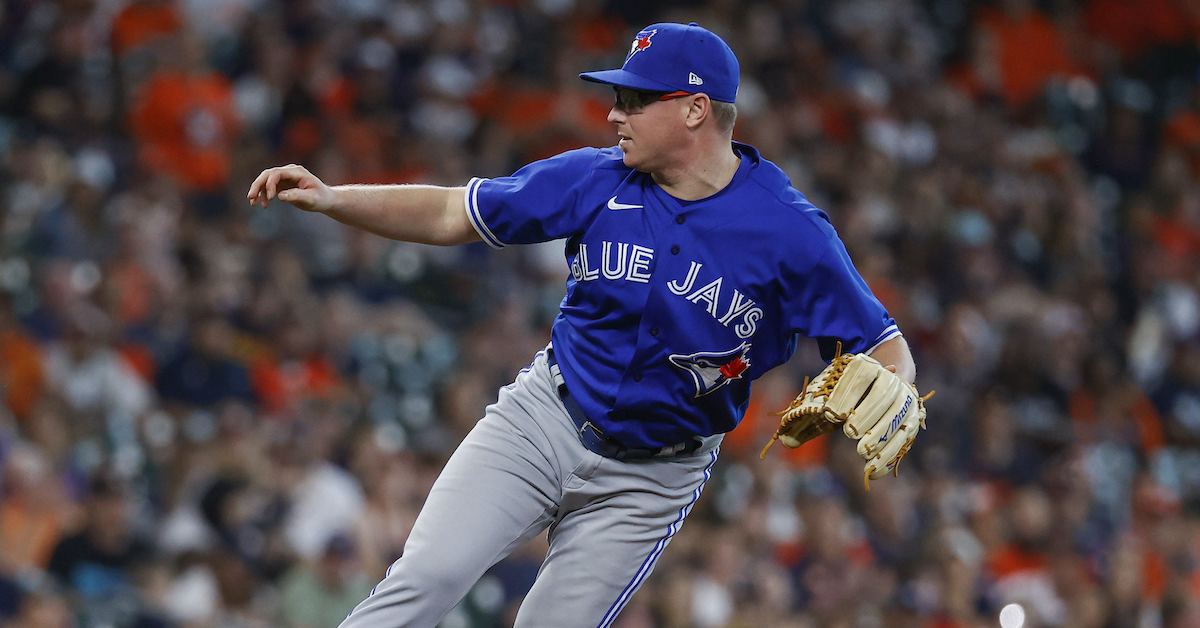
The Learning and Developing a Pitch series is back for another season, and once again, we’re hearing from pitchers on a notable weapon in their arsenal. Today’s installment features a pair of right-handers — Toronto’s Trent Thornton and Minnesota’s Josh Winder — on their distinctly different sliders.

———

Trent Thornton, Toronto Blues Jays

“Last year, I struggled with putting away righties. My slider wasn’t playing very well. I feel like curveballs are normally better to lefties anyways, so I started tinkering with a new slider grip that [Blue Jays pitching strategist] David Howell showed me. I started throwing that halfway through spring training, saw some pretty promising results, and took it straight into this season. I feel pretty confident with that pitch, being able to throw it in the zone, or out of the zone.

“It’s kind of an interesting grip for a slider. Normally, when guys are throwing a slider they want to think fastball as long as possible and kind of get that short, late action. But with this one, I’m almost thinking, ‘Completely on the side of the ball.’ In my mind, I’m trying to up-shoot it almost. I want to go straight across. It’s weird, because when I throw it, my wrist is literally like this; it’s kind of sideways. Basically, I’m thinking about bringing the back of my hands straight at the hitter. Read the rest of this entry »
