Archive for Daily Graphings

Jeff McNeil is a Throwback

It would be inaccurate to say that Jeff McNeil came out of nowhere, but unless you were a Mets fan with a deep knowledge of the team’s minor league system, chances are that you hadn’t heard of him before he was called up last July 24. Since then, he’s done nothing less than post the majors’ fourth-highest batting average (.339) as part of a contact-centric profile with echoes of yesteryear. Having additionally shown himself capable of manning multiple positions, the 27-year-old lefty swinger has become a staple of manager Mickey Callaway’s lineups, and a key cog in a much-improved offense.

McNeil arrived as a man of mystery largely because of his age and injury history. A 12th-round 2013 draft pick out of Cal State Long Beach, he hit for high batting averages with minimal power (a total of four home runs) in his first three professional seasons, most notably leading the Florida State League with a .373 on-base percentage in 2015. Just as he reached the high minors, surgeries to repair a pair of sports hernias and a torn labrum in his hip limited him to a mere three games in 2016; he played in just 48 games in 2017 due to a groin injury. Between the lack of playing time and minimal power, he barely grazed even the deepest prospect lists. Just before the injury bug bit, Baseball America included him as a 40-grade prospect, 27th in the Mets’ system, in its 2016 Handbook. He was an honorable mention on FanGraphs’ Mets list that same year.

Finally healthy, and sporting 40 pounds of additional muscle relative to his pre-injury days, the 26-year-old McNeil broke out to hit .327/.402/.626 (182 wRC+) with 14 homers (five more than his previous career total) in just 57 games at Double-A Binghamton last year, then .368/.427/.600 (165 wRC+) with five more homers in 31 games at Triple-A Las Vegas. He began garnering attention, from prospect hounds, though even Baseball America’s midseason Mets top 10, published four days before his debut, merely consigned him to the “Rising” category. He arrived in Queens in late July, just before the team traded incumbent second baseman Asdrubal Cabrera to the Phillies. As the Mets went nowhere amid an otherwise sour season, he hit .329/.381/.471 (137 wRC+) in 248 PA while playing a credible second base (0.4 UZR in 54 games), good for 2.7 WAR. Notably, he struck out in just 9.7% of his plate appearances, the second-lowest mark of any player with at least 200 PA. Read the rest of this entry »

Trevor Bauer and the Math of Pitching Backwards

When I was a kid, my dad taught me about baseball whenever he got a chance. A lot of these lessons were just meaningless baseball truisms: always hit to the right side of second base when there’s a runner on, the best count to steal on is 2-0, catchers are never lefties. Most of these sayings stuck in my brain without ever registering on a conscious level, but one of them fascinated me the moment I heard it. “Throw fastballs when the batter is ahead in the count and breaking balls when he’s behind.” It is known. I’ve pondered the reasoning and factuality of that rule of thumb ever since.

At the most basic level, I totally understand the thinking going on. Fastballs are easier to locate for a strike, and when you’re behind in the count you can ill afford to throw a pitch for a ball. It’s not just that, either. When a batter is down in the count, they need to be much more proactive about swinging at any pitch in the strike zone. If you throw a 1-2 breaking ball that starts out looking like a strike, the batter needs to swing. Throw the same pitch on 2-0, however, and even if it looks like a strike at the start, the batter might not swing — they could be looking for a specific location rather than defending the entire plate.

Go one level higher, however, and things get a lot more confusing. Pitchers throw fastballs when behind in the count, and batters know that pitchers throw fastballs in hitters’ counts. If a hitter knows you’re going to throw a certain type of pitch, that makes their job a lot easier. One of the hardest parts of being a major league batter is that you have to determine how a pitch is going to break after leaving a pitcher’s hand almost instantaneously. Curveballs and fastballs might start at the same place, but they end up in different areas entirely. Take this deception out of the equation, and hitting gets quite a bit easier.

That’s only one level up, though. We can go further. Pitchers know that hitters know that pitchers throw fastballs when behind in the count. If you’re getting a Princess Bride vibe here, you’re not alone. This is a complex issue. What batters expect pitchers to do plays a role in what pitchers should do, and vice versa. There’s an entire field of economics, game theory, devoted to solving this problem. Maybe you saw the movie about it, where Russell Crowe inexplicably writes on every glass surface he can find.

Let’s leave that all aside for now, though. Whatever the theoretical equilibrium is, pitchers do indeed lean away from breaking balls when behind in the count. In 2018, for example, pitchers threw sliders and curveballs 18.8% of the time when behind in the count, versus 27.5% of the time when they were ahead. That’s major league baseball as a whole, though. Collin McHugh has gone to a breaking ball 58% of the time when down in the count. Gerrit Cole is above 40%, and Robbie Ray isn’t far behind him.

Trevor Bauer, on the other hand, seems to have listened to my dad’s advice. Bauer has thrown 139 pitches while behind in the count this year. He’s gone to a breaking ball exactly twice. He’s on pace to set a career low for breaking balls while down in the count, and it’s not even particularly close. In 2016, Bauer fired only 43 breaking balls out of 878 pitches he threw while behind in the count. That was a preposterously low 4.9%, and still triple the rate he’s put up this year so far. Read the rest of this entry »


Zack Greinke Is Hitting Like Barry Bonds

Marcell Ozuna has had a solid start to his 2019 season. Through 89 plate appearances, Ozuna has hit .256/.348/.615 (150 wRC+) with eight home runs, producing 0.6 WAR. Ozuna’s WAR total puts him in the 67th percentile among qualified hitters to begin the year; that’s not elite, though it’s certainly not bad, either.

But what if I told you that there is a pitcher who has produced as much position player value as Marcell Ozuna, as Nelson Cruz, as Jean Segura, Whit Merrifield, Byron Buxton, Jay Bruce, Mike Moustakas, and a host of other solid hitters? Would you believe me? Could you guess who it is?

One of the (few) fun things about small sample baseball season is the ridiculous numbers that come from it. Jay Jaffe already covered some of these blips from both the pitcher and hitter perspective, but there’s one overlapping case that, at least to me, was worth discussing in its own separate piece, the answer to the above questions, perhaps obvious given this piece’s title: Zack Greinke.

This whole idea came about when I was glancing over the Statcast leaderboards at Baseball Savant a few days ago. At the time, the default setting on the hitter numbers was just 10 batted ball events, allowing for some smaller samples to sneak their way into prominent positions on the board. But there’s no position more prominent than No. 1, and seeing Greinke leading all major league hitters in barrels per plate appearance made me chuckle. It also made me take a second look at his season stats this year.

In 13 plate appearances, Greinke has slashed .500/.545/1.300 (361 wRC+). He has hit two home runs, two doubles, and a single, all while drawing a walk without registering a single strikeout. That’s better than Barry Bonds‘ slash line after 13 plate appearances (.400/.538/.900) in 2004, when he went on to post a ridiculous 1.422 full-season OPS. Let’s marvel at that for a second while we watch Greinke’s two home runs. Read the rest of this entry »


The Fastest Freeze in History

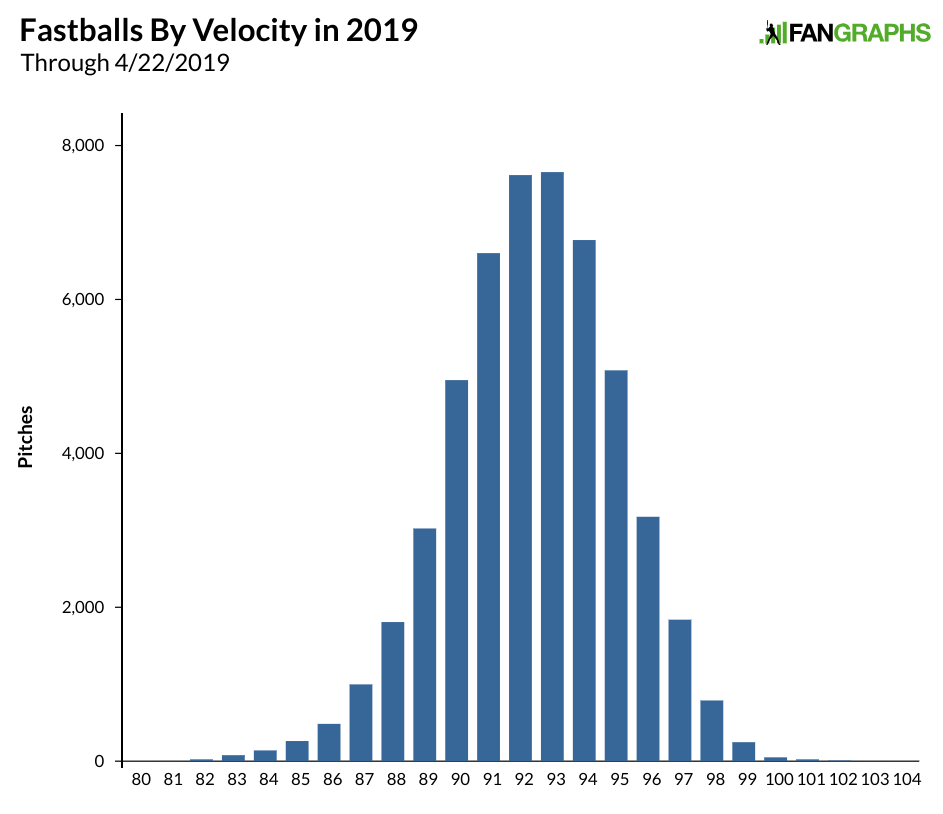
All major league pitchers throw pretty hard, and on average, fastballs are hitting close to 93 miles per hour these days. Pitchers throwing 95 seems common-place, and we regularly see pitches in the upper-90s. Pitchers throwing the ball really hard seems routine, but that should make us appreciate pitchers throwing the hardest even more. As pitch velocities get higher and higher, there are still upper limits, and the players who tend to reach those upper limits seem to find themselves alone. Right now, Jordan Hicks is alone.

The graph below represents all the fastballs thrown, except those by J.R. Murphy, this season.

It might be difficult to see the bars at 102 mph and above, so here’s a chart showing those pitches.

Fastest MLB Pitches in 2019
Player Date MPH
Jordan Hicks 4/21 104.2
Jordan Hicks 4/21 103.7
Jordan Hicks 4/21 103
Jordan Hicks 4/21 102.8
Jordan Hicks 4/21 102.4
Jordan Hicks 4/17 102.3
Jordan Hicks 4/21 102.1
Jordan Hicks 4/7 102.1
Jordan Hicks 4/17 102.1
Jordan Hicks 4/17 102
SOURCE: Baseball Savant

And to further clarify matters, here’s the average fastball velocity for pitchers with at least 10 fastballs this season.

Fastest MLB Pitchers in 2019
Player Fastballs Avg Fastball Velocity
Jordan Hicks 71 100.5 MPH
Jose Alvarado 147 98.3 MPH
Tayron Guerrero 127 98.3 MPH
Ryan Helsley 28 98.2 MPH
Felipe Vazquez 129 98.1 MPH
Diego Castillo 76 98.0 MPH
Ryne Stanek 109 97.7 MPH
Trevor Rosenthal 90 97.7 MPH
Lou Trivino 64 97.6 MPH
Noah Syndergaard 292 97.6 MPH
Robert Stock 69 97.6 MPH
Aroldis Chapman 106 97.5 MPH
SOURCE: Baseball Savant

Read the rest of this entry »


Michael Chavis on Doubling (and Almost Crying) in His MLB Debut

Michael Chavis lived a dream on Saturday. The No. 3 prospect in the Red Sox system not only made his MLB debut, he banged out a pinch-hit double in his first-ever at bat. He did so against Tampa Bay’s Jose Alvarado, with one on and one out in the top of the ninth inning, and the score knotted at five apiece. Boston went on to score, then held on for a 6-5 win.

There’s a pretty good chance that Chavis was the happiest person in Tropicana Dome that night. He was certainly one of the most excited. At age 23, the native of Marietta, Georgia had done in real life what he once fantasized about doing while batting rocks with a stick in his family’s back yard.

Chavis described the thrill-of-lifetime experience prior to yesterday’s game at Fenway Park.

———

Michael Chavis: “I wasn’t in the lineup — I was on the bench — but I knew the situation. They’d said there was a chance I would get to hit that day. Of course, I didn’t know when, who for, or who would be pitching. Come the eighth inning, looking at the lineup and how the game was playing out, I was thinking there was a chance.

“I’m taking some swings in the cage, and they come in and say, ‘Hey, you’re going to pinch hit in the ninth.’ I’m like, OK. Beautiful. ‘Who’s pitching?’ They say, ‘It’s Alvarado.’ I’m like, ‘Oh, wow.’ He’s a talented guy. Very good fastball.

“I’d faced him in spring training. I’d just come back from being sick, and it was kind of a similar situation in that I didn’t know if I was going to hit. I went up there and K’d on something like four pitches. I hadn’t seen a pitch in seven days, which made a 100-mph fastball that runs like his even more difficult to see. Read the rest of this entry »


The KBO Appears to Be De-Juicing Its Baseballs

The 2019 KBO baseballs (Photo: Sung Min Kim)

Last year, Rob Arthur and Tim Dix of FiveThirtyEight helped to reveal to the masses that the core of the major league baseball had changed, reducing the air drag and resulting in the ball traveling farther in the air. Ever since then, the ball has been a recurring topic of conversation, including here at FanGraphs. The subject got a re-boot earlier this month when Arthur, writing for Baseball Prospectus, concluded that there’s less drag on the batted balls hit in the 2019 season, which has led to more speculation that the league has “juiced” the ball.

While it is fun to see more dingers and harder hit batted balls, there’s something to be said about how the league may or may not have deliberately manipulated the ball to make it happen. It’s fun to see players like Aaron Judge have a 50-homer season in his rookie campaign or to watch Giancarlo Stanton flirt with a 60-homer mark on the way to earning an MVP award, but fans may question how “authentic” those feats are compared to the pre-juiced ball days, though it’s worth noting that the liveliness of the ball has changed throughout baseball’s history.

Here in Korea, there’s been an opposite trend. Prior to the start of the 2019 season, it was reported that the Korean Baseball Organization (KBO) would decrease the coefficient of restitution (COR) value in their baseball. To put it in layman’s terms, the higher the COR number is, the further the ball travels from the impact of the bat. Last year, the KBO allowed baseball COR values between .4134 and .4374. To put that in contrast, Nippon Professional Baseball (NPB) in Japan allows it to be between .4034 and .4234; MLB allows between .3860 and .4005. The KBO decided to lower it to the NPB’s Mizuno baseball level of between .4034 and .4234. There’s a reason for such a change. If you’ve followed the KBO for awhile, you know that the league has been quite hitter-friendly for the past few years. Here’s how hitters fared in the three seasons prior to 2019:

2016-18 KBO Offensive Numbers
BA OBP SLG OPS wOBA BABIP
2016 .290 .364 .437 .801 .359 .331
2017 .286 .353 .438 .791 0.348 0.327
2018 .286 .353 .450 .803 .349 .329
SOURCE: Statiz

To give you an idea how hitter-friendly an environment it was, MLB hitters slashed .248/.318/.409 overall in 2018. The recent baseball change is not the first time the KBO has attempted to curb its high-offense environment. In 2017, they increased the length of the strike zone, which I wrote about during my residency last year. It had an effect, but not really a lasting one. The umpires struggled to maintain consistency with the zone and the hitters adjusted well enough to keep up the league’s high-offense reputation. Read the rest of this entry »


Christian Yelich Is Raising His Game

It would not have been a surprise if Christian Yelich had leveled off after coming out of Baseball Nowhere (a.k.a. Miami), joining the Brewers, and winning the NL MVP award. He may yet do that, because nobody makes baseball look so easy for very long. Thus far this season, however, the 27-year-old slugger appears to be improving in several areas, and despite Monday night’s 0-for-4 against the Cardinals — just the third time in 24 games that he had failed to get on base this year — he’s been as hot as any hitter in baseball, batting .337/.439/.820 with a 210 wRC+.

Yelich began his 2019 season with an Opening Day home run off the Cardinals’ Miles Mikolas, and proceeded to go yard again in each of the next three games, thus joining Willie Mays (1971), Mark McGwire (1998), Nelson Cruz (2011), Chris Davis (2013), and Trevor Story (2016) as the only players to homer in each of his team’s first four games. After a relatively quiet 12-game stretch in which he homered just once, he broke out with a three-homer game against the Cardinals on April 15, the first hat trick of his career. Thus began an eight-homers-in-six-games binge that, if not for a bit of highway robbery by the Dodgers’ Cody Bellinger on Sunday, would have been nine homers in seven games.

Even with his two-game drought, Yelich’s 13 homers in his team’s first 24 games put him in select company. Read the rest of this entry »


Robbie Erlin, Tommy Hottovy, and Marcus Stroman Expound on Curveballs

Pitchers learn and develop different pitches, and they do so at varying stages of their lives. It might be a curveball in high school, a cutter in college, or a changeup in A-ball. Sometimes the addition or refinement is a natural progression — graduating from Pitching 101 to advanced course work — and often it’s a matter of necessity. In order to get hitters out as the quality of competition improves, a pitcher needs to optimize his repertoire.

In this installment of the series, we’ll hear from three pitchers — Robbie Erlin, Tommy Hottovy, and Marcus Stroman — on how they learned and developed their curveballs.

———

Robbie Erlin, San Diego Padres

“I started throwing my curve when I was nine. Everybody frowns upon that — throwing one that young — but I never had any problems. Basically, my dad put me on one knee and taught me. It was almost like casting a fishing reel. What that does is… when you throw a curveball, you want your elbow to come up a little bit. If your elbow is coming down to throw the curveball, you get exposed. That’s when it’s dangerous [health-wise].

“My dad pitched in high school — he was a righty — and he told me that’s how he was taught. So yeah, he put me on his knee and said, ‘Just flip it to me. Just work on spin. We’re not throwing it hard.’ Eventually I got the feel of it. I started throwing it in games — flipping it out in games — but only once in awhile. Not too much as a kid. Read the rest of this entry »


Who Framed Victor Caratini?

It’s still April, so it may be premature to talk about the year’s most extreme events. If a home run was hit on a high pitch, there will likely be a higher pitch that gets hit for a home run later on. Think an umpire called a perfect pitch a ball? We’ve got plenty more time for an even better pitch to be missed. However, I think we may have already seen the best pitch frame of the year.

I don’t mean the pitch furthest outside the strike zone that gets called a strike — there’s still plenty of time for that to change. I’m talking about full dedication to the craft of pitch framing. Francisco Cervelli sold a pitch against the Cubs not just with his glove and his positioning, but with his whole being. You’ll probably see worse pitches sold for strikes this year. Heck, you might see Cervelli get more egregious calls than this. You won’t see better framing, though — I can pretty much guarantee it. Read the rest of this entry »


What Clayton Kershaw Still Has

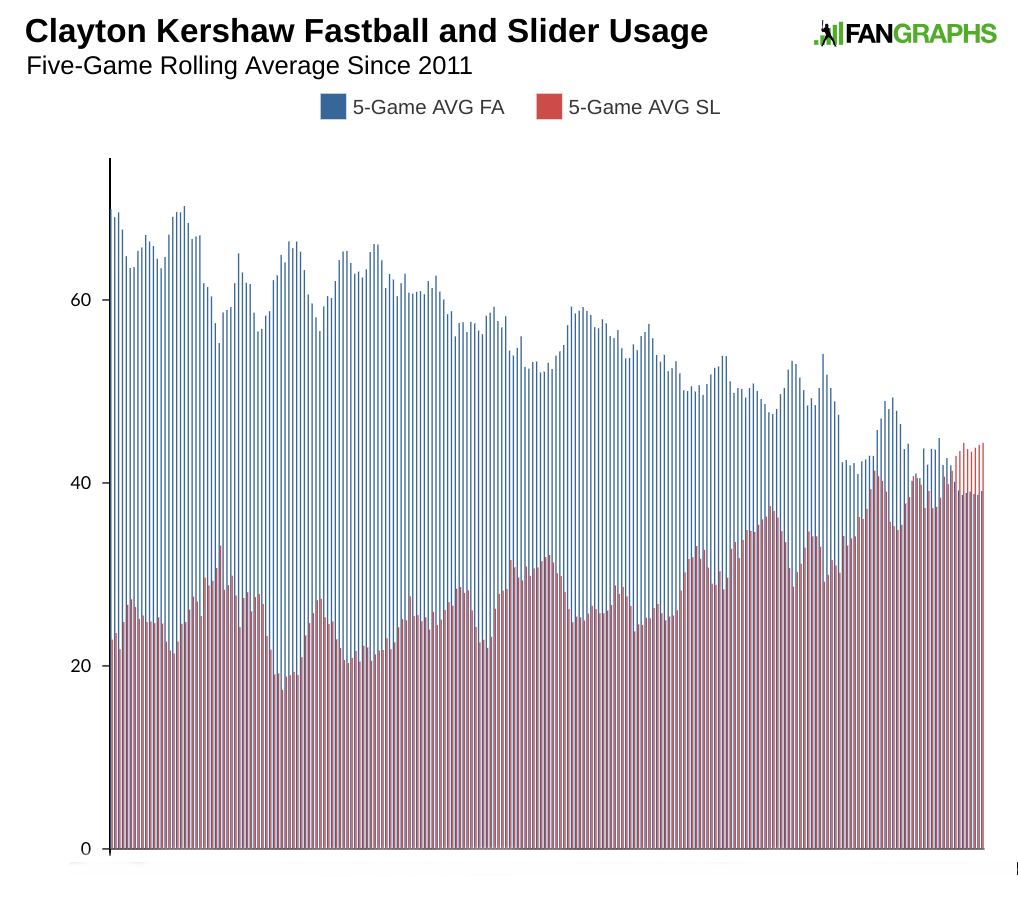
As players decline, we tend to focus on what they have lost since their primes. Whether it is velocity, speed, or power, what is newly absent is typically most notable. This is particularly true for once-great, Hall of Fame-type players like Clayton Kershaw. The Dodgers’ ace is one of the greatest pitchers of all time, but the last few seasons have seen his fastball velocity dip considerably, which has negatively affected his numbers. I noted late last season that Kershaw was no longer a fastball pitcher, and instead used his slider as his dominant pitch. This spring, some focus switched to his changeup, and how Kershaw might need something new to combat what he has lost. So far this season, Kershaw has been effective by going to his strengths and using hitter tendencies to his advantage.

Through two starts, Clayton Kershaw has pitched 13 innings, struck out 13 batters, walked four, and given up two homers and four runs total. If we assume that Kershaw will give up homers at a slightly lesser rate but keep the same strikeout and walk numbers, he’d be one of the best 10 or 20 starting pitchers the rest of the season. While we obviously can’t say he will do that, we can look at what he’s done so far and see what has made him successful this season compared to years past. While we won’t focus on Kershaw’s fastball, we can’t escape it entirely. Here’s the graph I used last year showing how Kershaw’s slider usage overtook his fastball.

That trend has held up so far this season, with Kershaw throwing one more slider than fastball in his first two games. That fastball has averaged just over 90 mph, several ticks slower than his prime. It’s a fine fastball, but the velocity is below-average. To get batters out, Kershaw has been forced to go away from his fastball and to his offspeed offerings. This is particularly true when Kershaw is ahead. The graph below shows Kershaw’s fastball usage when ahead in the count since 2011. Read the rest of this entry »