Archive for Featured

The Astros’ Staff Is the Best Ever*

*Or would be, if the season ended today.

We know the Astros’ pitching staff has been absurdly dominant.

The truth is, they’re historically dominant at the moment.

Just a season after the Indians became the first team to strike out 10 batters per nine innings, set a record with a 27.5% strikeout rate, and finish with the highest pitching WAR total of all time (31.7), the Astros are a threat to top those marks.

The Astros have already recorded 11 WAR this season, while the next closest pitching staff, that of the Red Sox, has 7.9. The Astros are on pace to shatter the Indians’ WAR mark, and their 10.35 strikeouts per nine and 29.6% strikeout rate would also be records. Gerrit Cole, Charlie Morton, and Justin Verlander — who was outstanding against Wednesday — all have sub-2.00 ERAs.

(The Astros and Indians met last weekend, with the Astros taking two of three games, and Houston travels to Cleveland for a four-game series beginning Thursday. Get your popcorn ready.) Read the rest of this entry »


The Impact of the NFL’s Anthem Rule on Baseball

On Wednesday, one of the top stories across the sports world was the National Football League’s institution of a new policy banning players from kneeling in protest during the national anthem.

From ESPN’s Kevin Seifert and Dan Graziano:

 NFL owners have unanimously approved a new national anthem policy that requires players to stand if they are on the field during the performance but gives them the option to remain in the locker room if they prefer, it was announced Wednesday.

The policy subjects teams to a fine if a player or any other team personnel do not show respect for the anthem. That includes any attempt to sit or kneel, as dozens of players have done during the past two seasons to protest racial inequality and police brutality. Those teams also will have the option to fine any team personnel, including players, for the infraction.

A couple of notes here: the policy was unanimous among owners who voted; the San Francisco 49ers abstained from the vote. Also, this policy was evidently something of a compromise; the league was previously throwing around ideas like a 15-yard penalty for kneeling.

The previous policy required players to be on the field for the anthem but said only that they “should” stand. When then-San Francisco 49ers quarterback Colin Kaepernick began kneeling in 2016, the league had no rule it could use to prevent it. The movement drew increasing criticism from President Donald Trump, as well as many fans, who believed it was a sign of disrespect toward the flag and country.

Owners, however, had been divided on how to extricate the league from that criticism. Some owners, including the Dallas Cowboys’ Jerry Jones and the Houston Texans’ Bob McNair, wanted all players to stand. Others, such as the New York Jets’ Christopher Johnson, wanted to avoid any appearance of muzzling players.

Even the seemingly simple option of clearing the field prior to the anthem was rejected by some owners who thought it would be interpreted as a mass protest or at least a sign of disrespect.

But it wasn’t a compromise with the union; the NFLPA said it wasn’t even consulted.

So how does this impact Major League Baseball? More than you might think. There’s actually no rule on the national anthem in MLB right now — there’s not even a rule requiring that it be played at all — which makes baseball unique among the major North American sports. Both the NBA and WNBA require players to stand for the anthem. When asked by Seifert, an MLB spokesman said this:

While this is not a league rule, the playing of the national anthems of the United States and Canada remains an important tradition that has great meaning to our fans. The playing of ‘God Bless America’ at designated games is a club choice.

But the absence of a rule doesn’t mean this isn’t an issue. Orioles center fielder Adam Jones had told USA Today last year that he didn’t expect such a protest to occur — and then, two weeks later, A’s catcher Bruce Maxwell knelt during the national anthem before a game last year.

Maxwell’s decision to kneel came after President Donald Trump — speaking on Friday in Huntsville, Ala., where Maxwell grew up — made reference to NFL players not standing for the anthem as employees who, as he put it, should be fired by their teams. Maxwell, an African-American raised in a military family, joins Colin Kaepernick and other athletes in attempting to raise awareness about brutality and injustice at the hands of authorities by kneeling during the anthem.

Maxwell received relatively little pushback, but then, he was also the first MLB player to kneel during the anthem, at least in the 21st century. He also knelt for just two games, and said himself that his anthem protest wouldn’t continue this season.

So clearly the idea of anthem protests — and a policy banning them — is a controversial one, and the incidents which athletes are protesting continue to occur. It’s also one on which the MLBPA has thus far declined comment. If MLB wanted to create a Rule, like the NFL and NBA, requiring players to stand for the national anthem, could it?

Let’s start by examining some of the more popular tweets from Wednesday.

https://twitter.com/NotScottInSC/status/999341939261616132

This is a smattering of the prevailing back-and-forth on Twitter, which seems to focus on whether and how this policy impacts players’ First Amendment rights. However…
Before I continue, please note: I am not saying the NFL is correct or incorrect. What I am saying, however, is that just about every non-lawyer in the twitterverse invoking the First Amendment on this issue — on both sides — is absolutely wrong.

Read the rest of this entry »


Top 43 Prospects: San Diego Padres

Below is an analysis of the prospects in the farm system of the San Diego Padres. Scouting reports are compiled with information provided by industry sources as well as from our own (both Eric Longenhagen’s and Kiley McDaniel’s) observations. For more information on the 20-80 scouting scale by which all of our prospect content is governed you can click here. For further explanation of the merits and drawbacks of Future Value, read this.

All the numbered prospects here also appear on THE BOARD, a new feature at the site that offers sortable scouting information for every organization. Click here to visit THE BOARD.

Padres Top Prospects
Rk Name Age High Level Position ETA FV
1 Fernando Tatis Jr. 19 AA 3B 2019 65
2 Luis Urias 20 AAA 2B 2018 55
3 MacKenzie Gore 18 A LHP 2020 55
4 Michel Baez 22 A+ RHP 2020 55
5 Anderson Espinoza 19 A RHP 2019 50
6 Adrian Morejon 19 A+ LHP 2020 50
7 Joey Lucchesi 24 MLB LHP 2018 50
8 Logan Allen 20 AA LHP 2020 50
9 Cal Quantrill 23 AA RHP 2018 50
10 Gabriel Arias 18 A SS 2021 45
11 Tirso Ornelas 18 A LF 2021 45
12 Hudson Potts 19 A+ 3B 2020 45
13 Chris Paddack 20 A+ RHP 2020 45
14 Josh Naylor 20 AA 1B 2020 45
15 Pedro Avila 21 A+ RHP 2021 45
16 Jacob Nix 22 AA RHP 2019 45
17 Franchy Cordero 23 MLB CF 2018 45
18 Esteury Ruiz 19 A 2B 2022 45
19 Edward Olivares 22 A+ OF 2021 45
20 Jeisson Rosario 18 A CF 2022 40
21 Walker Lockett 23 AAA RHP 2018 40
22 Mason Thompson 18 A RHP 2022 40
23 Blake Hunt 19 R C 2022 40
24 Jordy Barley 18 R SS 2023 40
25 Luis Campusano 19 A C 2023 40
26 Eric Lauer 22 MLB LHP 2019 40
27 Franmil Reyes 22 MLB OF 2019 40
28 Brad Zunica 22 A+ 1B 2022 40
29 Robert Stock 28 AAA RHP 2018 40
30 Luis Patino 18 A RHP 2023 40
31 Ronald Bolanos 21 A+ RHP 2021 40
32 Buddy Reed 22 A+ CF 2019 40
33 Andres Munoz 19 A RHP 2020 40
34 Jorge Ona 21 A+ OF 2019 40
35 Mason House 19 R OF 2023 40
36 Luis Almanzar 18 R SS 2021 40
37 Reggie Lawson 19 A+ RHP 2021 40
38 Diomar Lopez 21 A+ RHP 2022 40
39 Trey Wingenter 24 AAA RHP 2018 40
40 David Bednar 23 A+ RHP 2019 40
41 Brad Wieck 26 AAA LHP 2018 40
42 Eguy Rosario 18 A+ 2B 2022 40
43 Michell Miliano 18 R RHP 2023 40

65 FV Prospects

Signed: July 2nd Period, 2015 from Dominican Republic
Age 18 Height 6’3 Weight 185 Bat/Throw R/R
Tool Grades (Present/Future)
Hit Raw Power Game Power Run Fielding Throw
30/55 60/70 40/60 55/45 50/55 60/60

Scouts in the U.S. became enamored of Tatis during 2016 extended spring training in Arizona, and San Diego poached him from the White Sox before he had even suited up for a professional game. He was sent to full-season Fort Wayne as an 18-year-old in 2017 and hit .280/.390/.520 with 20 homers and steals and, perhaps most impressively for his age, a 14.5% walk rate. He also flashes occasional acrobatic brilliance at shortstop, though scouts are not unanimous about his long-term prospects there because of the size of Tatis’s frame. He’s five years younger than the average regular at Double-A right now.

Read the rest of this entry »


Mike Trout Is Now an Average Hall of Famer

Mike Trout, pictured here, is a popular American athlete.
(Photo: Ian D’Andrea)

The Angels have struggled recently, losing seven out of 10 games to the Twins, Astros, and Rays and falling from a tie atop the AL West to 3.5 games back. Over the weekend, though, Mike Trout did something special. While going 3-for-8 with a double, a pair of homers, and four walks in 12 plate appearances against Tampa Bay, he pushed his seasonal WAR (Baseball-Reference flavor) to 4.0 and his career WAR to 58.2. With that, he reached the JAWS standard for center fielders, the average of each Hall of Fame center fielder’s career WAR and his seven-year peak WAR.

Mike Trout is two-and-a-half months shy of his 27th birthday.

Mike Trout has played six full seasons and parts of two others — roughly a quarter apiece — in the majors.

Mike Trout has not played long enough to be eligible for the Hall of Fame.

Mike Trout is very, very, very good at baseball.

You probably knew most of the above, qualitatively if not down to the first decimal place, and after six-plus years of reading about his feats at the plate, on the bases and in the field, you might be somewhat jaded as to his exploits. Right now, he might not even the most popular Los Angeles Angel thanks to the virtually unprecedented two-way prowess of Shohei Ohtani, the Most Interesting Man in the World. Trout, aside from his baseball excellence and his earnest fascination with meteorology, is not that interesting, much to the chagrin of those who fret about Major League Baseball’s lack of a Lebron James-level Face of the Game.

Read the rest of this entry »


The Rays Have Innovated Again

Necessity is said to be the primary motivator behind innovation. And no franchise is faced with a more difficult environment in which to compete, is confronted by a greater need for innovation, than the Tampa Bay Rays.

In possession of either the worst or second-worst stadium situation in the majors, with small-market revenues, the Rays also share a division with coastal elites like the Yankees (+76) and Red Sox (+75), who rank second and third in the majors in run differential, respectively, behind only the Astros (+98).

Because of this, the Rays have been more willing to experiment than just about every other club over the last 15 years. They brought defensive shifts to the American League, signed Evan Longoria to a club-friendly deal six days after he debuted in the majors, and have limited starting pitchers to two trips through the order more aggressively than any other club. This spring, they planned to employ a four-man rotation.

Read the rest of this entry »


When Lance McCullers Stops McCullersing

This is Jake Mailhot’s third post as part of his May Residency at FanGraphs. A lifelong Mariners fan, Jake now lives in Bellingham, Washington, just a little too far away from Seattle to make it to games regularly, which is sometimes for the best. He is a staff editor at Mariners blog Lookout Landing. He can be found on Twitter at @jakemailhot.

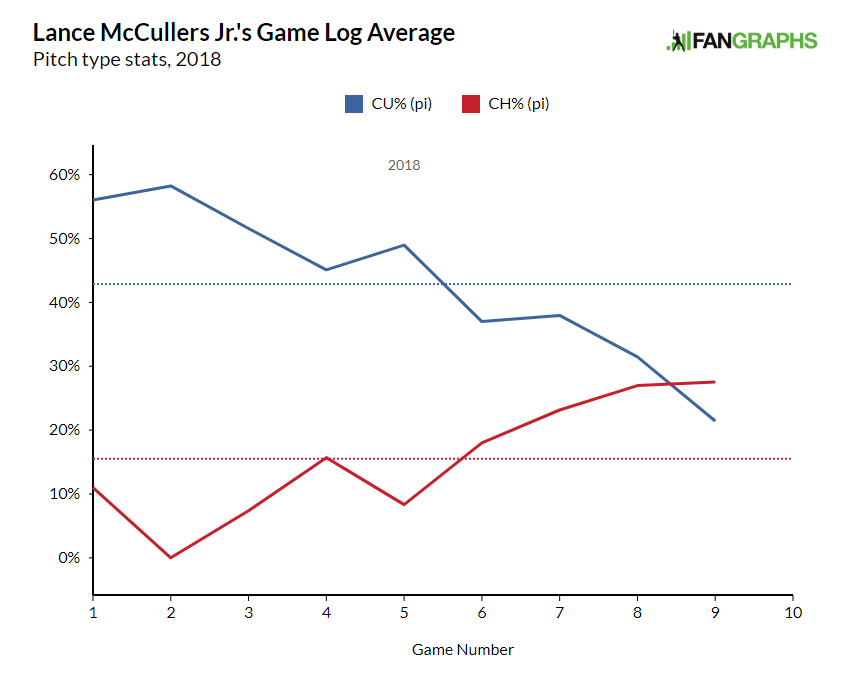
Earlier this year, Jeff Sullivan wrote a pair of articles, each about a pitcher who appeared to be McCullersing. That term, of course, is a reference to Lance McCullersJr., who in 2016 began throwing his excellent curveball more often than his fastball. He’s led all of baseball in curveball usage since then. He wound up throwing his curveball an astonishing 75% of the time in Game Seven of the ALCS last postseason. That appearance was peak McCullersing.

He started off this year throwing his curveball around the same amount as last year, 48% of the time. But when the calendar flipped to May, something changed. Just look at this graph of his secondary pitch usage in 2018.

That’s… interesting. In his start last night (not included here), McCullers threw his curveball around 40% of the time. That’s pretty normal for him. But it’s been less normal for him of late. In his start against the Angels last Monday, McCullers actually threw more changeups than curveballs, the latter pitch representing just 21.4% of his total count for the night. The last time his curveball usage fell below 30% was all the way back on August 3, 2015, during his rookie year.

Read the rest of this entry »


Sunday Notes: Brad Keller, Almost Once a Royal, is Thriving as a Rule 5 Royal

Brad Keller is having an impressive rookie season with the Kansas City Royals. Pumping fastballs with a bulldog mentality, the 22-year-old right-hander has appeared in 18 games and has a 1.96 ERA. He’s not afraid to challenge big-league hitters. Substantiating KC skipper Ned Yost’s assertion that he’s “been able to come in and bang strikes on the attack,” Keller has issued just five free passes in 18-and-a-third innings of work.

His path to the Kansas City bullpen was roundabout. In retrospect, it was also only a matter of time before he got there.

Drafted out of a Flowery Beach, Georgia high school by the Arizona Diamondbacks in 2013, Keller changed addresses twice in a 15-minute stretch during December’s Rule 5 draft.

“My agent called to say, ‘Hey, the Reds picked you up in the Rule 5,’” explained Keller. “I hung up the phone, called my parents, called my brother, and as soon as I hung up my agent called again. ‘Hey, you just got traded to the Royals.’ Then I had to pick up the phone and call everybody back.”

Keller’s next conversation was with the D-Backs — “they told me everything that was going down” — and soon thereafter Royals assistant GM Scott Sharp called to welcome him to his new organization. A similar call almost came four years earlier. Read the rest of this entry »


The Best of FanGraphs: May 14-18, 2018

Each week, we publish in the neighborhood of 75 articles across our various blogs. With this post, we hope to highlight 10 to 15 of them. You can read more on it here. The links below are color coded — green for FanGraphs, brown for RotoGraphs, dark red for The Hardball Times and blue for Community Research.
Read the rest of this entry »


Odubel Herrera Is Chasing Derek Jeter’s Record

When a rebuilding club begins its transformation into playoff contender, one can usually identify certain players who emerged during the team’s lean years and made that transformation possible. In the case of the Cubs, for example, that player is Anthony Rizzo. For the Astros, that player is Jose Altuve. For the Phillies, that player might be Odubel Herrera. The former Rule 5 pick is now in his fourth year with Philadelphia, and he has a contract that could keep him with the team for another five seasons beyond this one. He’s been the best player — averaging 3.5 WAR per year — on Phillies teams averaging 95 losses. He might now be the best player on a team that appears to be reversing its fortune and contending for the first time in a half-dozen years.

It would be fair to call Herrera’s 2017 campaign — despite an average offensive season, solid defense, and three wins at 25 years old — a disappointment. After two seasons during which he flirted with four wins, a drop in what should be his prime might have been slightly concerning. However, Herrera really just had a poor two months to start the year. As the calendar turned to June, Herrera was hitting .218/.262/.326 with a 48 wRC+ in 206 plate appearances. The rest of the way, he slashed .318/.361/.526 with a 130 wRC+ in 357 trips to the plate. Even including a couple rough weeks to end last May, Herrera has a 126 wRC+ over the past calendar year and 4.4 WAR, ranking 28th among position players and including a rolling mark that is likely to rise over the next few weeks.

Read the rest of this entry »


Aaron Judge Is Hitting Better with an Even Worse Strike Zone

We know the Aaron Judge story. He was a prospect whose contact ability was questioned. Would his 80-grade power play in games? After working on a swing adjustment in the winter of 2016-17, however, he dramatically improved his contact rate, posting a remarkable 173 wRC+ last season while nearly winning the AL MVP award.

In the 21st century, there have been only 31 completed or ongoing seasons with a wRC+ better than Judge’s mark. And what’s remarkable is that one of those — though, just a partial season — is Judge’s 2018 campaign, in which he has a wRC+ of 178.

After making one of the most dramatic year-to-year improvements in major-league history, Judge has actually improved through the first quarter of this season, which is amazing in a different way. While making gains is one thing, consolidating them is another, with the wealth of scouting information available.

Read the rest of this entry »