Archive for Daily Graphings

Sunday Notes: Better Than Evers, Lou Whitaker Belongs in the Hall of Fame

Along with Johnny Evers and Joe Tinker — they of Tinker-to-Evers-to-Chance fame — Alan Trammell and Lou Whitaker are the most-storied double-play combination in baseball history. As well they should be. The Detroit Tigers duo played more games together (1,918) than any middle-infield duo in history. Moreover, they combined for 11 All-Star appearances, seven Gold Gloves, seven Silver Sluggers, and they won a World Series together. Both are icons for a franchise that has played in the American League since 1901.

Tinker and Evans, who played together with the Chicago Cubs from 1902-1912, are both in the Hall of Fame. So is Trammell. Meanwhile — this for reasons best explained as inexplicable — Whitaker is not. His exclusion stands as one of Cooperstown’s most glaring omissions.

Whitaker has more WAR and a higher JAWS score than a number of Hall of Fame second basemen, but that can be a debate for another day. For now, let’s focus on how he compares to Evers.

Whitaker: 2,369 hits, 244 home runs, 118 wRC+, 68.1 WAR.
Evers: 1,659 hits, 12 home runs, 109 wRC+, 49.0 WAR.

While Evers’s numbers are anything but great, it should be noted that he won an MVP award and played for three World Series-winning teams (the Cubs twice and the Boston Braves once). That said, it’s highly unlikely that he would be in the Hall of Fame were he not part of a legendary double-play combination (he and Tinker were Old-Timers-Committee selections in the same year). How they became legendary is, of course, a big part of the story. The poem penned in 1910 by sportswriter Franklin Pierce Adams reads: Read the rest of this entry »


Brewers Finally Make A Signing, Reunite With Wade Miley

Wade Miley
Kamil Krzaczynski-USA TODAY Sports

When the ball dropped at midnight and 2022 turned into 2023, 29 of the 30 major league teams had signed at least one free agent, from the Mariners spending $1.2 million on Trevor Gott to the Mets agreeing to terms with seemingly every star player on the market. Even the penny-pinching Marlins brought in Jean Segura, and the A’s committed a respectable $34 million to four solid role players. Now, a few days into the new year, team no. 30 has joined the fray: the Brewers are bringing back left-handed pitcher Wade Miley on a one-year contract that will pay him $3.5 million with a $10 million mutual option for ’24 (with a $1 million buyout) and another $1.5 million in playing time incentives. In total, that guarantees him $4.5 million this season.

Formerly an innings eater who completed at least 190 frames every year from 2012 to ’15 with a 98 ERA-, Miley has battled injuries in each of 2018, ’20, and ’22. Last season, he was limited to just nine appearances with the Cubs as he dealt with elbow and shoulder issues. With that in mind, I’ll be looking at his performance in a limited 2022 campaign in conjunction with his full ’21 season, where he barely qualified for the leaderboards with 163 innings pitched. His stats were very similar in those two samples; he ran an ERA in the low-threes with far less inspiring peripherals and near equal numbers in the walk and strikeout departments. Read the rest of this entry »


Fast and Furious: Free Agency Signings Are Proceeding at a Record Pace

© Brad Penner-USA TODAY Sports

For years, the baseball offseason had a predictable rhythm. When the World Series ended, we’d hit a lull. Around the Winter Meetings, a few Scott Boras clients would sign while he spouted strange, vaguely nautical similes. A few more marquee names would get caught up in Boras’ wake (see what I did there?) and sign as well. Then we’d have a lull around year end, and contract activity would pick up again in the new year.

That pattern hasn’t held even a little bit this winter. As of this writing, 45 of our top 50 free agents have signed, including the entire top 30; many guys who just missed the cut have signed as well. Four years ago, plenty of teams were still looking for free agent help in the first week of January. This year, your options are Johnny Cueto, Jurickson Profar, and then tumbleweeds.

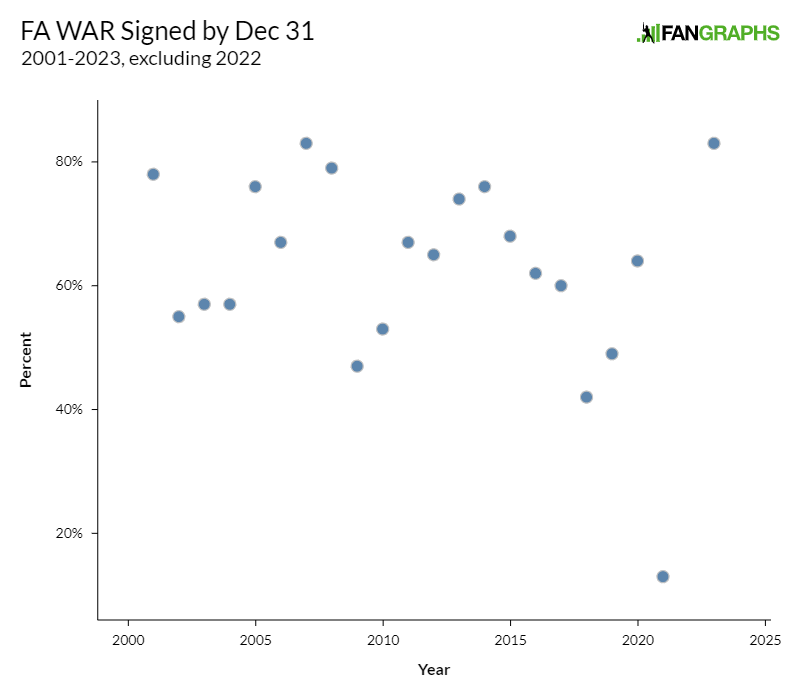
This feels different than previous years of free agency, but I wanted to put some quantitative rigor behind that. I set out to compare this offseason to each previous one. I’ll spend plenty of time going through my methodology below, but first, let’s give the people what they want. This year really is different. Here’s the percentage of all free agents, weighted by previous year WAR, that had signed new deals by December 31 of each offseason since the conclusion of the 2000 season, excluding last year’s lockout weirdness:

The 2022-23 offseason (which I’ll be calling 2023 for simplicity’s sake for the remainder of the article) is tied for the most front-loaded offseason of this millennium. Given that offseasons had been getting progressively slower, that’s a meaningful change. Now, let’s talk about how I got to this conclusion, and come up with a few takeaways about the new landscape of free agency. Read the rest of this entry »


The Phillies Get to Spin the Craig Kimbrel Wheel

Rick Scuteri-USA TODAY Sports

Our story begins in June of 2019, when the Cubs took a chance on a still-unsigned Craig Kimbrel. What happened next can only be described as a disaster. Kimbrel gave up a preposterous number of home runs, almost single-handedly causing the Cubs to miss the playoffs. He didn’t show any signs of improvement the following season, and his once lustrous career looked just about over, seemingly bringing the Cubs’ three-year, $43 million investment down with him.

Then, a miracle: In the first half of 2021, Kimbrel returned to form. He trimmed the walks and home runs, and co-authored a no-hitter in the process. The Cubs traded him to the White Sox at the deadline, after which he became one of the worst relief pitchers in baseball. Kimbrel ended the year with a respectable 2.26 ERA, but consider how that’s split: a 0.49 ERA with the Cubs, a 5.09 ERA with the White Sox. That offseason, the Dodgers traded for Kimbrel, hunting for upside as they usually do. And despite the controversy surrounding his usage, Kimbrel finished the year with pedestrian numbers. He wasn’t a complete mess, but he wasn’t great, either.

All this brings us to the Phillies, who’ve signed the now 34-year-old closer to a one-year deal worth $10 million. I don’t know if there’s really such a thing as a “safe” reliever. What I do know is that Kimbrel is decidedly not one. His whole career post-Boston has been a series of ups and downs, the latter more frequent than the former. But given how shallow the market for relief pitching is this offseason, it seemed inevitable that someone would take a flier on him. Kimbrel, for better or worse, has become the Phillies’ problem to solve. Read the rest of this entry »


Red Sox Add Corey Kluber to Rotation of Question Marks

Corey Kluber
Ken Blaze-USA TODAY Sports

The 2021 ALCS feels like it happened far more than 15 months ago. After coming within two wins of their fifth World Series berth in the 21st century, the Red Sox dropped 14 wins off their 2021 total to finish in last place in ’22, albeit in the only division in baseball with four teams over .500. The offensive production was okay, the rotation and bullpen proved unreliable, the defense was at times humiliating, and injuries underscored a lack of sufficient depth in a number of areas. Come November, key contributors including Xander Bogaerts, Nathan Eovaldi, and J.D. Martinez hit free agency, leaving Boston with a handful of needs just to stay level in 2023. And though the organization insisted that a Bogaerts extension was its top priority of the offseason, Boston instead watched as the Padres swooped in and inked him to a jaw-dropping 11-year, $280 million deal, leaving the Red Sox with only a fourth-round compensation pick to show for their efforts.

The offseason hasn’t been a total loss. On Wednesday, Carlos Baerga (yes, really) broke the news that the club had signed Rafael Devers to the largest and longest contract in Red Sox history, extending the 26-year-old for $331 million over 11 years. The agreement is a big change of direction for a team that failed to retain either Mookie Betts or Bogaerts, and also a bit of a salvation for a winter that up until last night had seemed to bring more bad news than good.

In terms of bringing on new players to help lift the team back to the playoffs in the immediate future, Boston’s biggest addition this offseason so far is Japanese outfielder Masataka Yoshida on a surprisingly lucrative five-year deal worth $105 million. Beyond him, the Red Sox made some smaller additions on short, low-cost deals for veterans. They aimed to revamp the bullpen with the additions of Kenley Jansen, Chris Martin, and Joely Rodríguez, and brought in Justin Turner as a right-handed corner infield bat and DH. Most recently, they added much-needed depth to the starting rotation by signing 36-year-old Corey Kluber on a one-year, $10 million contract with an $11 million club option for 2024. Read the rest of this entry »


Andrew Benintendi Is a Batted Ball Profile Chameleon

Andrew Benintendi
Wendell Cruz-USA TODAY Sports

The ongoing conversation as to whether a hitter can control where they hit the ball has always confused me. As a hitter, you tailor your swing for a specific batted ball profile and come to an understanding of the types of pitches you can handle and the types you cannot. Within that context, your swing might be malleable enough to produce different types of hard contact, but if it isn’t, then you have a plan for where adjustments can be made. From that perspective, a hitter has every bit of control over where they’re going to hit the ball, even it’s more of a long-term endeavor.

On the other hand, there is the dilemma of hitting what you get, and from pitcher to pitcher, that will vary. Each pitcher has a different plan of attack, whether it’s in the pitches themselves, command of specific areas of the zone, arm slot, etc. Most hitters have limitations, and it’s the job of the pitcher to pitch to those limitations. A hitter can have a specific set of strengths that can’t be bent much at all, but then there are hitters who can change their strengths, or more specifically their batted profile, to cater to where they are playing.

In any specific matchup, it might be hard to execute on that plan. For example, we often think about situational hitting and moving runners over or trying to hit a sacrifice fly. That is difficult to do if you don’t get the pitch to do it or don’t have the motor skills to control your body with a changing set of pitch speeds and locations. But when zooming out and looking at batted ball profile, some hitters can change with time. One example of that is Andrew Benintendi. Read the rest of this entry »


Unranked a Year Ago, Mason Auer Is One of Tampa Bay’s Most Promising Prospects

Mark J. Rebilas-USA TODAY Sports

Mason Auer made some of the biggest strides in the Tampa Bay Rays system in 2022. Unranked going into his first full professional season, the 21-year-old Joplin, Missouri native not only slashed .290/.372/.487 with 15 home runs between Low-A Charleston and High-A Bowling Green, he legged out 12 triples and swiped 48 bases. Moreover, he impressed on defense. A fifth-round pick in 2021 out of San Jacinto College, Auer is rated the best defensive outfielder, and as having the best outfield arm, among Rays prospects.

Auer discussed his path to pro ball and the skill set that has allowed him to emerge as a promising prospect at the end of last season.

———

David Laurila: You were a late-round pick out of high school in 2019 but opted to attend a junior college rather than sign with the Chicago Cubs. What went into that decision?

Mason Auer: “There were talks earlier in the draft, but it wasn’t the money I wanted. Then they picked me in the 39th round. They called and said that there was maybe going to be some more money opening up if they didn’t get a few guys signed, so there was some serious talk about me signing, but that didn’t happen. I mean, it was still a hard decision. Ultimately, I knew that I wanted to keep working hard and go higher in [an upcoming] draft.” Read the rest of this entry »


The Dodgers Have Had a Strange Offseason

Orlando Ramirez-USA TODAY Sports

Maybe we shouldn’t doubt the Dodgers. They’ve won nine out of the last 10 NL West titles, and in the year they didn’t win the division, they won 106 games. They’re juggernauts by design, a team built to withstand the slings and arrows of outrageous fortune. They draft well, develop well, spend a ton of money, and spend that money intelligently. They’re the closest thing baseball has to a dynasty these days, and given the inherent randomness of the playoffs, that’s not likely to change anytime soon.

That’s all true – and despite it all, I’m leaning towards doubting their chances in 2023. For the first time in years, I don’t have to jump through hoops to come up with reasons to do so. The Dodgers look like one of the best teams in baseball, but they no longer look, at least to me, like the absolute class of the league. It’s weird to think of it that way, but let’s talk through it together.

First things first: the Dodgers lost a ton of good free agents this year, just like they do every year. That’s simply the cost of doing business when you’re good as consistently as they are; your team will naturally be filled with great players approaching free agency. This year’s iteration of the team lost a whopping 21.3 WAR worth of 2022 production, the highest mark in the majors. The list of the top five teams when it comes to lost 2022 production is a who’s who of clubs trying to contend right now:

2022 WAR Lost in Free Agency
Team 2022 WAR Lost
Dodgers 21.3
Yankees 20.8
Mets 18.2
White Sox 13
Padres 11.7

Read the rest of this entry »


Amed Rosario Can’t Stop Running

Amed Rosario
Kevin Jairaj-USA TODAY Sports

I don’t know if you’ve heard, but here at FanGraphs we enjoy the occasional number. Even our logo has its own bar graph. Today our topic is competitive runs, a statistic that rarely gets the love and appreciation it deserves, due to the fact that it’s mostly made up. Competitive runs is a classification created for Statcast. In order to measure average sprint speed, you need a pool of plays when players will presumably be running their hardest:

Competitive runs are essentially just the sample size. When you go to Baseball Savant’s leaderboard, the players are always sorted from fastest to slowest. However, you can also sort by competitive runs, and I can never resist. All season long, one player was absolutely trouncing the field:

2022 Competitive Runs Leaders
Player Competitive Runs Sprint Speed
Amed Rosario 342 29.5
Brandon Nimmo 282 28.7
Vladimir Guerrero Jr. 279 26.6
Trea Turner 276 30.3
Steven Kwan 272 28.4
SOURCE: Baseball Savant

Amed Rosario is the grand champion of competitive runs. The difference between Rosario in first place and Brandon Nimmo in second place is the same as the difference between Nimmo and Jeff McNeil in 34th place. I’m sure Nimmo takes some solace in knowing that he’s the undisputed leader of the non-competitive run. Whether it’s a walk or a hit by pitch, the dude straight up loves scampering to first base for his own particular reasons:

Turning our attention back to Rosario: It’s not as if he’s just racking up competitive runs as a counting stat. He also leads the league on a rate basis, no matter which rate you choose:

2022 Competitive Runs Leaders
Rank Player Per Plate Appearance Rank Player Per Ball in Play
1 Amed Rosario 51.0% 1 Amed Rosario 64.5%
2 Isiah Kiner-Falefa 48.2% 2 Isiah Kiner-Falefa 60.9%
3 Starling Marte 44.2% 3 Starling Marte 60.4%
4 Luis Rengifo 43.4% 4 Brandon Nimmo 60.0%
5 Steven Kwan 42.8% 5 Juan Soto 59.6%

I don’t know about you, but I think this is incredibly fun. Competitive runs is an incidental statistic. It’s just scaffolding for another stat, but there’s one person who plays baseball like competitive runs is his own personal pinball machine. The other reason I love it is that even though competitive runs exists only to serve a higher master, it’s still a descriptive stat in its own right. A player’s competitive runs total tells you plenty about the way they play the game. Read the rest of this entry »


Rich Hill Continues Tour of MLB, Signs With Pittsburgh

Tommy Gilligan-USA TODAY Sports

Long, successful baseball careers usually have a predictable shape to them. A young, highly-regarded prospect gets his first cup of coffee, then becomes a full-time starter over the next few years, possibly ascending to star level. Then he slowly ages and declines, riding off into the sunset in his late 30s. Some choose not to follow that trend. Jamie Moyer pitched twice as many innings in his 40s as he did in his 20s, finally retiring at the absurd age of 49. In 1965, a 59-year-old Satchel Paige returned to the majors for one more game, and despite his signing being a largely ceremonial move, he still tossed three scoreless innings.

Then there’s Rich Hill. First drafted out of high school in a different millennium, Hill debuted with the Cubs in 2005 at age 25. Over the next decade, he bounced around the league, often struggling with elbow injuries and poor command. At the end of 2014, Hill was a 34-year-old who had played for six different teams, only completing 100 frames in a season once. After opting out of a minor league deal with the Nationals in the middle of the 2015 season, Hill ran out of offers with affiliated clubs. He signed with the independent Long Island Ducks and laid waste to his Atlantic League competition… for two starts. Hill was then tendered a big league contract with his hometown team, the Red Sox, had four excellent starts to close out the season, and has held down a big league roster spot ever since. Hill will begin the upcoming spring training by celebrating his 43rd birthday, making him the oldest major league player since the then 45-year-old Ichiro Suzuki last suited up in 2019. The Pirates will be his 12th team, making him one of just six players to appear for a dozen or more clubs.

When a slightly younger Hill signed with the Red Sox (for the seventh time in his career), Ben Clemens used the prophetic projection system RiPS (Rich is Pitching Superlatively) to forecast a 4.15 ERA and 1.7 WAR for his 2022 season. Hill’s actual numbers? A 4.27 ERA (but a 4.13 SIERA), and 1.8 WAR. Not bad, RiPS. But it gets even better. Ben wrote, “If he pitches to this line, he’ll earn $8 million next year and be well worth it for Boston.” In 2023, the Pirates will be paying Hill (checks notes) $8 million on the dot. Can we get some RiPS projected standings for the season? They might even turn out to be more accurate than the baseball Reddit’s marble race simulations. Read the rest of this entry »