Ben Lindbergh and Meg Rowley remind people to vote in their preseason predictions game, discuss the completion of the season preview series, and then (10:15) analyze Shohei Ohtani’s remarks from Monday and preview the rest of the 2024 Los Angeles Dodgers season with The Athletic’s Fabian Ardaya, followed (1:15:31) by a 2024 Colorado Rockies preview with The Denver Gazette’s Luke Zahlmann, plus a postscript on the Diamondbacks signing Jordan Montgomery (1:55:50) and a recap of preview guests’ goals for each team this year (2:01:25).
Up until now, the Rockies had made very little noise this offseason. After agreeing to extensions with Germán Márquez and Charlie Blackmon just before the 2023 season wrapped up, Colorado spent a mere $3.5 million on major league free agent deals in the six months since, the fewest of any team in the majors. Yet, at the tail end of a long, quiet winter, the Rockies finally made headlines, when on Sunday they signed 22-year-old Ezequiel Tovar to a long-term contract extension. The deal, which begins right away, will pay Tovar $63.5 million over the next seven years. After that, the Rockies have a $20.5 million team option for 2031, the shortstop’s age-29 season.
Across three offseasons at the helm for Colorado, general manager Bill Schmidt has largely avoided multi-year free agent deals, with one notable exception: Kris Bryant and the seven-year, $182 million pact he signed before the 2022 season. Over the past two winters, the Rockies are one of only three teams not to have signed a single multi-year free agent deal; the other two clubs, the Pirates and Orioles, have outspent Colorado by totals of $37.71 million and $10.13 million, respectively. However, free agency isn’t the only way for teams to keep players around for longer periods of time. Under Schmidt, the Rockies have signed eight players to multi-year extensions; only the Braves have extended more players on multi-year deals in that span. Atlanta has gotten far more extension attention, but this is how Colorado operates, too.
Even so, the Tovar deal represents a different approach for the Rockies because it is the first time that Schmidt has extended a player with fewer than four years of service. It’s also the longest extension the Rockies have awarded since February 2019, when they signed Nolan Arenado to an eight-year, $260 million deal that began in 2020. Moreover, while we have started to see more and more pre-arb players signing long-term extensions around the majors, many of those players either are stars or have star potential. Perhaps the only good comp for Tovar’s extension is the eight-year, $50 million deal Keibert Ruiz signed with the Nationals after putting up a 91 wRC+ and 1.8 WAR in 2022, his first full season. Then again, even Ruiz arguably had a higher ceiling at the time. Tovar might be in a class of his own when it comes to low-ceiling, high-floor youngsters signing lucrative long-term deals.
Entering the 2023 season, Eric Longenhagen and Tess Taruskin ranked Tovar no. 41 on our Top 100 Prospects list, describing him as “a fantastic defensive shortstop” with “poor plate discipline” that “somewhat undermines his excellent bat-to-ball skill.” One year later, Tovar is no longer a prospect, but that remains the prevailing report. He finished his debut season with the lowest walk rate and the second-highest O-Swing% among qualified NL batters. He also finished with 16 OAA and 13 DRS; the only shortstop to outpace him in both metrics was Dansby Swanson. Despite his 70 wRC+, worst among qualified NL hitters, Tovar finished his rookie season with 1.6 WAR. That’s hardly star-level performance, but a 1.6-WAR player is still a big league regular.
Let’s get the bad stuff out of the way first: Tovar’s offensive numbers last season were pitiful. One of the only areas in which he was above average was batting average, and Coors Field likely inflated that number. His plate discipline was dreadful, as expected, but so were his contact skills, which came as something of a surprise. Tovar ranked 66th out of 72 qualified NL hitters in contact rate, and he wasn’t just whiffing on pitches outside the zone. While his O-Contact% was poor, his Z-Contact% also came in below league average.
On the bright side, when he did manage to put the ball in play, Tovar showed flashes of his promising hit tool. His .378 xwOBAcon was a few ticks above league average, thanks to his line drive tendencies. He ranked in the 71st percentile in Baseball Savant’s Sweet-Spot% and finished seventh among qualified NL players in line drive rate. If he can make more contact, especially on pitches in the strike zone, his offensive numbers will improve even if he never adds a lick of discipline to his game. If he can improve his plate discipline, then all the better. For what it’s worth, he significantly improved his walk rate during his final season in the minor leagues, prompting his Double-A manager, Chris Denorfia, to rave about Tovar’s growth. “He’s made this developmental jump,” Denorfia told David Laurila in 2022. “Something clicked to where he’s recognizing situations where pitchers are going to try to get him to chase.” Plate discipline is a different animal in the majors than in the minors, but still, it’s worth acknowledging that this is a skill he has successfully improved in the past.
Tovar also showed off 69th-percentile sprint speed in 2023. He won’t ever be a weapon on the basepaths, but with speed like that, he should be a better base runner than his numbers last year would suggest; he went 11-for-16 on stolen base attempts and was worth -0.6 BsR. Long story short, this is a player with much more offensive potential than we saw last season, and he has a strong enough glove to allow him to nurse his growing pains at the highest level while still contributing positive value to his club.
Courtesy of Dan Szymborski, here is what the ZiPS projections envision for Tovar over the next eight years:
ZiPS Projection – Ezequiel Tovar
Year
BA
OBP
SLG
AB
R
H
2B
3B
HR
RBI
BB
SO
SB
OPS+
WAR
2024
.259
.300
.424
552
75
143
32
4
17
76
28
142
11
87
2.2
2025
.263
.306
.438
562
79
148
33
4
19
81
30
138
11
91
2.6
2026
.266
.310
.442
568
82
151
34
3
20
84
32
133
11
94
2.9
2027
.267
.313
.448
572
85
153
34
3
21
86
34
129
10
96
3.1
2028
.267
.313
.446
574
85
153
34
3
21
87
35
125
10
96
3.1
2029
.266
.314
.445
571
86
152
33
3
21
86
36
122
9
96
3.2
2030
.268
.317
.449
563
85
151
33
3
21
86
36
121
8
97
3.2
2031
.270
.318
.453
552
84
149
32
3
21
84
35
119
8
99
3.2
With projections like that, ZiPS would give Tovar $92 million over seven years. That’s more than he’ll make even if the Rockies pick up his team option for an eighth year.
With all that in mind, it’s easy to see why the Rockies offered Tovar a long-term extension. We’ve already seen his floor, and it’s rather sturdy — he can be a valuable player even if he’s the worst hitter in the league. The Rockies could do a heck of a lot worse than pay $9 million per year for seven seasons of a 1.5-win shortstop. What’s more, it won’t take much for this deal to pay dividends in Colorado. If Tovar’s hit tool progresses against big league pitching, he would blossom into an above-average shortstop throughout his twenties.
As for Tovar, his youth has gifted him the rare opportunity to cash in now without giving up the chance to sign another long-term deal. His $63.5 million guarantee is more than the vast majority of players will earn in their careers, yet he can still reach free agency before his 30th birthday. If Colorado picks up its club option, Tovar will have to wait another year to test the open market. Yet, if the Rockies are comfortable paying $20.5 million for his services (even the Rockies, and even in 2031 dollars), that suggests Tovar will be playing well enough to cash in on the free agent market at 30 years old. The two or three free agent years he is losing aren’t nothing, especially for a glove-first player. Still, Tovar had to sacrifice something for lifelong financial security, and it’s not difficult to understand why he made that choice.
Ultimately, this is a rock solid move for both sides. The Rockies are betting they secured three additional years with an excellent shortstop at price tag well below market value. If that doesn’t work out, they’re only slightly overpaying one of the better defensive players in baseball. Meanwhile, Tovar gets to work out his kinks at the MLB level without ever having to worry about money, and if everything goes according to plan, he can still sign a lucrative free agent deal in the 2030s. Now, both sides can get to work on what they need to do next: Tovar will try to improve his plate discipline, while the Rockies will look to acquire, develop, and yes, extend the stars who can help them escape the NL West basement.
I’ve had depth on my mind a lot recently. That’s because a lot of us here at FanGraphs have, and it’s turned into some pretty cool work that I previewed last week. That’s probably the last you’ll hear about that little project for a bit while we keep refining it and trying to figure out how to use the general concept in different ways. But there was one takeaway in the comments section that I found pretty amazing and I’m going to riff on it today because hey, it’s still early March and baseball news is in short supply.
Remove the top 10 players from 28 teams in baseball – all but the Rockies and Nationals – and look at every team’s winning percentage against neutral opposition. The Rockies are projected 29th out of 30 teams, ahead of only the White-Sox-Minus-10s. The Nationals, meanwhile, are 27th, ahead of just the Angels-Minus-10s and then those Rockies and the Pale-Hose-Minus-10s.
That just sounds wrong. Remove the Mets’ best 10 players, to pick a so-so divisional rival for one of our benighted franchises, and their best remaining player would be either Brett Baty or Luis Severino, both projected for 1.6 WAR. Again, that’s their best player in this hypothetical world. And we have them down as a .425 team. We think the Nats are at .408 at full strength! It’s truly hard to wrap your head around how that could be possible. Read the rest of this entry »
The Colorado Rockies are a bit of a laughingstock at the moment. I say this intending no undue disrespect; from a player evaluation and roster-building standpoint, they’re one of the handful of organizations in baseball that doesn’t meet the bare standard of competence. They’ve missed the playoffs five years running and lost 197 games over the past two seasons.
Unfortunately, this fallow period is the historical norm in Colorado. The Rockies strung together a pair of surprising playoff appearances in 2017 and 2018; apart from those two campaigns, which netted a total of one playoff win, the Rockies haven’t finished over .500 since 2010. In 31 seasons, they’ve never won the NL West.
And there isn’t really an end in sight. No Orioles-style bumper crop of prospects that can turn 100 losses to 100 wins in 18 months. Our playoff odds didn’t give the Rockies the dreaded goose egg, but it came down to the wire. The Rockies are projected to go 63-99, with a 0.1% chance of making the postseason. Both numbers are the worst in baseball. The projected 31-game gap to first place isn’t the largest in the league, if only because the Nationals are just as bad and the computers see the Braves as better than the Dodgers. (So do I, Ohtani and all, for what it’s worth.) Read the rest of this entry »
By most any measure, Rockies outfielder Nolan Jones had an excellent rookie season in 2023. He finished fourth in National League Rookie of the Year voting behind unanimous winner Corbin Carroll, Kodai Senga, and James Outman. He posted a .297/.389/.542 batting line in 106 games, becoming the first Rockie rookie to go 20-20 in franchise history. His .395 wOBA ranked 10th among the 212 players with at least 400 plate appearances. He was an above-average fielder, spending most of his time in the outfield corners, with his fairly poor range more than made up for by his elite arm (OAA, DRS, and UZR all agree that he was a plus defender). He led Colorado with 3.0 BsR, and finished as one of 12 players in the majors with as many as 3.0 runs above average in each of batting, base running, and fielding value:
Players With 3.0+ Runs of Batting, Base Running, and Fielding
The following article is part of Jay Jaffe’s ongoing look at the candidates on the BBWAA 2024 Hall of Fame ballot. For a detailed introduction to this year’s ballot, and other candidates in the series, use the tool above; an introduction to JAWS can be found here. For a tentative schedule, see here. All WAR figures refer to the Baseball-Reference version unless otherwise indicated.
Content warning: This piece contains details about alleged domestic violence. The content may be difficult to read and emotionally upsetting.
2024 BBWAA Candidate: José Reyes
Player
Pos
Career WAR
Peak WAR
JAWS
H
HR
SB
AVG/OBP/SLG
OPS+
José Reyes
SS
37.5
29.3
33.4
2,138
145
517
.283/.334/.427
103
SOURCE: Baseball-Reference
During the Mets’ run of relevance in the mid-2000s, José Reyes looked like a superstar in the making. Through 2008, his age-25 season, the electrifying and charismatic shortstop had already led the National League in triples and steals three times apiece while collecting at least 190 hits for four straight seasons. Before that run, however, he had also demonstrated a propensity for leg injuries that cost him significant time. Those injuries eventually soured the increasingly cost-conscious Mets ownership on him despite his All-Star level play, and to be fair, Reyes was never really the same after departing New York via free agency following the 2011 season. By the time he returned five years later, he was not only a considerably diminished player but something of a pariah, having been suspended for violating the league’s new domestic violence policy and then released by the Rockies. Read the rest of this entry »
For the 20th consecutive season, the ZiPS projection system is unleashing a full set of prognostications. For more information on the ZiPS projections, please consult this year’s introduction and MLB’s glossary entry. The team order is selected by lot, and the next team up is the Colorado Rockies.
Batters
Let’s get the obvious out of the way: the Colorado Rockies will almost certainly be one of the worst teams in baseball in 2024, a prime candidate to get the top pick in next year’s draft lottery. There’s just no way around that conclusion, as the Rockies don’t have the same young depth or big league-quality role players that the Baltimore Orioles had on hand to make their initial burst in 2022 possible.
Still, the team has at least shown signs of life in their decision-making processes over the year or so. Gone — as far as I’m aware — is the ownership talk of winning 94 games. And young players are seeing the field. There were times Ezequiel Tovar struggled mightily at the plate during his rookie season, especially in the first month, but for once, the team avoided panicking and blocking a top prospect with the Chris Owings/José Iglesias-type veterans who hang around Triple-A looking for a big league job. And while it took the franchise a month to get him onto the roster, the Rockies looked for excuses to play Nolan Jones rather than searching for reasons not to. That paid off, with Jones enjoying an excellent rookie season that saw him improve more in the outfield than most expected. A lot of Colorado’s marginal prospects in their 20s struggled, but at least they played. None of Elehuris Montero, Alan Trejo, or Michael Toglia did all that well, but their playing time demonstrated a (possible) change in organizational thinking, as players like them have been marginalized in the past. Think back to Tom Murphy or Mike Tauchman during their time with the Rockies — the team could not have seemed less interested in seeing what they had.
Brenton Doyle rightly won a Gold Glove award, and the defense is probably mostly real; the ZiPS probability-based method for minor league performance had him at 11 runs better than average in 2022 despite this method being intentionally conservative because of its uncertainty. (For those curious, the highest-ranked outfielders in 2023 were Jorge Barrosa and Ceddanne Rafaela.) Doyle’s bat leaves much to be desired, but there’s a real argument to be made that given the size of the Coors outfield, this is a spot where the team should be willing to swap offense for defense.
ZiPS doesn’t expect Jones to regress too much in 2024 — the Sophomore Slump is a myth, but regression toward the mean is not — and projects considerable growth from Tovar, who was extremely young in his debut. ZiPS also expects a typical season from Ryan McMahon, and while it appears that Brendan Rodgers no longer has star upside, he’s a roughly league-average player when healthy.
That isn’t to say that this team has completely avoided mistakes. The Rockies actually made some trades near the deadline, which they almost never did in the past, but if they were ever going to get anything for Elias Díaz, it would have been last July. Coco Montes deserved a longer look, and I think he’d be an interesting pickup for someone (though he did pass through waivers in September).
As for the rest of the lineup… well, things don’t look great. At this point, neither Kris Bryant nor Charlie Blackmon project particularly well. This team is going to have one of the worst offenses in baseball again, and any long-term turnaround is going to require greater creativity than simply waiting for Zac Veen and Drew Romo, both of whom had disappointing 2023 seasons for a variety of reasons, to come and save the day.
Pitchers
Losing Germán Márquez and Antonio Senzatela to Tommy John makes this group look even worse than it is, but let’s be honest: their arm trouble isn’t what’s keeping the Rockies from being playoff relevant in 2024. Márquez seems the more likely to appear towards the end of the season, having had his procedure a couple months earlier than Senzatela in 2023. Of the pickups the team has made to eat some innings, Dakota Hudson is a groundball pitcher in front of what should be a solidly above-average infield defense, while Cal Quantrill typically isn’t crushable when he struggles. Along with Austin Gomber and Ryan Feltner, they’re basically here so that the games will end and the bullpen doesn’t have to throw 1,100 innings.
As for the bullpen… yeah. ZiPS likes Justin Lawrence, Jake Bird, and Jalen Beeks to be around average, with the rest of the relief corps — including any possible interesting minor leaguers — set to be off that standard. But again, like the Orioles from 2019-2021, the 2024 record isn’t the point. Instead of paying too much for relievers who were good two or three years ago, the Rockies should try to accumulate any halfway interesting young thrower under 25, even if they don’t have a clue, and see who has an epiphany. This is a method only lousy teams have the luxury to adopt.
Right now, ZiPS has Colorado in the 64-68 win range, depending on the assumptions you make about who will play, where, and when. The problem with the Rockies hasn’t just been that they’ve been a bad team, but that they’ve been a bad team with no idea of how bad teams become good ones. Being a bad team with a vision would be a tremendous upgrade over the club that frittered away the prime years of some good young talent during the disastrous Jeff Bridich era. And I’m not one who tends toward optimism with this franchise!
Ballpark graphic courtesy Eephus League. Depth charts constructed by way of those listed here. Size of player names is very roughly proportional to Depth Chart playing time.
Here are how the ZiPS percentiles worked out in 2023 for pitchers and hitters in in 2023. Percentiles are based on the projected PA or TBF.
Players are listed with their most recent teams wherever possible. This includes players who are unsigned or have retired, players who will miss 2024 due to injury, and players who were released in 2023. So yes, if you see Joe Schmoe, who quit baseball back in August to form a Belgian Death Metal Skiffle Band that only plays songs by Franz Schubert, he’s still listed here intentionally. ZiPS is assuming a league with an ERA of 4.33.
Hitters are ranked by zWAR, which is to say, WAR values as calculated by me, Dan Szymborski, whose surname is spelled with a z. WAR values might differ slightly from those that appear in the full release of ZiPS. Finally, I will advise anyone against — and might karate chop anyone guilty of — merely adding up WAR totals on a depth chart to produce projected team WAR.
Over the first weekend of 2024, the Colorado Rockies made their first foray into the major league free agent market. And heavens to Betsy, they are loaded for bear.
Catcher Jacob Stallings signed a one-year deal for $1.5 million, which will count as $2 million for CBT purposes thanks to a potential $500,000 buyout of his 2025 mutual option. (Not that anyone cares; the Rockies are close to $75 million short of hitting the lowest tax threshold.) Dakota Hudson will also make $1.5 million in base salary, with the potential to double his money with innings-based incentives. The former Mississippi State right-hander is due one more season in arbitration after this.
The following article is part of Jay Jaffe’s ongoing look at the candidates on the BBWAA 2024 Hall of Fame ballot. For a detailed introduction to this year’s ballot, and other candidates in the series, use the tool above; an introduction to JAWS can be found here. For a tentative schedule, see here. All WAR figures refer to the Baseball-Reference version unless otherwise indicated.
2024 BBWAA Candidate: Matt Holliday
Player
Pos
Career WAR
Peak WAR
JAWS
H
HR
AVG/OBP/SLG
OPS+
Matt Holliday
LF
44.5
34.3
39.4
2,096
316
.299/.379/.510
132
SOURCE: Baseball-Reference
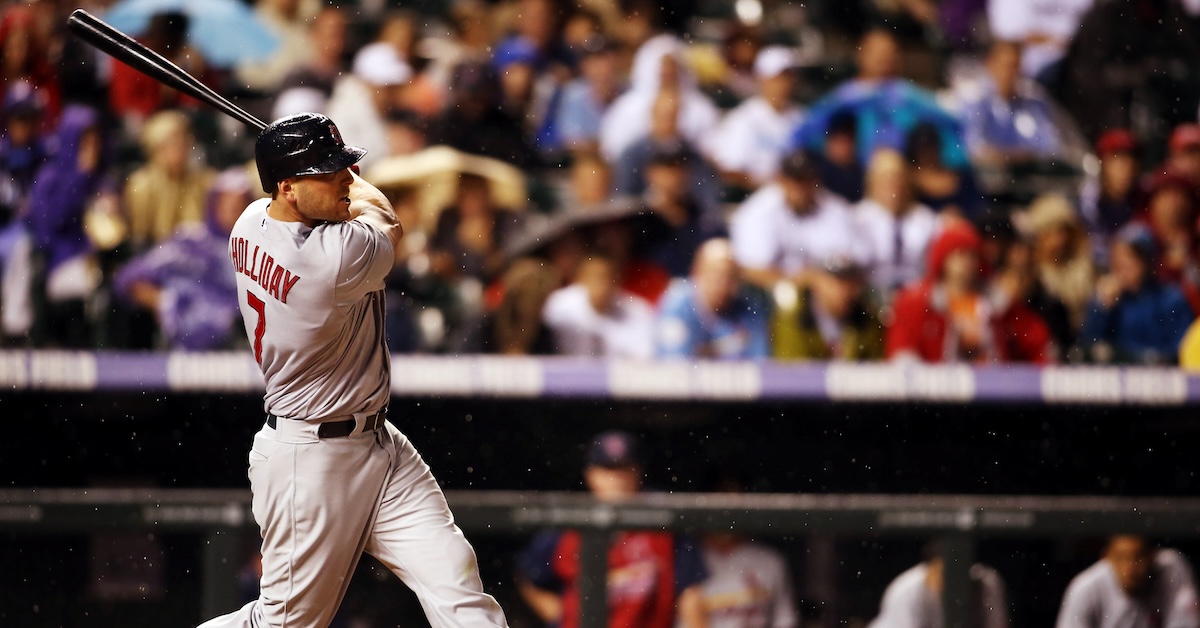
At his listed size of 6-foot-4, 240 pounds, Matt Holliday was built like a football player. He could easily have gone in that direction, having excelled as a quarterback in high school and received scholarship offers from big-time college programs. Holliday came from a baseball-rich family, however, and his heart was on the diamond, so he chose to follow in the footsteps of his father and older brother, both of whom played professionally. He surpassed both not just by reaching the majors but by becoming a star, making seven All-Star teams in a 15-year career spent with the Rockies, A’s, Cardinals, and Yankees. He won a Coors Field-aided batting title as well as NLCS MVP honors while leading the Rockies to their only World Series berth in 2007. Winning seemed to follow Holliday, or perhaps it was the other way around; nine times in those 15 seasons his teams made the playoffs, with three trips to the World Series including a championship in 2011.
Matthew Thomas Holliday was born on January 15, 1980 in Stillwater, Oklahoma. His father, Tom Holliday, spent a year in the Pirates’ organization before pursuing coaching at the collegiate level. From 1978–96, he served as Oklahoma State University’s pitching coach and recruiting coordinator, then took over as head coach from ’97–2003. His oldest son, Josh Holliday (b. 1976), starred at Stillwater High School ahead of Matt; the two played on the same team in 1995. Josh was drafted by the Twins in the 14th round in 1995 but instead chose to go to Oklahoma State, where he played for his father and helped the team to the College World Series in ’96 and ’99. Drafted again by the Blue Jays in the ninth round in 1999, he spent two seasons playing professionally before going the college coaching route; he took over as Oklahoma State’s head coach in 2013, and still holds the job. Read the rest of this entry »
Jim Leyland is headed to Cooperstown. The 78-year-old former manager of the Pirates, Marlins, Rockies, and Tigers was the only candidate elected by the 2024 Contemporary Baseball Era Committee for Managers/Executives/Umpires, which met on Sunday at the Winter Meetings in Nashville to consider eight figures who made their greatest impact from 1980 to the present. In his first appearance on an Era Committee ballot, the 78-year-old former skipper received 15 of 16 votes (93.8%) from a panel of Hall of Famers, executives and media members/historians.
In a 22-year managerial career with Pittsburgh (1986–96), Florida (197–98), Colorado (1999) and Detroit (2006–13), Leyland led his teams to the playoffs eight times, winning a World Series with the Marlins in 1997, a pair of pennants with the Tigers in 2006 and ’12, and six division titles. He ranks 18th in career regular season wins (1,769) but was only 41 games above .500 for his career, with a .506 winning percentage; his record included some lean years with teams that had been torn down and weren’t likely to compete. When given the resources to do so by ownership, he was quite successful, guiding seven teams to at least 90 wins. He was a three-time Manager of the Year, winning the NL award with the Pirates in 1990 and ’92 and with the Tigers in 2006. He’s one of 10 managers to win pennants in both leagues and just the second to lead two teams to a World Series in his first year on the job; Bucky Harris was first, with the 1924 Senators and ’47 Yankees (h/t @AlmostCoop).
Leyland was his era’s archetype of an old-school manager. Prematurely gray, he went from looking ancient at the start of his career to actually being ancient, at least in baseball terms. Known for sneaking cigarettes between innings, he cut an indelible image in the dugout and in front of a microphone, where his dry wit made him a media favorite. Despite a gruff exterior and a knack for getting his money’s worth from umpires when the situation merited it, he earned a reputation as a players’ manager rather than an old-school hard-ass. Read the rest of this entry »



 Sponsor Us on Patreon
 Facebook Group
 Twitter Account
 EW Subreddit
 Effectively Wild Wiki
 iTunes Feed (Please rate and review us!)
 Get Our Merch!
 Email Us: podcast@fangraphs.com