Archive for Teams

Kevin McGonigle Talks Hitting

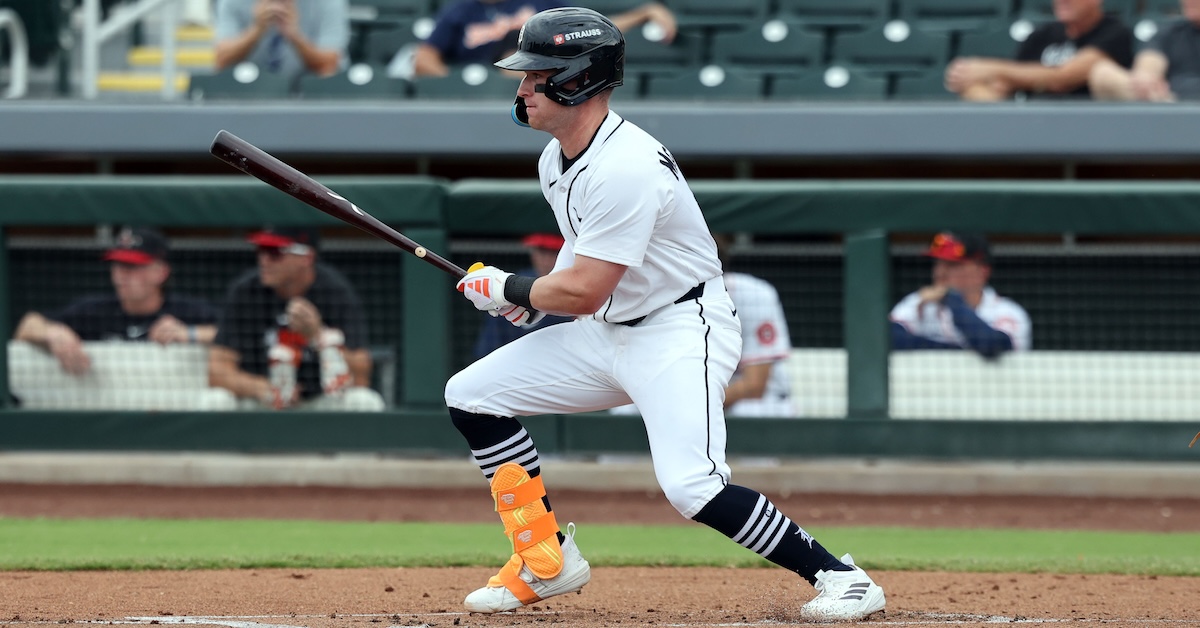
Kevin McGonigle is an elite prospect, and his bat is a big reason why. Playing across three levels in the Detroit Tigers organization — topping out at Double-A — the 21-year-old shortstop/third baseman slashed .305/.408/.583 with 19 home runs and 182 wRC+ over 397 plate appearances in 2025. Ranked third on The Board behind only Konnor Griffin and Jesús Made, McGonigle has been described by Eric Longenhagen as having “real juice in his hands” and a swing that is “geared for launch.” Built to bash baseballs, McGonigle’s left-handed stroke is both compact and lethal.

Currently with the Arizona Fall League’s Scottsdale Scorpions — he’s in the desert primarily to work on his defense — McGonigle has a bright future regardless of where he ends up in the infield. Longenhagen feels that his best fit might be second base. But again, there is juice in his hands. The bat is McGonigle’s carrying tool, and it promises to carry him a long way.

McGonigle sat down to talk hitting prior to a recent game at Scottsdale Stadium.

———

David Laurila: How have you evolved as a hitter? For instance, if I looked at video from the time you signed and compared it now, would I see the same guy?

Kevin McGonigle: “You’d see the same swing. I’m a little bit bigger now, obviously, but the swing hasn’t changed. It’s been the same since I was 10 years old, to be honest with you. That’s the way my body naturally wants to move, and the best way I can explode on a baseball, so I try to keep doing the same thing I’ve done since I was younger.”

Laurila: How does your body naturally move?

McGonigle: “I’ve got the toe tap, and I’m in my legs more than a lot of guys are at the plate. I pretty much see ball, hit ball, and try to… not take the same swing. I feel that you’re going to have a different swing on every pitch. But I try to keep the same toe tap, the same everything.”

Laurila: While you’re continuing to do what comes naturally, you also have talented hitting instructors to work with. How are you balancing that?

McGonigle: “What I like about the Tigers is that they’re not really hands-on unless you have questions. I go to them for little pieces, like routines or drills that I want to do. One big thing for me was bat speed, so they put me on a bat-speed program last offseason. That really helped me with power this year. Bat-to-ball, of course. Gap-to-gap power. I’m trusting in them — the Tigers and all the coordinators — because they’re there to help you get better and better each day.”

Laurila: What is your approach in terms of where you’re looking to hit the ball?

McGonigle: “It depends on who is on the mound. If a good lefty is out there, I’ll think left-center gap and then just react to his offspeed and pull it. Same thing with right-handers. If it’s a guy throwing really hard, like upper-90s, maybe I’ll think right-center. That’s the farthest I’ll go with a heater. Then, changeup, curveball — whatever secondary he throws — pull it down the line. Top hook it in the corner is what I like thinking.

“When I’m on, I’m mostly hitting balls hard in the right-field gap or down the right-field line. That’s even with pitches dotted away. I’ll still be able to get under it and pull it. There does comes a time and place when I want to let the ball travel, though. With two strikes, I try to use all parts of the field.

“I’m also always sitting on fastballs and reacting to offspeed from there. I don’t like sitting on other pitches, really. If it’s a lefty that just spams sweepers, I’ll sit sweeper, but that’s about it. For me, it’s mostly all reaction.”

Laurila: My impression is that you fit into the KISS category — Keep It Simple, Stupid — yet you think about hitting quite a bit. Is that accurate?

McGonigle: “Definitely. I mean, if I’m hitting the ball hard and it’s going right at somebody, there’s nothing you can do about it. So, my main thing is to just find the barrel. That’s it. If you find the barrel, it’s a win. If you don’t, then get him next time.”

Laurila: Coming up from amateur ball and and through different levels of pro ball, you’re basically the same guy, but with more reps under your belt…

McGonigle: “Yeah, just seeing more pitching. In high school, I didn’t really see 95 [mph] really at all. Once I got a feel for that, I had to get used to guys having better offspeed. They like to throw it in leverage counts, and that’s one thing I really needed to work on this year. Last year I got a lot of fastballs to hit, and this year they’re flipping in 3-0 sliders, 3-1 sliders, changeups in 0-0 counts.

“Getting my hack off on 0-0 counts when I get offspeed that is middle-middle, or it’s a get-me-over offspeed… if I swing and miss, so what? I’m down 0-1. But if I put a barrel on it, then it’s a win. I’m more aggressive now than I was last year.

“If he’s a fastball-changeup guy who throws a lot of changeups, I’ll still sit fastball. A lot of times I’m going to look up. The changeup is going to start there, then have a little bottom to it and go to the heart of the plate. I’m kind of tunneling where I want the pitch to start.”

Laurila: Has bat-speed training helped you react better to heaters when you’ve been expecting something offspeed?

McGonigle: “Yeah. I’d say there were a few times this year that I was sitting offspeed, a guy threw a heater down the middle, and I was still was able to hit it hard to left field. Having a quicker bat has definitely helped. I’m able to protect on two-strike counts. If I’m beat on a fastball, I can at least get a bat on it and foul it off, give myself life to hopefully win that two-strike count.”

Laurila: How much do strikeouts matter? That was something Riley Greene struggled with this year, even while putting up good numbers.

McGonigle: “It’s not a great feeling. I mean, Riley Greene is a great baseball player. I’m looking forward to hopefully one day sharing a field with him. He wouldn’t be in the spot he is right now if it wasn’t for the way he plays baseball, and the way he hits. Strikeouts aren’t the best thing in the world, but he also performed in all the different aspects of the game. The whole strikeout thing… I think it is a big deal, but not as big as everyone thinks it is.”

Laurila: Outside of defense, what do the Tigers want you to work on this coming offseason?

McGonigle: “We have exit meetings with our hitting coordinators — mine will be after [the AFL] — and off the top of my head, I don’t know exactly. But the curveball is one pitch that I struggled with this year. I was either under it, or on top of it.”

Laurila: Why was that?

McGonigle: “Some of it was timing, but some of it was swinging at the wrong curveballs. If it’s low, that’s where the pitcher wants it, and the high ones would kind of fool me. A pitcher would go up top with a curveball, and I would clip it back, whereas that’s a pitch you want to hammer. I’m so used to training it down in the zone, where pitchers usually want to get it, but now some guys are trying to get it up top. I need to work on that, on hitting offspeed up top.”

Laurila: Any final thoughts on hitting?

McGonigle: “There’s not a perfect swing. Every swing is going to be different. If it’s a low pitch, if it’s a high pitch, if it’s away… but you see a lot of guys trying to chase that perfect swing. That’s hard to do when you have a guy throwing 99 and it’s running 20 inches, or sinking 20 inches. My thought is just, ‘Go up there and get the bat to the ball.’ Keep it that simple. Don’t try to chase the perfect swing. I want my swing to be adjustable. Simple and adjustable.”

——

Earlier “Talks Hitting” interviews can found through these links: Jo Adell, Jeff Albert, Greg Allen, Nolan Arenado, Aaron Bates, Jacob Berry, Alex Bregman, Bo Bichette, Justice Bigbie, Cavan Biggio, Charlie Blackmon, JJ Bleday, Bobby Bradley, Will Brennan, Jay Bruce, Triston Casas, Matt Chapman, Michael Chavis, Garrett Cooper, Gavin Cross, Jacob Cruz, Nelson Cruz, Paul DeJong, Brenton Del Chiaro, Josh Donaldson, Brendan Donovan, Donnie Ecker, Rick Eckstein, Drew Ferguson, Justin Foscue, Michael Fransoso, Ryan Fuller, Joey Gallo, Paul Goldschmidt, Devlin Granberg, Gino Groover, Matt Hague, Andy Haines, Mitch Haniger, Robert Hassell III, Austin Hays, Nico Hoerner, Jackson Holliday, Spencer Horwitz, Rhys Hoskins, Eric Hosmer, Jacob Hurtubise, Tim Hyers, Walker Jenkins, Connor Joe, Jace Jung, Josh Jung, Jimmy Kerr, Heston Kjerstad, Steven Kwan, Shea Langeliers, Trevor Larnach, Doug Latta, Dillon Lawson, Brooks Lee, Royce Lewis, Evan Longoria, Joey Loperfido, Michael Lorenzen, Mark Loretta, Gavin Lux, Dave Magadan, Trey Mancini, Edgar Martinez, Don Mattingly, Marcelo Mayer, Hunter Mense, Owen Miller, Paul Molitor, Colson Montgomery, Tre’ Morgan, Ryan Mountcastle, Cedric Mullins, Daniel Murphy, Lars Nootbaar, Logan O’Hoppe, Vinnie Pasquantino, Graham Pauley, David Peralta, Luke Raley, Julio Rodríguez, Brent Rooker, Thomas Saggese, Anthony Santander, Drew Saylor, Nolan Schanuel, Marcus Semien, Giancarlo Stanton, Spencer Steer, Trevor Story, Fernando Tatis Jr., James Tibbs III, Spencer Torkelson, Mark Trumbo, Brice Turang, Justin Turner, Trea Turner, Josh VanMeter, Robert Van Scoyoc, Chris Valaika, Zac Veen, Alex Verdugo, Mark Vientos, Matt Vierling, Luke Voit, Anthony Volpe, Joey Votto, Christian Walker, Jared Walsh, Jordan Westburg, Jesse Winker, Bobby Witt Jr. Mike Yastrzemski, Nick Yorke, Kevin Youkilis


Game 7 in Three Jumps

Dan Hamilton-Imagn Images

My job is to write about baseball, which means that in large part, my job is to generate novel circumlocutions for the word “jump.” How many times can you say that somebody’s exit velocity jumped, their whiff rate jumped, their outfield jump jumped into the 82nd percentile before your editor is tempted to bludgeon you with a thesaurus? I would prefer not to find out, as I bruise easily.

I would estimate that I write the word jump about 20 times more often than I actually jump. Nobody jumps all that much on any given day. Unless you’re at the gym, unless you’re playing sports, unless you’re a child, life just doesn’t involve much jumping. This is intentional. It is a result of the way we have structured our lives. We keep things in reach. We have downstairs neighbors. We wear complicated shoes. With the notable exception of the décor at Barnes & Noble, nearly every aspect of our lives encourages us to remain seated. Jumping in jeans is a rare occurrence. All in all, this seems like a bad thing.

Dan Hamilton-Imagn Images

Every once in a while, jumping is a matter of practicality. There’s no way I’m lugging the stepladder out from the laundry room just to get this stupid cake pan off the top shelf. I’m not tracking back five blocks just because a tiny part of this walkway is blocked by a low fence. I’ve been staring at the backs of various heads for this entire concert and I just want to get one good, unobstructed look at the band. It never occurs to us at that moment, jumping out of some mixture of desperation and exasperation, that what we’re doing could be beautiful, graceful. Read the rest of this entry »


Postseason Managerial Report Card: Pat Murphy

Benny Sieu-Imagn Images

Hey kids, there’s a substitute teacher today! But I’ve been given the lesson plan, so we’re going to go ahead and talk about Milwaukee Brewers manager Pat Murphy — no spending the day watching old episodes of The Simpsons that I have on VHS, even though this classroom still has a functioning VCR for some reason. As your normal teacher, Mr. Clemens, would do, I’m going to grade Murphy based on his overall performance in the playoffs, rather than scrutinize every single micro decision made. If you’d like to see Mr. Clemens’ reports on the managers who lost in the various Division Series, you can find the American League write-up here, and the National League write-up here.

I find the Brewers fascinating, both because I’ve always appreciated them having the best logo in sports, and because I’m really bad at projecting them. While I had a better time of it than some others did this year, and at least only had them two wins short of the Cubs, the preseason ZiPS standings have repeatedly underestimated the Brew Crew. I’d love to be able to directly blame the computer for this phenomena, but ZiPS has actually done a solid job of projecting individual Milwaukee players. The problem is that when it comes time to guess exactly who will see the field, I’ve been giving them short shrift. In each of the last five seasons, if I had known precisely who would end up getting playing time, the preseason projections would have gone up by an average of just under four wins per year. It’s not simply that they’ve been healthier than expected, either; the Brewers tend to promote interesting players at a much faster pace than I expect them to, are very quick to understand what’s not working, and deploy role players extremely effectively.

OK, the bell rang, so let’s get going. Read the rest of this entry »


InstaGraphs: Intentionally Walking Cal Raleigh

John E. Sokolowski-Imagn Images

In Game 7 of the ALCS on Monday night, John Schneider’s Blue Jays pulled off a dramatic comeback in the bottom of the seventh inning that sent them to their first World Series in 32 years. The heroics came courtesy of George Springer, who hit a go-ahead three-run home run. But first, Schneider himself made a big decision in the top of the inning. With two outs and no one on base, Cal Raleigh stepped up. Two innings earlier, he had smashed a solo shot to give Seattle a 3-1 lead. Schneider wasn’t interested in facing him; he put up four fingers and called for the intentional walk.

Intentionally walking someone with the bases empty is a statement of strong fact: We absolutely cannot allow this person to hit a home run. To be fair, that’s definitely how Schneider felt in that moment; a home run would have been backbreaking for his team’s chances. Raleigh hit 60 of them in the regular season, so he’s obviously a pretty reasonable guy to fear when you’re specifically afraid of homers. But Josh Naylor, due up next, is a good hitter, too. And baserunners are bad in general. What did the math say about this move? Read the rest of this entry »


The Month of the Splitter

Kirby Lee-Imagn Images

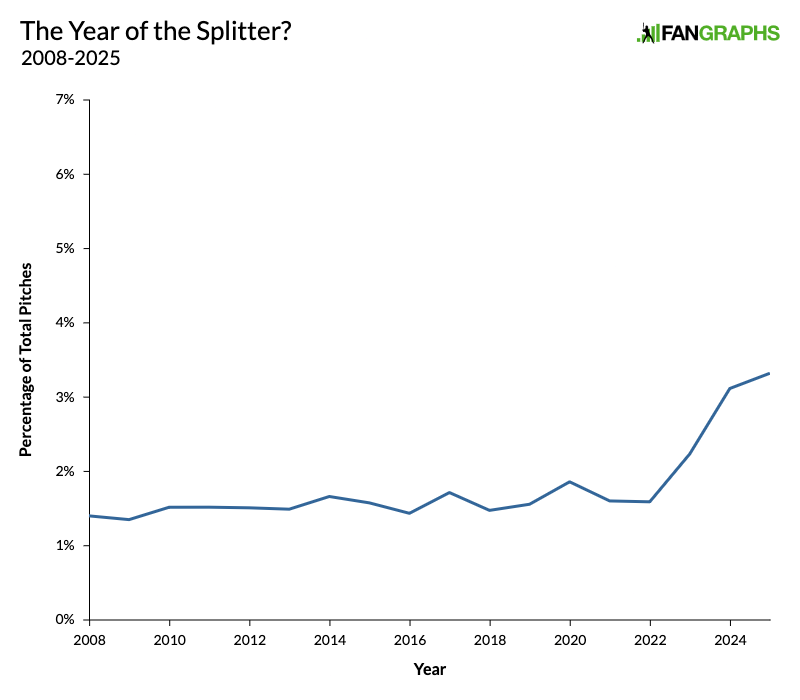
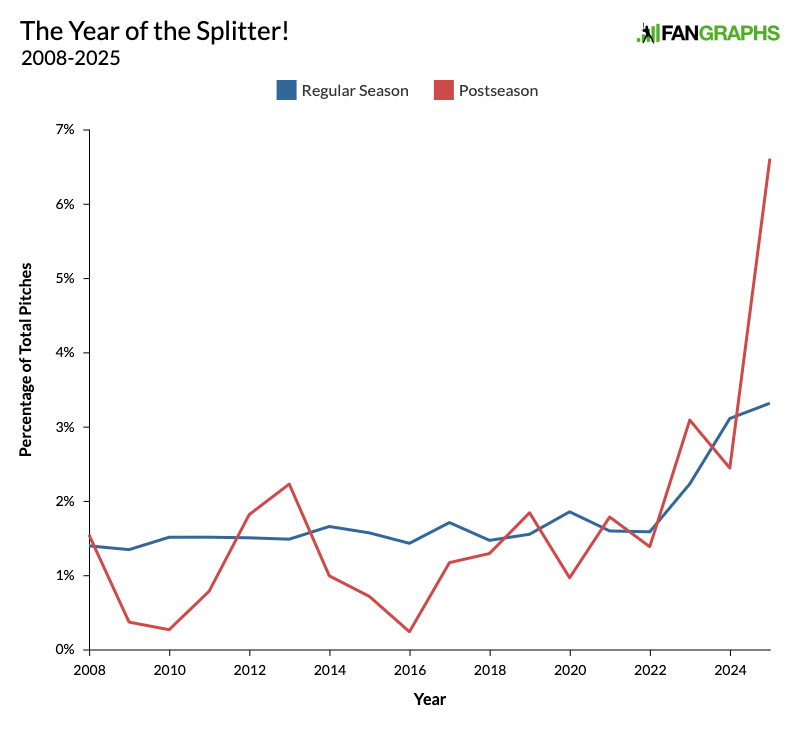
The year of the splitter has come and gone. Actually, those of us who follow these things closely know that both 2023 and 2024 were considered the years of the splitter, and then we established back in March that 2025 would be the year of the kick change. While major league pitchers ran a 3.3% splitter rate in 2025, the highest mark since the pitch tracking era started in 2008, that represented a jump of just 0.21 percentage points from 2024. It’s a difference of less than one splitter per team every three games. While the number is still going up, the big increases came in 2023 and 2024, and the pace fell off this year.

That graph makes it official. This isn’t the year of the splitter. But now let me add another line to that graph. That was the regular season. We’re in the thick of the playoffs, so let’s throw the postseason in the mix, too. If you saw that first graph and wondered why I left all that empty space at the top, well, now you know.

That’s more like it. October 2025 has seen a splitter explosion. The red line is always going to be more volatile than the blue line because the postseason is such a small sample, but even so, the playoffs have seen a 6.6% splitter rate. That’s not just the highest we’ve ever seen. It’s twice the rate for any regular season or postseason in the past 23 years. Maybe 2025 was the year of the kick change, but October 2025 is very definitely shaping up to be the month of the splitter. The playoffs aren’t even over, and we’ve already seen more splitters this October than in the postseasons of 2023 and 2024 combined. Read the rest of this entry »


By George, They’ve Done It

Dan Hamilton-Imagn Images

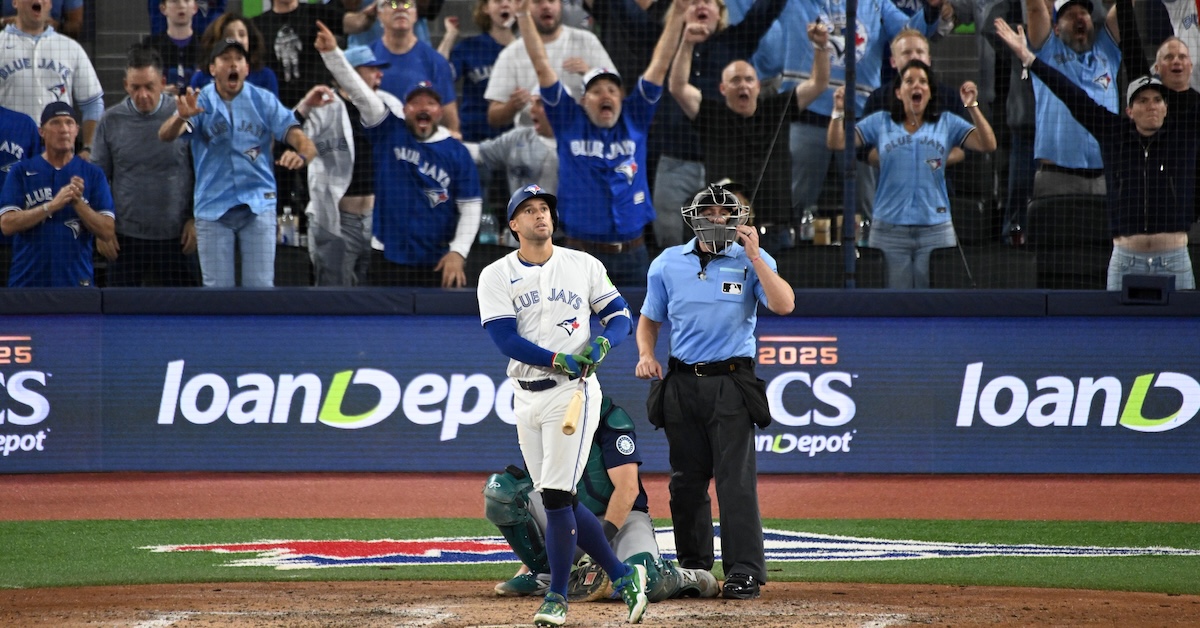
The Toronto Blue Jays are headed to their first World Series since 1993 after defeating the Seattle Mariners 4-3 in a tense seventh game, thanks largely to yet another seismic postseason moment forged by the bat of George Springer. Three nights after he was laying in a heap at home plate, having been kneecapped by an errant mid-90s fastball, Springer added to his already legendary postseason résumé with a three-run home run against, ironically, another fastball tailing in the direction of his knees. The blast was a microcosm not only of Springer’s season (by wRC+ he posted the lone below-average offensive season of his career in 2024, and then set a career-best in 2025) but also of Toronto’s as a group, as the Jays led the majors in comeback wins during the year.

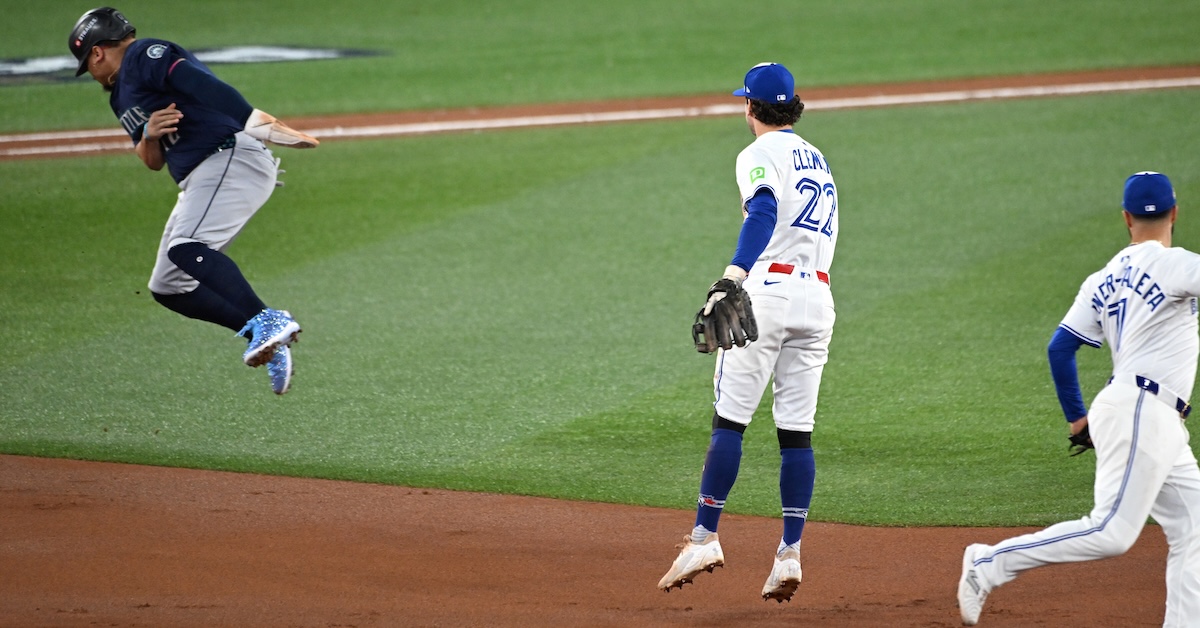
Julio Rodríguez cut the ribbon on Game 7 with a leadoff double, and came around to score a few batters later when Josh Naylor ripped a single just beyond the outstretched glove of a diving Vladimir Guerrero Jr. Thereafter, Seattle’s first-inning rally was stemmed by one of the weirder double plays you’ll ever see, as Naylor did a 180 leap into Ernie Clement’s throw to first base and, after discussion, the umpires decided to rule both runners out, Naylor on the force and batter Jorge Polanco via Naylor’s interference.

Toronto responded with a run of its own in the bottom of the first. A Springer leadoff walk and a Guerrero single (it was fortunate for the Mariners that Guerrero’s 110-mph hit was only a base hit) set the table for an eventual Daulton Varsho RBI knock, but after that, Seattle controlled most of the game. Read the rest of this entry »


Vladimir Guerrero Jr.’s Postseason for the Ages

Nick Turchiaro-Imagn Images

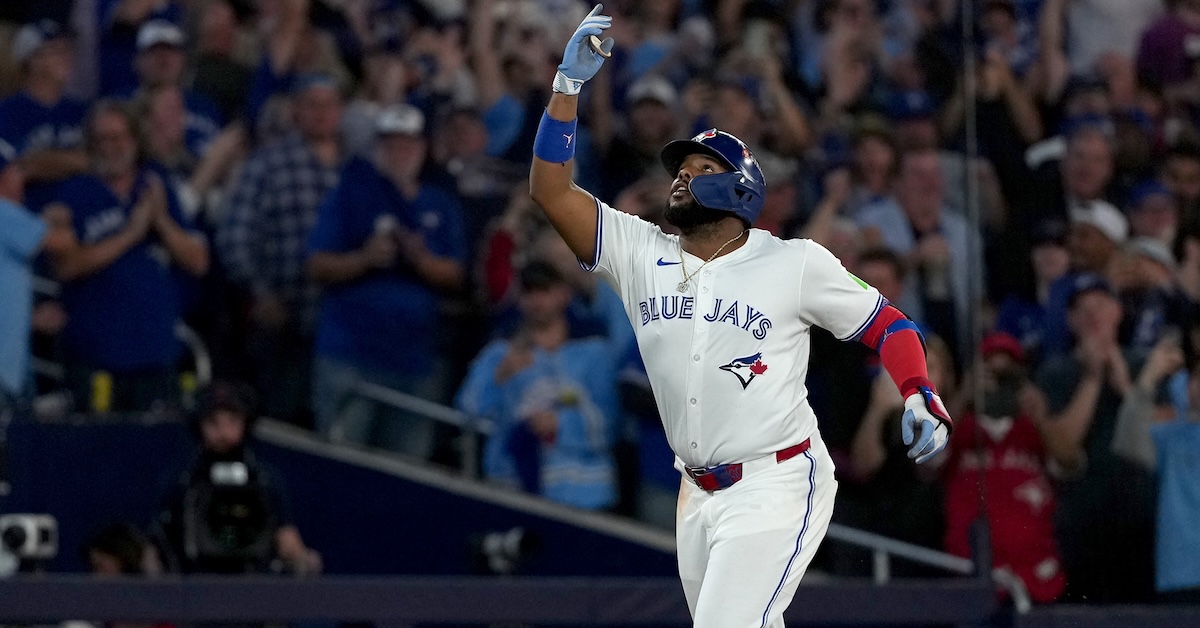
In his first postseason since signing a 14-year, $500 million extension, Vladimir Guerrero Jr. has powered the Blue Jays to within one win of their first trip to the World Series since 1993. The 26-year-old slugger continued his October heroics during Sunday night’s ALCS Game 6 in Toronto, helping the Blue Jays stave of elimination at the hands of the Mariners by clubbing his third home run of the series and sixth of the postseason while also displaying a key bit of baserunning savvy. Guerrero has rebounded from a season-ending slump to put up some absolutely astronomical numbers this fall.

Sunday night’s game didn’t start out that way for Guerrero. As they had done in Games 1 and 2 in Toronto, and Game 5 in Seattle, the Mariners kept him from doing major damage through his first two plate appearances against starter Logan Gilbert. In the first inning, with Nathan Lukes on first, Guerrero chased a low slider and grounded softly into a forceout. In the second, with the Blue Jays having rallied for two runs and with George Springer on first, he hit a scorching 116-mph grounder to the left side, where third baseman Eugenio Suárez made a diving stop, then threw to second from his knees to end the inning.

That 116-mph exit velocity was Guerrero’s hardest-hit ball of the postseason, and the eighth-hardest contact of any player this fall; the other seven, by the likes of Shohei Ohtani, Seiya Suzuki, Kyle Schwarber, Giancarlo Stanton, and Aaron Judge, all went for hits. No such luck for Vladito. Read the rest of this entry »


The Giants Are Circling the Most Interesting Managerial Hire in Decades

Brianna Paciorka/News Sentinel/USA TODAY NETWORK

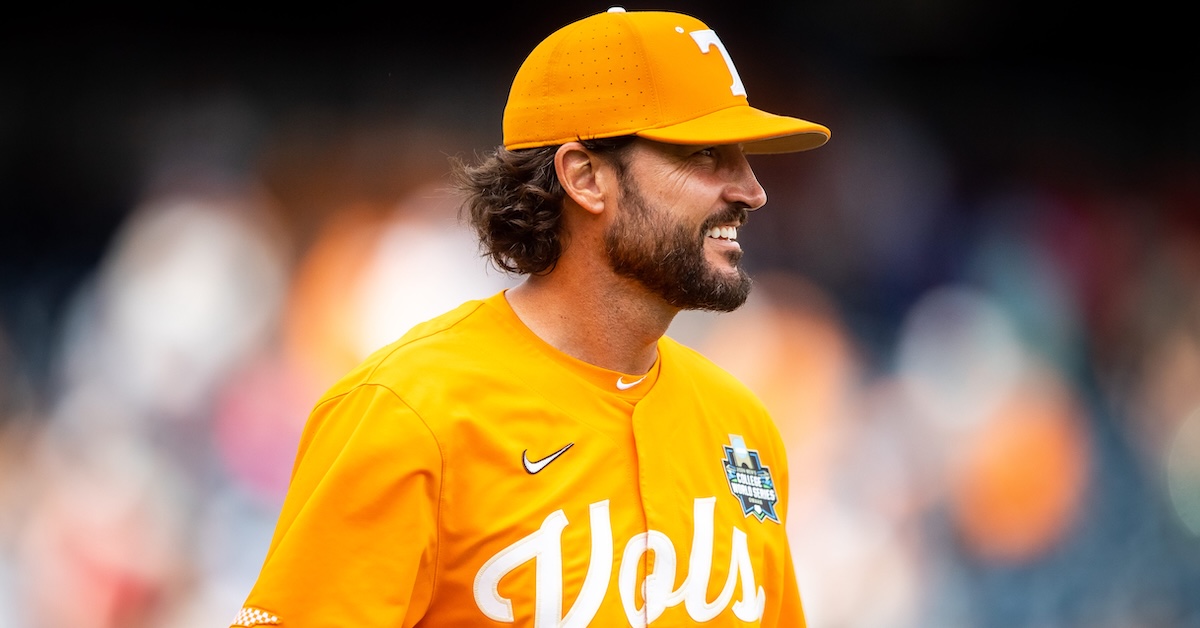
Forgive me for getting excited about this one, because even in sports, it’s not every day that the most interesting outcome happens. But the Giants are, according to The Athletic, “closing in on” hiring a new manager: Tony Vitello.

Two offseasons ago, I wrote about the five categories of major league manager: The hot assistant to a successful skipper; the grizzled baseball lifer; the front office liaison; the recent ex-player who’d been talked up as a future coach since his late 20s; and Aaron Boone.

Vitello is none of those things. When I run the player linker for this post, Vitello’s name is not going to come up in bold. Not only has he never played in the majors, he’s never drawn a paycheck from a professional baseball team in any capacity — not as a player, or a coach, or a scout, or a special assistant. Read the rest of this entry »


Job Posting: Boston Red Sox – Multiple Openings

Direct links to applications (please see job details below):

Applied Baseball Scientist
Computer Vision Analyst
Performance Analyst
Principal Developer
Senior Baseball Sciences Developer


Applied Baseball Scientist

DEPARTMENT OVERVIEW:
The Baseball Sciences department leverages cutting-edge research, data, and technology to enhance player performance, development, and overall team success. By integrating principles from biomechanics, sports science, data analytics, and artificial intelligence, the department plays a critical role in driving innovation on and off the field. The team works closely with coaches, medical staff, strength & conditioning experts, and front-office personnel to develop and implement evidence-based strategies that maximize athletic potential, improve player health, and optimize in-game performance. The Baseball Sciences department is committed to pushing the boundaries of sports science in baseball, putting the Red Sox at the forefront of technological and analytical advancements in the sport.

POSITION OVERVIEW:
The Boston Red Sox are seeking an Applied Baseball Scientist to help translate biomechanical insights into actionable coaching interventions across the organization. This role focuses on the application and evaluation of biomechanics and performance science data to inform skill-specific development, assess the effectiveness of training strategies, and refine program design. This role will work closely with coaches, coordinators, and performance staff to ensure that biomechanical insights directly support player development and on-field performance.

This is an opportunity to use your biomechanics expertise in a highly applied, coach-facing capacity, contributing to the measurement, iteration, and education of coaching practices throughout the organization.

RESPONSIBILITIES:

  • Partner with coaches and coordinators to interpret results, provide ad-hoc analyses for high-leverage cases, and generate clear, actionable feedback for players. 
  • Analyze and refine program design and training approaches, creating tools and frameworks that support consistent, evidence-based application across development settings. 
  • Integrate biomechanics, force plates, wearable sensors, and performance testing data into decision-making processes to inform individualized player plans. 
  • Contribute to educational initiatives that promote effective use of Baseball Sciences tools and ensure staff are equipped to apply biomechanical insights in their daily work. 
  • Contribute to the broader innovation roadmap of the Baseball Sciences department through research, prototyping, and cross-disciplinary collaboration. 

QUALIFICATIONS

  • Education:
  • Bachelor’s or advanced degree in biomechanics, kinesiology, exercise science, engineering, statistics, data science, or a related quantitative field is preferred. 
  • Applied Biomechanics: 
  • Demonstrated experience analyzing biomechanical and performance science data, such as motion capture, force plates, wearable sensors, or computer vision. 
  • Previous experience working directly with coaches and athletes, with the ability to communicate complex concepts in clear, practical terms. 
  • Interest in and/or past experience with coaching, demonstrating an applied understanding of how to design training environments to target identified deficiencies. 
  • Quantitative Analysis:
  • Proficiency with data analysis tools (e.g., R, Python, SQL) and the ability to create intuitive visualizations and reports for non-technical audiences. 
  • Strong applied research skills, with an ability to design studies, evaluate outcomes, and iterate on interventions. 
  • Experience leveraging AI-assisted analysis tools for identifying and implementing solutions. 
  • Soft Skills:
  • A passion for leveraging biomechanics and performance science to improve player development and performance outcomes. 
  • Spanish language proficiency is a plus. 
  • Prior baseball playing experience is a plus. 

In addition to the above requirements, all roles within Baseball Operations are expected to effectively demonstrate our universal competencies related to problem solving, teamwork, clarity of communication, and time management, along with embodying our culture of honesty, humility, relentlessness, and commitment to DEIB.

To Apply
To apply, please follow this link.


Computer Vision Analyst

DEPARTMENT OVERVIEW:
The Baseball Sciences department leverages cutting-edge research, data, and technology to enhance player performance, development, and overall team success. By integrating principles from biomechanics, sports science, data analytics, and artificial intelligence, the department plays a critical role in driving innovation on and off the field. The team works closely with coaches, medical staff, strength & conditioning experts, and front-office personnel to develop and implement evidence-based strategies that maximize athletic potential, improve player health, and optimize in-game performance. The Baseball Sciences department is committed to pushing the boundaries of sports science in baseball, putting the Red Sox at the forefront of technological and analytical advancements in the sport.

POSITION OVERVIEW:
The Boston Red Sox are seeking a Computer Vision Analyst to join our Baseball Sciences group. This role will focus on developing and deploying computer vision methods that transform raw video into actionable data at scale, driving improvements in player evaluation, training environments, and performance analysis. Working within a collaborative research and development team, the Computer Vision Analyst will help advance our ability to extract meaningful signals from the wealth of video available across baseball operations.

This is an opportunity to apply advanced quantitative skills to a broad range of problems in baseball sciences, supporting scouting, player development, and sports performance initiatives.

RESPONSIBILITIES:

  • Develop and refine computer vision models to extract meaningful features from video, generating new datasets that enhance player analysis and performance research. 
  • Collaborate with developers, analysts, and stakeholders to ensure computer vision outputs integrate effectively into organizational tools, systems, and workflows. 
  • Build pipelines for video processing, feature extraction, and event detection at scale. 
  • Partner with Baseball Sciences, Player Development, and other stakeholders to identify opportunities where video-derived data can enhance evaluation and training. 
  • Contribute to the broader innovation roadmap of the Baseball Sciences department identifying novel opportunities for computer vision and machine learning applications.

QUALIFICATIONS

  • Education:
  • Bachelor’s, Master’s, or PhD in Computer Vision, Machine Learning, Computer Science, Engineering, Applied Mathematics, or a related quantitative field is preferred. 
  • Computer Vision Expertise:
  • Demonstrated experience developing and deploying computer vision models and algorithms using frameworks such as PyTorch, TensorFlow, Keras, OpenCV, or similar. 
  • Proficiency in Python or R, with experience handling large-scale video and image datasets. 
  • Experience applying computer vision methods to sports, biomechanics, or human movement data is a plus. 
  • Deployment:
  • Familiarity with database technologies (SQL) and data pipeline development. 
  • Background in machine learning model deployment, cloud computing environments, or scalable infrastructure. 
  • Experience leveraging AI-assisted analysis tools for identifying and implementing solutions.
  • Soft Skills:
  • Knowledge of public baseball analytics research or prior experience working with sports performance data is a plus. 
  • Strong critical thinking skills, intellectual curiosity, and ability to communicate findings clearly to both technical and non-technical stakeholders. 

In addition to the above requirements, all roles within Baseball Operations are expected to effectively demonstrate our universal competencies related to problem solving, teamwork, clarity of communication, and time management, along with embodying our culture of honesty, humility, relentlessness, and commitment to DEIB.

To Apply
To apply, please follow this link.


Performance Analyst

DEPARTMENT OVERVIEW:
The Baseball Sciences department leverages cutting-edge research, data, and technology to enhance player performance, development, and overall team success. By integrating principles from biomechanics, sports science, data analytics, and artificial intelligence, the department plays a critical role in driving innovation on and off the field. The team works closely with coaches, medical staff, strength & conditioning experts, and front-office personnel to develop and implement evidence-based strategies that maximize athletic potential, improve player health, and optimize in-game performance. The Baseball Sciences department is committed to pushing the boundaries of sports science in baseball, putting the Red Sox at the forefront of technological and analytical advancements in the sport.

POSITION OVERVIEW:
The Boston Red Sox are seeking a Performance Analyst to join our Baseball Sciences department. This role will leverage quantitative methods to assess athlete health, readiness, and performance across strength & conditioning, sports medicine, nutrition, and mental performance.

The Performance Analyst will work with diverse data streams—including force plates, weight room testing, wearable devices, and cognitive assessments—to provide actionable insights that support player availability, injury risk mitigation, and development. This position offers the opportunity to apply advanced analytical skills in a collaborative environment, directly influencing training practices and performance outcomes.

RESPONSIBILITIES:

  • Analyze performance data from physical testing (e.g., force plates, weight room measures), wearables, and cognitive/vision assessments. 
  • Build and maintain statistical models to evaluate player readiness, injury risk, and training effectiveness. 
  • Develop objective frameworks to monitor athlete progression and workload management. 
  • Translate findings into recommendations for staff across strength & conditioning, medical, and player development. 
  • Create clear, data-driven reports and visualizations to support decision-making for coaches, staff, and front office stakeholders. 
  • Communicate complex quantitative findings in a concise, actionable manner. 
  • Partner with developers to integrate performance science metrics into organizational tools and applications. 
  • Contribute to the broader innovation roadmap of the Baseball Sciences department through research, prototyping, and cross-disciplinary collaboration. 

QUALIFICATIONS

  • Education:
  • Bachelor’s degree or advanced degree in a quantitative field (statistics, data science, applied mathematics, engineering) or a relevant performance science field (exercise science, biomechanics, kinesiology) is preferred. 
  • Performance and Sports Science Expertise:
  • Demonstrated experience analyzing athlete performance data such as force plates, wearable technology, and weight room testing. 
  • Knowledge of sports science, physiology, and strength & conditioning principles in elite performance environments. 
  • Quantitative Analysis:
  • Proficiency in statistical programming languages (Python, R, or similar) and ability to work with relational databases (SQL). 
  • Strong background in data visualization and reporting, with the ability to tailor outputs to both technical and non-technical audiences. 
  • Familiarity with statistical modeling, predictive analytics, and experimental design in applied settings. 
  • Experience leveraging AI-assisted analysis tools for identifying and implementing solutions. 
  • Soft Skills:
  • Passion for baseball performance and player development is strongly preferred. 
  • Spanish language proficiency is a plus. 
  • Prior experience playing or working in baseball is a plus. 

In addition to the above requirements, all roles within Baseball Operations are expected to effectively demonstrate our universal competencies related to problem solving, teamwork, clarity of communication, and time management, along with embodying our culture of honesty, humility, relentlessness, and commitment to DEIB.

To Apply
To apply, please follow this link.


Principal Developer

DEPARTMENT OVERVIEW:
Members of the Baseball Systems team at the Boston Red Sox are focused on designing, building, and refining the software and data pipelines used within Baseball Operations. These tools and applications are an integral part of the decision-making process, are directly integrated in the workflows of all departments within Baseball Operations, and provide an efficient, consistent, and accessible experience when interacting with our internal data sources and applications.

POSITION OVERVIEW:
The Principal Developer, Baseball Systems position will be a member of the baseball operations software development team, and is responsible for the design, development, and support, of all baseball systems. This individual will work closely with members of baseball operations to understand business requirements that drive the analysis, design, and development of quality baseball systems and solutions. This position is responsible for designing and building highly complex front end applications and will collaborate closely with colleagues on the software development team and baseball operations personnel from all departments.

RESPONSIBILITIES:

  • Serve as critical resource and subject matter expert in the design and delivery of data-intensive, highly interactive interfaces that serve a broad collection of front office stakeholders.
  • Contribute to the advancement of the overall architecture by partnering with domain leads, and establishing best practices and patterns through delivery.
  • Participate in key phases of the software development process of critical baseball applications, including requirements gathering, analysis, effort estimation, technical investigation, software design and implementation, testing, bug fixing, and quality assurance.
  • Responsible for the design and development of complex web-based user interfaces, web services, back-end logic, and other aspects of web applications.
  • Actively participate with other software developers in design reviews, code reviews, and other best practices.
  • Work closely at times with baseball analysts to design and implement solutions to their data needs.
  • Respond to and resolve technical problems and issues in a timely manner.
  • Identify and implement creative solutions for technical challenges.

COMPETENCIES

  • Aptitude and ability to apply academic or applied experience in software development or data engineering related field.
  • An understanding of frontend and backend development and proficiency with modern databases and programming languages.
  • Ability to pick up quickly and think both creatively and critically to solve problems.
  • A solid understanding of contemporary baseball and/or sports analysis and development practices.
  • A team-player that collaborates effectively with technical and non-technical stakeholders. 

ADDITIONAL QUALIFICATIONS

  • Bachelor’s degree in Computer Science, Software Engineering, Computer Engineering, or a related field.
  • 7+ years of deep experience building web applications in Angular, and experience developing with Typescript, CSS/Tailwind, GraphQL, and other modern development approaches.
  • Experience with relational database design and development in SQL Server, Snowflake, MySQL, PostgreSQL, or similar technologies, is required.
  • Experience building front-end visualizations using Three.js, D3, chart.js, or similar, is a plus.
  • Experience developing with cloud technologies from Azure, GCP, or AWS are a plus.
  • Experience integrating systems and data using third-party APIs and services are a plus.
  • Ability to work autonomously and as a team in a fast paced environment.
  • High level of attention to detail with the ability to multi-task effectively.
  • Comfortable working remotely when required and using Zoom, Teams, Slack, Trello, and other tools to communicate with all team members.
  • High degree of professionalism and ability to maintain confidential information.
  • Excellent organizational and time management skills.

In addition to the above requirements, all roles within Baseball Operations are expected to effectively demonstrate our universal competencies related to problem solving, teamwork, clarity of communication, and time management, along with embodying our culture of honesty, humility, relentlessness, and commitment to DEIB.

To Apply
To apply, please follow this link.


Principal Developer

DEPARTMENT OVERVIEW:
Members of the Baseball Systems team at the Boston Red Sox are focused on designing, building, and refining the software and data pipelines used within Baseball Operations. These tools and applications are an integral part of the decision-making process, are directly integrated in the workflows of all departments within Baseball Operations, and provide an efficient, consistent, and accessible experience when interacting with our internal data sources and applications.

The Baseball Sciences department leverages cutting-edge research, data, and technology to enhance player performance, development, and overall team success. By integrating principles from biomechanics, sports science, data analytics, and artificial intelligence, the department plays a critical role in driving innovation on and off the field. The team works closely with coaches, medical staff, strength & conditioning experts, and front-office personnel to develop and implement evidence-based strategies that maximize athletic potential, improve player health, and optimize in-game performance. The Baseball Sciences department is committed to pushing the boundaries of sports science in baseball, putting the Red Sox at the forefront of technological and analytical advancements in the sport.

POSITION OVERVIEW:
The Boston Red Sox are seeking a Senior Developer, Baseball Sciences to join our Baseball Systems department. This role will lead the design and development of specialized software tools that support biomechanics, sports science, and performance initiatives.

As a dedicated developer for the Baseball Sciences group, you will create intuitive applications, data visualizations, and reporting tools that directly impact player health, performance, and decision-making. This is an opportunity to bring advanced development skills to a cutting-edge area of baseball operations, working alongside developers, sports scientists, analysts, and coaches.

RESPONSIBILITIES:

  • Design and build applications that integrate biomechanics and sports science data into performance workflows.
  • Develop custom visualization tools and reporting platforms to support decision-making across Strength & Conditioning, Sports Medicine, Player Development and Scouting.
  • Create flexible tools for workload monitoring and athlete performance tracking.
  • Operate thoroughly and effectively through all phases of the software development lifecycle, from requirements gathering to deployment and maintenance.
  • Collaborate closely with staff across performance and player development to ensure tools align with applied workflows.
  • Provide mentorship and establish best practices within the Baseball Sciences domain.
  • Contribute to the broader innovation roadmap of the Baseball Sciences department through research, prototyping, and cross-disciplinary collaboration.

COMPETENCIES

  • Aptitude and ability to apply academic or applied experience in software development, data engineering, or a related field.
  • An understanding of frontend and backend development and proficiency with modern databases and programming languages.
  • Ability to pick up quickly and think both creatively and critically to solve problems.
  • A solid understanding of contemporary baseball and/or sports analysis and development practices.
  • A team-player that collaborates effectively with technical and non-technical stakeholders. 

ADDITIONAL QUALIFICATIONS

  • Bachelor’s degree in Computer Science, Software Engineering, or related field.
  • 5+ years of professional software development experience, ideally with exposure to sports science or biomechanics data streams such as motion capture, force plates, and wearable technology.
  • Proficiency in TypeScript and JavaScript, with experience in Angular (preferred) or React.
  • Strong background in building complex web-based user interfaces and APIs.
  • Experience with data visualization libraries (e.g., D3.js, Three.js) to represent biomechanics and workload data effectively.
  • Exposure to GraphQL and using GraphQL engines such as Hasura
  • Experience leveraging AI-assisted development tools for efficiency, debugging, and scaling solutions
  • Interest in sports science, biomechanics, and athlete performance data, with the ability to translate domain needs into technical solutions.
  • Database design and development experience (Snowflake and SQL Server preferred).
  • Knowledge of modern baseball analytics and player development methods is a plus.

In addition to the above requirements, all roles within Baseball Operations are expected to effectively demonstrate our universal competencies related to problem solving, teamwork, clarity of communication, and time management, along with embodying our culture of honesty, humility, relentlessness, and commitment to DEIB.

To Apply
To apply, please follow this link.

The content in this posting was created and provided solely by the Boston Red Sox.


With a Quick One-Two Punch, Blue Jays Force Game 7

John E. Sokolowski-Imagn Images

Facing elimination in Game 6 of the ALCS, the Blue Jays were right where they wanted to be. Back in Rogers Centre, where they had the best home record in the majors during the regular season, the Jays defeated the Mariners 6-2 on Sunday night to force a decisive Game 7. On the other side, looking at an opportunity to advance to the World Series for the first time in franchise history, Seattle was wholly unprepared to meet the moment. The Mariners committed three errors, grounded into three inning-ending double plays, and just couldn’t keep up with Toronto’s relentless offense.

Trey Yesavage, making just his sixth start in the big leagues and second in this series, held the Mariners to two runs in 5 2/3 innings. His splitter was particularly nasty; he threw 31 on Sunday, the most he’s thrown in a big league start so far. He earned 10 whiffs on 17 swings (a 59% whiff rate) with that tumbling offspeed pitch and induced two critical double plays with it in back-to-back innings.

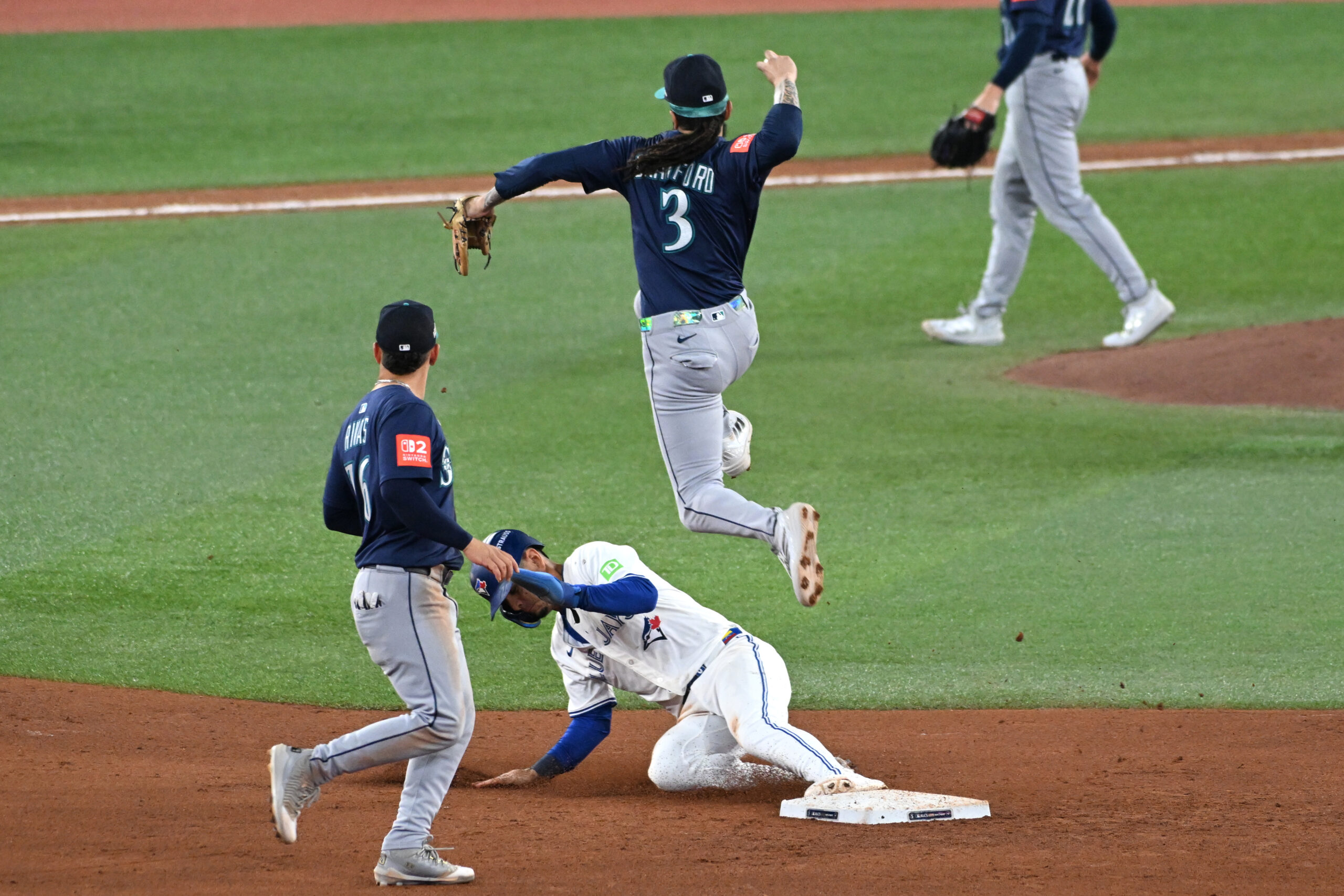
In the third inning, after the Jays had scored two, the Mariners quickly built an opportunity to strike back. J.P. Crawford walked to start the inning, and after Dominic Canzone struck out, Leo Rivas lofted a 360-foot single off the top of the right-center wall. Crawford misread the fly ball and remained too close to first base, so by the time center fielder Daulton Varsho played the carom and fired back into the infield, Crawford had only advanced to second base, meaning Rivas had to hold up at first. Instead of having two runners in scoring position with one out and the top of the order coming up, the bad baserunning had put the Mariners in a textbook double play situation. Nevertheless, after Julio Rodríguez walked to load the bases, it looked like Cal Raleigh, whose 57.7% fly ball rate was the highest in the majors this season, would at least be able to lift a sacrifice fly to get the Mariners on the board. But Yesavage buckled down, turned to his trusty splitter, and got Raleigh to ground into an inning-ending double play on the first pitch of the at-bat. Read the rest of this entry »