Will Middlebrooks didn’t have an especially accomplished career. Hampered by injuries, the slugging third baseman saw action in just 347 big league games — the bulk of them with the Boston Red Sox — before hanging up his spikes shortly after his 29th birthday. But there were memorable moments along the way, and he has good stories to go with them. Now a broadcast analyst for the Red Sox, Middlebrooks shared several of them in the latest installment of our Challenging Career Quiz series.
I began by asking which pitcher he faced the most times.
“I had the most success against Mark Buehrle, and it could have been him,” replied Middlebrooks, who logged 262 hits, including 43 home runs, while playing from 2012-2017. “I know I faced him a lot. Was it Buerhle?”
Nope. Middlebrooks stood in the box against the longtime Chicago White Sox southpaw 19 times, going 8-for-18 with a pair of doubles and a hit-by-pitch, but it’s another hurler who has the honor. Asking Middlebrooks if he had any other guesses prompted a good exchange. Read the rest of this entry »
The Yankees have been limping along since losing Aaron Judge to a stress fracture in his right first rib in early June, and they’ve been without Giancarlo Stanton for even longer due to a right calf strain. Now their lineup has suffered another major blow, as Cody Bellinger sustained a Grade 2 left hamstring strain on Saturday and landed on the injured list, a loss that ought to affect how the Yankees approach the August 3 trade deadline.
The 31-year-old Bellinger injured himself during Saturday’s game against the Phillies. While hustling his way into a double on a two-out eighth-inning hit to left-center field off Jonathan Bowlan, he appeared to slow up a bit before sliding into second. He ended up advancing no further, and when the Yankees took the field for the bottom of the eighth, Max Schuemann replaced him in left field.
Bellinger was spotted doing light agility drills on Sunday, but once it was clear to him that he wouldn’t be ready to return within a few days, he suggested an IL stint made sense because he didn’t want his teammates to play while down a man. “I just feel like I won’t be able to put on the cleats for the next four days, at least,” he said on Sunday. “So being short a man for that long, they’ll get a full roster up here and give the guys as much opportunity as they can.” Read the rest of this entry »
As August 3 draws closer, we’re continuing to update the farm systems of some of the clubs we expect to be buyers at the trade deadline. These teams are both contending for a playoff berth and in clear need of a significant upgrade, the kind that will likely require parting with a top farmhand or two. Today, we’re evaluating the Texas Rangers. The new list accounts for the graduations of Gavin Collyer and Robby Ahlstrom, includes the team’s new draftees, and reflects some of the biggest developments down in the minors this season.
It hasn’t been a great year for most of the upper-level pitchers on our offseason Rangers list, but there are a couple arrow-up hitters in the mid-minors and some very intriguing talent blossoming on the complexes. It’s a farm in flux, packed with eye-of-the-beholder players, which makes this a particularly interesting org for prospect heads to monitor at the deadline.
The Situation
Aging, banged up, and barely playing .500 ball, the Rangers nonetheless find themselves atop the AL West. Though they’re two games up on the Astros and 2.5 up on the Mariners, our Playoff odds only very recently tilted their divisional chances above pre-season favorite Seattle’s. Right now, we estimate that they’re about a 50/50 shot to win the division, and their chances of reaching the playoffs at all are up around 67%. That isn’t normally the résumé of a big deadline buyer, particularly since this isn’t a case of a talented squad weathering an unexpected rough patch: Coming into the year, we pegged the Rangers as a .500 team.
And yet, there’s a strong case to make that Texas should act aggressively because this era of Rangers baseball is drawing to a close. Corey Seager is 32, recovering from an abdominal injury, and showing signs of decline amidst the worst year of his career. Brandon Nimmo is 33. Jacob deGrom is 38 and Nathan Eovaldi is 36. Josh Jung feels young and vaguely prospect-ey still, but he’s actually 28 and his injury history is nearly as checkered as Seager’s. MacKenzie Gore is only around for one more year. This core will never be better than it is right now.
Needs: Starting Pitcher, Bullpen Depth, Catcher
There are two kinds of players you can trade for at the deadline: guys who can help you get to October, and guys who can help you win in October. While the latter are the better, more desirable players in practically every circumstance, they’re also rarer and more difficult to obtain. Conveniently for Texas, players in the former category would do quite a bit of good here.
This is perhaps clearest when evaluating the Rangers rotation. Even the 2026 versions of deGrom, Eovaldi, and Gore are compelling playoff starters. Texas would obviously benefit from a luxury addition like Reid Detmers, but what the club really needs is a better fifth starter than Cal Quantrill. There aren’t many internal candidates on the horizon: Jack Leiter is recovering from ankle surgery and theoretically should be available later this summer, but that shouldn’t reassure anybody. Cody Bradford is on the mend, but he’s still working in fairly short stints in his rehab assignment. Winston Santos and David Davalillo, good options on paper at the outset of the year, do not seem ready to contribute meaningfully. Even the generic no. 4/5 starters on the market look like a real upgrade.
A similar sentiment applies in the bullpen. Jacob Latz has been great as a closer — the Rangers won’t be desperate to find this year’s version of Jhoan Duran or Mason Miller — but it’s hard to imagine them making a run through October with Peyton Gray and Jakob Junis as their top setup men. Even if you mostly trust those guys, there’s precious little depth behind them. As a unit, Texas’ bullpen is 15th in FIP, 27th in groundball rate, and 26th in strikeout rate. Those last two in particular look like a dicey combo in the playoffs.
The Rangers are also in the unenviable position of needing to find a catcher midseason. This didn’t look like a glaring weakness until very recently, but Danny Jansen hurt his elbow and is considering undergoing season-ending surgery, while Kyle Higashioka is also out indefinitely with a flexor strain. We don’t know if the Rockies would seriously consider moving Hunter Goodman, but Texas, arguably more than any team, should be kicking the tires in Denver. The same applies to Ryan Jeffers and really anything resembling an everyday catcher not nailed down on other clubs.
The Rangers’ needs are otherwise less acute on this side of the ball. There isn’t a replacement out there that offers more than what a healthy Seager and Jung can provide, and so the front office is mostly left to cross its fingers and hope they return as the most potent versions of themselves. Squint and you can see an average regular or better everywhere else.
State of the Farm
The arrow is down a little here relative to the offseason. The Rangers had five prospects on our February Top 100 list, and a baker’s dozen received a 40+ FV grade or better, but the pitchers in that tier haven’t progressed much. Caden Scarborough deserves a lot of grace for his uneven 2026 season — it feels wrong to fret much about a guy’s fastball velocity when he’s returning from cancer treatment — and he held his place on our midseason update. But while the rest of the crew — Davalillo, Santos, Jose Corniell, Leandro Lopez, and Marc Church — all looked poised to contribute this year, they’ve combined to throw all of six innings in Arlington.
The reasons why read like a failure to launch manual. Davalillo’s control fell completely apart in Triple-A, and he’s sprinkled in a lot of 91s and 92s on the gun in recent outings, a combination troubling enough that we dropped him from the Top 100. Santos fell off the list as well, in large part because he’s not getting results. He’s long been a personal favorite, and I still like his athleticism, arm strength, and changeup. At some point, though, you have to get hitters out, and it was untenable to keep a pitcher with a high-minors ERA north of 6.00 in that kind of orbit. Corniell’s stuff, which looked crisp in his return from injury last year, has backed up and he’s again on the IL. Lopez started giving up homers for the first time in his career this spring, and he too is on the shelf. Church’s grade was an aggressive projection on a reliever with good stuff; he’s continued to battle injuries and the strike zone, and was outrighted off of the 40-man earlier this year.
Meanwhile, the two hitters who ranked above the 40+ FV tier this offseason have also missed a lot of time. Sebastian Walcott has only played in 10 games this year, though he recently made his triumphant return from a UCL tear a little ahead of schedule, and has wasted no time reminding us why he’s one of the game’s best prospects. Paxton Kling has been out since mid-June with a wrist injury; before getting hurt, he’d put up decent surface-level numbers, albeit with more swing and miss and less power growth than I’d anticipated. There’s enough uncertainty here to slide him.
The positive energy in this system is mostly coming from the kids. Yolfran Castillo remains a stand out, as he’s hitting in Low-A and looks like an above-average defensive shortstop. His measurable power is up only slightly year over year, but he’s making a ton of contact and, more importantly, he has one of the most projectable frames in the low minors. His teammate, Paulino Santana, remains on the 40+ track, as he’s managed to hit for power in Low-A while slightly improving some of his scary contact metrics. He’s also physically projectable and could grow into real thump.
Arguably the two most interesting players in the system spent the summer in Surprise. The two-way guys both had productive years and, delightfully, we’re not much closer to seeing where on the field Seong-Jun Kim fits best long-term. He looks like a no. 4 pitching prospect, sitting 92-96 with impressive command for his age, particularly for a guy splitting his attention. On the other side of the ball, he still projects as a contact hitter and long-term fit at shortstop. I remain skeptical that he has the physicality to pull off double duty over the long haul, but for the time being, the game hasn’t told him to pick a lane just yet.
Josh Owens, meanwhile, has the physicality but might not have the contact skill. The power is legit, but he’s whiffing 35% of the time on the complex, and precious few hitters have missed that often at that level and gone on to have any kind of career. His fastball/slider mix looks pretty darn good on the mound, though, and it’s starting to look like that’s where his future lies. I’m already itching to see what kind of strides he can make as a pitcher — he isn’t yet throwing a change in games — if or when that becomes his full-time job.
The ACL club had a couple of other pleasant developments. Jay McQueen, a 20th-round, $280,000 flier out of a Mississippi high school in the 2025 draft, joins the list. While raw at the plate, McQueen has average power, he made a viable amount of contact on the complex and he showed some ability to move the bat head up and down. He’s a high-variance fourth outfielder prospect. Jacob Johnson gets some of the longest tail on a two-seamer I’ve encountered, and he pairs it with a slider that flashes above average. While he’ll need a beat to harness his fastball, he’s already got uncommonly good feel for locating the bender. After sneaking onto the main section of the offseason list, his arrow is up a little bit as well; like McQueen, he was recently promoted to Low-A Hickory.
For those who really like a sleeper, there’s Breyner Figuereo. He signed with the Cubs as an outfielder in the 2025 international class but was released after one season. The Rangers signed him, put him on the mound, and now he’s touching 98 with good feel for spin from the left side down in the DSL. He’s been aggressively fast-tracked onto the main section.
In the mid-minors, a couple of honorable mention bats have taken big steps forward. I’ve worn a hole in my shoe kicking myself for not listing Rafe Perich on the main section this spring. I liked him on the backfields in March of 2025, but lost my nerve after he posted pedestrian numbers as an older player in Low-A. He’s gone nuts at two levels in 2026, and his age (he’s 24) no longer looks so scary now that he’s giving Texas League arms a rough ride. A switch-hitter with plus raw power, he’s hit 10 homers in 44 games since a midseason promotion, with a barely a dip in his ability to make contact. We gave him a look as we built our recent Top 100 update and didn’t quite see a fit there, in part because he’s no more than a fringy defender at third, where he has a long, slow release and tends to scatter his throws. Still, if he can offer power off the bench and fill in at a couple of spots, that’s a big win for the Rangers amateur and dev groups.
Hector Osorio also slots in. He’s a hitterish outfielder who has suddenly bashed 21 homers out of nowhere. While I think some of the league and ball contexts explain a good deal of the power surge, you still have to pull the fly balls, which Osorio is proving that he can do.
Texas prioritized intriguing, risk/reward players in the draft. They also spent big early: Their first three draftees received bonuses north of $2 million, and then only one other guy in the entire class signed for more than $200,000. Gio Rojas was the best high school pitcher in the class and a potential no. 2/3 starter, though his delivery is more violent than you normally see out of a high school pitcher. Connor Comeau, who had committed to Texas A&M, has big lefty power projection, but less promising feel for contact. Brody Bumila is hurt and will have elbow surgery in Texas after his signs. He’s a spring pop-up arm with triple digit heat, freakish size, a precocious changeup, and a breaking ball that needs some pitch design love; we’ll see if this is the right org for him. Hudson Calhoun is a walk-prone reliever with a bat-missing fastball; he tucks in at the very end of the updated list.
A couple of other minor notes: Aidan Curry goes from the bottom of the 40 FV tier to near the top, as he’s throwing more strikes while working deeper into games in Double-A. Rotation mate Dalton Pence climbs with him. I was a little too bearish on the lefty’s command projection and chances to start in the spring, and in any case he alleviated some of the concerns I had about the moving parts in his delivery by making his motion more fluid and compact. If his slider continues to play like a plus pitch (I’m a little skeptical), Texas will really have something here.
Finally, a quick word on three recent early-round picks. AJ Russell, Malcolm Moore, and Dylan Dreiling are all holding steady. Russell looks ever more like a reliever, as he’s still heavily reliant on his fastball and prone to missing badly even with that pitch; he also hasn’t yet completed the fourth inning in any of his starts. Dreiling’s surface numbers have jumped considerably at Double-A this year, but once you adjust for context and take a look under the hood, he’s still tracking like a fourth outfielder. Moore, meanwhile, has struggled since a midseason promotion to Frisco, where his chase and strikeout rates have climbed markedly. Here are the players graded as 40 FVs and above on the updated list:
The team’s full list, complete with scouting reports and tool grades, can be found on The Board.
It’s rare, though not necessarily tricky, to find a backstop midseason. Contending teams don’t like to do it, as they’d understandably prefer not to have their starting catcher acquaint himself with a brand new pitching staff in the heat of a pennant race. The Rangers have to do that anyway, though, so they might as well see if they can find an everyday regular for the job. Clubs with catching to spare — Colorado, Minnesota, Miami, and perhaps Washington spring to mind — would presumably love to pry away Castillo or Scarborough, and may be able to make it work if they throw in some pitching to sweeten the deal. If not, Santos and Davalillo look like intriguing change-of-scenery candidates.
Among the prospective secondary pieces, the arrow-up arms in Frisco look attractive. Curry and Pence each have a chance to start and runway for growth (perhaps a little more velo as he fills out in Curry’s case, a better change in Pence’s). For the more adventurous sorts, McQueen and Figuereo have impact traits and enough risk to keep the price point fairly low.
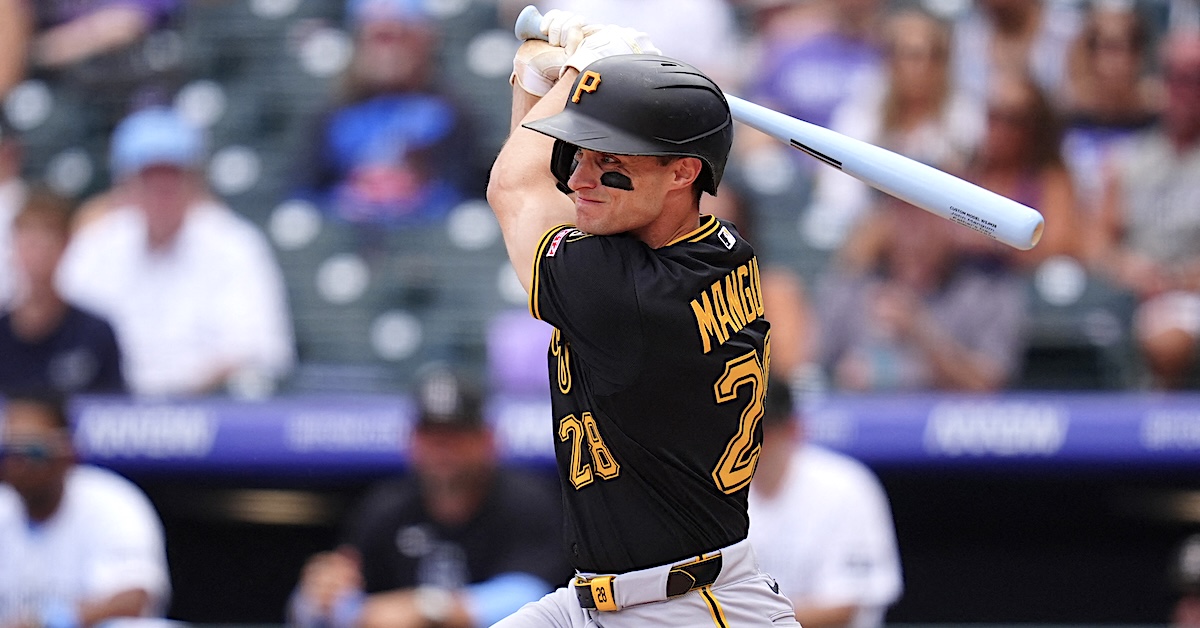
Not counting RotoGraphs posts, Jake Mangum has been a featured player in three articles on this site since the start of last season. In two of those — one each by myself and David Laurila — the phrase “Old School” appears in the headline.
I wouldn’t put too much stock in headlines, especially my own, but in this case it tells you everything you need to know.
Mangum, a legend at Mississippi State, has a style of play that firmly rebukes generations of baseball wisdom. That’s why I wrote about him last April; if you hate hitters who strike out too much and look to hit doubles and home runs instead of dinking drop shots behind the infield, Mangum is your man. Read the rest of this entry »
As we approach August, now is a good time to take a fresh look at the farm systems of some of the clubs we expect to be buyers at the trade deadline. These teams are both contending for a playoff berth and in position to make a buyer’s style trade for a star big leaguer, the kind that will likely require parting with a top farmhand or two. We kicked things off with the Atlanta Braves, and we’ll continue today with the Los Angeles Dodgers.
In tandem with an evaluation of the team’s needs and deadline posture, I’ve updated Los Angeles’ prospect list to account for graduations, incorporate the team’s new draftees, and reflect developments on the farm. The Dodgers have a great farm system, heavy on outfield prospects and pitchers who throw hard but who might just be relievers.
The Situation
The Dodgers have a comfortable 12.5-game lead in the NL West. They’ve successfully weathered injuries to several key cogs on offense (Tommy Edman, Teoscar Hernández, and Will Smith) through a combination of their older stars remaining productive, and Andy Pages and Dalton Rushing improving. On the pitching side, their younger hurlers, especially Justin Wrobleski and several of the sophomore relievers, have stepped up after many of their other arms went down (including Edwin Díaz, Tyler Glasnow, and Blake Snell), and despite a full injury ward, Los Angeles has a top six pitching staff in most statistical categories. More reinforcements are on the way from within, as a few of the injured Dodgers (Díaz, Snell, and Enrique Hernández) are on rehab assignments as the trade deadline approaches, creating a bubble that will force some action on the margins of the big league roster. They may have to play musical chairs a bit as they decide how aggressively to pursue star-caliber improvements to their few weak spots. Read the rest of this entry »
Justine Willard, Wendell Cruz, Rick Osentoski-Imagn Images
If you’re a baseball fan, the end of July means one thing: Trades. That’s right, we’re less than a week away from this year’s deadline, which is set for Monday at 6 p.m. ET, and there’s plenty of action still to unfold. Even a real snoozer of a deadline tends to have at least a few big deals, and so far, the only real needle mover swap made was the fascinating challenge trade that sent Connelly Early from the Red Sox to the Nationals for Curtis Mead.
While we don’t know precisely what will actually happen, since there are no such things as oracles, we have an idea that something will occur, making the trade deadline the ideal time for wish-casting and imagineering. As I do every year, I whip up some trade scenarios that are plausible and productive. We usually get fun additional trade discussion in the comments, so make sure to check those out and maybe even add your own. I’d also suggest letting me know when I give up too much or too little in a trade. Read the rest of this entry »
The Boston Red Sox and Washington Nationals kicked off trade deadline season in earnest on Saturday night, when Boston sent left-handed pitcher Connelly Early to the Nats for corner infielder Curtis Mead.
Most consequential trades this time of year involve a contender swapping one or more prospects for an established big leaguer. Not so this one. At the time of the trade, the Red Sox and Nationals were in similar positions in the standings: The Sox were 53-50, seven and a half games out of the division lead, but half a game up in the AL Wild Card race. The Nats were 53-52, eight and a half games out of first place in the NL East, but only two games out of a Wild Card spot. Both teams are playing with house money: Boston on account of being 14 games under .500 less than five weeks ago, and Washington on account of… everything that’s happened since the start of the 2020 season.
And there’s little difference between Early and Mead in terms of age or team control: Mead is 25, and barring substantial changes in the next CBA, he’ll be arbitration-eligible after the 2027 season and under team control through 2030. Early is one year younger and one year behind Mead on the journey to both of those milestones.
Three interviews — two with pitchers, another with a hitter — were published here at FanGraphs over the past week. All were the result of lengthy conversations, and in each case, worthwhile snippets landed on the cutting-room floor. This week’s column will lead with those leftovers, which come courtesy of Drew Rasmussen, Cole Sulser, and Pete Alonso.
We’ll start with Rasmussen, who addressed his ability to command his offerings, particularly his four-seam/two-seam/cutter combination.
“Command is kind of a sliding scale,” said the Tampa Bay Rays right-hander, whose 4.3% walked rate ranks lowest among qualified hurlers. “Some days it’s really good and some days it’s not so good. The job is to figure out what you have as quickly as possible. On days when my command is really good… I would say that is situation-driven. If I need a ball on the ground, I can throw it with a little more tail and a little less carry. If I’m just trying to steal strike one, maybe I don’t want the [movement] profile to be as big; that way it has a better chance of staying in the zone.
“Conversely, on days that I’m not overly confident with my command, I simplify to the absolute max,” he continued. “We’re going to try to just throw the same one over and over again. Then, hopefully at some point over the course of the outing, something clicks and I start to get more and more confident, and comfortable, with the command I have that day.” Read the rest of this entry »
Controversy surrounding José Caballero’s pre-pitch routine struck twice in the Bronx this week, with the first time prompting the benches to clear and the second causing unnecessary confusion. In the eighth inning of the Yankees’ 8-5 win over the Pirates on Monday night, Caballero did what he usually does — he dug into the batter’s box and didn’t look up at the pitcher until there were eight seconds left on the pitch timer. The idea is to disrupt the pitcher’s rhythm. Pittsburgh reliever Dennis Santana took exception to Caballero’s tactic — which, again, he has done many, many times for the last four seasons — and yelled at him after getting him to ground into a double play. The benches emptied, and the Pirates complained to MLB about it.
Turns out, the griping worked. After the game, the league told the umpires to more strictly enforce the rules requiring batters to engage with the pitcher with no fewer than eight seconds left on the clock. Instead of warning the batter, and then calling an automatic strike for a repeat violation, the umpires were directed to assess a strike to Caballero for attempting to deceive the pitcher, no matter how much time was left on the pitch timer. Both Caballero and the Yankees claim the league did not notify them about the change. As crew chief Adrian Johnson told a pool reporter after, “He’s been warned all season. We were instructed not to warn him. We were instructed to violate him. That’s what it is. It’s a violation.” Along with Johnson’s poor phrasing, the sudden change in enforcement is quite jarring and, in my opinion, inappropriate. If what the Yankees said is true — that the league didn’t tell them about the change — then I think this is an overstep by MLB to single out a player. Caballero accused the umpires and the league of “picking on” him. But even if MLB did give the Yankees and Caballero the heads up, I think the escalated enforcement is an incorrect interpretation of the rule. I love that Caballero uses the pitch clock to his advantage; pitchers can hold the ball and run down the clock to zero, so why shouldn’t batters be allowed to wait their full allotted time before engaging with the pitcher? Moreover, I also don’t know how Caballero is deceiving the pitcher by doing something he does so frequently. He’s certainly trying to annoy the opposing pitcher, but that’s not deception — that’s good gamesmanship.
Anyway, that’s the last you’ll read about Caballero in this week’s mailbag. Instead, we’ll be answering your questions about Esmerlyn Valdez’s heater, Gunnar Henderson’s woes against fastballs, how to fix the Angels, and whether anyone will break Jesse Orosco’s record for games pitched. But first, I’d like to remind you that this mailbag is exclusive to FanGraphs Members. If you aren’t yet a Member and would like to keep reading, you can sign up for a Membership here. It’s the best way to both experience the site and support our staff, and it comes with a bunch of other great benefits. Also, if you’d like to ask a question for an upcoming mailbag, send me an email at mailbag@fangraphs.com. Read the rest of this entry »
As is tradition at FanGraphs, we’re using the lead-up to the trade deadline to take stock of the top 50 players in baseball by trade value. For a more detailed introduction to this year’s exercise, as well as a look at the players who fell just short of the top 50, be sure to read the Introduction and Honorable Mentions piece, which can be found in the widget above.
For those of you who have been reading the Trade Value Series the last few seasons, the format should look familiar. For every player, you’ll see a table with the player’s projected five-year WAR from 2027-2031, courtesy of Dan Szymborski’s ZiPS projections. The table will also include the player’s guaranteed money (exclusive of any signing bonus), if any, the year through which their team has contractual control of them, last year’s rank (if applicable), and then projections, contract status, and age for each individual season through 2031 (assuming the player is under contract or team control for those seasons, or has a player or vesting option). Last year’s rank includes a link to the relevant 2025 post. Thanks are due to Sean Dolinar for his technical wizardry. At the bottom of the page, there is a grid showing all of the players who have been ranked up to this point.
A note on these rankings: At the top of the list, I’ve tried to group like with like, but that’s not always possible when you’re talking about the very best couple of players in baseball. I’ve noted this in the text, but there’s one tier of players today where I think all three have roughly equal value, and another where I feel strongly that the top guy is the best of the bunch. I’ll note the places where I disagreed meaningfully with the people I spoke with in calibrating this list, and I’ll also note the players whose value my contacts disagreed about. As I mentioned in the Introduction and Honorable Mentions piece, I’ll indicate tier breaks between players where appropriate, both in their capsules and bolded in the table at the end of the piece. Read the rest of this entry »