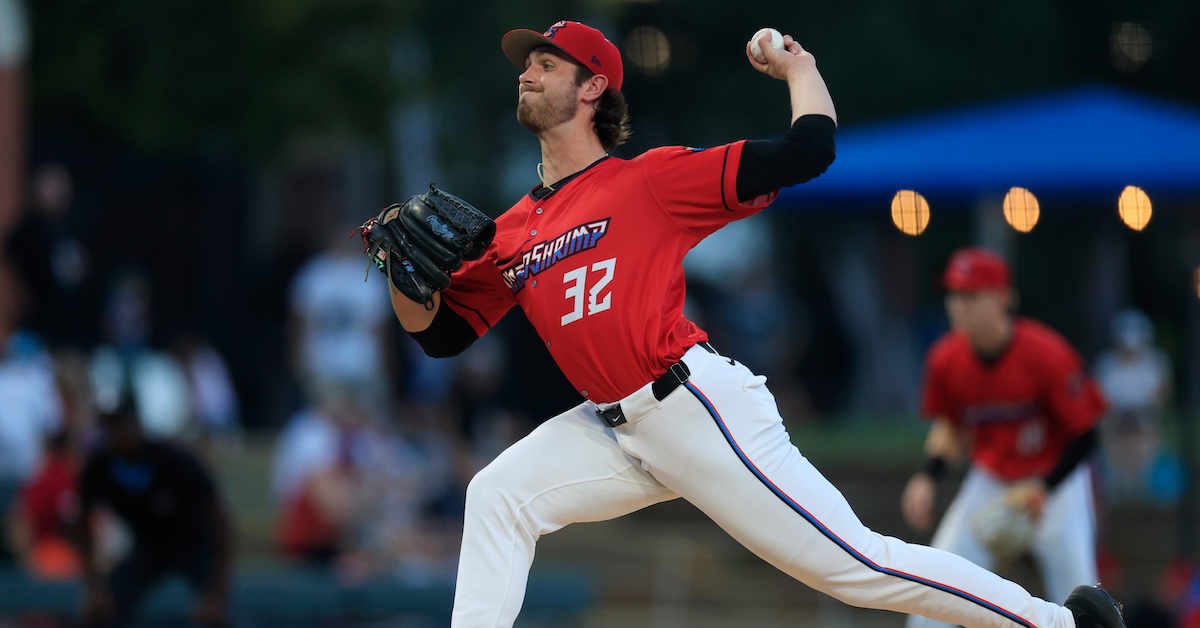
Frankly, it’s impressive that Yankees general manager Brian Cashman can get anything done while locked in a staring contest with agent Scott Boras over the terms necessary to re-sign outfielder Cody Bellinger. As for Miami’s side, I deeply respect the Marlins pro scouting department for looking at all the work they did scouring New York’s farm system for potential targets during the Cabrera talks and refusing to let all that effort go to waste.
Weathers, like Cabrera, still has three seasons of team control remaining before he hits free agency. This is not a rebuilding team trading contracts set to expire before its next window of contention opens. Rather, the Marlins, who are in the early stages of transitioning from rebuilding to contending, have such a surplus of starting pitching that they feel comfortable trading not one, but two established starters in favor of stockpiling additional position player talent in the minors. When Michael Baumann wrote up the Cabrera trade, he speculated that we might see debuts this coming season from Thomas White and Robby Snelling, two of Miami’s top pitching prospects who both graduated to Triple-A last year. By trading Weathers in addition to Cabrera, the Marlins are all but committing to giving one or both of them meaningful innings in the majors in 2026. Read the rest of this entry »
The following article is part of Jay Jaffe’s ongoing look at the candidates on the BBWAA 2026 Hall of Fame ballot. For a detailed introduction to this year’s ballot, and other candidates in the series, use the tool above; an introduction to JAWS can be found here. For a tentative schedule, see here. All WAR figures refer to the Baseball Reference version unless otherwise indicated.
2026 BBWAA Candidate: Gio Gonzalez
Pitcher
Career WAR
Peak WAR Adj.
S-JAWS
W-L
SO
ERA
ERA+
Gio Gonzalez
28.3
26.2
27.2
131-101
1,860
3.70
111
Source: Baseball-Reference
The baseball industry loves its pitching prospects — and sometimes seems to love dreaming on them by using them as trade chips almost as much as it does actually letting them pitch. Considered to have one of the best curveballs in the game from the outset of his professional career, Gio Gonzalez was traded three times before he’d thrown a major league pitch, and five times during a career that ended just after he turned 35. Along the way, the undersized southpaw made two All-Star teams, received Cy Young votes twice, and helped his teams reach the playoffs five times. While he wasn’t always easy to watch given his high walk rates, his ability to miss bats was a testament to the quality of his stuff.
…
Giovany Aramis Gonzalez was born on September 19, 1985 in Hialeah, Florida, a city in Miami-Dade County where roughly three-quarters of the population is of Cuban ancestry. He’s the oldest of six children of Max and Yolanda (Yoly) Gonzalez. Max, a first-generation Cuban-American, installed billboards and owned a scooter shop, while Yoly, an immigrant from Cuba, worked at various jobs to help the family make ends meet.
Gio was just four years old when his parents introduced him to baseball. Growing up, he played sandlot baseball with neighborhood kids in a narrow, rocky strip of land behind the family’s townhouse. “We broke so many windows that I found a guy who would replace them for 15 bucks apiece,” Yoly recalled in 2011.
“Max grew up tough, never got to play as much ball as he wanted and, when it rained on too-rare Sundays when he had a game as a child, he broke down in frustration and cried. But he never stopped studying the sport,” wrote the Washington Post’s Thomas Boswell in 2012. When his eldest son showed an aptitude for the game, Max taught him the curveball that would become his signature. Read the rest of this entry »
As you’re probably aware, the collective bargaining agreement between MLB and the MLBPA expires this year. Time flies, doesn’t it? The last time this happened, MLB locked out its players — the sport’s first work stoppage since the infamous strike that canceled the 1994 World Series.
The smart money is on there being another lockout next offseason; last time around, both sides did a lot of saber-rattling, but relatively little changed. We got the pre-arb bonus pool and some tinkering around the edges, but there was no salary cap, no abolition of the arbitration system, nothing that I’d describe as revolutionary. The duration of the lockout reflects that assessment; the stalemate lasted long enough to delay the season by a week, but not to cancel any games outright.
Having walked up to the verge of the abyss, peeked over the edge, and retreated, neither capital nor labor reaped a painful object lesson in the reality of all-out labor war. Last time that happened, it scared both sides into détente for 25 years. It seems reasonable to assume that either the players or owners might at least think about tickling the dragon’s tail next winter. Read the rest of this entry »
Happy New Year, everyone! I hope you all had a relaxing and enjoyable lobe of the year; now it’s back to reality. As you return to your usual routines and start counting down to Opening Day, rest assured that all of us at FanGraphs are here to provide you with the same entertaining and informative baseball coverage that you’ve come to expect.
Speaking of the coming season, there are still plenty of star free agents left unsigned, including four of the top five and six of the top 10 on Ben Clemens’ Top 50 rankings, so it’s bound to be an eventful two-month lead-up to spring training.
In this week’s mailbag, we’ll answer your questions about the pitchers with the most WAR who never made an All-Star team, why the Hall of Fame matters, the Marlins, and Rickey Henderson’s 1982 season. Before we do, though, I’d like to remind you that this mailbag is exclusive to FanGraphs Members. If you aren’t yet a Member and would like to keep reading, you can sign up for a Membership here. It’s the best way to both experience the site and support our staff, and it comes with a bunch of other great benefits. Also, if you’d like to ask a question for an upcoming mailbag, send me an email at mailbag@fangraphs.com. Read the rest of this entry »
One can’t help but imagine the chagrin of Pete Fairbanks’ dermatologist. The fair-haired closer has spent nearly his entire major league career with the Rays, racking up at least 23 saves in each of the past three seasons. And now, instead of leaving the Sunshine State, he’s traveling even farther south to Miami. The 32-year-old Fairbanks has signed a one-year, $13 million deal with the Marlins. He was the last closer available in free agency, and with Ronny Henriquez out for the season due to a torn UCL, Fairbanks will play a crucial role for a Miami bullpen that finished in the bottom 10 in just about any category you can think of. Will Sammon of The Athletic broke the news, while Jeff Passan of ESPN reported the terms, and Mark Feinsand of MLB.com reported that the contract included a $1 million signing bonus and another $1 million in incentives. According to AJ Eustace of MLB Trade Rumors, Fairbanks would also get a $500,000 bonus if he’s traded.
The move represents a reunion with president of baseball operations Peter Bendix, who previously served as Tampa Bay’s general manager. Speaking to reporters on Wednesday, Fairbanks made it clear that Bendix’s role with the Marlins was part of their appeal. “To hear all the things that he’s been doing over his tenure down in Miami, from what I’ve heard previously to what I have now, how much things are changing and how much he has been attempting to put his stamp on things. I felt like that made it a pretty easy choice, and I am excited to see the direction that he takes.” (Hat tip to Kevin Barral of Fish on First, who published this quote and the others you’ll read in this article.) Fairbanks also noted that moving just a four-hour drive away from Tampa is a boon because he and his wife are expecting their third child “basically on Opening Day.” This is the first All-Star break baby we write in 2026, but I can assure you that it won’t be the last. Read the rest of this entry »
Throughout history, the Miami Marlins have only produced four kinds of season: The star-studded World Series team of 1997, the star-studded last place team of 2012, unwatchable detritus, and a feisty .500ish club with some fun talent. (The 2003 World Series-winning Marlins were the latter group, plus a one-year cameo by Ivan Rodriguez.)
That team looked like a juggernaut in the making, because it had a roster full of guys who would spend most of the next decade starting for playoff teams. Just, you know, other playoff teams, and not the Marlins. Read the rest of this entry »

Many were surprised when Zach McKinstry outpolled Kansas City’s Maikel Garcia and New York’s Ben Rice to win this year’s American League Silver Slugger Award at the utility position. That’s understandable — McKinstry’s numbers weren’t as good as those put up by his co-finalists — but the honor was nonetheless deserved. For one thing, he was a true utility player. Not only did McKinstry start 20 or more games for Detroit at each of third base (69), shortstop (27), and right field (20), he was stationed everywhere besides center field and catcher. Conversely, Garcia started just 21 games at positions other than third base, while Rice’s only action came as a catcher and a first baseman.
And it’s not as though the Tiger didn’t have solid numbers of his own. Over 511 plate appearances, McKinstry slashed .259/.333/.438 with a 114 wRC+. Moreover, he logged 23 doubles, 11 triples, 12 home runs, and 19 stolen bases. Amid little fanfare, the 30-year-old erstwhile Central Michigan University Chippewa was one of the more valuable players on a team that went on to play October baseball.
By most accounts, McKinstry is an overachiever. Exactly one thousand players were chosen before him in the 2016 draft, and he ranked as just the 28th-best prospect in the Los Angeles Dodgers organization when he made his MLB debut in 2020. When the Tigers subsequently traded for him in March 2023 — he was by then a Chicago Cub — he had appeared in 121 big-league games to the tune of a 79 wRC+ and 0.8 WAR. Read the rest of this entry »
The following article is part of Jay Jaffe’s ongoing look at the candidates on the BBWAA 2026 Hall of Fame ballot. For a detailed introduction to this year’s ballot, and other candidates in the series, use the tool above; an introduction to JAWS can be found here. For a tentative schedule and a chance to fill out a Hall of Fame ballot for our crowdsourcing project, see here. All WAR figures refer to the Baseball Reference version unless otherwise indicated.
In an age when baseball is so obsessed with velocity, it’s remarkable to remember how recently it was that a pitcher could thrive, year in and year out, despite averaging in the 85–87 mph range with his fastball. Yet that’s exactly what Mark Buehrle did over the course of his 16-year career. Listed at 6-foot-2 and 240 pounds, the burly Buehrle was the epitome of the crafty lefty, an ultra-durable workhorse who didn’t dominate but who worked quickly, used a variety of pitches — four-seamer, sinker, cutter, curve, changeup — moving a variety of directions to pound the strike zone, and relied on his fielders to make the plays behind him. From 2001 to ’14, he annually reached the 30-start and 200-inning plateaus, and he barely missed on the latter front in his final season.
August Fagerstrom summed up Buehrle so well in his 2016 appreciation that I can’t resist sharing a good chunk of it:
The way Buehrle succeeded was unique, of course. He got his ground balls, but he wasn’t the best at getting ground balls. He limited walks, but he wasn’t the best a limiting walks. He generated soft contact, but he wasn’t the best at generating soft contact. Buehrle simply avoided damage with his sub-90 mph fastball by throwing strikes while simultaneously avoiding the middle of the plate:
That’s Buehrle’s entire career during the PITCHf/x era, and it’s something of a remarkable graphic. You see Buehrle living on the first-base edge of the zone, making sure to keep his pitches low, while also being able to spot the same pitch on the opposite side of the zone, for the most part avoiding the heart of the plate. Buehrle’s retained the ability to pitch this way until the end; just last year [2015], he led all of baseball in the percentage of pitches located on the horizontal edges of the plate.
Drafted and developed by the White Sox — practically plucked from obscurity, at that — Buehrle spent 12 of his 16 seasons on the South Side, making four All-Star teams and helping Chicago to three postseason appearances, including its 2005 World Series win, which broke the franchise’s 88-year championship drought. While with the White Sox, he became just the second pitcher in franchise history to throw multiple no-hitters, first doing so in 2007 against the Rangers and then adding a perfect game in ’09 against the Rays. After his time in Chicago, he spent a sour season with the newly rebranded Miami Marlins, and when that predictably melted down, spent three years with the Blue Jays, earning one more All-Star nod and helping them make the playoffs for the first time in 22 years.
Though Buehrle reached the 200-win plateau in his final season, he was just 36 years old when he hung up his spikes, preventing him from more fully padding his counting stats or framing his case for Cooperstown in the best light. A closer look beyond the superficial numbers suggests that, while he’s the equal or better of several enshrined pitchers according to WAR and JAWS, he’s far off the standards. Like fellow lefty and ballot-mate Andy Pettitte, he gets a boost from S-JAWS, a workload-adjusted version of starting pitcher JAWS that I introduced in 2022. Thus far, I’ve only included Pettitte on one of my five ballots (one of seven including virtual ballots), though I’m mulling his inclusion this year — a thought process that’s taking place as the electorate grapples with shifting standards for starting pitchers following last year’s election of CC Sabathia and the candidacies of Félix Hernández (who debuted last year) and Cole Hamels (this ballot’s top newcomer). I’ve pledged to reconsider Buehrle as well; I’m 0-for-5 in voting for him thus far, and I’m hardly alone, as he debuted with 11% in 2021, scraped by with 5.8% the next year, and has barely regained that lost ground, receiving 11.4% in 2025. Read the rest of this entry »
For the 22nd consecutive season, the ZiPS projection system is unleashing a full set of prognostications. For more information on the ZiPS projections, please consult this year’s introduction, as well as MLB’s glossary entry. The team order is selected by lot, and the next team up is the Miami Marlins.
Batters
While the Marlins were expected to need to fight hard to get out of the NL East basement in 2025, the team was surprisingly solid from midseason on, and though they never reached .500, they at least flirted with it thanks to a winning record in the second half.
A lot of the happy surprises in Miami came from the starting lineup. While a team wRC+ of 96, good for 21st in the majors, doesn’t exactly occasion a “Mission Accomplished” banner, both marks were a notable improvement on the team’s recent history. Indeed, a 96 wRC+ represents the team’s best result since 2017, that year being one of only two seasons in which the Marlins passed the century mark. While there’s no direct comparison to the team’s terrific Marcell Ozuna/Christian Yelich/Giancarlo Stanton outfield of that era, there’s actually some good young offensive talent on the team. And importantly for Miami, it’s generally inexpensive. Read the rest of this entry »