Archive for Nationals

Maybe James Wood Just Thinks He Has a Really Tiny Strike Zone

Brad Mills-Imagn Images

After posting an excellent 125 wRC+ over his first two seasons, James Wood is establishing himself as one of the best hitters in baseball this year. The 23-year-old National is running a 169 wRC+, third best among qualified batters, and he’s on pace for 43 homers, 26 stolen bases, and 7.2 WAR. Everybody knows the parameters of Wood’s game by now. He’s 6-foot-6, extremely choosy at the plate, and so spectacularly powerful that his proclivity for whiffs and groundballs barely holds him back. This year, he’s improved on both fronts, dropping nearly 10 percentage points from his groundball rate and adding nearly four points to his contact rate on pitches in the strike zone. It’s huge news – James Wood-huge even – and if he can hold on to even some of those gains, he’s going to live at the top of the leaderboards for a long, long time. Today, however, we’re going to talk about a leaderboard where Wood ranks dead last.

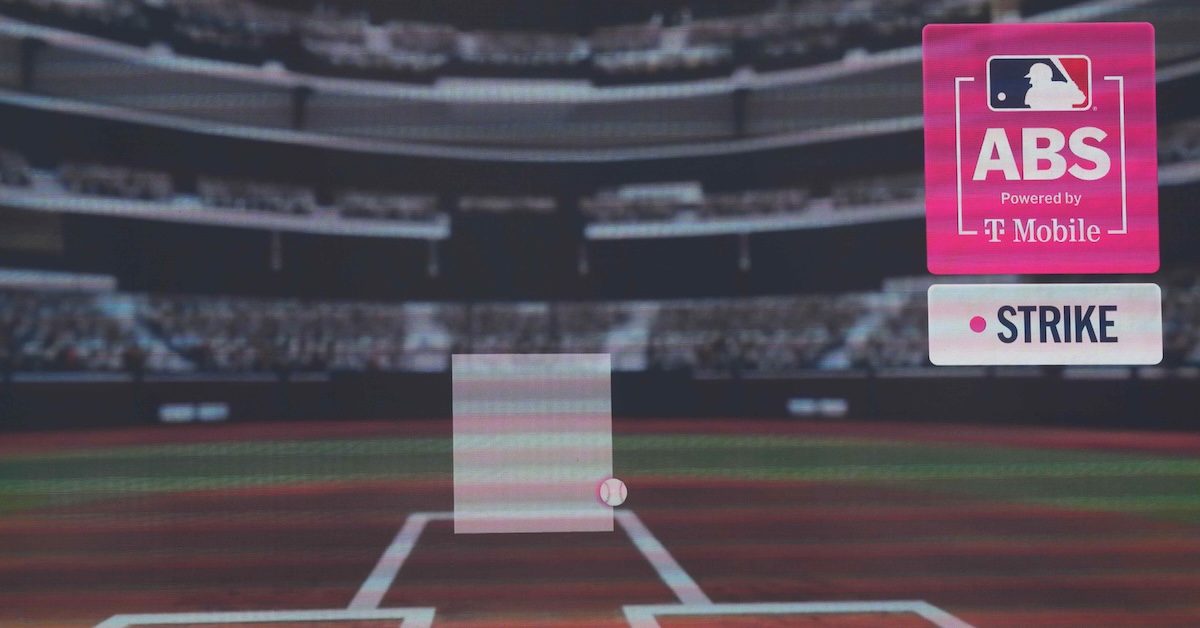
If you head over to Baseball Savant’s new ABS challenge leaderboard, you’ll find Wood all the way at the bottom. A big caveat before we get going: The challenge system is very new, and because each player challenges so few times, the sample sizes are very small. Moreover, everyone involved is still adjusting to the system, so the trends we’re seeing now are likely to change. In this article, I’m going to be overreacting to these early numbers. It’s way too soon for big proclamations. However, I don’t think it’s too soon to look for patterns and draw some early conclusions about players who stand out as starkly as Wood does. End of caveat.

Now let’s go to the leaderboard and sort by either Net Overturns or Net Runs. There’s Wood, dead last. According to Statcast’s reckoning, an average batter who saw the same pitches Wood has seen would have made 4.8 more successful challenges and netted their team 1.4 more runs. No player has been worse, and even if you ignore the advanced numbers for a moment, Wood’s record tells you all you need to know. He’s made 13 challenges. He’s won three of them and lost 10. For those of you keeping score at home, that stinks. The average batter has won 47% of their challenges, twice as many as Wood. Read the rest of this entry »


Sunday Notes: Nationals Prospect Erik Tolman Has a Remarkable Backstory

Erik Tolman has a remarkable backstory. Currently playing for the Triple-A Rochester Red Wings, the 26-year-old left-hander threw to one of baseball’s most prolific pitchers as a prep, and that is a comparatively insignificant part of his past. His level of perseverance is nothing short of remarkable. Tolman has overcome debilitating injuries on his journey to the doorstep of the big leagues.

His travails began in 2021, the year the Washington Nationals drafted him in the 14th round out of Arizona State University. He had the first of two Tommy John surgeries, costing him all but three games in his final collegiate campaign — and his bad fortune was only just beginning.

“I tore my UCL again at the end of my rehab,” Tolman explained. “Fourteen months after having surgery, in my last live ABs, I felt my elbow go again. It was a sad moment, honestly. But I talked to my family, and I believed in myself — I thought I could still be a big-leaguer — so I kept at it. Unfortunately, on my fifth start back, in August 2023, I dislocated my knee. That made for a whole new mountain that I’ve had to climb.

“The injuries have driven me to have a work ethic, and a mental fortitude, of just going balls to the wall,” he added. “I figured I could either struggle coming back from the injuries, playing baseball, or struggle out in the real world. At the end of the day, we’re the ones responsible for our lives and careers. If you get hurt, are you going to cave, or are you going to overcome?”

Tolman did far more than simply dislocate a knee after returning from the second TJ. What happened was not only catastrophic: it was hard to fathom. Read the rest of this entry »


Five Things I Liked (Or Didn’t Like) This Week, May 22

Rafael Suanes-Imagn Images

Welcome to another edition of Five Things I Liked (Or Didn’t Like) This Week in Baseball. In keeping with the increasingly lenient definition of “this week” that I’ve been using of late, we’ve got stuff from all throughout May in this column. May is a great time to watch baseball. (It’s always a great time to watch baseball, but May is particularly good.) The weather is heating up. Ballparks are swelling with the start of summer crowds. Tarps are coming off. So please join me on a trip through the league, from fun teams to watch to nifty little plays. And as always, thanks to Zach Lowe of The Ringer for the inspiration.

1. The Go-Go Nats
Nationals fans have endured seven years in the wilderness since the team’s 2019 title. Washington’s season-high win total in that span was 71 (2023 and 2024). This year’s team is finally playing around .500 ball, though our projections think the Nats will end up right around that 71-win high-water mark again. (We have them down for 74 at the moment.) But while the winning hasn’t quite come back yet, the fun has.

This year, the Nationals are dominating on offense. They’re leading the majors in scoring by a mile, averaging an enormous 5.49 runs per game. They’ve hit the most doubles in baseball – in fact, they have the most extra-base hits in baseball. They’re top 10 in on-base percentage, top five in slugging, and top five in stolen bases. They’re first in overall baserunning value. They’re third in BaseRuns-projected scoring. This isn’t smoke and mirrors. Read the rest of this entry »


FanGraphs Weekly Mailbag: May 2, 2026

Stan Szeto-Imagn Images

I don’t pay too much attention to the standings in April. I look at them, of course, but that’s more a matter of routine than a desire to learn something substantial. It’s hard for teams to pull ahead of the pack this early in the season, and I’d rather not read too much into the fact that, say, the banged-up Blue Jays are a few games below .500, or that none of the five teams in the NL Central has a losing record. It takes time for these things to sort themselves out.

And yet, upon checking the standings Friday morning, I found myself pondering the significance of what I saw: specifically, that only three teams in the American League had a winning record. After a dizzying 20 minutes of digging, I lifted my head from my laptop in a daze, wondering how the heck I ended up staring at Baseball Reference’s playoff odds for the 14-18 White Sox. I think seeing the number 16.1% is what snapped me out of my stupor. (For what it’s worth, our Playoff Odds gave the South Siders a 2.2% chance to make the postseason, double their odds on Opening Day.) Anyway, about those three AL clubs above .500, the Yankees (20-11) were expected to be one of the best teams in baseball, so their place atop the standings wasn’t surprising, but the strong starts of the Rays (18-12) and Athletics (17-14) caught me a bit off guard. I thought Tampa Bay was destined for last place when the season began, and our Playoff Odds agreed, projecting the team to finish with 79.7 wins and giving it a 28.9% shot to reach the postseason. Entering May, the Rays have only added about two wins to their median projection (81.9), but they now have a 45.6% chance of making the playoffs. Meanwhile, I believed the A’s would be better this year, but better meant maybe a third-place finish in the AL West and an outside shot to snag the final AL Wild Card spot. Still, I figured they were more likely still a year or two away from true contention. Our preseason Playoff Odds tabbed them for 78 wins and a 21.4% shot at the playoffs. Now, they’re up to a projected 81.3 wins and 43.1% odds. I still don’t think either team will play postseason baseball this year; according to both their Pythagorean and BaseRuns records, the Rays have played more like a .500 team than one that’s on pace to win 97 games, while the A’s simply don’t have enough pitching. Remember, it’s only the start of May. There’s so much more baseball still to be played.

OK, that’s enough about the Rays and A’s in this week’s mailbag. Today, we’ll be answering your questions about how good Shohei Ohtani would be at basketball, whether James Wood is one of the best lefty batters ever at hitting the ball the other way, which batter has the most hits against a pitcher without recording an out, and what would happen if ZiPS forgot about 2020. But before we get to all of that, I’d like to remind you that this mailbag is exclusive to FanGraphs Members. If you aren’t yet a Member and would like to keep reading, you can sign up for a Membership here. It’s the best way to both experience the site and support our staff, and it comes with a bunch of other great benefits. Also, if you’d like to ask a question for an upcoming mailbag, send me an email at mailbag@fangraphs.com. Read the rest of this entry »


The ‘W’ Is for Work in Progress

Jamie Sabau-Imagn Images

The Washington Nationals are starting out strong, but not strong enough.

They weren’t supposed to be good in 2026. They weren’t good last year, or the year before, or the year before, or the — they haven’t been good since they won the World Series in 2019. Our preseason positional power rankings had them 29th by overall projected WAR. Justin Klugh led the Nationals essay in the 2026 Baseball Prospectus annual with the story of an enema given to George Washington just before his death. And no, the parallel was not a particularly happy one.

Indeed, the Nationals have not been good. They’re 11-15 with a -18 run differential and a bottom-five WAR. They’re not yet last in the NL East because of whatever is going on in New York and Philadelphia. But our projections assume they’ll find their way there eventually.

Still, it’s the way they’ve gotten to “not good” that’s been frustrating, entertaining, and perhaps even a bit encouraging. Let’s start with a plot: Read the rest of this entry »


Washington Nationals Top 41 Prospects

Eli Willits Photo: Sarah Phipps/The Oklahoman/USA Today Network via Imagn Images

Below is an analysis of the prospects in the farm system of the Washington Nationals. Scouting reports were compiled with information provided by industry sources as well as my own observations. This is the sixth year we’re delineating between two anticipated relief roles, the abbreviations for which you’ll see in the “position” column below: MIRP for multi-inning relief pitchers, and SIRP for single-inning relief pitchers. The ETAs listed generally correspond to the year a player has to be added to the 40-man roster to avoid being made eligible for the Rule 5 draft. Manual adjustments are made where they seem appropriate, but we use that as a rule of thumb.

A quick overview of what FV (Future Value) means can be found here. A much deeper overview can be found here.

All of the ranked prospects below also appear on The Board, a resource the site offers featuring sortable scouting information for every organization. It has more details (and updated TrackMan data from various sources) than this article and integrates every team’s list so readers can compare prospects across farm systems. It can be found here. Read the rest of this entry »


Davey Lopes (1945–2026): Speedster, Student, and Mentor

Jayne Kamin-Oncea-USA TODAY Sports

Davey Lopes was my first favorite ballplayer. In retrospect, I’m not sure how my eight-year-old self settled upon Lopes in a star-laden lineup featuring power hitters Dusty Baker, Ron Cey, Steve Garvey, and Reggie Smith, who the year before (1977) had become the first quartet of teammates to homer 30 times apiece in a season. I have a much better grasp of how Bill James helped my teenage self appreciate Lopes for his combination of high on-base and stolen base rates with mid-range power, but James wasn’t communicating those ideas via mass-market paperbacks circa 1978. Perhaps it was Lopes’ position atop the lineup I memorized while learning to decode box scores (my theory) or the Topps baseball card set that began my collection. Maybe it was simply his instantly recognizable, bushy mustache (my friends’ theory), but one way or another, even before later heroes such as Fernando Valenzuela and Jim Bouton, Lopes was my guy.

The news that Lopes passed away on April 8 at age 80 due to Alzheimer’s and Parkinson’s diseases — a brutal double bill — reached me while I was traveling in Austria with my own 84-year-old parents and additional family as we tracked down the Vienna addresses of my long-deceased paternal grandparents. I had no shortage of thoughts regarding mortality, and yet the hits kept coming. Lopes wasn’t even the most recent former All-Star-second-baseman-turned-manager to pass away, as Phil Garner, his National League rival and then predecessor in managing the Brewers, died of pancreatic cancer on April 11. So it goes.

Though he didn’t debut until well past his 27th birthday, Lopes spent 16 seasons in the majors (1972-87), the first 10 with the Dodgers, whom he helped to four pennants and a championship while making four All-Star teams, winning a Gold Glove, and becoming team captain. From 1973–81, he manned the keystone in the longest running infield in major league history, along with Garvey at first base, Cey at third, and Bill Russell at shortstop — a unit that formed the foundation of those pennant-winning teams under managers Walter Alston and Tommy Lasorda. “He was the catalyst of the engine. It was 700 horsepower with the four of us, and the equation was his ability to get on base,” Garvey told CBS LA in the wake of Lopes’ death. Read the rest of this entry »


How Long Could Joey Wiemer Have Kept Getting on Base Before You Suspected the Involvement of Shadowy Outside Forces?

Matt Marton-Imagn Images

Over the past few years, one thought has kept bouncing around in my mind: “I must be taking crazy pills.” Don’t run off to the comments to complain about this post getting political, because that’s not the point I’m trying to make. Over the past few years, longstanding institutions and norms have come crashing down without so much as a peep from the people charged with defending them. Whether you think that’s good or not, it’s a matter of historical fact.

Therefore, we live in disconcerting times. COVID, AI, mass media consolidation, man’s inhumanity to man… it messes with one’s sense of order in the universe. We’re rapidly approaching an era in which battery tech and solar power actually make electricity too cheap to meter, but NATO and the Washington Post might not exist by the time we get there.

It’s unsettling. There have been times when I’ve looked around and found that the most logical explanation is that I am, genuinely, being slipped crazy pills without my knowledge. Because surely this must make sense to someone. Read the rest of this entry »


Ponce Injury Lowlights First Starts for NPB, KBO Free Agents

Kevin Sousa, Benny Sieu, Eric Hartline, Troy Taormina-Imagn Images

Cody Ponce left his first start on a cart with a trainer.

Ponce collapsed in considerable pain Monday after making an awkward attempt to field a grounder in the third inning against the Rockies. He appeared to twist his right knee in a direction it’s not meant to go. He stood and limped to the cart on his own before exiting. Blue Jays’ manager John Schneider said after the game that Ponce will get an MRI.

The injury is an unfortunate setback for Ponce, who was making his first start in the majors since 2021. He was perhaps the most anticipated in a quartet of free agent pitchers who signed out of the KBO or NPB this winter. I’d already planned to write about each of them, leading with Ponce for the reasons he displayed before the injury. And while I don’t want to overreact to one start, I think there are interesting takeaways from each that could inform the shape of their respective seasons to come. Read the rest of this entry »


Sent Down but Not Out: Five Players Who Will Start the Season in Triple-A

Sam Navarro, Eakin Howard, Rafael Suanes-Imagn Images

Dean Kremer has been a staple of the Orioles rotation in recent years. Even while missing significant time due to injuries in a couple of seasons, he’s made more starts than any other Baltimore pitcher since the beginning of 2022, a span that encompasses both the division-winning Orioles from ’23 and last year’s basement dwellers. Yet this past weekend, Kremer was optioned to the team’s minor league camp, the odd man out in a rotation battle. He’s not the only familiar name among those slated to start the season in the minors due to such decisions.

Opening Day is full of fanfare and so often freighted with meaning, but it’s still just one day on the baseball calendar; the decisions regarding who gets to be there (and who doesn’t) don’t actually define the season. Still, unless they’re recalled to replace injured players — which is hardly out of the question — optioned position players need to remain in the minors for 10 days and pitchers for 15 days, counting from March 25 (Opening Day for the Giants and Yankees). In other words, they’ll be eligible to return on April 4 or April 9. Beyond that, circumstances change as the season progresses, and rosters are in a constant state of flux.

Kremer stands out because he’s fully established himself in the majors, while the other high-profile decisions I’ve highlighted below involve players who are or were recently considered top prospects. They’re all headed to Triple-A, and I expect them to stay past the aforementioned dates, but they’re notable because they’re still expected to play substantial roles in 2026. The players are listed alphabetically. Read the rest of this entry »