FanGraphs Baseball

Houston, We Might Need a Fourth Starter

The great starting pitching of these two teams was the headlining feature heading into this edition of the World Series. The matchup of two historically good rotations promised a fiercely competitive series with runs at an even higher premium than they already are in the postseason. We are two games in and the Astros’ two best starters have allowed a combined nine runs while the bullpen has allowed an additional eight. It’s been an ugly start for the Houston pitching staff.

The Astros will hand the ball to Zack Greinke in Game 3 while the Nationals counter with Aníbal Sánchez. ZiPS gives the Astros an overwhelming 58.3% chance to claw their way back into the series in Game 3. After his relief appearance in Game 1, Patrick Corbin draws the start on Saturday in Game 4. While Sánchez doesn’t approach the level of the Nats’ top three starters, his presence on the roster gives them the flexibility to rest their best pitchers should the series stretch longer than five games. And to Sánchez’s credit, he held the Cardinals scoreless and nearly hitless in his Game 1 start in the NLCS.

After Greinke, the Astros’ plan is a little less clear. When Houston needed to call on a fourth starter in the ALCS, they instead leaned on their bullpen, using seven different pitchers in the deciding Game 6. At that point in the series, they held a 3-2 advantage over the Yankees and were coming off an off day in the schedule. If they had lost Game 6, they had a rested Justin Verlander and Gerrit Cole available for Game 7. They don’t have that luxury in the World Series. Read the rest of this entry »

Contract Crowdsourcing 2019-20: Ballot 10 of 10

Free agency begins five days after the end of the World Series. As in other recent offseasons, FanGraphs is once again facilitating a contract-crowdsourcing project this offseason, the idea being to harness the wisdom of the crowds to the end of better understanding the 2019-20 free-agent market.

Below are ballots for six of this year’s free agents — in this case, a group of potential-but-not-yet-for-sure free agents, some of whom will be among the best at their position should they hit the market. Stephen Strasburg, Aroldis Chapman, and J.D. Martinez have the ability to opt out of their existing contracts. Yasmani Grandal and Mike Moustakas are bound to their current teams by an option that must be mutually exercised. Edwin Encarnación is subject to a team option. Numbers are prorated to full season where noted. Projected WAR figures from final the update of the 2019 Steamer forecast.


Contract Crowdsourcing 2019-20: Ballot 9 of 10

Free agency begins five days after the end of the World Series. As in other recent offseasons, FanGraphs is once again facilitating a contract-crowdsourcing project this offseason, the idea being to harness the wisdom of the crowds to the end of better understanding the 2019-20 free-agent market.

Below are ballots for six of this year’s free agents — in this case, a group of starting pitchers. Numbers are prorated to full season where noted. Projected WAR figures from final the update of the 2019 Steamer forecast.


Fielding the Yordan Alvarez Decision

As the World Series shifts to Washington, the Astros already find themselves in a two-games-to-none hole, and now they have to contend with another loss, namely that of the designated hitter slot. While Yordan Alvarez hasn’t been able to replicate the impressive regular season showing that’s made him the presumptive favorite to win AL Rookie of the Year honors, he’s shown signs of emerging from a slump by getting on base a team-high five times in the series’ first two games. Given his defensive limitations, playing him in the field is no trivial concern, but the Astros — whose offense in October has rarely resembled the juggernaut it was during the regular season — probably need his bat more than they do a better outfield defense.

In Thursday’s media session, manager A.J. Hinch conceded that he was wrestling with the problem:

I do like the at-bats he’s had specifically in the last game or two. The balance of where to play defense, where to keep your weapons on the bench, playing a National League game where you anticipate a few pinch-hits, having some resources on the bench in order for a big at-bat. I put Tucker in that at-bat yesterday with first and second with Strasburg at the end of his outing.

I’m weighing all of that. This is a really big left field, and I’m taking that into consideration… I can probably talk myself in and out of every scenario. I don’t think we play all three games here without him seeing the outfield. I’m not sure that will be tomorrow. Right now I’m kind of leaning against it. But I’ll make that decision when I have to.

Since arriving in the majors in early June, Alvarez has been one of the game’s most productive hitters. From his debut on June 9 — during which he homered off Dylan Bundy, the first of nine longballs in his initial 12 games — to the end of the season, his 178 wRC+ (via a .313/.412/.655 line) was virtually tied with Nelson Cruz for third in the majors, behind only Ketel Marte (183) and Alex Bregman (182); his slugging percentage ranked fourth in that span, his on-base percentage fifth, his 27 homers tied for 10th, and his 3.8 WAR tied for 11th — and that’s with the positional adjustment penalty that comes with regular DH duty. Read the rest of this entry »


Patrick Corbin, Reliever

In Game 1 of the World Series, the Nationals found themselves with an interesting decision. They were up three runs on the Astros, but Max Scherzer had labored mightily to hold Houston to two runs. After five innings, he’d thrown 112 pitches. He wouldn’t be heading back out for the sixth.

The Nationals don’t really trust their bullpen. Sure, they could get innings from Sean Doolittle and Daniel Hudson, but they had four innings to cover. Tanner Rainey? Break glass in case of emergency only, and that still leaves an inning. Here is a list of all the relievers the Nationals had used this postseason (as of Game 1) who aren’t Rainey, Doolittle, or Hudson:

Slim Pickin’s
Player IP Reg Season ERA Reg Season FIP
Fernando Rodney 2.2 5.66 4.28
Hunter Strickland 2 5.55 6.3
Wander Suero 0.1 4.54 3.07

Yeesh. Strickland wasn’t on the World Series roster, Suero only made the NLCS roster as a replacement during Daniel Hudson’s paternity leave, and Fernando Rodney — well, we all know the Fernando Rodney Experience. Rainey is no great shakes, either — he was fine this season but uninspiring. Javy Guerra would later pitch an inning in Game 2, but the cupboard was pretty bare.

But Dave Martinez had an answer. Patrick Corbin stepped to the mound to start the sixth. He did his job admirably, striking out two Astros on his way to a scoreless inning, the only blemish a single to Yordan Alvarez. And then he was gone, replaced by Rainey.

Rainey wasn’t good (his four batters: homer, strikeout, walk, walk), but Hudson and Doolittle held on, recording four outs each as the Nationals won 5-4. Martinez squeezed just enough out of the bullpen to make it through the game. Corbin’s inning loomed large: the final margin was one run, and while it’s not automatic that a lesser pitcher would have given up a run in his place, his inning was important. Read the rest of this entry »


Reds Seek Another Chance to Turn Win Ledger Black in 2020

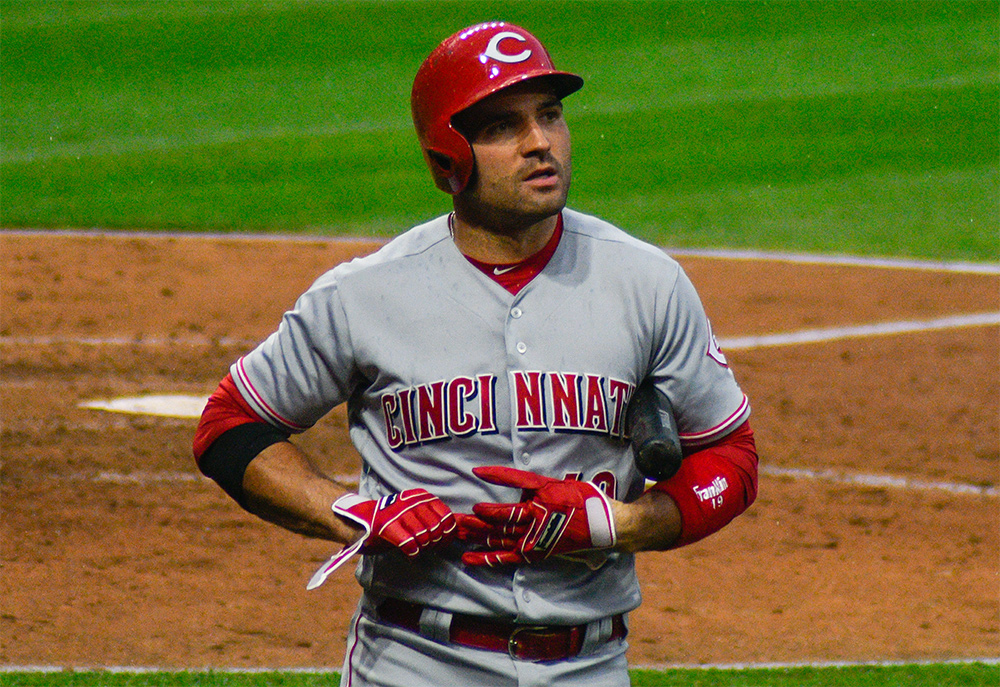
The Reds are close to contention, but they may need Joey Votto to turn back the clock a bit. (Photo: Erik Drost)

“He who never made a mistake, never made a discovery.” – Josh Billings

The Cincinnati Reds used an unusual strategy during the 2018-2019 offseason: trying. OK, that’s a bit hyperbolic, but while last winter’s actual weather was mild, we saw a veritable blizzard of excuses in baseball. As top free agents remained unsigned going into spring training, we heard all sorts of reasoning from teams about why they couldn’t sign this guy or couldn’t afford that guy or why that player over there in the corner was impossible for them to acquire. No, the Reds didn’t pursue Bryce Harper or Manny Machado, but they did make aggressive moves to turn the team into a winner in the short-term, seeing an opportunity in an NL Central where every team had serious flaws. It didn’t quite work out, but many of the reasons they looked like a promising team in 2019 apply to the club in 2020 as well.

The Setup

I appreciated Cincinnati’s ambition last winter, even if I didn’t like every move they made. To be fair, the Reds didn’t go into the offseason intending to please one particularly sarcastic, overweight, middle-aged baseball analyst. But as noted above, there moves were a refreshing departure from baseball’s version of Rasputitsa.

Cincinnati went 67-95 in 2018, and adding 25 wins in one offseason was always going to be difficult. To start with, they needed all of their returning players to be the best versions of themselves. That meant Joey Votto needed to hold off serious decline for another year. Scooter Gennett had to play like an All-Star again. Ideally, Nick Senzel and Jesse Winker would have both been healthy and All-Star candidates themselves. Second-half Luis Castillo would have to become both-halves Luis Castillo. Read the rest of this entry »


Effectively Wild Episode 1447: The Astros Stay Losing

EWFI
After an update from Ben Lindbergh on the Astros’ firing of Brandon Taubman and inadequate apology, Ben and Sam Miller follow up on a discussion of postseason chase rate, talk more about Taubman, and break down the first two games of the World Series, focusing on what went right for the Nationals, what went wrong for the Astros, why putting balls in play can be both good and bad, what lessons teams might draw from this postseason and the Nationals’ success, the outlook for the rest of the series, and more.

Audio intro: The 88, "Not Enough"
Audio outro: Stephen Malkmus & The Jicks, "Houston Hades"

Link to latest Astros statement
Link to Luhnow’s press conference
Link to Ben on Taubman
Link to Ben on Game 2
Link to order The MVP Machine

 iTunes Feed (Please rate and review us!)
 Sponsor Us on Patreon
 Facebook Group
 Effectively Wild Wiki
 Twitter Account
 Get Our Merch!
 Email Us: podcast@fangraphs.com

01:20:46

Mark Trumbo Talks Hitting

Mark Trumbo has always had pluses and minuses as a hitter. He’s consistently hit for power, but at the same time he’s displayed sub-par on-base skills. A free-swinging approach has been the major culprit. The 33-year-old slugger has walked just 299 times in 4,419 big-league plate appearances, largely because of a 50.6% Swing% and a 37.1% 0-Swing%. When he does make contact, he hits bombs. Trumbo has 218 home runs, and that includes a 47-home-run season.

He’s long recognized his limitations. Moreover, he’s owned up to them. An interview that ran here in April 2016 was titled “Mark Trumbo on Home Runs and (Not) Drawing Walks“. How to change for the better has been the issue, and truth be told, Trumbo’s reached a point in his career where that probably can’t happen. Not because he’s incapable of adopting a more disciplined approach — that would actually be a priority now — but rather because his playing days may be coming to an end. Trumbo played in just 12 games with the Orioles this year due to a knee injury, and even if he does return to full health, he’s somewhat of a square peg in a round hole. Today’s game is anything but kind to one-dimensional boppers.

Trumbo talked about the art and science of his craft, including his recent role as a mentor and the likelihood of one day becoming a hitting coach, on the last weekend of the 2019 season.

——

David Laurila: You’re a veteran player on a young team. Do you see yourself as a mentor?

Mark Trumbo: “I enjoy talking hitting. As far as being a mentor, just by age alone there’s probably an element of that. But hitting is the thing I’ve done the longest in life, and it’s what I’m surrounded by the most, so I find myself naturally segueing into conversations that delve into all aspects of it — be it the mental, or physical, component. Adjustments have always been particularly interesting to me. That’s whether they come over the winter, or in-game. Regardless of when that is, there are a lot of things that can allow you get to another level.”

Laurila: Adjustments obviously vary in size and scope.

Trumbo: “Yes. The bigger changes usually happen over the winter. People are making fairly drastic swing changes, or their entire approach becomes different from what it was before. The day-to-day adjustments usually relate more to timing, rhythm, and pitch selection. As someone who has taken quite a few at-bats, I can usually offer insight into those topics.

“That said, I’m very much interested in the mechanics of a swing. I’ve always looked at guys who are getting it done at a highly-consistent level, and tried to see if I can steal some of their moves, so to speak. I’ve tried to figure out what is allowing them to be as productive as they are, in hopes that I can incorporate some of those things into my own game.” Read the rest of this entry »


Craig Edwards FanGraphs Chat–10/24/2019

Read the rest of this entry »


You’re Gosh Darn Right We’ve Got More Intentional Walks

I thought that with the advent of the World Series, the intentional walk beat was probably done for. The Astros famously didn’t intentionally walk anyone all year, and Dave Martinez seems to use intentional walks sparingly, albeit at wild times — his intentional walk of Max Muncy was one of the worst of the playoffs.

Imagine my surprise, then, when both managers intentionally walked players last night. The Nationals are always a threat to do that, sure, but the Astros?? If the Astros are intentionally walking someone, you know it’s serious. Let’s dive in.

First, the Nats walk. This one was a classic spot — Yordan Alvarez was at the plate in the sixth with a man on second in a tie game. With Carlos Correa on deck, it’s not as though it got a lot easier, but intentionally walking someone with first base open to switch the platoon matchup is a tactic as old as time.

Being as old as time doesn’t mean a tactic is good, though. Intentionally walking someone with only one out is almost never a good decision — there are just so many ways the inning can go wrong. Indeed, the walk bumped Houston’s win percentage from 60.5% to 62.8%. That 2.3% of a win is a lot to give up with a walk — could it possibly be worth it?

Alvarez has only a tiny platoon split, but with so few plate appearances, he looks like a basically average hitter when it comes to the platoon advantage after regressing his stats. He’s a good hitter overall, though, regardless of handedness. How good of a hitter? Well, Depth Charts doesn’t quite buy the hype; it projects him as a .363 wOBA hitter overall, which works out to .372 against righties. Pretty solid, if not quite Alvarez’s .437 wOBA against righties this year.

How about Correa? He’s a good hitter in his own right; a .355 wOBA per our projections. After applying platoon splits, that works out to .350 against righties. This decision doesn’t look merited unless Strasburg has huge platoon splits — and he emphatically does not. Strasburg has a huge sample of split-less pitching — so much of one, in fact, that even after regressing his line, he’s hardly worse against lefties than righties. Overall, he projects to allow a .278 wOBA to righties and .282 to lefties — basically a scratch. Read the rest of this entry »

