Author Archive

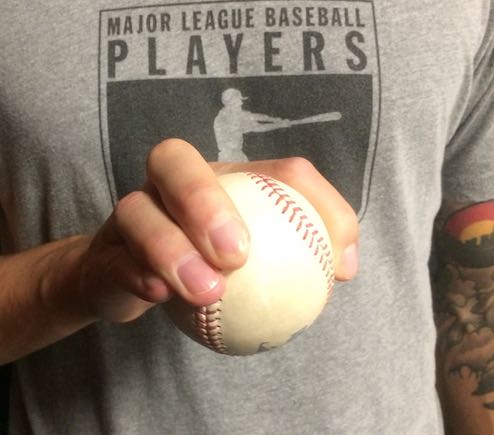
Wade LeBlanc, Michael Lorenzen, and Lou Trivino on Cultivating Their Cutters

Pitchers learn and develop different pitches, and they do so at varying stages of their lives. It might be a curveball in high school, a cutter in college, or a changeup in A-ball. Sometimes the addition or refinement is a natural progression — graduating from Pitching 101 to advanced course work — and often it’s a matter of necessity. In order to get hitters out as the quality of competition improves, a pitcher needs to optimize his repertoire.

In this installment of the series, we’ll hear from three pitchers — Wade LeBlanc, Michael Lorenzen, and Lou Trivino — on how they learned and developed their cutters.

———

Wade LeBlanc, Seattle Mariners

“I learned a cutter in 2009. I taught myself. That was after I got my brains beat in, and got sent back to Triple-A. I figured it was my last shot. If I was going to make anything out of this career, I was going to have to find something that worked.

“My fear about throwing cutters, or sliders, was always arm issues. I’ve never actually had an arm issue, but that was the fear. I didn’t want to throw something that could cause some problems with my arm, so I’d held off. But at that point, I was on my last legs. It was either figure something out, or go home. Read the rest of this entry »

Sunday Notes: Grayson Greiner Compares His Dingers

Grayson Greiner hit the first home run of his brief big-league career two weeks ago Friday. He then banged out number-two the following Tuesday. What did the blasts have in common? I asked the Detroit Tigers catcher that very question a day after the second dinger.

“They were similar pitches,” Greiner told me. “They were kind of down in the zone, and middle-in-ish. Both fastballs. One was off Ryan Burr, a right-hander for the White Sox, and yesterday’s was off Chris Sale. The one off the righty was on a 2-2 count, and the one off Sale was 1-1 count. I think the counts being even is a reason they were both home runs. I wasn’t sure what was coming, and that made me stay back a little bit longer, instead of getting out front. I was in a good, strong hitting position.”

Greiner and Burr know each other, having played summer ball together when they were collegians. Baseball friendships being what they are, Greiner received a text after the April 19 game saying, ‘Congrats on the first homer. I wish it wasn’t off of me.’ He didn’t hear from Sale after taking him deep. “He probably doesn’t know who I am,” was Greiner’s guess as to why that didn’t happen.

The fact that Sale is Sale, and Fenway is Fenway, made Greiner’s second-ever home run even more meaningful than his first. Read the rest of this entry »


Jesse Winker Talks Hitting

Jesse Winker had a strange April at the plate. The Cincinnati Reds outfielder came into May with eight home runs — that’s already a career high — and a frustratingly-low .200 BABIP. As a result, his slash line is a far cry from what it was over his first two big-league seasons. A .299/.397/.460 hitter coming into the current campaign, Winker is slashing a more-akin-to-slugger .228/.311/.511.

What kind of numbers can we expect going forward? At age 25, with 574 big-league plate appearances under his belt, Winker profiles as a player well capable of merging the best of both worlds — on-base excellence and pop. That’s exactly what he’s looking to do. The sweet-swinging native of Orlando doesn’t want to be boxed in as a hitter. He wants to do everything.

Winker discussed his multi-dimensional approach when the Reds visited PNC Park in early April.

———

David Laurila: How have you evolved as a hitter? I’m thinking of both your approach, and your bat path.

Jesse Winker: “I use the ball to tell me where my bat path is at. The ball gives me the best feedback I need for that. What’s changed the most for me is the knowledge I’ve gained about opposing pitchers. That, and what I’m trying to feel at the plate. I’m more aware of how I’m feeling in the box, and what I’m trying to do.”

Laurila: What do you mean by ‘what I’m trying to feel at the plate’? Read the rest of this entry »


Tyler Glasnow on Embracing (and Controlling) the Cut

Tyler Glasnow has a plus fastball — a somewhat-unique plus fastball — and he relies on it heavily. The Tampa Bay Rays righty is throwing it 66% of the time, the fourth-highest rate among qualified pitchers. A four-seamer delivered from Glasnow’s towering 6-foot-8 frame, the offering has an average velocity of 96.6 mph. It’s the pitch you’re going to read about here.

When I approached him on Saturday, I’d actually been thinking about his changeup. While it’s a pitch Glasnow throws infrequently, the always-insightful Daniel Russell wrote about it recently at Drays Bay, and I was intrigued. When I’d spoken to Glasnow last August, we talked primary breaking balls; his seldom-used change-of-pace wasn’t even mentioned.

Glasnow threw me a changeup on Saturday. When I suggested it as a topic, he said we should talk about his fastball instead, for the aforementioned reason: he rarely throws his changeup.

The following day, Glasnow threw nine of them in a dominating performance against the Red Sox at Fenway Park. That’s as many changeups as he’d thrown in his first five starts combined; hence his subterfuge. It was part of the plan going in.

Is it also his plan going forward? I asked that question following the game. Read the rest of this entry »


Kevin Gausman, Bob Scanlan, and Matt Shoemaker Reflect on Their Splitters

Pitchers learn and develop different pitches, and they do so at varying stages of their lives. It might be a curveball in high school, a cutter in college, or a changeup in A-ball. Sometimes the addition or refinement is a natural progression — graduating from Pitching 101 to advanced course work — and often it’s a matter of necessity. In order to get hitters out as the quality of competition improves, a pitcher needs to optimize his repertoire.

In this installment of the series, we’ll hear from three pitchers — Kevin Gausman, Bob Scanlan, and Matt Shoemaker — on how they learned and developed their splitters.

———

Kevin Gausman, Atlanta Braves

“I want to say I started throwing it my sophomore year of high school. I had a coach at the time who had pitched — his name is Chris Baum — and he had been trying to teach me a circle changeup. I couldn’t really figure it out, so he showed me this fosh, this split-change, that I throw now.

Kevin Gausman splitter grip.

“It was a pretty frustrating pitch at first, because it’s tough to gain consistency with. He kind of told me from Day One, ‘Hey, if you keep throwing it, you’ll eventually have a feel for it.’ I trusted him, and he was right. It’s a big weapon for me.

“The only thing I’ve really changed is where my thumb is on the ball. I’ll kind of mess around with it when I want to throw a strike, or when I don’t want to throw a strike. Moving the thumb affects the speed, and how much break, and tilt, you get on the pitch. If my thumb is under it, it’s going to be a little bit straighter. When my thumb is on the side of it, it might be a little bigger, with more fading action. Read the rest of this entry »


Sunday Notes: Daniel Norris is Missing One of His Friends

Daniel Norris has a lot of friends. They include a fastball, a slider, a changeup, and a curveball. The Detroit Tigers southpaw doesn’t actually converse with them — not in the way that Mark “The Bird” Fidrych once talked to the baseball — but they are nonetheless part of his coterie. They are his compadres. His amigos.

Norris is known for his unconventional ways. A few years back he gained a certain amount of notoriety for living in a VW van. His beard — since shorn — is often bushy, his soliloquies on life thoughtful. Moreover, his responses to reporters’ questions have rarely been of the paint-by-numbers variety. A few hours before he fanned the first big-league batter he faced — David Ortiz, in September 2014 — I happened to ask Norris if he’s imagined what his debut would feel like. His response was, “I have, and it will be like that times 10.”

A few days ago, I asked the now-26-year-old about his arsenal. The answer I received didn’t disappoint. Read the rest of this entry »


Matthew Boyd on Drivelining His Slider (And Getting His Body In Line)

Matthew Boyd is one the 120 pitchers who have been featured in our ongoing Learning and Developing a Pitch series. In an installment that ran last June, the Detroit Tigers southpaw spoke of how he was introduced to a slider at Oregon State University, and later tweaked his wrist action to give the pitch more consistency and depth. There’s more to the story than was divulged in that telling
— especially when you consider that further fine-tuning has occurred over the past 10 months. Boyd’s slider is better than it’s ever been.

Right now, the lefty is a better pitcher than he’s ever been. Five starts into the season, Boyd boasts a 3.16 ERA, a 2.41 FIP, and has fanned 39 batters in 31.1 innings. The sample size is admittedly small, but there are nonetheless reasons to believe that the 28-year-old Seattle-area product is starting to come into his own. The slider — a pitch he’s throwing 38% of the time — is a big reason. Boyd discussed the offering’s evolution earlier this week.

———

Matthew Boyd: “I’ve worked on it at Driveline a ton in recent years. I worked with Matt Daniels, with Taiki Green, with Kyle [Boddy]. We were just drilling that thing. We got it to a point where it was high-80s, and it was good, but it was inconsistent. It got better, but in 2017 it kind of fell off a little bit, so we worked it again.

“It really started taking off when I was able to match up my delivery. I had been landing in different spots — my land foot would vary by three or four inches, compared to the pitch before. When you have that type of inconsistency with the lower half, it’s going to put your body at changed angles. One degree of wrist angle on the pitcher’s mound is something like 17 inches on the front. That’s huge, right? When I was able to get that consistency… stuff I worked on at Driveline was huge. Things started taking root before [the 2018 season]. Read the rest of this entry »


Michael Chavis on Doubling (and Almost Crying) in His MLB Debut

Michael Chavis lived a dream on Saturday. The No. 3 prospect in the Red Sox system not only made his MLB debut, he banged out a pinch-hit double in his first-ever at bat. He did so against Tampa Bay’s Jose Alvarado, with one on and one out in the top of the ninth inning, and the score knotted at five apiece. Boston went on to score, then held on for a 6-5 win.

There’s a pretty good chance that Chavis was the happiest person in Tropicana Dome that night. He was certainly one of the most excited. At age 23, the native of Marietta, Georgia had done in real life what he once fantasized about doing while batting rocks with a stick in his family’s back yard.

Chavis described the thrill-of-lifetime experience prior to yesterday’s game at Fenway Park.

———

Michael Chavis: “I wasn’t in the lineup — I was on the bench — but I knew the situation. They’d said there was a chance I would get to hit that day. Of course, I didn’t know when, who for, or who would be pitching. Come the eighth inning, looking at the lineup and how the game was playing out, I was thinking there was a chance.

“I’m taking some swings in the cage, and they come in and say, ‘Hey, you’re going to pinch hit in the ninth.’ I’m like, OK. Beautiful. ‘Who’s pitching?’ They say, ‘It’s Alvarado.’ I’m like, ‘Oh, wow.’ He’s a talented guy. Very good fastball.

“I’d faced him in spring training. I’d just come back from being sick, and it was kind of a similar situation in that I didn’t know if I was going to hit. I went up there and K’d on something like four pitches. I hadn’t seen a pitch in seven days, which made a 100-mph fastball that runs like his even more difficult to see. Read the rest of this entry »


Robbie Erlin, Tommy Hottovy, and Marcus Stroman Expound on Curveballs

Pitchers learn and develop different pitches, and they do so at varying stages of their lives. It might be a curveball in high school, a cutter in college, or a changeup in A-ball. Sometimes the addition or refinement is a natural progression — graduating from Pitching 101 to advanced course work — and often it’s a matter of necessity. In order to get hitters out as the quality of competition improves, a pitcher needs to optimize his repertoire.

In this installment of the series, we’ll hear from three pitchers — Robbie Erlin, Tommy Hottovy, and Marcus Stroman — on how they learned and developed their curveballs.

———

Robbie Erlin, San Diego Padres

“I started throwing my curve when I was nine. Everybody frowns upon that — throwing one that young — but I never had any problems. Basically, my dad put me on one knee and taught me. It was almost like casting a fishing reel. What that does is… when you throw a curveball, you want your elbow to come up a little bit. If your elbow is coming down to throw the curveball, you get exposed. That’s when it’s dangerous [health-wise].

“My dad pitched in high school — he was a righty — and he told me that’s how he was taught. So yeah, he put me on his knee and said, ‘Just flip it to me. Just work on spin. We’re not throwing it hard.’ Eventually I got the feel of it. I started throwing it in games — flipping it out in games — but only once in awhile. Not too much as a kid. Read the rest of this entry »


Sunday Notes: Tucker Barnhart is Embracing Data, Because Now He Can

The Cincinnati Reds were behind the curve in terms of analytics. And while the club’s primary catcher wasn’t fully aware of that — he did have an inkling — he’s certainly aware now. A lot changed when David Bell was hired as manager, and Derek Johnson, Lee Tunnell, and Caleb Cotham came on board to lead the pithing staff.

These aren’t your father’s Reds, and quite frankly they aren’t your older brother’s [or older sister’s] either. That became clear when I asked Tucker Barnhart how his conversations with coaches compare to previous seasons’.

“I would say they’re more numbers-driven now,” the backstop told me. “They’re more percentage-driven, and more based on exit velocities and probable outcomes. Things like that. I still trust my eyes, but in the back of my mind there are always the percentages of what’s supposed to work. You’d be naive not to fall back on that, especially if you’re stuck calling a pitch.”

With the caveat that we’re dealing with a small sample size, and cause and effect can be difficult to determine, the results have been positive. Last year’s 4.65 team ERA ranked seventh from the bottom in MLB. So far this season, it ranks third from the top, at 3.16. And while Sonny Gray and Tanner Roark are new additions, it’s not as though we’re talking about Jose Rijo and Mario Soto. Read the rest of this entry »