Hagen Smith has a promising future on the South Side. Drafted fifth overall in 2024 out of the University of Arkansas, the 22-year-old left-hander in the Chicago White Sox system is No. 81 on The Board with a 50 FV. Currently making up lost innings in the Arizona Fall League — he missed six weeks this summer due to elbow soreness — Smith has been described by Eric Longenhagen as possessing “a killer fastball/slider combo.”
The erstwhile Razorback’s go-to breaker — a pitch our lead prospect analyst has assigned a 70 on the scouting scale — isn’t notable solely for its bat-missing attributes.
“No, not at all,” Smith replied when asked if his slider grip is fairly standard. “I actually don’t hold any laces on the ball. My first year of college — it was a start in Omaha — I was warming up in the outfield and just kind of tweaked the grip. That’s what it’s been since then. I really don’t know why it works as well as it does. I mean, it’s a good pitch metrically, but outside of that I guess it just plays well off of my heater. It comes out of the same tunnel, and it also helps that I can throw it slower or harder when I want to.”
Well, the dream is dead. Throughout the season, I have been tracking Nick Allen’s chances of reopening the Homerless Qualifier Club, the exclusive fraternity of players who make enough plate appearances to qualify for the batting title but fail to hit a single home run. In 2022, Myles Straw became the only entrant since 2012 and just the 19th of the century. Allen has played in 128 of Atlanta’s 139 games, but batting last and frequently giving up his spot in favor of a pinch-hitter has kept him just under the threshold of 3.1 plate appearances per game all season long. The cruel cat-and-mouse game is finally over, though, because the Braves have claimed Ha-Seong Kim from the Rays off waivers. Kim started at shortstop on Tuesday, going 2-for-4. Manager Brian Snitker made it clear that Kim will play there for the remainder of the season.
Kim tore the labrum in his right shoulder on August 18 last year, requiring surgery and putting an unceremonious end to his final season with the Padres. The Rays took a gamble on him knowing that he wouldn’t be available until May at the earliest, signing him on a two-year deal with an opt-out for $13 million this year (with $2 million more in incentives), then $16 million in 2026. If he performed well, Tampa Bay would have him for one season at a big discount, and he’d get a second shot at having a proper platform year. Instead, Kim’s return was delayed until July by hamstring and calf injuries, and lower back issues put him on the IL twice more in the past two months. In all, Kim got into just 24 games with the Rays, making 93 plate appearances and recording a wRC+ of 72, his worst offensive showing since 2021, his first year in the U.S. That made keeping Kim around for the 2026 season too big a risk for the Rays.
All of this is a shame. Kim is a great player, an excellent, versatile defender with a solid bat, and injuries have now robbed him of his second chance to sign a deal that would reflect that excellence. Even if he puts up a fantastic 2026 campaign, he’ll be re-entering free agency after his age-30 season, which isn’t easy for a player whose value is so wrapped up in his glove.
Now, the Braves are the team taking a chance on Kim. Unless he puts up the greatest September in recent memory, he will forego his opt-out and get paid $16 million to anchor the Atlanta infield in 2026. He wouldn’t have to return all the way to the form he showed from 2022 to 2024 – when he ran a 106 wRC+ with 15 DRS and 7 FRV to average 4.0 WAR per 162 games – in order to make that a bargain. Still, he represents a risk. Atlanta is tying itself to a player who has suffered several minor injuries while recovering from a major one, and who hasn’t performed in his limited time with Tampa Bay. On the other hand, that time was so limited that it’s hard to tell where the noise leaves off and the signal starts. Read the rest of this entry »
I’m not telling our readers anything they don’t already know, but defense is a very important part of baseball, especially at the up-the-middle positions. You probably watch enough baseball to list the best and worst couple of defenders at each position with a fair amount of accuracy; I bet you’d nail most of them off the top of your head (aside from Trea Turner, I think the 2025 FRV list is damn good), and that you have a proper appreciation for the importance of defense at the premium positions, even if it comes with some amount of sacrifice on offense.
In the prospect realm, though, things are trickier. Prospect hit data from TrackMan and Hawkeye has become common in public-facing analysis and discourse, but defense remains something of a black box. There aren’t many publicly available minor league defensive stats, and so much of evaluating defense is still best done visually, at least in my opinion. I wrote a version of today’s piece a few years ago, wherein I performed the same sort of video deep dive that I use to evaluate top shortstop prospects’ defense, and ripped and edited together key plays from that deep dive to share with you.
This year, I’m turning that exercise into a series. I’m going to batch together a few players at a time until I’ve gone through all of the 50 FV shortstops, as well as a few key prospects with lesser grades. That will include all of the players linked here, plus a few more. Read the rest of this entry »
Welcome to another edition of Five Things I Liked (Or Didn’t Like) This Week. Between a vacation, the All-Star break, the Trade Value Series, and the trade deadline, Five Things has been on a bit of a summer hiatus. Baseball itself doesn’t stop, of course; weird and delightful things happen whether I’m documenting them or not. But I still couldn’t shake the feeling that this week had an extra helping of whimsy. Balls took funny hops. Good pitchers got shelled in unexpected ways. Balks took center stage. Leads changed hands late, defenders kicked things into high gear – there was so much delightful baseball this week that I struggled to narrow it down to five things. Seven things just doesn’t have the same ring to it, though, so let’s quickly nod to Zach Lowe of The Ringer for the column inspiration and get going.
1. The True King of Contact
Writing about Luis Arraez can be a bummer sometimes. Not because he’s bad – he’s emphatically not – but because merely mentioning his name reinvigorates the age-old argument between those who say there are too many strikeouts and those who insist that slug is in the air. Should everyone be doing what Arraez is doing? Is he an anachronism? Is he underrated? Overrated? He’s so good at what he does – and what he does is so different from what most good baseball players do – that these questions are frustratingly omnipresent in any discussion about Arraez.
That said, I think I found an Arraez play that won’t divide the audience. The key is for it not to involve a ball in play, a walk, or a strikeout. Take a look at this beauty:
The Yankees had a busy deadline season. Whether trading for Ryan McMahon, patching smaller holes, or adding top relievers, they were in the news seemingly every day for adding to the 2025 club. As the deadline approached, they looked at their roster and decided that merely adding wasn’t enough. Thus, they finessed a roster reshuffle Thursday afternoon, acquiring utility infielder José Caballero from the Rays and trading utility infielder Oswald Peraza to the Angels.
Let’s start with Caballero. A plus-fielding, slap-hitting nuisance (complimentary), he has been a perfectly serviceable utility infielder in two-plus years of big league play. He has below-average raw power and a patient approach at the plate, which can result in some ugly strikeout numbers when pitchers challenge him early in the zone and he takes. Though he’s good at elevating the ball, it’s rarely with much authority, and he never quite worked out the Isaac Paredes trick of turning mediocre raw power into pulled homers. He was still a league-average contributor overall, though, because the rest of his game is excellent.
No matter which metrics you subscribe to, Caballero is a plus defender across the infield. He started playing the outfield this year and took to it quickly. He’s a pretty good bunter, if you’re into that; if you need someone to come off of the bench in a late-and-close situation and advance the runners, he’s your guy. Read the rest of this entry »
Matt Blewett, Chet Strange, Bruce Kluckhohn-Imagn Images
I was starting to get worried that Griffin Jax was going to be left behind in the Twins’ wholesale liquidation of their bullpen. Fear not; the hardest thrower in the Air Force Reserve is headed out after all. The Rays currently sit two games under .500 and 3 1/2 games out of a Wild Card spot, with a 9.9% chance of making the playoffs. That long-shot contender status did not dampen their enthusiasm for Jax in the slightest. Tampa Bay sent the talented but inconsistent starter Taj Bradley to Minnesota in exchange for Jax, who is under team control through 2027.
Albert Cesare/The Enquirer/USA TODAY NETWORK via Imagn Images
Last night, after Zack Littell had started for the Rays in what would turn out to be a dramatic extra-inning loss at Yankee Stadium, he was traded to the Reds as part of a three-team deal with the Dodgers. The names of the players involved slowly trickled out into the ether, and after an hour or so, the entire transaction came into focus:
Littell, who turns 30 in October, is in his final arbitration season and will be a free agent this winter. After spending the first half decade of his big league career in the bullpen, he made a successful transition to the rotation starting in the middle of 2023. He has the third-lowest walk rate among all qualified pitchers since then, at a microscopic 4%. This season, Littell has a 3.58 ERA (his FIPs and xERA are in the 4.20 to 4.90 range) across 22 starts. He’s a quintessential soft-tossing pitchability guy whose fit in the Rays rotation the last few years was largely driven by his addition of a sinker and a shift away from using his fastballs so much. Littell’s splitter has been his most reliable bat-missing weapon and played like a plus pitch in 2023 and 2024 before losing some of its sink in 2025; it has backed up into more of an average area in terms of garnering whiffs. He’s posting the lowest full-season strikeout rate of his career and one of the lowest across qualified big league pitchers this year. He’s also surrendered 26 home runs, the most in the majors and a potential concern in the bandbox that is Great American Ballpark. Read the rest of this entry »
Nathan Ray Seebeck and Charles LeClaire-Imagn Images
The Rays have shuffled up their catchers just a few days before the trade deadline, first sending their starter Danny Jansen to the Brewers along with some cash in return for infielder Jadher Areinamo. Then, Tampa Bay followed it up with a second swap, this time bringing in Nick Fortes from the Marlins for outfielder Matthew Etzel.
While Jansen’s bat has fallen off significantly from his 2021-2023 seasons, when he posted a 120 wRC+ over 754 plate appearances for 6.0 WAR, he’s still an adequate part of a catching tandem and provides the occasional round-tripper. He’s slashing .204/.314/.389 with 11 home runs and a 98 wRC+ this season. His framing numbers have been down considerably the last few years, as well, enough to knock off just under a WAR per season or so from his overall value. Considering the Rays were practically certain to pay out Jansen’s $500,000 buyout rather than pick up their side of a $12 million mutual option, this looks like them getting what they can while the getting was good. Read the rest of this entry »
Austin Hays is having a productive-when-healthy season with the Cincinnati Reds. The 30-year-old outfielder has missed time with a calf strain, a hamstring strain, and a foot contusion, but he’s also slashed .282/.338/.510 with 10 home runs in 228 plate appearances. Moreover, his 128 wRC+ and .360 wOBA are both second on the team (behind Elly De La Cruz) among those with at least 140 PAs.
His résumé is that of a solid hitter. From 2021-2023— his first full seasons in the majors — Hays had 97 doubles and 54 home runs, as well as a wRC+ ranging between 106 and 111. Those three seasons were spent with the Baltimore Orioles, who subsequently swapped him to the Philadelphia Phillies in exchange for Seranthony Domínguez and Cristian Pache a few days before last July’s trade deadline. Hays’s 2024 campaign was the worst of his career. Hampered by injuries and illness — a kidney infection proved most problematic — he had a 97 wRC+ while playing in just 85 games. The Reds then inked him to a free agent contract over the winter,
Which brings us to the crux of this column’s lead item: the reasons behind the success he’s currently having.
“Consistency is probably the biggest thing,” Hays told me. “There’s not always an adjustment to be made. Sometimes it’s just the game [and] you’re being pitched tough. I don’t want to be altering too much of what I do well. In the past, I would sometimes pay too much attention to what the pitcher was doing and try to adjust to that. Staying strong to my strengths — locking in on those strengths — is going to help me over the course of 162 [games].” Read the rest of this entry »
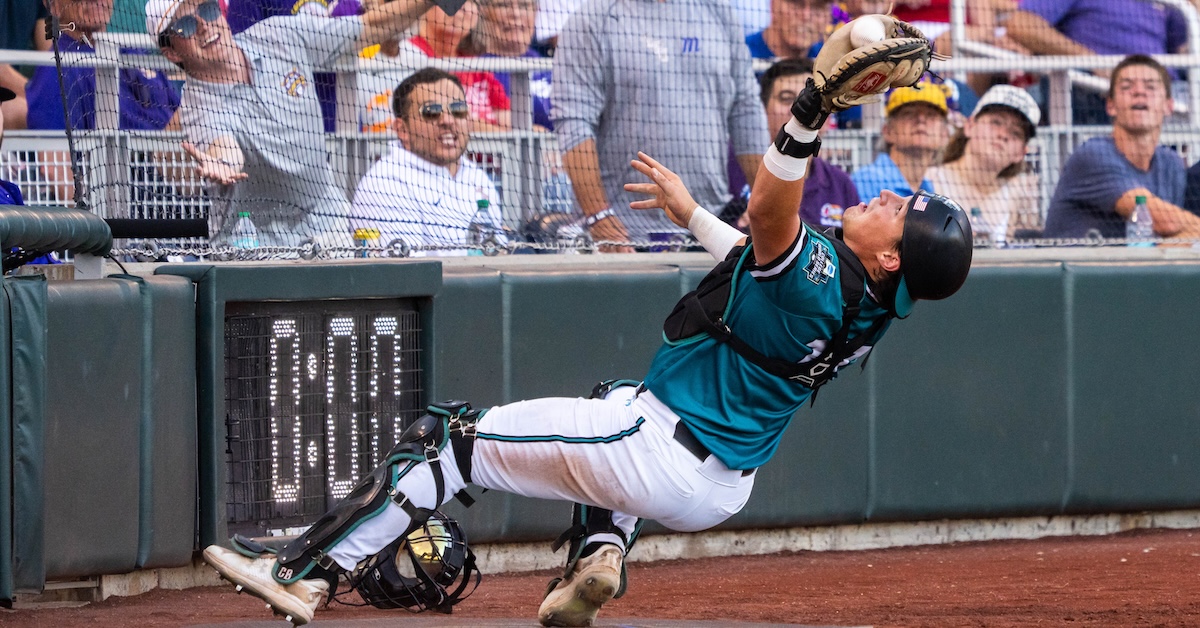
Payton Tolle is the top pitching prospect in what is arguably baseball’s best farm system. Drafted 50th-overall last summer by the Boston Red Sox out of Texas Christian University, the 22-year-old left-hander features a fastball that Eric Longenhagen has assigned a 70 grade, and not just because of its high octane. Per our lead prospect analyst, the 6-foot-6, 250-pound hurler possessed “the 2024 draft’s most deceptive secondary traits,” which included seven-and-a-half feet of extension.
I asked Tolle about his four-seamer, which sat 95 mph when I saw toe the rubber for the Double-A Portland Sea Dogs versus the Hartford Yard Goats 10 days ago.
“The velo is something we’ve kind of driven hard ever since I got to the Red Sox org,” said Tolle, who was 90-92 in college and is now topping out at 98-99. “I’m buying into the system, buying into how the velo is going to change how everything looks. I also understand that more swing-and-miss is going to come at the top of the zone. At Wichita State, my first year, I felt like I was almost more sinkers, but then I switched up my grip. I brought my fingers closer together and started to have more ride on it.”
Tolle transferred from Wichita State to TCU for his junior year, where he — along with the Horned Frogs coaching staff — “really dove into how the fastball plays and what we can play off of it.” Since turning pro, that evolution has continued with a heavy emphasis on secondary offerings. Whereas his fastball usage as an amateur was often 70-75%, it has been closer to 50% in his recent outings. A work-in-progress changeup has become more prevalent — Tolle got bad swings on a few of them when I saw him in Portland — but a hard breaking ball is currently his top option behind his heater. Read the rest of this entry »