Archive for Featured

Sunday Notes: Pitchers, Pop-Ups, and Unnecessary Deference

It remains one of the game’s unsolved mysteries. A batter hits a pop-up near the mound and the person closest to it — a professional athlete wearing a glove — isn’t expected to catch the ball. Moreover, he’s not supposed to catch the ball. That job belongs to any one of several teammates, all of whom has traversed a greater distance. As often as not they’re climbing a slope to get under the descending baseball.

Chaos can ensue as the infielders and the catcher converge. The multiple “I’ve got its,” are drowned out by crowd noise and suddenly what should be a routine out becomes an adventure. We’ve all seen it. A bumper-car-like collision occurs and the catch is made clumsily… or not at all.

Just last week, Red Sox right-hander Rick Porcello was charged with an error when he failed to catch a pop up in front of the mound. Not because of ineptitude, but rather because he was veritably mugged by his catcher as the ball was about to arrive comfortably in his glove.

Why aren’t pitchers expected to handle simple pop-ups? They’re perfectly capable, so it makes sense that they should be catching them. Right?

“I don’t know why, and yes, they should be,’ said Seattle’s Perry Hill, whom many consider the game’s best infield instructor. “They’re on on the field of play when the ball is in play, so they should be able to make a play. It’s practiced in spring training. That little short pop-up that nobody can get to. The third baseman is playing way back. The first baseman is way back. The pitcher is the closest guy to the ball. He’ll catch that ball.”

Scott Servais sees it somewhat differently than his first base coach. Read the rest of this entry »


Top 29 Prospects: San Francisco Giants

Below is an analysis of the prospects in the farm system of the San Francisco Giants. Scouting reports are compiled with information provided by industry sources as well as from our own (both Eric Longenhagen’s and Kiley McDaniel’s) observations. For more information on the 20-80 scouting scale by which all of our prospect content is governed you can click here. For further explanation of the merits and drawbacks of Future Value, read this.

All of the numbered prospects here also appear on The Board, a new feature at the site that offers sortable scouting information for every organization. That can be found here.

Giants Top Prospects
Rk Name Age Highest Level Position ETA FV
1 Joey Bart 22.4 A+ C 2020 55
2 Heliot Ramos 19.7 A+ CF 2023 45+
3 Marco Luciano 17.6 R SS 2023 45+
4 Alexander Canario 19.0 R RF 2023 45
5 Gregory Santos 19.7 A RHP 2021 45
6 Sean Hjelle 22.0 A RHP 2021 40+
7 Melvin Adon 24.9 AA RHP 2020 40+
8 Shaun Anderson 24.5 MLB RHP 2019 40+
9 Logan Webb 22.5 AA RHP 2021 40+
10 Patrick Hilson 18.7 R CF 2024 40+
11 Camilo Doval 21.9 A+ RHP 2021 40+
12 Seth Corry 20.5 A LHP 2023 40
13 Tyler Beede 26.0 MLB RHP 2019 40
14 Luis Toribio 18.6 R 3B 2024 40
15 Mike Gerber 26.9 MLB RF 2019 40
16 Jairo Pomares 18.8 R CF 2023 40
17 Ray Black 28.9 MLB RHP 2019 40
18 Ricardo Genoves 20.0 A- C 2022 40
19 Blake Rivera 21.4 A RHP 2023 40
20 Jake Wong 22.7 A RHP 2022 40
21 Chris Shaw 25.6 MLB 1B 2019 40
22 Jalen Miller 22.4 AA 2B 2020 40
23 Jacob Gonzalez 20.9 A 3B 2023 35+
24 Abiatal Avelino 24.3 MLB 2B 2020 35+
25 George Bell 21.0 R OF 2022 35+
26 Jandel Gustave 26.6 MLB RHP 2019 35+
27 Raffi Vizcaino 23.5 AA RHP 2020 35+
28 Sam Wolff 28.1 AAA RHP 2019 35+
29 Jose Marte 22.9 A+ RHP 2020 35+
Reading Options
Detail Level
Data Only
Full
Position Filter
All

55 FV Prospects

Drafted: 1st Round, 2018 from Georgia Tech (SFG)
Age 22.4 Height 6′ 3″ Weight 225 Bat / Thr R / R FV 55
Tool Grades (Present/Future)
Hit Raw Power Game Power Run Fielding Throw
30/45 60/65 45/55 40/30 55/60 55/55

Bart was a solid mid-tier prep prospect in the Atlanta suburbs who a couple of clubs really liked, but they ultimately couldn’t meet his price, pushing him to Georgia Tech. He made the leap between his sophomore and junior years, growing into his athleticism and developing plus raw power along with above average defensive tools and arm strength. The defensive tools are especially rare for a catcher of Bart’s size, as it’s much easier for a more compact-framed player to excel behind the plate. Bart has the rare ability to slow the game down defensively and scouts rave about his makeup, game calling, and game preparation.

At the plate, Bart has big power and gets to it pretty often in games, particularly to his pull side, where he hit a majestic shot that was never found over the facade of the football complex in left field at Georgia Tech’s stadium. But while he is exceptional behind the plate, Bart doesn’t have the same ability to slow the game at it, with elevated strikeout rates in his draft year and just okay pitch selection. The bat speed is good and he doesn’t have trouble against velocity, and some scouts point to his solid pro debut as evidence that Bart was just frustrated by being pitched around and developed some bad habits in college. Since literally everything else you could want except for contact is already present, most assume that Bart will figure out a way to get to a 40 to 50 bat with above average game power and above average defense, even if it’s on the job in the big leagues in 2020. He broke his hand early in 2019 and will miss several weeks. He’s a strong Arizona Fall League possibility.

45+ FV Prospects

2. Heliot Ramos, CF
Drafted: 1st Round, 2017 from Leadership Christian HS (PR) (SFG)
Age 19.7 Height 6′ 2″ Weight 200 Bat / Thr R / R FV 45+
Tool Grades (Present/Future)
Hit Raw Power Game Power Run Fielding Throw
25/45 55/60 30/55 60/55 45/50 60/60

After he looked like a newly-drafted force of nature during the summer of 2017, Ramos’ physical tools actually regressed last year. The bat speed and quality of contact both dipped, and Ramos was noticeably out-shined by the other (mostly older) Futures Game participants during batting practice. Ramos developed some feel for opposite field contact during this span, something he retained as the power returned this spring. He’s hitting lasers to all fields now, adept at peppering the right center field gap.

Built like, and as fast as, a bowling ball SEC running back, Ramos is going to stay in center field for a while but most scouts think he’ll eventually move to a corner. That could be a problem if such a move occurs sooner than anticipated, as Ramos has had whiff/discipline issues in the past, though they’ve been much more palatable this year. He has Mitch Haniger/Randal Grichuk-ish tools. Staying in center will be important, as will retaining some of this new plate discipline. If both happen, Ramos is going to be a highly entertaining star.

Signed: July 2nd Period, 2018 from Dominican Republic (SFG)
Age 17.6 Height 6′ 2″ Weight 180 Bat / Thr R / R FV 45+
Tool Grades (Present/Future)
Hit Raw Power Game Power Run Fielding Throw
20/50 60/70 20/60 50/50 40/50 50/55

Luciano’s broad, square, muscular shoulders look like they belong to a D1 high school football prospect. He has one of the better frames of all the 17-year-old hitters in pro ball, and plenty of room to add power to a body that already produces a lot of it. Luciano has explosive hands and a natural uppercut swing. He hits many more balls out during BP than is typical for a hitter this age, and has taken his peers deep in games, too.

Luciano’s feet and actions are workable on the infield but he struggles with throwing velocity and accuracy when he’s forced to throw from a lower arm slot, as shortstops often are. If he can’t correct that, he’ll need to move to the outfield. If he can, this is a shortstop with 80 bat speed. Luciano is a potential superstar. Much of his profile (the plate discipline, ultimate defensive home) is still not in focus, but this young man has rare physical talent.

45 FV Prospects

Signed: July 2nd Period, 2016 from Dominican Republic (SFG)
Age 19.0 Height 6′ 1″ Weight 165 Bat / Thr R / R FV 45
Tool Grades (Present/Future)
Hit Raw Power Game Power Run Fielding Throw
20/45 60/65 30/60 55/50 40/50 60/60

This system has three teenagers with awesome bat speed, and Canario is one. Some of his batting practice sessions during the Giants’ new January instructional camp were even up there with Joey Bart’s. But much of Canario’s game is unkempt. He has mediocre natural timing and feel to hit, and his front side often leaks, which impacts his ability to spoil breaking stuff away from him. His lower half got thicker and stronger during the offseason, making it more likely that he ends up in right field rather than center. But this is a potential middle-of-the-order hitter because of the raw power; the swing has natural loft, and the early-career plate discipline data is strong. There’s huge ceiling if the hit/approach component improves, but of course, this type of prospect often fails to fully actualize.

Signed: July 2nd Period, 2015 from Dominican Republic (BOS)
Age 19.7 Height 6′ 2″ Weight 190 Bat / Thr R / R FV 45
Tool Grades (Present/Future)
Fastball Slider Changeup Command Sits/Tops
55/60 50/60 45/50 35/50 92-96 / 98

The Giants proactively sent Santos, who was acquired from Boston as part of the Eduardo Nunez deal, to the Northwest League as an 18-year-old because his stuff was simply too powerful for AZL youngsters. He was 93-96 with sinker and cutter variation last year, and his breaking ball was often plus. He threw more strikes in affiliated ball than he did during the spring in extended, then arrived to 2019 camp with a better changeup. A strong breakout candidate, Santos had a shoulder strain in late-April. There’s probably no more velo coming because Santos is a mature-bodied guy, but he already throws hard so that doesn’t really matter. He has mid-rotation upside as long as the command improvement holds and this shoulder issue doesn’t become chronic.

40+ FV Prospects

6. Sean Hjelle, RHP
Drafted: 2nd Round, 2018 from Kentucky (SFG)
Age 22.0 Height 6′ 11″ Weight 215 Bat / Thr R / R FV 40+
Tool Grades (Present/Future)
Fastball Curveball Changeup Command Sits/Tops
50/55 45/50 45/50 45/55 91-94 / 96

Hjelle body comps to a young Pau Gasol and is remarkably athletic for his size. His delivery is graceful and fluid, and he has no trouble repeating it nor fielding his position, as he’s quick off the mound to corral bunts and cover first base, both of which can be challenging for XXL pitchers. Hjelle’s (it’s pronounced like peanut butter and _____ ) fastball only sits in the low-90s but plays up because of extension, life, and the angle created by his height. Those traits in concert with one another make for a heater that competes for whiffs in the zone. The secondaries are closer to average, often below, though Hjelle can locate them. He’s a pretty safe No. 4/5 starter candidate, though we might be underrating the impact of Hjelle’s size on hitters’ discomfort.

7. Melvin Adon, RHP
Signed: July 2nd Period, 2014 from Dominican Republic (SFG)
Age 24.9 Height 6′ 3″ Weight 235 Bat / Thr R / R FV 40+
Tool Grades (Present/Future)
Fastball Slider Changeup Command Sits/Tops
80/80 60/60 40/40 30/40 96-100 / 102

A raw, arm strength goon for what seemed like forever, Adon found slider feel late last season and had dominant stretches where he looked like a potential closer. He has carried that into the early part of this season, more frequently dotting his slider just off the plate to his glove side and even getting it over for strikes when he’s behind in counts. Adon still just kind of chucks his fastball and hopes it arrives near the plate, but he’s going to get away with mistakes in the zone because of the velocity. Likely to have harrowing bouts of wildness, Adon has high-leverage/closer stuff and could be one of the better relief pitchers in baseball at some point, though he may already be in his late-20s once things really click.

Drafted: 3rd Round, 2016 from Florida (BOS)
Age 24.5 Height 6′ 4″ Weight 225 Bat / Thr R / R FV 40+
Tool Grades (Present/Future)
Fastball Slider Curveball Changeup Cutter Command Sits/Tops
55/60 55/60 50/50 45/50 55/55 40/45 91-95 / 96

Anderson has an unusually deep repertoire for a pitcher who scouts overwhelmingly project into the bullpen. He has a two seamer, a four seamer that has natural cut to it when he locates to his glove side, a slider (his best pitch dating back to college), and a changeup which has been the focal point of development since Anderson entered pro ball. A casualty of Florida’s ability to recruit and develop pitching, Anderson was a college reliever who would’ve been starting on just about every other college team in the country, so there’s a reason he lacks some of the finer attributes scout want to see from a starter. He could be an inefficient No. 4/5, but he might be really good in a multi-inning relief role where he throws 80 or more innings.

9. Logan Webb, RHP
Drafted: 4th Round, 2014 from Rocklin HS (CA) (SFG)
Age 22.5 Height 6′ 2″ Weight 220 Bat / Thr R / R FV 40+
Tool Grades (Present/Future)
Fastball Curveball Changeup Command Sits/Tops
55/60 55/60 45/50 40/45 91-94 / 95

Webb spent most of 2016 on the shelf due to Tommy John, and the little bit of 2017 for which he was healthy he spent in a well-manicured relief role. Then he broke out in 2018, as he retained big stuff through a move back to the rotation. He was holding a tailing 92-95 deep into starts, topping out at 97, and spinning in a dastardly, bat-missing breaking ball. Unrefined fastball control led to a lot of bullpen projection, but Webb hadn’t pitched very much because of injury, so it seemed possible that it might yet improve.

Early in 2019, Webb’s stuff was down a bit, more 91-94 and touching 95, before he got popped for PEDs and was suspended for 80 games. He’s missed about two years of development due to the TJ and this suspension and developmentally is more like a junior college arm than an advanced Double-A prospect. He has Top 100 stuff (assuming the 2018 heater comes back after this suspension) and if he can somehow refine fastball command and the changeup (or a third pitch of some kind), he could be a No. 4 starter. We don’t know how the PEDs, which Webb denies knowledge of using, may have impacted his stuff. He seems like a logical Fall League candidate.

Drafted: 6th Round, 2018 from Nettleton HS (AR) (SFG)
Age 18.7 Height 5′ 11″ Weight 175 Bat / Thr R / R FV 40+
Tool Grades (Present/Future)
Hit Raw Power Game Power Run Fielding Throw
20/35 50/55 20/45 70/70 45/55 70/70

Of all the players we’ve written up on the team reports (there are about 1,000 on The Board and well over that if you count the Others of Note section of the lists) the gap between what Hilson is now and what he might be is perhaps the biggest. He has scintillating physical ability. Speed, arm strength, barrel quickness, burgeoning power, hit-thieving defensive ability in center field. But he is raw as steak tartare and often takes hapless, juvenile swings that demonstrate an alarming lack of baseball feel, as evidenced by his 67 strikeouts in 166 2018 at-bats.

Likely a long term project who will move through the minors with this exciting young contingent of talent from Latin America, Hilson’s chances of even making the big leagues are probably in the 20-30% range, and that may be optimistic. But on the scouting card, the tools read like David Dahl’s or Starling Marte’s, so there’s a chance for a star turn here, as well. It will likely take a long time and there will likely be developmental bumps in the road, but Hilson has monster, long-term potential and would be a peacock feather in the cap of Giants player dev if he can realize it.

11. Camilo Doval, RHP
Signed: July 2nd Period, 2015 from Dominican Republic (SFG)
Age 21.9 Height 6′ 2″ Weight 185 Bat / Thr R / R FV 40+
Tool Grades (Present/Future)
Fastball Slider Cutter Command Sits/Tops
55/60 45/50 60/70 20/40 89-98 / 100

This is one of the weirder pitchers in all of the minors. At times, Doval will sit in the upper-90s with cutting action; at others, he’s living in the low-90s with no movement. Scouts think the cause is that he doesn’t grip the baseball in a consistent manner. Doval also has a delivery totally unique to him. It’s a long, swooping, side-winding look that creates cut/rise on the ball. He also throws a hard, horizontal slider.

The Trackman readout for Doval is shocking. His primary fastball/cutter spins in at about 2700 rpm, which is incredible considering how hard he throws. He also generates nearly seven feet of extension, and the effective velocity of his fastball is about 2 mph harder than it’s actual velo.

He has outings where he walks everyone and gives up a bunch of runs before he accrues an out, and he has outings where he’s untouchable for several innings. It’d be somewhat terrifying to acquire Doval if the outcome of a trade for him dictated one’s job security, but his stuff is bewitching and we think he has a chance to be an elite bullpen weapon if he ever figures things out.

40 FV Prospects

12. Seth Corry, LHP
Drafted: 3rd Round, 2017 from Lone Peak HS (UT) (SFG)
Age 20.5 Height 6′ 2″ Weight 195 Bat / Thr L / L FV 40
Tool Grades (Present/Future)
Fastball Curveball Changeup Command Sits/Tops
50/55 50/55 50/55 40/45 90-94 / 95

Corry was a pretty raw fastball/curveball high school prospect whose changeup got much better throughout last season, which is especially relevant because that pitch’s movement pairs better with his fastball than the curve does. He’s a fairly stiff, short strider and often has scattershot fastball control, so there’s significant relief risk here. But Corry’s pitch mix is more complete than most of the other arms in this system and he’s the youngest non-Santos arm on the main section of this list, so you could argue he belongs up near Hjelle if you think he ends up starting. Realistically he’s a No. 4/5 or a three-pitch relief piece.

13. Tyler Beede, RHP
Drafted: 1st Round, 2015 from Vanderbilt (SFG)
Age 26.0 Height 6′ 2″ Weight 190 Bat / Thr R / R FV 40
Tool Grades (Present/Future)
Fastball Curveball Changeup Command Sits/Tops
60/60 50/50 55/55 40/40 91-95 / 98

It appears that Beede has ditched the cutter/slider thing bestowed upon him for a time and is, as he was in college, a fastball/curveball/changeup guy again. His velocity also seems to have been reborn. He’s once again lighting up radar guns with a mid-90s heater that has touched 98. His changeup has power sinking movement and should miss bats when Beede locates it competitively, but he’s more consistently able to do that with his curveball. Fastball control likely keeps Beede in the bullpen even though he did have stretches this spring where he looked like a mid-rotation starter. He’s 26, but looks like a strong three-pitch reliever. Maybe there’s a chance for high-leverage or multi-inning work here.

14. Luis Toribio, 3B
Signed: July 2nd Period, 2017 from Dominican Republic (SFG)
Age 18.6 Height 6′ 1″ Weight 210 Bat / Thr L / R FV 40
Tool Grades (Present/Future)
Hit Raw Power Game Power Run Fielding Throw
20/50 55/60 25/55 40/30 40/45 55/55

Built at age 18 like Aramis Ramirez was in his prime, it’s likely that Toribio’s promising pro debut was at least somewhat a product of physical maturity. He has above-average raw power already and generates it with a comfortable, understated swing. He’s shown feel for contact in games. He’s too pull-heavy at times, or at least tries to pull pitches he shouldn’t, ones he should just take. So there’s power, early indicators that the contact skills will be fine, and a chance to stay at third. The size/frame means there’s risk Toribio ends up at first base if he gets bigger, and also probably means we shouldn’t expect much of an increase in raw power. He has a chance to be an everyday third baseman, and lots of other viable outs if he can’t get there, including a corner infield platoon of some kind and a low-end first baseman. Or maybe more power comes, and he’s a 50 at first.

15. Mike Gerber, RF
Drafted: 5th Round, 2014 from Creighton (DET)
Age 26.9 Height 6′ 0″ Weight 190 Bat / Thr L / R FV 40
Tool Grades (Present/Future)
Hit Raw Power Game Power Run Fielding Throw
40/40 60/60 50/55 50/50 55/55 50/50

Boxed out of a surprisingly crowded corner outfield situation in Detroit, Gerber should get an opportunity to become a lefty-hitting platoon corner outfielder with power. He has at least above-average raw and has adjusted his swing to better ensure consistent lift. He’s going to strike out a lot, but he mashes right-handed pitching and plays a very good corner outfield, so he might play against lefties, too, and just hit toward the bottom of the order on those days. He’s older, but is a clear fit in a limited but necessary role.

16. Jairo Pomares, CF
Signed: July 2nd Period, 2018 from Cuba (SFG)
Age 18.8 Height 6′ 1″ Weight 185 Bat / Thr L / R FV 40
Tool Grades (Present/Future)
Hit Raw Power Game Power Run Fielding Throw
25/55 45/45 20/35 55/50 45/50 45/45

The Giants signed Pomares for just shy of $1 million during the 2018 July 2 period. He’s already almost 19 and is, as one can probably guess, a little more advanced and a little less projectable than most other recent J2 signees. Pomares is a center field prospect with feel to hit. His swing is geared for all-fields contact and while he has above-average bat speed, it’s unlikely that he hits for power without a swing adjustment. He looked a little thicker and stronger than anticipated during San Francisco’s January instructs and early in the spring, so there may be less certainty that he stays in center than there was when Pomares was in Cuba. He looks more like a fourth outfield prospect than a potential regular right now, but Cuban players often have long stretches away from baseball and training, so what we’ve seen so far in Arizona might just be rust.

17. Ray Black, RHP
Drafted: 7th Round, 2011 from Pittsburgh (SFG)
Age 28.9 Height 6′ 5″ Weight 225 Bat / Thr R / R FV 40
Tool Grades (Present/Future)
Fastball Slider Command Sits/Tops
80/80 55/55 35/35 96-99 / 102

Black is the oldest player on The Board and he’s only here, despite a career rife with injury and inconsistency, because his stuff is so good. He’s among the hardest throwers in professional baseball and also one of the best at spinning the baseball. He is wild and the quality of his secondary stuff is inconsistent, but at times he looks unhittable. He struck out 33 in 23 big league innings last year, but he’s currently on the IL with a forearm strain. He could one day pitch his way into high-leverage innings as long as he has this kind of stuff, which he has maintained despite the many maladies.

Signed: July 2nd Period, 2015 from Venezuela (SFG)
Age 20.0 Height 6′ 2″ Weight 210 Bat / Thr R / R FV 40
Tool Grades (Present/Future)
Hit Raw Power Game Power Run Fielding Throw
30/50 55/60 30/45 20/20 45/50 50/50

Built like a one of the moai sculptures on Easter Island, Genoves faces size-based questions about his ability to catch long term. But he has a plus arm, he’s procedurally advanced for a 20-year-old, and he has the leadership qualities and intangibles that have an outsized impact at catcher. He also has plus power, enough to put balls out to right center, though Genoves’ current approach to contact doesn’t often enable it. He pulls just about everything.

Genoves’ future is heavily dependent on him staying behind the plate and ideally, he’d catch more than just 33 games (last year’s total at an affiliate, not including extended) throughout the course of this year, and show that the workload doesn’t detract from his bat or agility. The power gives him a shot to be a regular, though a backup role is probably more likely.

19. Blake Rivera, RHP
Drafted: 4th Round, 2018 from Wallace State CC (SFG)
Age 21.4 Height 6′ 5″ Weight 225 Bat / Thr R / R FV 40
Tool Grades (Present/Future)
Fastball Curveball Changeup Cutter Command Sits/Tops
55/55 55/60 40/45 55/55 40/45 93-97 / 98

The Giants drafted Rivera after his 2017 freshman season, but he went back to school, raised his stock, and was the first JUCO arm off the board the following year. He has power stuff — 93-96 with cut action at times, and a plus curveball — but is wild and may be a reliever, though probably a very good one.

20. Jake Wong, RHP
Drafted: 3rd Round, 2018 from Grand Canyon (SFG)
Age 22.7 Height 6′ 1″ Weight 210 Bat / Thr R / R FV 40
Tool Grades (Present/Future)
Fastball Slider Changeup Command Sits/Tops
50/50 45/50 40/45 40/50 92-95 / 96

Wong was holding 93-96 with sink deep into games as a junior, he throws strikes, and he occasionally snaps off a good curveball. Changeup development and refined command are areas of need, and they will likely dictate Wong’s ceiling, which is probably that of a No. 4/5 starter who induces weak contact rather than strikeouts.

21. Chris Shaw, 1B
Drafted: 1st Round, 2015 from Boston College (SFG)
Age 25.6 Height 6′ 3″ Weight 260 Bat / Thr L / R FV 40
Tool Grades (Present/Future)
Hit Raw Power Game Power Run Fielding Throw
45/50 50/55 70/70 40/40 40/40 55/55

Shaw is one of many whiff-heavy corner bats with huge power who floats around the upper levels of the minors, putting up big power numbers while struggling to find a big league role if their parent club has someone at 1B/DH. The Giants have tried Shaw in the outfield but scouts don’t think he’s playable out there. Shaw has the advantage of hitting left-handed, but unless the Giants make a concerted effort to give him reps soon (they demoted him to Double-A to start 2019, so not a great sign) he’ll probably bounce around on waivers until a team with 40-man space — and the time to see whether or not Shaw can hit big league pitching — gives him a chance. Sometimes this is how clubs fall into Jesus Aguilar and Christian Walker, but it’s also the fate of many a Quad-A hitter.

22. Jalen Miller, 2B
Drafted: 3rd Round, 2015 from Riverwood HS (GA) (SFG)
Age 22.4 Height 5′ 11″ Weight 190 Bat / Thr R / R FV 40
Tool Grades (Present/Future)
Hit Raw Power Game Power Run Fielding Throw
40/50 50/50 40/45 55/55 45/50 40/40

Miller’s lack of arm strength really boxes him in at second base, which means he has to hit enough to be a regular there because defensive versatility, and therefore a viable utility role, isn’t part of his profile. Much of the pressure will be on the bat to ball skills as Miller is a compact guy with average bat speed. He probably needs to be a 60 bat or better to play every day, which is feasible considering that his attributes, dating back to high school, are lead by a short swing and barrel control. He’s off to a good start in 2019, walking nearly as much as he has struck out.

35+ FV Prospects

Drafted: 2nd Round, 2017 from Chaparral HS (AZ) (SFG)
Age 20.9 Height 6′ 3″ Weight 190 Bat / Thr R / R FV 35+
Tool Grades (Present/Future)
Hit Raw Power Game Power Run Fielding Throw
30/40 60/70 30/55 45/40 40/40 55/55

Though he looked somewhat better defensively during January workouts, Gonzalez still projects over to first base for all the scouts we’ve spoken with, and his inability to hit breaking stuff makes that pretty scary. He’s a hard worker with a frame built for longevity and he has arguably the best raw power in this system. His future looks much like Shaw’s, but Jacob hasn’t had the in-game power output yet.

Signed: July 2nd Period, 2011 from Dominican Republic (NYY)
Age 24.3 Height 5′ 11″ Weight 195 Bat / Thr R / R FV 35+
Tool Grades (Present/Future)
Hit Raw Power Game Power Run Fielding Throw
45/45 50/50 30/30 55/55 50/50 60/60

Last year, Avelino shuttled back and forth between Double-A (which he crushed) and Triple-A (which he did not) while with the Yankees, then was sent to San Francisco at the end of August as part of the McCutchen trade. He has rare power for a viable defensive shortstop but hits the ball on the ground so much that it’s highly unlikely he does much in-game damage with the bat unless his swing is overhauled. And while solid at short, Avelino’s not so good that you’d live with zero offense and play him everyday. He’ll likely be a glove-first utility guy, but he hasn’t played much second or third base yet and he’s already 24.

25. George Bell, OF
Drafted: 13th Round, 2018 from Connors JC (OK) (SFG)
Age 21.0 Height 6′ 4″ Weight 215 Bat / Thr R / R FV 35+

Former MVP George Bell has two sons also named George Bell in pro ball — this one and George Bryner Bell, who is with Oakland. This Bell is a body/power/speed junior college sleeper who has some plate discipline and bat control issues. He has a shot to break out in the Northwest League this summer and merit a promotion to Low-A for the stretch run. August will be a key time to evaluate him if that’s the case.

26. Jandel Gustave, RHP
Signed: July 2nd Period, 2010 from Dominican Republic (HOU)
Age 26.6 Height 6′ 2″ Weight 210 Bat / Thr R / R FV 35+
Tool Grades (Present/Future)
Fastball Slider Command Sits/Tops
70/70 55/55 40/40 96-98 / 99

We typically slot relievers in their mid or late-20s in the honorable mention section of lists, especially if they’ve had injury issues. But the four you’re about to read about all have premium stuff and, at least at times, look capable of handling late-inning duty. Arm injuries have limited Gustave to 20 total innings since 2016, but his fastball was back into the upper-90s this spring. His slider is closer to average right now, which may mean he maxes out in a lower-leverage role.

27. Raffi Vizcaino, RHP
Signed: July 2nd Period, 2011 from Dominican Republic (SFG)
Age 23.5 Height 6′ 2″ Weight 235 Bat / Thr R / R FV 35+
Tool Grades (Present/Future)
Fastball Slider Curveball Changeup Command Sits/Tops
55/55 45/45 50/55 50/55 40/40 91-95 / 98

Vizcaino has been hurt for long stretches during the last few years and was moved to the bullpen this spring. He’ll touch 98 but sit mostly 91-95, and he has an above-average changeup, as well as two lesser breaking balls.

28. Sam Wolff, RHP
Drafted: 6th Round, 2013 from New Mexico (TEX)
Age 28.1 Height 6′ 1″ Weight 204 Bat / Thr R / R FV 35+
Tool Grades (Present/Future)
Fastball Slider Curveball Changeup Command Sits/Tops
55/55 55/55 55/55 40/40 40/40 92-95 / 96

Wolff was part of the Matt Moore trade and he’s spent time in Double-A every year since 2016. He has standard 40 FV, middle relief stuff, but he’s 28 and has a long injury history.

29. Jose Marte, RHP
Signed: July 2nd Period, 2015 from Dominican Republic (SFG)
Age 22.9 Height 6′ 4″ Weight 180 Bat / Thr R / R FV 35+
Tool Grades (Present/Future)
Fastball Slider Changeup Command Sits/Tops
60/60 45/45 50/55 35/40 90-96 / 97

Marte has a four-pitch mix and generates plus-plus extension, which makes his mid-90s fastball play up. We have his 2018 breaking ball spin rate on The Board because this year’s are way, way down, likely due to injury.

Other Prospects of Note

Grouped by type and listed in order of preference within each category.

Power Bats
Diego Rincones, OF
Zach Green, 3B/1B
Sandro Fabian, OF
Jacob Heyward, OF
Kwan Adkins, OF

Rincones, 19, is a plump corner outfielder with quick, strong hands. He’s posted two consecutive years of strong offensive statistics (AZL and NWL) and has plus raw power, but he’s a corner-only guy with a high-maintenance build, so he’ll need to keep doing that. Green was a minor league free agent who had an average exit velo of about 95 mph through this season’s first month. He has plus-plus power and barely hits the ball on the ground (25% GB%). Fabian looked like a potential contact/power corner outfielder but his approach is just too aggressive and he’s posted sub-.300 OBPs for two years. Heyward, 23, is a bit older than most prospects at Double-A but he has plus raw power and athleticism. He needs to keep walking a lot to balance the strikeouts. Adkins was a two-sport athlete at Northwestern State (he played wide receiver as a junior) who didn’t have statistical success in college, but has so far flashed all-fields power against younger pro pitching.

Relief Potential
Sam Coonrod, RHP
Garrett Williams, LHP
Franklin Van Gurp, RHP
Kervin Castro, RHP

Coonrod touches 99 and has a pretty good cutter and curveball. Williams is a low-90s lefty with a plus curveball but he’s quite wild. Van Gurp could be a traditional sinker/slider reliever if he develops above-average command. Castro is a projectionless 20-year-old who throws hard (93-96 this spring) with flat, up-in-the-zone plane that’s suited for missing bats. His secondaries are raw, but he missed most of the last two years with injury.

Younger Sleepers
Ismael Munguia, OF
Ghordy Santos, INF
Andrew Caraballo, INF

Izzy Munguia is a tiny corner outfield prospect with great feel to hit. His power is limited. He’ll likely need to be a 7 bat to profile. Santos and Caraballo are each built like Jorge Polanco. Santos has plus bat speed and some low-ball ability. Caraballo has plus infield hands and actions and Eric thought he saw him breaking in a catcher’s mitt on the backfields.

System Overview

This rebuild could take a while. There’s probably a dominant, homegrown bullpen in this system but most of the pitchers who’ll be part of it are already in their mid or late-20s. There’s a huge timeline gap between that group and the more exciting, potentially impactful group of teenagers (mostly bats) who are, by and large, currently in rookie and A-ball. Parlaying current big leaguers and upper-level prospects into long-term assets will be an important part of accelerating a return to competitiveness. That means nailing a seemingly imminent Madison Bumgarner trade. Scouts from opposing clubs are already deviating from their normal coverage to get extra looks at the left-hander so their teams have as much info as possible as we approach June and July.

Now that the org is under new leadership, the way talent is acquired and developed will change, but we’re not yet sure exactly how. It seems as if early priorities involve throwing fringe roster guys like Connor Joe, Aaron Altherr, and Breyvic Valera at the wall to see who sticks. Expect the Giants to try to find diamonds in the rough on the waiver wire who they’ll likely look to flip for long-term help rather than keep around.

We’ve seen Giants personnel at amateur games with the same model camera we’re using to take high-speed video, so they’re proactively entering that space. It’s likely their new Ops leader, Farhan Zaidi, will bring Dodger player dev concepts with him to San Francisco because the Dodgers have been so good at improving their players, but some of LA’s more prominent scouting tendencies (injured arms, toolsy college hitters with contact red flags, talent from Mexico) will be harder to replicate effectively because the Dodgers still exist in those spaces, too.


The Twists and Turns of Edwin Jackson

It is 2019, and Edwin Jackson is making his first major league start of the season.

As far as games in mid-May go, this is not a particularly compelling one. The Blue Jays are not very good, and neither are the Giants; it is a sleepy grey afternoon in San Francisco, cool and windy. The Giants do have Shaun Anderson making his major league debut, and the Jays have the constant allure of Vladimir Guerrero, Jr. There is little promise, though, of fireworks on the pitching side.

Jackson is a veteran right-hander filling in a vacancy in a weak rotation. There is no expectation of transcendence here. He opens the frame by hitting Joe Panik with a cutter; he follows that up with a four-pitch walk to Steven Duggar, he of the 5.0% walk rate. Two men on, nobody out.

Jackson doesn’t seem frazzled. He gets ahead of Evan Longoria, and then, on a 93.6 mph fastball, induces a double play ball. And though he doesn’t emerge from the inning unscathed thanks to a Pablo Sandoval double, the damage is minimal. One run comes across; the game is tied.

When the third out is recorded, Jackson walks back to the dugout, having finished his first inning on a new team for the 14th time. Read the rest of this entry »


Tommy La Stella is Doing Mike Trout-like Things

Just as we all predicted in spring training, Tommy La Stella has taken over the Angels’ lead in home runs, surpassing Mike Trout. Wait, what?

You’re forgiven if you haven’t been paying much attention to the Angels, who are 20-22, haven’t been more than a game above .500 all season, and are now more than a month removed from their last time at that plateau. Trout was impossibly hot to start the season, but he cooled off, and Shohei Ohtani only made his 2019 debut last week, albeit without the novelty of double duty due to his Tommy John surgery. The Ohtani-less rotation has been dead-last dreadful, with practically everybody carrying ERAs and FIPs in the 5.00s, 6.00s, and 7.00s, or else on the injured list, and there’s been no heroic career turnaround for Matt Harvey, to say the least. Albert Pujols just passed the 2,000 RBI milestone, but he’s a shadow of his former self, and who cares about RBI, right?

Into this less-than-compelling spotlight has stepped La Stella, a 30-year-old lefty-swinging infielder who entered this season best known for his pinch-hitting prowess (.278/.397/.386 in 193 PA) and the Cubs’ gentle handling of his mid-2016 walkabout, the kind of thing that could have ended his career. The Angels acquired him last November 29 in exchange for a player to be named later (lefty reliever Conor Lillis-White) who has yet to throw a competitive inning in 2019, and are paying him all of $1.35 million. In our preseason Positional Power Rankings, we forecast La Stella to receive just 77 plate appearances as the Angels’ second baseman behind David Fletcher, with another 105 at third base behind Zack Cozart, and 14 at designated hitter. Given that he’d hit just 10 homers and produced a 96 wRC+ (.264/.345/.366) and 2.0 WAR in 947 career plate appearances — including just one homer and an 86 wRC+ in 192 PA last year — he wasn’t on anybody’s radar as a potential impact player.

Read the rest of this entry »


The Astros’ Other Best Player

In 2014, George Springer received an April callup to the majors and for half a season, he was Houston’s second-best player, with Jose Altuve leading the way. In 2015, Springer was on his way to a very good season when he fractured his wrist. Despite playing in just 102 games, he put up nearly four wins, about half a win shy of Altuve’s total. In 2016, Springer put up a very good five-win campaign, but he was bested not just by Altuve, but by rising shortstop Carlos Correa. The trio finished in the same order the following season, but last season, Alex Bregman jumped to the front of the pack, followed by a five-win season from Altuve, and a disappointing three-win year from Springer. Entering this season, Springer looked like the fourth-best position player on the Astros, but thus far, he’s been the fourth-best position player in baseball and tops in the American League.

Springer hasn’t exactly languished in the shadows of his star teammates, but his best seasons haven’t been nearly as good as their’s have been, and at 29 years old, he’s the same age as Altuve, four years older than Bregman, and five years Correa’s senior. Despite his relatively lesser status on the Astros, Springer’s 19 wins since the start of the 2015 season rank 21st in baseball, just ahead of Anthony Rizzo, J.D. Martinez, Andrelton Simmons, Charlie Blackmon, Giancarlo Stanton, and Correa. His 117 homers ranks 20th, just ahead of Kris Bryant and Freddie Freeman. Since the start of the 2016 season, his 15 wins are 15th among position players and his 101 homers is 12th in the sport. Looking at Springer’s numbers over multiple years helps to shape a greater appreciation for him, but it also glosses over a disappointing 2018 season.

Last season, Springer looked a lot like the player he’d been earlier in his career, with a walk rate around 10% and a strikeout rate twice that. His batted ball profile in terms of groundballs, fly balls and balls pulled looked the same. He had roughly the same number of doubles as in previous years. The problems for Springer came because the ball just wan’t flying out of the park. His 22 home runs constituted a big drop after hitting 63 the previous two seasons, and his .169 ISO was close to average. He just wasn’t hitting the ball as hard, with an average exit velocity on fly balls that was down to 92.6 mph from 94.4 mph in 2017, per Baseball Savant. In 2017, his average fly ball went 338 feet; it was down to 329 feet last season. Read the rest of this entry »


Mock Draft 2.0

Since our last effort to project the top 10 picks in this year’s draft, things have come into greater focus in the top half of the first round, though it’s still hazy beyond that even to the clubs picking in the back half of the round. For those picks, what you’ll read here is more a product of partial intel and tendencies. We also have a good sense of the high-end prep players who may end up going to college, and the team/player that may define the top of the draft. For reference, here are the bonus pool amounts and slot values.

1. Orioles – Adley Rutschman, C, Oregon State
We’re sticking with Rutschman here, but other teams still think there’s a chance new GM Mike Elias will, as he did with Houston, find a way to make an underslot deal with this pick to acquire more talent later. Cal 1B Andrew Vaughn may be emerging as a fit for this, if the Orioles are uncomfortable with Rutschman’s medical (he had a lower leg bruise, and back and shoulder soreness in 2018, and a shoulder injury prevented him from playing quarterback during his sophomore year of high school) or if they think the bonus he’ll command will undercut the rest of their class. As you’ll see below, Vaughn slides in this scenario. You could argue Vaughn belongs in a tier of his own behind Rutschman, so signing him for the slot value of pick four or five could mean reallocating as much as $3 million to other picks, which could be a very attractive option for Baltimore. Early rumors that Georgia high school SS C.J. Abrams would be an option for this type of sequence seem to have died.

2. Royals – Bobby Witt, Jr., SS, Colleyville Heritage HS (TX)
It sounds like Kansas City’s options are Rutschman or Witt at this pick.

3. White Sox – C.J. Abrams, SS, Blessed Trinity HS (GA)
Vaughn seemed tailor made for the White Sox here given how talented he is, and Chicago’s recent preference for college bats with high picks, but Abrams seems to be in the lead now. Sources have told us that heavy-hitting White Sox personnel have seen Abrams a combined five or six times recently. Since Abrams would likely slide to the sixth pick if he doesn’t go third, there may be some pool money saved here (about $1.5 million based on the gap in slot between this pick and the sixth). That money would go a long ways toward tempting another mid-first round, high-upside prep talent to the White Sox next pick at 45, as the savings plus their overage would be a late-teen’s value slot.

4. Marlins – J.J. Bleday, RF, Vanderbilt
The Marlins seem like they would take Bleday if things play out this way. New scouting director D.J. Svihlik coached him at Vanderbilt. The rumor in scouting circles is that Derek Jeter likes Abrams, but the shortstop isn’t available in this scenario and Jeter isn’t expected to assert himself in the draft. Texas prep 3B Brett Baty is the rumored underslot option here.

5. Tigers – Andrew Vaughn, 1B, Cal
Here is where things get really interesting. The Tigers have been locked in on Riley Greene all spring, and many expect him to be the pick here regardless of who else is on the board. But with the recent development that Vaughn could possibly get to their pick, it’s unclear where Detroit stands on him. They had personnel with an Edgertronic camera at Cal’s recent road series at Arizona, so they didn’t just assume he’d be gone by this point. He would at least get a long look here.

The Andrew Vaughn Scenarios
If Detroit opts for Greene, then where does Vaughn, arguably one of the best college hitters of all time, fall? Except for Texas, who may end up locked in an underslot deal, the next several teams are all NL clubs with big names at first base — San Diego (Eric Hosmer, Josh Naylor), Cincinnati (Joey Votto), Atlanta (Freddie Freeman, Austin Riley) and San Francisco (Brandon Belt, Buster Posey) — and we’re not sure how that might impact how teams value a likely quick-moving Vaughn. We tend to think someone would just realize he’s a great value and take him anyway. The string of NL teams with several good and/or highly-paid first base options certainly isn’t helpful, and possibly unlucky for Vaughn, though you could argue this is the sort of scenario that makes it more likely he goes No. 1. Vaughn had a dry spell earlier in the year as Cal played LSU and began PAC 12 play, but he’s hit in 17 of his last 18 games, batting .418 during that span, despite being pitched around in ways that have impacted his power output.

6. Padres – Riley Greene, RF, Hagerty HS (FL)
GM A.J. Preller was seen at Abrams and Bleday games last week while he was in the southeast for draft meetings, and each would seem to be in play if they are still here. We think any of the first six hitters we have mocked here would be the favorite to go in a mix that also includes Arizona State OF Hunter Bishop, TCU LHP Nick Lodolo, and Kentucky LHP Zack Thompson, who have all been scouted heavily by the Padres down the stretch.

7. Reds – Nick Lodolo, LHP, TCU
The Reds are believed to be looking for a college player, ideally a bat, but have been connected mostly to the bats going ahead of them. We think they would take Vaughn if he got here, but we aren’t sure. In this scenario, they get their pick from among of all the pitching, and while Lodolo hasn’t been as good of late, he’s still seen as the favorite to go off the board first among the college arms.

8. Rangers – Brett Baty, 3B, Lake Travis HS (TX)
For over a month, Texas has been rumored to be looking underslot here and we’ve heard three names, presented here in the order of their likelihood to be the choice: Baty, Texas JC RHP Jackson Rutledge, and Tulane 3B Kody Hoese. Baty is from a high school in Austin and is a trendy underslot target for clubs in the top 10 as he checks all the boxes of a Nolan Gorman or Austin Riley, but he’s 19.6 on draft day. We have the Rangers taking Baty’s prep teammate Jimmy Lewis with their next pick, following the blueprint of the Blue Jays taking Texas high school teammates last year (Jordan Groshans and Adam Kloffenstein from Magnolia HS). The Rangers may get a hometown discount if they did this, along with having extra money to spend at later picks.

9. Braves – Hunter Bishop, LF, Arizona State
The Braves have been tied to a number of players that go ahead of them here, with Bishop the last one among them. They may opt for a pitcher if Bishop goes seventh or eighth.

10. Giants – Bryson Stott, SS, UNLV
Missouri OF Kameron Misner is getting a long look by the Giants, but likely goes about a dozen picks later. They’re taking a long look at the pitching, with West Virginia RHP Alek Manoah believed to be their top option of the available arms. This is the spot in the draft where the Giants could have a final group of 3-4 players, with one of them going in the mid-20s because opinions vary much more team-to-team after the top tier of guys. The Giants have been tied to Stott for a while. He is often compared to Brandon Crawford (more for his build and bat; he’s not that level of defender), and fits the various tendencies of new GM Farhan Zaidi and new scouting director Michael Holmes.

11. Blue Jays – Jackson Rutledge, RHP, San Jacinto JC (TX)
The Jays have been tied to Thompson (who has an elbow that worries some teams despite never having surgery) and Rutledge (who had hip labrum surgery in 2018), along with some of the college bats above if they slide, and prep CF Corbin Carroll, who could be the prep bat who slides just enough to make it to the Diamondbacks’ pick, where they can assert their draft-leading pool.

12. Mets – Zack Thompson, LHP, Kentucky
Thompson has been mentioned here the most. A decision maker was in to see Elon RHP George Kirby shove last weekend. Most expect a college pitcher to be the pick.

13. Twins – Alek Manoah, RHP, West Virginia
The Twins are in a nice spot to pick through the leftovers of the second tier of talent and get a top-10 quality player for slot or below, to set up paying an overslot prep later. Manoah, Texas Tech 3B Josh Jung, and Baylor C Shea Langeliers all make sense here.

14. Phillies – Josh Jung, 3B, Texas Tech
It sounds like this would be Rutledge’s floor, as he’s in play at most of the last half dozen picks. The Phillies have sent in heat multiple times to see Alabama prep SS Gunnar Henderson, who has a couple interested clubs in the teens, but is seen by most as a late first round type. Chicago-area prep RHP Quinn Priester is also of interest here.

15. Angels – George Kirby, RHP, Elon
The Angels have been tied mostly to high school players: Henderson (who GM Billy Eppler has seen), Priester, Florida prep RHP Matthew Allan (rumors have him seeking $4 million, so he’d be overslot starting at this pick), Tennessee prep CF Maurice Hampton, and NorCal prep SS Kyren Paris, who is another polarizing prospect with interest in the mid-first round, but isn’t a top-40 prospect for some clubs.

16. D’Backs – Corbin Carroll, CF, Lakeside HS (WA)
The D’Backs have lots of picks and the most pool money, so they’re expected to flex this muscle and take some sliding prep talents; they’re also generally expected to lean toward upside prep types up top. Allan and the rest of the Signability Guys make some sense here, as does Priester.

The Signability Guys
The toughest sign in the draft is New Jersey prep RHP Jack Leiter, son of Al Leiter and a Vanderbilt commit. It’s long been rumored his price is over $4 million and may also come with a short list of clubs he would even be willing to sign with for that amount of money. (The rumor is that list may only include the Yankees and Mets.) Leiter’s prep teammate and fellow Vanderbilt commit SS Anthony Volpe is apparently looking for at least $3 million, and may also have a short list of clubs that he’d play for, believed to also be northeast-focused. We mentioned Allan (Florida commit) above, though his talent level is seen as close to $4 million, so he’s likely to get paid, while Leiter isn’t seen as being quite that good and might come with less willingness to sign in general.

Volpe and Leiter are both advised by the same group and headline what could be an all-time recruiting class for Vanderbilt. The only other top prospect with a good chance to get to campus, according to sources, is North Carolina popup LHP Blake Walston (N.C. State commit), as he has a polarized market, so there aren’t as many spots for him to be taken and paid, though it’s still likely that happens. The same goes for Georgia prep RHP Brett Thomas, a South Carolina commit. Two more lower-ranked prospects in Florida — RHP Brandon Sproat (Florida commit) and Arizona C Kody Huff (Stanford commit) — are threats to go to college as well.

The rest of the higher-tier of the signability list are all Vanderbilt commits: SoCal LHP/1B Spencer Jones, Florida RHP Kendall Williams, Maine CF Tre Fletcher, and Washington SS Carter Young. Vanderbilt already has seven players on our 2020 board and three more on our 2021 board, so they could end up with half of their scholarship roster in 2020 having top five round draft potential.

17. Nationals – Shea Langeliers, C, Baylor
Kirby would make some sense here but we’ve heard they prefer Langeliers. Allan fits their tendencies and is the other loudest name mentioned here, but last year’s top pick was an overslot Florida prep RHP (Mason Denaburg) and he’s still in extended spring training, so it may be hard to do that again.

18. Pirates – Gunnar Henderson, SS, Morgan Academy HS (AL)
The Pirates are tied to Henderson, Priester, Texas prep RHP J.J. Goss (who is in play at a number of picks starting around here), and Puerto Rican prep SS Matthew Lugo, though Lugo makes more sense at their next pick. Prep righties are the running backs of the MLB draft, as they tend to slide, but team preference also plays a big part (clubs are specific about frames and deliveries, and some just won’t take a prep righty with their first pick), so they are more likely to go in a non-consensus order than other demographics.

19. Cardinals – Will Wilson, SS, North Carolina State
Wilson may be in play for most clubs in the mid-20s but St. Louis is on him, and he fits the mold of the versatile middle infielders they prefer. Kirby also makes some sense if he gets here.

20. Mariners – Anthony Volpe, SS, Delbarton HS (NJ)
Volpe and Georgia prep SS Nasim Nunez are similar players and are both mentioned here most often.

21. Braves – Quinn Priester, RHP, Cary-Grove HS (IL)
Priester has lots of landing spots and given Allan’s demands and below average command, has more possible landing spots, so sources are calling him the likely top prep pitcher off the board. Wilson and Florida prep RHP Brennan Malone (who recently hit 99 mph) both make some sense here as well.

22. Rays – Keoni Cavaco, 3B, Eastlake HS (CA)
Lots of young-for-the-class prep bats (Cavaco, Paris, Henderson, Volpe, Hampton) are rising into this range and pushing down other prospects expected to go around here. Teams that lean on models will push these players up the most and those with loud tools will attract interest from a wide group of clubs; Cavaco does both but his weakness is a lack of track record.

23. Rockies – Kameron Misner, RF, Missouri
Misner has interest as high at pick 10 to the Giants and also could last until the 30s due to his lack of track record and spotty performance versus the SEC this spring, but there’s legit 70 power and deceptive athleticism if a club believes their player dev group can dial in the approach.

24. Indians – Kyren Paris, SS, Freedom HS (CA)
Paris may not even make it to this pick, but the Indians are known in the industry for targeting young-for-the-class bats, so expect a couple from that aforementioned group to be in their final mix.

25. Dodgers – Brennan Malone, RHP, IMG Academy HS (FL)
The Dodgers have been tied to a few prospects, like Clemson SS Logan Davidson, Volpe, and handful of prep pitchers, which backs up their willingness to tap any demographic. Malone arguably has the best mix of now stuff, command, and delivery/arm action quality in the draft.

26. D’Backs – Matthew Allan, RHP, Seminole HS (FL)
Allan has flashed two 70 pitches (fastball, curveball) at times this spring and Arizona has the financial muscle to get him to this pick.

27. Cubs – Logan Davidson, SS, Clemson
Davidson strikes out too much, but he’s a big, switch-hitting shortstop who has always produced and some clubs think they can dial in the approach.

28. Brewers – Maurice Hampton, CF, Memphis University HS (TN)
Hampton fits the Brewers’ upside type as a young-for-the-class, up-the-middle athlete with big exit velos, though he’s raw enough to get to this pick. Hampton is also an LSU cornerback commit but should be signable in this range.

29. A’s – Michael Busch, 1B, North Carolina
Busch shouldn’t last this long on talent, but with young prep bats sneaking up, the college first baseman without a 70 tool may be the one to slide, where Oakland should be happy to scoop him up.

30. Yankees – Tyler Callihan, 3B, Providence HS (FL)
The Yankees are tied to Misner and Lugo, and figure to look for prospects with tools big enough to play a role for them in the big leagues. Some think Callihan could be a 60 hit/power third baseman and New York cares less about age for prep hitters than other clubs (Callihan is 19.0 on draft day, the same as Blake Rutherford in 2016).

31. Dodgers – Kody Hoese, 3B, Tulane
Landing spots for Georgia prep RHP Daniel Espino have been hard to find, with more than a handful of clubs totally out, but some clubs that emphasize now stuff amongst prep pitchers seem interesting in the 20-40 range. The Dodgers could pull the trigger here, but Hoese is a better value, and likely doesn’t get past Houston at the next pick.

32. Astros – Daniel Espino, RHP, Premier Academy HS (GA)
This is believed to be Hoese’s floor. They’ve taken a long look at UNC Wilmington SS Greg Jones recently, arguably the top athlete in the draft and with a decent eye at the plate, but in need of a swing overhaul. Espino makes some sense here and could move quickly in a system geared to his strengths.

33. D’Backs – Matthew Lugo, SS, Beltran Academy HS (PR)
34. D’Backs – J.J. Goss, RHP, Cypress Ranch HS (TX)
35. Marlins – Nasim Nunez, SS, Collins Hill HS (GA)
36. Rays – Greg Jones, SS, UNC Wilmington
37. Pirates – Brooks Lee, SS, San Luis Obispo HS (CA)
38. Yankees – Drey Jameson, RHP, Ball State
39. Twins – Braden Shewmake, SS, Texas A&M
40. Rays – Ryne Nelson, RHP, Oregon
41. Rangers – Jimmy Lewis, RHP, Lake Travis HS (TX)


Stephen Strasburg’s Big Zig

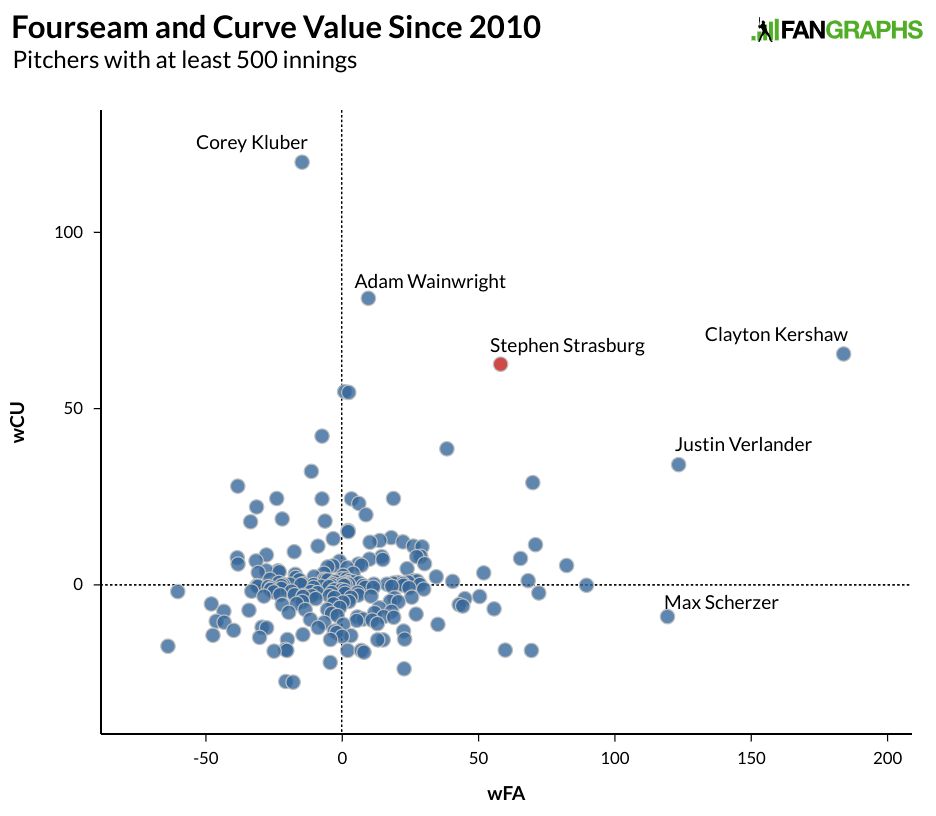
Over the last decade, pitchers have striven to be more and more like Stephen Strasburg. While Strasburg has always had one of the better changeups in the game, the 30-year-old righty has long used a four-seam fastball up in the zone paired with a big curve to dominate hitters. It’s a combo the Astros have famously used to successfully transform multiple pitchers, but almost nobody has been better than Strasburg with both the four-seamer and the curve over the last decade. The graph below shows all pitchers with at least 500 innings pitched who have thrown a four-seamer and curve, and the total run value the two pitches have produced.

Sure, Clayton Kershaw is on another planet, but Strasburg is the only other pitcher at least 50 runs above average on both pitches. Since 2016, he’s been the best at combining the fastball and the curve to get great results. Read the rest of this entry »


Hyun-Jin Ryu Has Stepped Up His Game

The Dodgers have an injury-prone lefty who’s been dominating hitters lately, and it’s not Clayton Kershaw. Nor is it Rich Hill — it’s Hyun-Jin Ryu. The 32-year-old South Korea-born southpaw has yet to allow more than two runs in any of his eight starts (one of which, admittedly, was curtailed by a groin strain), and lately, he’s been utterly stifling. On May 1, he threw eight innings of four-hit one-run ball against the Giants. On May 7, he threw a four-hit shutout of the Braves. On Sunday in Los Angeles, he no-hit the Nationals for 7.1 innings before Gerardo Parra — who on Saturday night hit a game-winning grand slam — clubbed a ground-rule double that proved to be the Nationals’ only hit of the day.

Here’s some good company:

Though Ryu wasn’t as efficient as in his previous turn, where his 93-pitch outing gave him the season’s second Maddux, after Kyle Hendricks‘ 81-pitch job on May 3, he had allowed only one baserunner to the point of Parra’s hit, via a fourth-inning walk issued to former teammate Brian Dozier. He had served up just two hard-hit balls, a 99.1 lineout off the bat of Kurt Suzuki in the second inning, and a 95.5 mph fly ball from Anthony Rendon in the fourth, and had been the beneficiary of every no-hit bid’s seemingly obligatory defensive gem. In the sixth inning, Stephen Strasburg appeared to have singled to right field… only to be thrown out at first base by right fielder Cody Bellinger (it’s just after the one-minute mark here):

Alas, the lefty-hitting Parra, who earlier this month drew his release by the Giants and entered the day hitting an anemic .194/.276/.290, sliced a 98.0 mph drive to the warning track in left centerfield, where it bounced over the wall for the Nationals’ first and only hit of the day. That was Ryu’s 105th pitch of the afternoon; he completed the frame having thrown 116 pitches, the highest total of his MLB career.

Completing the no-hitter had seemed like an unlikely proposition; Ryu had finished the seventh inning at 98 pitches. Given the 24 pitches he burned in the fourth (including eight on Adam Eaton’s leadoff groundout), he appeared hellbent on testing the length of manager Dave Roberts‘ leash. Since taking the reins of the Dodgers for the 2016 season, Roberts has been at the forefront of a growing trend of pulling pitchers with no-hitters in progress (forget the openers, we’re talking those of at least five innings). His total of three in that span is tied with the Marlins’ Don Mattingly for the MLB high. Roberts famously gave the hook to Ross Stripling after 7.1 no-hit innings on April 8, 2016, then removed Hill after seven perfect innings on September 10 of that season, and told Walker Buehler to hit the showers on May 4 of last season; three relievers helped the rookie finish the job.

What’s more, Ryu had never thrown more than 114 pitches in a stateside start, and had been above 105 only twice in the past three seasons: 108 pitches against the Padres on August 12, 2017, and 107 pitches in the aforementioned May 1 start. “I’m not sure there’s a pitcher/manager combo alive less likely to push him through 9 just to try for a no hitter,” tweeted MLB.com’s Mike Petriello. Roberts suggested that he would have been more flexible…

…which was easy to say in hindsight, but anyway, enough about the manager. The pitcher struck out nine to go with his one walk and one hit, generating 14 swings and misses, including seven via his changeup and four via his cutter. In doing so, he lowered his ERA to 1.72, second in the NL; he’s tied for third in FIP (2.71), and ranks fifth in WAR (1.5). Most impressive within his stat line is his 54-to-3 strikeout-to-walk ratio in 52.1 innings. That’s a 28.6% strikeout rate (eighth in the NL) and a league-low 1.6% walk rate; his 27.0% K-BB% is third.

Combine that stingy walk rate with a .230 BABIP (second in the league, thanks in large part to the Dodgers’ stellar defense thus far) and you’ve got a pitcher who rarely has anybody on base. I haven’t played fantasy baseball in nearly a decade, so I seldom look at stats like WHIP or strand rate for even casual purposes, but dig: his 0.726 WHIP is second in the majors behind only Chris Paddack (0.689), while his 94.6% strand rate is in a virtual tie with Justin Verlander for the highest mark of the post-strike era. Blake Snell (88.0% last year) and Kershaw (87.8% in 2017) own the highest marks among full-season ERA qualifiers, while Pedro Martinez (86.0% in 2000) and Zack Greinke (86.5% in 2015) are tops among those who reached 200 innings.

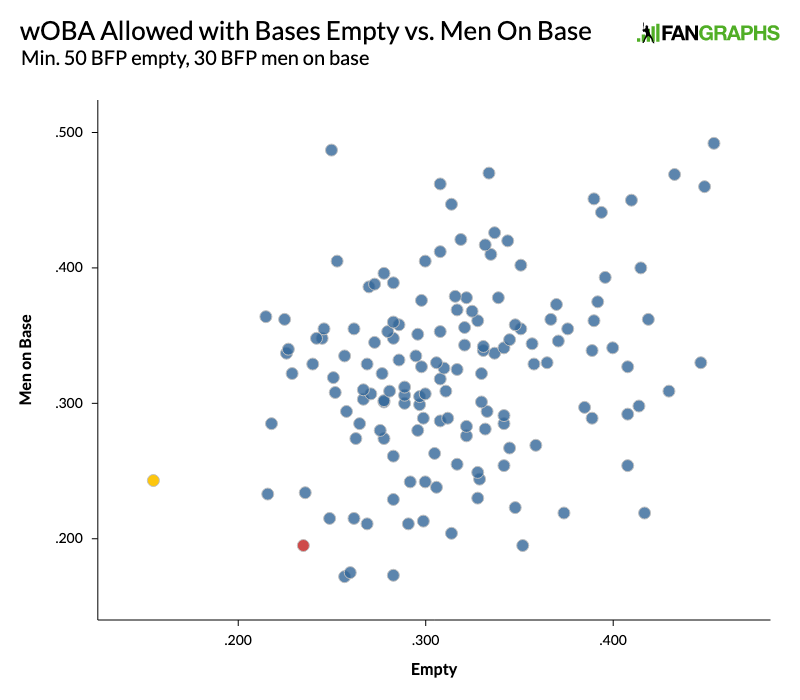
Putting this in more analytical terms, albeit with the usual sample size caveats, here’s a scatter plot of pitcher performance (wOBA allowed) with the bases empty versus when men are on base:

Ryu is the red dot, Paddack the yellow one (the Padres righty is one of the reasons I had to lower the threshold of batters faced with men on base).

This is actually the second season in a row that Ryu has ranked among the majors’ stingiest pitchers. Last year, in 15 starts, he posted a 1.97 ERA and 3.00 FIP, with a 27.5 % strikeout rate and 4.6% walk rate. He missed 3.5 months due to a left groin strain so severe its description included the cringe-inducing phrase “tore muscle off the bone,” but he did not require surgery. That was just the latest in a string of injuries that has dogged the burly lefty since coming over from Korea, most notably a torn labrum that cost him all of 2015 and the first half of ’16, then elbow woes that culminated in debridement surgery after he made just one start in the latter season. Only in his 2013 rookie season did he make 30 starts or qualify for the ERA title, yet he owns a career 3.11 ERA and 3.36 FIP. Among the 112 pitchers with at least 600 innings in that span, his 82 ERA- ranks 17th, his 85 FIP- 18th, but because of his less-than-perfect attendance, he’s a modest 47th in WAR (11.9).

Ryu doesn’t have exceptional velocity; per Statcast, his four-seamer’s 90.4 mph average velo ranks in the 11th percentile as does his fastball spin. He’s in the middle of the pack as far as exit velocity (87.7 mph) and hard hit rate (38.8%) are concerned too. His 11.7% swinging strike rate is in the 66th percentile, though his 34.5% chase rate is in the 81st percentile. As The Athletic’s Eno Sarris pointed out last week, he’s the rare pitcher who has above-average command of five different pitches according to Stats LLC’s new Command+ metric, along with Marco Gonzales, Merrill Kelly, Mike Leake (who has six such pitches), Max Scherzer, and Noah Syndergaard; for Ryu, that would be his four-seamer, sinker, cutter, changeup, and curve. Obviously, that group includes a couple of impressive names, but it’s nonetheless a mixed bag, and only tells us so much.

The exceptional results Ryu has been getting owe a considerable debt to his changeup and cutter. The former, which he throws 22.0% of the time, averages just 79.1 mph according to Pitch Info, giving him more than 10 mph of separation from the, uh, heater. It falls out of the zone more often than not, batters can’t resist chasing it, and when they make contact, they tend to hit it on the ground. His results are more or less on par with the two young changeup artists I covered last week, Luis Castillo and Chris Paddack; he allows fewer baserunners with the pitch thanks to the low walk rate, but gets hit a little harder:

Some Damn Good Changeups
Pitcher PA AVG OBP SLG wOBA xwOBA EV GB% O-Swing% Zone% SwStr%
Ryu 2018 65 .177 .203 .274 .194 .229 79.9 37.2% 49.3% 34.8% 23.0%
Ryu 2019 60 .121 .133 .207 .146 .251 83.1 55.8% 56.4% 39.5% 20.4%
Castillo 85 .110 .190 .121 .152 .141 80.8 68.6% 54.2% 24.4% 31.1%
Paddack 63 .138 .206 .155 .172 .219 83.5 66.7% 51.2% 36.6% 21.3%
SOURCE: Brooks Baseball, Baseball Savant
wOBA, xwOBA and EV via Baseball Savant, all other stats via Pitch Info.

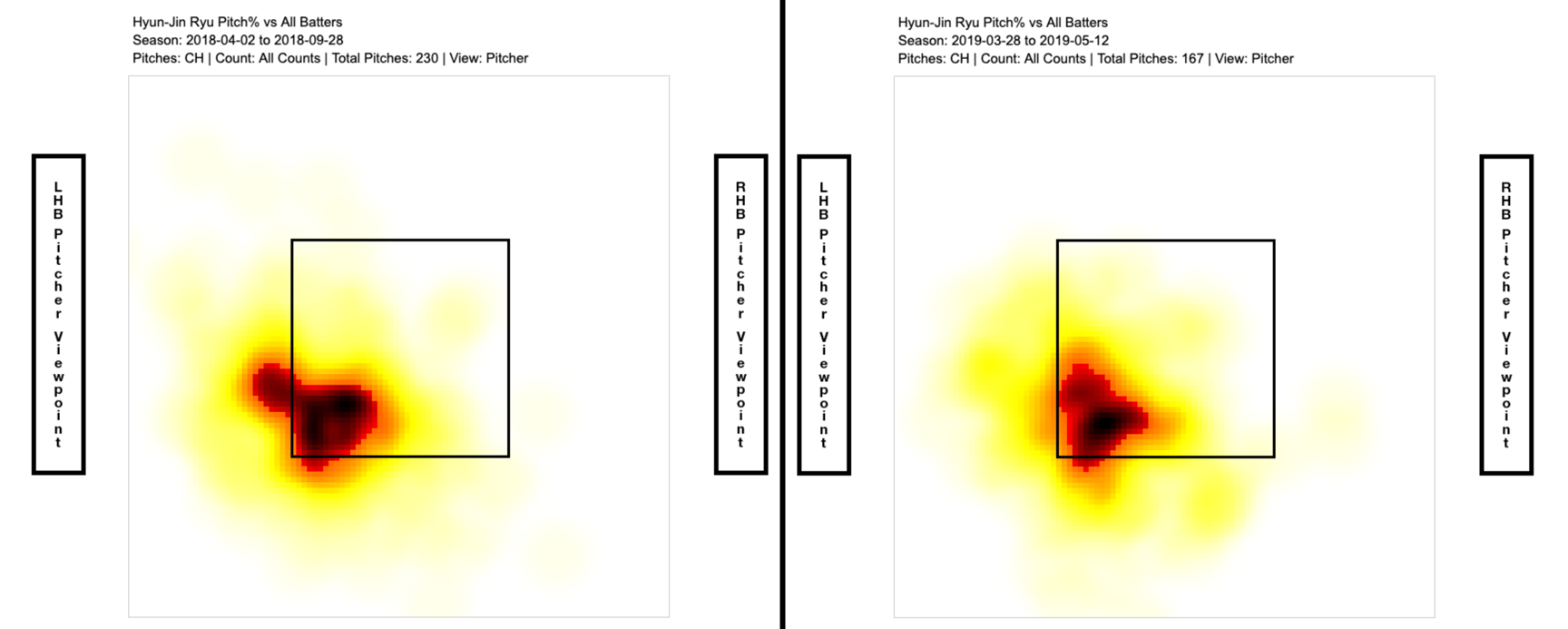
I’ve included Ryu’s 2018 numbers there to illustrate that the pitch is working even better for him than it did last year, when it worked pretty well. The big differences from then to now are last year’s lower groundball rate and tendency to work further off the plate against righties (and in to lefties):

Petriello has a good look at how the vertical gap between Ryu’s four-seamer and his changeup has widened this year, though that’s mostly due to his working higher with the heater. As for the cutter, it’s a pitch Ryu didn’t introduce into his arsenal until 2017. It’s about three clicks slower than the fastball, averaging 87.3 mph, and it now accounts for 21.2% of his pitches thrown; over that three-year timespan, he’s mothballed his slider and cut way back on the usage of his curve. The pitch didn’t work especially well for him last year:

Hyun-Jin Ryu’s Cutter
Year PA AVG OBP SLG wOBA xwOBA EV GB% O-Swing% Zone% SwStr%
2017 108 .232 .324 .326 .272 .282 83.3 58.1% 27.2% 48.7% 6.3%
2018 87 .274 .299 .452 .318 .322 88.1 52.4% 23.9% 55.1% 6.8%
2019 41 .150 .171 .275 .192 .248 91.8 56.0% 29.1% 47.7% 15.2%
SOURCE: Brooks Baseball, Baseball Savant
wOBA, xwOBA and EV via Baseball Savant, all other stats via Pitch Info.

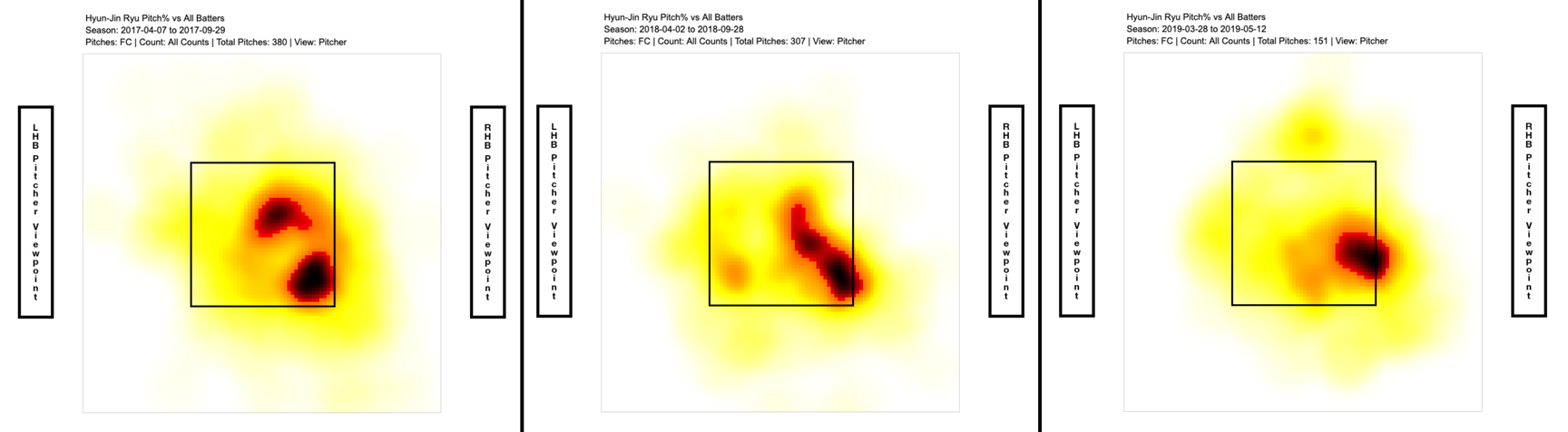
Look at that jump in swinging strike rate! I don’t see a great deal of year-to-year variation in his spin rate (2029 to 2063 rpm in that span) or movement to account for the jump, but location-wise, he’s not only throwing it in the zone less often (while getting significantly more chases), he’s keeping it out of the middle third:

Obviously, the caveat all over this is that of small sample size; we are talking about a body of work that covers a modest 134.2 innings over the past two seasons. Still, it’s been an impressive run, and if Ryu — who returned to the Dodgers upon completion of his six-year, $36 million deal by accepting a $17.9 million qualifying offer — can stay upright while fleshing out this body of work, he should be in line for some kind of multiyear payday this coming winter, though one with some complexity of structure likely — incentives, a vesting option or a club option. J.A. Happ’s two-year, $34 million deal with a $17 million vesting option for year three comes to mind.

While Ryu’s fragility makes him one more pitcher in a rotation full of less-than-durable ones, his early-season performance has provided a best-case scenario while helping the Dodgers weather the late arrivals of Kershaw and Hill, whose combined total of eight starts matches his own. His rise to the occasion is just one more reason why the Dodgers (27-16) are vying for the league’s best record and remain the favorites for a third straight NL pennant.


The Unlikelihood of Mike Fiers’ Second No-Hitter, Quantified

When baseball fans quibble with sabermetrics, one of the arguments I hear is, “If we can already predict everything that will happen, then why isn’t baseball just played on a computer?” It’s a funny stance to me for two reasons. First, statistics can’t predict everything; they can only tell you the odds of an event occurring. And, second, the randomness of baseball — and, really, sports in general — is something that even the most devout statisticians can marvel at.

Mike Fiers threw the second no-hitter of his career last week. Rachael McDaniel did a brilliant job of explaining how unlikely it was for Fiers, the individual, to have the fortunate of joining the group of 35 pitchers to throw two no-hitters in the big leagues. I just want to borrow a few lines from McDaniel’s prose, but you should really read the whole thing. It’s great:

That’s the wonderful thing about pitching achievements, the no-hitter and the perfect game. With their length and intensity, with the level of collaboration and the sprinkling of luck that is necessary to sustain that nine-inning walk along the knife’s edge, there is so much room for serendipity. In the annals of the no-hitter, you can just as easily find the greatest of all time proving why they’re the greatest as you can a roster of unlikely heroes — rookies, journeymen, washed-up veterans — who, for those few hours, reach out and find perfection.

I want to take a second crack of explaining how unlikely Fiers’ second no-hitter was, but with a different angle: math. Read the rest of this entry »


Sunday Notes: Rowdy Swings Maple, Mancini Swings Birch

Rowdy Tellez’s weapon of choice is 34 inches long, weighs 32 ounces, and is made out of maple. Trey Mancini’s is 33-and-a-half inches long, weighs 31 ounces, and is made out of birch. Both do damage. The Blue Jays first baseman is known for his light-tower power, while the Orioles outfielder is coming off of consecutive 24-home-runs seasons.

How they went about choosing, and then settling on, their bat models differs.

“When I first got into pro ball, I signed a bat contract with Victus,” explained Tellez, who was drafted by Toronto out of an Elk Grove, California in 2013. “I told them what I wanted, and they sent me bats. I didn’t really like it at first, so I tweaked it a little more. I got to what they called an AC24, which is kind of a combination of models. It’s kind of like a 271 knob and handle, maybe a little bit thicker heading towards the barrel, and then almost like an I13 barrel, but circumference-wise a little bit thinner, and a tick longer. I’ve kind of stuck with that. It’s a comfort thing.”

Mancini was drafted by Baltimore out of Notre Dame in 2013. Three years later, a C243 model Louisville Slugger became his bat of choice. Read the rest of this entry »