Ben Clemens FanGraphs Chat – 5/11/20
by Ben Clemens

May 11, 2020

This is the latest installment of a series in which the FanGraphs staff rounds up the latest developments regarding the COVID-19 virus’ effect on baseball.
Major League Baseball owners and commissioner Rob Manfred will convene over a conference call Monday to approve plans for the league’s return, according to a report by Ken Rosenthal at The Athletic. If approved, a proposal will be passed on to the players’ union on Tuesday.
The details of the proposal, Rosenthal says, are likely to address many of the questions that have been batted around in the public sphere over the last few weeks. Spring training would get rebooted for three weeks in mid-June, setting up a regular season that begins in early July and lasts between 78 and 82 games. Teams would open in their home ball parks where possible, and play regionalized schedules that include only teams in their typical divisions and those in opposite league’s corresponding division (AL East teams would face AL and NL East teams, and so on). Teams whose home cities are not containing the virus at the level the league requires could temporarily locate to their spring training sites. Rosters could be expanded to include 45 to 50 players.
This proposal would also expand the playoffs from five to seven teams in each league. Each No. 1 seed would get a first round bye, while the other two division winners and the top Wild Card team would host the three other Wild Card teams in a best-of-three Wild Card round. Read the rest of this entry »
The frequency of North American baseball players randomly disappearing from their teams reached a peak in the early 20th century. Baseball was a big enough deal that a player going missing was newsworthy, which allowed me to read about their disappearances a century later. At the same time, baseball was not yet a big enough deal that choosing to skip out on your team meant missing a multi-million dollar payday, or the prospect of multi-million dollar legal action brought against you. The phenomenon seemed so common in the early 1900s that the stories of players going missing were often preceded with “another” or followed by “again,” and the tales were plentiful enough to allow for quite a bit of variety in their conclusions.
While the tale of the bridegroom who never came arrived from the late 19th century, the stories that will follow over the next few entries hail from a time when both the American and National Leagues existed alongside a veritable wilderness of competitive minor league teams, constantly moving, changing names, collapsing, scheming, and springing up again. It was the perfect time for baseball players to get lost in intrigue and confusion — and a time in which it was easy for players to be obscured by history. We begin with a story of the latter.
***
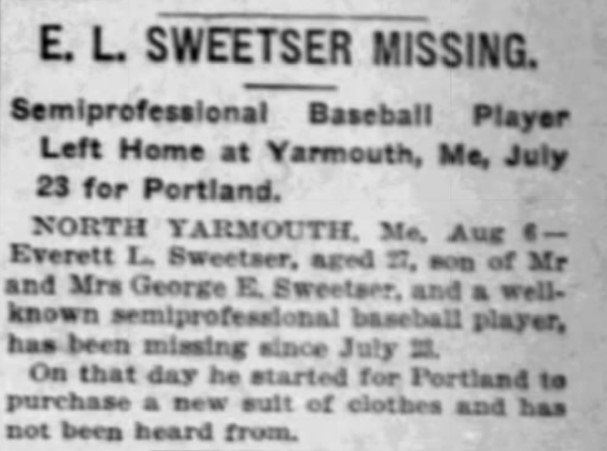
This is the very brief tale of Everett L. Sweetser, a 27-year-old semiprofessional baseball player and resident of North Yarmouth, Maine. By all accounts, Sweetser wasn’t a particularly notable player. In fact, I can find no public connection between his name and the word “baseball” until August 6, 1912: the day that his missing notice was published in the Boston Globe.
FanGraphs merchandise is still available for pre-order, but time is running out for this round! Pre-orders for all sizes of select merch conclude tonight at midnight PDT, with merchandise expected to ship in early June.
Items available for pre-order include:
So far this season, my OOTP Brewers updates have followed a familiar cadence. Every Monday or Tuesday, I write about some new disaster for the team. Josh Lindblom is out for the year, maybe, or Lorenzo Cain isn’t hitting. Maybe the Mets put up six trillion runs on us, or Luis Urías broke his foot rehabbing his broken hand. You get the idea — these articles has been a struggle to keep a team on the field, serialized.
This week is going to be about whatever the opposite of that is. The Brewers have played six games since my last update. They’ve won all six, taking them to 23-18 on the year. The contributions have come from everywhere — the team allowed only 15 runs in those six games while scoring 32. Josh Hader faced 20 batters and struck out 12. This is the Brewers team the Milwaukee brass hoped for in the offseason; pitching lines that look like this:

Oh yeah — Corey Knebel is back. The above game was his first one back in the majors, but he looked fine during his rehab assignment as well. In the meantime, we’ve added Tony Cingrani on a minor league contract, and after a few tune-up appearances, he’ll be ready to bolster the big league bullpen whenever needed. Mystery man Sam Pierron is still going back and forth with me about money, but between Knebel and Cingrani, the reinforcements have arrived. Read the rest of this entry »
Below is an analysis of the prospects in the farm system of the Los Angeles Dodgers. Scouting reports are compiled with information provided by industry sources as well as my own observations. For more information on the 20-80 scouting scale by which all of our prospect content is governed, you can click here. For further explanation of the merits and drawbacks of Future Value, read this.
All of the numbered prospects here also appear on The Board, a resource the site offers featuring sortable scouting information for every organization. It can be found here.
| Rk | Name | Age | Highest Level | Position | ETA | FV |
|---|---|---|---|---|---|---|
| 1 | Gavin Lux | 22.5 | MLB | 2B | 2020 | 70 |
| 2 | Dustin May | 22.7 | MLB | RHP | 2020 | 60 |
| 3 | Josiah Gray | 22.4 | AA | RHP | 2022 | 50 |
| 4 | Tony Gonsolin | 26.0 | MLB | RHP | 2020 | 50 |
| 5 | Keibert Ruiz | 21.8 | AAA | C | 2020 | 50 |
| 6 | Brusdar Graterol | 21.7 | MLB | RHP | 2020 | 50 |
| 7 | Diego Cartaya | 18.7 | R | C | 2023 | 45+ |
| 8 | Andy Pages | 19.4 | R | CF | 2023 | 45+ |
| 9 | Kody Hoese | 22.8 | A | 3B | 2022 | 45 |
| 10 | Michael Busch | 22.5 | A | 2B | 2021 | 45 |
| 11 | Miguel Vargas | 20.5 | A+ | 3B | 2022 | 45 |
| 12 | Jacob Amaya | 21.7 | A+ | SS | 2022 | 45 |
| 13 | Gerardo Carrillo | 21.7 | A+ | RHP | 2022 | 45 |
| 14 | Alex De Jesus | 18.1 | R | 3B | 2024 | 45 |
| 15 | Andre Jackson | 24.0 | A+ | RHP | 2021 | 40+ |
| 16 | Ryan Pepiot | 22.7 | A | RHP | 2022 | 40+ |
| 17 | Luis Rodriguez | 17.7 | R | CF | 2025 | 40+ |
| 18 | Robinson Ortiz | 20.4 | A | LHP | 2023 | 40+ |
| 19 | Michael Grove | 23.4 | A+ | RHP | 2022 | 40+ |
| 20 | DJ Peters | 24.4 | AAA | CF | 2020 | 40 |
| 21 | Jimmy Lewis | 19.5 | R | RHP | 2024 | 40 |
| 22 | Edwin Uceta | 22.3 | AA | RHP | 2021 | 40 |
| 23 | Omar Estevez | 22.2 | AA | 2B | 2021 | 40 |
| 24 | Josh Sborz | 26.4 | MLB | RHP | 2020 | 40 |
| 25 | Cody Thomas | 25.6 | AA | RF | 2021 | 40 |
| 26 | Dennis Santana | 24.1 | MLB | RHP | 2020 | 40 |
| 27 | Victor Gonzalez | 24.5 | AAA | LHP | 2020 | 40 |
| 28 | Zach McKinstry | 25.0 | AAA | 2B | 2020 | 40 |
| 29 | Edwin Rios | 26.1 | MLB | 1B | 2020 | 40 |
| 30 | Mitchell White | 25.4 | AAA | RHP | 2020 | 40 |
| 31 | Jorbit Vivas | 19.2 | R | 2B | 2022 | 40 |
| 32 | Carlos Duran | 18.8 | R | RHP | 2024 | 40 |
| 33 | Cristian Santana | 23.2 | A | 3B | 2021 | 40 |
| 34 | Jerming Rosario | 18.0 | R | RHP | 2024 | 40 |
| 35 | Brett de Geus | 22.5 | A+ | RHP | 2021 | 35+ |
| 36 | Jordan Sheffield | 24.9 | AA | RHP | 2020 | 35+ |
| 37 | Brandon Lewis | 21.6 | A | 3B | 2023 | 35+ |
| 38 | Marshall Kasowski | 25.2 | AA | RHP | 2020 | 35+ |
| 39 | Devin Mann | 23.3 | A+ | 2B | 2022 | 35+ |
| 40 | Jeren Kendall | 24.3 | A+ | CF | 2021 | 35+ |
| 41 | Jose Martinez | 21.1 | A+ | RHP | 2022 | 35+ |
| 42 | Zach Reks | 26.5 | AAA | DH | 2021 | 35+ |
| 43 | Luke Raley | 25.6 | AAA | 1B | 2020 | 35+ |
| 44 | Juan Morillo | 21.1 | R | RHP | 2021 | 35+ |
| 45 | Hyun-il Choi | 20.0 | R | RHP | 2024 | 35+ |
| 46 | James Outman | 23.0 | A | CF | 2022 | 35+ |
| 47 | Guillermo Zuniga | 21.6 | A+ | RHP | 2021 | 35+ |
Other Prospects of Note
Grouped by type and listed in order of preference within each category.
Toolsy Lottery Tickets
Sauryn Lao, 3B
Luis Yanel Diaz, 3B
Carlos Rincon, RF
Yunior Garcia, RF
Leonel Valera, SS
Lao has clumsy-looking bat control similar to Todd Frazier’s, who has made quite a career out of somehow getting the barrel where it needs to be. Lao is a 35/40 at third and probably fits better in 1B/RF, which puts more pressure on his bat than I’m comfortable with to put him on the main section of the list, though I do dig him. Diaz is perhaps the most explosive rotator in the entire system, and he has among its highest exit velos (93 average, 100 max, both incredible for a teenager) but he has very little feel for the game and takes erratic at-bats despite having been in pro ball for a couple years now. Rincon and Garcia are right field power prospects. Rincon, now 22, has reached Double-A, where his approach has now been exposed. He posted a .282 OBP in over two months at Tulsa. Garcia is similar, a strong-bodied, 18-year-old powder keg with plus-plus bat speed and a totally unhinged approach. He walked just once all last year. Valera, 20, has a great build and significant power projection for a shortstop but — you guessed it — is a low-probability prospect because of his hit tool.
Role Players
Hunter Feduccia, C
Eddys Leonard, 2B
Justin Yurchak, 1B
Drew Avans, OF/LHP
Sam McWilliams, 2B
Romer Cuadrado, 1B
There was some support for Feduccia, 22, to be on the main section of the list. He had a strong statistical 2019 but it was at Low-A, a level with pitching worse than what he saw at LSU. He projects as a third catcher for now. Leonard is a stocky, contact-oriented infielder with limited physical projection. He hit .285/.379/.425 in the AZL last year and projects as a bench infielder. Yurchak keeps hitting. He’s 23 and now has a .300/.400/.450 career line in the minors, though he lacks the physical tools typical of big league first basemen. Avans and McWilliams are small school gamers from the swampy southeast. Avans may end up pitching once in a while but mostly he’s a speed and contact outfielder who might play a bench spot. McWilliams is a sleeper second base prospect with lots of average tools. Cuadrado is a 30 athlete with huge power and a swing that the org hasn’t been able to dial in to produce power yet.
Older Pitchers
Jeff Belge, LHP
Jack Little, RHP
Mark Washington, RHP
Mitchell Tyranski, LHP
Zach Willeman, RHP
While he was an amateur Belge dealt with several freak incidents involving his eyes and also had issues throwing strikes at St. John’s, but he’s a lefty up to 96 with a good slider so he has a shot to pitch out of a bullpen. Little is a low slot righty reliever with starter’s command, but his pitches have diminishing utility over multiple looks. Washington, a Lehigh alum, and Tyranski are both backspinning fastball pitchers whose stuff sneaks past hitters. Both have an up/down relief shot. Willeman was a 35+ FV prospect last year, as he was throwing really hard in Arizona while rehabbing from TJ, which cost him much of 2017 and 2018. He was held back to start 2019 and his stuff was down a bit when he returned, more 89-94 than sitting in the mid-90s the way it was the year before.
Younger Pitchers
Reinaldo De Paula, RHP
Jeisson Cabrera, RHP
Melvin Jimenez, RHP
Heisell Baro, RHP
Joan Valdez, RHP
Franklin De La Paz, LHP
De Paula, 21, is a relief-only prospect with a low slot delivery. He’s only up to 95 but his fastball spins at 2700 rpm and has monster tailing action. Cabrera is more of a typical three-pitch look — modest physical projection, up to 96, has a good changeup, fringe breaker. Jimenez has missed a ton of bats — 90 K in 50 IP last year — sitting 88-93 almost entirely because of deception that I think will loose its tooth at upper levels. Baro is an 18-year-old Cuban who sits 86-89 right now but he’s a plus-plus on-mound athlete who gets down the mound and whose arm works really well. He’s not a big-framed guy, I just love the delivery, athleticism, and feel for the breaking ball. Valdez and De La Paz are arm strength-only types up to 96.
System Overview
I don’t have much to say about this system that I haven’t said in the past. The Dodgers draft a lot of pitchers who have fallen due to injury, as if they think all pitchers, presently injured or not, are of equal risk to be hurt in the future. It’s netted them Walker Buehler, Andre Jackson, Michael Grove, Jimmy Lewis, Mitch White, and Marshall Kasowski, as well as lots of players who aren’t on the list because they remain injury-prone, like Texas righty Morgan Cooper, who threw a bullpen for the first time since he signed only recently.
The org also scoops up lots of players with odd career paths, like two-way backgrounds or ones who converted to pitching (Gray, Gonsolin, Brandon Lewis, Jackson again) or who may have been under-scouted because they’re from smaller schools in parts of the country with an over-saturation of talent, like the Southeast and California. The Dodgers are one of the, if not the, teams hurt most by a shortened draft because of how well they’ve done on Day Three under the current regime.
Swing changes? Yup, still a core competency for the Dodgers. It’s a less prominent trait now than in past years, in part because several of the successful swing changers are on the big league roster, but Lux and Vargas are clear examples. Velocity development is also rampant, so much so that several upper-level arms whose fastballs live in the mid-to-upper-90s, like Stetson Allie, Joel Inoa, Yordy Cabrera, Chris Nunn, Nathan Witt, and a host of others were either left off the list due to a combination of age and poor command, or because they were jettisoned to other clubs during the offseason because this org is so flush with pitching at a time when it’s at a premium for everyone else. That’s part of why (at least I like to think) Caleb Ferguson and Ross Stripling kind of slipped through the prospect cracks to some degree; it’s much easier for someone to get lost in the shuffle in an org like this than in a thinner system.
Episode 886
On this edition of FanGraphs Audio, I welcome FanGraphs senior writer Jay Jaffe to the program. Jay and I discuss his impressions of the first week of KBO action, the teams he finds the most compelling, and the differences between the KBO and MLB that he has appreciated most. We also discuss his recent piece on the impact that the cancellation of Induction Weekend has had on the Hall of Fame, as well as the people and small businesses of Cooperstown.
Jay’s KBO Coverage: A Thumbnail Guide to the KBO’s 2020 Season; Nothing Lost in Translation: Meet Dan Kurtz, the KBO’s Top Ambassador Part 1, Part 2; Half a World Away, the Korea Baseball Organization Looks to Play.
Shakeia Taylor: Is Baseball Ready to Love Dick Allen?
To become a FanGraphs member, click here.
To donate to FanGraphs, click here.
Don’t hesitate to direct pod-related correspondence to @megrowler on Twitter.
You can subscribe to the podcast via iTunes or other feeder things.
Audio after the jump. (Approximate 41 min play time.)
Podcast: Play in new window | Download
Subscribe: RSS
Evan White was playing in his first full professional season when I interviewed him 24 months ago. I went on to write that White “not only bats right and throws left, he’s a first baseman whose athleticism and offensive skill set are more akin to that of a center fielder.” My esteemed colleague Eric Longenhagen had recently called the University of Kentucky product “perhaps the 2017 draft’s most unique player.”
Two years later, White is No. 4 on our Mariners Top Prospects list, and No. 64 on our 2020 Top 100 Prospects list. Moreover, he’s projected to begin the season — assuming there is a season — in Seattle’s starting lineup. If so, he’ll have leapfrogged Triple-A. White spent last year at Double-A Arkansas where he slashed .293/.350/.488, with 18 home runs in 400 plate appearances.
The introduction to the 2018 interview also included the line, “Last June’s 17th overall pick doesn’t project to hit for much power.” As evidenced by the aforementioned output, that’s now looking to be untrue. White’s swing is proving to be more lethal than expected — this despite his not having retooled it toward that end.
“I’m just continuing to learn, continuing to grow,” White told me prior to spring training’s being shut down. “My approach is the same — it’s to stay middle of the field — but my timing is more consistent. If I’m late, I’ve got to rush, and when I’m rushing I’m not making as good decisions because I’m not seeing the ball as well.”
Seeing the ball has never been much of an issue. Along with possessing solid bat-to-ball skills, the Columbus, Ohio native strives to be a selective hitter. That’s not by chance. As noted in the earlier piece, White has a strong appreciation for what Joey Votto brings to the table in Cincinnati. Read the rest of this entry »

Ben Lindbergh and Meg Rowley banter about an aggressive umpiring demotion in the KBO, FanGraphs adding KBO stats, and the pleasures of falling asleep with baseball on in the background. Then (16:30) they talk to former lefty pitcher Andy Van Hekken, who pitched professionally for 21 seasons across nine countries, about being one of the most-traveled pro players of all time, his memorable MLB debut with the 2002 Detroit Tigers, pitching in the KBO, CPBL, and NPB, the customs, strike zones, and strategies of Asian baseball, match-fixing in Taiwan, the key to overseas success, the baseball language barrier, the art of the forkball, becoming a star player and local hero in an unexpected place, and more. Finally (56:45), they bring on Leander Schaerlaeckens to discuss his Slate investigation into President Trump’s high school baseball career, how and why he fact-checked claims about Trump being a pro prospect, and Trump as a player and teammate.
Audio intro: Mac DeMarco, "Baby You’re Out"
Audio interstitial 1: Slothrust, "Travel Bug"
Audio interstitial 2: Yo La Tengo, "If it’s True"
Audio outro: Someone Still Loves You Boris Yeltsin, "Travel Song"
Link to article on umpiring demotions
Link to FanGraphs KBO stats post
Link to MLB.com article on Van Hekken
Link to local Michigan article on Van Hekken
Link to video of Van Hekken’s MLB debut
Link to KBO video of Van Hekken
Link to CPBL video of Van Hekken
Link to list of players who played in MLB/NPB/KBO/CPBL
Link to list of B-Ref’s most-traveled players
Link to article on CPBL match-fixing
Link to article on the CPBL’s resurgence
Link to Leander’s Trump investigation
Link to Kram on the home-court assists advantage
Link to order The MVP Machine
 iTunes Feed (Please rate and review us!)
 Sponsor Us on Patreon
 Facebook Group
 Effectively Wild Wiki
 Twitter Account
 Get Our Merch!
 Email Us: podcast@fangraphs.com
Podcast: Play in new window | Download
Subscribe: RSS
In this week’s MLB The Show 20 stream, featuring Paul Sporer, Ben Clemens, and Dan Szymborski, the Red Sox head to New York to start a three-game series against the Yankees.
Mookie Betts was a huge real-life loss for Boston, but the PlayStation Sox have surprised and spent most of April at the top of American League East. Boston (22-17) is currently just three games behind the first-place Yankees thanks to the digital good health of Chris Sale (5-1, 2.44 ERA, 2.1 WAR) and Collin McHugh (3-0, 2.97 ERA, 1.0 WAR). Alex Verdugo has struggled at times as the de factor replacement for Betts and currently has a .636 OPS, but Xander Bogaerts and J.D. Martinez rank first and sixth in the American League in WAR, respectively.
The Red Sox have benefitted from a healthy Chris Sale, but the Yankees have also lucked out in this alternate reality, with Luis Severino having avoided Tommy John surgery. The Yankees are cruising on an eight-game winning streak after sweeping the Tigers, Blue Jays, and Pirates. In the rotation, only Jordan Montgomery has an ERA above four and the Yankees offense leads baseball in runs (214), home runs (68), batting average (.296), and slugging percentage (.507). Gio Urshela has continued where he left off in 2019 and is currently tied with Aaron Judge for the team lead in home runs (10).

