Archive for Daily Graphings

Can Tommy Pham Repeat His 2017 Performance?

Tommy Pham had a breakout 2017, and while he remained above average in 2018, his stats took a significant hit. His past two seasons have been so good that his trade to the Rays is widely derided by Cardinals fans as one of the team’s least-astute moves of the past few years. However, entering his age-31 season, there are questions about whether he can maintain his level of production at the plate. Twelve games and 56 plate appearances into the season, Pham needs to make some adjustments if he wants to repeat 2017.

His 2017 season was outstanding, as he became the first Cardinal to reach the 20/20 mark in 13 years. He ended that season with 25 stolen bases (fourth in the NL) and 23 homers. Pham’s slash line of .306/.411/.520 was fantastic, and that .411 OBP was third in the league. His wRC+ of 148 was fifth in the league among qualified hitters and his 13.4% walk rate was ninth. However, there was a substantial dip in those stats last season.

Pham’s Hitting
Year PAs AVG OBP SLG wRC+ WAR
2017 530 .306 .411 .520 148 6.1
2018 570 .275 .367 .464 129 4.0

All of Pham’s numbers took a step back in 2018, though they remained well above average. Since it was his second full season, there could be a few different reasons for that downturn. It could be pitchers adjusting to him. Maybe it was reaching his age-30 season, and the beginning of a decline. Or perhaps his struggle with injuries in the second half was a major contributor. Maybe it was all three! Whatever it was, we can conclude that Pham’s ceiling is capable of more than what he did last season, even if his 2018 was pretty good!

The first thing to note about Pham in this young 2019 season is that he is maintaining his uptick in exit velocity. He continues to make hard contact, with his average exit velocity sitting pretty at 92.9 mph. That is virtually the same as it was last season, and is a 3.6 mph increase from his best season.

The two words most often used to describe Tommy Pham are “focused” and “intense.” That really shines through in his plate discipline. Below are his swing and contact rates for pitches inside the strike zone.
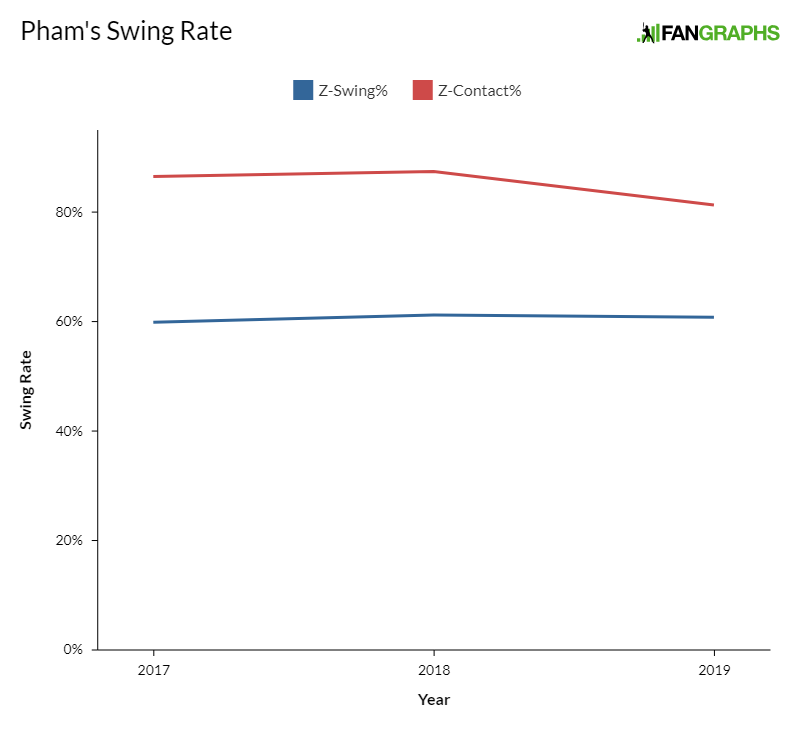
His swing rate in 2017 was about 60%, which went up by one percentage point last season. Those are good numbers. On those pitches, he made contact 86.5% of the time in 2017 and 87.4% last year. That has remained consistent over the first couple weeks of the season, as Pham has swung at 60.9% of pitches inside the strike zone and made contact on 83.0% of them.

Let’s step away from batted balls and look at the other facets of plate discipline. Pham keeps taking walks at a similar rate; 11.8% of his plate appearances last year and 13.4% the year prior resulted in walks. In his first 12 games, Pham has split the difference and worked 10 walks, good for a 17.9% rate, about 10% higher than last year’s MLB average. In addition to bases on balls, Pham’s strikeout rate is fairly consistent, if a tad above the league norm. The average strikeout rate for all batters was 22.3% last season, and Pham fell in at 24.6%. He is at 17.9% so far this season. These first 12 games are a very small sample, but everything we have seen from him indicates he is still seeing the ball well.

We know he understands the zone, but what about results? What happens once Tommy Pham puts a ball in play?

His ground ball rate has been, at times, problematic. In 2015, 51.3% of the pitches he put in play were on the ground. That decreased to 45.5% in 2016, then jumped up more than 6% the following season. Are these numbers making you dizzy? In 2018, the ground ball rate fell to 48% but that roller coaster has swung back up to 57.1% this season, though again, it’s early.

Pham has not proven himself to be a power hitter; all 12 of his hits this season have been singles. In 2017, only 35% of his hits went for extra bases, then 33% of his hits last season. The major league average is 36%; Pham hasn’t reached that point even at his best. His wRC+ this season is 112. He relies on ground ball singles, which is not what he should be doing if he wants to repeat 2017. His batting average is above the mean, but all these singles do not generate runs at a high enough rate.

The counter-argument is that he bats second in the Tampa Bay lineup. His role is to get on base, not so much to be the guy driving in the most runs. Walks and singles suit his role. Pham already has four stolen bases after taking 15 last season. He has the ability to compensate for all these singles by stealing an additional base and is well on track to outpace his stolen base total from 2018. Whether the extra base hits will come in 2019, and how often, remains to be seen.

Looking at last season, however, it appears Pham tried to make some of these adjustments.

Pham’s Team Splits
Team PAs GB% GB/FB Hard%
STL (2017) 530 51.7% 2.0 35.5%
STL (2018) 396 52.4% 2.0 47.4%
TBR (2018) 174 37.3% 1.2 51.0%

Even during his fantastic 2017 season there were things Pham could improve. He needed to make more hard contact and did just that. After being traded to Tampa Bay, the hard contact increased even more. His ground ball to fly ball ratio was consistent in St. Louis, but was nearly cut in half during his time as a Ray. And his overall ground ball rate decreased fifteen percent! While only 29% of his hits went for extra bases during his time in St. Louis last year, that number jumped to 41% once he was traded to Tampa Bay. Something in that Florida water worked pretty well for Tommy Pham. If he gets back to that contact and fly ball rate over the course of this season, that wRC+ will increase and he could bounce back all the way to his 2017 numbers.

Pham’s lack of extra base hits are cause for concern, as is his penchant for ground balls. Last year, however, he proved he could make the necessary adjustments to make harder contact and put more balls in the air. The question is whether he will do it again.

Pham appears to be maintaining the aspects of his game that made him dangerous at the plate. Since being traded to Tampa Bay, he has played in 51 games for the Rays and has been on base in 49 of them. He walks, he steals bases, and he hits for a good average. Pham is not the sort of person to swing wildly at anything and is fairly selective with the pitches he sees inside the strike zone. There are ways he can improve, but even if he just matches his 2018 season, he will be a great offensive asset this year. If he picks up where he left off last season, Pham might just be as good as he was in 2017.

Mariners’ Hot-Hitting Start Defies Rebuild

While the Dodgers’ bolt from the gate isn’t too surprising given their back-to-back NL pennants and preseason playoff odds around 90% (though yes, I reaaaally nailed the timing of my investigation into their hitting), the Mariners’ hot start is the kind of early-season anomaly that reminds us how reality often fails to conform to our preconceptions. Expected to be a bystander during a rebuilding year, Seattle opened the season by sweeping a two-game series in Japan against last year’s upstarts, the A’s, and has continued to roll. They own the majors’ best record (11-2) and run differential (+40) so far.

The Mariners did spend most of last year in contention, ultimately notching 89 wins — their highest total since 2003 — but finishing eight games behind the A’s for the second AL Wild Card spot. In missing out on the October festivities, they ran their postseason drought to 17 years, the longest in North American professional sports. Given a club record payroll ($157.9 million as of Opening Day 2018) and the game’s worst farm system, general manager Jerry Dipoto opted to plunge the team into rebuilding mode, bidding adieu to free agent Nelson Cruz and trading away Robinson Cano, Alex Colome, Edwin Diaz, James Paxton, Jean Segura, and Mike Zunino, among others — nearly all of the popular kids, basically. With Kyle Seager suffering a torn tendon in his left hand, the only players common to Seattle’s 2018 and ’19 Opening Day lineups were Dee Gordon, Mitch Haniger, and Ichiro Suzuki, the last of whom used the Japan series as a farewell tour. Read the rest of this entry »


Trevor Williams is Executing Plan-A With Aplomb

This past Sunday’s notes column included Trevor Williams on the subject of pitcher won-lost records. As was pointed out in the piece, the Pittsburgh Pirates righty probably deserved better than last season’s 14-10 mark. On eight occasions he got either a loss or a no-decision despite allowing three-or-fewer earned runs.

His wins weren’t gift-wrapped. Not by a long shot. Ten times he went at least six innings without allowing a run — that was the most in the majors — and he was nearly as stingy in the others. Only five of the enemy combatants who crossed the plate in Williams’ 14 W’s went onto his ledger. At season’s end, his 3.11 ERA stood seventh-best in the senior circuit (min. 170 innings).

Not bad for an 26-year-old hurler who, for all intents and purposes, was acquired in exchange for a pitching instructor.

As Pirates fans are well aware, his ascent began in July. Williams went into last season with a 4.36 ERA in 163 big-league innings, and through 19 starts he was holding that form to a T. His ERA was exactly what it was on Opening Day. Then he morphed into Greg Maddux. Over his final baker’s-dozen outings, Williams allowed just 11 runs — four of them in his lone clunker — in 71.1 frames. Read the rest of this entry »


The New and Exciting Rays Slugger

If you’re talented enough to make it to the majors, you often have had to make a series of adjustments to maximize your potential and survive in the league. If you are really talented, knowing yourself and being open to changes can really put your name on the map. Yandy Diaz is really talented. We’ve raved about his tools and uber-muscular physique. The Rays are giving him a starting opportunity pretty much every day, which is exciting; they have to be excited by the return as well.

So far in 2019 (all statistics are as of April 9), Diaz has turned in a .308/.386/.615 line with a 183 wRC+ and three home runs. The Rays have gotten what they have hoped to get from him in the first 10 games. Diaz’s underlying numbers — not only this year, but also from the years prior — testify to his strength. In 2017 and 2018 with Cleveland, Diaz hit for average exit velocities of 91.5 and 92.1 mph, respectively, which was well above the league average of 87.4 mph. He also was an extreme ground-ball hitter. In 2018, his launch angle was 4.4 degrees, much lower than the league average of 10.9. As a result, 53.3% of his batted balls last year were grounders, which, if he had had a qualified number of at-bats, would have ranked in the top 10 in the entire league.

Because Diaz has such a low launch angle, all he has to do is swing up, elevate, and celebrate, right? It’s not exactly that simple. In midst of baseball’s fly-ball revolution, we have seen instances of players actually trying to swing more “level.” Last year, Jeff Sullivan noted Joc Pederson and Kyle Schwarber’s adjustments. Kris Bryant also saw strides in his production after adjusting his swing to spend more time in the zone. We have many other success stories in which hitters benefited from, well, learning to lift the ball. The point is that the equation isn’t so simple. If it were, every hitter would be enjoying success by altering their swings in the same way. It is a league-wide trend, for sure, but there are things that work for some and don’t for others.

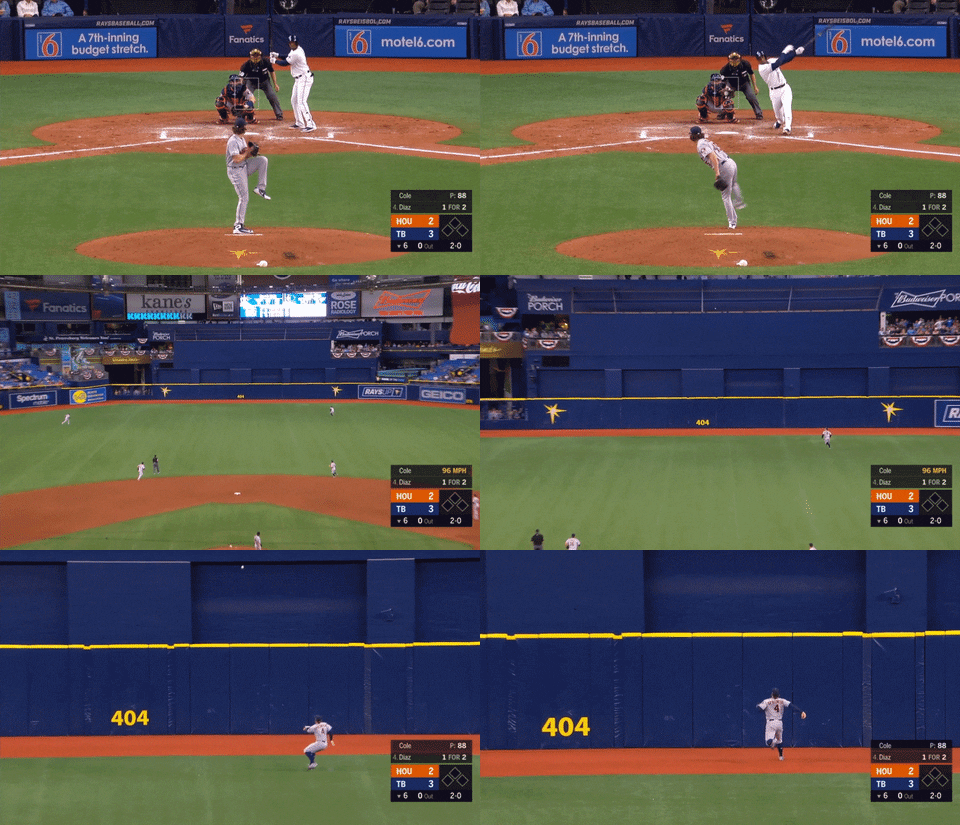
Diaz is a special case though. Because he is such an extreme groundball hitter who can also hit the ball hard, it could be worth it for him to experiment with different approaches to become his best self in the majors. It might not work out, of course. But because of his above-average exit velocity, it could pay off quite handsomely. Look at his home run versus Gerrit Cole from earlier this season.

Readers, that was smoked. It traveled for a 112.2 mph exit velo with a distance of 420 feet. It’s been documented that Diaz can hit for average (he had a .311/.413/.414 career line in the minors and hit .312/.375/.422 with Cleveland last year), but what raised my eyebrows were his 2019 power numbers. Increased power production is usually a product of some sort of change. Think Jose Bautista with his leg kick and Justin Turner with Doug Latta. Read the rest of this entry »


With Wes Johnson, Twins Pitching Appears to Be Embracing Change

One of the beautiful things about baseball is that history is always being made. During every season, every game, every pitch, we may witness something that has never happened in the long history of this sport.

This offseason, the Twins made baseball history in a different way than I think you were expecting. They hired Wes Johnson, then the University of Arkansas’ pitching coach, to join their big league staff, serving in the same role. According to this story from La Velle E. Neal III in the Star Tribune, Johnson became the first pitching coach in baseball history to move directly from college to the majors. And, at the time, he was believed to be the first coach or manager of any kind to make this transition since Dick Howser left Florida State to manage the Yankees in 1980. That’s some legitimate baseball history there.

What was even more interesting about the Twins’ hire was Johnson’s pedigree as a pitching coach. From Neal’s story:

[Johnson] studies biomechanics. He uses analytics. He is into the gadgets teams invest in to help train pitchers. He earned a reputation in college as a velocity expert, someone who can help pitchers throw harder — although he says it’s difficult to do once a pitcher is no longer in his teens.

Perhaps the story of the Twins hiring a pitching coach who “uses analytics” might not sound all that exciting to you; you likely assume big league coaches use analytics at this point. But the change represented a real organizational philosophy shift. Read the rest of this entry »


Daily Prospect Notes: 4/9/2019

These are notes on prospects from lead prospect analyst Eric Longenhagen. Read previous installments here.

Seuly Matias, RF, Kansas City Royals
Level: Hi-A   Age: 20   Org Rank: 1   FV: 45+
Line: 3-for-4, 2B, 3B
Notes
Matias’ 34% career strikeout rate is a sizable red flag that ultimately is what kept him off our overall prospect rankings. With a few exceptions, even the most whiff-prone big leaguers struck out less than that when they were in the minors. But so gifted and physically dominant is Matias that we think he’ll be effective, even if it’s in a streaky, inconsistent way like Domingo Santana or Carlos Gomez. As a teen, he was already posting exit velocities on par with burly, Quad-A type hitters. We hope he learns to take a walk, but “Randal Grichuk with more raw power” is a good player, so we’re cautiously optimistic that the Royals at least have a good big leaguer here, and a potential superstar if there’s contact/approach refinement, which is admittedly easier said than done.

Nolan Gorman, 3B, St. Louis Cardinals
Level: Low-A   Age: 18   Org Rank: 3   FV: 50
Line: 2-for-5, 2 HR
Notes
The Cardinals gave Gorman some reps with the big league team during spring training, and a scout told me they thought it would make Low-A, where Gorman struck out 37% of the time for a month of 2018, appear slower and easier by comparison. He has reached base in each of his 2019 games, and six of his 10 hits have gone for extra bases. We considered Gorman one of the more advanced high school bats in last year’s class (he and Jarred Kelenic were the only two in that top tier) and thought he might move quickly if the strikeout issues that popped up during his senior spring could be remedied. It looks like Gorman is just going to strike out a little more than is ideal, but he also appears poised for a quick move to the upper levels of the minors. When is the right time for promotion? I’d give opposing pitchers the chance to make adjustments to Gorman, and vice versa, which means waiting until mid-May when he sees Beloit, Quad Cities, Wisconsin, and Cedar Rapids for the second time. If he hits until then, and those clubs can’t find a way to get him out the second time they see him, perhaps we see Gorman in Hi-A just after he turns 19.

Joey Bart, C, San Francisco Giants
Level: Hi-A   Age: 22   Org Rank: 1   FV: 55
Line: 2-for-5, HR, 2B, BB
Notes
Nothing to see here as Bart should be expected to hit for power in the Cal League both because of its offensive environment and because last year he teed off on ACC competition, which is second only to the SEC, in my opinion. It’s ironic that the top two picks in last year’s drafts seem likely to be ready for the majors well before their parent club is likely to be competitive, but perhaps it will behoove the Giants to move Bart to Double-A semi-early this summer if for no other reason than to get him working with that pitching staff, which I think has more future big league teammates on it than the group in San Jose does.

Josh Naylor, DH, San Diego Padres
Level: Triple-A   Age: 21   Org Rank: 11   FV: 50
Line: 3-for-6, 2 2B
Notes
Naylor should be monitored closely because he’s the type of hitter who could explode if he makes a relevant approach change. He has both huge raw power and excellent bat control, but his willingness to offer at pitches he can’t drive had limited his power output until 2018, when he homered 17 times at Double-A. If he learns to attack the right pitches, he’ll hit so much that it won’t matter that he doesn’t really have a defensive home. As Naylor is just 21, we’re cautiously optimistic that he will. It’s too early to draw conclusions from his stats but his pull% is currently much higher than is usual.

Trying New Things
I noticed two odd things while combing box scores last night. First, Astros prospect Myles Straw (17th on the Astros list) has been playing shortstop. A quick perusal of the interwebs unearthed this article in the Houston Chronicle, which reports that the Astros will give this a try for a few weeks and see if Straw can actually play there. Their upper levels have been so crowded with outfielders that many of those players have been traded, and seeing as Straw’s best tool (his defense) is made redundant by Jake Marisnick, it makes sense to explore his defensive versatility.

Similarly, the Rangers are trying 1B/LF/3B Andretty Cordero at second base. Unlikely to do enough damage to profile at first (where he’s seen the most time), Cordero’s bat was still notable enough to include him in the Others of Note section of the Rangers list. Should he prove passable at second base, he’ll be much more relevant.

Former shortstop Javy Guerra of the Padres has moved to the mound, and I’ve been told he’s sitting in the upper-90s with natural cut. He’s on the San Diego 40-man.


Dodgers Bashing Their Way to the Head of the Pack

The Dodgers juggernaut was stopped in its tracks on Monday night in St. Louis. For the first time in this young season, the team failed to homer, and for the second time, they failed to score at least four runs, and for just the third time in 11 games, they lost. Still, there’s much for the two-time defending NL champions to be happy about at this point in the season, particularly compared to last year.

Recall that it took the 2018 Dodgers until the third game of the season to get on the board, as they lost their first two games by 1-0 scores, both courtesy of Joe Panik solo homers. With a lineup lacking Justin Turner and a bullpen coping with a struggling Kenley Jansen, they stumbled to a 4-9 start, took until the 19th game of the season to score their 87th run, and didn’t really right the ship until mid-May, after they’d dug a 16-26 hole and lost Corey Seager for the season due to Tommy John surgery.

It’s been a different story this time around. On Opening Day, the Dodgers pounded out a major league record eight home runs against the Diamondbacks, and so far, they haven’t looked back. Through 11 games, they’re 8-3 with 87 runs scored, the most by a team to this point in the season since the turn of the millennium:

Most Runs Scored Through 11 Games Since 1901
Rk Team Year W-L RS RA Rdiff Final Finish Postseason
1 Yankees 1932 8-3 95 52 43 107-47 1 WS Champ
2T Rockies 1997 8-3 91 56 35 83-79 3
2T Americans 1901 6-5 91 85 6 79-57 2
2T White Sox 1901 7-4 91 64 27 83-53 1 AL Pennant
5 Indians 1999 9-2 90 50 40 97-65 1 Division Champ
6T Brewers 1901 3-8 88 97 -9 48-89 8
6T Athletics 1994 6-5 88 78 10 51-63 2
8 Dodgers 2019 8-3 87 52 35 N/A N/A N/A
9T Yankees 1950 7-4 86 59 27 98-56 1 WS Champ
9T Tigers 1901 8-3 86 85 1 74-61 3
9T Orioles 1901 7-4 86 70 16 68-65 5
9T Tigers 1993 7-4 86 55 31 85-77 3
9T Cardinals 1901 5-5 86 76 10 76-64 4
14T Mariners 2019 9-2 85 56 29 N/A N/A N/A
14T Giants 1962 8-3 85 51 34 103-62 1 NL Pennant
14T Yankees 1926 8-3 85 53 32 91-63 1 AL Pennant
17T Blue Jays 1994 6-5 84 70 14 55-60 3
17T Cardinals 1962 7-3 84 53 31 84-78 6
19T Cardinals 2000 7-4 83 65 18 95-67 1 Division Champ
19T Indians 1995 7-4 83 57 26 100-44 1 AL Pennant
SOURCE: Baseball-Reference

As you might expect, bashing out so many runs so early often portends good things. While “only” eight of the 18 teams above besides this year’s Dodgers and Mariners made the playoffs, five of those 18 teams (including the Boston Americans, who became the Red Sox circa 1908; the Milwaukee Brewers, who became the St. Louis Browns in 1902; and those Baltimore Orioles, who were dissolved and replaced by the New York Highlanders in 1903) were battling it out in the inaugural edition of the American League, which must have been crazy circa April and May, 1901; the Junior Circuit averaged 5.35 runs per game that year overall, compared to 4.63 in the NL. Read the rest of this entry »


FanGraphs Legal Mailbag: Long-term Contracts, Umpire Collisions, Arbitration Audits

By far the best part of writing for FanGraphs is you, our readers. That’s not just because if you didn’t exist my words would simply be shouted into the void and I’d be talking to myself. Over the past year, you’ve sent me dozens of really thoughtful questions about the intersection of baseball and the law, and the fast pace of current baseball events (and my day job) has meant I haven’t been able to respond to half as many as I would have liked. So we’re starting this feature to provide a place where you can get your baseball law questions answered. If you have a question for the mailbag, go ahead and hit me up on Twitter @Ring_Sheryl, or email me at Sheryl@sherylringlaw.com. A couple of quick disclaimers: these are questions about general baseball concerns only; I’m not going to give you legal advice or tell you how to handle your own personal legal issues. Also, your questions might be condensed or rephrased for space purposes. We’ll do this as often as the question volume allows and necessitates. Thank you in advance for your questions!

Jeremy asked: Hi Sheryl. I read your article a while back about the hypotheticals of giving Mike Trout a lifetime contract. Regarding California law, does this mean that the Dodgers (for example) couldn’t offer a contract to Bryce Harper that’s longer than eight years (if they wanted to)?

Mike Trout just signed a big extension with the Angels that will guarantee the future Hall of Famer $430 million over the next twelve years. Remember, however, as Nathaniel Grow explained a couple of years agom, California, like many states, has a law which caps the length of employment contracts.

A relatively obscure provision under California law — specifically, Section 2855 of the California Labor Code — limits all personal services contracts (i.e., employment contracts) in the state to a maximum length of seven years. In other words, this means that if an individual were to sign an employment contract in California lasting eight or more years, then at the conclusion of the seventh year the employee would be free to choose to either continue to honor the agreement, or else opt out and seek employment elsewhere.

As we discussed before, most states (with Illinois being the most notable exception) include either a statute or common law doctrine barring lifetime contracts, though not all include a requirement that the contract be capped at a specific number of years. Does this kind of law have an impact on the offer being made by the team?

The answer is actually pretty straightforward, and we can use Trout’s deal as an example. As Nathaniel explained,

Section 2855 would allow a player to opt-out of a contract after year four of a six-year contract extension, so long as he has been employed by the team for a total of seven or more years. Because of this precedent, some California companies require their employees to spend at least one day “unemployed” – i.e., not under contract with the company – every seven years in order to avoid the application of Section 2855.

What does that mean? The Angels’ contract is still legally binding. Section 2855 is simply an additional term of the contract implied by law, and creates an opt-out by operation of law. In other words, when the Angels offered the twelve-year contract extension to Trout, the law simply added another term not written down: that of Trout’s right to opt out after seven years. This is important, because a number of media outlets reported the contract had no opt-outs. But that’s not entirely true – California law allows Trout to opt out after seven years. Notably, the same is true of Manny Machado’s deal; he, too, can opt out after year seven. But it is not, notably, true for Bryce Harper – Pennsylvania law allows for employment contracts of any definite term.

Waldy asks: What happens if a player collides with an umpire during a play? Is it considered interference?

The official Major League Rules discuss umpire interference in Rule 6.01(f):

If a thrown ball accidentally touches a base coach, or a pitched or thrown ball touches an umpire, the ball is alive and in play. However, if the coach interferes with a thrown ball, the runner is out.

This doesn’t cover Waldy’s exact hypothetical, but you’ll notice it also doesn’t mention what happens if a batted ball collides with an umpire. For that, we need Rule 5.05(f)(4), which gives a batter an automatic hit where “[a] fair ball touches an umpire or a runner on fair territory before touching a fielder. If a fair ball touches an umpire after having passed a fielder other than the pitcher, or having touched a fielder, including the pitcher, the ball is in play.”

But neither of these Rules prohibit an umpire from colliding with a player. In fact, in the Comment to Rule 6.01(f), that scenario isn’t even mentioned, except in the context of catchers throwing to bases:

Umpire’s interference occurs (1) when a plate umpire hinders, impedes or prevents a catcher’s throw attempting to prevent a stolen base or retire a runner on a pick-off play; or (2) when a fair ball touches an umpire on fair territory before passing a fielder.  Umpire interference may also occur when an umpire interferes with a catcher returning the ball to the pitcher.

Generally speaking, that means that an umpire does not commit interference by making contact with a player other than the catcher. So if an outfielder or infielder collides with an umpire while trying to make a play, and the ball drops, the play continues even if the umpire was at fault.

DJ Asks: Are there any independent audits of salary arbitrations in MLB to make sure the arbitrators follow the rules?

In a word, no. Now, under the Collective Bargaining Agreement, the MLB Players’ Association has the right to audit “any particular transaction” of a team. If we give the broadest possible meaning to the term “transaction,” we could argue that this language includes arbitrations, which in theory would give the MLBPA audit rights of arbitration proceedings. Now, this is a pretty stretched interpretation; under the CBA, a “transaction” is an instance in which a player signs a contract with a team, or two teams make a trade, or a team is sold. So an arbitration isn’t so much a “transaction” as it is a device meant for conflict resolution. And as far as I can tell, even if the MLBPA believes it has audit powers over arbitrations, it has not – at least publicly – exercised those audit rights. And the CBA is explicit that arbitration awards are confidential.

 There shall be no release of the arbitration award by the arbitration panel except to the Club, the Player, the Association and the LRD. The panel chair shall initially inform the Association and the LRD of the award only and not how the panel members voted. The panel chair shall disclose to the Association and the LRD the individual votes of the panel members on each March 15 following the February hearings.

Although we know that teams have individual audits conducted on their own financial data, it doesn’t appear that those audits include arbitration results. And because the arbitrators don’t issue written findings, the result is that we don’t really know how or why an arbitrator makes a particular decision. That’s a feature of the system, not a bug, designed to protect the sanctity of the process. Whether or not it’s a good idea I leave for you to decide.


J.D. Davis’ Changed Approach Could Turn Him Into a Big-Time Slugger

Through the Mets’ first nine games this season, J.D. Davis has 28 plate appearances. Jeff McNeil has 27. This, despite our playing time projections; we expected Davis to make just 67 trips to the plate all season. McNeil, on the other hand, was pegged for 509.

Davis, to say the least, has made the most of his early boon in playing time. He’s slashed .280/.357/.600, with two homers, three walks, and six strikeouts. He has also hit the ball incredibly hard. And, when I say incredibly hard, I really do mean it. Of Davis’ 17 batted balls, two have already left the bat at 108+ mph. Why is 108 mph a significant figure? Because, as Rob Arthur wrote in The Athletic in April 2018, “For every mile per hour above 108, a hitter is projected to gain about 6 points of OPS relative to their predicted number.” (Arthur looked at this correlation using a hitter’s projected OPS from PECOTA, Baseball Prospectus’ player projection system.)

On Saturday, Davis hit this home run off of Patrick Corbin at a whopping 114.7 mph off the bat, the hardest hit ball he has hit all season:

Going off of Arthur’s findings, this would mean Davis could gain up to 40 points of OPS off of his projected value, which our Depth Chart projections have as .718. By no means would 40 “bonus” points take Davis into elite territory — it only ups his projected OPS to .758 — but having a max exit velocity of 114.7 mph this early in the season is clearly not a bad sign. In fact, it’s the third-highest max exit velocity of any hitter in the big leagues (minimum 10 batted ball events), behind only Aaron Judge (118.1 mph!) and Joey Gallo (115.4 mph). That is some pretty good company to be in. And perhaps it means that Davis could be tapping into new potential. Read the rest of this entry »


Cincinnati’s Playoff Odds Are Worse Than the Chili

As anybody who follows my weekly chats in the early part of baseball seasons can attest, I’m a big proponent of shooing off small sample size worries with a brush of the hand and a curt reply of “April.” That answer mostly applies to players, but for teams that are fringe contenders, it’s possible to dig a hole in April that’s nearly impossible to escape from, especially in a competitive division. Expected playoff teams such as the Red Sox and Cubs have had wretched starts of their own, but they also had some room for error based on their talent level. For the Cincinnati Reds, however, it may be closer to panic time.

One reason why it’s easier to panic on the team level than it is for individual players at the start of the season is due to the fact that the bright lines for team success are quite different than the foggier ones for players. If a four-win player has a replacement-level month but then otherwise plays at his normal levels, his eventual 3.3-3.4 WAR still contributed greatly to the team’s bottom line. But the playoffs provide a much sharper divide for team success, and a team that makes the postseason by a single game has a much different penumbra of success than one that misses it by that margin.

So let’s talk about the Reds. On a basic level, it’s disheartening that they’ve struggled to this degree, being one of the few teams this past offseason to aggressively push their roster forward and try to open their contending window early. Teams being successful when they do this kind of thing is something I feel is fundamentally beneficial to baseball.

The Reds didn’t go after the big stars this offseason, and if they ever talked with the Harper, Machado, or Corbin camps seriously this winter, it’s news to me (though there was a rumor last fall they were at least interested in Corbin). But they did make significant moves and take on salary, adding Yasiel Puig, Sonny Gray, Alex Wood, and Tanner Roark in a bid to provide a short-term boost to their weakest spots. They’ve already committed to Gray for an even longer period, extending him through 2022 with a $12 million team option for the 2023 season. Read the rest of this entry »
