Archive for Twins

Effectively Wild Episode 1336: Season Preview Series: Twins and Phillies

EWFI
Ben Lindbergh and Jeff Sullivan banter about differently shaped players being in the best shape of their lives, the Luis Severino extension, and three trends: the disappearance of highly ranked pitching prospects, the plateauing of league-wide fastball velocity, and arbitration-eligible players signing team-friendly extensions. Then they preview the 2019 Minnesota Twins (17:54) with Baseball Prospectus editor-in-chief Aaron Gleeman, and the 2019 Philadelphia Phillies (46:23) with The Athletic Philadelphia’s lead Phillies writer, Matt Gelb.

Audio intro: The Microphones, "I Felt Your Shape"
Audio interstitial 1: Jeremy Messersmith, "Fast Times in Minnesota"
Audio interstitial 2: Prince, "Still Waiting"
Audio outro: Leonard Cohen, "The Guests"

Link to Ben’s article about pitching prospects
Link to Jeff’s velocity research
Link to Jeff’s post about the Kepler extension
Link to Jeff’s post about the Severino extension
Link to Baseball Mogul offer
Link to preorder The MVP Machine

 iTunes Feed (Please rate and review us!)
 Sponsor Us on Patreon
 Facebook Group
 Effectively Wild Wiki
 Twitter Account
 Get Our Merch!
 Email Us: podcast@fangraphs.com


Max Kepler Didn’t Bet on Himself

We’ve officially entered extension season. This happens every year around the start of spring training, with arbitration hearings ending and with opening day coming up. Some expect that this particular extension season will be unusually busy, given the concerns players have about the state of the free-agent market. Aaron Nola just signed an extension with the Phillies. Jorge Polanco just signed an extension with the Twins. And Max Kepler has also just signed an extension with the Twins. Nothing against Polanco, but I find the Kepler move more interesting.

Kepler was already looking at a 2019 salary of $3.125 million, in the first of four arbitration years. He’d qualified as a Super Two. That’s wiped out now, with Kepler and the Twins agreeing to a five-year contract worth $35 million. There’s also a sixth-year club option, worth $10 million. Kepler, therefore, has signed away up to two years of would-be free agency. From Kepler’s own standpoint, he’s now guaranteed his own long-term wealth, as a German kid made good. He wouldn’t have agreed to this if he weren’t happy to do so. At the same time, you wonder what could’ve been. Where is Kepler going to be, as a player, a year from now?

Read the rest of this entry »


Rocco Baldelli Extols Charlie Montoyo’s Leadership Skills (And Nelson Cruz’s, Too)

Rocco Baldelli knows Charlie Montoyo well. Not only did they spend the last four seasons together on Tampa Bay’s coaching staff, but Baldelli once played for the 53-year-old Montoyo in the minors. Minnesota’s new manager counts Toronto’s new manager as both a mentor and a friend.

Not surprisingly, Baldelli was effusive in his praise when I asked him about Montoyo. Citing his experience and leadership skills, he opined that the Blue Jays are getting “a tremendous manager and a great person.” Fittingly, Montoyo was hired on October 25, the same day his 37-year-old protege was tabbed by the Twins.

Baldelli wasn’t caught by surprise when he heard the news from north of the border. He knew that Montoyo had interviewed with the Cincinnati Reds, and that he would soon be doing the same with Toronto. The second of those sit-downs obviously went well. Mere days after meeting with him, the Blue Jays announced Montoyo’s hiring.

All told, five candidates went through the interview process in Toronto. Baldelli didn’t want to go on the record as to whether he was one of them, but he did allow that his post-season vacation plans were put on hold for a period of weeks. Multiple teams met with him about their openings. That was to be expected. The “future-manager” tag was assigned to him by myriad members of the media over the course of the 2018 season. Read the rest of this entry »


Sunday Notes: The Orioles Newest Pitcher Evokes Emerson, Lake & Palmer

Fans of prog rock are well familiar with Emerson, Lake & Palmer’s “Karn Evil 9.” The song, which is on the seminal 1973 album Brain Salad Surgery, includes the line, “Welcome back my friends, to the show that never ends.” Nearly 30 minutes long, Karn Evil 9 has been described, thematically speaking, as a battle between humans and computers.

Which brings us to the first major league free agent signed by the Orioles new-and-geeky front office regime. On Thursday, Mike Elias, Sig Mejdal and Co. welcomed Nate Karns back to The Show, inking him to a reported $800,000, one-year deal.

Karns has been a good pitcher when healthy. He hasn’t been healthy very often. The righty had labrum surgery back in 2010, and more recently he’s had thoracic outlet surgery and elbow issues. He didn’t pitch at all in 2018, and in 2017 he was limited to just 45-and-a-third innings. In the two years preceding the more recent of those, ahem, evil injuries, he showed plenty of promise. Pitching with Tampa Bay and Seattle, he went 13-7 with a 4.25 ERA and a 4.17 FIP.

My colleague Rain Watt will have more on Karns’s comeback tomorrow, so I’ll keep the rest of this look contained to the 31-year-old’s curveball. It’s his primary secondary, and a pitch he refined while going through a shoulder program after having his labrum repaired. Read the rest of this entry »


Sunday Notes: New Ranger Taylor Guerrieri is No Longer Between the Railroads

Taylor Guerrieri is a Texas Ranger now, having signed a free-agent contract with the A.L. West club on Tuesday. His MLB experience is scant. Originally in the Tampa Bay organization — the Rays drafted him 24th overall in 2011 — he debuted with the Toronto Blue Jays last September and tossed nine-and-two-thirds innings over nine relief appearances.

Guerrieri features a high-spin-rate curveball, but what he throws most often is a sinker. Per StatCast, the 26-year-old right-hander relied on the pitch 47.1% of the time during his month-long cup of coffee. I asked him about it in the waning weeks of his maiden campaign.

“The main thing with the two-seam is to stay on top of it and drive it downhill,” Guerrieri told me. “That way you get the depth you’re looking for. Horizontal movement isn’t a very good play. Guys can see side to side. They struggle with up and down, so the more depth, the better.”

Natch. The goal for a sinker is to make it sink, and what Guerrieri explained is part of Pitching 101. As for grips… well, those are more nuanced. In Guerrieri’s case, they can also be a bit of a moving target. Read the rest of this entry »


Twins, Angels Swap Very Different Fringe Prospects

There was a minor trade on Tuesday night as the Angels acquired recently DFA’d righty John Curtiss from Minnesota for 18-year-old Dominican infielder Daniel Ozoria.

The Curtiss addition is the latest of many examples of relief pitcher diffusion happening on the fringe of the Angels 40-man roster. Since November, the Angels have been part of eleven transactions involving relief pitchers, either via trade, waiver claim, or DFA. The likes of Austin Brice, Parker Bridwell, Luke Farrell, and Dillon Peters have been on and off the roster, sometimes more than once (Bridwell, who was DFA’d for Curtiss, has now been DFA’d three times since this offseason), as the Angels try to patch holes in their bullpen for free.

Curtiss, who is 25, has thrown an unsatisfying handful of innings during each of the last two seasons, totaling 15 big league frames. He throws hard, 92-96 with the occasional 7 or 8, and can really spin a power, mid-80s slider (he averaged 2600 rpm in 2018). His command backpedaled last season and is the biggest thing standing between Curtiss and a steady middle relief gig. Perhaps the change of scenery will be good for him.

Ozoria spent his second professional season as a 17-year-old in the AZL, and at times he looked like he could have used a second pass at the DSL. Listed at 5-foot-9, 135 pounds, Ozoria struggled with the pace and comparably mature athletes of Arizona. He does have interesting tools, though, and played hard throughout a tough summer on a team that was really struggling. He’s an above-average runner and athlete. Though not a polished, instinctive defender, he has good range and hands, and enough arm for the left side of the infield.

Because Ozoria so lacks present strength, he needs to take max-effort, full-body hacks just to swing the bat hard, and sometimes things can get out of control. His swing also has some length, but I’m not sure it matters as much for hitters this size, because their levers aren’t. Much of Ozoria’s offensive potential just depends on how much growing he has left to do. He’s small enough that I believe that were he a high school prospect, scouts would rather he go to college to get a better idea of how his body might mature than sign him now. The realistic upside is probably a utility infielder, and even that depends on significant growth that may not materialize, but Ozoria is so uncommonly young for a pro prospect that it’s fair to like the things he can already do and project heavily on the stuff he can’t. He will likely spend all of 2019 in Fort Myers and is probably four or five years away from the big leagues.


Willians Astudillo and Shooting for History

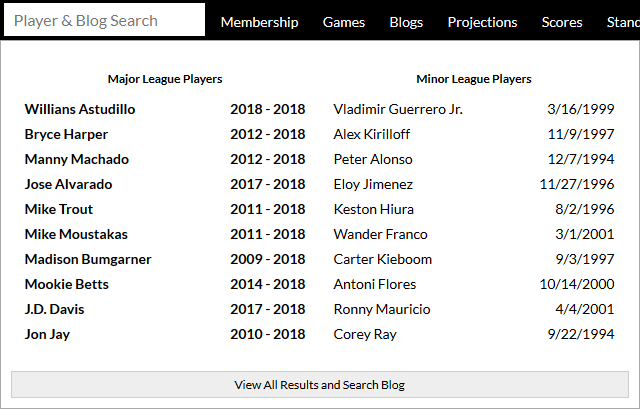
Some of you might not realize that, if you hover over the search bar up there, you’ll see which player pages have recently been the most popular. Let’s give it a spin, shall we?

Willians Astudillo. Between Astudillo and Vlad, I don’t know which has been more popular, but I strongly suspect it’s the former, and it’s definitely the former among major-league players. People have been losing their minds over Astudillo of late. Now, I did write about him last week. Playing winter ball down in Venezuela, Astudillo has performed like a deserving MVP candidate. But also, there’s a clip that’s been making the rounds. Willians Astudillo hit a home run.

Read the rest of this entry »


FanGraphs Q&A and Sunday Notes: The Best Quotes of 2018

In 2018, I once again had the pleasure of interviewing hundreds of people within baseball. Many of their words were shared in my Sunday Notes column, while others came courtesy of the FanGraphs Q&A series, the Learning and Developing a Pitch series, the Manager’s Perspective series, and a smattering of feature stories. Here is a selection of the best quotes from this year’s conversations.

———

“My slider will come out and it will be spinning, spinning, spinning, and then as soon as it catches, it picks up speed and shoots the other way. Whoosh! It’s like when you bowl. You throw the ball, and then as soon as it catches, it shoots with more speed and power. Right? “ — Sergio Romo, Tampa Bay Rays pitcher, January 2018

“One of the biggest lessons we learn is that iron sharpens iron. That is 100% how we try to do things with the Rockies — hiring people that are smarter than we are, and more skilled, and have different skills that can complement, and train people to be better at their jobs than I am at my job. That’s how you advance an organization.” — Jeff Bridich, Colorado Rockies GM, January 2018

“We could split hairs and say, ‘Hey, you’re playing in front of a thousand drunk Australians instead of 40,000 drunk Bostonians, and you’re living with a host family instead of at a five-star hotel.’ But The Show is The Show, and in Australia the ABL is The Show.” — Lars Anderson, baseball nomad, January 2018

“Baseball is heaven. Until our closer blows the game.” — Michael Hill, Miami Marlins president of baseball operations, January 2018 Read the rest of this entry »


The Twins Have Cornered the DH Market

Nelson Cruz, a man seemingly determined to hit 30 home runs in every ballpark in America, has signed a one-year deal to hit 30 home runs for the Twins. Jon Heyman reported the contract is for $14.3 million for 2019, with a $12 million club option for 2020. That puts 2019’s value right around Kiley McDaniel’s AAV estimate from our Top 50 Free Agents list. That seems like a perfectly reasonable price to pay for the services of a man who, at age 38, is projected to produce about 2.7 WAR next year, though both Kiley and the crowd expected Cruz to secure a two-year deal, even with his market largely confined to the American League.

Cruz will likely spend much of his time in Minnesota as the Twins’ primary designated hitter, ably backed in that capacity by C.J. Cron, a fine power hitter in his own right and a recent waiver acquisition from Tampa. Cruz might also play a little right field from time to time, allowing Max Kepler to spell Byron Buxton in center; Cron will split time between DH and first base (sorry, Tyler Austin) though he could also, of course, be spun off in exchange for someone else, now that the Twins have reeled in Cruz. The winter certainly isn’t over yet, and the gap between the Twins and the Indians is still large enough that if the Twins mean to compete in 2019, we might expect another move or two from them before they’re done.

Here’s the reason for the deal in a nutshell:

The Twins Have Powered Up
Player PA HR wOBA wRC+ WAR
Nelson Cruz 630 35 0.367 132 2.7
C.J. Cron 495 24 0.343 115 1.3
Joe Mauer 543 6 0.319 98 1.0
Logan Morrison 359 15 0.283 74 -0.7
Mauer and Morrison stats are 2018 actuals. Cruz and Cron stats are 2019 Steamer projections.

You can quibble with the playing time projections a bit, because people are going to move around or out of town, but the overall message is clear: the Twins want to get better right now and are willing to pay real money to do so. In an AL Central division marked by rebuilding and a Cleveland roster that’s not getting any younger, that’s a refreshing change of pace. And there’s room to grow yet. The Twins’ payroll, even with Cruz in hand, is just slightly north of $100 million, and they don’t have a single guaranteed contract in place for 2020. Cruz stabilizes their lineup for 2019 without taking a single iota of flexibility away from the team in the future. That’s a deal you should do every time.

It’s true that you’d usually be concerned about a 38-year-old designated hitter falling off a production cliff, especially in a new ballpark. But Cruz has shown time and again that the usual rules don’t apply to him. That 132 wRC+ projection seems eminently sensible to me (it would be his lowest mark since 2013) and nothing about his 2018 performance at Safeco suggests the final, inevitable collapse is near at hand. Cruz may not be the hitter he was in 2018 next year, but even if he’s half that he’s a valuable addition for Minnesota. He will certainly be better than Logan Morrison.

And however you slice it, the Twins just added a lot more power in the short term; at least right now, they have three players (Cruz, Cron, and holdover Miguel Sano) who might reasonably be expected to hit 30 home runs, and two more (Eddie Rosario and Jonathan Schoop) who could match that figure with luck and a fair wind.

The Twins may not be so far away from contending. Pretty much everything went poorly for them in 2018, and they still won 78 games. If Sano’s titanium leg gets him back on the field with any consistency, if Buxton can bounce back from a wildly disappointing 2018, and, critically, if this Cruz signing is paired with other moves, you could squint and see how the Twins have the chance to be respectable in a division running low on respectability. The only thing standing between them and the postseason in the Central is a still-dangerous but weakened Cleveland squad (the Wild Card field, while theoretically an easier sell, is relatively crowded). The White Sox are still probably a year or two away from contention, and the Royals and Tigers are for the most part concerned with figuring out which way is up. If you’re the Twins and you still have money to spend, why not go for it?

Maybe Cruz will be bad in 2019. Maybe the Twins will be, too. But it isn’t a foregone conclusion coming into the season, and that’s more than can be said for a number of teams around the league today, including at least two in their own division. Nelson Cruz is a good baseball player and the Twins need a few more of those to be a good baseball team in 2019. They got him, and all they had to pay was money. This move won’t seal the division or the postseason for them, but it’ll get them much closer than they were last year. And if this is the beginning of a series of moves, it might be just enough to make the Indians think about spending money, which is a win in and of itself. This is a good signing for the Twins. On to the next.


Sunday Notes: J.D. Martinez’s Swing Adjusts Every Day To His Body

J.D. Martinez received a lot of props this year for how he helped his Red Sox teammates approach at bats. A direct correlation between the cerebral slugger’s arrival in Boston and the increased offensive production from the likes of Mookie Betts and Xander Bogaerts is impossible to prove, but there’s no disputing his influence. Few hitters hone their craft as studiously — and pass on their knowledge as effectively — as does Martinez.

A question about his mindset jump-started a conversation this summer. I asked the outfielder/DH if he processes information in much the same manner on both sides of the ball. In other words, does he approach defense — 83% of his career games have been in the outfield — like he approaches offense.

“That’s kind of a weird question,” opined Martinez. “I think I evaluate them the same, but you’re not going to be as analytical with your defense, because there’s not nearly as much data to help you go about it.”

I countered that a lot of work goes into defense, including how to position opposing hitters against certain pitchers, and in different counts. Read the rest of this entry »